nine
Health Warn
- License — License: GPL-3.0
- Description — Repository has a description
- Active repo — Last push 0 days ago
- Low visibility — Only 5 GitHub stars
Code Pass
- Code scan — Scanned 12 files during light audit, no dangerous patterns found
Permissions Pass
- Permissions — No dangerous permissions requested
No AI report is available for this listing yet.
Self-hosted AI agent runtime in a single Go binary: local models via Ollama, persistent SQLite state, a web UI and REST API, and tools from plugins, MCP servers and sandboxed JS/Wasm.
Nine
 ███╗   ██╗██╗███╗   ██╗███████╗
 ████╗  ██║██║████╗  ██║██╔════╝
 ██╔██╗ ██║██║██╔██╗ ██║█████╗
 ██║╚██╗██║██║██║╚██╗██║██╔══╝
 ██║ ╚████║██║██║ ╚████║███████╗
 ╚═╝  ╚═══╝╚═╝╚═╝  ╚═══╝╚══════╝



Nine is a self-hosted AI agent runtime in a single Go binary: local models through Ollama
or the hosted Mistral API, persistent SQLite state, a web UI and an OpenAPI-specified REST API,
and tools from plugins, MCP servers and sandboxed JS/Wasm.
Use Nine to research subjects, work on codebases, automate processes, experiment.
Nine is developed against small models as a baseline.
The binary ships for Docker, Linux and macOS, and implements client, server and plugin roles at
once. Each session runs a dedicated agent loop that plans work, calls tools, persists data and
orchestrates sub-agent loops — interactively through the web UI, or unattended through scheduled and
periodic goals. Everything — conversations, goals, memories, session events — lives in one SQLite
file.
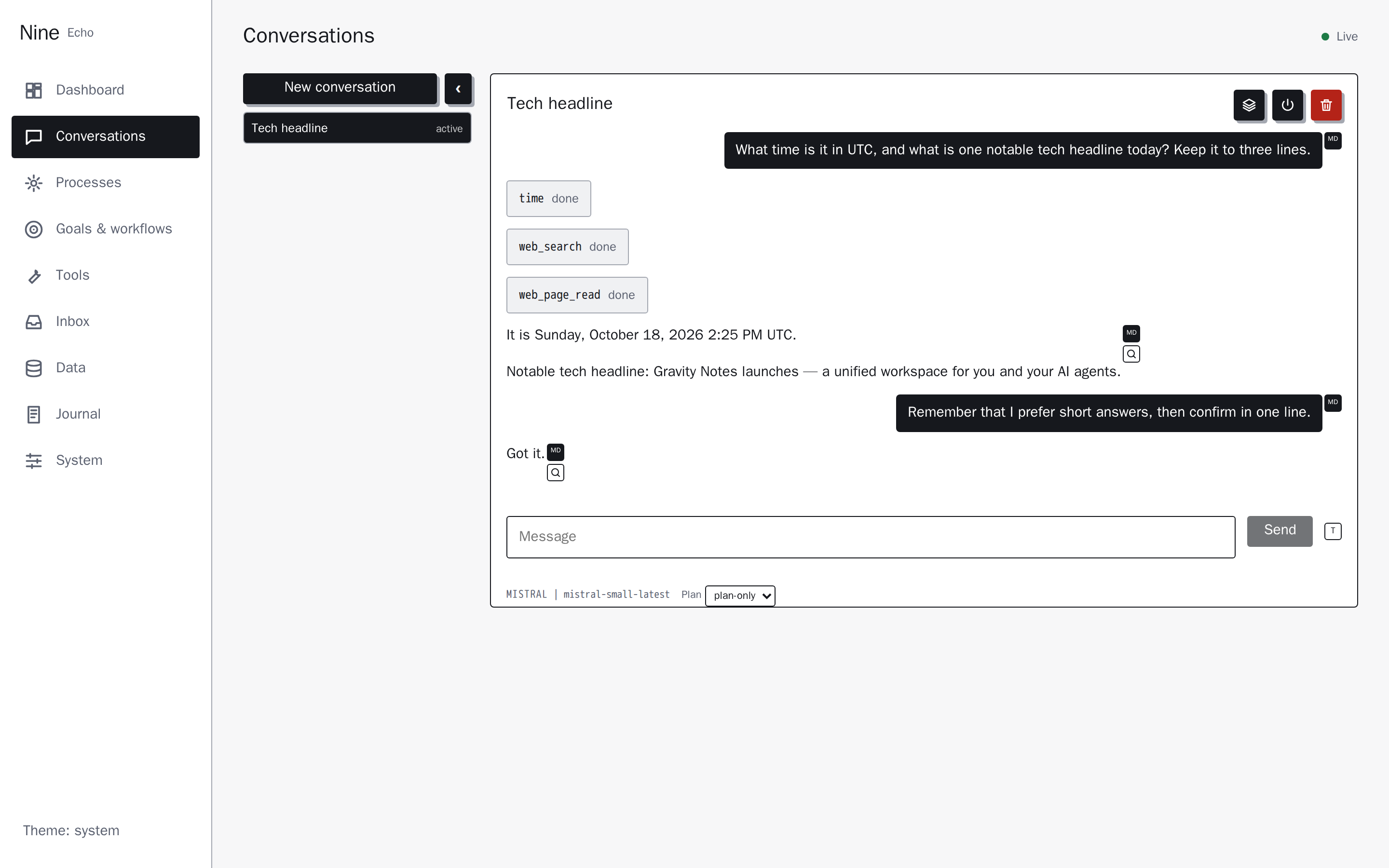
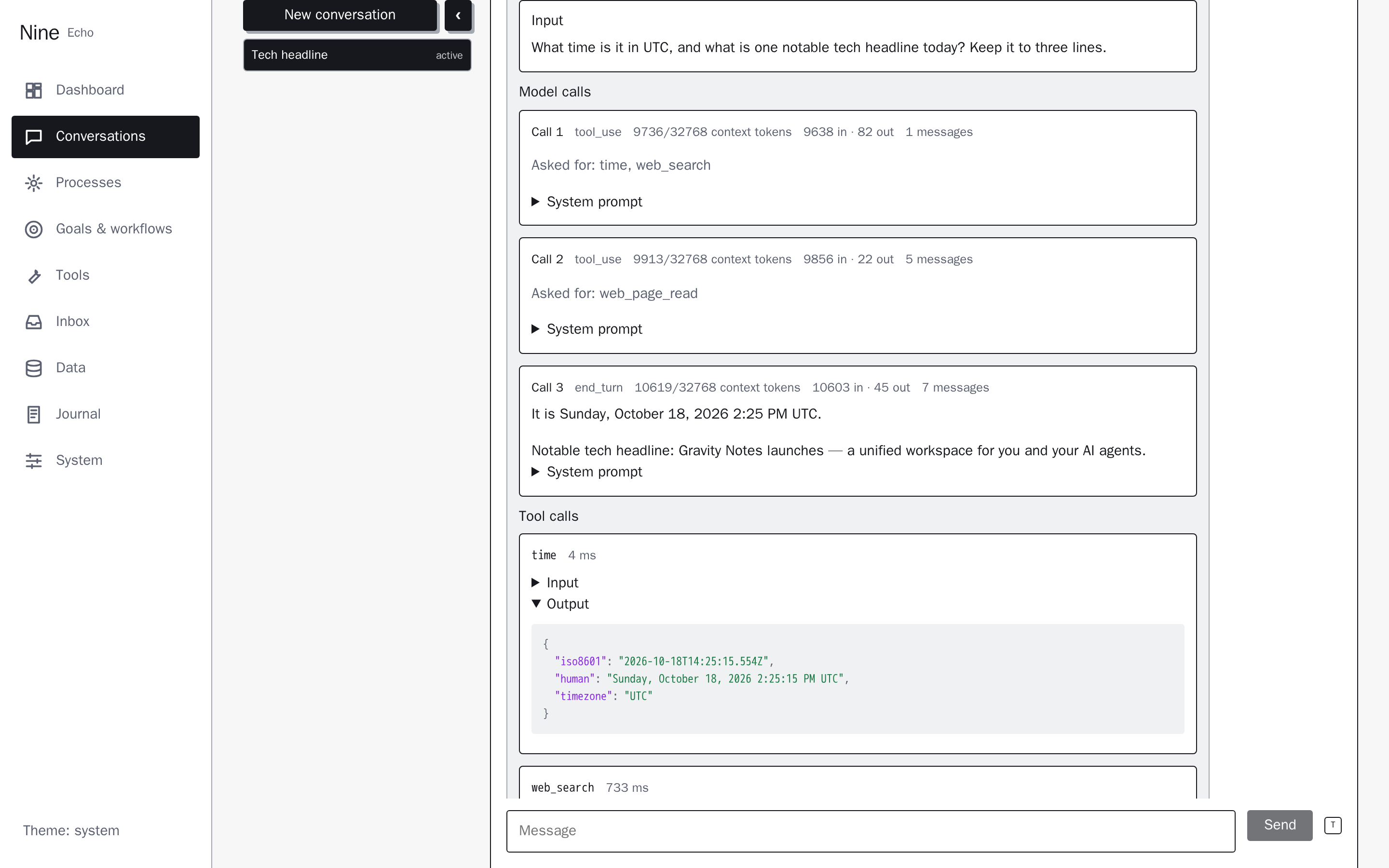
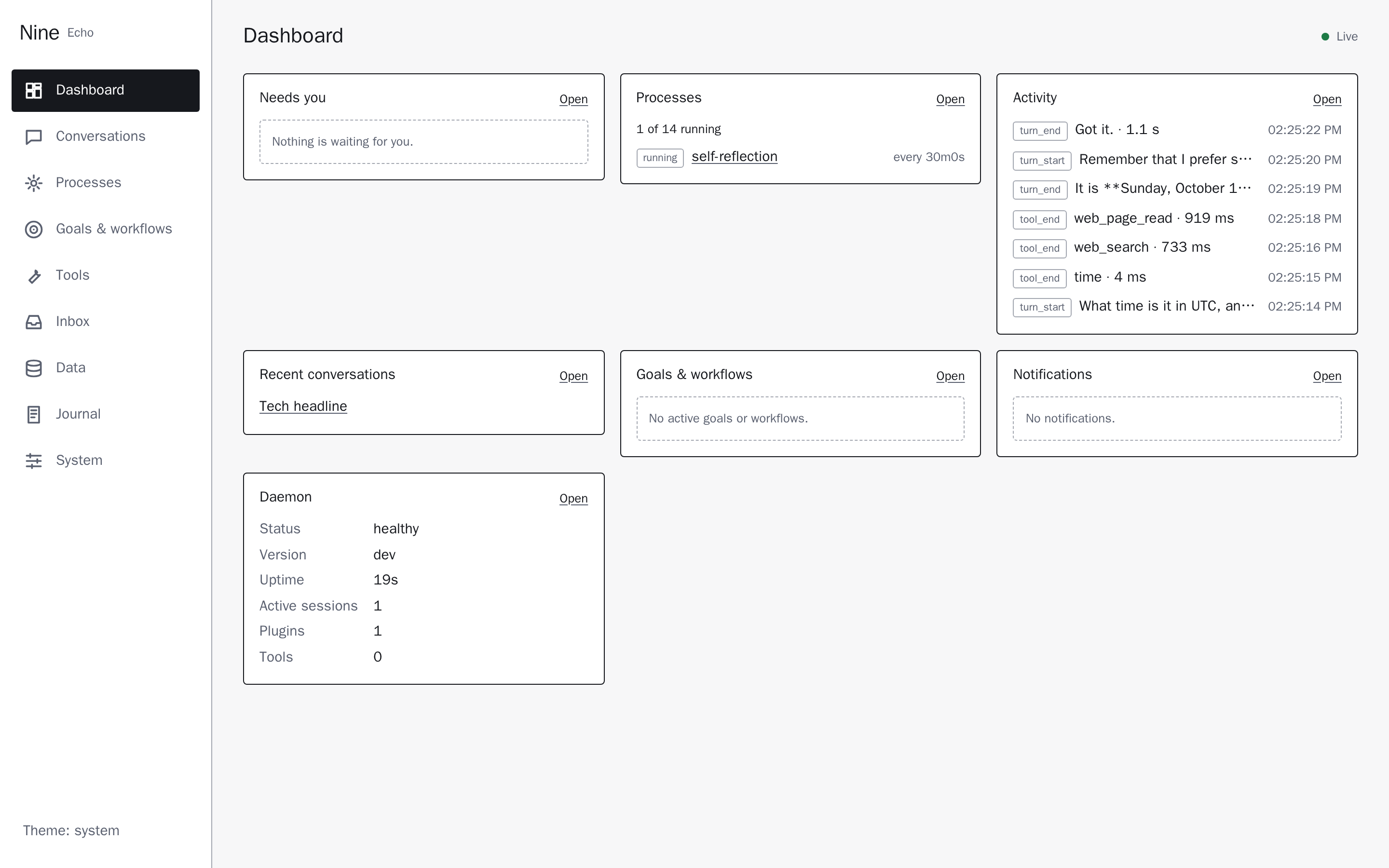
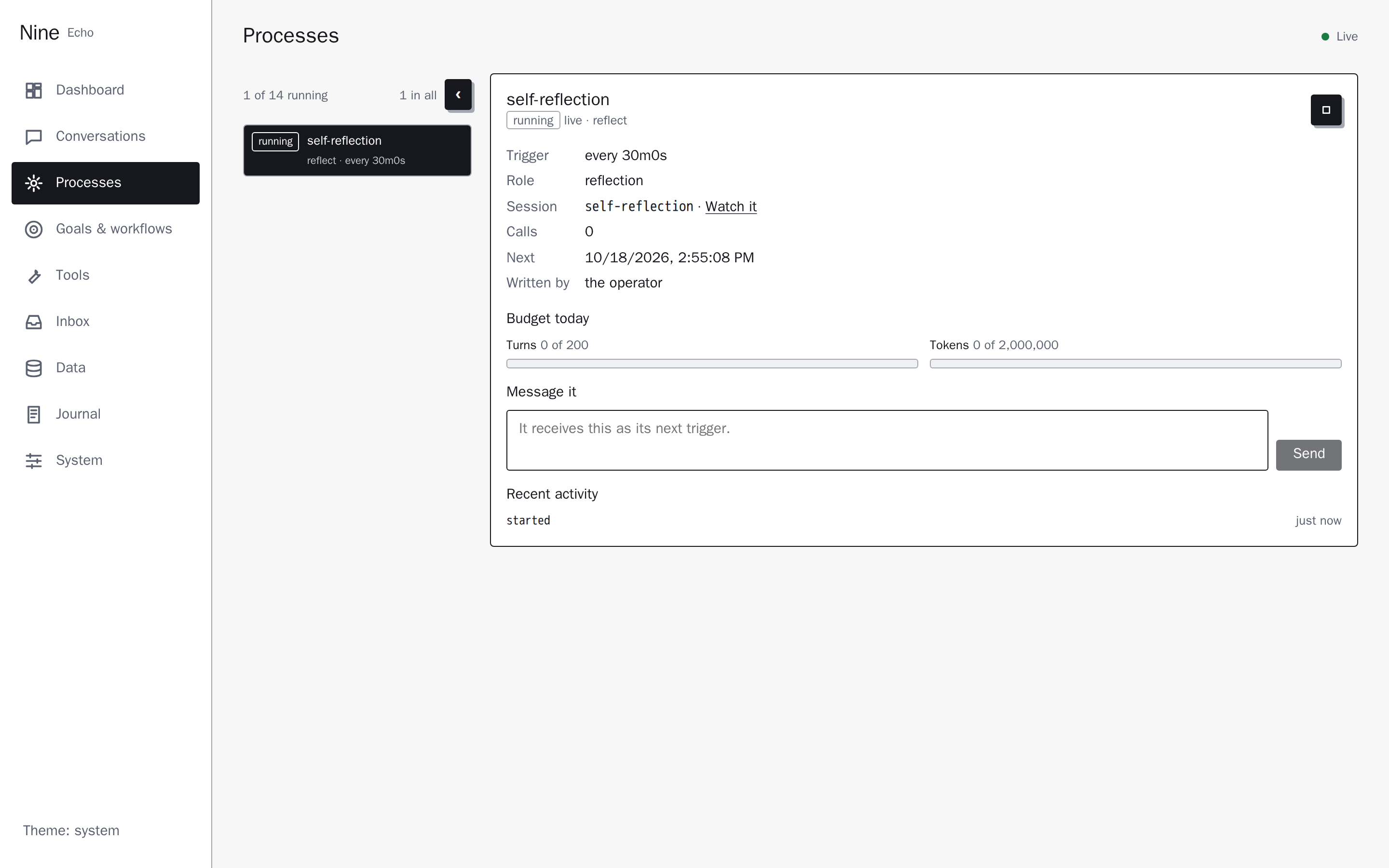
Screenshots
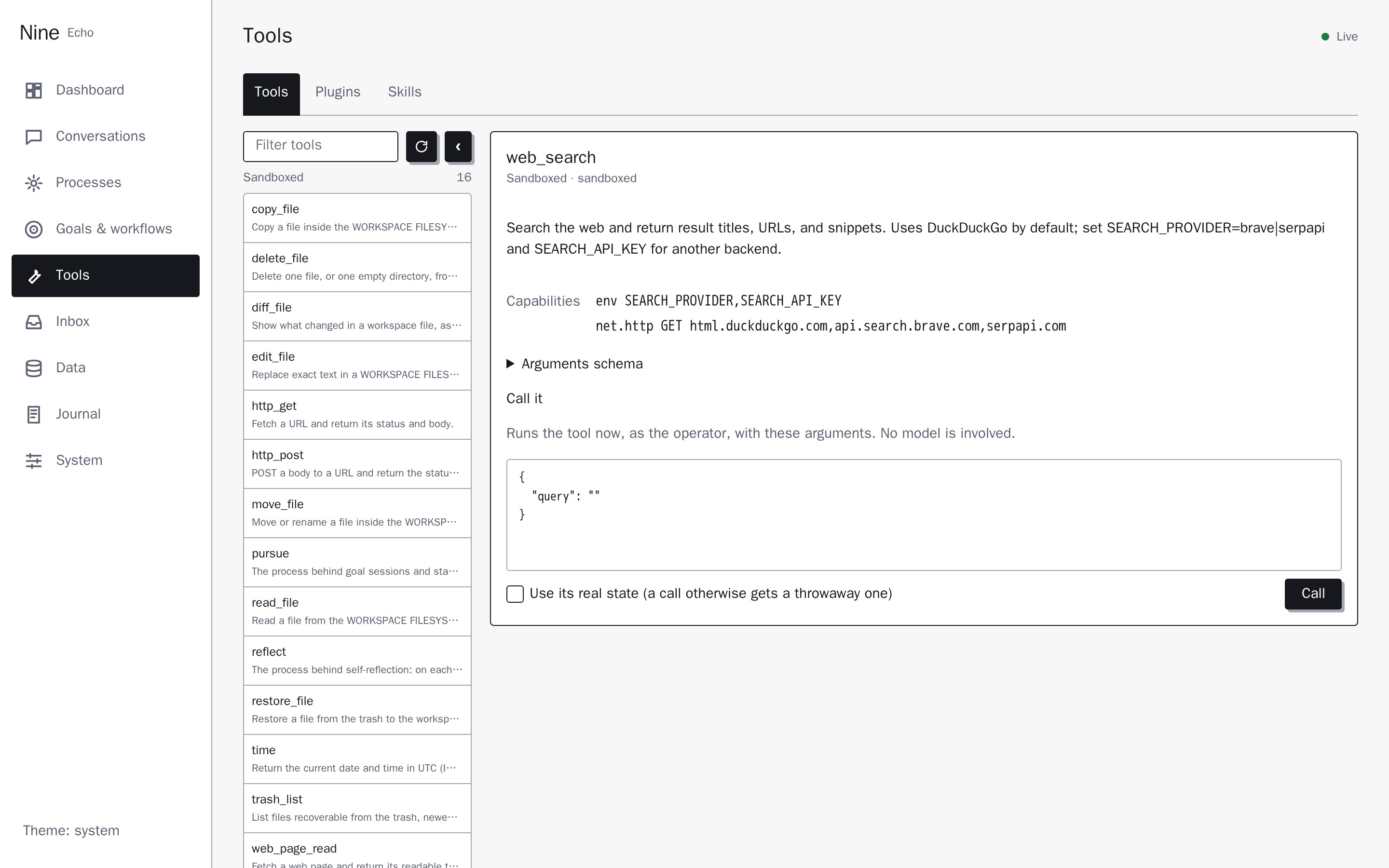
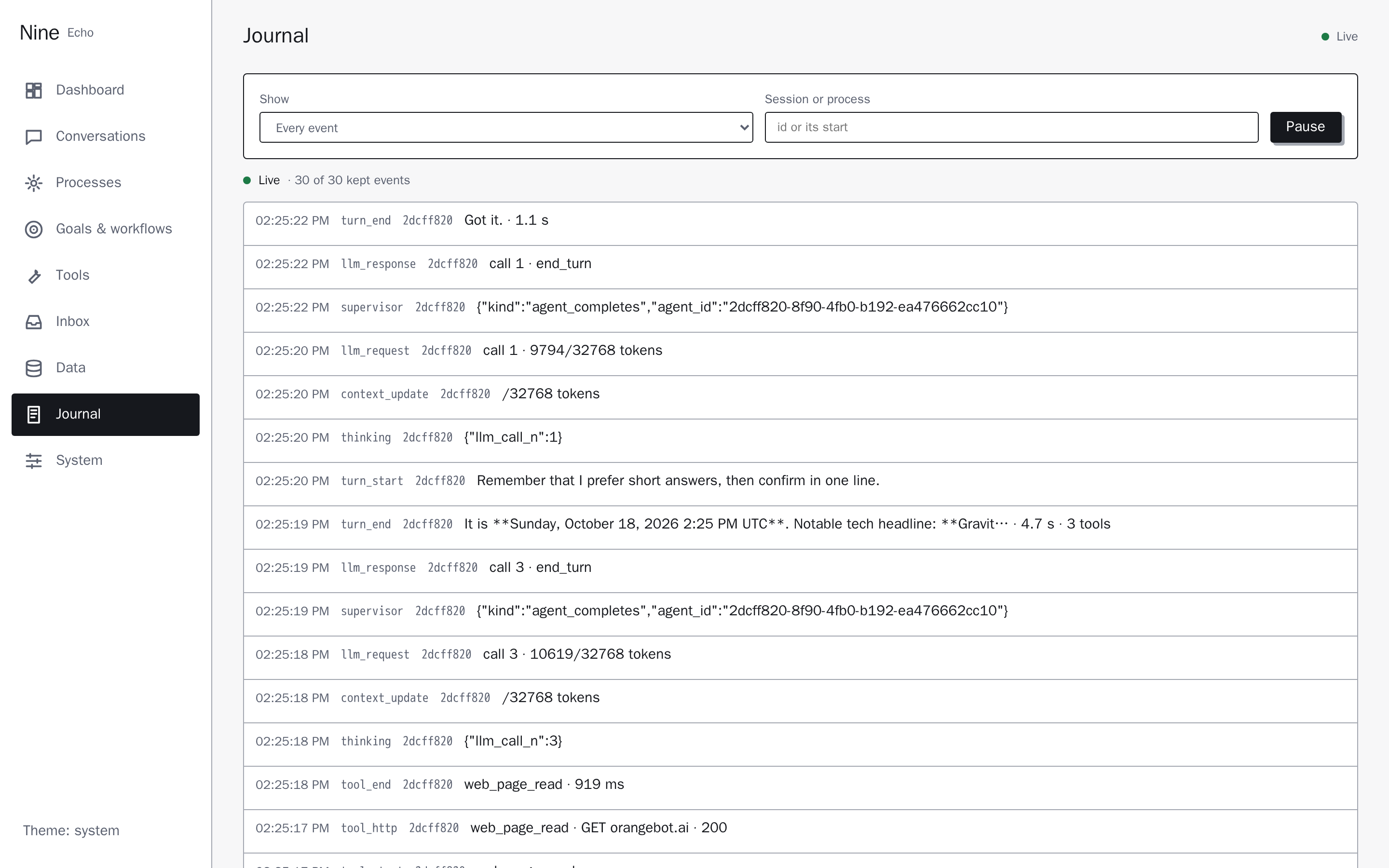
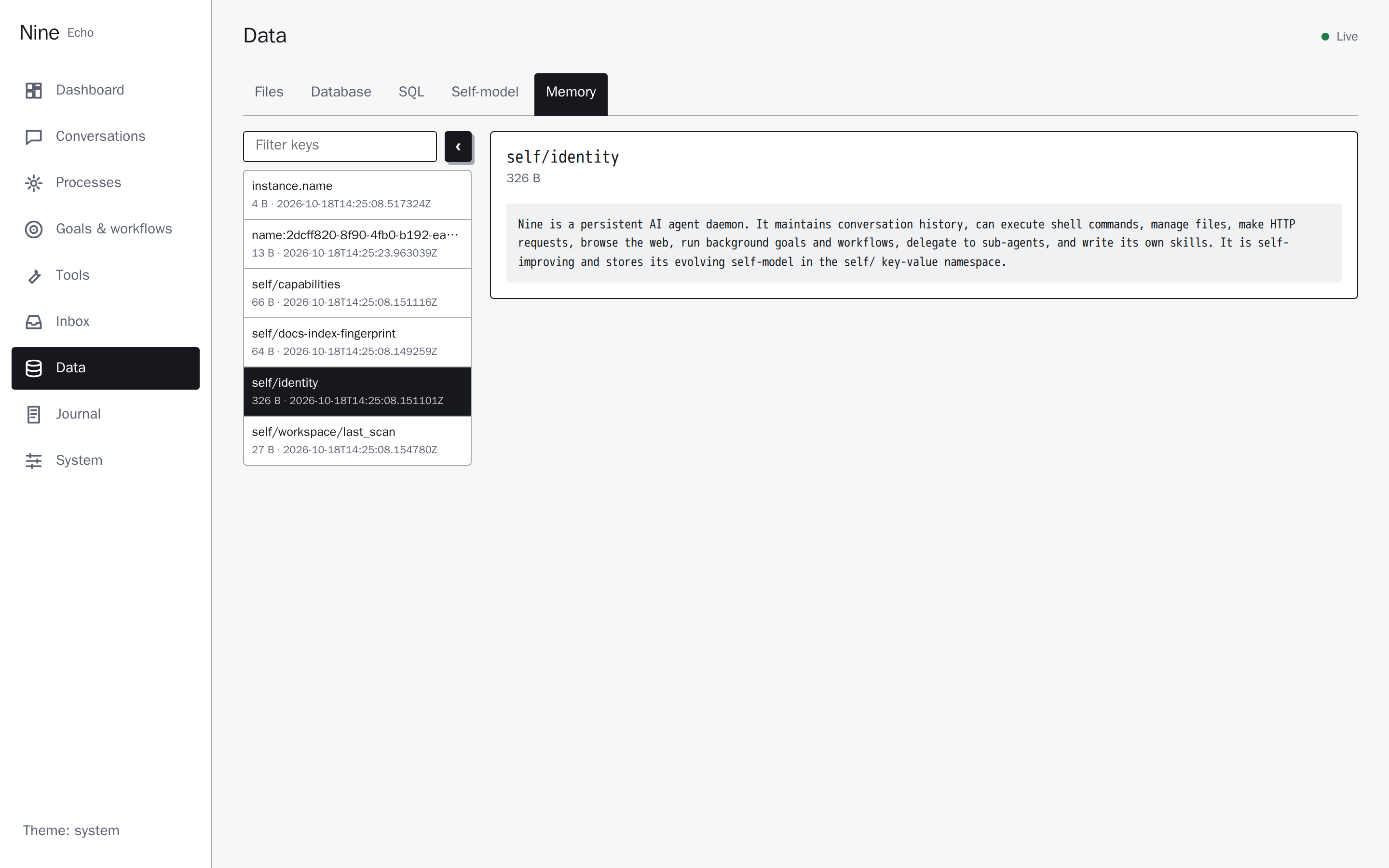
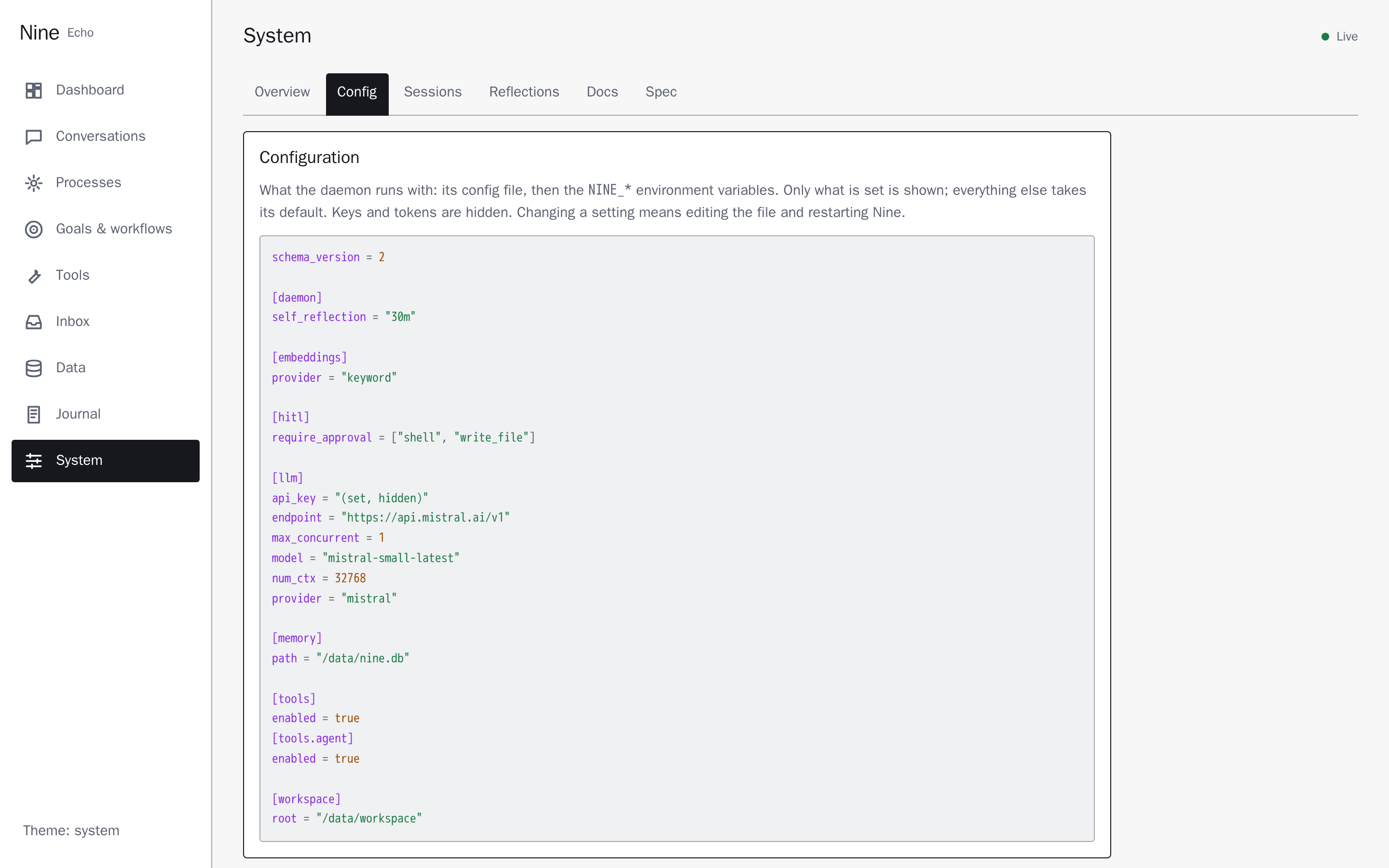
The web UI that nine api serve serves beside the API (web UI).
 |
 |
 |
 |
 |
 |
 |
 |
Quick start
No clone needed — the image ships a working config, and the package is public, so the pull
needs no credentials. Published for linux/amd64 and linux/arm64.
# 1. A model on the host
ollama pull qwen3.5:4b

# 2. Nine
docker run -d --name nine \
  -p 127.0.0.1:8080:8080 \
  --add-host host.docker.internal:host-gateway \
  -v nine-data:/data \
  ghcr.io/djordlucas/nine:latest

# 3. Open the web UI at http://localhost:8080
The web UI
Open http://localhost:8080 once Nine runs. The UI is part of the binary and the image, andnine api serve serves it beside the API, so there is nothing else to install or start.
| To | Go to |
|---|---|
| Chat with Nine | Conversations › New conversation. T asks for its reasoning on the next message; P changes the session's plan mode. |
| See what needs you | Inbox: capability requests to approve and questions to answer. The dashboard shows them too. |
| Watch what Nine does on its own | Processes, then a process's Watch it; the Journal for every event, live |
| Follow goals and workflows | Goals & workflows: a goal's tree, a workflow's steps |
| Call a tool, read a skill | Tools |
| Read or edit the workspace and the database | Data |
| Download a backup, read the docs | System |
Sign-in depends on the API token:
auth_token |
The UI |
|---|---|
| unset (the quick start) | opens straight to the dashboard, open to anyone who reaches the port; keep the port on 127.0.0.1 |
set (-e NINE_API_AUTH_TOKEN=…) |
asks for the token once per browser and keeps a session cookie, never the token; required to reach Nine from another machine |
The CLI stays available in the container for scripting and operator tasks:docker exec -u nine nine nine help. The web UI guide covers every section
and control.
Point Nine at a different LLM without a config file, and verify what you pulled before
running it:
docker run -d --name nine -v nine-data:/data \
  -e NINE_LLM_ENDPOINT=http://192.168.1.10:11434 \
  -e NINE_LLM_MODEL=qwen3.5:9b \
  ghcr.io/djordlucas/nine:latest

cosign verify ghcr.io/djordlucas/nine:latest \
  --certificate-identity-regexp '^https://github.com/djordlucas/nine/.github/workflows/release-image.yml@' \
  --certificate-oidc-issuer https://token.actions.githubusercontent.com
From a clone, for hacking on Nine or building the image yourself. make all produces
exactly one file, dist/nine — the CLI, the daemon, the API server with its web UI and the four built-in
plugins. Deploying Nine is copying that file.
git clone https://github.com/djordlucas/nine
cd nine
make all       # native build -> dist/nine
make up        # or: build and run the runtime image; the web UI is at http://localhost:8080
Nine reads its config from $NINE_CONFIG, ./nine.toml, /nine.toml, then~/.nine/nine.toml, and creates its database on first run at ~/.nine/nine.db. The repo'snine.toml is a development config and works as-is against a local Ollama; the published
image's baked config is narrower. Configuration belongs to the operator — Nine cannot rewritenine.toml at runtime.
make ci is the same gate CI runs. GitHub Actions runs it on every push and pull
request; running it locally first is how a red run gets caught before it is pushed.make scan adds the Trivy passes. Both need only Docker.
Prerequisites, the full Makefile target list, the container's environment overrides and the
configuration reference: installation,
Docker image, configuration.
Concepts and features
| Concept | Description |
|---|---|
| UI | The web UI, served by the API server, and the CLI; both thin clients of the daemon's Unix socket |
| Daemon | Long-running background process; manages agents, plugins and state |
| Agent | An LLM agent running the ReAct loop |
| Plugin | A tool container — a standalone binary, or an MCP server |
| Sandboxed tool | User-supplied JS or wasm run in-process in a wasm sandbox (wazero), through capability grants |
| Generated tool | A sandboxed tool Nine wrote itself, stored as a row; its code is the agent's, its capabilities the operator's |
| Capability | A conferred reach — fs, env, net.http — declared by a tool's manifest, granted by the operator in nine.toml or by approving a request |
| Skill | Markdown how-to note, semantically retrieved into context |
| Goal | An open-ended intention with no end condition, pursued in the background |
Every other term — workflow, process, standing agent, supervisor, checkpoint, journal —
is defined in the glossary.
Modular. Built-in tools, custom plugins, MCP servers, and JS/Wasm tools all reach the agent
through one dispatcher. Roles gate which of them a given worker may call.
Persistent. Conversations, goals, workflows, memory, files, skills and generated tools live
in a database file, and every turn is checkpointed — kill the daemon mid-task and it resumes
with the same history and plan.
Autonomous. Given a goal, Nine spawns a background session that wakes on an interval to push
it forward. Standing agents declared in nine.toml skip the human entirely: cron-scheduled,
narrowly tool-scoped, surfacing findings to nine notifications. Background work always runs at
lower priority than your active conversation.
Auditable. An append-only journal records every step the agent has taken — turn boundaries,
the exact LLM request and response, tool I/O, context usage, sub-agent lifecycle. nine trace
and nine replay read it back; nine context shows the session's current context.
Evolving. Nine writes its own skills, and its own sandboxed tools, to close capability gaps
— bounded by a capability ceiling that defaults to the workspace. The agent writes the code, the
operator writes the grants.
Local. Built to run against a local model through Ollama, with a SQLite database; mistral
is the hosted alternative when you want one (configuration).
Tested against qwen3.5:4b, qwen3.5:9b, gemma4:e4b and gemma4:e2b on a 16 GB M4
(model compatibility).
Architecture
Nine is a daemon/client pair. The CLI and the API server, which serves the web UI, are thin —
they open a Unix socket, send a message, relay the reply. Everything long-lived is in the daemon.
  nine CLI / API server ──JSON over Unix socket──┐   (thin client: send, print)
                                                 │
┌────────────────────────────────────────────────▼──────────────────────────┐
│ Daemon                                                                    │
│                                                                           │
│   Conversation Manager ──spawns──┐        Supervisor Agent ──monitors──┐  │
│                                  ▼                                     ▼  │
│                       ┌──────────────────────────────────────────────────┐│
│                       │ Agent Loops   ReAct: reason → act → observe      ││
│                       │ builds context from roles, skills, tools         ││
│                       └───────┬──────────────────────────┬───────────────┘│
│                               │                          │                │
│            ┌──────────────────▼─────────┐   ┌────────────▼──────────────┐ │
│            │ LLM Queue → provider       │   │ Tool Dispatcher           │ │
│            │ supervisor > active        │   │  ├ core (in-process)      │ │
│            │           > background     │   │  ├ plugins (subprocess)   │ │
│            └────────────────────────────┘   │  └ wasm host (capability) │ │
│                                             └────────────┬──────────────┘ │
│   ┌──────────────────────────────────────────────────────▼──────────────┐ │
│   │ memory.Store → SQLite, one file: all durable state + event journal  │ │
│   └─────────────────────────────────────────────────────────────────────┘ │
└───────────────────────────────────────────────────────────────────────────┘
The context builder treats context as a budget rather than a buffer. Sources compete by
priority — system prompt, tool definitions, self-model, enrichment, message history, scratchpad —
and low-priority ones are trimmed when the budget is tight. Tool definitions are capped at top-N
and ranked by cosine similarity against the query, so the model sees the tools that matter for
this turn.
The LLM queue serializes requests across every concurrent agent, prioritizing the supervisor
above active conversations above background work, so a goal grinding away in the background never
makes you wait.
Memory is one SQLite file reached through a single store, covering conversations, goals,
workflows, KV memory, full-text-searchable files, vectors, skills, generated tools, processes,
human-in-the-loop state, and the event journal. Operational tables are daemon-private, so an agent
cannot reach in and rewrite its own goal state.
The event journal is written off the turn's critical path by an async batched sink, and is
subscribable with durable per-subscriber cursors. The first subscriber links topically-similar
sessions so a later turn can pull relevant prior context in.
Topology, concurrency, the turn lifecycle, boot sequence and the invariants that hold it together:
docs/architecture.md.
Tools
The tool dispatcher is the single place a tool name resolves to an implementation, with three
backends behind one namespace: core tools calling the store in-process, plugin subprocesses, and
the wasm sandbox host. A name resolves to exactly one — an unexpected collision is a load failure,
not a silent override.
Plugins are tool containers, and may run asynchronous jobs. Nine ships four — shell,files, http, time — served out of the nine binary itself: the daemon starts each by
re-executing itself as nine plugin serve <name>, so they keep process and crash isolation
without their own artifact. A crashing plugin cannot take the daemon down with it. An MCP
server declared as [[mcp.server]] becomes a plugin too, with its tools prefixed by the server
name; that is how Nine drives a browser (docs/browser.md).
Writing one means answering two methods — plugin.describe and plugin.call — over HTTP on a
Unix socket, then dropping the binary beside a manifest in [plugins].user_dir
(plugins.d/weather + plugins.d/weather.toml). The description string is what gets embedded and
ranked for tool selection, so it decides whether your tool is offered to the model at all.
See docs/plugins.md and
docs/plugins-http-transport.md.
Memory, durable file storage, semantic search and skills are not plugins — they are core
tools, wired into the agent loop and calling the store in-process. They are still ordinary tools
from the model's side.
Sandboxed tools
Sandboxed tools are files you drop in a directory, run in a wasm sandbox in-process with exactly
the capabilities the operator granted — by default, none. No subprocess, no compile step, no
image rebuild. The host runs by default; your own tools live in [tools] user_dir
(./tools.d), and a .js or .wasm file with no manifest beside it is never loaded.
tools.d/
  csvstats.toml        # the manifest — the gate, and where the model's view comes from
  csvstats.schema.json # the argument schema
  csvstats.js          # the code: default-export a function
The js kind runs on a trimmed QuickJS-NG interpreter compiled to wasm: ES2023 and nothing
else — no Node standard library, no require, no setTimeout, no URL, and fetch only wherenet.http was granted. Bundle dependencies at development time. For another language or full
speed, ship a .wasm module from Rust, TinyGo, Zig or C exporting the two-function ABI
(nine_alloc, nine_run).
The manifest declares a need; only nine.toml grants it. The two must match exactly —
declaring something ungranted fails to load, and being granted something undeclared fails too.
# csvstats.toml — the tool declares a need
[capabilities]
fs = ["read"]

# nine.toml — the operator grants it, by name
[tool.csv_stats.capabilities.fs]
read = [{ host = "/srv/data", guest = "/data" }]
| Capability | You get | Default |
|---|---|---|
clock, random, log |
Date.now(), Math.random(), console.* |
granted |
fs.read / fs.write |
mounted directories, addressed by their guest path | declare + grant |
env |
named keys only (NINE_* and *_API_KEY can never be granted) |
declare + grant |
net.http |
a fetch subset |
declare + grant |
Everything with reach starts at nothing. A capability is either a wazero pre-open or a host
function the daemon exports, so anything else is not "denied" but structurally absent: a sandboxed
tool cannot spawn a process, open a socket, load a native library, or call another tool. net.http
is the exception — wazero has no network, so it is a host function and its security is Nine's
problem: the hostname must match allow_hosts and the dialed address must be publicly
routable, checked immediately before connect, on every redirect hop. Loopback, link-local
(including 169.254.169.254) and RFC 1918 are refused regardless of the allowlist. Bounds are
always on: one instance per call, a 5s wall clock, 16 MiB.
The tier Nine writes itself
Nine writes its own tools at runtime, as rows in the store rather than files on disk, running in
the identical sandbox under the identical rules. The tier is on by default with[workspace].root as its ceiling — the same directory the shipped file tools reach and shell
runs in — and is gated by [tools] enabled above it.
[tools.agent.capabilities] is a ceiling: the most any generated tool may be granted, never an
automatic grant. A tool gets a capability only by declaring it, one that declares nothing runs with
nothing, and declaring past the ceiling is a refusal the model can act on. Declarations are
re-resolved on every load, so narrowing the ceiling disables a tool that no longer fits rather than
leaving it running with reach you withdrew. tool_write writes JavaScript and a capability
declaration; it has no path to write a grant:
| Code | Capabilities | |
|---|---|---|
| Native plugin | operator (build time) | operator (nine.toml) |
| Developer sandboxed tool | developer (file on disk) | operator (nine.toml) |
| Generated sandboxed tool | Nine (runtime) | operator (nine.toml) |
Generated tools may always import a small vendored standard library (nine:csv, nine:date,nine:diff). External npm packages are a separate switch, off by default: imports are resolved
once, at write time, in the daemon, verified against published checksums, with no install scripts,
and inlined — so by call time the tool has no imports left. A write can be gated on a human;require_approval defaults to on_capability. A new tool is visible next turn.
$ nine tools
  ok    csv_stats          js     fs.read /srv/data=>/data
  ok    due_date           gen    none
  SKIP  scraper            js     capability fs.read is declared by the tool but not granted; add it
                                  under [tool.<name>.capabilities] or remove the declaration
A tool that fails to load is always reported with its reason, and gen marks a tool as Nine's own.nine tools show <name> prints one in full, nine tools deps answers what third-party code is in
this daemon, nine tools reload re-scans live, and nine tool validate checks a manifest with no
daemon running. Authoring guide:
docs/writing-sandboxed-tools.md. Design rationale and the full
capability model: docs/sandboxed-tools.md, with the normative contract
in spec/contracts/toolvm.md (nine spec toolvm).
Skills
Skills are how Nine improves what it knows; generated tools are how it improves what it can
do. A skill is a markdown how-to note with YAML frontmatter, stored in the database. Its
description is embedded; when a skill is semantically relevant, its name surfaces into the
agent's self-model and the agent reads the body on demand — on-demand documentation rather than a
permanent context tax.
The boundary is deliberate: Nine writes skills and sandboxed-tool code, both store state, listable
and deletable like a goal. It does not generate plugins, write itself a capability grant, rewrite
its config, or rebuild its source at runtime. It can ask: capability_request records a request
an operator approves or denies, and an approval takes effect without a restart
(docs/self-modification.md).
Documentation
Documentation and specs live in this repo and inside the binary, rendered as markdown when
invoked — nine docs [topic] and nine spec [topic], each listing its topics when given none.
docs/README.md is the full guide, ordered for a first-time reader:
CLI usage, agent loop and
context builder, the event journal,
processes, roles,
predefined agents, scheduling,
human-in-the-loop, and the glossary.
Project status
Experimental, stabilizing. Interfaces change without notice, and there is no support promise
or stability guarantee.
Every feature lands with tests: unit tests, hermetic harness tests for the daemon and its wire
protocol, integration tests against a real container and a real model, and an eval suite that
replays recorded sessions deterministically and runs a live-model matrix
(evals, model compatibility). What that does not
buy is user mileage — the failure modes that only long uninterrupted runs, unusual hardware or an
unfamiliar model turn up are still ahead of it. Please open an issue when you hit one.
What is still missing, and what is partially there: docs/roadmap.md.
Limits
| Limit | Detail |
|---|---|
| Not hardened | Only sandboxed tools run behind a real boundary. The shell plugin and native plugins run as the daemon's process user with its full filesystem and network reach. In the published image that user is an unprivileged uid 1000, so the reach stops at the container. |
| API auth is off until configured | The API supports a bearer token ([api] auth_token, --auth-token, NINE_API_AUTH_TOKEN) and TLS. Neither is on by default, and the published image binds 0.0.0.0 — set a token, or publish the port to loopback. Nine warns at startup when it binds a non-loopback address with no token. |
| Single host | The daemon listens on a Unix socket, so every client runs on the same machine. |
| One model at a time | No routing across models within a deployment. |
| Ollama and Mistral only | Other providers are refused at startup rather than falling back. |
| Small-model baseline | Behavior on large hosted models is unmeasured — model compatibility. |
| Interfaces change without notice | No stability guarantee and no support promise while the project is experimental. |
| Low user mileage | Failure modes that only long runs, unusual hardware or an unfamiliar model turn up have not been hit yet. |
| Config is operator-only | Nine cannot rewrite nine.toml at runtime; changing a setting means editing the file and restarting. An approved capability grant is recorded in the store and installed on the running daemon — nothing writes the file. |
| No external pull requests | Deliberate — see Contributing. |
Security
Sandboxed tools are sandboxed; nothing else is. The wasm host is a real boundary —
default-deny capabilities, one instance per call, an SSRF-checked HTTP path — and it applies to
sandboxed tools only. The shell plugin runs commands as the daemon's process user, plugins are
ordinary subprocesses with the daemon's own reach, and the agent has real filesystem and network
access through them. Run Nine in Docker or under a restricted user if you are pointing it at
anything you don't trust.
In the published image the daemon runs as an unprivileged uid 1000, so that reach stops at the
container: the agent cannot write outside /data or install packages. The image is signed with
cosign and carries an SBOM and build provenance (docs/docker-image.md).
The API and the web UI on port 8080 have no authentication until you configureNINE_API_AUTH_TOKEN — bind the port to localhost, as the quick start does, or set a token.
[tools.agent] is on by default, so the agent writes code that then runs — bounded by a ceiling
that defaults to [workspace].root. That is the same directory the shipped file tools reach andshell runs in, so it is not new reach for the agent; what it adds is reach for a generated
tool's dependencies. Narrow the ceiling with an explicit fs grant if your workspace holds secrets,
or set enabled = false. Enabling external npm dependencies for that tier is the riskiest switch
in the system and is off by default, as are allow_long_running and allow_standing.
Reporting a vulnerability: .github/SECURITY.md.
Contributing
Issues yes, pull requests no. Bug reports, questions and ideas are genuinely welcome — please
open an issue. Pull requests won't be merged; this is a personal project developed solo, and
keeping it single-author is a deliberate choice. See CONTRIBUTING.md and the
code of conduct.
This project was made with the author's ideas, experience and orchestration, and built with Claude.
License
GPL-3.0-or-later. See LICENSE.
Copyright (C) 2026 The Nine Authors
This program is free software: you can redistribute it and/or modify it under the terms of the GNU
General Public License as published by the Free Software Foundation, either version 3 of the
License, or (at your option) any later version. It is distributed in the hope that it will be
useful, but WITHOUT ANY WARRANTY; without even the implied warranty of MERCHANTABILITY or FITNESS
FOR A PARTICULAR PURPOSE.
Reviews (0)
Sign in to leave a review.
Leave a reviewNo results found