liteflow
Health Pass
- License — License: Apache-2.0
- Description — Repository has a description
- Active repo — Last push 0 days ago
- Community trust — 3752 GitHub stars
Code Pass
- Code scan — Scanned 12 files during light audit, no dangerous patterns found
Permissions Pass
- Permissions — No dangerous permissions requested
No AI report is available for this listing yet.
Lightweight, fast, stable, programmable component-based rule engine — where AI Agents orchestrate just like ordinary components. Uniquely designed DSL: component reuse, sync/async & dynamic orchestration, multi-language scripting, nested rules, hot deployment and smooth refresh. If you can orchestrate LiteFlow, you can orchestrate AI.

Your star is my motivation to keep going. If you like LiteFlow, please help me with a star in the upper right corner.
Overview
LiteFlow is a powerful, modern rules engine framework that combines the best of orchestration and rules engines. It can be used in the field of complex componentized business orchestration. DSL rules drive the whole complex business, and can achieve smooth refresh hot deployment, supporting the embedding of multiple scripting language rules. Help the system become more silky and flexible.
LiteFlow was officially open-sourced in 2020 and has since become an indispensable presence in the field of open-source rule engines in China. What's more, the most crucial aspect is that LiteFlow is an open-source project that continues to iterate at a high speed.
Starting from v2.16.0, LiteFlow even turns an AI Agent into a first-class citizen that can be orchestrated directly into your rules, standing shoulder to shoulder with your existing business nodes.
LiteFlow is a community-driven project with a strong emphasis on its large and active user community. We welcome you to raise any issues or suggestions you may have within the community.
You can find out how to join the community on the official website!
Website url: Click here to access the official website
Documents url: Click here to enter the documentation to learn
Feature
- Component definition unified: All logic is a component, for all logic to provide a unified component implementation, small size, large energy.
- Rules lightweight: based on the rules file to arrange the process, learning the rules entry only takes 5 minutes, a read both understand.
- Rule diversification: rules support XML, JSON, YML three rule file writing methods, which you like to use.
- Arbitrary arrangement: Synchronous asynchronous mixing, no matter how complex the logic process, using LiteFlow rules, are easy to do, see the rules file to see how the logic works.
- Rules can be loaded from anywhere: The framework natively supports storing rules in a structured database, Nacos, Etcd, Zookeeper, Apollo and Redis. It also provides an extension interface that allows you to store rules anywhere.
- Elegant hot refresh mechanism: Rule changes, instant change of application rules without restarting your application. High concurrency does not cause any errors in executing rules due to refreshing rules.
- Wide support: LiteFlow works regardless of whether your project is built on Spring Boot, Spring, or any other Java framework.
- JDK support: From JDK8 to JDK25. Don't worry about JDK versions. Virtual threads are supported on JDK21 and above.
- Full Spring Boot support: Supports Spring Boot 2.X, 3.X, and now the latest Spring Boot 4.X.
- Scripting language support: You can define script language nodes that support Groovy, Java, Kotlin, JavaScript, QLExpress, Python, Lua and Aviator. More script languages will be supported in the future.
- Scripts fully connected with Java: All scripting languages can call Java methods, reference any instance, and even make RPC calls inside scripts.
- AI Agent orchestration: Wraps a full ReAct Agent into a standard LiteFlow component, so AI can be orchestrated directly into your business rules.
- Rule nesting support: You can use simple expressions to create multiple nested complex logic layouts if you want.
- Component retry support: Components can support retry, and each component can customize the retry configuration and specify exceptions.
- Context isolation mechanism: Reliable context isolation mechanism, you do not have to worry about high concurrency data flow.
- Declarative component support: You can make any of your classes become components in seconds.
- Detailed step information: How your link performs, how much time each component takes, what errors are reported at a glance.
- Stable and reliable: has been iterating for more than 2 years, running stably on the core systems of major companies.
- Excellent performance: the framework itself consumes little extra performance, depending on the efficiency of your component execution.
- Built-in simple monitoring: Built-in a command line monitoring framework, you can know the running time ranking of each component.
What scenarios apply
LiteFlow is a choreographed rules engine that is best at decoupling your systems. If you have a complex system with bloated code, the LiteFlow framework is a great solution.
LiteFlow uses regular expressions to drive the engine that you define. Have you ever thought about how to write multithreaded process choreography like the following?
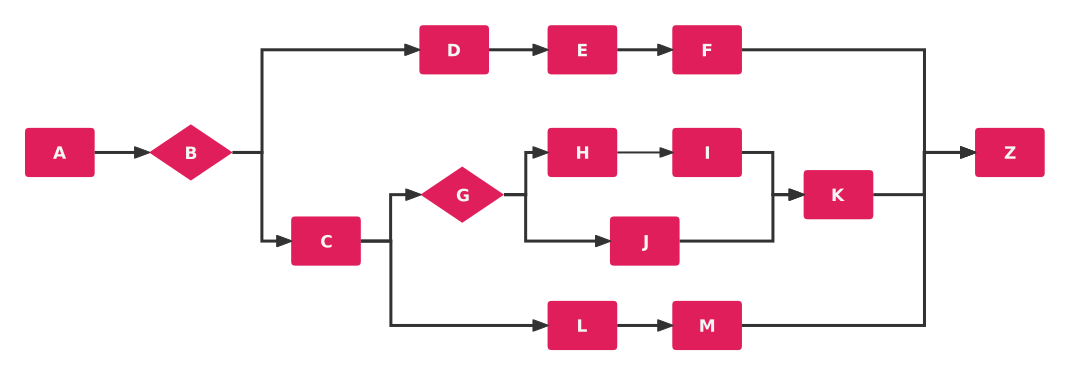
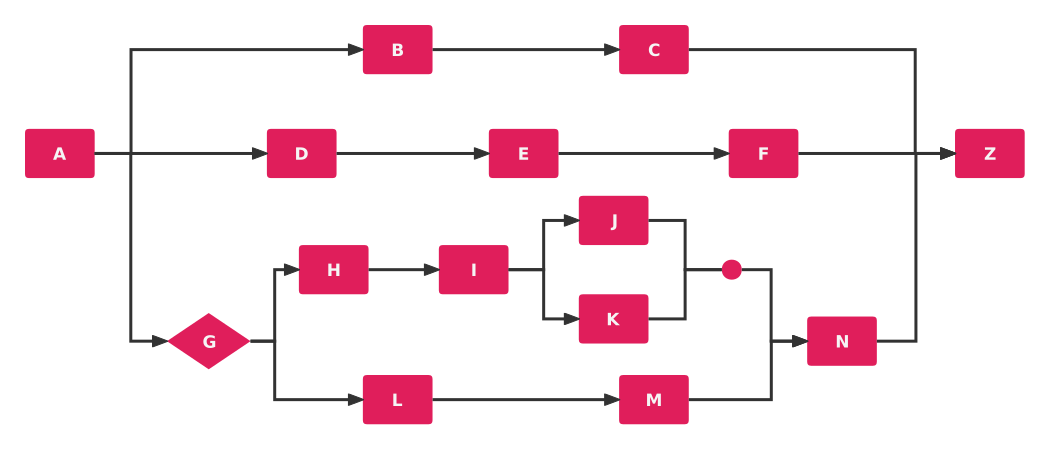
These processes can be easily solved with LiteFlow! The framework has a very low threshold to learn the expression language, but it can accomplish extremely high complexity of the choreography.
LiteFlow has an extremely detailed and easy-to-understand documentation, it can help you solve more than 95% of your problems when using the framework.
LiteFlow has 2000 test cases and more. Complete documentation and comprehensive test case coverage guarantee the stability of LiteFlow framework!
Looking forward to your use!
AI Agent Orchestration (New in v2.16.0)
Starting from v2.16.0, LiteFlow ships its own AI Agent module, liteflow-react-agent.
It is not a simple "LLM component". Instead, it wraps a full ReAct (Reasoning + Acting) Agent into a standard LiteFlow component — one component is one Agent. You only declare a component and implement a few simple methods; talking to LLM providers, multi-turn conversation memory, and the Skills system are all handled for you by the module.
Once an Agent becomes a LiteFlow component, it automatically inherits the full orchestration power of LiteFlow. You write rules exactly the way you always have — except one of the nodes is now a thinking AI:
// Sequential orchestration, the AI node naturally sits between business nodes
THEN(prepare, deepseekAgent, recordReply);

// Let two different LLMs analyze the same question in parallel
WHEN(deepseekAgent, qwenAgent);

// Route to different Agents based on a condition
IF(isMath, mathAgent, deepseekAgent);

// Multi-Agent collaboration: parallel analysis + aggregated decision
THEN(prepare, WHEN(analyzerAgent, riskAgent), summaryAgent, notify);
None of THEN, WHEN, IF, SWITCH or FOR here is newly invented for AI — they are the same orchestration operators LiteFlow has used for years. If you can orchestrate LiteFlow, you can orchestrate AI.
The module connects to mainstream LLM platforms — OpenAI, Claude, Gemini, DeepSeek, Qwen (DashScope), Kimi, GLM and more — and provides multi-turn conversation memory, the Skills system, workspace file tools, streaming output, and so on. Switching models is basically a one-line change to model().
Note: The AI Agent module is built on agentscope-java and requires JDK 21+ at runtime. See the official documentation for the full usage guide.
Sponsors
驰骋工作流引擎

FastBee物联网平台

速众 AI 低代码开发平台

Easysearch

DISCORD LINK
Discord Link: https://discord.gg/MpdBSBnFTu
WECHAT OFFICIAL ACCOUNT
Since the community group is over 200 people, you need to be invited to join the group. Follow the WECHAT OFFICIAL ACCOUNT and click Personal WeChat to add me, I can invite you into the group

Open source is not easy, please sponsor LiteFlow if you support it

Reviews (0)
Sign in to leave a review.
Leave a reviewNo results found