skills
Health Pass
- License — License: MIT
- Description — Repository has a description
- Active repo — Last push 0 days ago
- Community trust — 932 GitHub stars
Code Fail
- fs.rmSync — Destructive file system operation in scripts/install-skills.mjs
- os.homedir — User home directory access in scripts/install-skills.mjs
- process.env — Environment variable access in skills/visual/compare-screenshots/scripts/visual-parity-diff.eval.mjs
- process.env — Environment variable access in skills/visual/compare-screenshots/scripts/visual-parity-diff.mjs
Permissions Pass
- Permissions — No dangerous permissions requested
No AI report is available for this listing yet.
Reusable AI agent skills for software factories: explore ideas, write specs, implement, review, and run autonomous research. Works with Claude Code, Codex, and other skill-compatible agents.
Skills
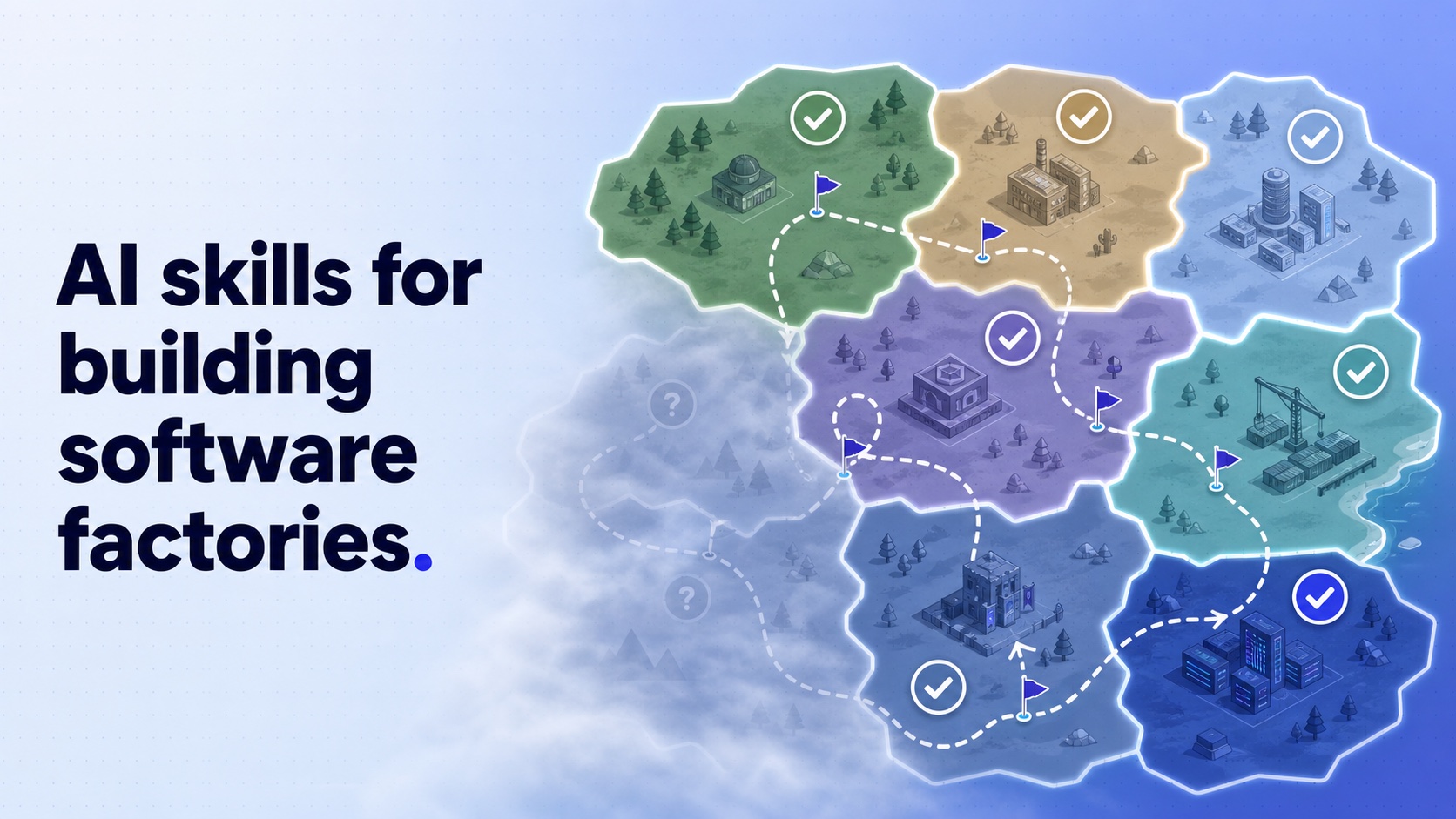
AI skills for building software factories. My personal library of
domain-agnostic agent skills, reused across every project. Small, composable,
and hackable — works with any harness that supports skills: Claude Code, Codex,
opencode, Cursor, duet, and
70+ others.
npx skills add dzhng/skills
Add --list to pick individual skills, or copy any skills/<category>/<name>/
folder into your harness's skills directory (e.g. .claude/skills/).
From a clone, npm run install-skills does the same without the registry:
npm run install-skills              # into ~/.agents/skills, linked from ~/.claude/skills
npm run install-skills -- ../my-app # into a repo instead of the home directory
npm run install-skills -- --only write-spec,review ../my-app
npm run list-skills                 # names and categories
.agents/skills/<name>/ holds the real files (flat, category-free, with
cross-category links rewritten to match); .claude/skills/<name> is a relative
symlink into it, so both harnesses read one copy. Re-running overwrites the
installed copies — a .claude/skills/<name> you keep as a real directory is
left alone, and a .claude/skills that is already a symlink is left as is. Add--dry-run to see the plan first.
Why
Software is moving from tasks to factories: agents that pursue a goal
autonomously until the output can be trusted. The hard part isn't breaking the
goal into tasks — it's breaking it into independently verifiable pieces, and
knowing where the pieces even are.
These skills run that loop. Treat the unknown as fog of war: map the
terrain, carve it into territories that build and verify in isolation, and
recursively re-slice whatever hides more map. And re-planning doesn't stop when
planning ends — the spec is a living document, updated and re-sliced
mid-implementation whenever the work teaches the agent that the plan is stale.
Every piece must prove itself — architecture review, code review, and visual
review against a baseline — before the loop moves on. Each iteration gets less
wrong, until the goal is done.
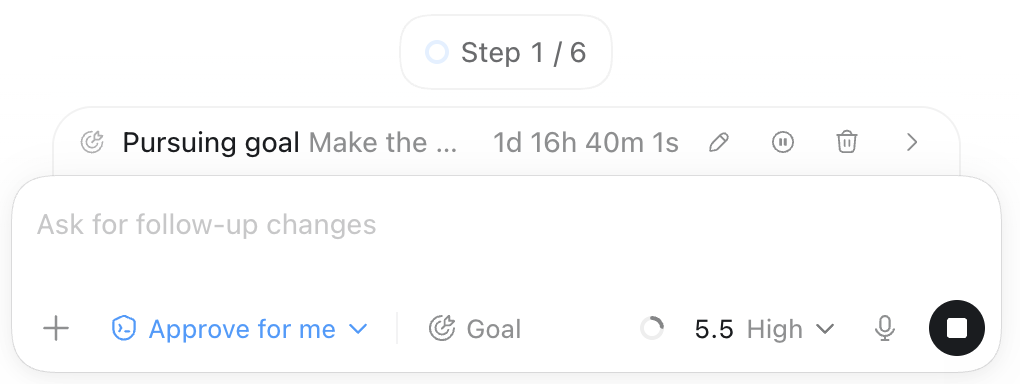
Proof: one unattended Codex run pursuing a single goal for 1d 16h on top
of these skills, slicing and iterating until done.
How to use
Use a chained pipeline to build a feature, a research loop to discover what
works, or individual skills as needed. Every skill stands alone.
The full loop — a big feature, start to finish
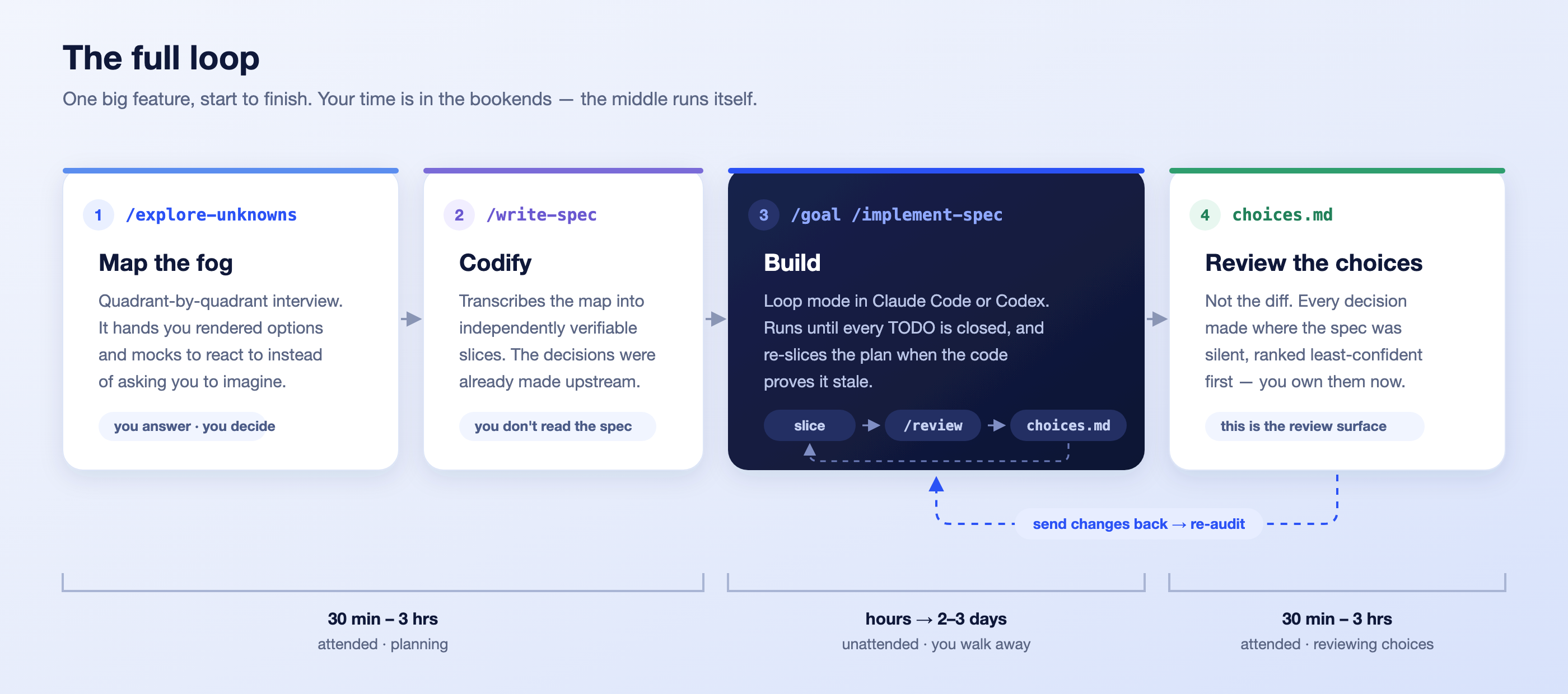
Map the fog.
/explore-unknownson the idea. It interviews you quadrant
by quadrant and hands you rendered options, mocks, and decision tables to
react to instead of asking you to imagine. By the end you know what the
feature does.Codify.
/write-specon that map. Most decisions were already made
upstream, so this pass is transcription — I don't read the spec. Anything
genuinely new it hits, it asks about instead of deciding.Build. Kick off the loop:
/goal /implement-spec specs/<feature>/goalis what puts the harness in loop mode — same move in Claude Code or
Codex — and the spec drives it from there. A couple of hours for a small
feature, two or three days for a large one. Add whatever framing fits:on the xyz branch, orusing /codex as the implementer while you stay the parent orchestrator and reviewer.Review the choices, not the diff. The run ends by consolidating
specs/<feature>/choices.md— every decision the agent made where the spec
was silent, ranked least-confident first. That's the review surface. Send
changes back and the next pass re-audits: every time the AI writes code, you
audit what it chose.The rest fires on its own: a
/reviewpass at the end of every slice,/screenshot-critiqueand/compare-screenshotson anything visual,/close-specwhen the last slice lands, and a re-slice of the plan whenever
implementation proves it stale.
Budget: 30 minutes to a few hours on steps 1–2, 30 minutes to a few hours on
step 4. A run that goes two days is more like 2–3 hours on each end. Your time
is in the bookends; the middle is unattended.
Research — learn through fast experiments
Use Auto Research when the next
decision needs experimental evidence. It starts with one fast, revealing task,
tests a short batch of hypotheses, checks combinations, and expands coverage as
the approach improves. New failures become the focus; earlier tasks become
regression checks.
/auto-research Reduce cost per task by at least 15% relative to the saved
baseline, without reducing task success. Start with one fast development task.
If the evaluator, metric, baseline, or required improvement is unclear, the
skill asks before experimenting. Passing an evaluation and meeting an
improvement target are separate requirements. The output includes the best
verified artifact and a parameter-effect map: what was tested, where it
helps or hurts, and how changes interact. Use that evidence to inform a spec
when the research is ready for implementation.
À la carte — the spontaneous path
A brainstorm turns out to be a feature.
/explore-unknownsworks at the
end of a discussion as well as at the start — run it to sweep for the angles
neither of you thought of, then pick the loop up at step 2.Any code change that didn't come from a spec. An ad hoc fix that touched
more than expected:/reviewfirst (refactor-clean → code-review →
write-docs), then/audit-choices. When the diff is too big to read, the
choices ledger is how you still understand what is now in your codebase.
Skills
Engineering — slice, build, verify, repeat
| Skill | What it does |
|---|---|
| explore-unknowns | Walk the user through mapping a task's unknowns quadrant by quadrant — known knowns first, then interviews, reactable artifacts, and blindspot passes — ending with a complete four-quadrant map. |
| auto-research | Optimize through fast, progressive experiments, producing a verified candidate and a map of parameter effects and tradeoffs. |
| write-spec | Break a large feature into independently verifiable, human-reviewable slices with API seams and playable checkpoints. |
| implement-spec | Build an existing spec to completion, one reviewable pass at a time, delegating independent slices in parallel. |
| implement-spec-with-codex | Run implement-spec with Codex writing the code — you orchestrate, integrate, and review every pass. |
| close-spec | Archive a shipped spec and rewrite it from a build plan into a durable rationale record that points back at the code. |
| refactor-clean | Refactor by moving ownership to one clean concept instead of layering compatibility sediment beside the problem. |
| write-tests | Write tests one tracer bullet at a time that pin real behavior — not implementation details, config values, or lucky samples. |
| audit-performance | Find hot paths that amplify or repeat without progress, rank them by real failure risk, and prefer the smallest bounded fix that preserves healing. |
| write-docs | Write docs as a glossary of principles and pointers, never a mirror of the code that will rot. |
| code-review | Audit a diff for stale names, dead references, needless complexity, and comments that narrate instead of explain — ending on a clean/not-clean verdict. |
| audit-choices | Audit the choices an implementer made, not its diff — a pure, never-blocking audit whose ledger discloses the architecture and decisions made on the user's behalf, reviewed instead of the code. |
| eli5 | Explain a spec or change in plain language without losing precision — the ELI5 register other skills borrow for standalone, walked-scenario explanations. |
| review | Closeout a finished change as one pass — refactor-clean, then code-review, then write-docs — sequenced into a single verdict. |
| codex | Use the local Codex CLI as an independent second agent for review and (on explicit ask) delegated implementation. |
| claude | Use Claude Code (claude -p) as an independent second agent for consultation and (on explicit ask) delegated implementation. |
| marketing-pages | Rulebook for writing, updating, and auditing marketing pages by page class — campaign landers stay noindexed and unlinked with one CTA; everything else earns its sitemap entry, crawl-rail link, and canonical copy source. |
Visual review — never accept visuals on vibes
| Skill | What it does |
|---|---|
| compare-screenshots | Judge which image is less wrong against a target you establish — telemetry to locate divergence, not a baseline match. Ships a reusable diff script that also measures a lone capture for flat, empty, or misframed content. |
| screenshot-critique | Use an unprimed subagent as a second set of eyes on visual work before accepting it; mandatory before declaring a reported visual bug fixed. |
| preview-shots | Open a curated set of image shots in one macOS Preview window for the user to eyeball. |
Authoring — keep the skills themselves sharp
| Skill | What it does |
|---|---|
| write-skills | Create or revise agent skills: triggers, leading words, progressive disclosure, and the failure modes to prune. |
| eval-skills | Eval a skill against golden cases — blind runs in fresh subagents, a separate judge, and gap-driven edits. |
Graphics
| Skill | What it does |
|---|---|
| renderer | Build, debug, or review WebGPU renderer work — three.js/TSL scene layers, node materials, WGSL passes, depth semantics, and browser-verified visuals. |
License
MIT
Reviews (0)
Sign in to leave a review.
Leave a reviewNo results found