flavormancer
Health Warn
- License — License: Apache-2.0
- Description — Repository has a description
- Active repo — Last push 0 days ago
- Low visibility — Only 8 GitHub stars
Code Pass
- Code scan — Scanned 12 files during light audit, no dangerous patterns found
Permissions Pass
- Permissions — No dangerous permissions requested
No AI report is available for this listing yet.
Predict taste & aroma from a molecule's chemical structure — on-prem flavor prediction for food, beverage & fragrance R&D. 🧪
Flavormancer
On-prem flavor prediction from chemical structure — taste and aroma, physicochemical
behavior, formulation notes, and safety flags for any molecule, plus substitution search.
Enter a common or IUPAC name (or a SMILES) and get a single, honest flavor read,
running entirely on hardware you own.
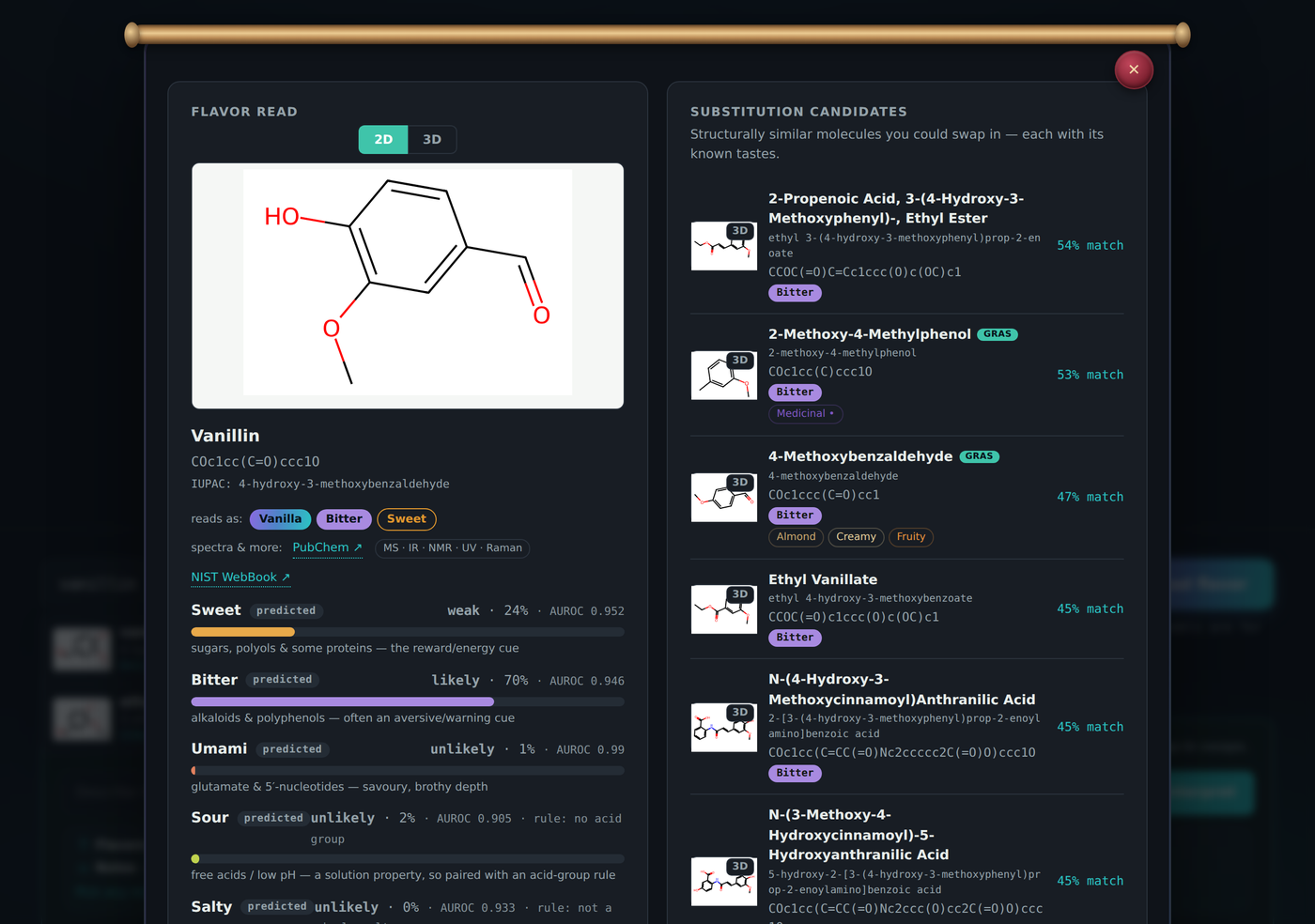
A single, confidence-tagged flavor read — taste, aroma, behavior, safety, and drop-in substitutions.
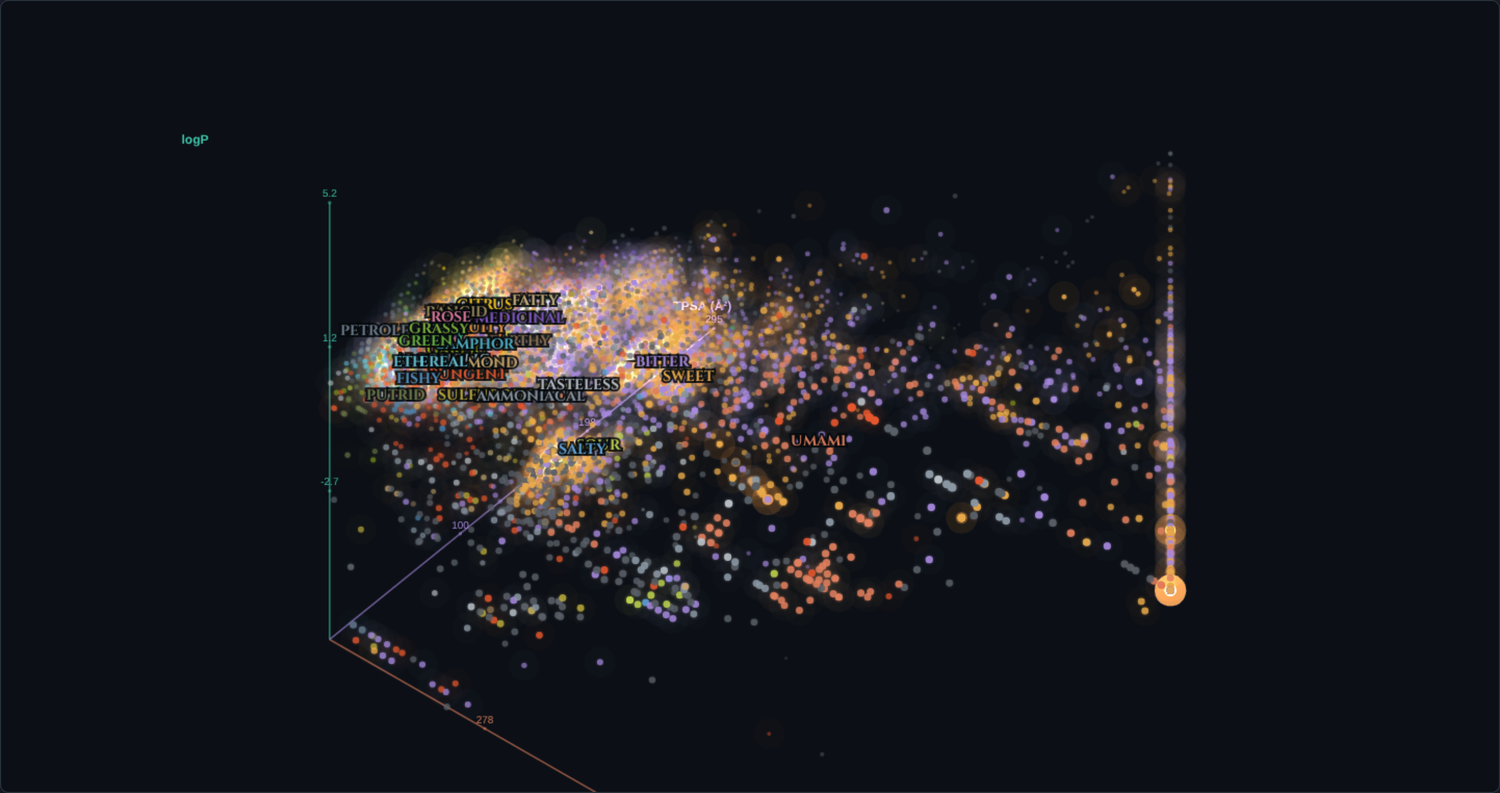
The interactive flavor-space map in 3D on real MW × logP × TPSA axes, colored by taste & aroma — every one of the 164 aroma + 6 taste classes labelled. 187 trained heads in all: 6 taste + 164 aroma + 5 mouthfeel + 12 safety.
8,847 unique molecules across the open datasets · taste + aroma + mouthfeel prediction from
structure · a flavor library (start from a flavor → its character-impact molecule) and
flavor designer (pick your notes → best food-safe molecules + drop-in swaps) · an
interactive 2D/3D flavor-space map · 2D & 3D structure views. All on
commercial-clean public data.Per set (unique molecules): taste training 3,845 · aroma training 2,394 · odor
corpus 2,255 · documented taste 676 · mouthfeel training 2,534 · Tox21 (safety)
7,823 · GRAS reference 2,781 · sweetness intensity 316 · character-impact aroma
supplement 602 associations (open-gov-sourced). Every one of the 8,847 is enriched with
names + measured properties from public-domain PubChem.How the universe grows: the flavor-space map and enrichment table show 8,847 unique
structures (deduped by connectivity skeleton), expanded by ingesting the full EU/GB
flavourings Union List (~2,200 authorised, Open Government Licence v3) so the browse-able
universe is food-forward. Meaningfully-distinct stereoisomers (e.g. R- vs S-limonene) that carry
their own documented odor/taste are surfaced as first-class rows; nothing is dropped.
This is the commercial edition — Apache-2.0 and commercial-clean: every
model (taste and aroma) trains only on permissively-licensed / public-domain
data, so it's free to use, sell, and run behind your firewall. The commercial-clean
aroma model ships here as presence/absence; a higher-fidelity academic
edition adds the scored-intensity model from research odor data (NonCommercial
terms) — see Two editions.
Status: the Python training pipeline and prediction core are built and
tested; the .NET serving layer, React workbench, and packaging are in progress.
See the roadmap — M0–M1 landed, M2–M6 next.
What it does
Given one molecule, Flavormancer returns a structured profile where every value
is tagged by how it was derived, so nothing reads as more certain than its source:
- Taste — six trained heads: sweet / bitter / umami / sour / salty /
tasteless (RandomForests on fingerprint + physicochemical features), plus a
sweetness-intensity regressor. Sour and salty also keep a transparent chemistry
rule (acid group / alkali-salt) as a deterministic cross-check alongside the model. - Aroma — 164 odor-descriptor heads (citrus, floral, minty, almond, fatty,
petroleum, earthy, medicinal, sulfurous, camphor, fruity, fishy, garlic, ethereal,
ammoniacal, pungent, pine, rose, rancid, alcoholic, woody, green, grassy, putrid)
trained on public-domain HSDB odor text + curated character-impact facts, surfaced
for any molecule, each with its held-out CV-AUROC (0.71–0.98). Presence/absence,
honestly — intensity is the "comes with your data"
upgrade (no public intensity data exists). Documented odor + detection thresholds are
shown where cited. - Behavior — logP, molecular weight, TPSA, H-bonding, ring/atom counts
(computed); water solubility (ESOL estimate); volatility tier and pKa ranges
(qualitative); measured boiling point / vapor pressure when a property table is
loaded (lookup — structure-based BP was evaluated and declined as too inaccurate). - Mouthfeel — five trained chemesthesis heads (cooling / pungent / warming /
astringent / tingling): the trigeminal sensation, trained on curated public-domain
agents (menthol & WS-coolants, capsaicinoids, tannins, Sichuan-pepper sanshools), each
with its held-out CV-AUROC. Distinct from the same-named aroma notes — the sensation, not
the smell (menthol feels cool; WS-23 cools with almost no odour). - Stability — oxidation / hydrolysis / photo watch-flags.
- Safety (defensive, caution-only) — a disclaimer + scope on every result,
twelve Tox21 in-vitro assay heads (nuclear-receptor + stress-response, each with its
CV-AUROC) surfaced as indicative review flags, structural tox-alert screening, a
preliminary TTC/Cramer concern tier, an optional GRAS cross-reference, and EU
declarable-allergen labeling. It flags for review; it never clears a compound for use. - Formulation — a documented dangerous-mixture screen (benzene, nitrosamine,
acrylamide, ethyl carbamate, furan, and more) and an OAV dosing-balance analysis
that flags the component about to overpower a blend (quantitative when threshold
tables are loaded). - Substitutes & structural neighbors — two nearest-neighbor searches over the whole
molecule universe for reformulation and cost-down: substitutes rank by taste + aroma
profile match (a molecule that tastes and smells like the target — e.g. ethyl vanillin for
vanillin — regardless of structure), while structural neighbors rank by Tanimoto/Morgan
structure similarity (the look-alikes). - Flavor Studio — one hub to pick any mix of everyday flavors (banana,
saffron, pumpkin, bubble gum…) and notes (citrus, floral…) → ranked food-safe
molecules + drop-in swaps. A flavor is a set of notes, so they live in one picker. - Flavor-space map — every molecule embedded 2D/3D: a similarity layout
(UMAP over fingerprints) and an interpretable property-axes layout (MW × logP ×
TPSA), colored by taste, aroma, or both. - Chirality explorer — enumerates every stereoisomer (R/S and E/Z), surfacing
the ones with distinct documented odor/taste (R- vs S-carvone) as their own reads. - Master enrichment table — sortable/searchable grid of the whole universe with a
"why it matters" note on every chemistry column. - External references — per-molecule deep links to PubChem (public domain) and
NIST WebBook for spectra (IR/MS/NMR) and GC retention indices, with an availability
flag showing what each source has. We link, never rehost.
On aroma intensity (the one gated piece). The aroma heads above are
presence/absence — which notes apply, from public-domain data. Scored
intensity (how strong) is the marquee upgrade that comes with a customer's own
panel data or a commercially-licensed set (Leffingwell PMP 2001); no
public-domain intensity data exists. That's the only aroma capability still gated.
What aroma training needs from you: molecules (SMILES, or GC-MS to identify
the compounds in your products) paired with your panel's expert odor descriptors
(e.g. green / fruity / woody, ideally with intensity). GC-MS identifies the
molecules; the sensory labels are what the model learns — GC-MS alone isn't enough.
For exactly what data unlocks each further capability (aroma, quantitative dosing,
retention index) and the formats we accept from a client, see
docs/DATA-REQUIREMENTS.md.
Scope: Flavormancer predicts flavor properties only. It is not a safety,
toxicity, GRAS, regulatory, or stability determination. A prediction is never a
clearance to consume.
Confidence tiers
Every output is labeled by how it was produced: computed (exact from
structure), trained (ML on open data), rule (deterministic structural
rule), estimate (published QSPR with known error), lookup (from a loaded
reference table), and qualitative (a class/flag, not a number). Full map in
docs/CAPABILITIES.md.
How does it all actually work? A plain-English tour of the method behind every
feature — fingerprints, the taste/aroma models, the map, chirality, the mixture
reactions — is in docs/HOW-IT-WORKS.md.
Why it's built this way
The value isn't any single number — those you can look up. It's four design choices:
- Prediction, not lookup. The trained models read a molecule from its structure,
so they answer for a novel or unmeasured compound that's in no database — not just
for known ones. - On-premise, behind your firewall. Proprietary candidate structures never leave
your network. You can screen confidential molecules without exposing your direction
to any external service — something no public web tool can offer. - One integrated read. Taste, behaviour, safety, and substitution in a single
confidence-tagged screen, instead of stitching together half a dozen databases and
manual checks per molecule. - It sharpens on your own data. The open-data models are the floor. Trained on a
user's own formulation and sensory data — on the same on-prem box — they become
specific to that user's products, which no public dataset can be.
Two editions
Flavormancer ships as two editions of one method:
| Flavormancer (this repo) | Flavormancer Research | |
|---|---|---|
| Edition | Commercial | Academic / open-source (coming soon) |
| License | Apache-2.0 | open-source, research / NonCommercial |
| Data | commercial-clean open data only | adds research odor datasets with NonCommercial terms |
| Aroma | 164 presence/absence descriptor heads ship (public-domain HSDB); scored intensity is trained on your data or a licensed set (PMP 2001) | full open model incl. intensity (research odor data) |
| Use | free to use, sell, run on-prem | research, teaching, advancing the method |
The split is deliberate. The richest aroma data is licensed for research only, so
it can't ship in a product you sell — keeping it out is exactly what makes this
edition clean to use and sell, and the academic edition is where that fuller model
lives.
Architecture
Python trains the models offline; a .NET application serves them at runtime —
nothing at runtime depends on Python.
data sources ─► Python training (build-time) ─► ONNX (taste) ──┐
                RDKit · scikit-learn                            │
                                                                ▼
React workbench ◄─ JSON API ◄─ ASP.NET Core + ONNX Runtime + Postgres/pgvector
                                              │
                                              ▼
                              Docker Compose on a single on-prem box
| Layer | Technology |
|---|---|
| Model training (build-time) | Python · RDKit · scikit-learn · skl2onnx |
| Model handoff | ONNX |
| App / API | ASP.NET Core (C#) |
| ML serving | ONNX Runtime, in-process in .NET |
| Frontend | React |
| Database | PostgreSQL + pgvector |
| Deploy | Linux + Docker Compose (single box) |
Repository layout
training/        Python — dataset build + model training (build-time)
api/             ASP.NET Core — app, auth, endpoints, ONNX serving
frontend/        React — the workbench UI
infra/           Dockerfiles, docker-compose.yml, deploy
docs/            architecture, capabilities, and design docs
tests/           pytest suite for the prediction core
Getting started
See training/SETUP.md for the clean-machine setup. Datasets and
trained models are not committed — the training scripts pull their sources and.gitignore keeps artifacts out of the repo.
Team
Built by Echelon Technology Solutions — a small team where
everyone is cross-training toward full-stack.
| Role | |
|---|---|
| Austin · @rvnminers-A-and-N | Founder & lead — training pipeline, backend, architecture, models, and roadmap; mentors the team across their areas |
| Jamie | Front-end lead — owns the UI/UX |
| Aaron · @Jabbacado | Full-stack (in training) — backend, infrastructure, AI, UI/UX |
| Ty · @Frostfire0101 | Full-stack (in training) — backend, infrastructure, networking, AI, UI/UX |
Austin — B.S. Chemistry (ACS-certified) & B.S. Physics, magna cum laude, Western
Kentucky University (minors in Mathematics & Astronomy), plus graduate coursework in a
computational-chemistry M.S. program. Background in molecular-dynamics simulation —
protein conformational states and SO₂ at the air–water interface — on the WKU HPC
cluster: the structure-to-property grounding behind Flavormancer.
Contributing
See CONTRIBUTING.md for branching, commit conventions, and the
review workflow. Commits are signed and signed off (DCO + CLA); PRs are
small, linked to an issue, and squash-merged after review.
License
Licensed under the Apache License 2.0 — code license only; datasets and
any pretrained models carry their own licenses, noted where used. The academic
edition is a separate repository under its own (NonCommercial) terms.
Reviews (0)
Sign in to leave a review.
Leave a reviewNo results found