kerux
Health Pass
- License — License: Apache-2.0
- Description — Repository has a description
- Active repo — Last push 0 days ago
- Community trust — 66 GitHub stars
Code Pass
- Code scan — Scanned 12 files during light audit, no dangerous patterns found
Permissions Pass
- Permissions — No dangerous permissions requested
This tool is a high-performance agent framework written in Rust designed to orchestrate Large Language Model (LLM) interactions. It processes AI outputs to automatically execute custom tools using a Think → Plan → Execute loop.
Security Assessment
The overall risk is rated as Low. A lightweight scan of 9 files found no dangerous code patterns, hardcoded secrets, or requests for dangerous system permissions. By design, the agent is built to execute external "tools" based on AI outputs. While the base framework does not execute arbitrary shell commands, developers should remain aware that any custom tools they write and register will be run locally. Network requests are inherently required to communicate with external LLM APIs like OpenAI.
Quality Assessment
The project has an Apache-2.0 license and was actively updated very recently. However, it currently has extremely low community visibility with only 6 GitHub stars. This indicates that while the code is actively maintained by the creator, it has not yet undergone broad peer review or widespread production testing by the wider developer community.
Verdict
Use with caution: the underlying code appears safe and well-structured, but the lack of community adoption means it should be tested thoroughly before being deployed in critical environments.
A high-performance Rust implementation orchestration loop for LLM-driven tool execution.




κῆρυξ — a fast, self-contained Rust agent for LLM-driven tool execution.
Streaming-first ReAct loop · ratatui TUI · Telegram & WhatsApp gateway · autonomous coding mode
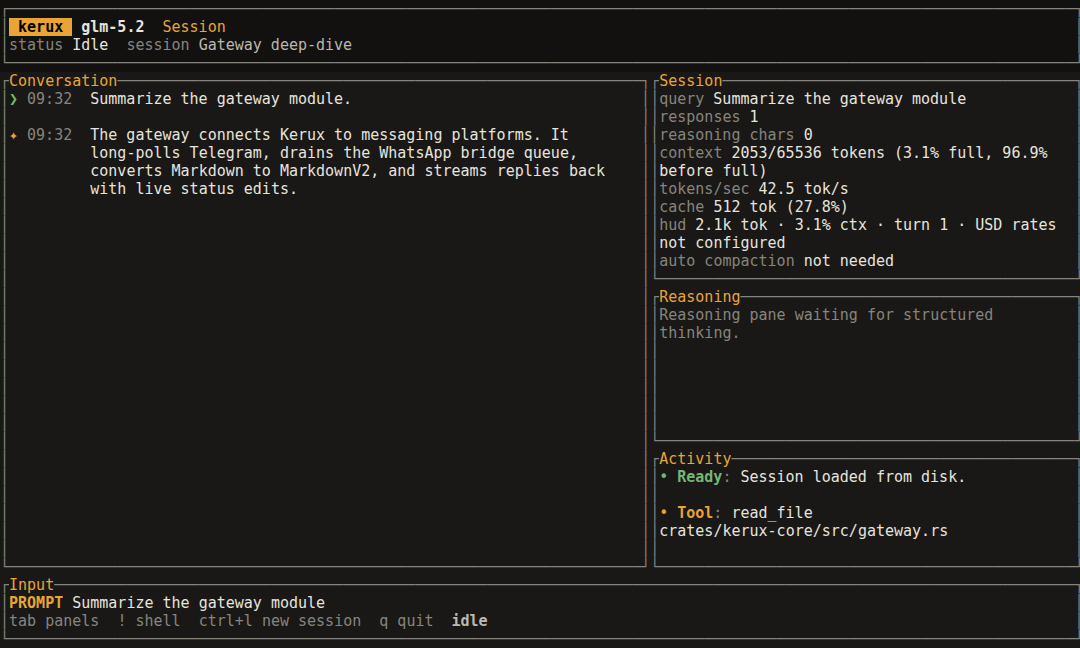
Highlights
- Streaming-first ReAct loop — tool calls detected and executed incrementally from partial LLM output, with a tolerant XML parser and self-healing re-prompts on failure
- Ratatui TUI — prompt-first landing screen, responsive workspace panes, reasoning rails, tool activity blocks, MCP/Skills/Behavior management
- Messaging gateway (
kerux serve) — Telegram long-polling + WhatsApp bridge, MarkdownV2 conversion, live status edits, SSE streaming replies, tool approval via inline keyboard, voice-note STT, cron scheduler, subagent delegation - Autonomous coding mode — 24/7 loop that reads
TODO.md, validates with local tests, and only pushes after success - Persistent state — sessions, memory, todos, and cron jobs survive restarts (atomic JSON writes under
~/.kerux/) - Repo-map context — tree-sitter symbols + personalized PageRank, token-budgeted into the system prompt
- Transactional git harness — pre-run snapshots, Conventional Commits, TUI
/undo
Install
cargo install --path crates/kerux-cli
# or grab a prebuilt binary from GitHub Releases
Quick start
export OPENAI_API_KEY=***        # or: kerux auth login nous (OAuth, no key needed)

kerux chat                        # prompt-first TUI
kerux run --query "What is 2+2?"  # one-shot
kerux serve                       # Telegram/WhatsApp gateway
kerux autonomous                  # 24/7 coding loop
Documentation
Full docs live at kerux.eikarna.dev — built with mdBook and refreshed automatically on every push:
| Quickstart | Build, configure, first run |
| Configuration | TOML schema, env vars, auth profiles |
| Architecture | Agent loop, streaming, tools |
| Gateway & Adapters | Telegram & WhatsApp |
| Features | Approval, compaction, fallbacks, STT, cron, delegation |
| Roadmap | What's next |
Screenshots in this README and the docs are generated automatically by CI (kerux screenshot renders the TUI headlessly) whenever the UI changes.
Development
cargo build --workspace
cargo test --workspace     # 423 tests
cargo fmt --all && cargo clippy --workspace --all-targets -- -D warnings
See CONTRIBUTING.md for conventions and the PR process.
Credits
A pure-Rust rewrite of the Hermes-Agent orchestration loop by Nous Research. Unofficial community port — not affiliated with or endorsed by Nous Research.
License
Dual-licensed under MIT or Apache-2.0.
Reviews (0)
Sign in to leave a review.
Leave a reviewNo results found