tokenhabit
Health Pass
- License — License: MIT
- Description — Repository has a description
- Active repo — Last push 0 days ago
- Community trust — 15 GitHub stars
Code Fail
- network request — Outbound network request in _workspace/06_launch/make_demo_logs.py
- rm -rf — Recursive force deletion command in _workspace/07_thumbnail/node_modules/playwright-core/bin/reinstall_chrome_beta_linux.sh
- rm -rf — Recursive force deletion command in _workspace/07_thumbnail/node_modules/playwright-core/bin/reinstall_chrome_beta_mac.sh
- rm -rf — Recursive force deletion command in _workspace/07_thumbnail/node_modules/playwright-core/bin/reinstall_chrome_stable_linux.sh
- rm -rf — Recursive force deletion command in _workspace/07_thumbnail/node_modules/playwright-core/bin/reinstall_chrome_stable_mac.sh
- rm -rf — Recursive force deletion command in _workspace/07_thumbnail/node_modules/playwright-core/bin/reinstall_msedge_beta_mac.sh
- rm -rf — Recursive force deletion command in _workspace/07_thumbnail/node_modules/playwright-core/bin/reinstall_msedge_dev_mac.sh
Permissions Pass
- Permissions — No dangerous permissions requested
No AI report is available for this listing yet.
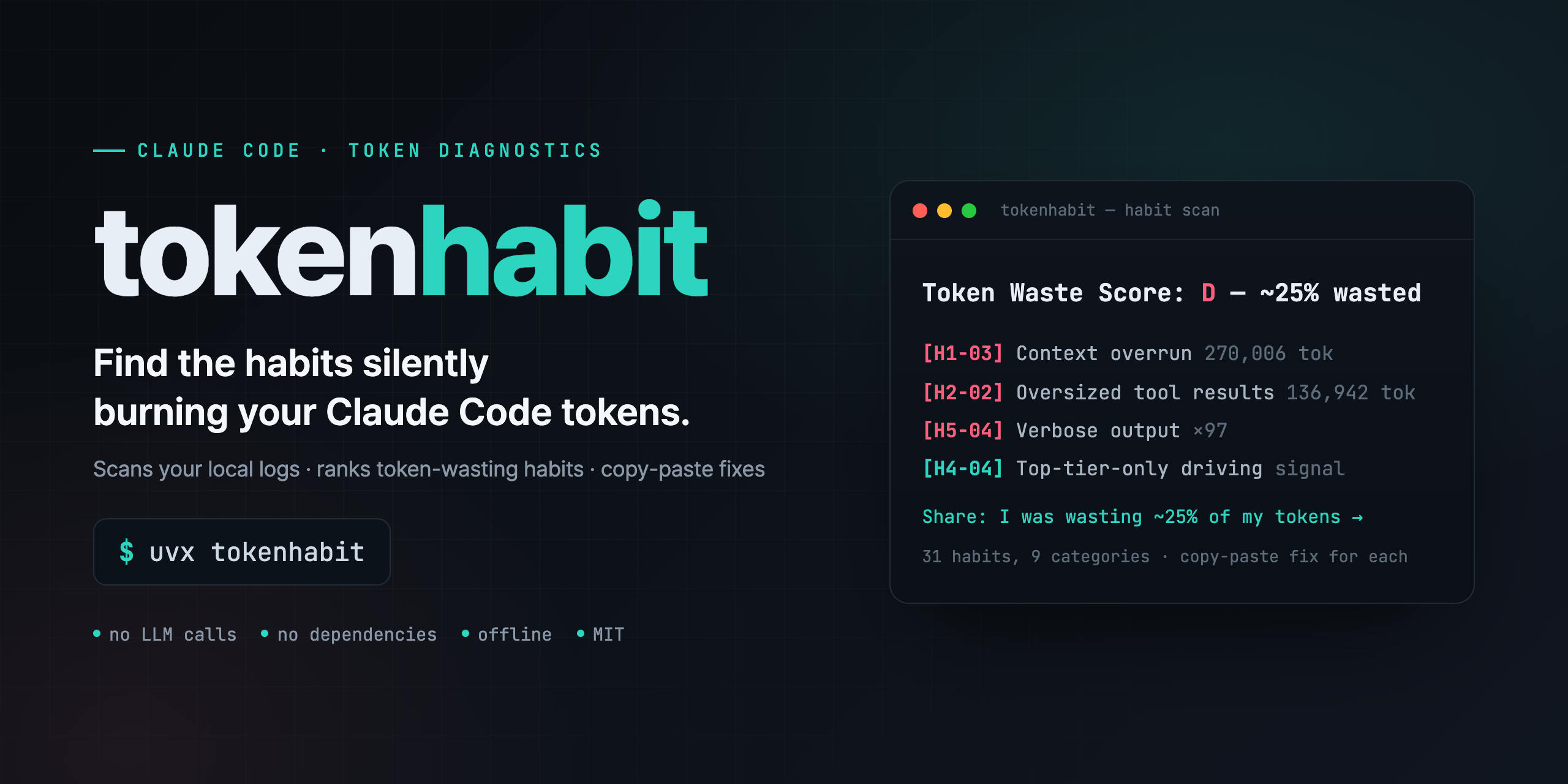
Scan your Claude Code logs and find the habits silently burning your tokens. No LLM calls, no deps, offline.
Useful? Give it a ⭐ — it helps others find it.
tokenhabit



What's leaking your Claude Code tokens? Scan your local logs and find out in one command.
ccusage tells you how much you spent. tokenhabit tells you which habits spent it — and how to stop.
No LLM calls. No dependencies. Runs offline on your own ~/.claude logs — the only
network access is the opt-in --ccusage flag.
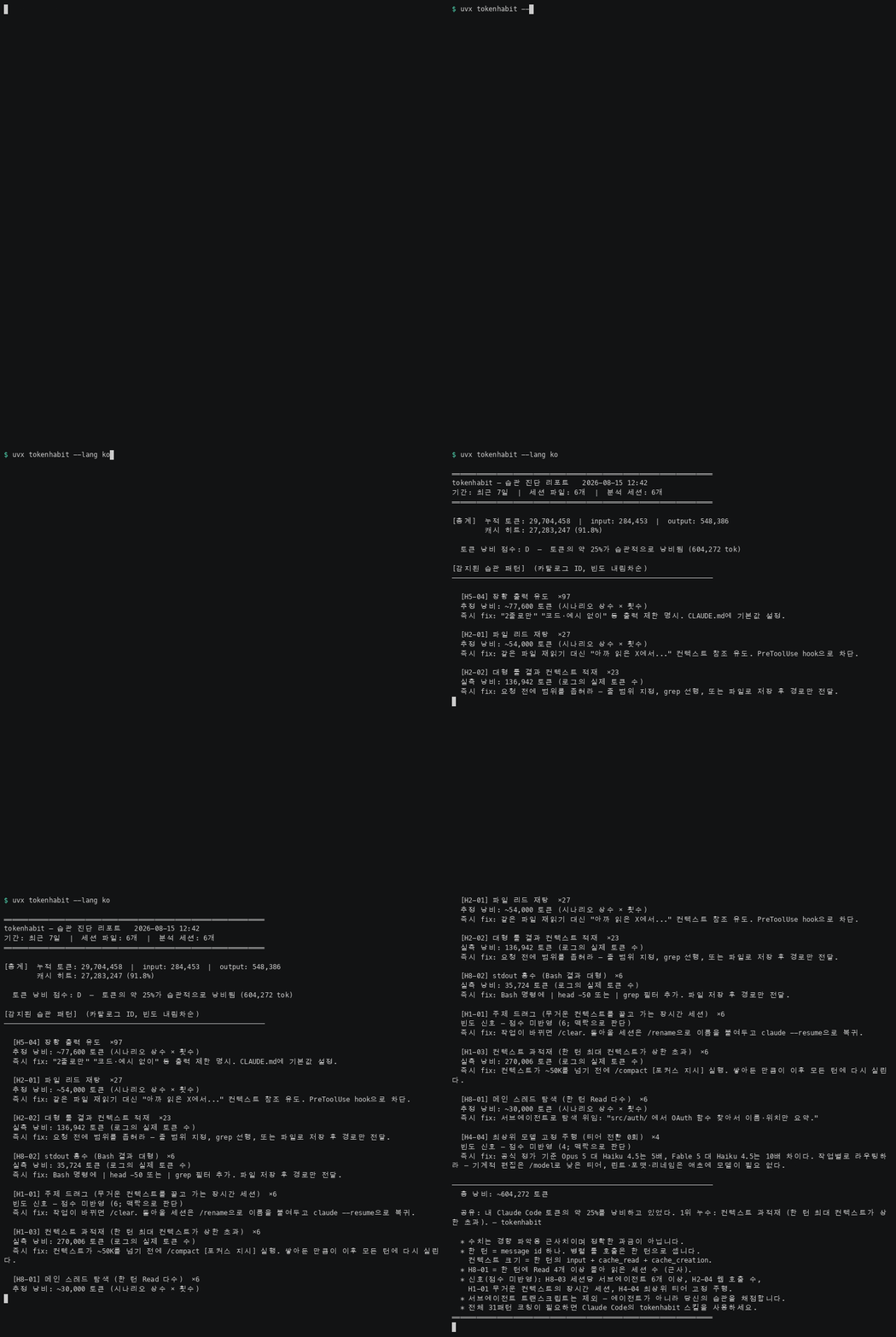
Sample run on synthetic logs (regenerate with python3 tests/make_demo_logs.py) — your real numbers will differ.
$ uvx tokenhabit

════════════════════════════════════════════════════════════════
tokenhabit — habit scan   2026-08-12 19:05
Window: last 7d  |  session files: 6  |  analyzed: 6
════════════════════════════════════════════════════════════════

[Totals]  tokens: 32,867,527  |  input: 121,953  |  output: 556,986
          cache hits: 31,576,016 (96.1%)

  Token Waste Score: F  —  ~86% of your tokens were likely wasted (1,111,076 tok)

[Detected habits]  (by catalog ID, most frequent first)
────────────────────────────────────────────────────────────────

  [H2-01] Re-reading the same file  ×194
  est. waste: ~388,000 tokens (scenario constant x hits)
  fix: Reference what you already read ("from the X you read earlier...") instead of re-Reading. Block it with a PreToolUse hook.

  [H5-04] Inviting verbose output  ×110
  est. waste: ~88,000 tokens (scenario constant x hits)
  fix: Cap the output: "in 2 lines", "no code or examples". Set response defaults in CLAUDE.md.

  [H8-02] stdout flood (large Bash output)  ×29
  measured waste: 172,666 tokens (from logged token counts)
  fix: Add | head -50 or a grep filter to Bash commands. Save output to a file and pass the path.

  [H1-01] Topic drift (long session carrying a heavy context)  ×6
  frequency signal — not scored (6; check context)
  fix: When the task changes, /clear. Name the session with /rename first if you plan to come back via claude --resume.

  [H1-03] Context overrun (peak turn context past the ceiling)  ×6
  measured waste: 432,410 tokens (from logged token counts)
  fix: Run /compact [focus] before the context passes ~50K. Every later turn re-sends whatever you let pile up.

  [H8-01] Main-thread exploration (many Reads in one turn)  ×6
  est. waste: ~30,000 tokens (scenario constant x hits)
  fix: Delegate exploration to a subagent: "search src/auth/ and return only function names + locations."

  [H4-04] Top-tier-only driving (never switched models)  ×4
  frequency signal — not scored (4; check context)
  fix: Official list prices differ 5x (Opus 5 vs Haiku 4.5) to 10x (Fable 5 vs Haiku 4.5). Route by task: /model for lighter tiers on mechanical edits; lint, format and rename need no model at all.

────────────────────────────────────────────────────────────────
  Total waste: ~1,111,076 tokens

  Share: I was wasting ~86% of my Claude Code tokens. Top leak: Context overrun (peak turn context past the ceiling). — tokenhabit

  * Numbers are trend-spotting approximations, not exact billing.
  * A turn is one message id, so parallel tool calls count as one turn.
    Context size = input + cache_read + cache_creation of a single turn.
  * H8-01 = sessions with >=4 Reads piled into a single turn (heuristic).
  * Signals (not scored): H8-03 >=6 subagent spawns/session, H2-04 web calls,
    H1-01 long session on a heavy context, H4-04 never left the top model tier.
  * Subagent transcripts are excluded — this scores your habits, not an agent's.
  * Want the full 31-pattern coaching? Use the tokenhabit skill in Claude Code.
════════════════════════════════════════════════════════════════
Quick start
No install needed:
uvx tokenhabit            # with uv  (recommended)
pipx run tokenhabit       # with pipx
Or install it:
uv tool install tokenhabit
# or
pip install tokenhabit
Then just run tokenhabit. It scans ~/.claude/projects/**/*.jsonl for the last 7 days and prints your report.
Prefer the bleeding edge? Run straight from the repo:
uvx --from git+https://github.com/epoko77-ai/tokenhabit tokenhabit
Usage
tokenhabit                      # last 7 days, all projects
tokenhabit --days 14            # last 14 days
tokenhabit --current            # only the current (most recent) session
tokenhabit --project /path      # a single project directory
tokenhabit --session run.jsonl  # a single session file
tokenhabit --lang ko            # Korean report
tokenhabit --json               # machine-readable (CI / piping)
tokenhabit --include-subagents  # also score subagent transcripts (off by default)
tokenhabit --ccusage            # also show `npx ccusage daily` totals (network)
What it detects
tokenhabit reads your raw session logs and flags the habits that quietly burn tokens. The eleven it can measure directly from logs:
| ID | Habit | Fix |
|---|---|---|
| H1-01 | Topic drift (signal) | /clear or /compact at topic switches |
| H1-03 | Context overrun (peak turn past the ceiling) | Manual /compact [focus] before ~50K |
| H2-01 | Re-reading the same file | Reference what's already in context |
| H2-02 | Oversized tool results pulled into context | Narrow the request before you make it |
| H2-04 | Stranded web results (signal) | Delegate research to a subagent |
| H4-03 | Cache-kill switch (model swapped mid-session) | Decide the tier before you start |
| H4-04 | Top-tier-only driving (signal) | Route by task; skip the model entirely for lint/format/rename |
| H5-04 | Inviting verbose output | Cap output ("in 2 lines") |
| H8-01 | Main-thread exploration | Delegate sweeps to a subagent |
| H8-02 | stdout flood (large Bash output) | Pipe to head/save to file |
| H8-03 | Subagent overuse (signal) | Delegate only big independent work |
These are 11 of a larger 31-pattern habit catalog (signal = frequency-only,
not scored into the waste total). The remaining patterns
(prompt clarity, CLAUDE.md hygiene, MCP setup, subscription overlap, …) can't be
judged from logs alone — for full interactive coaching, see
the Claude Code skill below.
Subagent transcripts are excluded by default: this scores your habits, not
what an agent did inside its own context.
How the score works
The Token Waste Score is the share-worthy headline: estimated wasted tokens
as a percentage of your billable work tokens (input + output + cache creation).
Cache reads are deliberately excluded from the denominator — they're cheap and
so voluminous they'd dilute every score to ~1%.
Waste comes in three flavours and the report labels each one:
- measured — taken from token counts the log actually recorded (oversized tool
results, the cache re-warm a model switch forced, context carried past the ceiling) - estimated — a scenario constant multiplied by a hit count; directional only
- signal — counted and shown, but not scored. A long session, a web search, a
subagent, or staying on one model tier is not waste by itself.
All numbers are trend-spotting approximations, not exact billing. The point is
to surface which habit dominates, not to reconcile your invoice.
Cutting waste is not spending less
The goal is to get the same result cheaper and spend what you save on actual work —
not to use Claude less. Rationing tokens until you can't finish the job is a more
expensive mistake than the waste itself. Every fix here removes tokens that bought
you nothing; none of them ask you to do less.
On sourced numbers
Token-saving advice circulates with confident figures that have no primary source.
Every price, multiplier, and saving rate in this project is traceable to official
provider documentation — cache reads at 0.1x, cache writes at 1.25x (5-min
TTL) or 2x (1-hour), Opus 5 to Haiku 4.5 list prices differing 5x, Batch API
at 50%. Where a popular claim conflicts with the official figure, we use the
official one and say so. Seeskill/references/measurement_and_hooks.md.
How it differs from ccusage
| ccusage | tokenhabit | |
|---|---|---|
| Question | How much did I spend? | Which habits spent it? |
| Output | Cost/token totals | Ranked habits + copy-paste fixes |
| LLM calls | none | none |
| Use them together | tokenhabit --ccusage shows both |
They're complementary. ccusage measures; tokenhabit diagnoses and prescribes.
The Claude Code skill
tokenhabit also ships as a Claude Code skill for interactive coaching across
the full 31-pattern catalog (session triage, prompt rewriting, runtime guard
hooks). See skill/. The CLI is the fast offline scan; the skill is
the deeper coach.
Detection logic lives in one place — the tokenhabit/ package. The skill carries a
generated copy under skill/scripts/_vendor/ so it runs without a pip install;python3 skill/scripts/sync_vendor.py --check fails CI if the two ever drift.
Privacy
Everything runs locally. tokenhabit only reads your own ~/.claude log files and
never sends anything anywhere. (The optional --ccusage flag shells out tonpx ccusage, which is also local.)
License
MIT © Seunghyun Lee
Reviews (0)
Sign in to leave a review.
Leave a reviewNo results found