agent-fleet-o
Health Pass
- License — License: AGPL-3.0
- Description — Repository has a description
- Active repo — Last push 0 days ago
- Community trust — 20 GitHub stars
Code Warn
- process.env — Environment variable access in mcp-gateway/index.js
Permissions Pass
- Permissions — No dangerous permissions requested
This tool is an open-source, self-hosted platform for building, running, and monitoring autonomous multi-agent systems. It features a visual DAG workflow builder, a credential vault, and exposes over 450 tools via an MCP server for integration with various large language models.
Security Assessment
The platform naturally handles sensitive data, including API keys, user credentials, and system prompts, though it provides an encrypted vault for this purpose. Because it orchestrates AI agents, it inherently executes commands and makes network requests to external LLM APIs. The codebase accesses environment variables to manage its configuration, which is an expected and standard practice. A rule-based scan found no hardcoded secrets or dangerous permission requests. However, it does allow SSH host access, which carries inherent execution risks. Overall risk is rated as Medium due to the high-privilege nature of an orchestration platform.
Quality Assessment
The project is actively maintained, with its most recent code push occurring today. It is properly licensed under AGPL-3.0, which is important to note as it requires anyone hosting modified versions to open-source their entire source code. The repository currently has 20 GitHub stars, indicating a small but present community footprint.
Verdict
Use with caution — the tool appears well-structured and actively maintained, but you should carefully configure network restrictions and access controls given its high-privilege orchestration capabilities.
Open-source AI agent orchestration platform — self-hosted mission control for autonomous multi-agent systems. Visual DAG workflows, 450+ MCP tools, human-in-the-loop approvals. Works with Claude, GPT-4o, Gemini, Ollama, Codex.
FleetQ — Open-Source AI Agent Orchestration Platform
Self-hosted mission control for AI agents. Build, run, and monitor autonomous multi-agent systems with a visual DAG builder, human-in-the-loop approvals, MCP server integration, and full audit trail. Works with Claude, GPT-4o, Gemini, Ollama, Codex, Claude Code, and any OpenAI-compatible LLM.





Keywords: AI agents · agent orchestration · MCP server · Model Context Protocol · LangGraph alternative · CrewAI alternative · n8n for AI · Claude agents · LLM workflow · autonomous agents · agent framework · AI automation · self-hosted
☁️ Prefer managed? Try FleetQ Cloud — zero setup, free tier.
⭐ Like the project? Give it a star on GitHub — it helps others find FleetQ.
Table of Contents
- Why FleetQ?
- Key Concepts
- Screenshots
- Features
- Use Cases
- How FleetQ compares
- Quick Start
- Authentication
- Configuration
- SSH Host Access
- Architecture
- MCP Server (450+ tools)
- Tech Stack
- Contributing
- Changelog
Why FleetQ?
Most agent frameworks give you a Python notebook. FleetQ gives you a production platform.
- 🧩 450+ MCP tools across 45 domains — every feature is exposed via Model Context Protocol, so any LLM (Claude Desktop, Cursor, ChatGPT, local agents) can drive the platform programmatically.
- 🔁 Visual DAG workflows with 8 node types (agent, conditional, human-task, switch, dynamic-fork, do-while) — no Python glue code.
- 👥 Multi-agent crews with coordinator/worker/reviewer roles, weighted QA scoring, and cross-validation.
- 💰 Budget controls with a real credit ledger, pessimistic locking, and auto-pause on overspend — not just token counters.
- 🧠 Agent evolution — LLM analyzes execution history and proposes config changes you approve with one click.
- ⚙️ BYOK + Local LLMs — Anthropic, OpenAI, Google, plus Ollama, LM Studio, vLLM, Codex, Claude Code. Zero vendor lock-in.
- 🔒 Production-grade — tenant isolation, encrypted credential vault, HMAC webhooks, SSRF guards, circuit breakers, audit trail.
- 📊 OpenTelemetry observability — structured error codes (gRPC-canonical), deadline propagation, distributed tracing. Jaeger UI one-command away.
- 🏠 Self-host or cloud — MIT-friendly AGPLv3 license, runs on Docker Compose, or use FleetQ Cloud.
Key Concepts
| Concept | What it is | When to use |
|---|---|---|
| Agent | A configured AI personality with role, goal, backstory, skills, and tool access | The basic unit — one agent per specialized task |
| Skill | A reusable LLM prompt, rule, connector, or GPU compute call | When multiple agents need the same capability |
| Experiment | A stateful run through a 20-stage pipeline (scoring → planning → building → executing → evaluating) | Any non-trivial agent task with lifecycle |
| Crew | A team of agents working on one goal (sequential, parallel, hierarchical, adversarial, fanout, chat-room) | Multi-perspective tasks or when you need review/QA |
| Workflow | A visual DAG template (reusable across experiments) with branching, loops, human-tasks | Recurring processes — CI/CD, content pipelines, QA flows |
| Project | A continuous (cron-scheduled) or one-shot container for experiments, with budget + milestones | Long-running initiatives, scheduled agent work |
| Signal | An inbound event (webhook, RSS, email, bug report, GitHub issue) that can trigger agents | Event-driven automation |
| MCP Tool | A programmatic action any LLM can call to query or mutate the platform | Expose FleetQ to external agents (Claude, Cursor, etc.) |
Screenshots
|
Dashboard 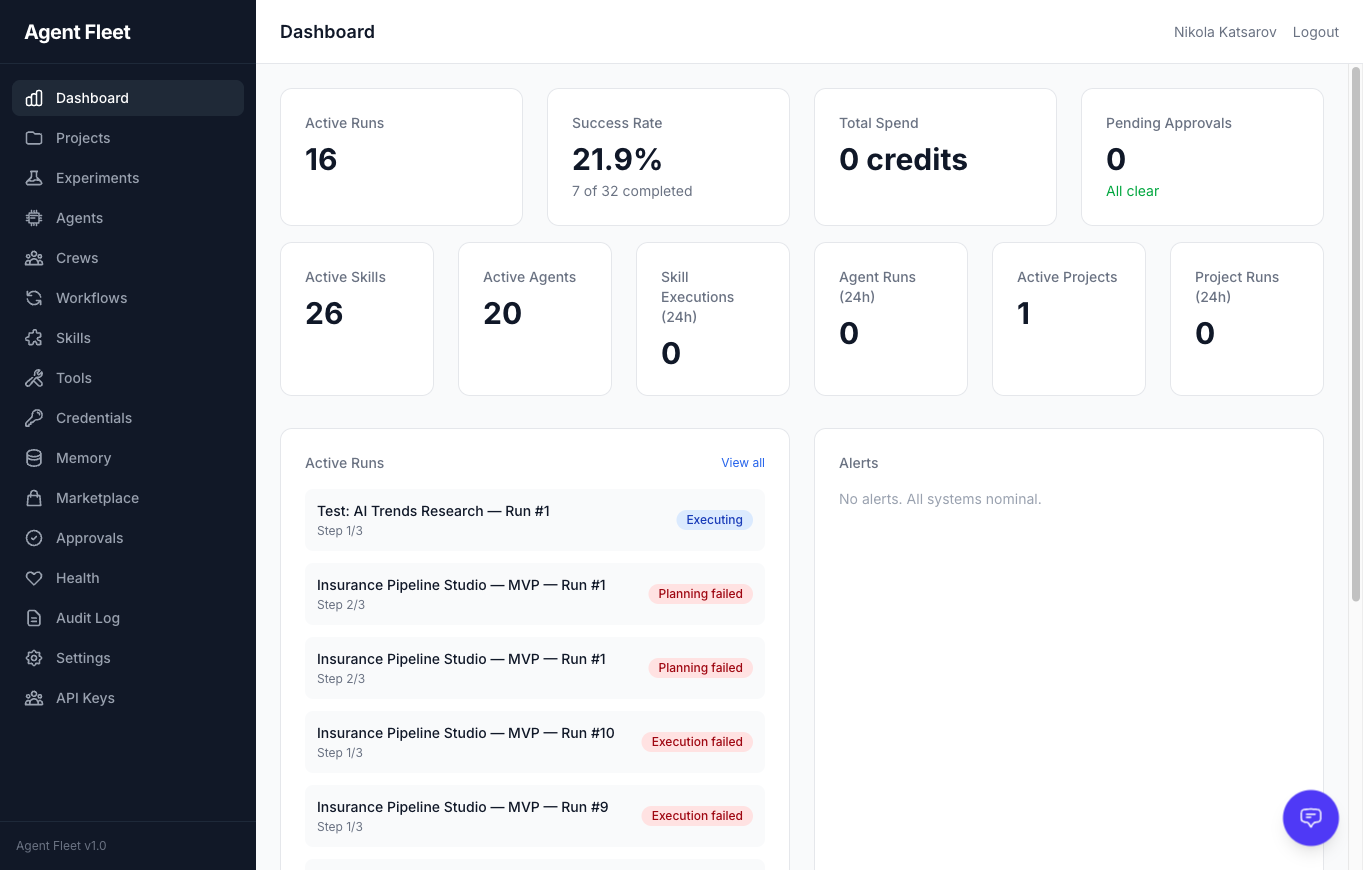
|
Agent Template Gallery 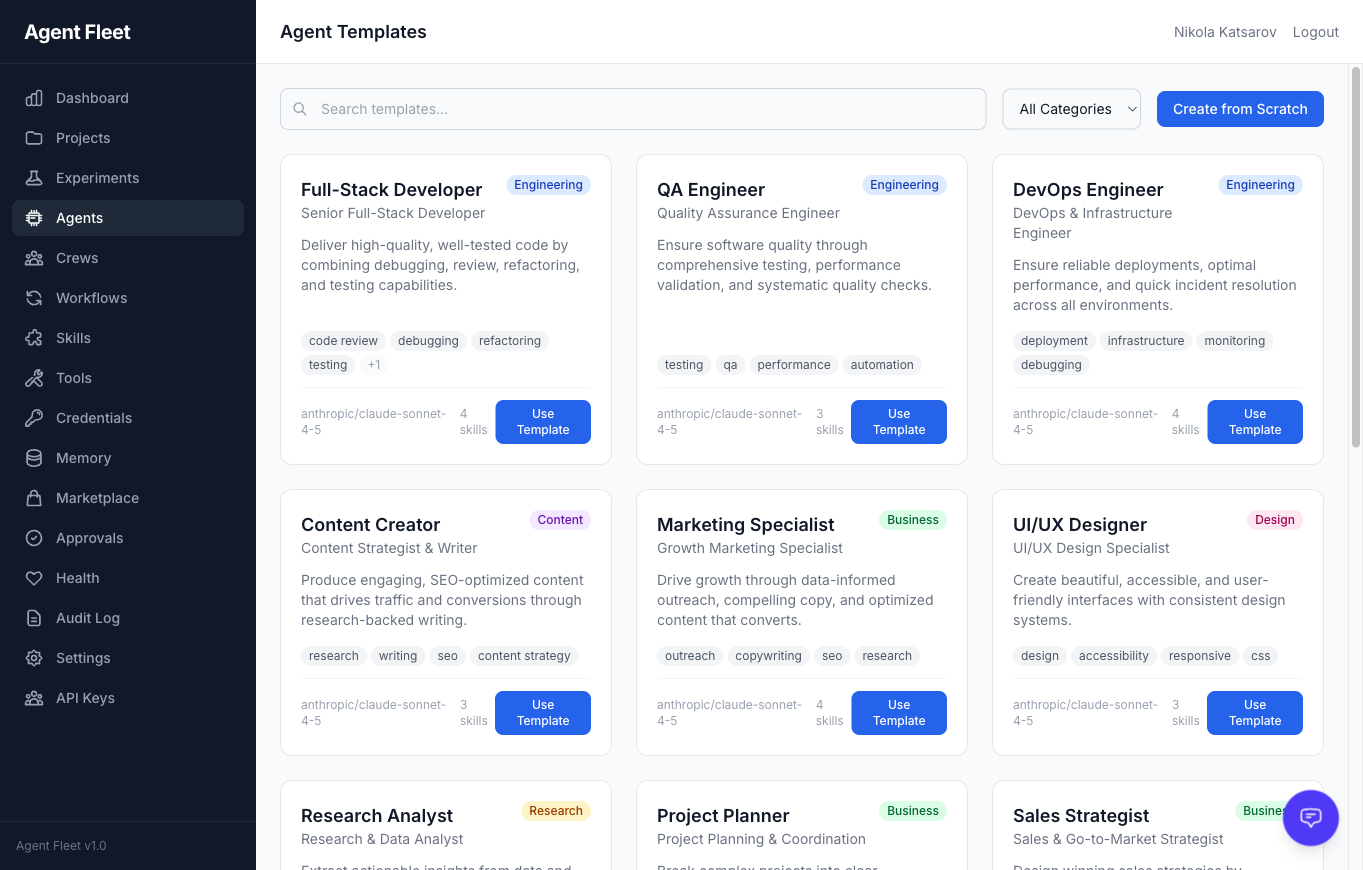
|
|
Agent LLM Configuration 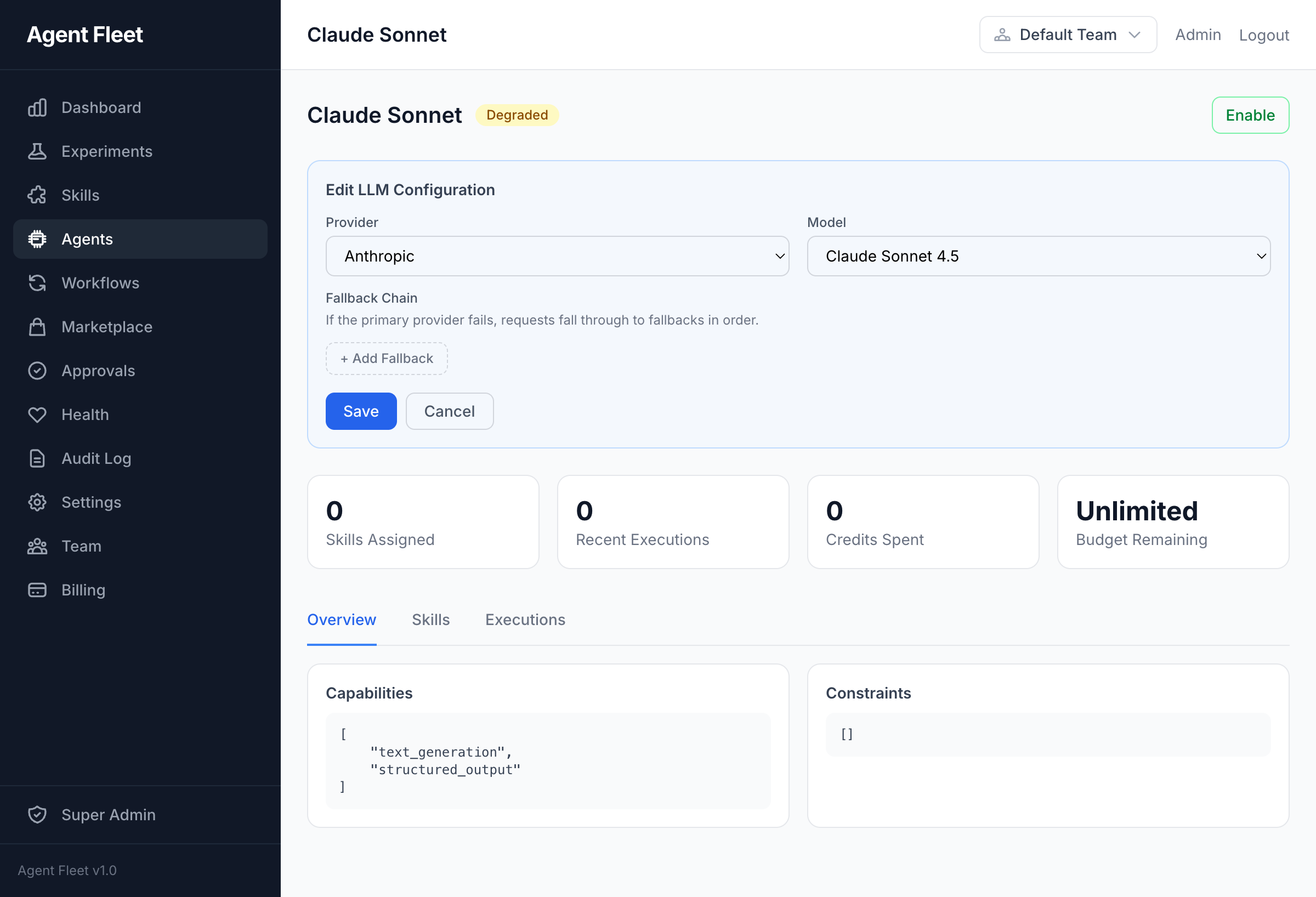
|
Agent Evolution 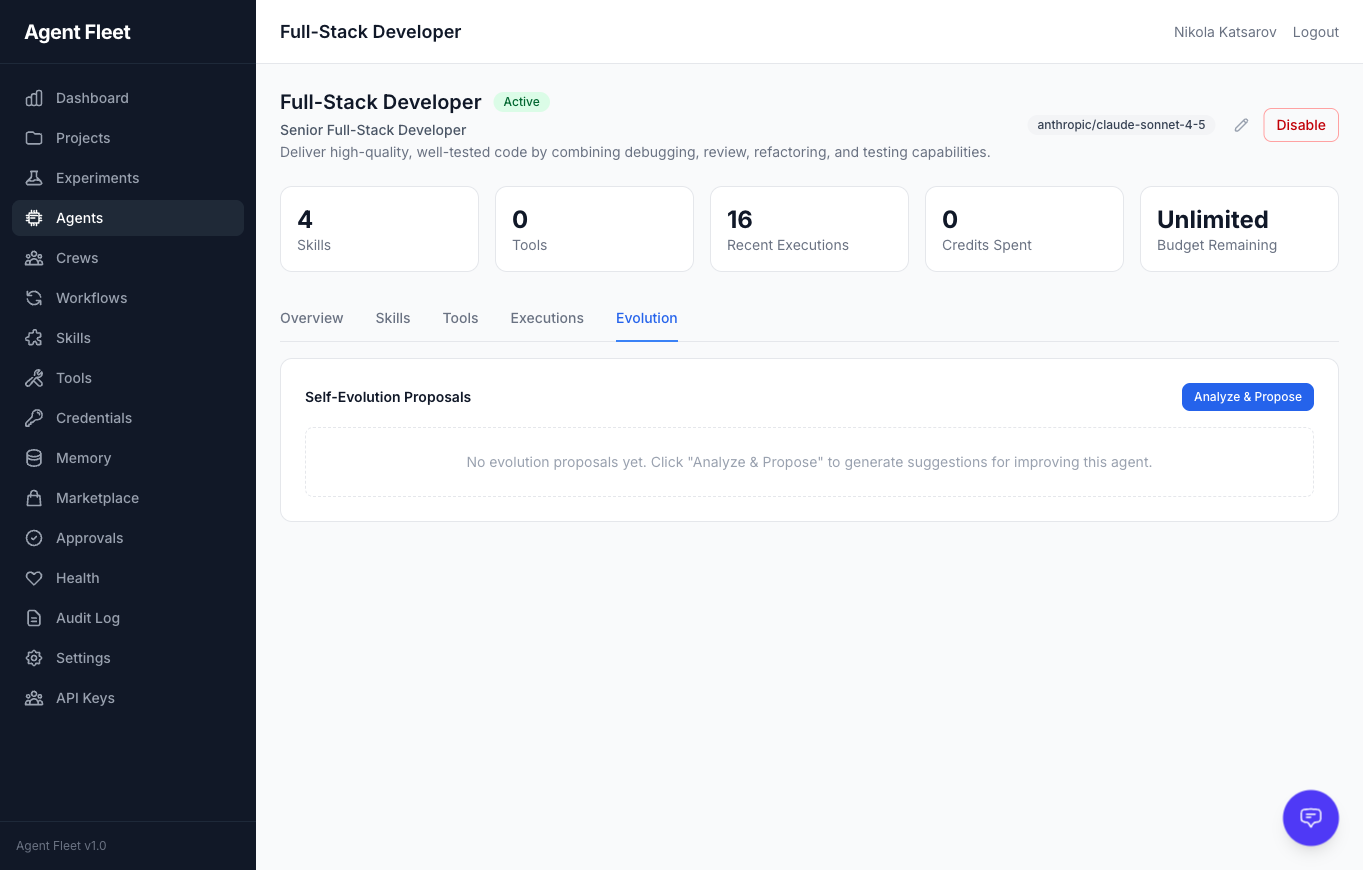
|
|
Crew Execution 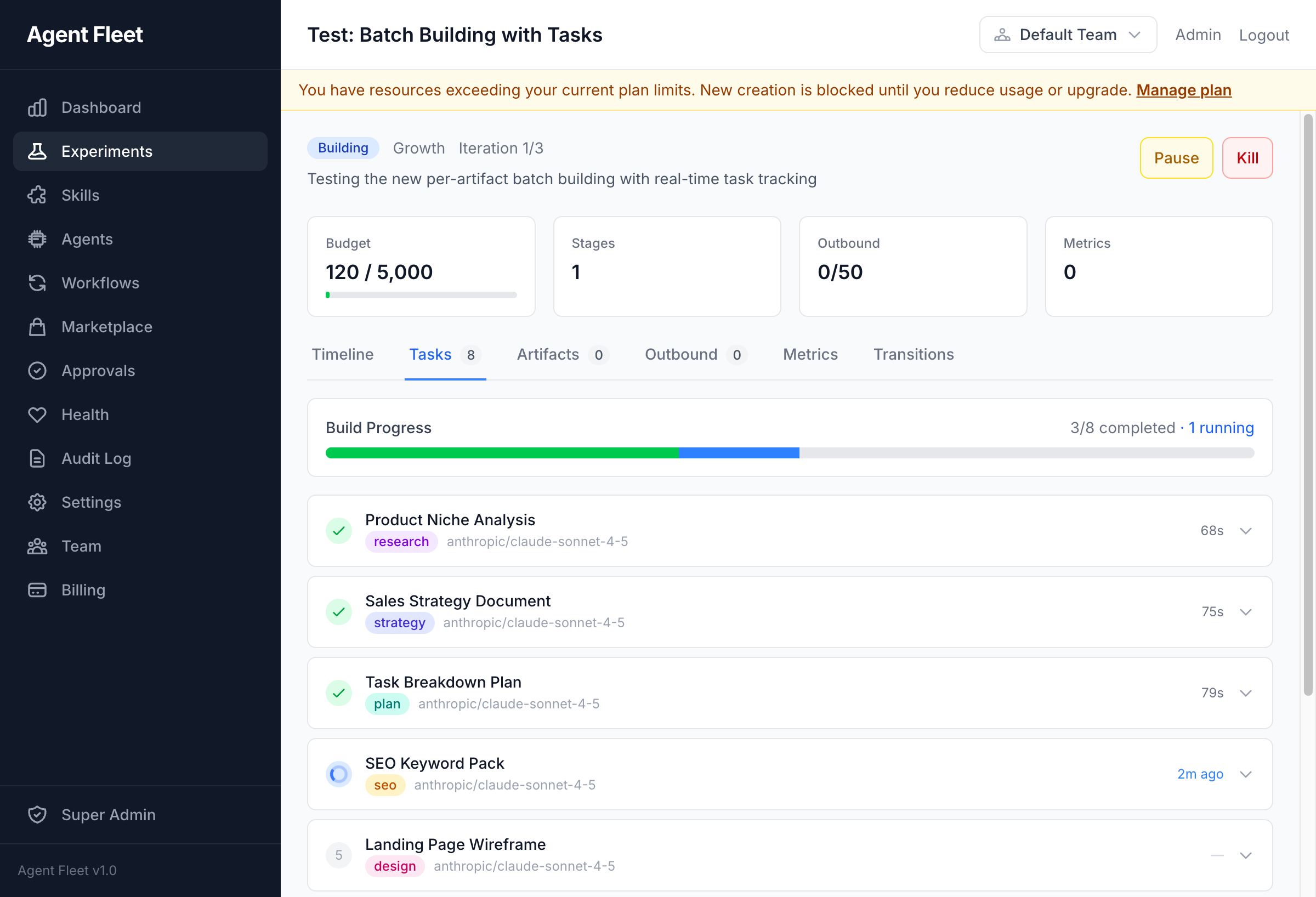
|
Task Output 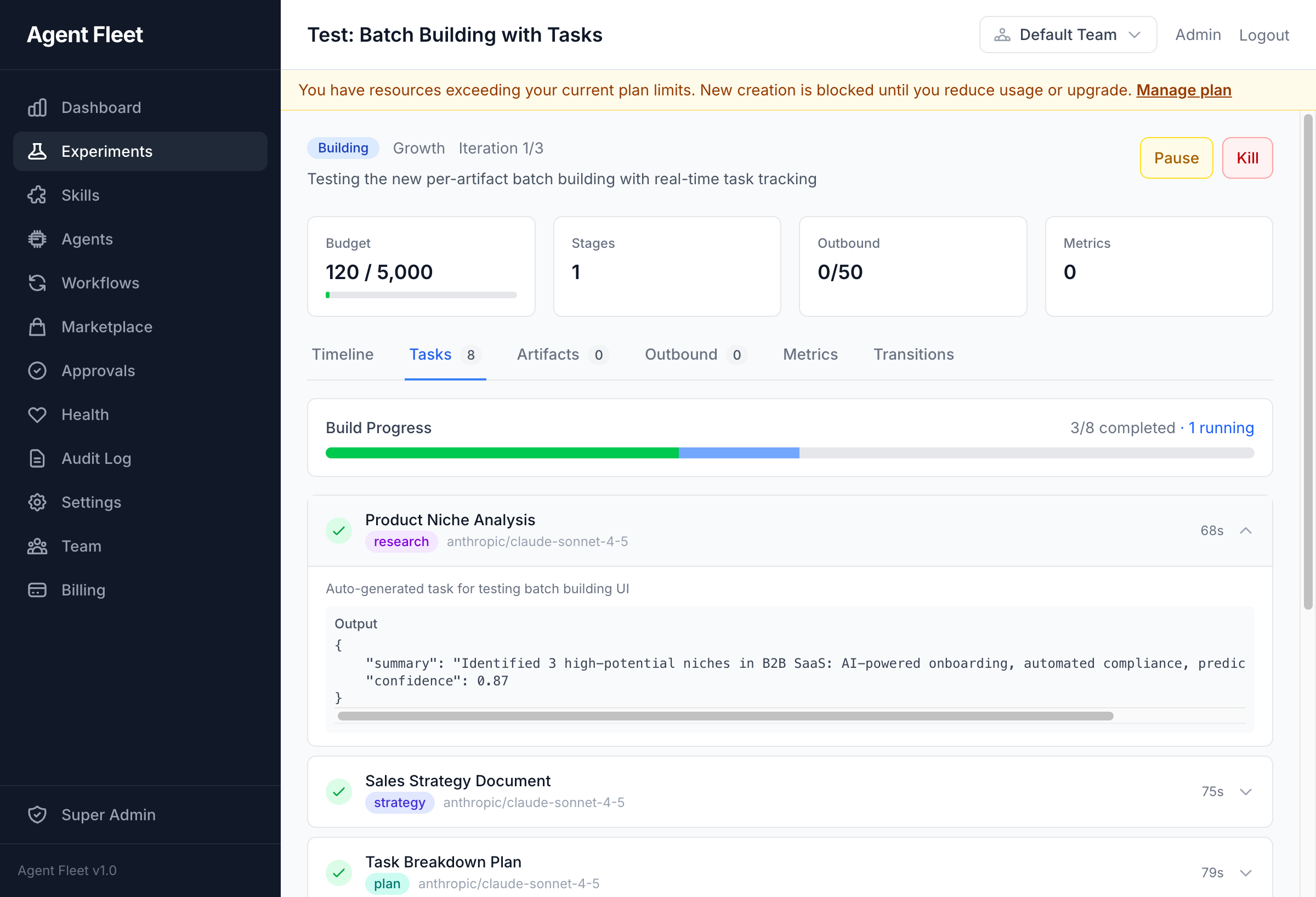
|
|
Visual Workflow Builder 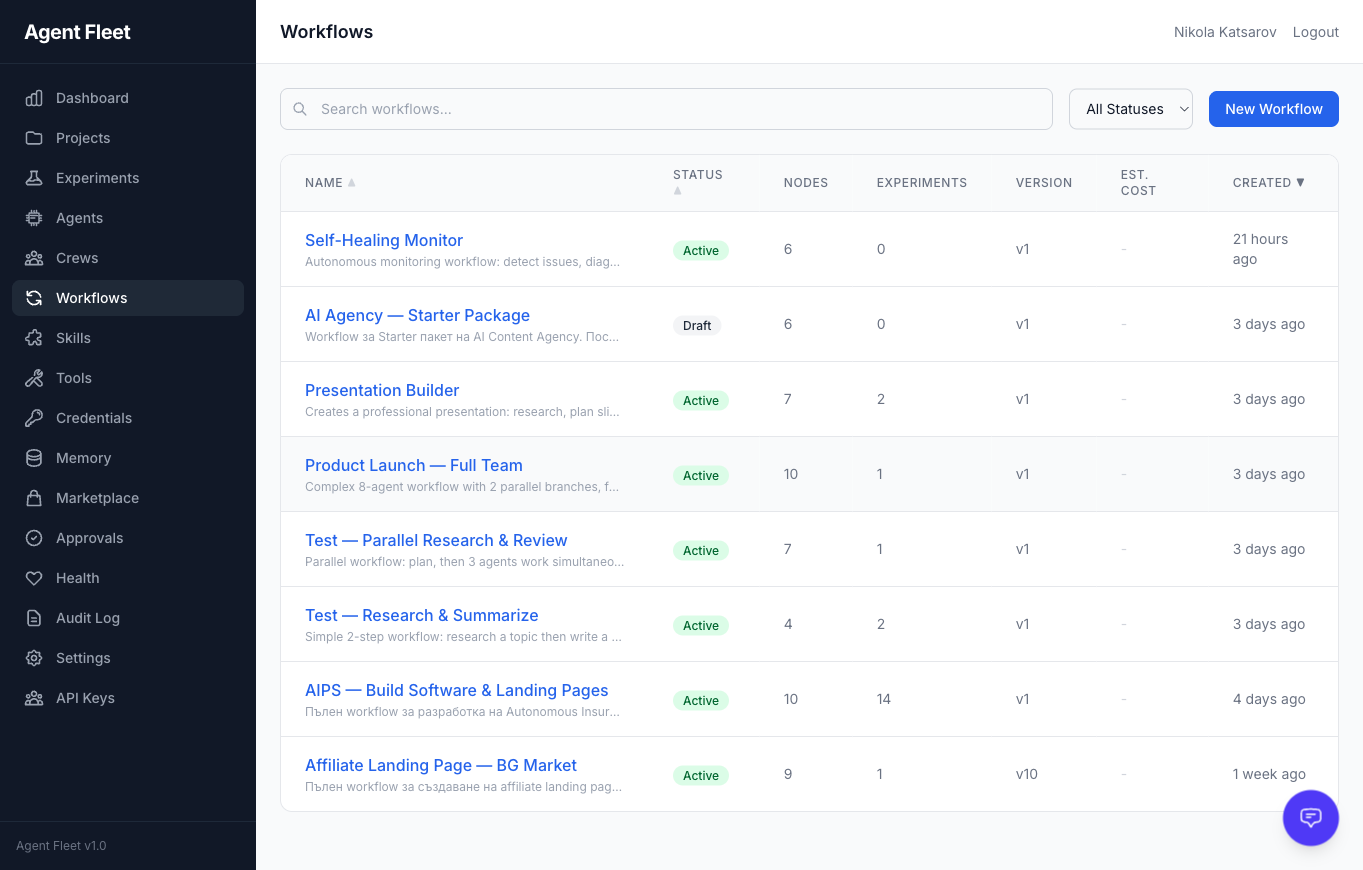
|
Tool Management 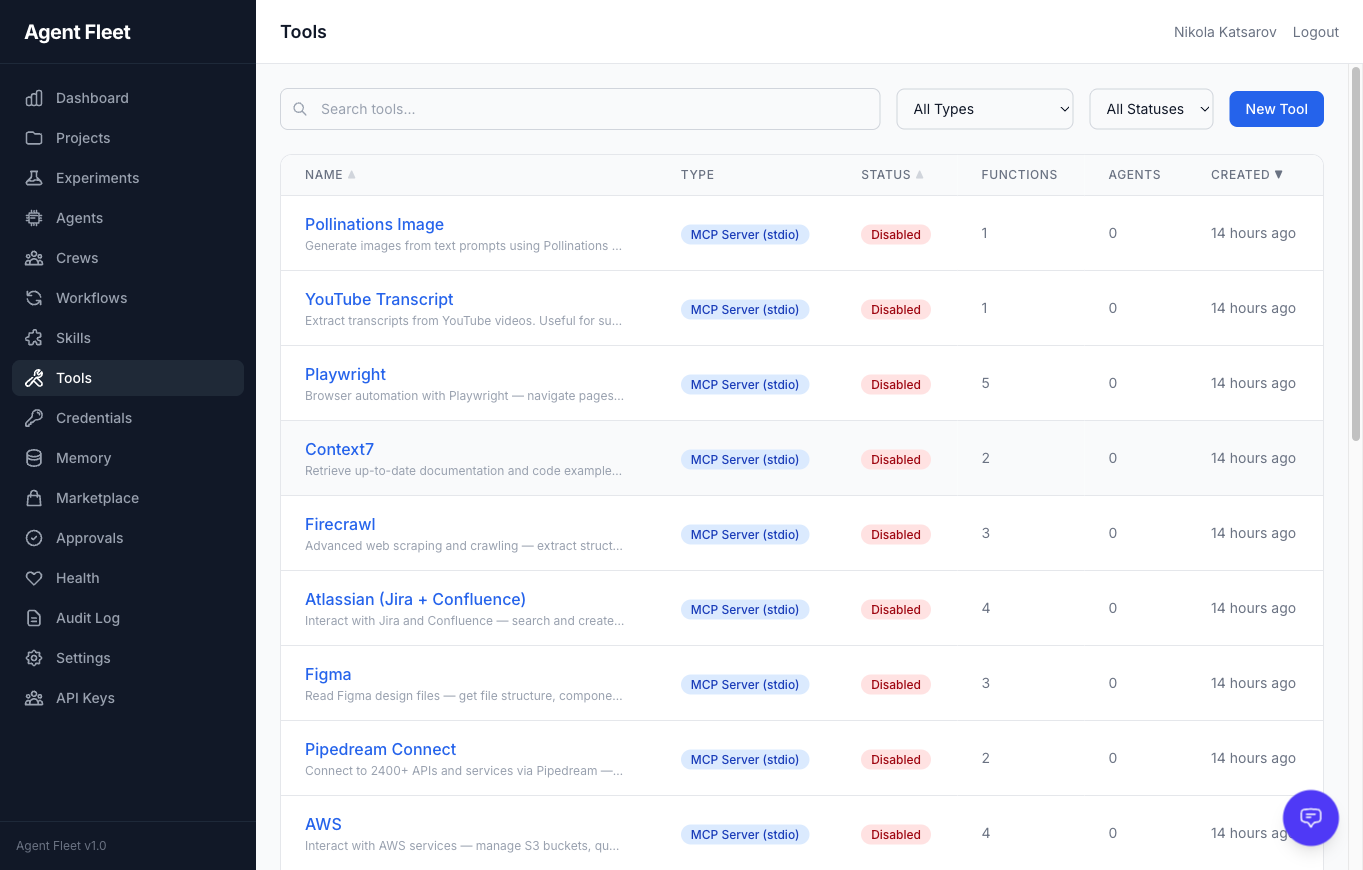
|
|
AI Assistant Sidebar 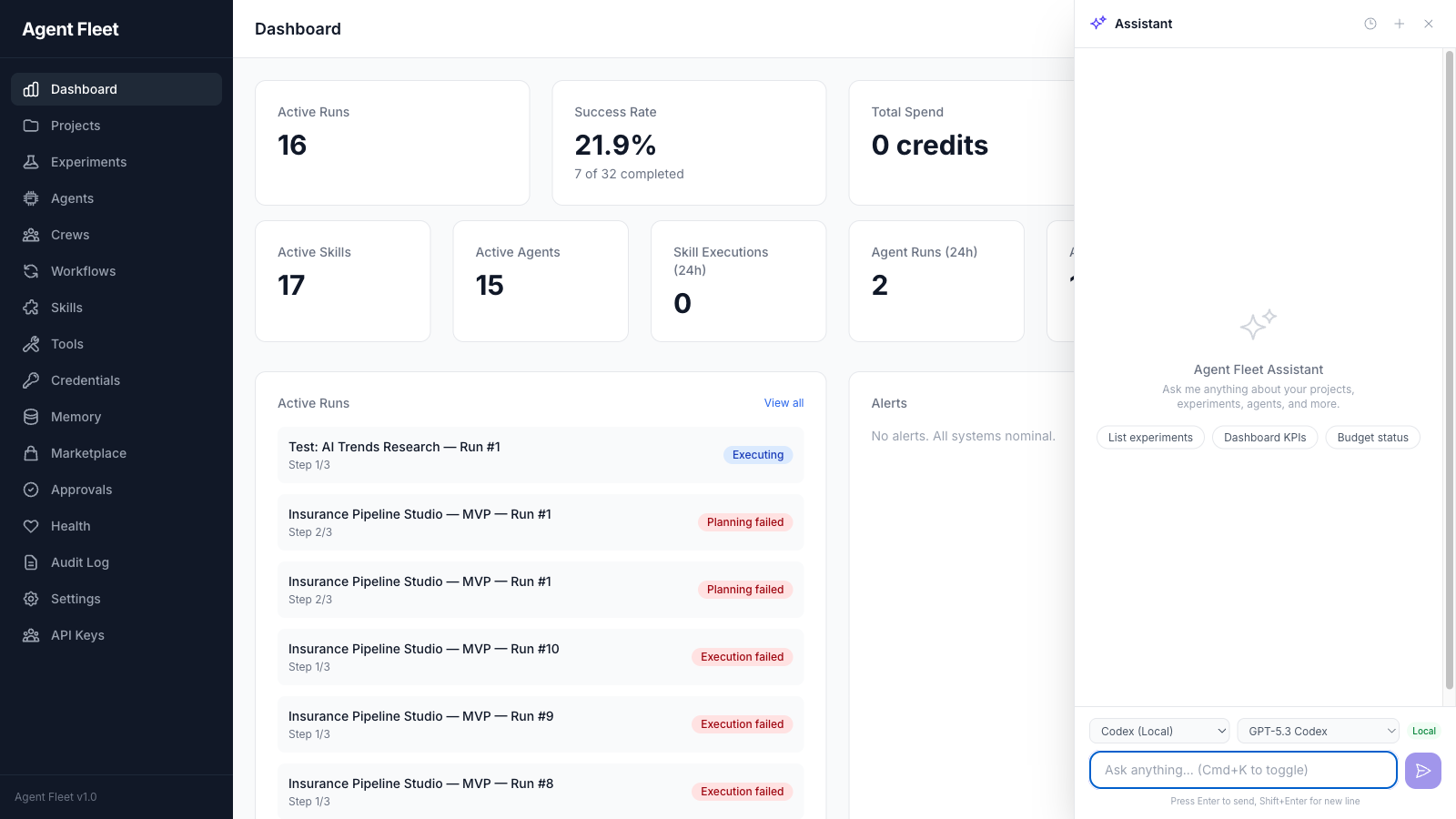
|
Experiment Detail 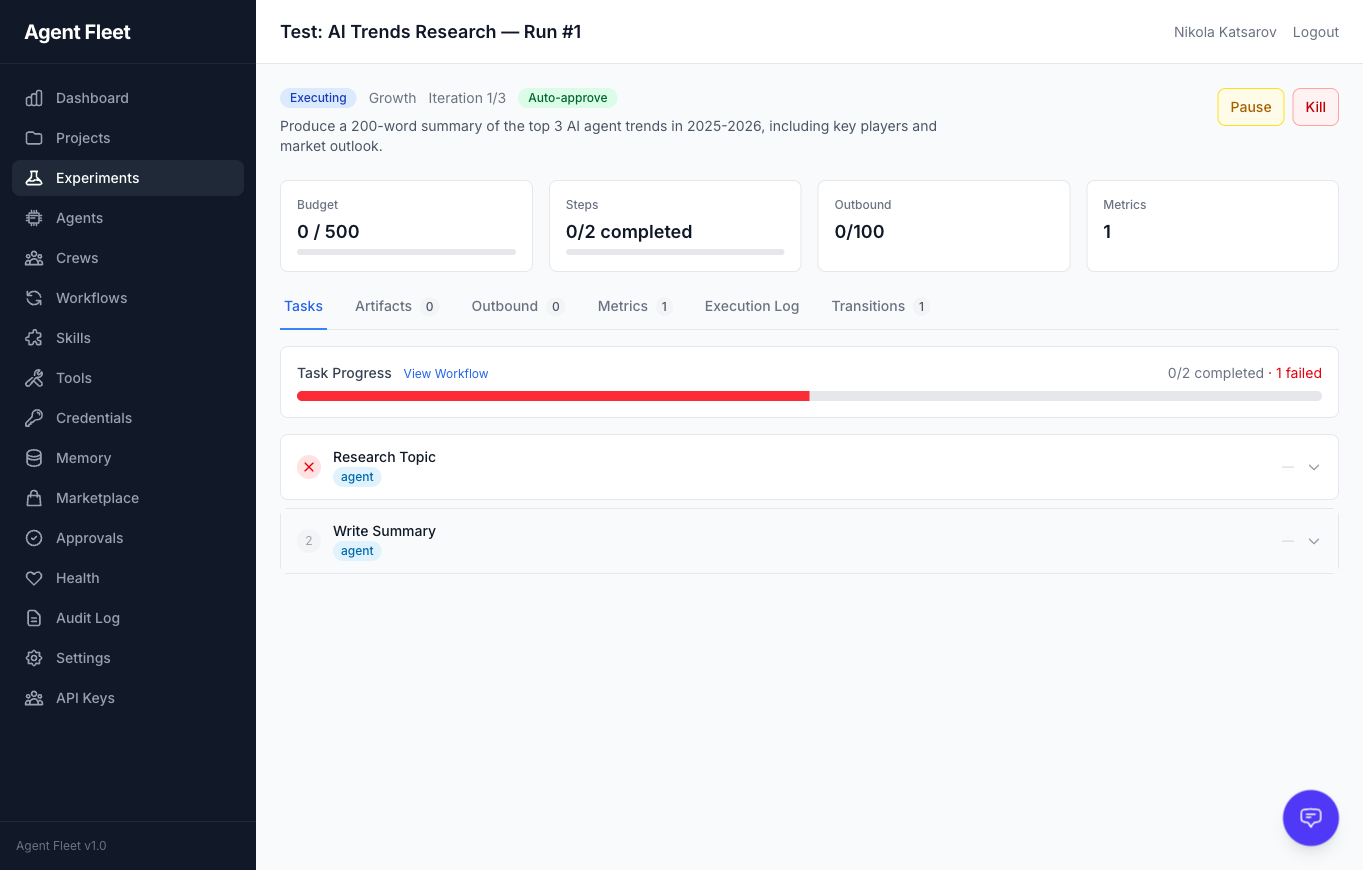
|
|
Settings & Webhooks 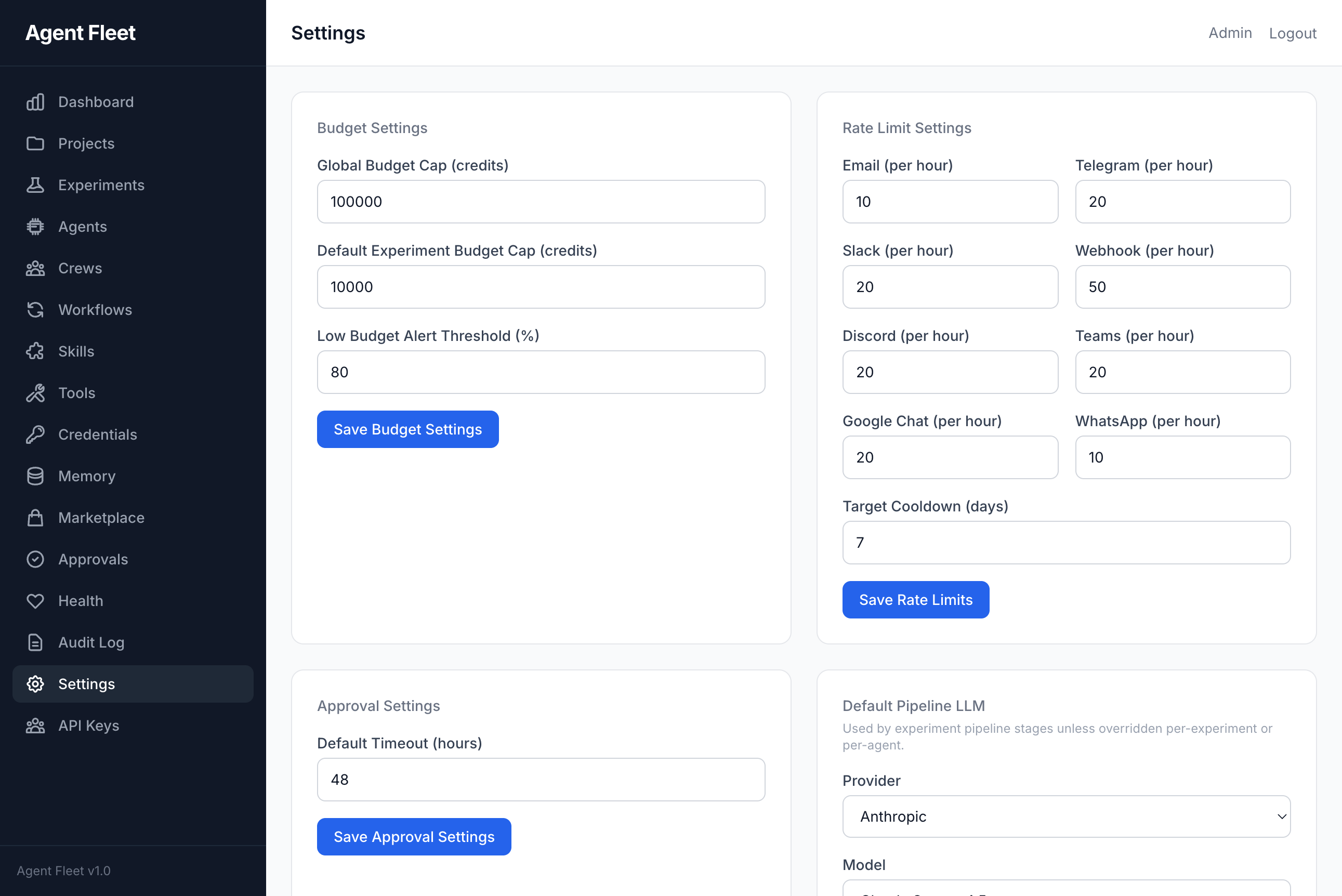
|
Error Handling 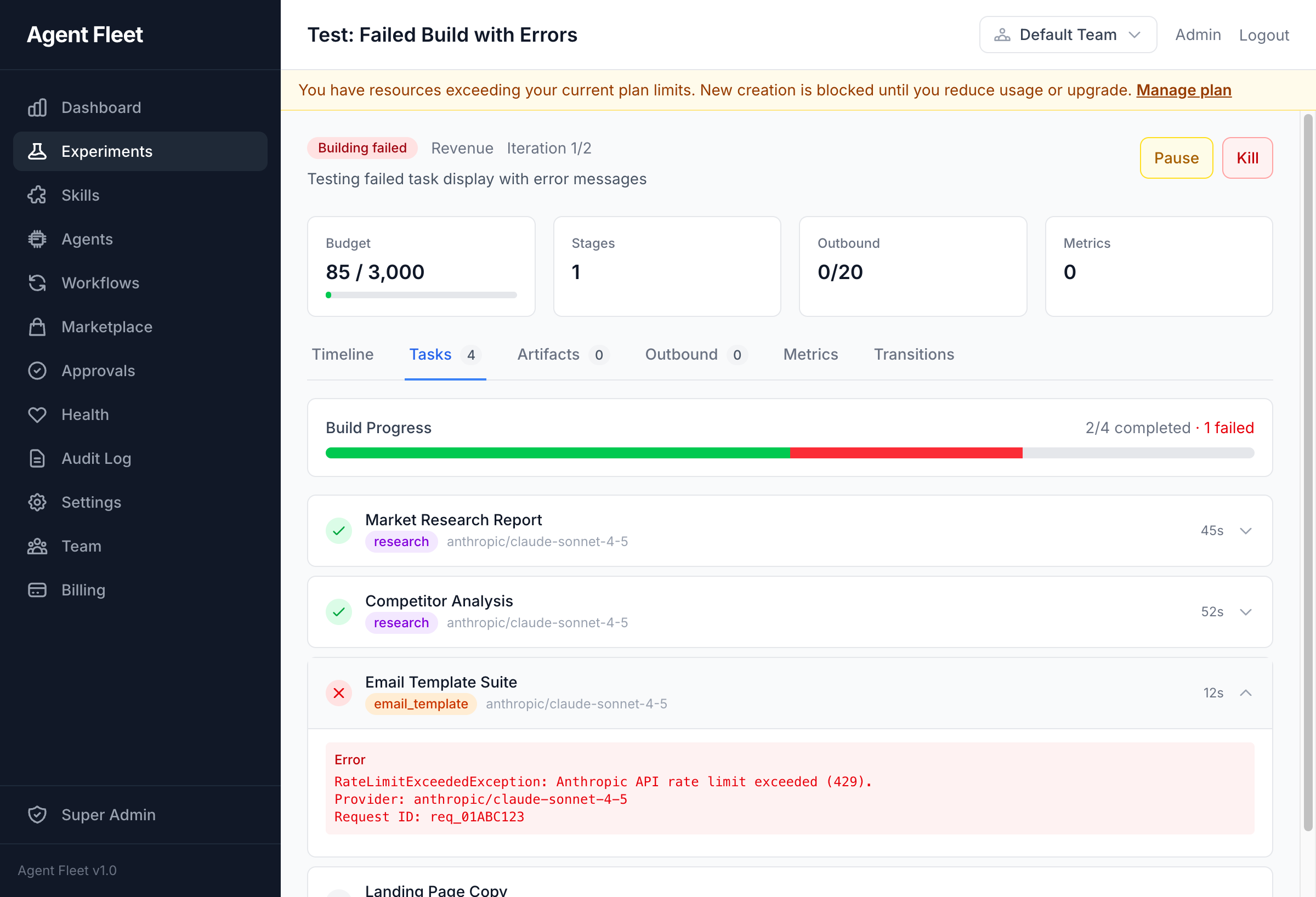
|
Features
Agents, crews, and workflows
- AI Agents — role, goal, backstory, personality traits, skill assignments, per-agent provider/model fallback chains
- Agent Templates — 14 pre-built templates across 5 categories (engineering, content, business, design, research)
- Agent Evolution — LLM analyzes execution history, proposes config changes, one-click approval
- Agent Crews — Multi-agent teams with coordinator/QA/worker roles, 7 process types (sequential, parallel, hierarchical, self-claim, adversarial, fanout, chat-room), weighted QA scoring
- Pre-Execution Scout Phase — cheap LLM pre-call identifies what knowledge the agent needs → targeted semantic search instead of generic recall
- Step Budget Awareness — agent system prompt targets 80% of allowed steps for core work, reserves the rest for synthesis
- Experiment Pipeline — 20-state machine with automatic stage progression (scoring → planning → building → approval → executing → metrics → evaluating)
- Visual Workflow DAG — 8 node types (agent, conditional, human-task, switch, dynamic-fork, do-while, compensation, sub-workflow). Pre-built Web Dev Cycle template. NL → workflow generator.
- Projects — one-shot and continuous projects with cron scheduling, budget caps, milestones, overlap policies
LLMs and compute
- BYOK — bring your own keys for Anthropic (Claude), OpenAI (GPT-4o), Google (Gemini)
- Local LLMs — Ollama, LM Studio, vLLM, llama.cpp via OpenAI-compatible endpoints; 17 preset Ollama models; SSRF protection
- Local Agents — Codex and Claude Code as execution backends (auto-detected, zero cost)
- Portkey Gateway — optional drop-in that unlocks 250+ LLM providers with semantic caching and fallbacks
- RunPod GPU Integration — invoke RunPod serverless endpoints or manage full GPU pod lifecycles as skills; BYOK API key; spot pricing
- Pluggable Compute Providers —
gpu_computeskills backed by RunPod, Replicate, Fal.ai, Vast.ai - AI Gateway — provider-agnostic via PrismPHP with 6-layer middleware (rate-limit, budget, idempotency, semantic-cache, schema-validation, usage-tracking), circuit breakers, fallback chains
- Semantic Cache — pgvector-backed cosine similarity (threshold 0.92) cross-team cache — cuts LLM spend on repeat prompts
Signals, triggers, outbound
- Signal connectors — 20+ drivers: webhook, RSS, IMAP, Slack, Discord, WhatsApp, GitHub, Linear, Jira, PagerDuty, Sentry, Datadog, ClearCue, Telegram, Matrix, Notion, Confluence, Screenpipe, Searxng, more
- Bug Report signals — lightweight QA pipeline with public JS widget, screenshot + console + network + action log capture, threaded comments (reporter + agent + support), agent delegation, SLA escalation
- Trigger rules — event-driven automation with condition evaluator, dry-run testing
- Multi-Channel Outbound — Email (SMTP), Telegram, Slack, Webhook, ntfy with rate limiting and blacklist
- Webhooks — inbound (HMAC-SHA256) + outbound (retry, event filtering)
Human-in-the-loop, budgets, security
- Approvals — inbox with SLA enforcement + escalation
- Human Tasks — embedded form schemas on workflow nodes
- Credit Ledger — per-experiment and per-project with pessimistic locking and auto-pause on overspend
- Credential Vault — encrypted external service credentials with rotation, OAuth2, expiry tracking, per-project injection
- SSH tools — TOFU (Trust On First Use) fingerprint verification, per-tool allowed-commands whitelist, multi-layer command security policy
- Audit Trail — full activity log (spatie/activitylog), searchable + filterable
- Tenant Isolation — multi-layer
TeamScope+BelongsToTeam+withoutGlobalScopes()discipline
Integrations & web dev pipeline
- Integrations — GitHub, Slack, Notion, Airtable, Linear, Stripe, Vercel, Netlify, generic webhook/polling with OAuth 2.0
- Autonomous Web Dev Pipeline — agents can open PRs, merge, dispatch CI workflows, create releases, trigger Vercel/Netlify/SSH deploys through MCP tools
- Website Builder — AI-generated static sites with 8 widget types, Vercel + ZIP deployment drivers, form submissions, blog/navigation/contact widgets
- Founder Mode pack — marketplace bundle of 6 persona agents (Strategist, Product Lead, Growth Hacker, Finance Advisor, Ops Manager, Risk Officer), 20 framework skills (RICE, SPIN, BANT, MEDDIC, OKRs, Shape Up, Unit Economics, Kano, TAM-SAM-SOM, K-Factor, NPV-IRR, RACI, A/B Testing, OWASP), 5 pre-built workflows
- Marketplace — browse, publish, install shared skills, agents, workflows, and bundles with AI risk scanning
API & MCP surface
- REST API — 175+ endpoints under
/api/v1/with Sanctum auth, cursor pagination, auto-generated OpenAPI 3.1 at/docs/api - MCP Server — 450+ Model Context Protocol tools across 45 domains (stdio + HTTP/SSE + OAuth2/PKCE)
- Structured MCP errors — canonical gRPC-style error codes (
UNAVAILABLE,PERMISSION_DENIED,RESOURCE_EXHAUSTED,DEADLINE_EXCEEDED,INVALID_ARGUMENT,FAILED_PRECONDITION,NOT_FOUND,INTERNAL) with retryable hints — agents know when to retry vs. fail fast - Per-tool deadlines — optional
deadline_msparameter on every MCP tool; agents can bound wall-clock time per call - OpenTelemetry tracing — OTLP HTTP exporter, Jaeger all-in-one via
docker compose --profile observability up, spans for MCP tool → AI gateway → LLM provider - Tool Management — MCP servers (stdio/HTTP), built-in tools (bash/filesystem/browser), risk classification, per-agent assignment
- MCP client compatibility — Claude Desktop, Claude.ai, ChatGPT Apps, Cursor, Codex, Claude Code, Gemini CLI, any OAuth2 client
Infrastructure
- Queue Management — Laravel Horizon with 6 priority queues and auto-scaling
- Testing — regression test suites for agent outputs with automated evaluation
- Per-Call Working Directory — local/bridge agents can operate in a configured working directory per-agent, isolated project contexts
Use Cases
FleetQ is built for teams running AI agents in production, not toy demos.
- Autonomous dev pipelines — agent opens PR → CI runs → reviewer agent approves → merge → deploy. Human approves only on risk signals.
- Customer support triage — bug report widget → agent extracts reproduction steps from console/network log → experiment runs → notifies reporter with fix or agent-generated workaround.
- Multi-agent research — crew of Strategist + Researcher + Writer with QA reviewer. Each step weighted by domain rubric.
- Scheduled content ops — continuous project runs daily, each run executes a DAG: draft → review → SEO-check → publish → schedule social.
- Incident response — PagerDuty/Sentry signal → trigger rule → diagnosis agent → human approval on runbook action → Slack notify.
- GPU workloads — agent calls
gpu_computeskill on RunPod serverless (Whisper, FLUX, Bark) as part of a larger workflow, with cost accounting. - Local-first agent dev — Ollama + Codex + Claude Code auto-detected, zero API cost for prototyping; switch to cloud providers for production.
- Bring FleetQ into Claude — expose your internal data + tools as MCP server, Claude Desktop/ChatGPT/Cursor can drive the platform programmatically.
How FleetQ compares
| FleetQ | n8n | CrewAI | LangGraph | Make.com | |
|---|---|---|---|---|---|
| Open source | ✅ AGPLv3 | ✅ Sustainable Use | ✅ MIT | ✅ MIT | ❌ Proprietary |
| Visual DAG builder | ✅ 8 node types | ✅ (not AI-first) | ❌ | ❌ | ✅ |
| Multi-agent crews | ✅ 7 process types | ❌ | ✅ | ✅ (build-your-own) | ❌ |
| MCP server (native) | ✅ 450+ tools | ❌ | ❌ | ❌ | ❌ |
| Human-in-the-loop | ✅ native | ⚠️ workaround | ⚠️ code | ⚠️ code | ⚠️ approve-node |
| Budget ledger + locks | ✅ pessimistic | ❌ | ❌ | ❌ | ❌ |
| Audit trail | ✅ every action | ✅ | ❌ | ❌ | ✅ |
| BYOK + local LLMs | ✅ both | ⚠️ BYOK only | ⚠️ depends | ⚠️ BYOK | ❌ |
| Self-hosted | ✅ Docker Compose | ✅ | n/a (library) | n/a (library) | ❌ |
| Agent evolution (self-improve) | ✅ | ❌ | ❌ | ❌ | ❌ |
| OpenTelemetry tracing | ✅ native | ❌ | ❌ | ⚠️ partial | ❌ |
| Credit/usage metering | ✅ per-team/project | ❌ | ❌ | ❌ | per-workspace |
TL;DR — if you're building production agent systems with LLMs and want visual workflows + MCP + human oversight, FleetQ is the only platform that bundles all of it.
Quick Start (Docker)
git clone https://github.com/escapeboy/agent-fleet-o.git
cd agent-fleet
make install
This will:
- Copy
.env.exampleto.env - Build and start all Docker services
- Run the interactive setup wizard (database, admin account, LLM provider)
Visit http://localhost:8080 when complete.
Quick Start (Manual — Web Setup)
Requirements: PHP 8.4+, PostgreSQL 17+, Redis 7+, Node.js 20+, Composer
git clone https://github.com/escapeboy/agent-fleet-o.git
cd agent-fleet
composer install
npm install && npm run build
cp .env.example .env
# Edit .env — set DB_HOST, DB_DATABASE, DB_USERNAME, DB_PASSWORD, REDIS_HOST
php artisan key:generate
php artisan migrate
php artisan horizon &
php artisan serve
Then open http://localhost:8000 in your browser. The setup page will guide you through creating your admin account.
Alternative: Run
php artisan app:installfor an interactive CLI setup wizard that also seeds default agents and skills.
Authentication
- No email verification — the self-hosted edition skips email verification entirely. Accounts are active immediately on registration.
- Single user — all registered users join the default workspace automatically.
No-Password Mode (local installs)
If you're running FleetQ locally on your own machine and don't want to enter a password on every visit, set APP_AUTH_BYPASS=true in .env:
APP_AUTH_BYPASS=true   # Auto-login as first user
APP_ENV=local          # Required — bypass is disabled in production
With bypass enabled, the app logs you in automatically on every request. A logout link is still shown but you'll be logged back in on the next page load — this is intentional.
Warning: Never set
APP_AUTH_BYPASS=trueon a server accessible from the internet.
Configuration
All configuration is in .env. Key variables:
# Database (PostgreSQL required)
DB_CONNECTION=pgsql
DB_HOST=postgres
DB_DATABASE=agent_fleet

# Redis (queues, cache, sessions, locks)
REDIS_HOST=redis
REDIS_DB=0          # Queues
REDIS_CACHE_DB=1    # Cache
REDIS_LOCK_DB=2     # Locks

# LLM Providers -- at least one required for AI features
ANTHROPIC_API_KEY=
OPENAI_API_KEY=
GOOGLE_AI_API_KEY=

# Auth bypass -- local no-password mode (never use in production)
APP_AUTH_BYPASS=false
Additional LLM keys can be configured in Settings > AI Provider Keys after login.
To use local models (Ollama, LM Studio, vLLM):
LOCAL_LLM_ENABLED=true
LOCAL_LLM_SSRF_PROTECTION=false  # set false if Ollama is on a LAN IP (192.168.x.x)
LOCAL_LLM_TIMEOUT=180
Then configure endpoints in Settings > Local LLM Endpoints.
SSH Host Access
Agents can execute commands on the host machine (or any remote server) via SSH using the built-in SSH tool type. This is useful for running local scripts, interacting with the filesystem, or orchestrating host-level processes from an agent.
How it works
- The platform stores SSH private keys encrypted in the Credential vault.
- An SSH Tool is configured with
host,port,username,credential_id, and an optionalallowed_commandswhitelist. - On the first connection to a host, the server's public key fingerprint is stored via TOFU (Trust On First Use). Subsequent connections verify the fingerprint — a mismatch raises an error to prevent MITM attacks.
- Manage trusted fingerprints via Settings > SSH Fingerprints or the
tool_ssh_fingerprintsMCP tool.
Setup (Docker — connecting container to host)
The containers reach the host machine via host.docker.internal, which is pre-configured in docker-compose.yml via extra_hosts: host.docker.internal:host-gateway.
Step 1 — Enable SSH on the host
| OS | Command |
|---|---|
| macOS | System Settings → General → Sharing → Remote Login → On |
| Ubuntu/Debian | sudo apt install openssh-server && sudo systemctl enable --now ssh |
| Fedora/RHEL | sudo dnf install openssh-server && sudo systemctl enable --now sshd |
| Windows | Settings → System → Optional Features → OpenSSH Server, then Start-Service sshd |
Step 2 — Generate an SSH key pair
ssh-keygen -t ed25519 -C "fleetq-agent@local" -f ~/.ssh/fleetq_agent_key -N ""
Step 3 — Authorize the key on the host
cat ~/.ssh/fleetq_agent_key.pub >> ~/.ssh/authorized_keys
chmod 600 ~/.ssh/authorized_keys
Step 4 — Create a Credential in FleetQ
Navigate to Credentials → New Credential:
- Type:
SSH Key - Paste the contents of
~/.ssh/fleetq_agent_key(private key)
Or via API:
curl -X POST http://localhost:8080/api/v1/credentials \
  -H "Authorization: Bearer $TOKEN" \
  -H "Content-Type: application/json" \
  -d '{
    "name": "Host SSH Key",
    "credential_type": "ssh_key",
    "secret_data": {"private_key": "<contents of fleetq_agent_key>"}
  }'
Step 5 — Create an SSH Tool
Navigate to Tools → New Tool → Built-in → SSH Remote, or via API:
curl -X POST http://localhost:8080/api/v1/tools \
  -H "Authorization: Bearer $TOKEN" \
  -H "Content-Type: application/json" \
  -d '{
    "name": "Host SSH",
    "type": "built_in",
    "risk_level": "destructive",
    "transport_config": {
      "kind": "ssh",
      "host": "host.docker.internal",
      "port": 22,
      "username": "your-username",
      "credential_id": "<credential-id>",
      "allowed_commands": ["ls", "pwd", "whoami", "uname", "date", "df"]
    },
    "settings": {"timeout": 30}
  }'
Step 6 — Assign the tool to an agent
In the Agent detail page, go to Tools and assign the SSH tool. The agent will now have an ssh_execute function available during execution.
Command security policy
The platform enforces a multi-layer security hierarchy for bash and SSH commands:
- Platform-level — always blocked:
rm -rf /,mkfs,shutdown,reboot, pipe-to-shell patterns - Organization-level — configure in Settings → Security Policy or via the
tool_bash_policyMCP tool - Tool-level —
allowed_commandswhitelist in the tool's transport config - Project-level — additional restrictions in project settings
- Agent-level — per-agent overrides on the tool pivot
More restrictive layers always win. A command blocked at the platform level cannot be unblocked by any other layer.
SSH fingerprint management
Trusted host fingerprints are viewable and removable via:
- API:
GET /api/v1/ssh-fingerprints/DELETE /api/v1/ssh-fingerprints/{id} - MCP:
tool_ssh_fingerprintswithlistordeleteaction
Remove a fingerprint when a host's SSH key is legitimately rotated — the next connection will re-verify via TOFU.
Architecture
Built with Laravel 12, Livewire 4, and Tailwind CSS. Domain-driven design with 33 bounded contexts — table below shows the 17 primary domains:
| Domain | Purpose |
|---|---|
| Agent | AI agent configs, execution, personality, evolution |
| Crew | Multi-agent teams with lead/member roles |
| Experiment | Pipeline, state machine, playbooks |
| Signal | Inbound data ingestion |
| Outbound | Multi-channel delivery |
| Approval | Human-in-the-loop reviews and human tasks |
| Budget | Credit ledger, cost enforcement |
| Metrics | Measurement, revenue attribution |
| Audit | Activity logging |
| Skill | Reusable AI skill definitions |
| Tool | MCP servers, built-in tools, risk classification |
| Credential | Encrypted external service credentials |
| Workflow | Visual DAG builder, graph executor |
| Project | Continuous/one-shot projects, scheduling |
| Assistant | Context-aware AI chat with 28 tools |
| Marketplace | Skill/agent/workflow sharing |
| Integration | External service connectors (GitHub, Slack, Notion, Airtable, Linear, Stripe, Generic) |
Docker Services
| Service | Purpose | Port |
|---|---|---|
| app | PHP 8.4-fpm | -- |
| nginx | Web server | 8080 |
| postgres | PostgreSQL 17 | 5432 |
| redis | Cache/Queue/Sessions | 6379 |
| horizon | Queue workers | -- |
| scheduler | Cron jobs | -- |
| vite | Frontend dev server | 5173 |
Common Commands
make start          # Start services
make stop           # Stop services
make logs           # Tail logs
make update         # Pull latest + migrate
make test           # Run tests
make shell          # Open app container shell
Or with Docker Compose directly:
docker compose exec app php artisan tinker       # REPL
docker compose exec app php artisan test          # Run tests
docker compose exec app php artisan migrate       # Run migrations
Upgrading
make update
This pulls the latest code, rebuilds containers, runs migrations, and clears caches.
Tech Stack
- Framework: Laravel 12 (PHP 8.4)
- Database: PostgreSQL 17
- Cache/Queue: Redis 7
- Frontend: Livewire 4 + Tailwind CSS 4 + Alpine.js
- AI Gateway: PrismPHP
- Queue: Laravel Horizon
- Auth: Laravel Fortify (2FA) + Sanctum (API tokens)
- Audit: spatie/laravel-activitylog
- API Docs: dedoc/scramble (OpenAPI 3.1)
- MCP: laravel/mcp (Model Context Protocol)
Contributing
Contributions are welcome. Please open an issue first to discuss proposed changes.
- Fork the repository
- Create a feature branch (
git checkout -b feat/my-feature) - Make your changes and add tests
- Run
php artisan testto verify - Submit a pull request
See CONTRIBUTING.md for coding conventions, commit style, and PR checklist.
Community & Support
- Issues — Bug reports + feature requests
- Discussions — Ask a question or share what you built
- Changelog — What changed in each release
- Cloud version — fleetq.net (free tier, no credit card)
Star History
If FleetQ saves you time, a ⭐ helps others find it. GitHub ranks repos by star velocity.
License
FleetQ Community Edition is open-source software licensed under the GNU Affero General Public License v3.0.
TL;DR of AGPLv3: You can self-host, modify, and run FleetQ for free — including commercial use. If you offer FleetQ as a hosted service to others, you must open-source your modifications. Questions? See our AGPLv3 FAQ.
Reviews (0)
Sign in to leave a review.
Leave a reviewNo results found