claude-code-growth-os
Health Warn
- License — License: MIT
- Description — Repository has a description
- Active repo — Last push 0 days ago
- Low visibility — Only 6 GitHub stars
Code Pass
- Code scan — Scanned 11 files during light audit, no dangerous patterns found
Permissions Pass
- Permissions — No dangerous permissions requested
No AI report is available for this listing yet.
Claude Code Growth Operating System (OS): Sales, Marketing, Product and Retention as one Revenue system
Claude Code Growth OS
Run your whole go-to-market inside Claude Code — not just your code.



In one sentence: Claude Code Growth OS is an open-source, MIT-licensed scaffold that turns Claude Code into a go-to-market operating environment — plain-text playbooks, daily rituals (morning briefing, follow-ups, end-of-day), guardrail hooks, and skill templates spanning all four growth functions (marketing, sales, product, and retention) — so your whole revenue motion runs from one git-tracked repo instead of living in your head.
Most people ask Claude Code to write code. You can also run your go-to-market in it: let it read your plain-text playbooks, run your daily rituals (the morning briefing, follow-ups, lead qualification, content) and reach your tools, so the whole motion runs from one place. Because everything is markdown in git, your sales & marketing system gets a diff, a history, and a blame view, and it stops living in your head.
Most sales & marketing skill packs just generate copy. This runs the operating day around it (qualify, prep, follow up, post) and keeps it all in git.
This repo is the scaffolding: opinionated hooks, daily rituals, a set of go-to-market skill templates spanning all four functions, and a worked example you can run in 30 seconds. Bring your own playbooks — the structure is here.
Why one repo for the whole motion? The buyer merged it — they research, buy, adopt, and renew as one relationship, and most of a B2B decision happens before sales is even in the room. Running marketing, sales, product, and retention as four separate systems is what creates the seams the buyer feels — and leaves the most valuable half, what happens after the sale, with no owner. This kit keeps all four in one place: one source of truth (the repo), two feedback loops (a MARKETING-ACTION line for sales→marketing, a RETENTION-RISK line for post-sale→product), shared definitions. The one-page argument, with sources, is in docs/why-align.md.
See it run in 30 seconds
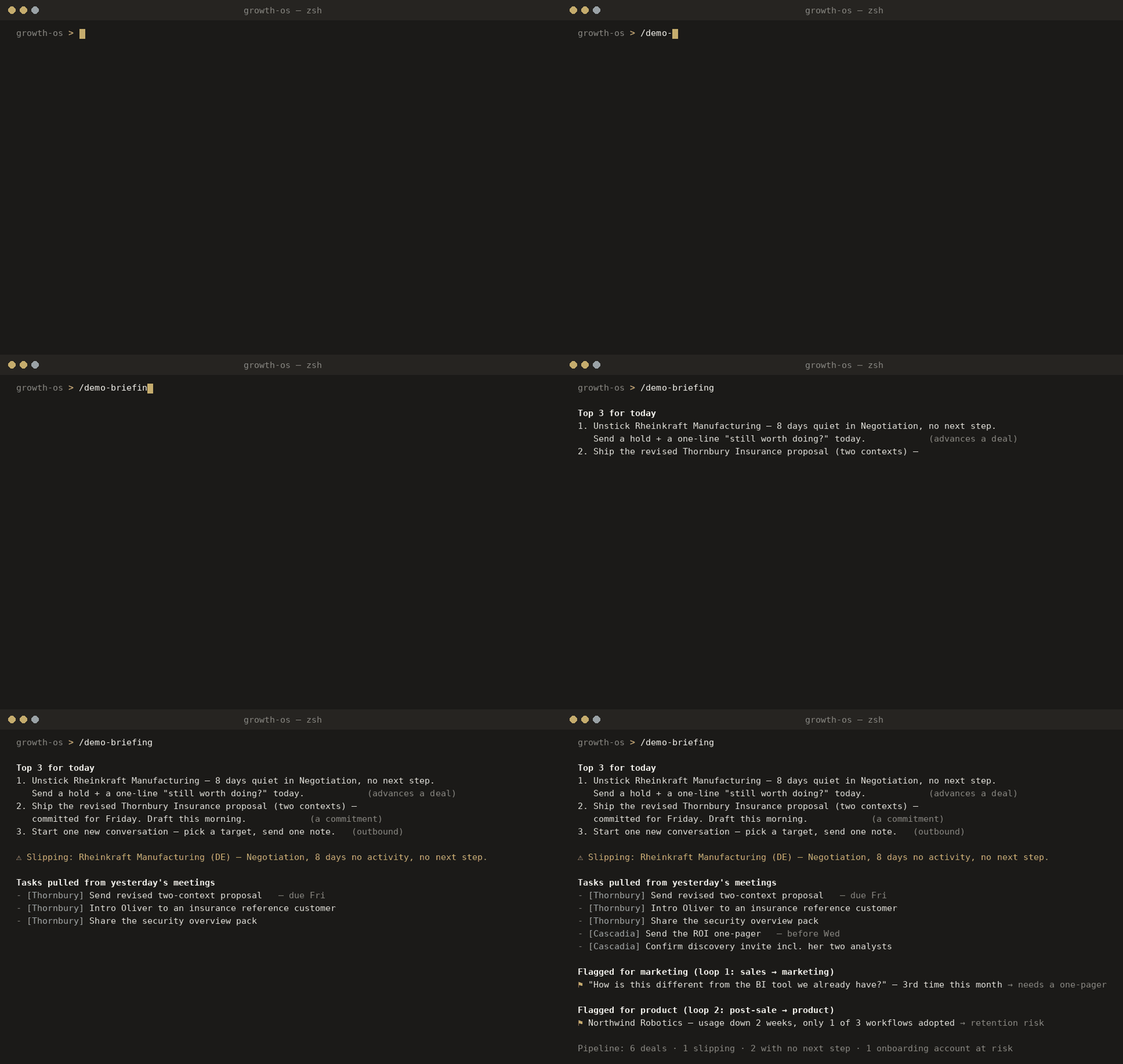
Clone, open in Claude Code, and run /demo-briefing. It runs the whole morning ritual against the fictional sample data in demo/:
Top 3 for today
1. Unstick Rheinkraft Manufacturing — 8 days quiet in Negotiation, no next step.
   Send a hold + a one-line "still worth doing?" today.            (advances a deal)
2. Ship the revised Thornbury Insurance proposal (two contexts) —
   committed for Friday. Draft this morning.                       (a commitment)
3. Start one new conversation — pick a target, send one note.      (outbound)

⚠ Slipping: Rheinkraft Manufacturing (DE) — Negotiation, 8 days no activity, no next step.

Tasks pulled from yesterday's meetings
- [Thornbury] Send revised two-context proposal           — due Fri
- [Thornbury] Intro Oliver to an insurance reference customer
- [Thornbury] Share the security overview pack
- [Cascadia] Send the ROI one-pager                       — before Wed
- [Cascadia] Confirm discovery invite incl. her two analysts

Flagged for marketing (loop 1: sales → marketing)
⚑ "How is this different from the BI tool we already have?" — 3rd time this month → needs a one-pager

Flagged for product (loop 2: post-sale → product)
⚑ Northwind Robotics — usage down 2 weeks, only 1 of 3 workflows adopted → retention risk

Pipeline: 6 deals · 1 slipping · 2 with no next step · 1 onboarding account at risk
Nothing there is real — delete demo/ whenever you like.
What's inside
| Piece | What it is |
|---|---|
.claude/hooks/ |
Five guardrails: session-start context, state re-injection across compaction, a commit secret-guard, sensitive-file protection, an end-of-day nudge |
.claude/commands/ |
Daily rituals you invoke by name: /morning-briefing, /midday-checkin, /end-of-day, /weekly-review, plus /demo-briefing |
.claude/skills/ |
Skill templates grouped by the four growth functions (see below) — so the balance across marketing, sales, product, and retention is visible, not acquisition-only |
ops/ |
Your plain-text playbooks — priorities.md, daily-log.md, pipeline.md (left side), customers.md and roadmap-signals.md (right side). Start here. |
demo/ |
A fictional pipeline and customer book so you can see the whole motion work (and present from it safely) |
docs/operating-model.md |
The spine: the bowtie, the four functions, the six handoffs (H1–H6), the one number (net revenue retention), and the three shared definitions |
docs/methodology.md |
The idea in full: Claude Code as an operating environment |
docs/why-align.md |
The one-page argument: why your whole go-to-market (marketing, sales, product, retention) runs as one system (with sources) |
docs/connecting-a-crm.md |
Optional: make an existing CRM the source of truth and project it into ops/pipeline.md — don't run two pipelines |
Skills by function — the motion is balanced across the bowtie, not just acquisition:
| Function | Skills |
|---|---|
| Marketing / Demand | content-repurpose, marketing-feedback (sales→marketing loop) |
| Sales | lead-qualify, meeting-prep, follow-up, cold-outreach |
| Product | product-signal (routes field + retention signals to the roadmap; writes the buyer-facing line for anything shipped) |
| Retention | onboarding-handoff (Won→onboarding), account-health (adoption, renewal motion, churn/expansion), retention-feedback (post-sale→product loop) |
| Cross-cutting | status-update, triage |
How it fits together
One loop, all plain text in git:
- Open a session → the SessionStart hook surfaces today's priorities.
/morning-briefingreads your priorities, yesterday's log, and your pipeline → today's top three.- Through the day, the skills work on your own data, on both sides of the bowtie. Left side:
lead-qualifya new opportunity,meeting-prepbefore a call,follow-upafter it,cold-outreachto a prospect,content-repurposea win into posts,marketing-feedbackto turn a recurring objection into a note marketing acts on. Right side:onboarding-handoffwhen a deal is won (carry the value hypothesis across the seam),account-healthto score adoption and start the renewal motion at day 60,product-signalto route retention and field signals to the roadmap, andretention-feedbackto turn an adoption slip into a signal product acts on. /end-of-daylogs what shipped and sets tomorrow;/weekly-reviewfinds the patterns across both sides — renewals due, accounts at risk, expansion candidates, and the top roadmap signals.- The hooks hold it together — your state survives a long session (
pre-compact), and nothing secret slips into a commit (pre-commit-guard).
The left side lives in ops/pipeline.md; the right side in ops/customers.md (the post-sale account book) and ops/roadmap-signals.md (product's triage queue). Priorities and notes round it out — all yours, with a fictional copy in demo/. Edit the markdown, commit, and your whole go-to-market has a history. The handoffs that connect the four functions are mapped in docs/operating-model.md.
Quickstart
- Clone and open in Claude Code. The SessionStart hook surfaces
ops/priorities.mdimmediately. - Run
/demo-briefingto see the loop on sample data. - Edit
ops/priorities.mdwith your own, run/morning-briefing, and commit. That's the loop. - Install the commit secret-guard once:
ln -s ../../.claude/hooks/pre-commit-guard.sh .git/hooks/pre-commit
The hooks earn their place
pre-compact.shre-injects your priorities and latest log when a long session compacts — your state lives in files, so the context window can't lose the thread.pre-commit-guard.shblocks a commit if staged changes look like they contain a secret (API keys, private keys, tokens).protect-files.shstops the agent writing to.env, keys, and credentials.session-start.shandstop-reminder.shopen and close the day.
All pure bash (one uses python3 to read a payload). No API keys, no MCP — it runs anywhere out of the box.
Make it yours
ops/— one file per area. Don't port your whole life on day one; pick the ritual you dread most and make it real..claude/commands/— a ritual is just a markdown prompt. Copy one and tweak it — write your first in 5 minutes..claude/skills/— a repeatable job, triggered by itsdescription. Copy one of the included skills as a pattern.- Connect your tools — copy
.mcp.json.example→.mcp.json(gitignored) to add MCP servers (calendar, notes, issue tracker, CRM), and put any keys in.claude/settings.local.json(copy.claude/settings.local.example.json). Your commands and skills can then reach them. If a CRM is your system of record,docs/connecting-a-crm.mdshows how to project it intoops/pipeline.mdinstead of running two pipelines.
Portability
The .claude/skills/ and .claude/commands/ are plain markdown on the Agent Skills spec, so they port to Cursor, Windsurf, and Codex with little change. The hooks/ and settings.json are Claude-Code-specific — they won't carry over, and that's fine; the rituals and skills are the part worth taking elsewhere.
What's deliberately not here
No real playbooks, positioning, pricing, or data. That's the point: the structure is reproducible; the judgment you put inside it is the part that's yours. Fill one drawer this week.
What's free vs. what's paid
This is open core. The chassis is free and MIT-licensed; the part that took twenty-two years isn't in the box.
| Free — this repo (MIT) | Paid — built & run for you |
|---|---|
| The chassis: hooks, daily rituals, and go-to-market skill templates across all four functions, plus a 30-second runnable demo. Bring your own playbooks. | Your customized, populated operating system, with your best tools integrated, alongside real playbooks, positioning, pricing, ICP — plus the wider automation layer (n8n: vendor management, ICP checks, pre- and post-meeting briefings and follow-ups) as well as Blackbird.io for multilingual content processes. Built and run for you, or run by a growth operator who works this way. |
The repo is the skeleton; the judgment you put inside it is the product → langoptima.com/features/growth.
Who's behind this
I'm Edwin Trebels — I run our company's entire go-to-market on a setup like this, and help clients run theirs. This repo is the open skeleton. The full version adds the wider automation layer (n8n handling vendor management, ICP checks, pre-meeting briefings, post-meeting debriefs and follow-ups, and the assistant that keeps the day straight; Blackbird.io for multilingual content), plus the judgment that fills the empty drawers. That part took twenty-two years and doesn't come in a folder.
Want it built and run for you, or a growth operator who works this way? That's what I do: langoptima.com/features/growth. The thinking behind the kit is in docs/methodology.md.
If it's useful, a ⭐ helps others find it. PRs welcome — see CONTRIBUTING.md. MIT licensed.
Reviews (0)
Sign in to leave a review.
Leave a reviewNo results found