Argyph
Health Warn
- License — License: Apache-2.0
- Description — Repository has a description
- Active repo — Last push 0 days ago
- Low visibility — Only 6 GitHub stars
Code Warn
- process.env — Environment variable access in .github/workflows/release.yml
- fs module — File system access in .github/workflows/release.yml
Permissions Pass
- Permissions — No dangerous permissions requested
No AI report is available for this listing yet.
Local-first MCP server giving AI coding agents fast, structured, and semantic context over any codebase. Zero config, zero cloud, full context.






One MCP server. Fast, structured, and semantic context over any codebase — entirely on your machine.
Install · Quick start · How it works · Tools · Architecture · Roadmap
Argyph is a single MCP server that gives any AI coding agent fast, structured, and semantic context over a codebase. It runs entirely on your machine, indexes incrementally, and is ready in under a second on previously-indexed repos.
The name is a portmanteau of Argus (the hundred-eyed watcher of Greek myth) and Glyph (a carved symbol with bound meaning) — a server that watches a codebase and gives the agent its symbols.
✦ What it does
Argyph replaces the half-dozen MCP servers most developers stitch together — one for grep, one for embeddings, one for symbol search, one for repo packing — with a single tool. It exposes three pillars of context behind one MCP endpoint:
| Pillar | What you get |
|---|---|
| 🧭 Ask-first retrieval | ask is the primary agent-facing lookup tool. It routes bare identifiers to symbol search, structured locators to locate, and natural-language questions to hybrid search — returning bounded Span results instead of whole files. |
| 🔗 File & symbol intelligence | A tree-sitter-driven symbol graph with find_definition, find_references, callers, callees, imports, and outline tools. Structural queries return in milliseconds. |
| 🧠 Semantic search | Hybrid (BM25 + vector) search over AST-aware chunks, backed by an embedded LanceDB store. A bundled local embedding model means no API key is required for full functionality. |
| 📦 Repo packing | Token-budgeted, repomix-style flattening of a repo or subset for agents that need to absorb a codebase quickly. |
Why local-first?[!NOTE]
Everything is read-only. Argyph never edits, commits, or executes code.
Most existing context servers depend on a cloud vector database (Milvus, Pinecone) and a remote embedding API. That's a non-starter for proprietary code at most companies, and a tax on cold starts everywhere else.
Argyph runs entirely on the developer's machine: a single binary, an embedded vector store, an optional bundled embedding model — no daemon, no account, no key required to get full functionality.
⬇ Install
Current release:
v1.0.4— published on npm, crates.io, the Homebrew tap, and as prebuilt GitHub-release binaries.
Claude Code (recommended):
claude mcp add argyph -- npx argyph@latest
npm / npx:
npx argyph
Homebrew (macOS / Linux)
brew install Ezzy1630/argyph/argyph
Universal installer
curl -fsSL https://raw.githubusercontent.com/Ezzy1630/argyph/main/scripts/install.sh | bash
Intel Mac (
x86_64-apple-darwin) users: the ONNX Runtime backend
doesn't ship a prebuilt for Intel macOS, so no prebuilt binary is
produced for that target. Use the Cargo path below — it builds
in a couple of minutes and works fine on Intel Macs.
Cargo
cargo install argyph builds Argyph from source. Requires a Rust
toolchain ≥ 1.88 (rustup update). The bundled local embedder usesort (ONNX Runtime); on most
platforms ort ships a prebuilt dynamic library and there is nothing
to do. On Linux you may need libssl-dev and a working C toolchain;
on Windows the MSVC build tools are required. If the build fails onort-sys linkage, set ORT_STRATEGY=download before re-running.
cargo install argyph --locked
Build from source
git clone https://github.com/Ezzy1630/argyph.git
cd argyph
cargo build --release
./target/release/argyph serve
Claude Desktop (DXT)
Download argyph.dxt from the latest release and double-click.
⚡ Quick start
# In any repo
cd ~/code/your-repo
argyph init
claude mcp add argyph -- npx argyph@latest
claude
In the chat:
What does this codebase do, and where is session expiration controlled?
Argyph indexes Tier 0 in under a second on first run, Tier 1 (symbol graph) in seconds, and Tier 2 (embeddings) in the background. You can query immediately — tools return what's available now plus an index_coverage field so the agent knows.
⚙ How it works
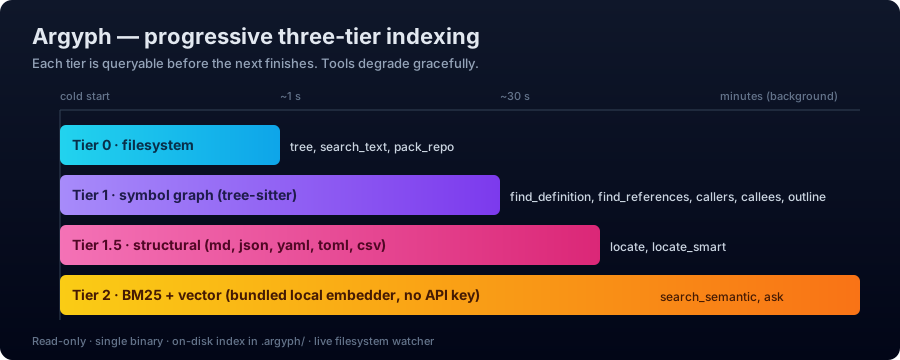
Argyph builds the index in three tiers, each useful before the next completes:
| Tier | What it builds | Time on a 1M-LOC repo | Useful for |
|---|---|---|---|
| 0 | File inventory, hashes, .gitignore-aware tree | <1 s | Tree views, ripgrep, packing |
| 1 | Symbol graph (defs, refs, calls, imports) | ~30 s | Go-to-def, find-references, call graphs |
| 1.5 | Structural index (non-code: md, json, yaml…) | seconds (after Tier 1) | locate for structured non-code files |
| 2 | Embeddings + hybrid index | minutes (background) | Fuzzy semantic queries |
The 80/20 insight: most agent queries are structural (where is parseConfig defined?, what calls validateUser?) and don't need embeddings. Argyph serves those from Tier 1 in milliseconds, even while Tier 2 is still building.
After the first index, the on-disk .argyph/ directory persists and only changed files are reprocessed on subsequent runs. A filesystem watcher keeps everything live.
🧰 Tools
19 tools across 4 tiers| Tool | Description | Tier required |
|---|---|---|
ask |
Primary lookup router returning bounded spans | 0/1/1.5/2 |
get_index_status |
Tier readiness, embedding progress, watcher state | 0 |
get_repo_overview |
Languages, entry points, README excerpt, tree | 0 |
search_text |
Ripgrep-style regex / literal search | 0 |
find_definition |
Locate the definition of a named symbol | 1 |
find_references |
Reference sites with surrounding context | 1 |
get_callers |
Functions that call a given function | 1 |
get_callees |
Functions a given function calls | 1 |
get_imports |
Imports of a file, and files that import it | 1 |
get_symbol_outline |
Hierarchical outline of a file | 1 |
search_semantic |
Hybrid BM25 + vector over AST-aware chunks | 2 |
pack_repo |
Token-budgeted repo flattening (XML or markdown) | 0+1 |
locate |
Smallest natural span containing the target | 1.5 |
locate_smart |
Retrieval subagent (opt-in; needs provider config) | 1.5 |
expand_span |
Expand one truncated span from a session handle | 0 |
memory_save |
Persist a memory entry under a scope | 0 |
memory_search |
FTS5 search over persistent memories | 0 |
memory_list |
List memories in a scope | 0 |
memory_forget |
Delete a memory entry by id | 0 |
Full schema reference: docs/tools-reference.md.
Optional:locate_smart — retrieval subagent
locate_smart is an opt-in tool that runs a bounded multi-step retrieval loop using an LLM provider. It's disabled by default; enable it in .argyph/config.toml:
[locate_smart]
enabled  = true
provider = "openai"        # or "anthropic" | "ollama"
model    = "gpt-4o-mini"
# endpoint = "http://localhost:11434"   # only for local providers
Or via env:
ARGYPH_LOCATE_SMART_ENABLED=1
ARGYPH_LOCATE_SMART_PROVIDER=anthropic
ARGYPH_LOCATE_SMART_MODEL=claude-haiku-4-5
When disabled, calls to locate_smart return LOCATE_SMART_DISABLED immediately and no provider keys are required.
Build with the smart feature:
cargo install argyph --features smart
Config is layered (highest priority first): env vars, .argyph/config.toml in the repo, built-in defaults. A config file is never required.
ARGYPH_LOG=info
ARGYPH_EMBED_PROVIDER=local        # local | openai | voyage
OPENAI_API_KEY=...                 # standard provider env vars
ARGYPH_DISABLE_WATCHER=true        # for sandboxed environments
Install agent lookup instructions in CLAUDE.md, AGENTS.md, or GEMINI.md:
argyph init
🆚 Why Argyph (vs alternatives)
| Tool | Symbol graph | Semantic search | Local-first | Single install | Incremental |
|---|---|---|---|---|---|
| claude-context (Zilliz) | — | ✅ | — | ✅ | ✅ |
| GitNexus / CodeGraphContext | ✅ | — | — | — | — |
| repomix | — | — | ✅ | ✅ | — |
| Serena | ✅ | — | ✅ | ✅ | — |
| Argyph | ✅ | ✅ | ✅ | ✅ | ✅ |
📊 Benchmarks
Reproducible numbers, methodology in docs/benchmarks.md. Reproduce locally with cargo bench --workspace. Numbers below are the median of three runs on the reference hardware tagged m3-pro (Apple M3 Pro, 36 GB RAM, macOS 15) unless stated otherwise.
| Fixture | Files | LOC | Tier 0 cold | Tier 1 full |
|---|---|---|---|---|
BurntSushi/ripgrep |
215 | ~52K | 71 ms | 6.8 s |
microsoft/TypeScript (src/) |
709 | ~452K | 30 ms | 8.2 s |
microsoft/TypeScript (whole repo) |
81,310 | ~2M | 2.1 s | see note ↓ |
Hot paths (criterion, mean times)
| Bench | Mean | What it measures |
|---|---|---|
locate_parse_path_bare |
~15 ns | Parsing a bare path locator |
locate_parse_path_heading |
~18 ns | Parsing path > Heading locators |
locate_strategy_path_only |
~19 ns | Strategy dispatch for path-only locator |
locate_strategy_scoped |
~32 ns | Strategy dispatch for scoped query locator |
token_count_rust_file |
~4.4 µs | cl100k_base tokenization of one source file |
walk_project_root |
~244 ms | Full walkdir traversal of this repo |
System-level
Reproduce via:
cargo run --release -p argyph-benches --bin system_bench -- /path/to/repo
Tier 0 — the "useful immediately" gate — scales linearly and fast
(81K files in 2.1 s). search_text and pack_repo are available the
moment Tier 0 is ready.
Tier 1 (the symbol graph) is fast on normal-to-large repos. Two
optimizations landed for v1.0: the within-file reference resolver was
rewritten from an O(symbols²) substring scan to one-pass hash-indexed
lookups (4.2× — TypeScript compiler source: 34.6 s → 8.2 s), and the
per-file symbol/chunk SQL writes are now batched. On very large
monorepos (the full 81K-file TypeScript repo, ~2M LOC) Tier 1 still
does not finish within 30 min — the residual cost is raw tree-sitter
parse volume across 79K files, which needs streaming/parallel indexing
(tracked in ROADMAP.md). The server never blocks at any
scale: Tier-1 tools return INDEX_NOT_READY with a retry hint until
the graph is ready. Full data: docs/benchmarks.md.
🏗 Architecture
Argyph is a Rust workspace of twelve focused crates with strict module ownership. The full architecture — including the Supervisor lifecycle, the three-tier indexing model, and per-crate responsibility boundaries — is documented in ARCHITECTURE.md.
📦 Project status
Stable. v1.0.x is published on all channels. Active development continues against the milestones at the top of ROADMAP.md; the build plan is in docs/BUILD_PLAN.md.
🤝 Contributing
Argyph is built with substantial AI assistance, but human-architected and human-reviewed. Contribution guide and the (strict) AI agent rules are in CONTRIBUTING.md. Commit conventions, including the project's attribution policy, are in docs/COMMIT_CONVENTIONS.md.
👤 Author
Built by Ezzy1630. See AUTHORS.md.
📄 License
Dual-licensed under either of:
- MIT License (LICENSE-MIT)
- Apache License 2.0 (LICENSE-APACHE)
at your option.
Reviews (0)
Sign in to leave a review.
Leave a reviewNo results found