claudux
Health Warn
- License — License: MIT
- Description — Repository has a description
- Active repo — Last push 0 days ago
- Low visibility — Only 5 GitHub stars
Code Warn
- fs module — File system access in .github/workflows/ci.yml
- process.env — Environment variable access in docs/.vitepress/config.ts
Permissions Pass
- Permissions — No dangerous permissions requested
No AI report is available for this listing yet.
Keep your docs true to your code. Deterministic, no-AI CI gate that fails your build when docs drift from the code they describe — plus VitePress generation via Claude or Codex.






claudux
Your build fails the moment a doc starts lying.
You changed a function. A doc three folders away now describes code that no longer exists. Nothing told you, and the next reader trusts it. claudux catches that in CI and fails the build the moment a doc falls behind the code it describes.
Why this exists
Anyone can generate docs now. Models do it for free, so "AI wrote my docs" proves nothing. The problem starts a week later. You ship a change, and every doc that described the old behavior quietly goes wrong. No test fails. No reviewer notices. The lie sits there until someone acts on it.
Increasingly that someone is an agent. It reads your API doc to decide how to call you, trusts it, and writes a plan on top of it. A wrong doc isn't a nuisance anymore. It's a confident lie an agent ships.
Think of the drift baseline as a package-lock for your docs: committed to the repo, checked on every build. Generating the docs is table stakes. Proving they still match is the hard part.
See it catch a lie
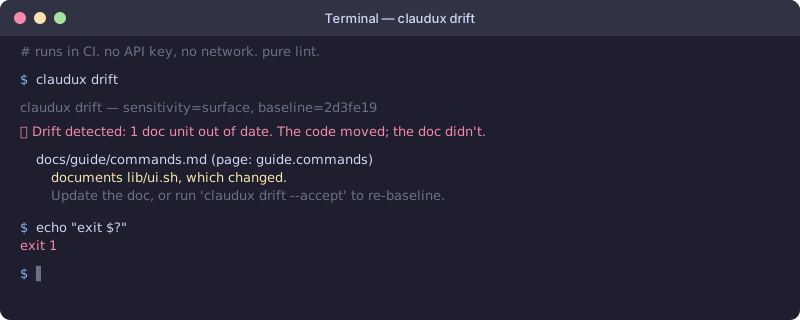
That is the same commit that made the doc wrong. The build is red before anyone merges it.
How claudux compares
| claudux | TypeDoc / JSDoc | Docusaurus | Manual docs | |
|---|---|---|---|---|
| Staleness check | claudux drift fails CI, keyless |
None | None | None |
| Input | Source code, existing docs, optional manifest | Type annotations and comments | Hand-written docs | Hand-written docs |
| Output | VitePress site | API reference | Static docs site | Any format |
| Maintenance | Re-run claudux update |
Rebuild on code change | Edit by hand | Edit by hand |
| AI backend | Claude or Codex CLI | None | None by default | None |
| Link validation | Built in | Generator-specific | Build-time | Manual |
| Structure guardrails | Manifest, pinned sections, bounded patches | No | Config-owned navigation | Manual review |
The staleness-check row is the whole argument. Everything else is table stakes.
Install
Run the drift gate. It ships in source (1.2.0). npm still serves 1.1.1, which has no claudux drift, so install from source until the 1.2.0 publish lands:
npm i -g firstbitelabsllc/claudux
# or: git clone https://github.com/firstbitelabsllc/claudux.git && cd claudux && npm link
Generate docs. The generator is on npm today:
npm install -g claudux
Requirements: Node 18+. Generation needs an authenticated Claude CLI (default) or Codex CLI on the machine; there is no hosted API key path. The drift gate needs neither. It is keyless and runs offline.
Quick start
cd your-project

claudux update   # generate or update the VitePress docs
claudux serve    # preview the site locally
claudux drift    # fail if a documented function changed but its doc didn't
Commit the baseline once with claudux drift --accept, then let CI run the drift gate on every push. (drift needs the source install above until 1.2.0 is on npm.)
The drift gate
This is the part nothing else does. The drift gate catches a stale doc on the commit that made it stale, not from a reader three weeks later.
It is deterministic: parse, hash, compare, exit code. No API key, no network, no model on the pass/fail path, so it runs offline in CI and never flakes. The manifest (docs-structure.json) already records which source each doc section describes. claudux drift reads a committed baseline (docs-drift-lock.json) and fails when a covered source moved while its doc stood still. When it flags drift it names the doc, the source that changed, and the fix.
claudux drift             # human report, exit 1 on drift (the CI gate)
claudux drift --json      # machine-readable report for tooling
claudux drift --warn-only # exit 0 even when drift is found (local pre-commit advisory)
claudux drift --accept    # re-baseline after you update the docs (no AI)
Exit 0 means clean or no baseline yet. Exit 1 means drift. Exit 2 means an error.
Commit the baseline once with claudux drift --accept, then drop this in .github/workflows/docs-drift.yml:
name: Docs drift
on: [push, pull_request]
jobs:
  drift:
    runs-on: ubuntu-latest
    steps:
      - uses: actions/checkout@v4
      - uses: actions/setup-node@v4
        with: { node-version: 18 }
      - run: npm i -g firstbitelabsllc/claudux   # source install until 1.2.0 is on npm; then: npx claudux drift
      - run: claudux drift
No secrets. The check is pure lint.
Locally, run it as a warning instead of a gate. Save this as .git/hooks/pre-commit and make it executable:
#!/bin/sh
claudux drift --warn-only
--warn-only always exits 0. You see the report on the commit that caused the drift, and the commit still goes through. CI stays the hard gate.
A sensitivity knob (drift_sensitivity) sets how much churn counts as drift. significant (default) ignores comment, blank, and whitespace churn and fires on renamed flags, changed defaults, and changed logic. raw hashes the whole file. surface (shell repos) tracks only exported function and command names.
What else it does
Generation. claudux update drafts a full VitePress docs site straight from your code, so you start from a real draft instead of an empty docs/ folder. It uses your authenticated Claude CLI by default (Sonnet); set CLAUDUX_BACKEND=codex for the Codex CLI (gpt-5.4). It is not an API-reference generator, so pair it with TypeDoc or JSDoc if you need one. Model output can be wrong; link checks and manifests shrink the blast radius, they do not replace review.
Audit. claudux audit prints a no-AI readiness snapshot: project detection, manifest validity, link status, checkpoint freshness, changed files since checkpoint, and uncommitted docs or config. --json makes it machine-readable for CI and agent handoffs.
Deterministic manifest mode. A committed docs-structure.json owns page structure and declares which source files each doc section describes. claudux applies bounded section patches instead of broad rewrites, and guards content through skip markers and path denylists.
How it works
- The repo owns structure.
docs-structure.jsonholds page IDs, navigation order, and which source each section describes, so the model rewrites wording and never reorganizes your docs. - Generation is bounded. claudux applies validated section patches, so a regen touches the sections that changed instead of rewriting whole pages.
- Your content stays put. Pinned sections, read-only sections, and skip-marker blocks are hashed before and after generation, so protected text cannot change silently.
- The checks are keyless.
serve,status,diff,validate,audit, anddriftnever call a backend, so they run in CI with no key and no network. Onlyupdate,recreate,template, and the interactive menu call the model.
Commands
claudux                 # Interactive menu
claudux update          # Generate or update docs
claudux update -m "..." # Update with a focused directive
claudux serve           # Start the VitePress dev server
claudux drift           # Fail CI when documented code changed but its doc did not
claudux drift --accept  # Re-baseline the drift lock (no AI)
claudux audit           # No-AI readiness report for CI and agent handoffs
claudux audit --release # Fail on docs/package release-readiness drift
claudux status          # Show documentation freshness
claudux diff            # Show files changed since the last checkpoint
claudux validate        # Validate manifest and internal links
claudux check           # Verify Node, backend CLI, and docs state
claudux template        # Generate claudux.md preferences
claudux recreate        # Delete docs and regenerate, unless the manifest guard blocks it
claudux diff and claudux status read .claudux-state.json, which is local per developer and ignored by git.
Configuration
Optional claudux.json in the project root:
{
  "project": {
    "name": "Your Project",
    "type": "react"
  }
}
claudux.jsonsets project metadata and type overrides.claudux.mdstores documentation preferences generated byclaudux template.docs-structure.jsonis the deterministic manifest for pinned pages, source-owned sections, bounded patching, and deletion guards.docs-drift-lock.jsonis the committed drift baseline; regenerate it withclaudux drift --acceptorclaudux update.
claudux auto-detects iOS, Next.js, React, Node.js, JavaScript, Java, Python, Go, and Rust. Anything else falls back to a generic profile, or set project.type in claudux.json.
Content protection
claudux never writes to protected paths: notes/, private/, .git/, node_modules/, vendor/, target/, build/, and dist/. Use skip markers to protect specific blocks:
<!-- skip -->
This block is preserved by claudux.
<!-- /skip -->
Language-specific pairs are supported, including // skip, # skip, /* skip */, and -- skip. In deterministic mode, skip-marker hashes are captured in the guard snapshot so protected blocks cannot change silently during generation.
Project docs
License
MIT
Reviews (0)
Sign in to leave a review.
Leave a reviewNo results found