jenny-android-ai-agent
Health Warn
- License — License: AGPL-3.0
- Description — Repository has a description
- Active repo — Last push 0 days ago
- Low visibility — Only 5 GitHub stars
Code Pass
- Code scan — Scanned 12 files during light audit, no dangerous patterns found
Permissions Pass
- Permissions — No dangerous permissions requested
No AI report is available for this listing yet.
A local-first personal AI agent that lives on your Android phone. Permanent memory, scheduled autonomous work, self-written mini-apps, and an optional home-screen launcher. Your data stays on the device — bring your own API key, or run a local model and keep the whole loop offline.
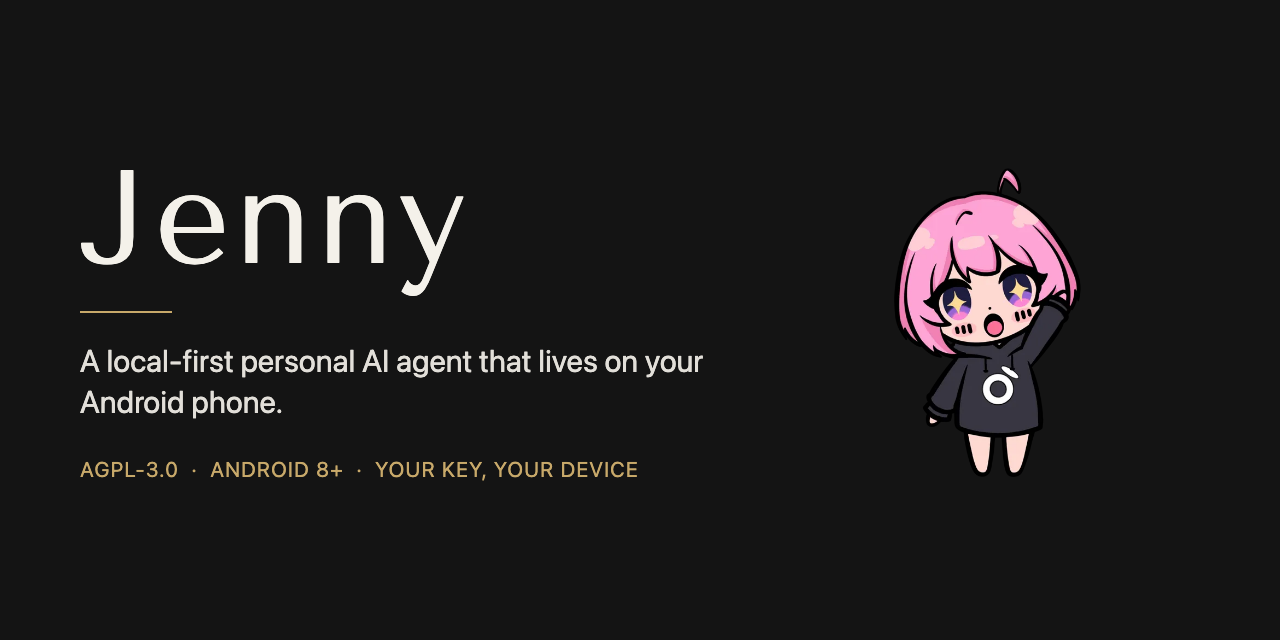
A local-first personal AI agent that lives on your Android phone
It remembers you permanently, acts on a schedule without being asked, writes its own
mini-apps on request, and can be your phone's home screen. Your memory, files and
conversations stay on the device. Bring your own API key — or run a model on your own
hardware and keep the whole loop offline.






Documentation · Quick start · Features · Privacy & security · Limitations · FAQ
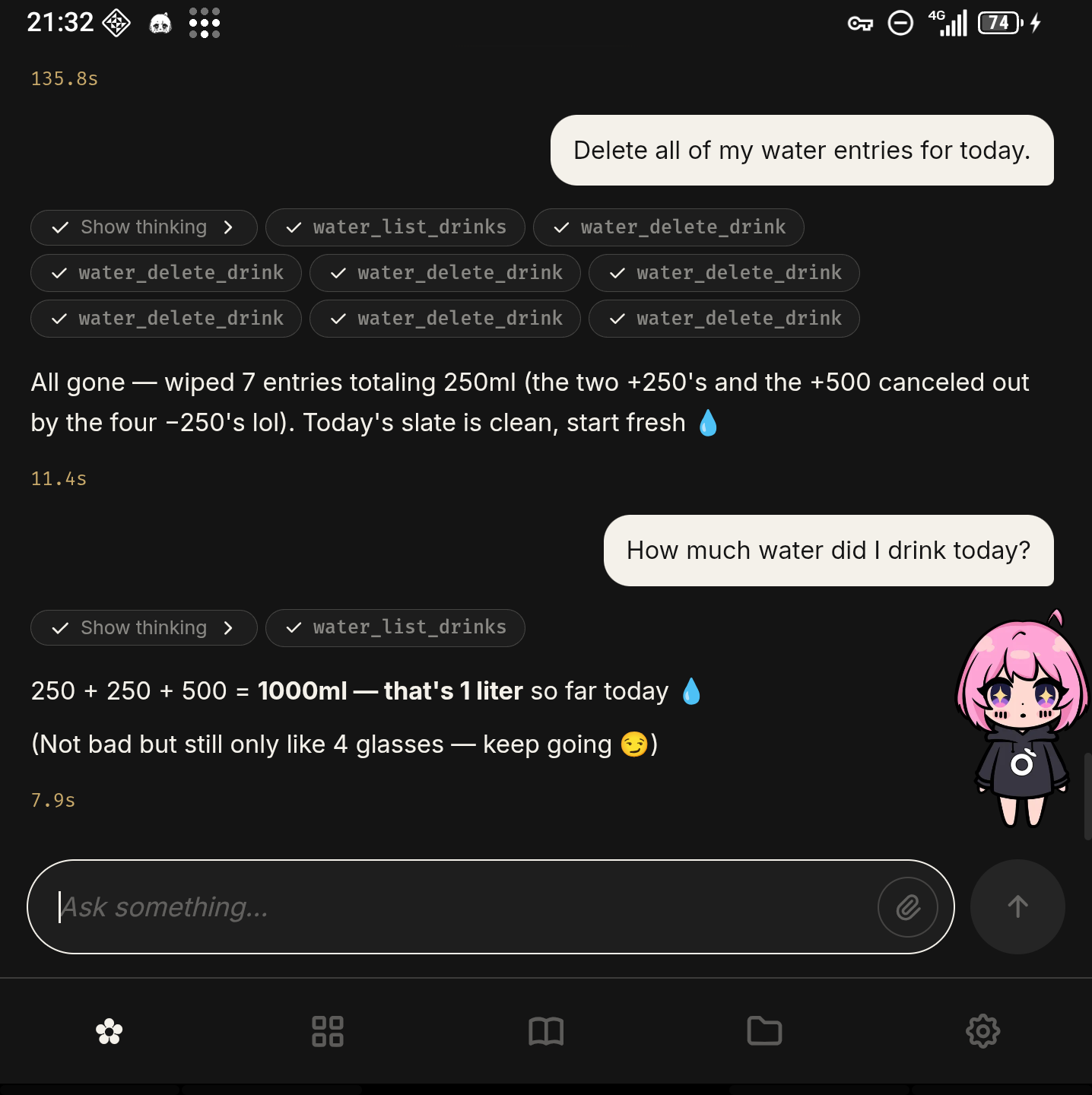
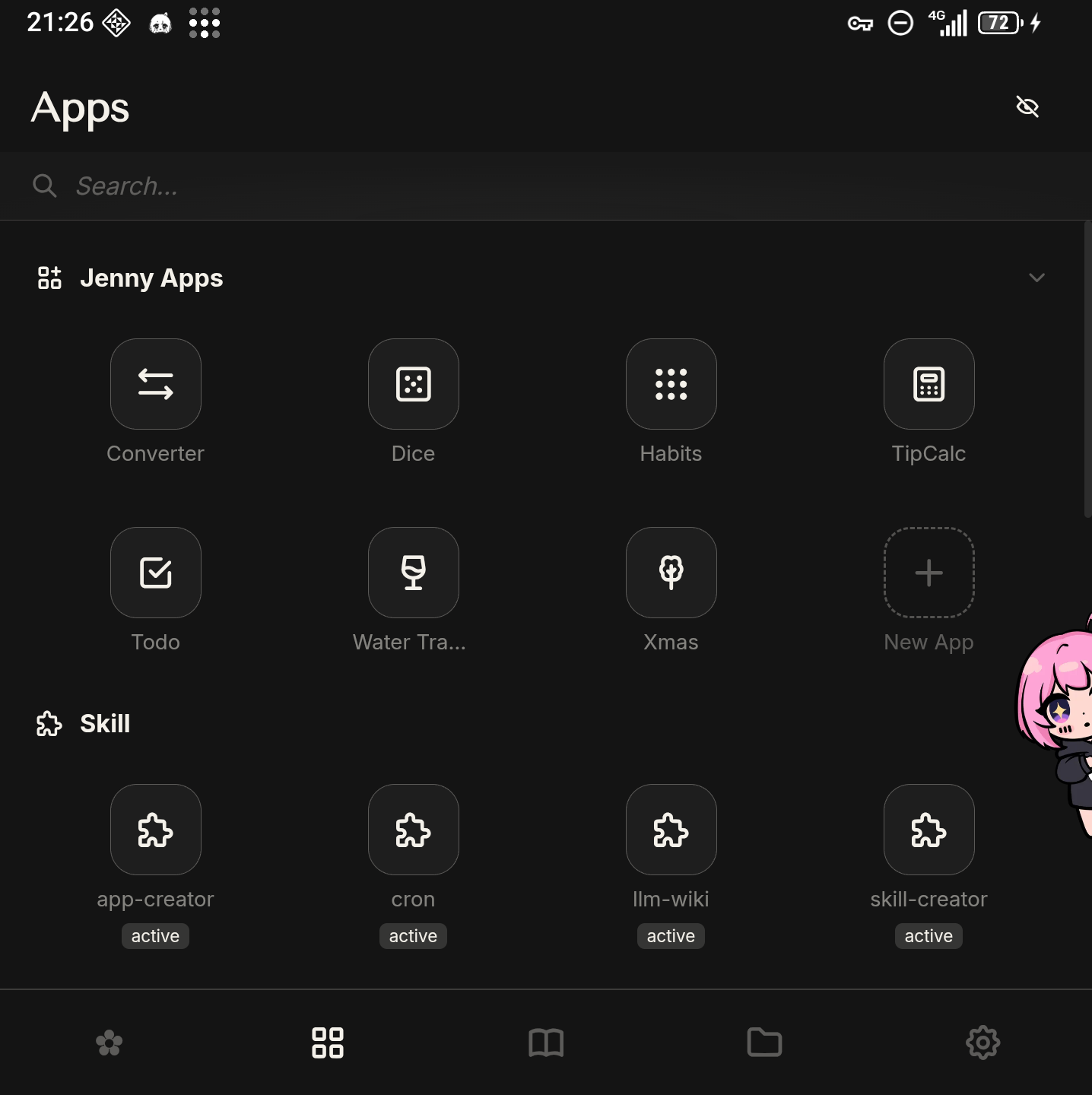
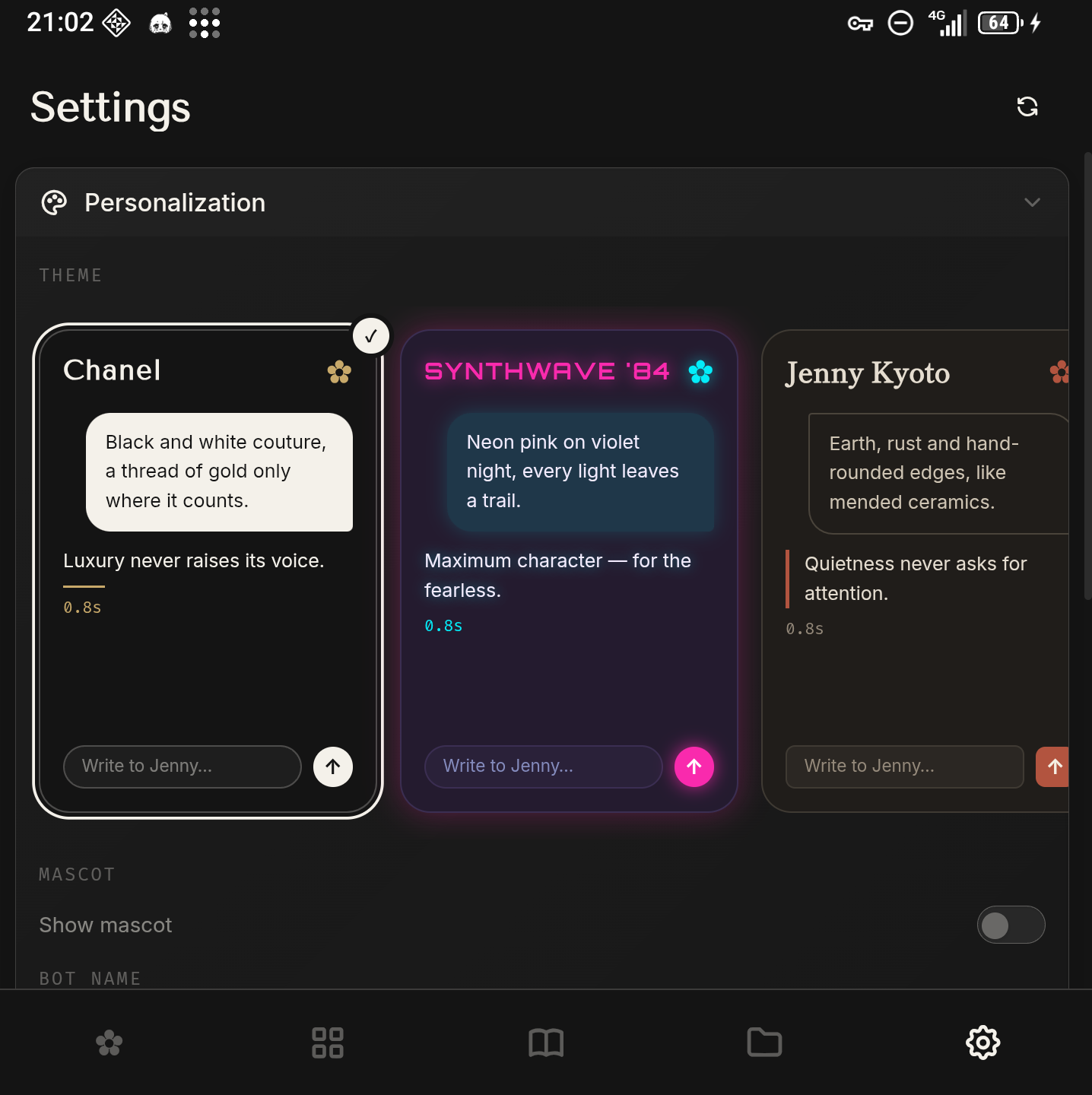
An AI agent that runs on your phone, not in someone's cloud
Jenny is an Android app with an embedded Python runtime. It registers as a HOME activity, so
if you want, pressing Home lands you in a conversation instead of a grid of icons. A
foreground service keeps the agent alive with the screen off — which is what makes scheduled
work and proactive messages possible at all.
If you have ever self-hosted an AI agent on a server, this is that: except the host is a
phone you already own, it has a screen, and its battery is the UPS.
It is a pre-release prototype. Sideloaded, no store and no auto-updates, and the
known limitations are listed in full rather than discovered later.
Is it actually free software?
The question worth answering first, because "AI agent" plus "API key" usually means a
proprietary service with an open-source shell.
- The app is AGPL-3.0, all of it, and it builds from this repository with no extra steps.
- There is no service of mine anywhere. No account, no sign-up, no telemetry, no
analytics, no crash reporter, no server of mine in the loop. Not a policy — there is
nowhere for me to look from. - The model provider is your choice, and it is optional. Point Jenny at Ollama or
LM Studio on your own hardware and the loop is fully offline: no traffic leaves your
network. See local models.
If you use a hosted provider, then yes — your prompts go to that provider under your own key,
and Jenny depends on a non-free network service for as long as you choose one. That is your
decision per install, not a property of the app.
What it can do
🧠 Permanent on-device memory. Every couple of hours a background pass replays the recent
conversation and distils it into structured Markdown on disk: who you are, the agent's own
behavioural notes, an index of durable context, and any procedure it saw you repeat, written
down as a reusable skill. Noise is pruned, signal accumulates. It's plain Markdown on the
device, so switching provider doesn't cost you your memory.
→ Memory
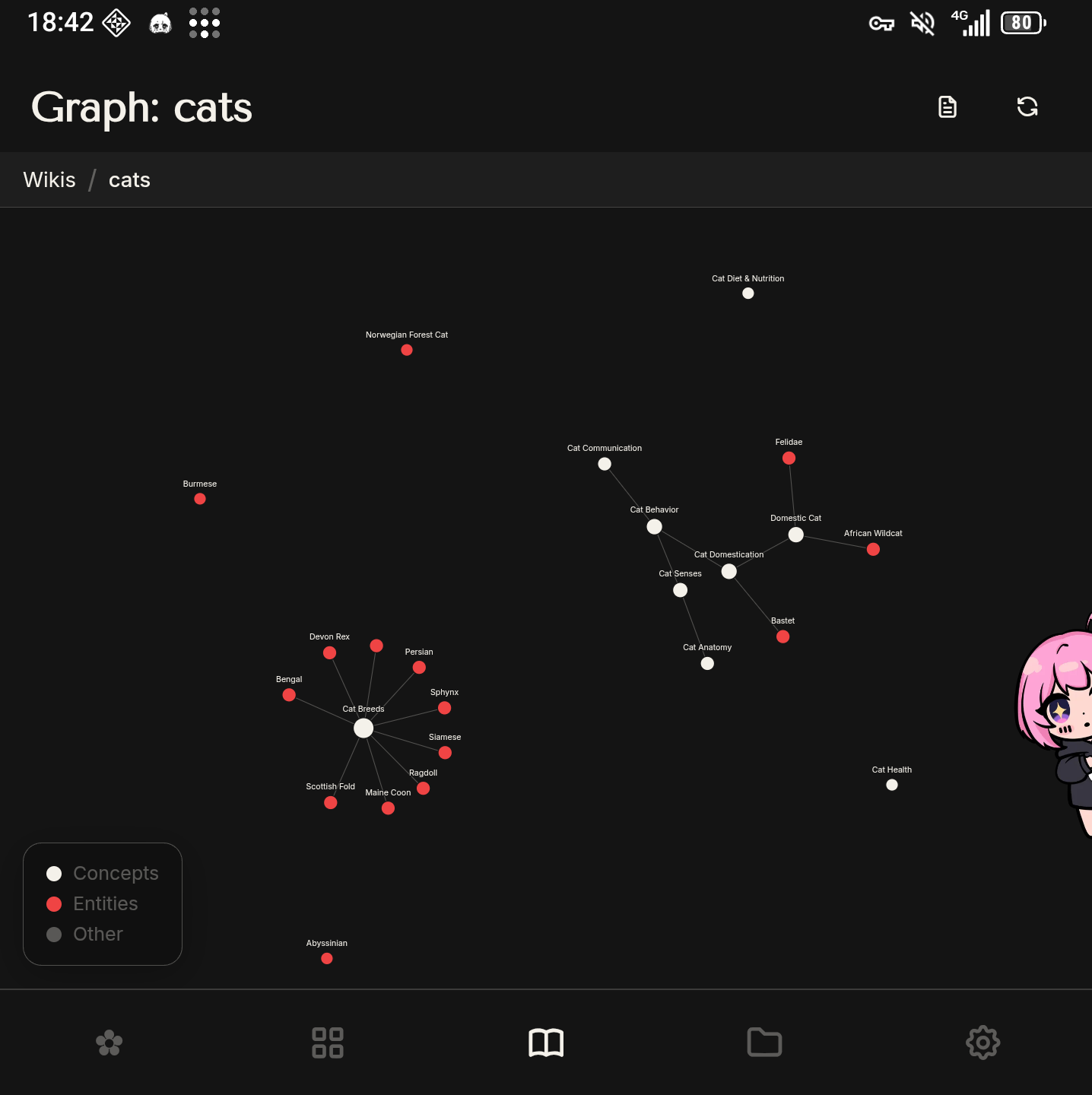
📚 It builds you a wiki. Feed it articles, notes, PDFs or web pages and ask it to compile
them: you get cross-linked Markdown pages — concepts and entities, joined by [[wikilinks]] —
browsable in their own tab, with a graph view of how they connect (that's the fourth screenshot
above). Driven entirely from chat through a built-in llm-wiki skill: create one, ingest a
source, compile, ask it questions, run a lint pass for dead links and orphan pages. It does
not update itself — every step is a request you make, or a job you schedule. Multiple wikis
live side by side as plain files in the workspace, so they're editable and backed up like
everything else. → Wiki
⚡ It acts on its own. Reminders, one-shot actions and recurring jobs ("every Monday,
summarise my week"). When one fires, it messages you first, screen off. It reads and
writes files, executes Python, and searches the web through a real hidden Chrome WebView
rather than a plain fetch, so JavaScript-rendered pages work.
→ Scheduling ·
Tools
🛠️ It writes its own Android mini-apps. Describe one in chat — "something to track my
plants" — and the agent builds it: UI, typed actions, persistent storage, installed into its
own app grid. Each action becomes a callable tool, so the same app is usable by you, by the
agent in conversation, and by anything that triggers a turn, including cron. That last one
is what makes "alert me if the basil needs water" work end to end.
→ Mini-apps
📱 It can be your Android launcher. It declares HOME + DEFAULT + LAUNCHER and handles
the Home gesture, listing and launching your installed apps from a panel inside the UI. Seven
visual themes and a draggable mascot you can switch off. Judged purely as a launcher it would
be a bad one — no widgets, folders or icon packs. The launcher part is the how, not the
what. → Launcher setup
💬 Optional Telegram bridge for
reaching the agent from anywhere — outbound-only, your own bot token, so nothing on your
network becomes reachable from the internet. Messages through it pass through Telegram's
servers; your memory and files never do. Off by default.
Quick start
Download the APK from Releases — Android 8.0 or newer, ~67 MB,
most of which is the embedded CPython runtime. Verify it against the hash published on the
release page:
shasum -a 256 jenny-0.3.0.apk
Android will ask you to allow installing from outside the Play Store. The APK is signed with
my own key (RSA 4096, schemes v2 and v3) — no store vouches for it, which is the deal with
sideloading, and checking the hash is how you confirm you got the file I built. Then launch it,
follow onboarding, paste your API key. No account to create, at any point.
Or build it yourself — the whole thing builds from this repository, which is rather the
point of not having a store in the middle.
Installing ·
first run ·
build from source ·
is it for you?
Privacy and security
Memory, conversations, files and generated apps live in the app's private storage. The web UI
is served on loopback by default (127.0.0.1) — no port exposed to your network, nothing
to reverse-proxy, no inbound attack surface unless you deliberately rebind it. The API is
token-gated even on loopback, because Android does not isolate loopback TCP between apps.
Jenny makes exactly five kinds of outbound connection — your provider, Bing when it searches,api.telegram.org if you enabled the bridge, any URL you or the agent explicitly fetch, and
OpenRouter's attribution headers when that's your provider. No sixth item, no phone-home. It
declares ten permissions and asks for no camera, microphone, contacts, SMS, call log,
background location or storage.
→ Every connection and permission
Two disclosures I would rather you hear from me than discover:
- Your prompts go to whichever provider you chose. On-device storage is not on-device
inference. If a location fix ends up in the agent's reasoning, it ends up in that prompt. android:allowBackup="true"is set on purpose — losing your memory when you change
phone would be worse. But with Google backup on, the app's private storage, including the
config file that holds your API keys in plain text, is eligible for your Google account's
backup. Turn backup off for this app and use Jenny's own encrypted backup instead.
→ Privacy in detail
Security, short version: python_exec is not a sandbox — arbitrary Python, in-process; the
module lists are a usability guardrail, not containment. Provider keys are plain text,
protected by the app sandbox and readable by the agent's own file tools. Prompt injection is
not solved — nobody's is; asking Jenny to "read this URL and do what it says" is handing a
stranger your tools. SECURITY.md is the long version, written to be useful
rather than reassuring — read it before you point this at anything you care about.
→ Security model
Known limitations
Collected in one place rather than scattered, so you can judge before installing.
- Sideload only. A signed APK on Releases, and the source. No Play Store, no F-Droid
listing, and no automatic updates — you check back here. - Not a full launcher. No widgets, folders, icon packs or wallpaper management.
- Web search is Bing-only. A real CAPTCHA page fails rather than being solved.
- Goals and subagents are separate tools, not an orchestrator. A registered objective
stays in context across turns, and the agent can delegate to background subagents, but
nothing guarantees a goal is automatically decomposed and driven to completion — delegation
is a per-turn decision by the model. - Mini-apps can't reach authenticated servers. Declaring
authin a manifest is refused
outright until there's a credential store. - Small models struggle. The agent loop leans hard on instruction-following and
tool-calling; quality tracks the model, and below the frontier tier it varies a lot. - Battery is unmeasured. It idles cheaply and asks for battery-optimisation exemption,
but I haven't published numbers and won't invent them. - Android only. Not a temporary gap — the whole design assumes a device you own that
stays on.
Status and roadmap
Pre-release prototype. It works, it's been my daily driver for months, and it has rough
edges — onboarding most of all, which is exactly where feedback is worth most.
Not promised, roughly in order: measured battery numbers · voice in and out · a credential
store so mini-apps can reach authenticated servers · the agent operating other apps on the
phone · richer system surfaces.
Contributing
Issues and PRs welcome — see CONTRIBUTING.md and
CODE_OF_CONDUCT.md. Contributions need a
DCO sign-off (git commit -s).
The most useful contribution right now isn't code: install it, try to set it up without
reading anything, and tell me exactly where you got stuck.
If the idea seems worth existing, a star is what makes it findable by the next person who
would want it — GitHub's search ranks on them, and this project has no marketing budget.
Architecture
A native Android app with an embedded CPython 3.11 (Chaquopy 17), minSdk 26 /targetSdk 34. The agent runs as a persistent foreground service and serves a mobile-first
SPA over loopback. Messages flow through an async bus that decouples the channel from the
core. Over 3,500 tests; CI runs ruff, pytest on 3.11 and 3.12, and pyright — blocking on the
subsystems that are already type-clean, advisory on the rest, which is the honest state of a
codebase being tightened rather than one pretending to be finished.
→ Architecture ·
Concepts ·
The agent turn
License, trademark, and upstream
Code is AGPL-3.0. Jenny is a fork of
nanobot (MIT, by Xubin Ren) — what this fork keeps,
removes and rewrites is documented in FORK_BOUNDARY.md, and upstream's
license is reproduced verbatim in THIRD_PARTY_NOTICES.md along with
every bundled library and font.
The Jenny name, logo and mascot artwork are not under the AGPL grant — see
TRADEMARK.md. Fork the code freely; ship it under your own name.
Developed by flagDiZero. Copyright © 2026 Ludovico Ragno.
FAQ
Is this a launcher like Nova or Niagara?
No — the launcher is the how, not the what. Jenny is a personal AI agent; being the home
screen is what makes it present instead of an app you remember to open.
Does it really work offline, with local models?
Yes — Ollama and LM Studio through the OpenAI-compatible engine. With the model on your LAN
and the Telegram bridge off, no traffic leaves your network at all. Expect quality to track
the model.
What does it cost?
The app is free and open source. You pay your provider directly, or nothing with a local model.
My marginal AI cost is zero, so there is no incentive to ration your usage — an architectural
fact, not a pricing promise.
Why AGPL, if it never touches a server?
So a hosted fork can't take the work closed. Personal use is unaffected.
On the record
So they can be held against me: BYOK is free, forever — using Jenny with your own key
will never require a subscription, an account, or a payment to me. And local-first is the
architecture, not a launch feature. Don't trust that sentence; check the permissions and the
source. That's why they're public.
Support the project
No subscription to sell you and BYOK stays free, so donations are the only thing funding the
work.


Local-first personal AI agent for Android · on-device memory · BYOK · offline-capable · AGPL-3.0
Reviews (0)
Sign in to leave a review.
Leave a reviewNo results found