context-compiler-bootstrap
Health Warn
- License — License: MIT
- Description — Repository has a description
- Active repo — Last push 0 days ago
- Low visibility — Only 5 GitHub stars
Code Fail
- rm -rf — Recursive force deletion command in scripts/bench-scale.sh
Permissions Pass
- Permissions — No dangerous permissions requested
No AI report is available for this listing yet.
An LLM builds and maintains your personal wiki. Vectorless, cited, git-native markdown — five slash commands, no SaaS.
context-compiler-bootstrap


A context compiler for LLMs. It turns unstructured sources — PDFs, articles, transcripts, spreadsheets, screenshots — into a structured, provenance-aware, machine-navigable context package your AI tool can navigate, retrieve from, and reason over. You curate raw sources and ask questions; the LLM does all the writing, cross-linking, and upkeep. Five slash commands, run entirely from your AI coding tool. No UI, no SaaS, no Obsidian, no vector DB. The pattern is Andrej Karpathy's; the compiler framing is spelled out in docs/CONTEXT-COMPILER.md.
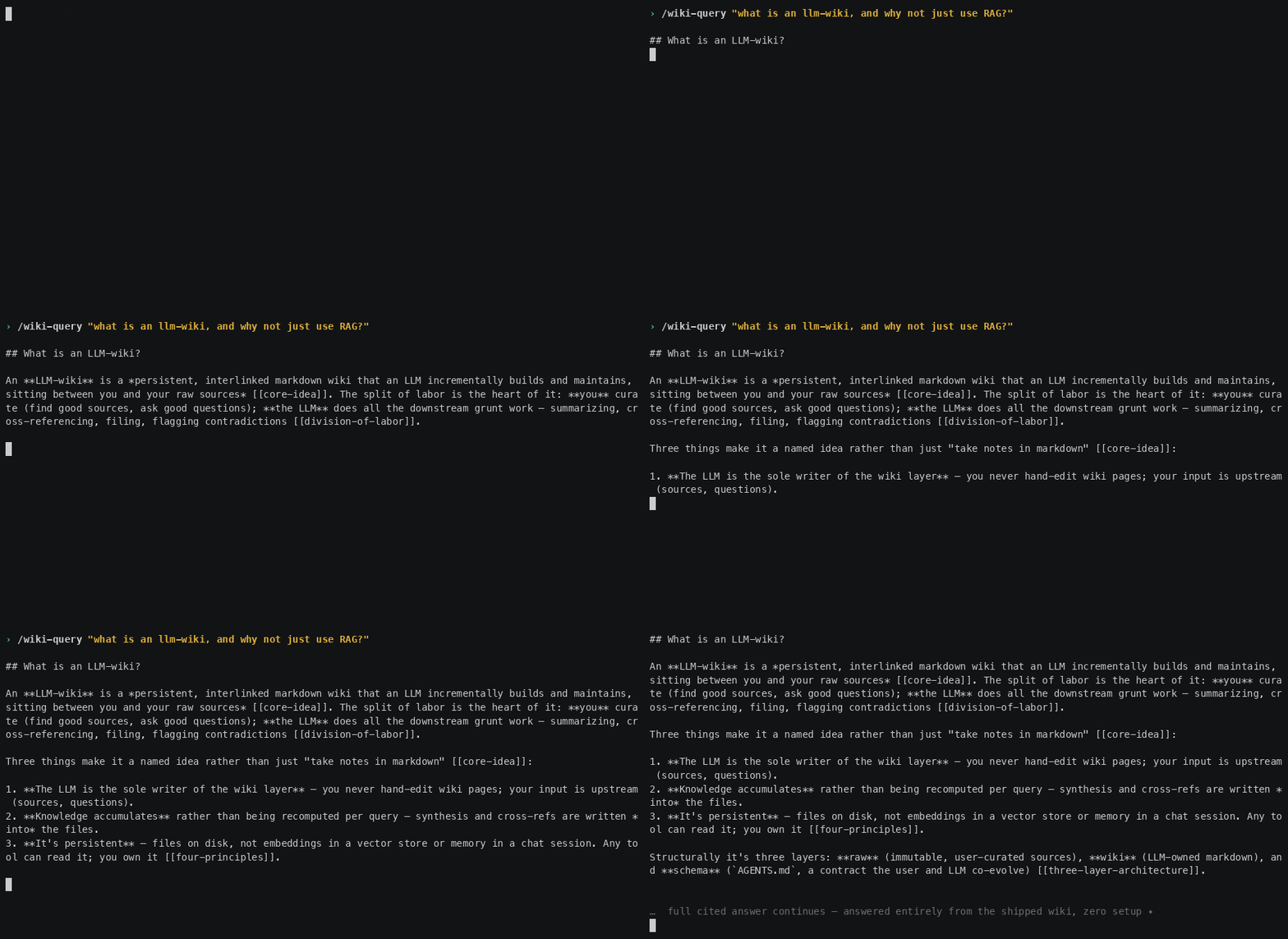
A replay of a real
/ctx-queryagainst the shipped demo wiki — the answer text is verbatim; terminal timing is illustrative. Reproduce it yourself with the block below (zero setup).
Quick start — first answer in one block
You need one thing: an agentic AI tool on your $PATH. The reference path is Claude Code (claude); other tools work too. Then:
git clone https://github.com/FrancyJGLisboa/context-compiler-bootstrap my-wiki
cd my-wiki && claude          # open Claude Code in the repo
The repo ships with a working demo wiki, so the very first command already returns an answer — zero setup:
/ctx-query "what is an llm-wiki, and why not just use RAG?" # answered from the shipped wiki
That's the whole pitch: you just queried a knowledge base nobody hand-wrote. Now make it yours — start building your own:
/ctx-extract https://example.com/some-article   # pull a source into raw/
/ctx-compile                                       # integrate it into the wiki
/ctx-query "what does that article say about X?"  # ask — answers now include your source
That's the whole loop. The wiki that ships here is meta — a wiki about the LLM-wiki pattern itself (wiki/index.md), there as a working example. Make it yours: keep adding sources alongside it, or start from a clean slate.
The block above is the one and only start-here. Not on Claude Code?
docs/QUICKSTART.mdhas the same loop as a command sequence for Cursor, Cline, Copilot, Gemini, and Codex — plus a VS Code + Copilot fast path. On Windows? Do the one-time 5-minute setup (Git Bash + Python) so the toolchain runs.
Install details
Starting your own wiki (clean slate)
The clone above keeps the demo content (a meta-wiki about the LLM-wiki pattern — a handy worked example). To generate a clean skeleton with no demo content instead:
git clone https://github.com/FrancyJGLisboa/context-compiler-bootstrap tmp
tmp/scripts/create-context-compiler.sh ~/my-wiki   # fresh skeleton, no demo content
                                           # refuses to clobber a non-empty target
rm -rf tmp
cd ~/my-wiki
./scripts/preflight.sh                     # confirm hard requirements + optional tools
git add -A && git commit -m "chore: bootstrap llm-wiki"   # installer already ran `git init`
claude                                     # open Claude Code in the new wiki
Then, inside Claude Code:
/ctx-extract https://example.com/some-article     # pull a source into raw/
/ctx-compile                                       # integrate every un-ingested raw/ file
/ctx-query "what does that article say about X?"  # ask
The skeleton ships the slash commands and an empty raw/ + a stub wiki/index.md, so this works immediately — no /ctx-init needed. The installer is manifest-driven (scripts/installer-skeleton-manifest.txt) and verified by scripts/verify-create-context-compiler.sh.
The compiler's output format is a portable context package. scripts/package-wiki.sh builds a versioned, hash-manifested bundle that refuses to ship a wiki failing its own citation gates, and carries its own verifier inside — so a recipient confirms integrity offline, needing nothing from you. That makes a curated wiki a transferable asset; docs/SELLING.md covers one thing you can do with that (schema, packaging, the raw-rights rule).
Optional: confirm your full setup
Just trying it out? Skip this. When you want to confirm the whole pipeline works on your machine, run:
./scripts/preflight.sh    # hard reqs (bash/awk/openssl/git) + which extract formats work first-try
./scripts/smoke-all.sh    # full pipeline (extract → ingest → query) on a fictitious fixture; 13 binary checks
preflight.sh tells you in advance which /ctx-extract formats your environment supports first-try (PDF needs pdftotext; DOCX needs pandoc; XLSX needs xlsx2csv — each has a fallback, but knowing in advance avoids surprises).
smoke-all.sh drives claude -p on a small fixture, asks the wiki a question, and confirms the answer recalls the fact and cites the source. First run takes ~30–60s (LLM); subsequent runs sub-second (idempotent via body-hash). All 13 green = your install works end-to-end. Spec at .scratch/plug-and-play-curator-smoke/GOAL.md.
For the per-tool first-use sequence (which commands to type, in order, in each AI tool), see docs/QUICKSTART.md. For the mental model — three layers, five commands, and the build-system analogy mapped to things you already know — see docs/EXPLAIN.md. For what category this is and how to tell a real one from a folder of notes, see docs/CONTEXT-COMPILER.md.
Tool support
The project ships shim files for every major agentic tool. Whatever you use, the AI will load the schema automatically:
| Tool | Shim file (already in repo) | Invocation | Status |
|---|---|---|---|
| Claude Code (modern) | AGENTS.md (canonical) |
/ctx-init, /ctx-extract, etc. — real slash commands |
e2e-verified (driven by scripts/smoke-all.sh) |
| Claude Code (legacy) | CLAUDE.md |
same as modern | e2e-verified |
| Cursor | .cursor/rules/context-compiler.mdc |
natural language: "run ctx-compile" | Documented, not yet e2e-verified |
| Cline (VSCode) | .clinerules |
natural language | Documented, not yet e2e-verified |
| GitHub Copilot | .github/copilot-instructions.md |
natural language | Documented, not yet e2e-verified |
| Gemini CLI | GEMINI.md |
natural language | Documented, not yet e2e-verified |
| OpenAI Codex | AGENTS.md (canonical — auto-loads) |
natural language | Documented, not yet e2e-verified |
The shim files all point at AGENTS.md as the canonical schema and at .claude/commands/ctx-*.md as the workflow definitions. Tools without first-class slash commands (Cursor, Cline, Copilot, Gemini, Codex) invoke the workflows by natural language; the LLM follows the prompt body of the corresponding command file step-by-step.
"Documented, not yet e2e-verified" means: the shim file ships, the natural-language workflow is specified, and the pattern is expected to work — but the smoke harness only drives Claude Code, so these paths have not been observed end-to-end by the project. If you use one of these tools and something does not work, that is a reportable bug — please open an issue.
Verify your tool in one command. scripts/smoke-tool.sh <tool> (claude/codex/gemini/copilot) drives that CLI through a real ingest→query loop in a throwaway wiki and asserts the agent built a citing wiki page and recalled a planted fact — with the raw source deleted before the query, so the answer must come from the wiki, not a re-read. It skips cleanly (exit 3) if the CLI isn't installed. claude passes today; if your tool passes, that row has earned "e2e-verified" — please open a PR flipping it (and attach the run).
The five slash commands
Every command has both a prefixed form (/ctx-extract) and a short alias (/extract). The short forms are the ones you'll actually type once you're inside a fresh installed repo; the prefixed form is there for global use where namespace collisions matter. Both resolve to the exact same procedure.
| Prefixed | Short | What it does |
|---|---|---|
/ctx-init |
/init |
Scaffold the wiki structure (raw/, wiki/, AGENTS.md, README.md, log.md). Idempotent. Use only if you copied just .claude/commands/ into an existing project — cloning this repo already gives you the structure. |
/ctx-extract <urls-or-files> |
/extract |
Pull one or many URLs / local files (PDF, DOCX, XLSX, CSV, image, or plain text) into raw/ with frontmatter. Bulk mode: pass multiple sources space- or newline-separated and they're all extracted in one pass with a consolidated OK/Degraded/Failed summary at the end. Parses binary content to markdown when a handler exists. Also accepts pasted inline text via --text [--title "..."] <content> (single source, never whitespace-split). Does not touch wiki/. |
/ctx-compile [<raw-file>] |
/ingest |
Process raw/ → wiki/ using the 7-step pipeline. Detects deltas via hash; idempotent on unchanged sources. |
/ctx-query <question> |
/query |
Answer from the wiki; web-search and auto-promote new knowledge if there's a gap. --no-promote suppresses promotion. --visual [html|pdf|png] also emits a diagram of the answer, archetype auto-picked from the query (same design system as /ctx-diagram). |
/ctx-lint [--apply] |
/lint |
Health-check: broken links, orphans, contradictions, stale claims, gaps. Reports by default; --apply writes proposed fixes. |
Full spec at wiki/commands.md.
Output commands
Two more commands render or export an already-built wiki — they sit outside the acquire→maintain loop above and are read-only on raw/ and wiki/ (they only write new output files).
| Prefixed | Short | What it does |
|---|---|---|
/ctx-visualize [graph|mermaid|slides|serve] [target] |
/visualize |
Render the wiki as an interactive D3 graph (default), MARP slides, or mermaid images, or serve it locally. Thin wrapper over scripts/visualize/*; checks python3/npx and prints install hints. |
/ctx-flashcards [dir] |
/flashcards |
Export every ## Flashcards section to an Anki-importable CSV. Wraps scripts/wiki-to-anki.sh. |
/ctx-diagram "<intent>" |
/diagram |
Synthesize an audience-targeted diagram from an intent — retrieve relevant pages, score the 8 archetypes, you pick, it generates a self-contained HTML poster. Output to diagrams/. |
/ctx-visualize is mechanical (renders the structure that already exists); /ctx-diagram is semantic (composes a new poster by reasoning over a query). See the diagram contracts in templates/infographic/.
Optional: typed relations. Inside ## Related, you can attach a verb to a link — - [[embrapa]] founded-by 1973 — Brazilian R&D agency. Pure CommonMark; backward-compat with untyped lines. Verb regex: [a-z][a-z0-9-]*. Validate with ./scripts/wiki-lint-typed-relations.sh wiki/; the graph viz colours and filters edges by verb. Full spec in AGENTS.md → "Typed relations". An empirical eval (scripts/eval-multi-hop.sh) measures whether typed verbs improve /ctx-query recall over the same wiki with verbs stripped — see .scratch/typed-wikilinks-semantic-viz/GOAL.md for the methodology and current null-result on a Wikipedia-derived fixture.
Visualize your wiki
From inside your AI tool, just run /ctx-visualize (alias /visualize) — it dispatches to the right backend and checks the required tool is installed. Or call the scripts directly:
./scripts/visualize/graph.sh wiki/ > graph.html   # interactive D3 force graph (no install)
./scripts/visualize/serve.sh                     # browse the wiki + graph locally
Five opt-in wrappers under scripts/visualize/: a Python+D3 graph generator (zero dependencies), plus slides.sh, mermaid.sh, serve.sh (MARP / mermaid-CLI / local HTTP), and render.sh (HTML poster → PDF/PNG, used by /ctx-query --visual and /ctx-diagram --pdf/--png; graceful fallback to HTML when no browser/Node). All open source; no Obsidian required. Heavier alternatives (Quartz, mdBook, SilverBullet) covered in docs/VISUALIZATION.md.
Executable context — rules the compiler enforces
Most of what a source says is knowledge. Some of it is a rule, and rules are
worth treating differently, because prose is a soft constraint on an LLM: it
can be misread, lost under a longer instruction, or sincerely reported as
followed when it wasn't. Every one of those failures is silent.
"Don't do X"          →  interpretation  →  self-report
gates/RULE-0007.sh    →  exit 0 | 1 | 2  →  an artifact you can look at
So /ctx-compile separates the two. Every rule it finds is classified once:
| Class | Means | What happens to it |
|---|---|---|
deterministic |
A script with an exit code can settle it | Becomes a gate under gates/ |
heuristic |
Needs judgement — "forecasts must be readable" | Stays a rule page; a reviewer's job |
unverifiable |
Nothing could check it, even in principle | Recorded in rules/discarded/ with the reason |
The standing rule: no deterministic rule stays prose-only. /ctx-lint
reports R-01 for any rule classified deterministic that still hasgate: none.
Building the gate is a separate, deliberate step:
/ctx-rules --scan-context    # what rules exist, and which are gateable?
/ctx-gate RULE-0007          # build the gate for one of them
/ctx-lint                    # R-01 clear?
/ctx-gate will not take your word for it. Before a gate counts as built it
must fail on a committed fixture that violates the rule, pass on a clean one,
survive five mutations, and declare three ways to violate the rule it does
not catch — because an author who can't name their gate's blind spots has only
observed that it passes. It refuses outright to build a gate whose detection
would need an LLM call: that answers differently on the same input tomorrow, so
it can't be ratcheted and its green means nothing.
Two things stop this from becoming decoration:
gate-fixtures.shruns every gate against both its fixtures on every CI
run, requiring exactly 1 then exactly 0. A gate that never fires is
indistinguishable from a broken one, and an unfixtured gate is a violation, not
a skip.gates/baseline.tsvis a ratchet: counts may not go up, and you are never
asked to fix the past. Scope exclusions and suppressions count in the same
number, so routing around a gate is possible but never quiet.
Gates and their fixtures travel inside scripts/package-wiki.sh bundles, so a
recipient gets the checks, not just pages describing them. Full doctrine indocs/deterministic-gates.md — which ships into
every wiki you create.
MCP access (optional)
Expose this wiki over the Model Context Protocol so any MCP-aware AI client — Claude Desktop, Claude Code, Cursor, ChatGPT Desktop, etc. — can read it (and optionally write to it) without slash-command indirection. Uses @bitbonsai/mcpvault, which works on any markdown directory with no Obsidian dependency. BM25 search built in.
./scripts/mcp-server.sh # foreground stdio server pointed at wiki/
For client config snippets (Claude Desktop, Claude Code, Cursor) and the recommended read-only posture, see docs/MCP.md.
Flashcards (optional)
Any wiki page may declare a ## Flashcards section with Q: … / A: … bullet pairs. Export to an Anki-importable CSV with /ctx-flashcards (alias /flashcards) from inside your AI tool, or run the script directly:
./scripts/wiki-to-anki.sh > anki.csv
The page slug becomes the Anki tag for that card. See the convention notes in AGENTS.md.
A typical session
# add a source
/ctx-extract https://example.com/some-article

# integrate it
/ctx-compile

# commit before the next ingest — git is your rollback (no atomic writes inside the pipeline)
git add wiki/ log.md raw/
git commit -m "ingest: <source title>"

# ask the wiki something
/ctx-query "what does this article say about X?"

# periodically tidy up
/ctx-lint
Commit-per-ingest is the recommended discipline: /ctx-compile touches many files (a summary page, several concept pages, the index, log.md, raw-file frontmatter) and is not atomic. If a future ingest goes sideways, git checkout -- wiki/ log.md raw/<file> is your only clean recovery path. Skip the commit and the rollback also rolls back the good ingest before it.
Make it yours
The shipped wiki content is illustrative — it's a wiki about the LLM-wiki pattern, derived from the YouTube transcript in raw/karpathy-llm-wiki-video-transcript.md. To start your own:
- Keep it as reference and add alongside: drop your own sources into
raw/, run/ctx-compile. Your pages live next to the meta-wiki content. - Replace it:
./scripts/wipe-meta-wiki.sh(prompts for confirmation;--yesto skip). Wipeswiki/*.mdandraw/*, resetswiki/index.mdandlog.mdto minimal stubs.
The AGENTS.md schema is project-agnostic — it works the same whether the wiki is about LLM-wikis, trading, M&A, your team's roadmap, or anything else.
Project layout
Full repository tree (click to expand).
├── AGENTS.md # canonical schema (read by AI tools) — schema v2
├── CLAUDE.md # shim → points to AGENTS.md
├── GEMINI.md # shim → points to AGENTS.md
├── README.md # this file (dev-side) — the one and only entry point
├── log.md # append-only log of ingests, schema bumps, infra changes
├── .claude/
│ └── commands/ # Claude Code slash commands (canonical + aliases)
│ ├── ctx-init.md
│ ├── ctx-extract.md
│ ├── ctx-compile.md
│ ├── ctx-rules.md # inventory + triage rules (writes no code)
│ ├── ctx-gate.md # build a gate behind the mutation proof
│ ├── ctx-query.md
│ └── ctx-lint.md
├── .cursor/
│ └── rules/
│ └── context-compiler.mdc # Cursor shim
├── .clinerules # Cline shim
├── .github/
│ └── copilot-instructions.md # GitHub Copilot shim
├── docs/
│ ├── QUICKSTART.md # per-tool first-use guide (start here after cloning)
│ ├── EXPLAIN.md # mental model for devs: build-system analogy, dev-mapped verbs
│ ├── CONTEXT-COMPILER.md # the category: definition, five properties, what it is not
│ ├── MCP.md # optional MCP read surface (Claude Desktop / Cursor / etc.)
│ ├── VISUALIZATION.md # graph view, slides, mermaid render, local server — no Obsidian
│ └── pitch-vscode.html # self-contained pitch page (PT, internal reference)
├── scripts/
│ ├── body-hash.sh # canonical SHA-256 over a raw file's body
│ ├── preflight.sh # environment & dependency check (run before first /ctx-extract)
│ ├── wipe-meta-wiki.sh # remove shipped meta-wiki content for a clean start
│ ├── verify-extract.sh # shape-check /ctx-extract output
│ ├── wiki-to-anki.sh # export ## Flashcards sections to Anki CSV
│ ├── verify-wiki-to-anki.sh # shape-check the Anki exporter
│ ├── mcp-server.sh # launch @bitbonsai/mcpvault pointed at wiki/
│ ├── smoke-build.sh # LLM-driven build phase (drives claude -p)
│ ├── smoke-check.sh # pure-shell asserts C1–C5 on the smoke artifacts
│ ├── smoke-all.sh # umbrella: build + check + <!-- claim:smoke-guard-range -->R1–R40<!-- /claim --> regression guards
│ ├── r3-obsidian-patterns.txt # patterns file for the no-Obsidian-syntax check
│ ├── create-context-compiler.sh # manifest-driven installer for a fresh skeleton
│ ├── verify-create-context-compiler.sh # oracle for the installer (I2–I7)
│ ├── installer-skeleton-manifest.txt # single source of truth for what ships fresh
│ └── visualize/ # opt-in OSS visualization wrappers
│ ├── graph.sh # bash wrapper around graph-html.py
│ ├── graph-html.py # stdlib-only D3 force-graph generator
│ ├── slides.sh # MARP-CLI wrapper (npx)
│ ├── mermaid.sh # mermaid-CLI wrapper (npx)
│ ├── serve.sh # python3 -m http.server wrapper
│ ├── render.sh # HTML poster → PDF/PNG (chrome/puppeteer; graceful fallback)
│ └── verify-visualizers.sh # smoke harness (V1–V5 + render checks)
├── templates/
│ ├── journal-entry.md # template for wiki/journal/YYYY-MM-DD-*.md entries
│ └── README-fresh.md # installer ships this as a fresh wiki's README.md (no demo content)
├── tests/
│ ├── canary/ # tiny known-good fixtures (shape-level smokes)
│ │ ├── canary-smoke-test.md
│ │ ├── canary-csv.csv
│ │ ├── canary-flashcards.md
│ │ ├── graph-fixture/ # 4 nodes / 4 edges flat fixture (V2 graph smoke)
│ │ └── graph-fixture-nested/ # 2 nodes / 1 edge nested fixture (V2b recursion smoke)
│ ├── smoke/ # end-to-end smoke (Phase Coherence fixture + outputs)
│ │ ├── smoke-source.md
│ │ ├── expected-query.md
│ │ └── output/baseline-wiki.txt
│ └── installer-output/ # temp dirs the installer verifier writes to (gitignored)
├── raw/ # immutable source material (you curate)
│ ├── karpathy-llm-wiki-video-transcript.md
│ ├── karpathy-video-slide-ingest-pipeline.png
│ ├── karpathy-video-slide-ingest-pipeline.png.md
│ └── smoke-source.md # ingest-demonstrated smoke source
└── wiki/ # the wiki itself (LLM-owned)
├── index.md # start here (dev meta-wiki)
├── index-FRESH.md # stub used by the installer for fresh skeletons
├── core-idea.md
├── ... (25 more pages, including the 4 smoke-derived pages: quortex-protocol, dr-alma-voss, phase-coherence-engineering, smoke-source-summary)
├── glossary.md
└── journal/ # user-owned, time-stamped observations (schema-v2 exception)
Vision — context that ships with receipts
Everyone building for agents has landed on the same insight: a model with a
well-organized directory of markdown beats a model with a vector store, because
the structure itself routes attention. That insight is about operating a body
of context. It leaves the harder question open — who builds the folders, and
who keeps them true? Hand-authoring works for fifty files and stops working at
five hundred sources. That's a build problem, and this is the build system for
it.
So the output isn't a pile of notes you hope are accurate: every claim is
mechanically traceable to a source, faithfulness is enforced at write-time, and
the whole package is portable and verifiable — not a service you rent. That's
the moat. The markdown is trivially copied (like an ebook); the verified
provenance is not.
Note what the definition does not claim. An earlier draft ended "…that an LLM
can reliably use," and that word was wrong: a compiler controls the
artifact, not the model reading it, and a flawless package can still be
misread. Navigability, retrievability, and reasoning support are properties of
the artifact — so they get measured instead of asserted. Run./scripts/package-quality.sh for the structural half (free, no LLM, no
network); the eval-* family measures the behavioural half at the cost of real
model runs. "Reliable" is a word to earn from a scorecard, not to put in a
definition.
The vision is falsifiable — these are the binary checks that say we're living it:
- Every wiki claim cites a raw anchor that resolves. (
scripts/citation-audit.py— zero BAD) - Every claim is entailed by its cited source. (the C3 entailment gate at ingest — applies to raw-source-backed claims, judged against local raw evidence; web-url-cited claims are not entailment-checked)
- A third party can verify a bundle with only what's inside it. (
scripts/verify-bundle.sh— no seller infra) - It runs with no app, viewer, or account. (pure CommonMark, slash commands)
- Every claim-bearing page carries provenance — none leak unsourced. (
citation-audit.py --coverage)
A change that can't answer "yes" to the relevant checks is drifting off-vision.
Supporting features (causal graph, discovery, flashcards, diagrams) earn their
weight only by inheriting these guarantees.
Principles this project honors
- Explicit. Everything in markdown. No hidden embeddings, no opaque memory.
- Yours. Local files. Portable. You decide what stays and what goes.
- File-over-app. Pure CommonMark. Works with
cat,grep,git, any viewer. No Obsidian dependency (or any other viewer). - BYO AI. Any LLM that supports file read/write and (optionally) web search.
See wiki/four-principles.md for the full account.
Status
V2. Multi-tool shims for Claude Code, Cursor, Cline, Copilot CLI, Gemini CLI, and Codex are all in place. Real slash commands exist only for Claude Code; other tools invoke the workflows by natural language using the same prompt bodies.
The Claude Code happy path is verified end-to-end. Three harnesses guard it. scripts/smoke-all.sh — 43 deterministic checks (extract → ingest → query, body-hash idempotence, installer, the eval, monitoring, and package-quality oracles, plus the prompt-purity, raw-append-only, and ratchet gates) — runs locally and is wired into CI on every push (--no-build, no API key needed); a full local run adds the LLM build phase's own checks on top. The suite counts its passes rather than printing a literal, so losing a check moves the number. scripts/eval-onboarding.sh drives claude -p as a brand-new user through a fresh wiki and confirms they reach the correct answer from a source they just ingested. scripts/eval-retrieval.sh builds a fresh wiki from a generated corpus and scores retrieval against 10 binary checks — needle recall per modality, point-in-time answers, refusal on absence, citation locus, stale-evidence detection, multi-valued scoped answers, graph-traversable supersession, clarify-on-ambiguity, feedback-loop composition, and citation integrity — each graded deterministically (no LLM grader; see tests/eval/retrieval-questions.md), with a held-out question set (--holdout) as the anti-Goodhart control. Latest run: 32/35, the losses being one fabricated citation anchor and one citation pointing into frontmatter rather than body text. scripts/eval-scale.sh reruns that whole eval at increasing corpus sizes with deterministic distractor filler: quality held from 19 to 495 pages (20/21 → 21/21) while median file reads per answer fell from 3 to 0, and the holdout passed 4/4 at 495 pages. Every grader is itself verified with no LLM and no spend by scripts/verify-retrieval-eval.sh (E1–E16), verify-scale-eval.sh (F1–F7), and verify-loops.sh (L1–L6) — an eval nobody checks measures nothing. The other tools' shims (Cursor, Cline, Copilot, Gemini, Codex) ship and follow the same prompt bodies by natural language, but are not yet driven by the harness — if one misbehaves, that's a reportable bug.
License
MIT — see LICENSE.
Reviews (0)
Sign in to leave a review.
Leave a reviewNo results found