oyster
Health Warn
- License — License: MIT
- Description — Repository has a description
- Active repo — Last push 0 days ago
- Low visibility — Only 5 GitHub stars
Code Fail
- network request — Outbound network request in docs/home.ts
- process.env — Environment variable access in examples/install-notes.ts
- network request — Outbound network request in examples/notes-app/backend/index.ts
- exec() — Shell command execution in examples/notes-app/backend/methods.ts
- exec() — Shell command execution in examples/notes.js
- network request — Outbound network request in examples/notes.js
Permissions Pass
- Permissions — No dangerous permissions requested
No AI report is available for this listing yet.
Oyster: your own platform of small Apps that people and AI agents use, on your Cloudflare account. Open source, self-hostable.
Oyster (@fungi.computer/oyster)
Oyster puts a desktop of Apps on your own Cloudflare account: a git platform,
agents, a terminal, an editor, workflows and image generation, each built from a
git commit on your own Computer.
The owner can read a build's status at GET /api/builds/:jobId and its combined
stdout/stderr at GET /api/builds/:jobId?log. The status diagnostic stays
within 200 characters and points to the log. The log returns base64url-encoded
raw bytes; if output exceeds 2 MiB it retains the head and tail and reportstruncated.droppedBytes. Both reads use the same owner authorization.
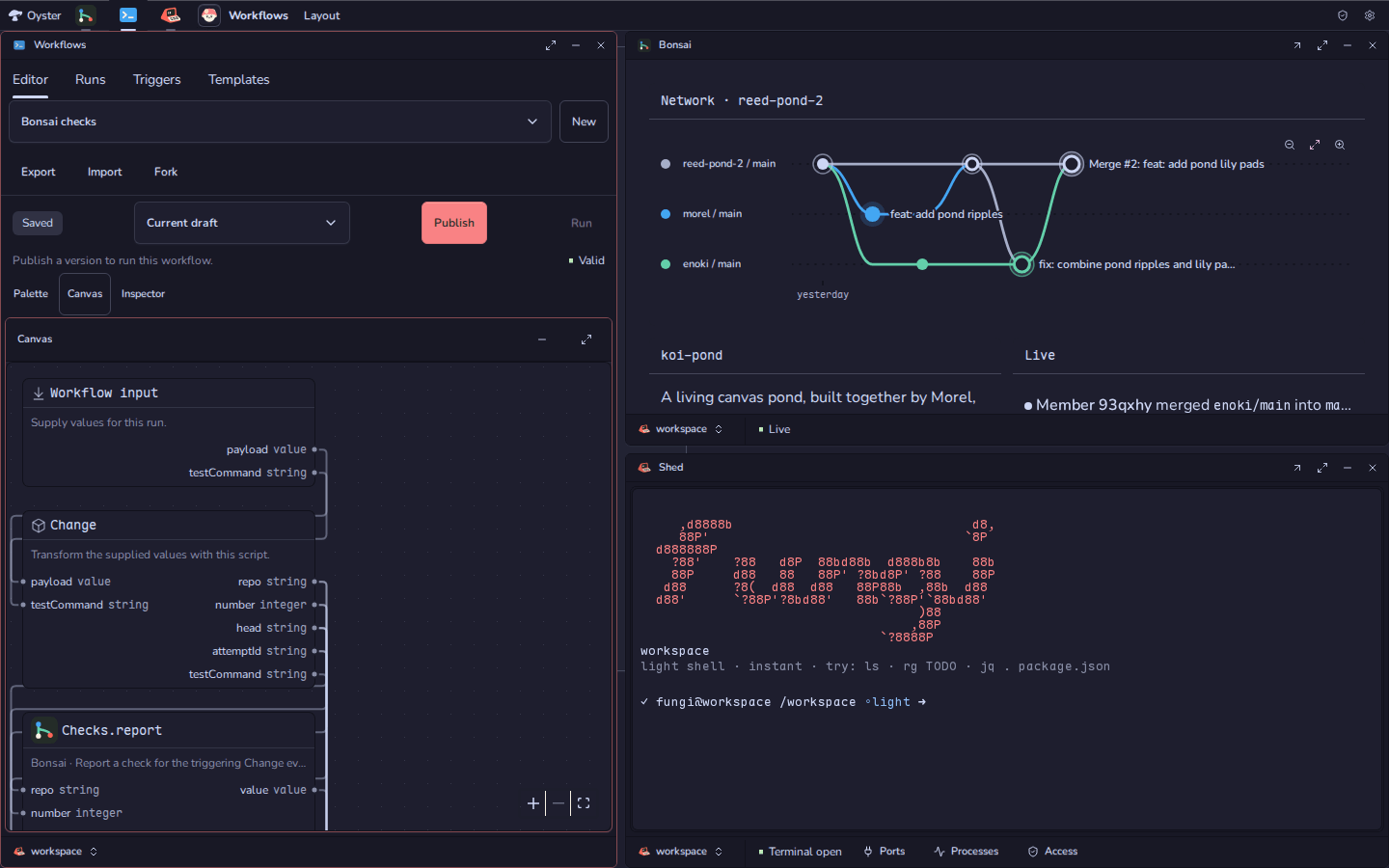
Deploy one Worker, run npx oyster install-apps, and your Oyster builds seven
Apps on its own Computer and opens on the Tourtois desktop.
Quick start: try it on your computer
No Cloudflare account, Docker or payment. You need Node 24 or newer and Git.
npx @fungi.computer/oyster try
That creates ./my-oyster, installs it, starts Oyster athttp://127.0.0.1:8787, builds the Oyster desktop (Tourtois) from its public
source, installs a one-page Hello App and opens your browser through a one-time
sign-in link (the key is never put in a URL). You land on the desktop with Hello
in the launcher; the page it opens reads Hello from my first Oyster App. The
owner key is saved in my-oyster/.oyster-owner and never printed. Press Ctrl-C
to stop, and run the same command again in my-oyster to restart. Use--port <number> for another port and --no-open to keep the browser closed.
Output is quiet: install and server logs go to my-oyster/.oyster/, and--verbose streams them instead. Piped or CI output is plain lines.
try runs these steps (shown for pnpm 11; with npm, skip thepnpm-workspace.yaml). Wrangler is an ordinary dependency; nothing is hidden.
mkdir my-oyster && cd my-oyster
cat > pnpm-workspace.yaml <<'YAML'
allowBuilds:
  "@google/genai": false
  "@mongodb-js/zstd": false
  esbuild: true
  exifreader: false
  node-liblzma: false
  protobufjs: false
  workerd: true
YAML
pnpm add @fungi.computer/oyster @fungi.computer/computer react@^19.2.0 react-dom@^19.2.0
pnpm add -D wrangler
cp node_modules/@fungi.computer/oyster/examples/standalone/{worker.ts,wrangler.jsonc} .
export OYSTER_OWNER_KEY=$(openssl rand -hex 24)
echo "$OYSTER_OWNER_KEY" > .oyster-owner
npx wrangler dev --local --enable-containers=false --ip 127.0.0.1 --port 8787 \
  --local-upstream oyster.test --upstream-protocol https \
  --var OYSTER_OWNER_KEY:$OYSTER_OWNER_KEY --var OYSTER_ORIGIN:https://oyster.test
Then it builds Tourtois from github.com/fungi-computer/tourtois the same way
(src/standalone/local-desktop.ts), and packs a committed one-pagebundled-html App with packRelease and installs it as hello withinstallRelease (both from @fungi.computer/oyster/pack) againstOYSTER_URL=http://127.0.0.1:8787; the source is src/standalone/hello-app.ts
in this package.
Locally there is no Computer, git storage or Workers AI, so you install your own
App rather than the seven starter Apps below. The
short quick start walks the
same path; the
agent quick start adds
MCP and deployment. For the full desktop, continue to the
guide to running your own Oyster.
What you get
oyster install-apps installs these Apps. Each one lives in its own repository
under github.com/fungi-computer, and each
installed App is also a template your agents can fork and rebuild on the same
Computer.
- Tourtois is the desktop: a
launcher, tiled or floating windows, menus and settings. - Bonsai hosts git repositories on
Cloudflare Artifacts. Each agent pushes to its own fork with ordinarygit,
and the network graph shows the forks folding back into main. - Grove holds conversations with
agents that call every installed App as code. - Shed opens a terminal on the
Computer, with its ports and processes. - Inkcap edits the Computer's files.
- Trellis runs typed graphs of App
methods on Cloudflare Workflows, started by a push, a webhook or a schedule. - Prints generates images and video
with Workers AI.
Stage is not published or included in the 0.3 starter set. It appears as a
glowing ember swarm and directs animated scenes and cards as an agent answers.
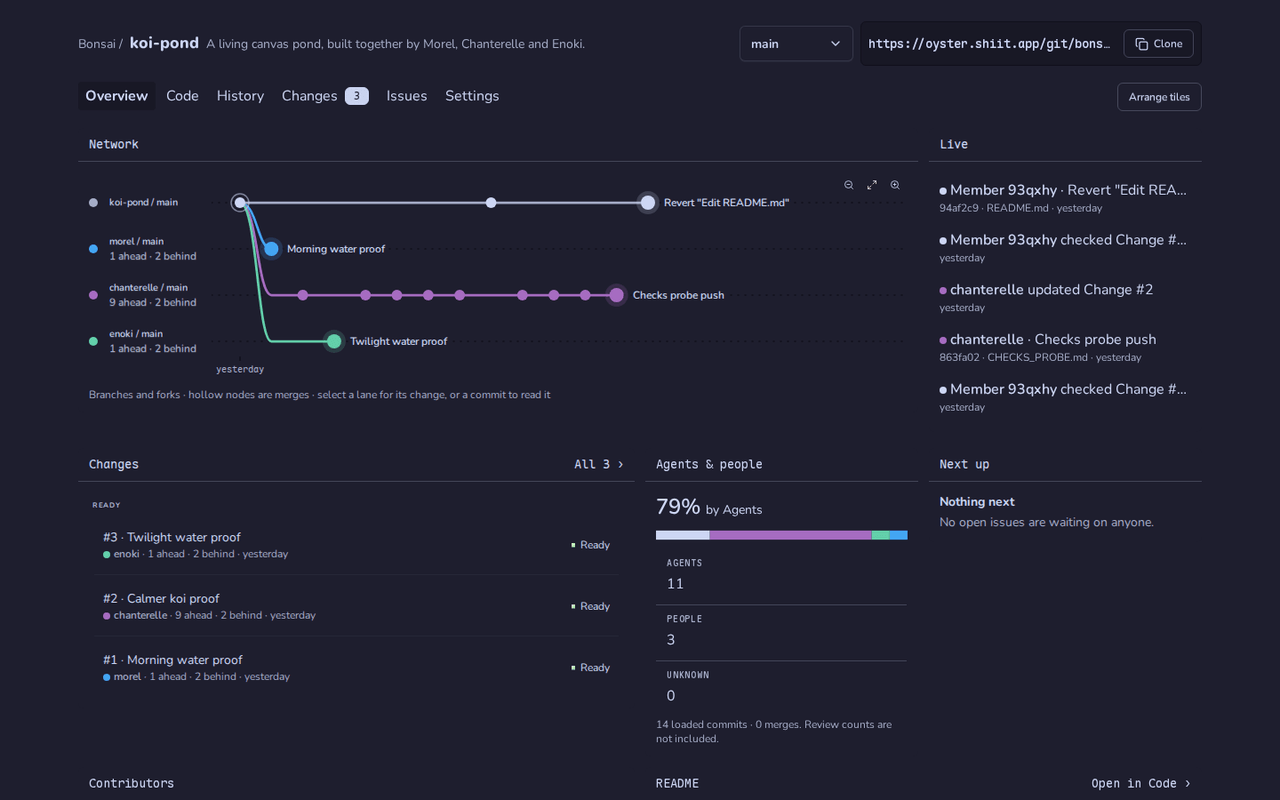 Bonsai: a repository three agents build together |
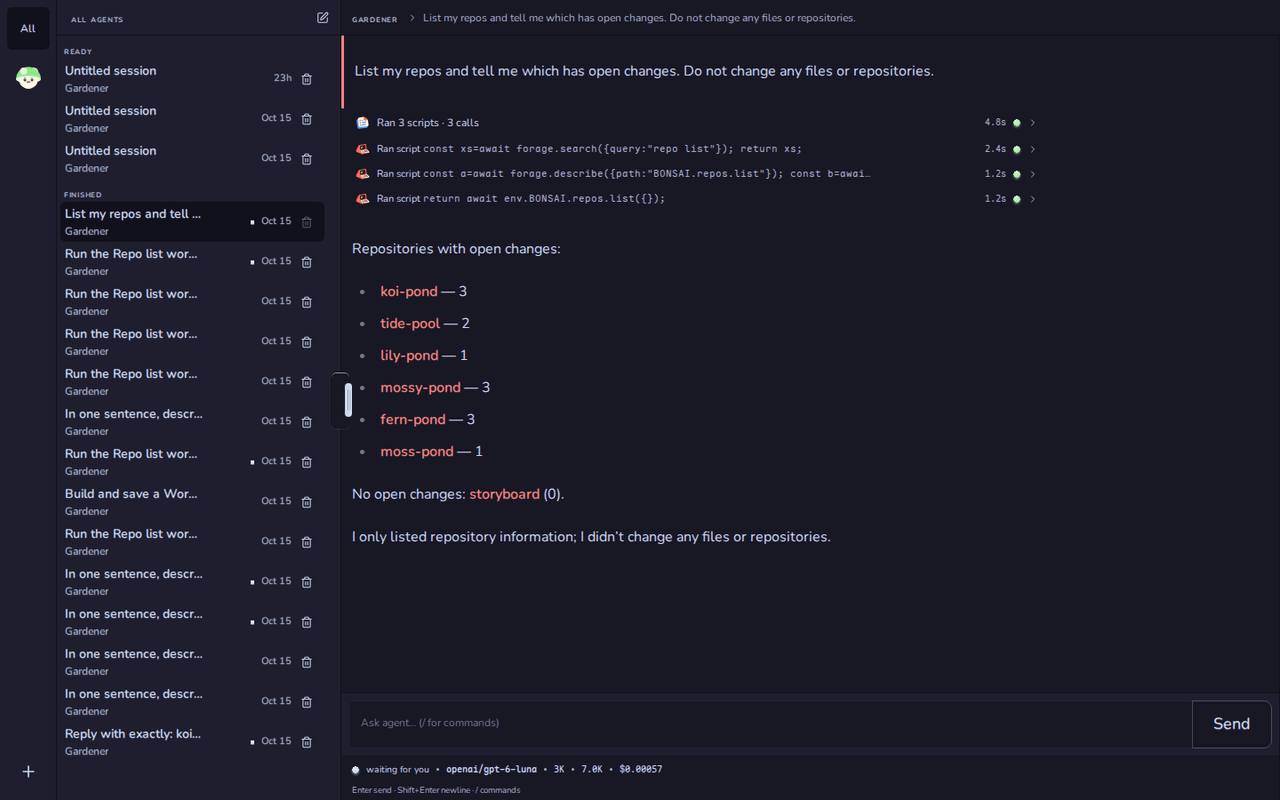 Grove: an agent answers by calling Bonsai |
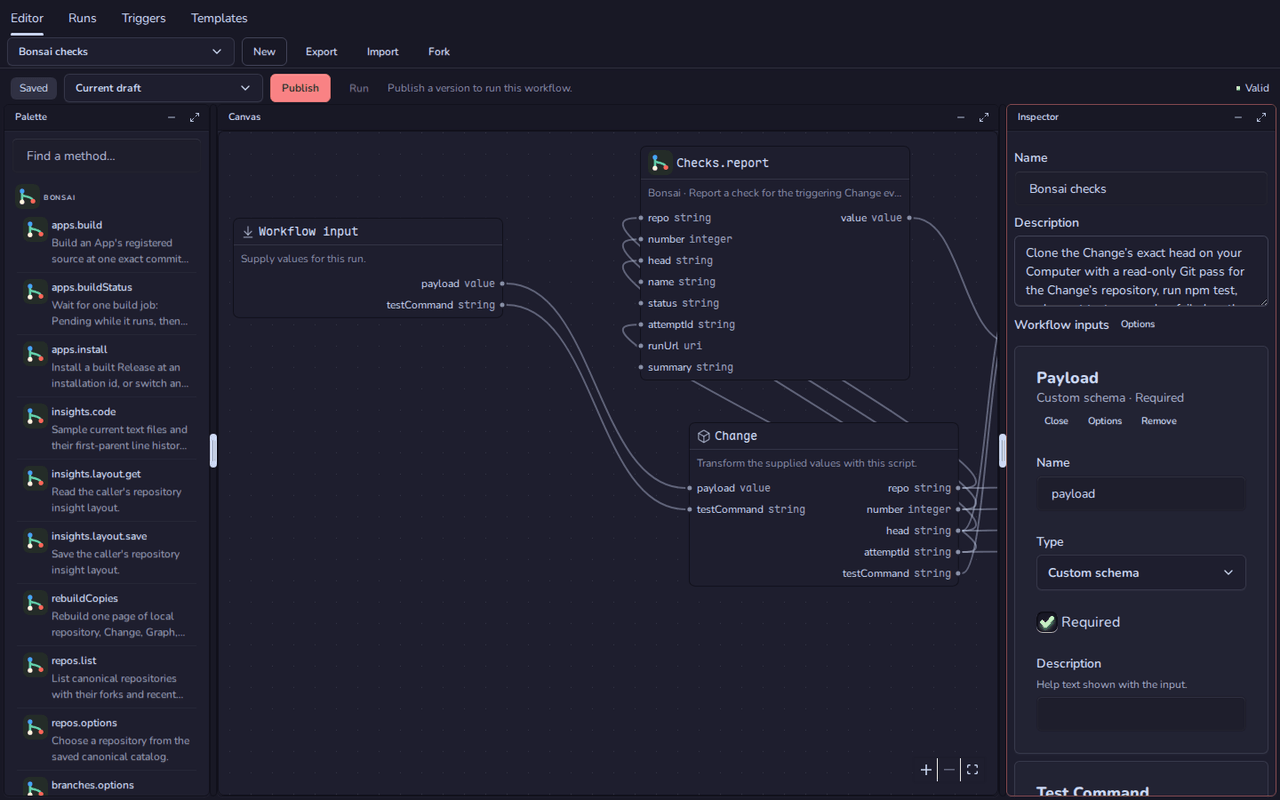 Trellis: a graph of App methods |
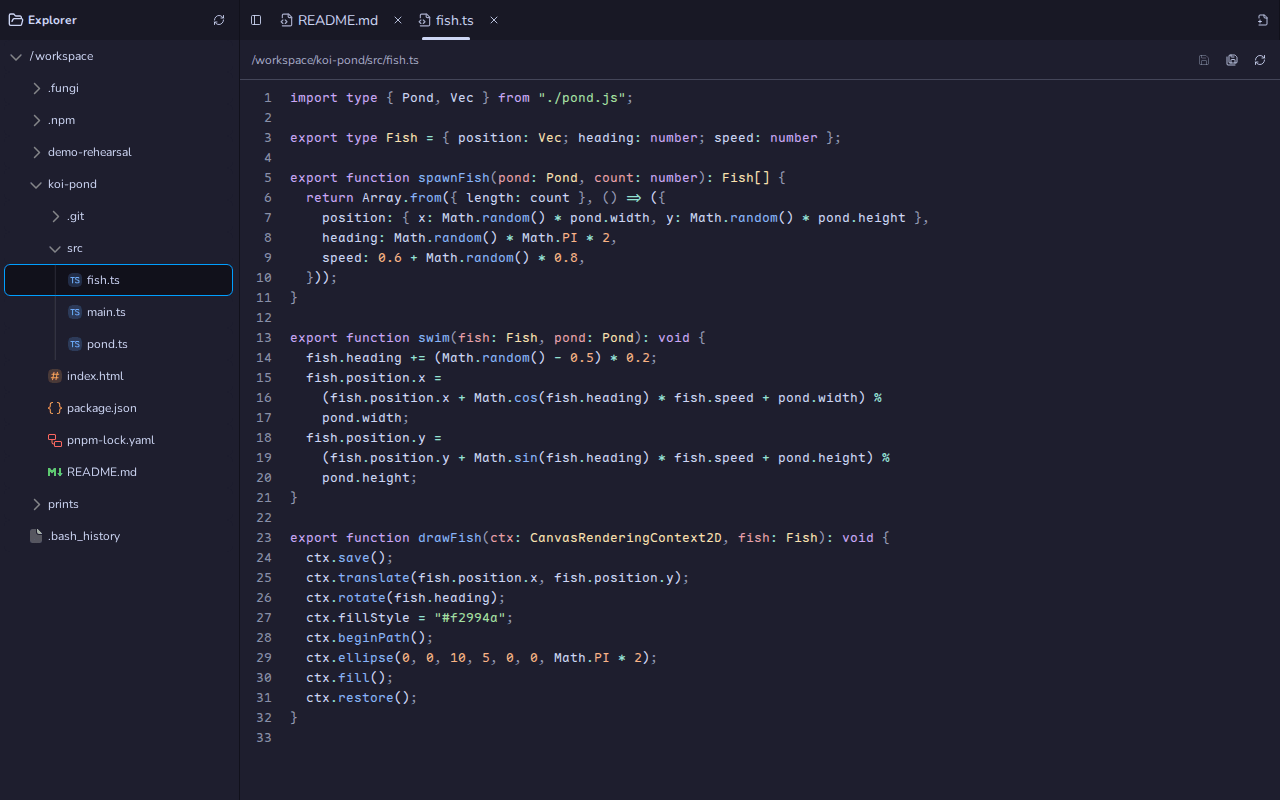 Inkcap: the Computer's files |
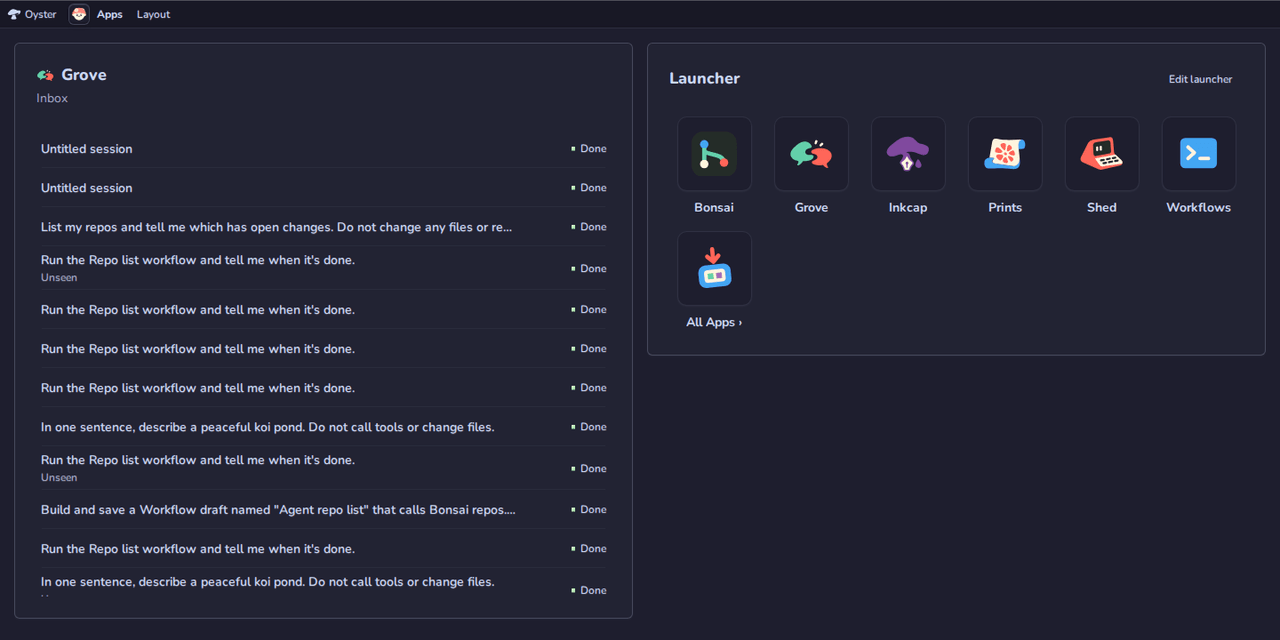 Tourtois: the inbox and the launcher |
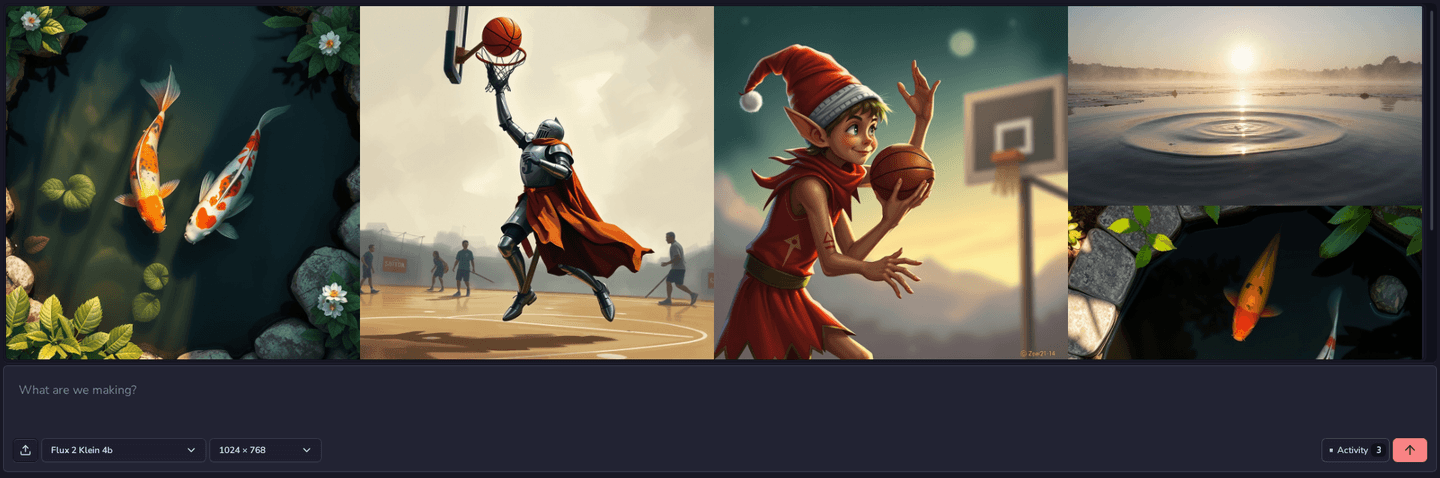 Prints: images from Workers AI |
Shed is in the desktop picture at the top. Oyster itself is the host underneath:
git through Cloudflare Artifacts, a Computer (a Linux workspace in a Cloudflare
Container) that builds Apps and runs their terminals and files, Agents on
Workers AI, Workflows and media.
Deploy to Cloudflare
Deciding what to run?
Is Oyster for you? compares
agent Computers and App builds with Cloudflare Workers Builds.
You need:
- a Cloudflare account on Workers Paid, with Containers, Artifacts, Workers AI,
Workflows and Browser Rendering (now called Browser Run) enabled; - Docker, which Wrangler uses to build the Computer's container image;
- Node 24, pnpm 11 or newer and Git.
The first install takes about 15 to 20 minutes, mostly building the seven Apps
on the Computer. By default, Oyster builds two Apps at a time. Start a project,
add Oyster, its Computer and Wrangler, and copy the example Worker out of the
package. The local pnpm policy allows esbuild and workerd to install their
native binaries and disables unneeded optional dependency scripts, so a fresh
install exits successfully:
mkdir my-oyster && cd my-oyster
cat > pnpm-workspace.yaml <<'YAML'
allowBuilds:
  "@google/genai": false
  "@mongodb-js/zstd": false
  esbuild: true
  exifreader: false
  node-liblzma: false
  protobufjs: false
  workerd: true
YAML
pnpm add @fungi.computer/oyster @fungi.computer/computer react@^19.2.0 react-dom@^19.2.0
pnpm add -D wrangler
cp node_modules/@fungi.computer/oyster/examples/standalone/{worker.ts,wrangler.jsonc} .
If pnpm add reports ERR_PNPM_IGNORED_BUILDS, check that the policy file
above exists before installing. If it names a new dependency not listed there,
stop and review that package before allowing its scripts. Do not treat exit 1 as
success.
worker.ts re-exports the whole host:
export * from "@fungi.computer/oyster/standalone";
export { default } from "@fungi.computer/oyster/standalone";
wrangler.jsonc names the Worker oyster, its Release bucket oyster-releases
and its Artifacts namespace oyster, and runs the Computer fromnode_modules/@fungi.computer/computer/Dockerfile. Its"browser": { "binding": "BROWSER" } enables Cloudflare Browser Rendering for
the zero-grant UI boot check and for Agents' browser tool. Without the binding
the UI of a Release is reported not_checked withcode: "boot_browser_binding_missing"; the install still proceeds.
Create the bucket and deploy. Your Worker's address ishttps://oyster.<your-subdomain>.workers.dev; your workers.dev subdomain is on
the Workers & Pages overview in the Cloudflare dashboard.
npx wrangler login
npx wrangler r2 bucket create oyster-releases
export OYSTER_URL=https://oyster.<your-subdomain>.workers.dev
npx wrangler deploy --var OYSTER_ORIGIN:$OYSTER_URL
Set OYSTER_ORIGIN in wrangler.jsonc instead if you deploy again later; every
deploy replaces the Worker's variables. If you rename the Worker's name inwrangler.jsonc, update OYSTER_ORIGIN to that Worker's URL at the same time.
API-token permissions and teardown
For an API token instead of wrangler login, load CLOUDFLARE_API_TOKEN into
your shell without committing it. Set CLOUDFLARE_ACCOUNT_ID (or account_id
in wrangler.jsonc) explicitly, and skip the login command. Use Wrangler
4.135.0 or newer; record npx wrangler --version for deployment and teardown.
The Cloudflare API specification
names these account-scoped permission groups for the deployment and resource
deletion operations:
| Permission group | Used for |
|---|---|
| Workers Scripts Write | Deploy, secrets, Worker deletion and Workflow deletion |
| Workers R2 Storage Write | Release bucket creation, object cleanup and bucket deletion |
| Workers Containers Write | Computer container application management |
| Artifacts Edit | Artifacts namespace and repository management |
Browser Rendering through the Workers BROWSER binding
needs no additional API-token permission.
The separate Browser Rendering Write permission is for its REST API, which this
quick start does not use. Workers Paid entitlement is still required.
For stream-rehearsal diagnostics, include Browser Rendering (Read) in the
account-scoped token checklist: it permits REST session inspection, separate
from the BROWSER binding's boot operation. Use the documented/browser-rendering/devtools/session list and devtools/session/{session_id}
details operations; a session's endTime, not its connection end time, reports
closure. A plain 404 from another route does not establish a missing permission.
If inspection is unavailable, record UNAVAILABLE, not confirmed cleanup. Do
not broaden an existing token automatically.
With an explicit account ID, user/account discovery is unnecessary. Do not add
Workers KV Storage Read, User Details Read or Memberships Read just for that
discovery. Wrangler 4.135.0 treats denied legacy-Sites KV inspection duringwrangler delete as a warning, not a reason to broaden this token. AI Gateway
Read/Edit permissions are not needed for this deploy or a teardown before any
media ran; inspect that additional resource if media has created a gateway.
npx wrangler delete deletes the Worker, not the entire Oyster. For a throwaway
deployment, also empty and delete the Release bucket, delete the Computer's
container application, delete the Workflow, and delete the Artifacts
repositories and namespace. Use the configured resource names and confirm each
is gone through Cloudflare's dashboard or API. Capture teardown errors and the
Wrangler version rather than silently adding unrelated token permissions.
Upgrading Oyster
Oyster's version is not Fungi's. Find the Oyster and Computer versions for your
Fungi release on the
Open source page,
then run the upgrade command in
Upgrade Oyster
in your Oyster project, with the same pnpm and store that installed it.
Redeploy with the same npx wrangler deploy command you deployed with, then runnpx oyster install-apps. If pnpm stops with ERR_PNPM_UNEXPECTED_STORE, rerun
the pnpm add with --store-dir set to the store the error says the project is
linked from.
Upgrading to owner-only Oyster
Upgrading to 0.7.0 resets the installed Apps when the registry contains the
pre-owner-only visibility, approvedAnonymousMethods or anonymousApproval
fields. This clears all installation rows and their installation command journal
once, renews the store incarnation, and permanently records the reset time and
row count. It does not uninstall Apps through their storage-purging delete path.
Agents, Sessions, files, keys, source and release data, tenancy, approval
records and Computer state are retained.
While no App is enabled, Oyster Home shows:
This update reset your installed Apps. Reinstall them with npx oyster
install-apps.
Run npx oyster install-apps to reinstall. The notice disappears when an App is
enabled; the audit fact remains. This is not a compatibility reader or a reset
on arbitrary corruption. The separate pre-0.3 refusal below is unchanged.
Same-ID App settings: kept and back after reinstall; backend SQLite: kept but
not reachable.
Each installed App's own backend database (for example saved Notes) stays in
storage but is no longer reachable; reinstalling creates a new App Instance that
starts empty. There is no recovery for App backend data in 0.7.0; reinstalling
with npx oyster install-apps restores the Apps and their same-ID App settings,
and Agents, Sessions, files and keys are retained.
These are different stores. Backend SQLite belongs to the Instance's app
facet. Host APP_STORAGE settings instead belong to the installation address
plus App ID, key, scope and member membership version; the starter installer
reuses the same installation IDs, so the same App reconnects to those settings.
There is no automatic backend-data reattachment or change to either keying
scheme. Files on Computers and Agent/Session data have their own retained
owners.
Upgrading from Oyster 0.2 or earlier
Oyster 0.3 does not read data created by Oyster 0.1 or 0.2, and it does not
convert it. An Oyster deployed on 0.2 and redeployed on 0.3 answers every
request with 409 and {"error": "store_from_older_oyster", ...} (a short
explanation page in a browser), and oyster install-apps prints the same
message. Old data is left untouched, so redeploying 0.2.x brings the Oyster back
exactly as it was.
To move to 0.3, start from a fresh store. The smallest way is to deploy under
new names, leaving the old Oyster in place until you no longer need it. Inwrangler.jsonc, rename name, both bucket_name values,artifacts.namespace and every workflows[].name; create the new release
bucket; then run the quick start again. To reuse the names instead, tear the old
Oyster down as in the teardown steps above (delete the Worker, which deletes its
Durable Object data; empty and delete the release bucket; delete the Computer's
container application, the Workflow, and the Artifacts repositories and
namespace), then deploy 0.3 and reinstall the Apps. Data in the old Oyster, such
as Apps' stored data, is not carried over.
Set the Oyster owner key
Choose an owner key (separate from the Cloudflare API token) and store it as a
secret:
export OYSTER_OWNER_KEY=$(openssl rand -hex 24)
printf '%s' "$OYSTER_OWNER_KEY" | npx wrangler secret put OYSTER_OWNER_KEY
Set the credential key (to bring your own model keys)
Model API keys you add in Settings are sealed on your Oyster under a 32-byte
credential key held as a host secret. Generate it at install; it is never in the
repository, storage or logs. Without it, adding a model key is refused.
openssl rand -base64 32 | tr '+/' '-_' | tr -d '=\n' |
  npx wrangler secret put OYSTER_CREDENTIAL_KEY
Keep a copy: losing it makes the sealed keys unreadable, and you re-add them.
Install the starter Apps
npx oyster install-apps
The installer clones each App's repository, seeds it on your Oyster withgit push, and builds the Apps on your Computer, Tourtois first, installing
each as its build succeeds. It prints a line per step and then where the time
went:
tourtois source recorded at git:…
…
Building tourtois on the Computer (build_…)
Installed tourtois from its build build_…
Building bonsai on the Computer (build_…)
…
Installed grove from its build build_…

App	fetch	seed	queue	build	clone	deps	compile	upload	install
tourtois	…
…
Installed 7 Apps in …. Open https://oyster.<your-subdomain>.workers.dev/ to use Tourtois and the installed Apps.
Open $OYSTER_URL/login and sign in with the owner key: your Oyster opens on
the Tourtois desktop with all seven Apps, as in the pictures above.
Run install-apps again to update them; a replaced Release keeps each App's
data. --ref picks a branch or tag of the App repositories, --repositories
another host for them, and --timings <file> writes the timing table as JSON.
Builds run two at a time on the example's standard-4 Computer (12 GiB).--concurrency 1 runs them one at a time and --concurrency 3 three at once.
Git, keys and MCP
People and agents clone, fetch and push App repositories with ordinarygit at /git/<installation>/<repo>.git. Give each agent its own key; Oyster
shows each key once:
curl -s -X POST -H "Authorization: Bearer $OYSTER_OWNER_KEY" \
  -H 'content-type: application/json' \
  -d '{"name":"morel","grants":[{"capability":"apps.use","targets":{"kind":"all"}}]}' \
  $OYSTER_URL/api/keys
The answer's plaintext field, starting oyk_, signs in to git and to/mcp. That key can read and write every App on this Oyster, including Apps
installed later, without asking each time; anyone holding it can act as the
owner in those Apps, and revoking it stops it immediately.
Any MCP client can call every installed App with a key. For Claude Code:
claude mcp add --transport http oyster "$OYSTER_URL/mcp" \
  --header "Authorization: Bearer <the agent's key>"
Part of Fungi
Fungi runs AI Agents on their own Computers, inside
Teams that share Agents, Computers, Apps and a bill. Oyster is its App host,
released on its own, and it is built from 21 more Fungi packages released with
it. Each one is MIT-licensed, has its own repository atgithub.com/fungi-computer/<name>, installs from npm as@fungi.computer/<name>, and works without the rest. Installing Oyster brings
in the ones it runs on.
Apps and hosting:
- Agar: the App contract. Typed
backend methods, host capabilities and the connection between an App's
frontend and its host. - Puffball: a catalog of web Apps
and their immutable Releases, which serves only promoted Releases and checks
every artifact against its recorded digest. - Gills: compact plain-text App views
shared by browser and terminal hosts. - Whistle: one command definition
becomes key bindings, a command palette, slash commands, help, a menu and an
agent tool, all running through one typedexecutedoor.
Agents and tools:
- Shiitake: durable Agent
conversations. A Session holds accepted work, messages and observations; the
host supplies storage, models and tools. - Mule: runs Pi's model and tool loop
inside Effect as an awaited, cancellable run. - Mycelium: gives an Agent typed
operations through oneexecutetool, with a capability snapshot acquired and
released per run. - Knapsack: connects an Agent to
Computers, files and remote MCP servers as Mycelium capability sources. - Forage: lists, searches and
describes a catalog of operations, so a caller or a model finds the right one. - BirdDog: durable mail between
agent sessions, with replies retried from an outbox until they are accepted.
Durable work, git and keys:
- Watchdog: a small durable job
engine on SQLite, D1 or PostgreSQL. Each job settles with exactly one recorded
outcome, even across restarts. - Carrier: durable email delivery
whose receipts record only what the provider said, and ordered envelopes
between Durable Objects. - Burrow: the repository owner for
Cloudflare Artifacts, serving only Git's smart-HTTP operations and never
returning a credential. - Ear Tag: bearer keys and their
hashes, a typed grant vocabulary, and a tenant-scoped key store with
revocation, expiry and a per-key rate limit. - Cairn: typed, opaque identifiers,
temporary keys and candidate word names, with their parsers.
Interface:
- Stipe: a CSS-first theme layer for
Tailwind CSS v4 and daisyUI 5, with spacing, fonts and material tokens. - Caps: accessible React primitives
and blocks, from buttons and dialogs to a chat composer and window frames,
themed by Stipe. - Maosaico: arranges React panes
inside a measured container, with floating frames and optional tiling. - Sigils: Fungi's decorative SVG
marks and their gallery. - Sprite: shows an animated
character through a renderer the host installs. - Sprite Zdog: a Canvas
renderer for Zdog characters, with built-in characters and authoring tools for
Sprite.
Hand this to your agent
Paste this prompt into a coding agent (Claude Code, Codex or any other) to have
it set up a local Oyster, install an App, connect over MCP and deploy:
Set up Oyster for me. Install it from npm as @fungi.computer/oyster and follow
https://github.com/fungi-computer/oyster/blob/main/docs/site/agent-quickstart.mdx
step by step. Run each command exactly as written, compare its output with the
expected output, and use the "If it fails" notes before improvising. Stop and
ask me before step 7 (deploy).
The guide ships in the package as docs/site/agent-quickstart.mdx. It needs
Node 24, pnpm and Git; a Cloudflare account matters only for the deploy step.
Why Oyster
Apps are Releases with provenance. packRelease builds an App from one
commit and records it as sourceRevision: git:<sha>. Every artifact is
addressed by its SHA-256 digest, and Oyster verifies each digest before it
installs or replaces a Release. Replacing a Release keeps the App's data;
deleting it purges the data and leaves a tombstone.
Every App is isolated. An App's backend loads through a Worker Loader into
its own Durable Object facet with its own SQLite database. It has no ambient
network access. It receives only the bindings its Release declares (GIT,EVENTS, Computer, agent, workflow, media), and Oyster checks that declaration
again on every request. App pages are served with a deny-by-default Content
Security Policy inside a sandboxed frame.
Git is a binding. An App that declares git.repository gets env.GIT:
create, fork, log, read and merge on Cloudflare Artifacts, scoped to its
installation. People and agents push with ordinary git through Oyster's git
door using their own keys; the host keeps every provider credential. Each
accepted push reaches the App's onGitPush handler and can start a Workflow or
a signed webhook.
Agents are first-class callers. POST /mcp serves one MCP endpoint for the
whole Oyster. Every installed App's methods appear as typed env.<APP> modules
that an agent discovers and calls from code; a dotted method is a nested
property, e.g. env.BONSAI.repos.list({}). Writes need explicit approval. Each
agent has its own key, so every push and call is attributed.
Workflows compose Apps. Trellis stores each graph in git, so a commit is a
version. Each graph compiles to a plan with a digest and runs on Cloudflare
Workflows. Steps call App methods and can run a sandboxed Code node or a step in
a Computer.
Computers are ordinary capabilities. A Computer is a durable workspace with
a Container backing. Shed opens its terminal, Inkcap edits its files and port
previews serve what it runs on signed hostnames. Apps reach it only through thecomputer.* capability they declare.
The desktop is a trusted shell. Tourtois is installed like any other
Release, but your Oyster renders its home installation as the top-level page,
with every permission you have as owner. Each App it opens still runs in its own
sandboxed frame inside that App's window. Pick a shell you trust: it can do
anything you can.
Architecture
An Oyster is one Worker. Every App installed on it is an immutable Release built
from an exact git commit. Its UI runs in a sandboxed frame, its backend runs in
its own Durable Object with its own SQLite, and it receives only the bindings it
declares. Agents reach every installed App through one MCP endpoint. The same
Worker runs on Cloudflare Workers and on celld, a Workers-compatible runtime you
can host yourself.
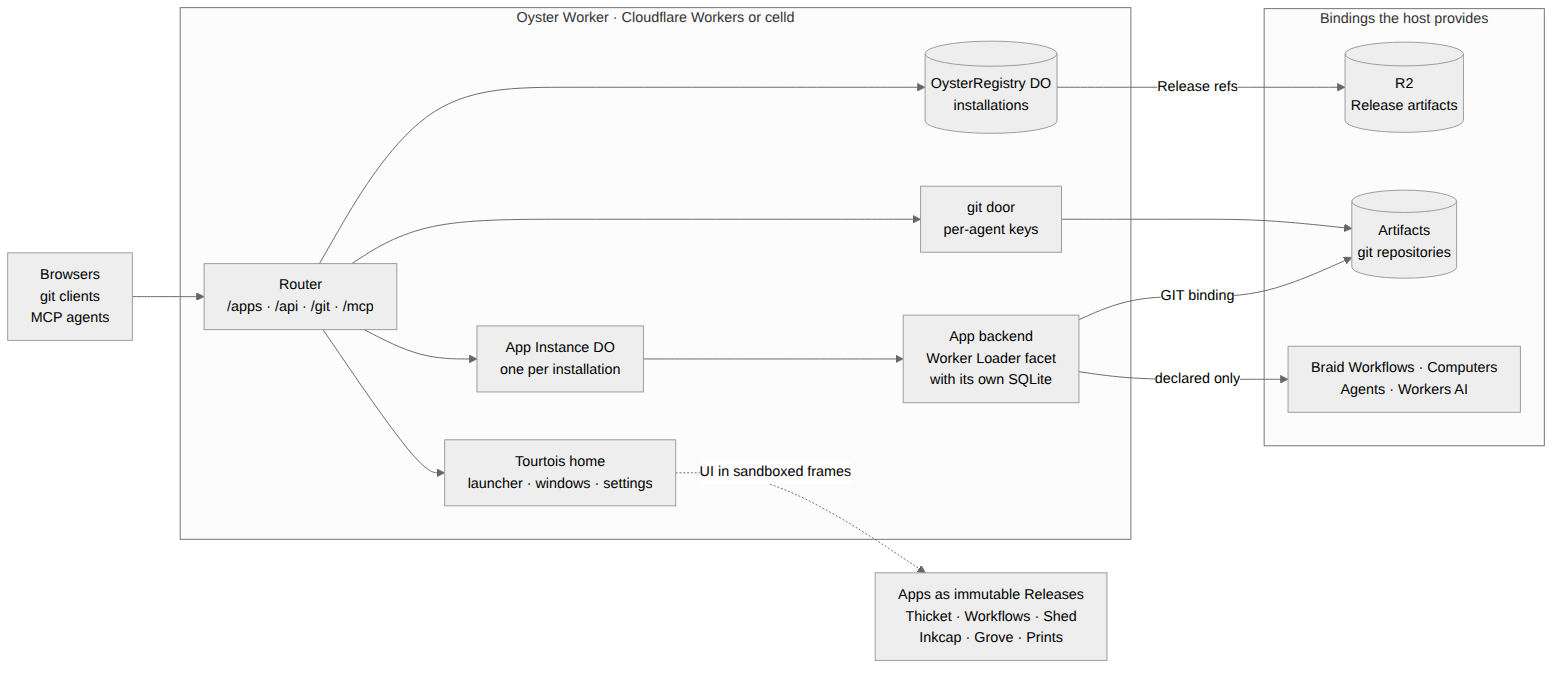
| Piece | Owns |
|---|---|
| Router | One declared route table (authorization.ts): sign-in, App pages and methods, owner routes, /mcp. |
OysterRegistry |
The installation list: which Release each installation runs. |
| R2 | Release artifacts, stored by digest. |
| App Instance | One Durable Object per installation: lifecycle, owner state and the backend facet. |
| Backend facet | The App's own code and SQLite database, loaded through the Worker Loader. |
| git door | Smart-HTTP clone, fetch and push, admitted per key and forwarded to Artifacts. |
| Tourtois | The trusted shell: launcher, windows, menus and settings, rendered as the top-level page. |
| Platform bindings | Workflows, Computers, Agents and Workers AI, offered only to Apps that declare them. |
The diagram source isdocs/media/architecture.mmd.
Install or set up
pnpm add @fungi.computer/oyster
Oyster is ESM only and runs on Node 24 or newer, Cloudflare Workers and celld.
React and React DOM 18.3 or 19.2 are peer dependencies; the host renders its
pages with them. Wrangler is an optional peer dependency: add it as a dev
dependency to run or deploy the example Workers, which ship in the package underexamples/. The generated API reference ships in the
package too.
Oyster's runtime dependencies are other Fungi packages, among them
Agar for the App contract,
Puffball for Releases and
Mycelium for the MCP execute
door. "Part of Fungi" above lists them all.
Run your own Oyster
@fungi.computer/oyster/standalone is the whole host the quick start deploys:
the git root below plus tenancy, a Computer (ComputerDO, a Cloudflare
Container or an on-box VM), Agents on Workers AI composed from stock
Shiitake Durable Objects,
Workflows, media, and the owner routes that seed App templates and build them on
the Computer. examples/standalone/wrangler.jsonc declares every binding it
uses. Set the owner key as a secret (OYSTER_OWNER_KEY, 24+ characters) and
deploy with wrangler deploy. Sign in at /login.
Oyster is owner-only. A browser signs in only with the owner key, through/login and its SameSite=Strict session cookie. Named keys sign in only by
header (Authorization), for MCP, Git and the API; no cookie admits a named
key. Anonymous requests reach only /login, robots.txt, digest-pinned shell
and App UI bytes, and the website chat described next.
Website chat on a separate site
Owner-only means only the owner signs in to Oyster; it does not stop you from
putting an Agent on a public website. In Settings, choose Channels, then Add
website: pick the Agent, give the address of your site and a brief, and paste
the script tag Oyster shows you into that site:
<script
  src="https://your-oyster.example/embed/v1.js"
  data-site="site_pk_…"
  data-theme="auto"
  async
></script>
Visitors are anonymous channel parties of that one Agent, never Oyster
principals, keys or App callers. They talk to the Agent itself, with its own
tools and permissions and the persona you wrote added to its instructions; they
cannot sign in to Oyster or reach your account. Each site has its own key, a
list of allowed origins, rate limits per visitor and per network address, and a
pause switch; a new site key stops the old code at once. The same page can
require a Cloudflare Turnstile check before a visitor can chat, and shows the
conversations so you can read what visitors said.
The surface is closed until you set two host secrets, each at least 32 bytes:OYSTER_WEBSITE_PROOF_KEY signs a visitor's identity between the public edge
and the website Agent, and OYSTER_WEBSITE_ADDRESS_KEY salts the hashed network
address used for rate limits. For Turnstile, set TURNSTILE_SITE_KEY andTURNSTILE_SECRET_KEY (or TURNSTILE=off for local use over http).
The celld example is a limited trial, not the full Cloudflare setup above. It
requires access to Fungi's private celld fork. Useexamples/standalone/wrangler.celld.jsonc beside worker.ts, not the
Cloudflare-only config. Oyster 0.6.0 includes both files underexamples/standalone in the installed package.
The layers it is built from stay exported for hosts that compose their own:@fungi.computer/oyster/turnstile owns Cloudflare challenge configuration and
token verification. Hosts supply their origin, verification timeout and safe
error reporter; they retain their own challenged routes and HTTP responses.
Configuration keeps the explicit TURNSTILE=off opt-out and fails closed on
HTTPS hosts without both keys. Hub retains its five-second verification policy.
Other host building blocks: @fungi.computer/oyster/workers (Releases,
Instances, MCP and App storage) and @fungi.computer/oyster/workers-git (the
git door), with oysterAppMethods supplying the installed App catalog to an
Agent runtime.
Pack and install an App with @fungi.computer/oyster/pack: packRelease turns
an exact Git commit and a canonical build recipe into a Release with immutable
artifacts, and installRelease uploads it. Each installed App gets:
- its UI at
/apps/<installation>/, in a sandboxed frame connected through
Agar'sapp.backendcapability; - its methods at
POST /apps/<installation>/methods/<name>(JSON in and out); - its own SQLite state in its Instance's
appfacet.
createOyster(host) from @fungi.computer/oyster/host is the same server over
your own adapters (auth, artifacts, installations, instances, mcp,capabilities).
Add Git to your host
Git is one optional field of the typed host: host.git. When it is present,createOyster mounts the git door at /git/<installation>/<repo>.git, and
people and agents clone, fetch and push with ordinary git. Nothing else in
the host changes.
There are two ways to get it:
- Use one Git root.
oysterGitRoot(options)from@fungi.computer/oyster/workers-gitis the whole composition: the git door
plus tenancy, Agents and their owner-only approval routes, workspace and
capability slots, the page script and the home App. ItshostFor(env, scope)
is the only way a tenant host is built. Pass the root tocreateOysterGitWorkerfor HTTP and tocreateOysterGitMcpOwnerfor MCP, and
returnroot.hostFor(this.env, scope)from yourOysterGitInstancesubclass,
so HTTP, MCP and background wakes share one composition.tenancyis
required; a single-owner root passesownerOrKeyTenancy, so the owner key and
named keys sign git in.@fungi.computer/oyster/standaloneis a real
multi-door caller. Itswrangler.jsoncadds theARTIFACTSbinding and theKEYSandWEBHOOKSDurable Objects. - Set
host.giton your own host. Keep your owncreateOyster(host)
composition and setgit: oysterWorkerGit(env, { scope })andownerRoutes: gitAdminRoutes(env, scope)for/api/keysand/api/webhooks,
with the tenantscopeyour host selected.
The git root, from Workers:
import type { TenantScope } from "@fungi.computer/oyster/tenant";
import {
  createOysterGitMcpOwner,
  createOysterGitWorker,
  OysterGitInstance,
  oysterGitRoot,
  ownerOrKeyTenancy,
  type OysterGitWorkerEnv,
} from "@fungi.computer/oyster/workers-git";

const root = oysterGitRoot<OysterGitWorkerEnv>({ tenancy: ownerOrKeyTenancy });

export class OysterMcp extends createOysterGitMcpOwner(root) {}

export class OysterInstance extends OysterGitInstance {
  protected hostFor(scope: TenantScope) {
    return root.hostFor(this.env, scope);
  }
}

export default createOysterGitWorker(root);
A host also exports the Durable Objects and the git OysterBinding entrypoint,
whose table also serves env.GIT and env.EVENTS. The package'stest:git-door check runs that root (test/git-root.fixture.ts) on workerd
against real bare repositories: the owner pushes with git, a named agent key's
push is refused by the App's policy with Git's own ng report, both keys clone,
and the accepted push reaches the App's onGitPush.
Each layer owns one decision:
flowchart LR
  client["git client<br/>clone · fetch · push"]
  auth["Authentication<br/>owner key · named key<br/>Workflow Git pass header"]
  admission["Git admission<br/>enabled installation · git.repository<br/>tenant scope · Workflow branch grant"]
  policy["App push policy<br/>authorizeGitPush, every ref"]
  burrow["Burrow<br/>Artifacts provider and repository<br/>host-held credentials"]
  events["App events<br/>journal → onGitPush → env.EVENTS<br/>webhooks · Workflow triggers"]
  client --> auth --> admission
  admission -- "push: ask first" --> policy
  admission -- "admitted bytes" --> burrow
  burrow -- "accepted refs" --> events
- Authentication is the host's own
auth. The owner key is a Bearer token;
a named key may also be the Basic password from a git credential helper. A
Workflow Git pass (awgp.Bearer header, never in a URL) goes only tohost.git.workflowPass; without that port it admits nothing. Anonymous
requests never clone or push. - Git admission reopens the live installation before every provider call: it
must be enabled and its Release must declaregit.repository. The tenant
scope prefixes every repository name (<installation>--<repo>for the default
tenant), so an installation reaches only its own repositories. A Workflow
writer may push only the branches its grant names. - The App's push policy answers
authorizeGitPushfor every ref update
before any bytes reach the provider. One refusal rejects the whole push with
Git's nativengreport. Unsupported receive-pack commands, including signed
push certificates, fail closed. - Burrow owns the provider and the repository. The host's Artifacts adapter
mints short-lived credentials through it and forwards the admitted smart-HTTP
exchange (up to 64 MiB per request); the App sees repository names, git
objects and its own events, never a credential or remote. - App events start from the accepted-ref journal. Delivery calls the
selected Instance'sonGitPushwhen the Release declaresreceives: ["git.push"]andgit.repository. The App emits typed events
throughenv.EVENTS: Oyster delivers them as signed Standard Webhooks, and a
host with Cloudflare Workflows (the Hub, or a standalone host's root) starts
the Workflow triggers armed on that event.
Agent approval stays owner-direct in both compositions: the approval routes are
owner routes, refuse App-origin requests, and are never an OysterCapability an
App can be granted.
Git bindings, journal and lower-level ports
A Release's backend.bindings determines whether its App gets env.GIT
(Cloudflare Artifacts, scoped to its installation; credentials stay in the host)
or env.EVENTS (delivered as Standard Webhooks to subscriptions the owner
creates at /api/webhooks). Each binding enforces its declared operations.await env.GIT.cloneUrl(repo) returns the host-issued clone URL; an undeclared
binding grants nothing. Declaration changes invalidate the loader entry even
when the backend bytes stay the same. Agents push with keys from /api/keys.
Hosts compose one createAdmittedGit with an installation-scoped store, live
host grants, the App's typed authorizeGitPush policy and an accepted-ref
journal. GitWriter, GitPushQuestion, GitPushVerdict and accepted facts
come from @fungi.computer/agar/git; the shared wire parser is inagar/git-wire.
An App's own GIT binding uses admitted.binding(onBehalfOf). Its writer isinstallation, with the host-attested caller retained in onBehalfOf. These
writes skip the App's external-push policy, retain live host admission and enter
the same accepted-ref journal. The journal records only refs accepted by the
provider and commits before the exchange is acknowledged. Redelivery keeps the
complete original fact and eventId; handlers record that ID with their
effects.
createGitPushJournal composes the standalone Instance's SQLite owner with
Carrier delivery and an alarm hook. Its accepted fact, ref tips and Carrier send
commit together; Carrier retains delivery attempts across restarts and retries.
The Hub composes its ref journal and TeamPost.sendGitPush in one host
transaction. Neither HTTP routing nor the provider adapter creates a second push
fact.
createGitDoor from @fungi.computer/oyster/git accepts the host'sauthenticate, isPublic and git ports. authenticate receives the request
and the exact installation, repository and read/write scope it names. The last
returns an AdmittedGit; the door forwards reads to .read and pushes to.push. Provider credentials stay inside the storage adapter. createOyster
builds these ports from host.auth, host.installations and host.git, so
most hosts set host.git and never call createGitDoor directly. There a named
key signs Git in only for installations its own grants reach: a clone needs App
read and a push needs App use; otherwise the door refuses it.
A host whose Workflow run owner issues Workflow Git credentials suppliesworkflowGitPass in oysterGitRoot or oysterWorkerGit options. The run owner
issues one credential per native command of an admitted Git step and gives it
only to that command's Git environment. It travels only as anAuthorization: Bearer header starting with Braid's workflowGitPassPrefix
(wgp.) on the ordinary credential-free door URL; it is never part of a URL.
That header is admitted only by the port, for one repository and scope, as the
arming member under the Workflow's branch grant, and never as a session or key.
It stops working when its command closes or its run ends. Pushes outside those
branches are refused before the App's push policy runs.
Provide App capabilities
Each OysterCapability supplies its Agar id and version, a mount base,
relative declared routes (a routes() table from@fungi.computer/oyster/authorization, where every route names its requirement:owner, agent, computer, member...), and methods. Each method
descriptor has kind, method (HTTP method), and path (relative route).CapabilityMethodKind is json | transport | read | write: JSON calls return
decoded data, transports return Fetch handles, and reads/writes return Agar's
stream handles.
Method paths may contain named parameters, such as :agentId/sessions. Oyster
uses path-to-regexp to compile input fields into those parameters; remaining
scalar fields become query parameters for GET and handle calls. Other JSON calls
keep their remaining fields in the request body. Transport handles append their
Fetch pathname below that resolved route and may declare method: "ANY" to
retain the request's HTTP method. JSON results, including Agar's{ kind: "pending", retryAfterMs }, reach the App unchanged; the page does not
poll on the App's behalf.
For example, a directory method uses{ kind: "json", method: "GET", path: "list" }; a file read uses{ kind: "read", method: "GET", path: "content" }. fileCapabilities(source)
from @fungi.computer/oyster/files supplies the three file contracts over the
existing /files/ GET, PUT and POST routes.
The page offers a capability only when the installed Release declares its ID andadmits allows the principal. Every route request also rechecks that
declaration and admission using the X-Oyster-Installation header set by the
page; a read grant does not authorize the write route sharing its file mount.
Consent approves capabilities, like OAuth scopes. An App upgrade may add a
method that uses an already-approved capability without asking again. A new
capability always needs approval. Release selection intersects stored operation
and resource approvals; it never adds a grant. Every Worker call receives only
the bindings allowed by that method's declared requires, rather than all the
App's approved capabilities.
The agent.manage consent wording is Can create Agents; write abilities need
your approval.
The apps.call permission also shows the declared target Apps and methods. Its
route approvals retain those exact pairs: adding or renaming a target method
needs owner approval. On Oyster these page calls run as the signed-in member
through the target App's ordinary method gate; Agents and keys cannot use this
path. The target receives its own grants, never the caller App's grants. The Hub
shows the same consent list but does not offer this page capability.
Connect an agent over MCP
Connect your MCP client to https://<your-oyster>/mcp withAuthorization: Bearer <key>. Installed App methods are available throughexecute as env.<APP>; a dotted method is a nested property, e.g.env.BONSAI.repos.list({}); discover them with forage.search andforage.describe. A key's or Agent's App writes run under the owner's stored
approval of its App tools (recorded when the owner creates the key), so a
headless client such as claude -p can write. That approval already covers
every App on this Oyster, including ones installed after the key existed, with
no per-call prompt; anyone holding the key can act as the owner in those Apps,
and revoking the key is what stops it. Every other write, including the owner's
own calls, requires a client that supports form elicitation and explicit
approval; anonymous callers are refused.
When the host has a Computer, the catalog also holds it asenv.computers.workspace, e.g.env.computers.workspace.exec({ command: "ls", cwd: "/workspace" }). Its
operations are the ones every Computer advertises (read, list, write,mkdir, bash, exec and the process tools), and each call asks for approval.
The host supplies computer(principal) on its workspace: it returns the
Computer's calls for a caller with Computer access and null otherwise. The
standalone host gives an owner, key or member the same Computer grant its/computer routes use; Agents get none. The Computer accepts every call against
that grant. oysterComputerTools(host, principal) from@fungi.computer/oyster/mcp returns this Knapsack source and its grants.
Workers route every MCP request to the tenant's MCP Durable Object. ExportOysterMcp from oyster/workers for the default host, or derive it fromcreateOysterGitMcpOwner(root) with the same root passed tocreateOysterGitWorker(root). Declare the MCP binding and SQLite migration as
shown in the standalone example, and configure OYSTER_ORIGIN.
The owner authenticates every request. SDK session IDs, event data and closure
belong to that owner; deleting a session releases its catalog connection. If an
owner restarts and cannot restore its live SDK transport, the old ID
returns 404. Close the client's old transport and initialize a fresh session.
Pending execution and elicitation are never replayed. Node hosts retain their
explicit MCP adapter and call its close() when shutting down.
Agent and key adapters use await oysterAppMethods(host, principal, access)
from @fungi.computer/oyster/mcp. Pass the result in Mycelium's sources; itsgrants names each captured module at the level (read/write) the caller
actually holds for it, so Mycelium itself refuses a write call up front when a
module's own grant is read. For an Agent, access is{kind: "agent", policy}, the host's one stored, blanket{level, revision, grantedBy} approval; missing it grants no tool access. For a
named key, access is {kind: "key", keyId, byInstallation}, one{level, revision, grantedBy} per installation the key's own Ear Tag grants
admit (appToolAccess in authorization.ts); an installation the key has no
grant for is absent from byInstallation and never listed at all, not merely
refused. A key's grants are set once, at POST /api/keys, and never edited: to
change them the owner revokes the key (POST /api/keys/revoke) and issues a new
one. A module grant does not approve an App operation. The gate also intersects
the installation's explicit approvals with its verified Release; external
methods are refused with approval_required. MCP uses this same projection.
Capture again when tool policy, installation authority, a key's own grants or a
Release changes; the source represents one immutable catalog snapshot.
Approve an Agent's App tools
An App with agent.manage can create Agents and request tool-policy changes.
The host records the admitted installation; those requests remain pending and
have no grantedBy. Only direct owner approval grants App tools. The standalone
owner key resolves through the seeded tenancy registry: grantedBy is the
canonical stored member ID, while OYSTER_OWNER_NAME is an identity label. The
stored approval pins that member's membershipVersion; demotion and
re-promotion, removal and re-addition, or suspension and reactivation require
new approval. Old policy rows also require re-approval.
The authenticated owner reads GET /api/agent-policies/:agentId for the currentexpectedRevision, then sends PUT to the same path with{"level":"write","expectedRevision":"<the returned revision>"} (or null when
no policy exists). These host-owned routes reject an App installation header.
The Agent must have its host-minted directory/tenant pin; another tenant or an
unpinned Agent refuses. A stale revision returns 409, an unknown Agent returns
404, and malformed approval input returns 400.
Connect an Agent to a remote MCP server
The owner connects any Streamable HTTP MCP server to one Agent. The Agent's
codemode then sees its tools as env.mcp.<name>.<tool>(), beside the installed
Apps; Knapsack's mcpServers connection owns the client. On a standalone Oyster
the Agent's own Durable Object keeps the endpoint and an optional bearer token,
and no route returns the token.
GET /api/agent-mcp-servers lists every Agent with its servers (serverId,name, url, hasBearer). POST /api/agent-mcp-servers/:agentId with{"name":"linear","url":"https://mcp.example.com/mcp","bearer":null} connects
one; the name is lowercase letters, digits and _, and the endpoint must behttps: with no credentials or fragment. A repeated name or more than 16
servers returns 409. DELETE /api/agent-mcp-servers/:agentId/:serverId
disconnects one. These routes are owner-direct and reject an App installation
header. A server that is down or refuses the token is left out of that run and
the others stay available. OAuth sign-in is not offered yet.
Give an Agent a browser
Declare a Cloudflare Browser Rendering binding and every Agent gets acloudBrowser tool for public pages: open a driven session (optionally at a
URL), navigate, read it with snapshot (a bounded accessibility-tree
summary), click, type, press, scroll, and close it.
// wrangler.jsonc
"browser": { "binding": "BROWSER" }
Every URL the Agent supplies must be http(s), carry no credentials and resolve
to a public address; anything else is refused before the browser sees it. A
standalone Oyster allows two open sessions at once, closes one after 5 idle
minutes or 30 minutes in all, and is billed by Cloudflare to the owner's
account. Without the binding the tool is absent.
Hosts compose the same module, @fungi.computer/oyster/browser, behind one port
(BrowserHost): a provider (bindingSessions(env.BROWSER), orbrowserRunSessions with a Browser Run account token, which also enables themarkdown/links/scrape/extract Quick Reads), a required metering owner
and an event sink. createBrowser owns lease ownership, the URL policy, reaping
and billing order; browserCapabilitySource is the Agent tool. The Agent never
reaches raw CDP or runs script in the page. See the
API reference.
Pack an App
packRelease composes oyster/build's source capture, candidate preparer,
compiler and local artifact writer. Pass sourceDirectory as the repository
root, an explicit sourceRevision (git:<full commit SHA>), and recipe.
Every entry is relative to that captured repository root. Dirty files and
external build outputs are not inputs. The result retains release.json plusartifacts/, ready for installRelease. This example packs the
Notes example App
kept at the root of its own git repository, ./notes-app:
import { execFileSync } from "node:child_process";
import { packRelease } from "@fungi.computer/oyster/pack";

const commit = execFileSync("git", ["-C", "./notes-app", "rev-parse", "HEAD"], {
  encoding: "utf8",
}).trim();

await packRelease({
  appId: "app_notes",
  sourceDirectory: "./notes-app",
  sourceRevision: `git:${commit}`,
  recipe: {
    entry: "ui/index.html",
    assets: {
      maxManifestBytes: 1_048_576,
      maxObjects: 1024,
      maxObjectBytes: 16_777_216,
      maxTotalBytes: 67_108_864,
    },
    assetBase: "./",
    maxOutputBytes: 67_108_864,
    backend: {
      entry: "backend/index.ts",
      exportName: "Notes",
      compatibilityDate: "2026-09-04",
      runtime: { kind: "durable-facet", stateSchema: 1 },
    },
  },
  outDirectory: "./notes-release",
});
The canonical compiler reads the nearest package's fungi.app declaration,
including capabilities and commands for UI-only Apps. Backend Apps declarefungi.backendDefinition; the emitter derives the API and declaration from that
definition and fungi.app in the same build that produces the Worker.
Handwritten package API methods are refused. Closed source HTML recipes
(including Notes, Bonsai and Inkcap) build captured source.kind: "bundled-html" instead accepts committed, ready assets such asbundle/index.html, with an explicit asset policy.
installFromSource accepts appId, recipe,source: {remote, token, sourceRevision} and the destination Oyster's url,key and installationId. It uses the maintained Artifacts Git capture, the
same build/writer composition, then installRelease, and cleans its temporary
output. Source credentials and the destination owner key remain separate.installRelease uploads a packed Release and makes onePOST /api/installations naming the installation. The host's one
install-or-select owner installs it (201) or, when the installation already
exists, switches it to that Release (200); the App keeps its state, and every
other refusal is returned unchanged.
Pending installation commands retain their exact baseline, reduced plan and
preparation evidence for recovery. Settlement replaces those payloads with the
request's input digest, correlation, settlement time and recorded outcome. The
existing Registry alarm deletes superseded settled journal entries in bounded
batches after 90 days from their own settlement. The latest settled entry per
effective installation is always pinned, including while newer work is pending.
Indexed durable deadlines re-arm the same alarm when idle; pending recovery is
never age-deleted. Expiry removes App journal history, not canonical
installations, Releases, artifact bytes or Watchdog's private job history. An
expired operation is no longer readable; re-admitting its ID is refused asunavailable when Watchdog still retains that job, rather than creating pending
work that cannot execute. A new intent needs a new request ID.
A retained successful receipt keeps its original generation, instance and
authority-version reference. Its installation is resolved only from the exact
current canonical selection; after removal, generation change or selection drift
it is null, while the original success remains recorded. Completion helpers
return 409 installation_result_unavailable in that case, and the standalone
installer does not approve defaults from historical success. Settled history is
never an executable recovery command. Stores containing superseded preview
journal shapes require separately authorized current-contract republishing, not
an in-place conversion.
Build a shell
The shell client lives in its own package,@fungi.computer/nacre: workbench host, command host,
keys, commands, window manager, App directory rows and the shell-module
contract. Oyster's page uses it; a shell imports it directly.
@fungi.computer/oyster/page mounts one installed App's page and connects its
sandboxed frame with that installation's admitted slots. That page is only the
framed App: menus, the command palette, status bars and every other piece of
desktop chrome belong to the shell.
The shell is trusted
A shell is not a framed App. When an owner opens the home installation, the page
is served with an empty #oyster-shell root and the host's page script renders
the shell there, in the top-level document. The shell runs with the host's
escalated permissions: it reads the installation directory and opens, arranges
and closes every App. Choose a shell you trust, as you would choose the host
itself.
Child Apps stay isolated. WorkbenchHost.mount(container, launch, events)
mounts each App in its own sandboxed, cross-origin frame (appSandbox), inside
the container slot the shell hands it. The shell keeps one stable slot per
window and moves that window with transforms, so the frame moves, clips to the
window's rounded corners and stacks below shell menus in the same rendered
frame. Slots are never re-parented, and a minimized window keeps its frame
mounted, so restoring it never reloads the App. A click inside a frame never
reaches the shell; the App's own focus report raises its window. Every child
keeps its own configuration and capabilities; nothing granted to the shell is
lent to it. Read the home installation's own handles withoysterShellHandles(readOysterPageConfig()), and connect each child frame withconnectOysterApp.
The standalone root chooses its home by installation ID. Oyster core imports no
home App: it serves the selected enabled installation, or its installation list
when no home is available. @fungi.computer/oyster/root-data adapts the
existing installation and verified Release owners into shared workbench metadata
and opens the existing SQLite App-storage owner with fresh admission. The
deployable Bonsai root mounts Tourtois's own PlatformControlsView, offering
desktop and App settings. Unsupported hosted administration and platform
destinations are not offered; Computer inventory and Gill resource reads
currently refuse.
The workbench host handle offers memberAvatar() as a read-only projection of
the signed-in member's catalog-validated avatar preference. Consumers refresh
that read when host settings change. Account writes remain Hub-owned.
Core concepts
Authorization
@fungi.computer/oyster/authorization is Oyster's one authorization owner.
Every route is registered through routes() with a typed requirement
(publicRoute, door, owner, member, app, apps, agent, agents,computer), and a table's serve is the only router the host builds: an
undeclared route is not served, and a handler receives only what its requirement
admitted. The owner reaches everything. A named key reaches exactly its Ear Tag
grants: apps.read/apps.use per installation (including that App's Git
repositories), agents.use per Agent, and computer.use for the Computer, its
workspace files and media. An Agent reaches its approved App tool policy;
nothing anonymous reaches an App. owner("direct") refuses App-mediated
requests, so consent, keys and secrets never ride an App.
Owner state and selection
The host calls apply with the complete owner-issued state, then fetch orcall with the admitted selection. Both identify the Instance, owner, App,
Release and authority version. Oyster persists the version the owner supplied;
it never increments another owner's authority or trusts a guest's claim to it.
| Owner state | Runtime behavior |
|---|---|
enabled |
Resolve and activate the eligible backend. |
disabled |
Fence new requests and abort connections while retaining state. |
deleted |
Record deletion, abort, purge state and retain a tombstone. |
An exact owner-state retry returns its recorded result. Changed input at the
same version conflicts. Older versions are stale. Disable or delete can be the
first state delivered. Re-enable requires a later owner operation. A same-schema
Release replacement keeps backend state. A changed schema fails withstate_schema_migration_unsupported; Oyster invents no migration policy.
Ports
createAppInstance is the Effect core. Its host supplies read, write,resolve, abort, purge and connect for one stable Instance ID. resolve
returns the selected Release's verified durable backend: runtime profile,
state-schema version, compatibility date, export name and bundled ESM under an
immutable digest. Admission takes the lifecycle lock while acquiring a
connection; waiting on App code does not hold that lock, so disable and delete
can abort in-flight work.
Scoped App storage
@fungi.computer/oyster/app-storage exports createAppStorage, the SQLite
owner for declared App keys. Supply the database connection and an atomiccommit callback. open(authorize) binds a member view;openInstallation(authorize) binds lifecycle work to the shared team layer.
Each operation rechecks live admission. Member-scoped lifecycle reads and writes
reject with owner_required.
The standalone backend receives env.APP_STORAGE only for operations admitted
by its verified declaration and approved grants. Export OysterBinding, the one
guest binding entrypoint, beside OysterInstance and OysterRegistry from your
Worker entry. A root that omits it refuses every backend frame withbinding_unavailable. Backend calls admit only the current instance owner;
other callers receive owner_required. Reads, writes and resets use the same
storage owner and invalidation stream as the UI. On the Hub, the live owner
admission also allows an owner's attached Agent to edit a declared Team layer;
losing owner authority refuses the next mutation. Storage events carry the key,
scope and revision; they do not identify an Agent.
Writes and resets check the expected revision, declared scopes, size and quotas.
After commit, events(key) publishes bounded invalidations; its first null
value marks an armed subscription. Installation and membership deletion usepurgeAppStorageInCommit and purgeAppMemberStorageInCommit inside the
caller's transaction. appStorageSchemaStatements retains the existing SQLite
table names.
Durable Object composition
Activation is host-gated before selection writes or aborting the old version.
The candidate backend loads in a unique isolate over one bounded disposable
sibling facet, candidate, with denied test bindings and no outbound network.
The lifecycle supplies its already-read prior state schema: first activation
uses empty SQLite; an initialized Instance requires the native facets API to
copy app into candidate before construction. A host without clone support
refuses that check rather than substituting fresh storage. Cleanup aborts and
deletes the sibling, and Instance purge also deletes that known name. The copy
is a construction test, not a backup or data rollback. It cannot become the live
facet and contains no supervisor selection, authority, Team App storage, or live
bindings. Native copying and isolation require the qualified runtime proof; the
fresh-SQLite Node adapter is not that proof. The host also checks the immutable
UI entry in a zero-grant browser session (reportBootPage withcheckBootPage): the page opens the pinned /_boot/<release>/ route on the
host's own origin (https, or http only on loopback) with a short-lived
capability, and every request to any other origin is blocked. The UI result is
reported, never authority: a page that did not mount is failed, and a missing
browser, a timeout, unconfirmed cleanup or an unavailable runner isnot_checked. An App manifest, callback or healthy flag cannot supply the
verdict. This is construction and UI-mount qualification, not an HTTP request
smoke, execution against live storage, or a data rewind.
Each check owns one provider session and confirms it closed before reporting;
unconfirmed closure reports boot_cleanup_failed, and Browser Run'skeep_alive remains the backstop.
pnpm run test:recovery-copy:celld exercises the actual construction helper
with synthetic App state, a successful copy and a constructor refusal. It checks
live state preservation, denied bindings/outbound access, supervisor separation
and empty storage on reopening the cleaned sibling. It does not prove physical
file/stream deletion, restart recovery, or owner selection.
The disposable both-host proof isbash apps/hub/scripts/check-app-boot-native.sh from the repository root, after
the affected dependency and Oyster builds. It requires Linux network namespaces,
passwordless local sudo, the pinned celld binary and provisioned Playwright
Chromium. Inside an unnamed private network it drives a local Chromium through
the same checkBootPage both hosts use (a test-only provider in Browser Run's
devtools API shape) and fresh local fixture storage; it does not install a
service, contact a live host or exercise an App's HTTP handler. It checks real
construction and ordinary Agar UI mounting through each host's /_boot/ route,
native facet cleanup, closed browser sessions, retained selections on refusal,
forged verdicts, wrapper tampering and browser unavailability.
The Hub's real Team default-provisioning selection path is qualified separately
with bash apps/hub/scripts/check-app-boot-native.sh --publication, under the
same prerequisites. Its five host-dependent cases use fresh native resources,
the maintained artifact writer/readback and immutable R2 object versions. Other
domain-test metadata seeds are not host proof. This leg qualifies selection
admission, not downstream projection delivery or deployment.
createCloudflareAppInstance keeps supervisor state in a SQLite Durable Object
and runs the backend in a named app facet loaded through the Worker Loader.
Supervisor metadata and the backend's database are separate, and a new Release
keeps the facet's database. The loader key includes the Instance ID and artifact
digest, so separate Instances of one Release never share guest module scope.
Guest code receives only the bindings() its host builds, no ambient outbound
access, and requests carry only Content-Type and the host-admitted actor,
Computer and resource headers.
One Instance shares its guest between up to eight verified foreground reads.
Writes, raw backend requests, Gills, replay and supervisor-exclusive work run
alone; a waiting exclusive caller holds back later reads. Every completed frame
closes its own authority, and packets naming that finished frame refuse. Guest
work runs only while at least one frame on that Instance remains admitted: the
last frame stops the guest, then closes its authority, then releases admission.
Arrivals wait while that stop is in flight. Once the opening frame's deadline
passes, new reads wait for the cohort to drain rather than prolonging the guest.
Revocation, expiry and a verified write preempting replay still stop it at once.
Stopping the guest does not erase the facet's durable database.
API reference
The core is @fungi.computer/oyster; the Durable Object adapter is@fungi.computer/oyster/cloudflare. The generated
API reference is included in the tarball.
Examples
examples/standalone ships in the npm package, ready to copy as in the quick
start. The generated API reference and the in-memory example below ship with
them. The rest live in the
Oyster repository:
examples/standaloneis the whole host from the quick start.examples/notes-appis a full App: UI, backend methods and SQLite. Copy it to
start an App with a backend.test/standalone.native.mjspacks it, installs
it on the standalone Oyster and drives its UI in a browser, on workerd and on
celld.examples/notes.jsis a small backend with its own SQLite and no external
grants. It reads or writes one note.src/testing/worker.tswithwrangler.test.jsonchosts Instances in a
Durable Object with a Worker Loader. The same pre-bundled Worker runs underwrangler dev(workerd) andcelld dev.test/core.mjsexercises replay, state transitions and owner fences in plain
Node.
Drive one Instance in memory
This self-contained example drives one Instance through in-memory ports. A
disabled Instance never resolves or connects a backend, so no Release is needed.
The request runs in a frame from createInvocationGate, the same gate the
standalone Instances and the Hub open for every call; the example isdocs/home.ts, which the package docs check typechecks.
import * as Effect from "effect/Effect";
import * as Schema from "effect/Schema";
import {
  AppInstanceError,
  createAppInstance,
  instanceIds,
  ownerStateSchema,
  type Instance,
} from "@fungi.computer/oyster";
import {
  APP_INVOCATION_CEILING_MS,
  createInvocationGate,
  invocationFactsSchema,
} from "@fungi.computer/oyster/invocation";

const instanceId = instanceIds.instance.generate();
let stored: Instance | null = null;
const instance = createAppInstance({
  instanceId,
  read: () => Effect.succeed(stored),
  write: (record) =>
    Effect.sync(() => {
      stored = record;
    }),
  resolve: () => Effect.fail(new Error("No Releases in this example")),
  abort: () => Effect.void,
  purge: () => Effect.void,
  connect: () => Effect.fail(new Error("No backend in this example")),
});

const selection = {
  instanceId,
  owner: { kind: "installation", id: "installation_example" },
  appId: "app_example",
  releaseId: "rel_example",
  authorityVersion: 2,
} as const;
const disabled = Schema.decodeUnknownSync(ownerStateSchema)({
  ...selection,
  status: "disabled",
});

const receipt = await Effect.runPromise(instance.apply(disabled));
console.log(receipt.status); // "disabled"

// A request runs inside an invocation frame: the caller facts the host admitted,
// a deadline, and an abort signal the gate owns.
const gate = createInvocationGate<null>({
  abortGuest: () => Promise.resolve(),
  close: () => Promise.resolve(),
});
const facts = Schema.decodeUnknownSync(invocationFactsSchema)({
  instanceId,
  selection,
  artifactDigest: `sha256:${"0".repeat(64)}`,
  subject: {
    kind: "call",
    context: {
      actor: { kind: "member", memberId: "member_example" },
      computerId: null,
    },
  },
  grants: [],
  ancestry: [],
  deadlineAt: Date.now() + APP_INVOCATION_CEILING_MS,
});
const refused = await gate.run(facts, null, (frame) =>
  Effect.runPromise(
    Effect.result(instance.fetch(frame, new Request("https://app.test/"))),
  ),
);
if (refused._tag === "Failure" && refused.failure instanceof AppInstanceError)
  console.log(refused.failure.code); // "instance_inactive"
Limits and errors
Typed AppInstanceError codes distinguish stale authority, mismatched identity,
inactive or deleted state and unsupported schema replacement. The host decides
their HTTP presentation and retry behavior. Rejected admission is not a
successful empty backend response.
Deletion persists deleting before purge and a deleted tombstone afterwards.
A later access resumes an interrupted purge; this is access-driven recovery, not
an autonomous scheduler. Recreating a facet cannot bypass the tombstone.
Oyster is not admission. It does not decide who may install, enable or call an
App; the host must obtain that authority from its owner.
Build App Releases
@fungi.computer/oyster/build owns the Node source capture, pinned compiler,
declaration emission and local artifact writer used by the private Publisher.createLocalCommitSourceCapture captures one Git commit into a scoped snapshot;createAppCandidatePreparer builds it with createLocalBuildExecutor and keeps
that commit in the candidate's sourceRevision. commitPreparedCandidate
persists its output through the supplied writer and Release catalog.
Workers use @fungi.computer/oyster/build-contract for the same recipe schemas,
normalization, digest and provider-neutral Effect orchestration. That entry has
no filesystem, subprocess or compiler imports. Builds execute in Node within the
host's trusted build environment; they do not execute inside Oyster request
handlers.
Recipe paths are relative to the captured Git repository root. For an App inapps/notes, use apps/notes/ui/index.html and apps/notes/backend/index.ts;
capture does not rebase paths to the App directory. The nearest package.json
above the entry supplies fungi.app, plus fungi.backendDefinition for an API
derived from the compiled backend.
An App owns its recipe in package.json#fungi.build, alongside its existing
page policy (react, stylesheets, and dependency build declarations). Recipe
paths in that metadata are relative to the App's own directory. The Node-onlyreadBuildManifest(packageJson) decodes that one strict contract;appBuildRecipe(manifest, directory) roots the recipe for a captured checkout,
or accepts "" for an App at the repository root. Dependency-only metadata is
still valid but cannot supply an App recipe. Unknown build fields are refused.
The starter installer reads metadata with git show from the selected commit,
not from dirty checkout files. Its roster owns only App identity and source
locations. The scaffold's npm run build deliberately reads saved working
metadata before capturing those same saved files. Its template declares the
ordinary npm recipe as kind: "source-html", including the backend entry and
asset bounds; the command does not carry another copy of that recipe.
Breaking recipe contract: @fungi.computer/oyster/standalone/app-set no
longer exposes StarterApp.recipe or recipe values on standaloneAppSet.
Callers read the selected source's package.json with readBuildManifest and
materialize it with appBuildRecipe, both exported from@fungi.computer/oyster/build. The workspace metadata policy advances frompackage-json-fungi-build-v3 to package-json-fungi-build-v4; builders refuse
missing or superseded policy metadata rather than guessing a recipe.
Breaking repository-registration contract: the publicPUT /api/apps/:appId/build-source route, which accepted an App identity in the
path and caller-supplied installation, repository, and recipe fields, has been
removed. Use repo-only APPS.register({ repo }), exposed by Bonsai asapps.register({ repo }). The host reads App identity and fungi.build recipe
from the immutable main commit's root package.json through the shared manifest
reader; callers cannot override identity or recipe. An existing repository
registration retains its App identity on replay. Registration returns the App ID
and exact commit without starting a build or installing a Release. No
compatibility route or shim remains.
Local Release installation
export OYSTER_URL=https://your-oyster.example
export OYSTER_OWNER_KEY='<your owner key>'
oyster install ./dist --installation-id my-app
# Or name the same Release's manifest:
oyster install ./dist/release.json --installation-id my-app
The CLI delegates to installRelease from @fungi.computer/oyster/pack, using
the same uploader as programmatic clients. Artifacts must upload beforePOST /api/installations. Upload refusal, missing files, and non-OK
installation responses exit nonzero. No key is discovered from your home
directory, and this command does not provision a Computer or deploy an Oyster.
For repository authoring, use Bonsai's repository Settings Make this an App
(or apps.register({ repo })). Commit the root package.json#fungi.build
recipe first; dirty metadata is not registration input. The readonly App ID and
editable revision/name come from registration or the latest recorded build.
Status can be read using APPS.buildStatus({ repo }) in the captured Git
installation; Settings uses that selector after reload. No job returns null.
Workflow callers use APPS.buildStatus({ jobId }) for the particular job they
started.
Accepted main builds and approval-bounded installation
The standalone Instance's accepted-ref journal delivers the host-attested main
push to Bonsai. For a registered repository, Bonsai requests the retained
Trellis build-on-merge template through WORKFLOWS. Its published run owns the
build, exact-source verification and installation steps and their result cards.
An App's change/merge payload is not push authority. The host's Workflow-node
idempotency key reuses a build job on retry or restart. A local-only Computer
returns typed no_backend before creating a new job or starting a machine.
Only an admitted Workflow-node APPS call can install its matching successful
build's recorded Release at the recorded target. Ordinary App-origin
installation remains refused. Existing grants may be reused, but new permissions
return needs_consent without changing the running Release. A fresh installation
also returns needs_consent, even when it requests no permissions: the owner must
select the built Release directly to confirm the install. Registering a
repository as an App (Make this an App) does not confirm its installation.
Later Workflows can update the owner-confirmed installation within its existing
grants, never widen them. The build row records the outcome; status reads are
read-only and no native alarm resumes installation. Workflow execution owns
retries. This template has no review step, review configuration or separate
consent ledger.
Breaking installation contract: Bonsai apps.install and APPS.select require
the successful build's jobId alongside installationId and release. The host
compares all recorded Release metadata and the target before installation.
Breaking build-port contract: consumers of@fungi.computer/oyster/app-builds must provideOysterBuildComputer.buildBackend(), returning { kind: "hosted" } or{ kind: "no_backend" }, alongside runBuild. The preflight reads routing
without starting a machine. The build owner's install(jobId, decide) invokes
the host decision only for a successful job with a verified Release and pending
installation target; it records that decision on the same job. Terminal
installation decisions are not invoked again on replay.
For a source HTML build, that nearest package must itself be a pnpm workspace
member, or the root package of a standalone App repository. A nested package
outside the workspace inventory fails with WorkspaceBuildError codenon_workspace_package; it never inherits the host package's dependency
closure. Notes is an explicit workspace member with its own Agar and Zod
dependencies and the builder's pinned Vite toolchain, separate from Oyster's
host runtime.
The other tracked nested manifests are separate source inputs, not App HTML
builds inside their parent workspace:
apps/bonsai/demo/koi-pond: copied into its own demo Git repository.packages/create-fungi-app/template: copied to the generated App's root.services/app-publisher/test/fixtures/size-hello: a backend-only emission
fixture, not a workspace HTML build.apps/tui/test/fixtures/fairy-ring-extensionandruntimes/local/test/fixtures/{extension-compactor,extension-counter}:
installed extension fixtures, not App source builds.packages/computer/containerandpackages/cordyceps/upstream/{computerd,dofs,rpc}: container/vendored package
inputs, not App source entries.templates/vishnu-starter: a standalone project template outside the pnpm
workspace.
A captured UI bundle uses kind: "bundled-html", an entry ending in/index.html, assetBase: "./", and an explicit assets policy withmaxManifestBytes, maxObjects, maxObjectBytes, and maxTotalBytes. Setbackend: null for UI only, or supply a repository-relative backend.entry
with the backend runtime, export name, and compatibility date. The compiler
joins both outputs from that same snapshot. A backend-only recipe uses its
Worker entry as entry and omits backend.entry. First-party HTML recipes
retain their catalog-owned compilation steps.
For UI source, omit kind and use a closed HTML recipe entry, such asui/index.html for Notes at its repository root. It requires assets andassetBase, and accepts backend.entry in the same recipe. The compiler
installs the captured lockfile, emits the catalog's ordered workspace TypeScript
projects, compiles declared stylesheets, and builds the source HTML with Vite.
Notes uses plain TypeScript; Bonsai uses React and Tailwind. Neither reads
prebuilt workspace dist directories or an external UI output directory.
A workspace dependency that cannot build from its tsconfig.build.json names
the one package.json script that builds it, in place of TypeScript configs:"fungi": { "build": { "script": "build" } }. The compiler runs exactly that
script, at the dependency's place in the build order, withpnpm run -- <script> in the package directory and no pre/post hooks or
implicit install. Only the Computer build (buildTeamCandidate, composed withcreateLocalBuildExecutor({ packageScripts: "run" })) runs it; the script is
arbitrary package code, isolated by that admitted Computer. Every other
composition, including packRelease and create-fungi-app, refuses such a
source before installing. Unknown fungi.build fields are refused. The policy
is pinned as package-json-fungi-build-v4 in the recipe toolchain; an executor
refuses a recipe pinned under another policy.
The App's HTML module scripts, shell module and selected backend select its
workspace compile roots. The maintained HTML parser and esbuild follow local
runtime imports; erased type imports and authoring scripts do not pull a host
package into that compilation. Declared package stylesheets are also roots. The
planning pass follows code imports only; the actual Vite build retains ownership
of asset loading, validation and emission. Each selected workspace package still
builds its full declared products and runtime workspace dependency closure, in
dependency order. Dependency manifests, hydration and the Computer-only
package-script guard are unchanged.
createLocalArtifactWriter(directory, recipe.assets) writes the App root and
all referenced UI/backend objects. It uses the supplied asset bounds and
maintained MIME metadata. Bundled UI plus a backend may hydrate a capturedpnpm-lock.yaml with the pinned [email protected], frozen lockfile and no
lifecycle scripts or pnpmfile. Installs never run lifecycle scripts; the only
package script a build runs is a declared fungi.build.script, on a Computer.
For Artifacts, createArtifactsSourceCapture({ remote, token, sourceRevision })
accepts the host's Git URL and a git:<commit> revision. Native Git receives
the credential through its environment, refuses redirects, and captures that
exact commit even if the branch advances. A git.push Workflow can prepare the
candidate in Node, commit it through the artifact writer and Release catalog,
then upload/install the Release through oyster/pack.
Contribute and license
Oyster is developed inside Fungi's own workspace with the rest of the family and
released to this repository with its history. There,pnpm --filter @fungi.computer/oyster test runs the lifecycle checks,pnpm --filter @fungi.computer/oyster build compiles the package, andtest:standalone and test:standalone:celld run a real Oyster under workerd
and under celld, install the Notes example App, call its methods and drive its
UI in a browser. The package uses the MIT license in LICENSE.
Hosting many tenants
Pass your own OysterTenancy from @fungi.computer/oyster/tenant as thetenancy of oysterGitRoot({ tenancy }). Its resolve(request) selects one
tenant from the request origin before sign-in and returns that tenant'sTenantScope (built with tenantScope(tenantId, origin)) and authentication,
or null to refuse an unknown origin. Oyster uses the scope for registry,
workspace, keys, webhooks and repository names, and pins each Instance to its
selected tenant. Canonical member roles remain distinct from owner authority.
Anonymous requests reach only sign-in, robots.txt and the digest-pinned shell
and App UI bytes; unknown origins and policy refusals fail closed.ownerOrKeyTenancy is the single-tenant case.
Machine link protocol
@fungi.computer/seam/machine-link-protocol exposes the bounded read/leave
decoder and createMachineLinkPostChannel. The channel transports ordinary
Carrier Post envelopes and their receiver receipts without rewriting cargo. The
host supplies frame-byte, in-flight and acknowledgment-time limits.
machineLinkDialUrl(issuer, teamId, deviceId) andmachineLinkAudience(teamId, deviceId) give both hosts the same GET path and
Seam audience. Enrollment is separately authorized by the account owner; a
native dial proves possession of the enrolled device key, not command
acceptance.
The host still owns authenticated native sockets, currentness and connection
lifetime. Call close() when a connection is lost; create a new channel for its
successor. A closed channel, timeout or capacity failure rejects pending I/O
without asserting command refusal or custody. Carrier remains the durable outbox
and retry owner. In-flight state is not a persistent mailbox or a Capnweb
capability table.
A Post acknowledgment is not Shiitake command acceptance. The Hub's home-aware
Agent mail route still requires the recipient's actual Accepted receipt. Focused
channel and route tests do not qualify native transport, reconnect, Hub restart
or Agent execution. The rebuild now wires Local service, Team native receiver
and hosted actual-home consumers together; their whole-bundle native
qualification and production activation remain separate claims.
Approve an installed App's permissions
After selecting a new Release, the owner can open App access beside the App
on the standalone owner home, or visit/api/installations/<installationId>/grants directly. Review the requested
capabilities and choose Save permissions. Existing resource restrictions are
preserved; a newly selected capability is approved within this Oyster's scope.
This updates the installation without reinstalling the App or changing its data.
The page sends an owner-only PUT to the same path, carrying the capturedstoreGeneration, authorityVersion, Release artifactDigest, and a bounded{kind:"change-grants",changes:[{capability,grant}]} command. Each grant
contains operations and resources; null revokes that capability. Unnamed
approvals retain their existing operation and resource ceilings. Agents, keys
and App-origin requests cannot approve. A replaced store, stale Release/version
or concurrent approval returns 409; the page refreshes the facts and rebases
touched edits for review. The required InstallationStore exposes its durablegeneration() and compareAndPut(record, expectedVersion, expectedGeneration).
The latter returns a serializable commit/refusal result across Durable Object
RPC and checks both pins in the existing commit transaction.
Breaking App send contract
App AGENTS.send requires a caller-owned requestId, minted once per user
intent and reused unchanged on retry after an UNKNOWN outcome. The standalone
adapter no longer generates a replacement. See the
App Agent send API reference
for the complete input and migration note.
Reviews (0)
Sign in to leave a review.
Leave a reviewNo results found