Fuxi
Health Pass
- License — License: NOASSERTION
- Description — Repository has a description
- Active repo — Last push 0 days ago
- Community trust — 470 GitHub stars
Code Pass
- Code scan — Scanned 1 files during light audit, no dangerous patterns found
Permissions Pass
- Permissions — No dangerous permissions requested
No AI report is available for this listing yet.
FuXi is a fast, self-contained AI coding agent that lives in your terminal — edit code, run commands, and drive tools, with cost-aware routing across LLM providers.
FuXi




An AI coding agent that lives in your terminal.
Codename YiHuaKaiTian — "one stroke opens the heavens."
FuXi is a fast, self-contained AI developer terminal: read code, edit files, run
commands, and drive tools from a rich TUI, with cost-aware routing across many
LLM providers and automatic failover. One static binary, no runtime
dependencies.
Terminal-first · Provider-agnostic · Bring your own key · MCP client · Self-updating
Homepage: https://www.fuxicode.com
curl -fsSL https://releases.fuxicode.com/bootstrap.sh | bash   # install
fuxi                                                        # start

Contents
- Highlights
- How FuXi compares
- Evaluation & benchmarks
- Install
- Getting started
- Usage guide
- Keyboard shortcuts
- FAQ
- Changelog
- Support
- Project layout
- License
Highlights
The model is the engine. FuXi is the vehicle. A model alone answers
questions; FuXi turns it into a worker — reasoning, acting on your real
codebase, verifying results, and doing it affordably and under your control.
- Think → Act → Verify loop — FuXi does not just answer. It works in a
loop: reason about the task, act with tools (edit files, run commands,
search code), inspect the result, and iterate until the work is done and
verified — a failing test fixed, a suite green, a PR ready. - Intelligent routing — every request is scored by complexity and routed
to the right model tier: cheap models handle simple tasks, powerful models
are reserved for hard ones. Automatic failover and optional primary-vs-
fallback racing keep you working when a provider stumbles. - 50+ built-in tools — file read/write/edit, shell (
bash/ PowerShell),
ripgrep search, web fetch, LSP-backed diagnostics, Jupyter, browser use via
MCP, background tasks, and parallel sub-agents — all in one binary. - Safety guardrails — shell commands pass an AST safety classifier and a
rule set before execution; fine-grained permissions, audit logging, and an
explicit permission model keep autonomous work under your control. - Durable sessions & memory — transcripts persist to disk; checkpoints let
you resume, roll back, or fork; an idle "dreaming" pass consolidates memory
across sessions; long conversations auto-compact to save tokens. - Bring your own key, or log in — use any provider API key (OpenAI-
compatible, Gemini, Bedrock/Vertex, or other OpenAI-compatible endpoints), or
sign in with FuXi OAuth. Data stays under your control. - Extensible — MCP client, hooks, skills, plugins, and user-defined slash
commands, all hot-reloadable. - Free forever — one static binary, no runtime dependencies, no license
cost for individuals, teams, or enterprises. - Self-updating — a background version check and a one-command
fuxi updatekeep your install current, with checksum verification before it ever
replaces the running binary.
How FuXi compares
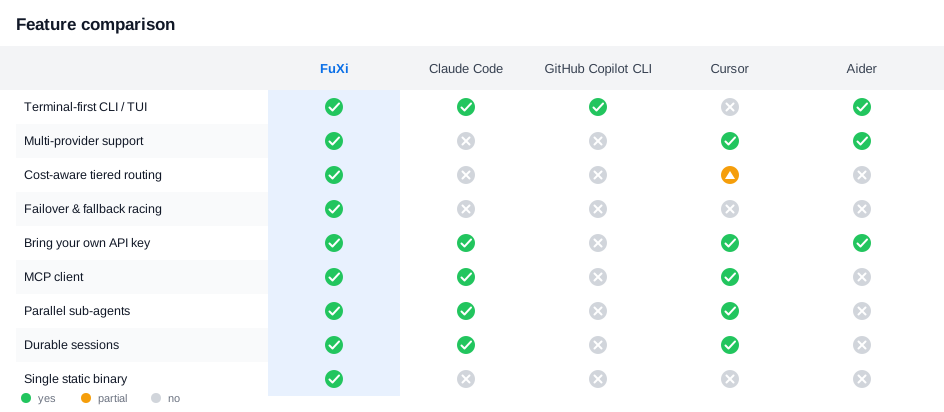
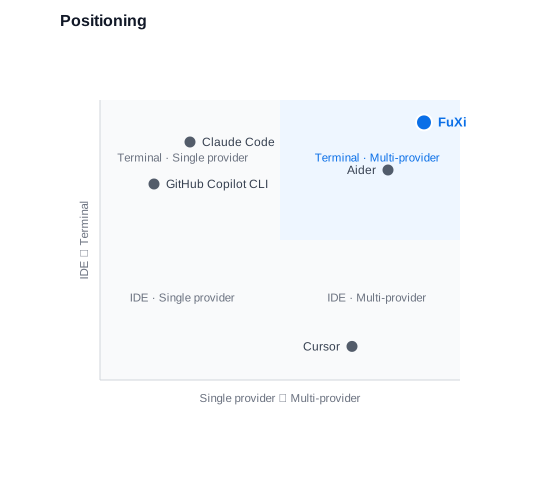
FuXi is a terminal-first AI coding agent designed to be provider-agnostic.
Feature availability reflects each product's publicly documented positioning
as of mid-2026; details evolve quickly, so treat it as an orientation.
Evaluation & benchmarks
FuXi is built to be measured honestly. It currently ships without a published
score on third-party benchmarks (e.g. SWE-bench, Terminal-Bench, or the Aider
polyglot benchmark). We prefer reproducible, self-verifiable evaluation over
headline numbers — so here is how to evaluate FuXi yourself, on your own work.
A practical evaluation checklist
- Install & self-check — after installing, run
fuxi doctorto verify your
environment (config, API key, git, ripgrep) andfuxi verifyto confirm the
provider connection. A clean bill here is the baseline. - Reproduce a real task — pick a failing test in one of your own projects
and let FuXi fix it; then extend the module and re-run the suite (the demo
above shows exactly this flow). Repeat across a handful of daily tasks:
code review, commits, PRs, refactors. - Compare side by side — run the identical task, model, and context through
another tool and compare: correctness, tool coverage, cost, and iteration
time. Judging on the same ground keeps the comparison fair.
FuXi exposes everything needed for that comparison — /cost, /usage,/context, and /status inside the TUI — and ships its own environment
self-check (fuxi doctor). Benchmarks that are published in the future will
be linked from this section.
Install
macOS / Linux
curl -fsSL https://releases.fuxicode.com/bootstrap.sh | bash
Windows (PowerShell)
irm https://releases.fuxicode.com/bootstrap.ps1 | iex
Windows (CMD)
curl -fsSL https://releases.fuxicode.com/install.cmd -o "%TEMP%\fuxi-install.cmd" && "%TEMP%\fuxi-install.cmd"
All three install to ~/.local/bin (%USERPROFILE%\.local\bin on Windows) and add
it to your user PATH if it isn't there already. Running the same command again
later upgrades an existing install in place — it's the same command for install and
upgrade.
By default they install the latest version; pin a specific one with an argument, e.g../bootstrap.sh 0.1.2 or ./bootstrap.ps1 0.1.2.
Verify the install
fuxi --version
fuxi doctor      # environment sanity checks (config, API key, git, ripgrep, ...)
Uninstall
# macOS / Linux
rm -f "$HOME/.local/bin/fuxi"
rm -rf "$HOME/.fuxi"   # optional: also drop config/state

# Windows (PowerShell)
Remove-Item -Force "$env:USERPROFILE\.local\bin\fuxi.exe"
Remove-Item -Recurse -Force "$env:USERPROFILE\.fuxi"   # optional
Getting started
Launch the TUI:
fuxi
On first run FuXi creates its config under ~/.fuxi/. You need a model to talk to,
via one of two paths:
Sign in —
fuxi loginopens a browser to authenticate with your FuXi
account, which provisions FuXi-managed models automatically. No API key needed.Bring your own key — set a provider API key via environment variable, or
write~/.fuxi/config.yamldirectly (fuxi initgenerates a starter template,
auto-detecting a provider from whatever env vars are already set):provider: openapi base_url: https://your-endpoint/v1 api_key: <your-key> # or export FUXI_API_KEY instead model: your-modelManaging several providers/models instead of one? Use the layered schema — a
providers:catalog plus amodel:selection layer:providers: custom: type: openapi base_url: https://your-endpoint/v1 api_key: <your-key> models: - id: your-model-id model: active: { provider: custom, id: your-model-id }The layered schema supports multiple providers and per-model settings.
Or run
fuxi wizardfor an interactive setup flow (pick a provider, enter the
base URL/key, choose a model, test the connection).
Once a model is configured, pick it any time with /model, and manage the rest of
your settings with /config — everything (permissions, hooks, skills, plugins) is
driven from inside the TUI via slash commands.
Usage guide
Command-line flags
Common flags when launching fuxi, grouped by purpose. The complete reference
is in fuxi --help.
| Area | Flag | Purpose |
|---|---|---|
| Model | -m, --model <name> |
Override the model for this run |
-P, --provider <type> |
Provider type: anthropic | openapi |
|
-b, --base-url <url> |
Override the base URL (enables the OpenAPI provider) | |
-k, --api-key <key> |
Override the API key for this run | |
| Session | -r, --resume <sessionId> |
Resume a specific past conversation |
-c, --continue |
Continue the most recent conversation in this directory | |
--session-id <uuid> |
Use a specific session ID (must be a valid UUID) | |
--fork-session |
When resuming, create a new session ID instead of reusing the original | |
--prefill <text> |
Pre-fill the prompt input with text without submitting it | |
-d, --dir <path> |
Working directory | |
| Permissions | --permission-mode <mode> |
default | plan | bypassPermissions |
--auto |
Auto-approve safe tool calls (classifier-gated, with a circuit breaker) | |
--dangerously-skip-permissions |
Skip all permission checks (DANGEROUS) | |
| Thinking | --thinking <mode> |
enabled | adaptive | disabled |
--effort <level> |
low | medium | high | max |
|
--max-tokens <n> |
Max output tokens per API call | |
| Tools & MCP | --tools <tools...> |
Restrict the built-in tool set ("" = none, default = all, or names) |
--mcp-config <configs...> |
Load MCP servers from JSON strings or file paths | |
--strict-mcp-config |
Only use MCP servers from --mcp-config |
|
| Inspect | --status |
Print resolved provider status and exit |
--config |
Print resolved configuration and exit | |
| Debug | --debug [pattern] |
Enable debug logging, optionally filtered by pattern |
--verbose |
Enable verbose logging | |
-v, --version / -h, --help |
Version / full flag & command reference |
fuxi --help also lists system-prompt overrides, tool restrictions, sampling
controls, and swarm/agent flags.
Subcommands
| Command | What it does |
|---|---|
fuxi (or fuxi tui) |
Launch the interactive TUI |
fuxi login |
Sign in to a FuXi account, then configure API credentials |
fuxi setup-token |
Sign in and print a token to export as FUXI_OAUTH_TOKEN (headless/CI) |
fuxi wizard |
TUI setup wizard: provider, base URL, key, model, connection test |
fuxi init [--force] |
Generate a ~/.fuxi/config.yaml template (auto-detects provider from env) |
fuxi doctor |
Run diagnostic checks on your environment |
fuxi verify |
Verify provider connectivity |
fuxi info |
Show provider and model information |
fuxi update [version] |
Download and install a release (checksum-verified, atomic) |
fuxi agents |
List configured agents grouped by source |
fuxi proxy |
Start the smart routing proxy (protocol bridging between providers) |
fuxi launch [args] |
Launch a proxied binary via the proxy, using your FuXi config |
fuxi mcp serve |
Run FuXi itself as an MCP stdio server |
fuxi remote-control |
Run as a cloud remote-control worker (alias for --remote-control) |
In-TUI slash commands
Type / and press Enter (or Tab-autocomplete) to browse all commands:
| Command | What it does |
|---|---|
/help, /commands, /menu |
Show or search all commands |
/model |
Switch the active model |
/config |
Open configuration |
/status |
Show provider status |
/context |
Show current context-window usage |
/cost, /usage |
Session cost / plan usage limits |
/compact |
Compact conversation history to free up context |
/clear |
Clear the conversation |
/history, /resume |
Browse or resume a past session/checkpoint |
/tools |
List available tools |
/permissions |
Show the current permission configuration |
/memory |
Show the project memory file |
/fork |
Show fork-agent stats |
/away |
List or show stored session away-summaries |
/commit |
Create a git commit |
/review |
Review code / create a PR |
/doctor |
Run diagnostic checks |
/copy, /paste |
Copy the last reply / send clipboard text as the next prompt |
/exit |
Quit |
Keyboard & input: / then Enter opens the command browser · Tab
autocompletes a slash command · Ctrl+R searches prompt history · Ctrl+V or
terminal paste pastes directly into the input · bracketed paste handles large
pastes. The full shortcut reference is in
docs/keybindings.md.
Updating
FuXi checks for new versions in the background and prints a one-line notice when
one is available. Update in place with:
fuxi update            # latest
fuxi update 0.1.2      # a specific version
fuxi update downloads the target build, verifies its SHA-256 against the
published manifest, and atomically replaces the running binary — it never leaves
you with a partially-installed version. Suppress the background check with--no-update-notifier or NO_UPDATE_NOTIFIER=1.
Configuration
- Config directory:
~/.fuxi/(override withFUXI_CONFIG_DIR). - Config file:
~/.fuxi/config.yaml— provider, model, thinking/effort,
routing preferences, and per-endpoint overrides. Changes hot-reload while
FuXi is running.fuxi initgenerates a starter template, and/config
manages settings from inside the TUI. - Precedence: environment variables >
config.yaml> built-in defaults. - Project settings: a checked-in project settings file (permissions, hooks)
is honored per-project. - Plugins: first-party marketplace at
fuxicode.com/plugins.
Key environment variables:
| Variable | Purpose |
|---|---|
FUXI_BASE_URL / FUXI_API_KEY / FUXI_MODEL |
OpenAPI-compatible provider config |
FUXI_THINKING_MODE / FUXI_THINKING_EFFORT |
auto|enabled|disabled / low|medium|high|max |
FUXI_CONFIG_DIR |
Override the config directory (default ~/.fuxi) |
FUXI_DEBUG |
Set to 1 to enable debug logging |
NO_UPDATE_NOTIFIER |
Set to 1 to suppress the background update-check notice |
FUXI_TEMPERATURE / FUXI_TOP_P / FUXI_SEED |
Sampling controls |
Run fuxi --help for the full environment-variable reference, including
sandbox limits and MCP resource caps.
Project layout
This repository hosts FuXi's documentation, release installers, and the issue
tracker. The product source is proprietary and is not published here (see
License).
README.md/README.zh-CN.md— the main documentation (English / 简体中文)docs/— demo GIF, comparison graphics, keyboard reference, FAQCHANGELOG.md— release historyCONTRIBUTING.md,CODE_OF_CONDUCT.md,SECURITY.md,SUPPORT.md—
community and support guides
License
Proprietary. Copyright © 2026 FUXI (Shanghai YiTai Technology Co., Ltd.). All
rights reserved.
Reviews (0)
Sign in to leave a review.
Leave a reviewNo results found