OneBrain
Health Pass
- License — License: MIT
- Description — Repository has a description
- Active repo — Last push 0 days ago
- Community trust — 34 GitHub stars
Code Pass
- Code scan — Scanned 10 files during light audit, no dangerous patterns found
Permissions Pass
- Permissions — No dangerous permissions requested
No AI report is available for this listing yet.
Unify every AI agent on ONE local shared memory over MCP. Obsidian vault + gbrain (by Garry Tan) + Ollama. 100% offline, $0 API. Orchestrate with OpenClaw or Hermes.
OneBrain
One Obsidian vault → one local brain → every AI agent sharing the same memory. 100% on-device, $0 API.
OneBrain is a thin, reproducible setup layer that puts all of your AI agents
(Claude Code, Codex, Grok, a self-hosted gateway/bot, Claude Desktop/Cowork) on a
single shared memory served from your own machine over MCP. Edit a fact once in
Obsidian and all of them see it.
It is not a new database or model. The actual brain is gbrain.
Credit: gbrain by Garry Tan
The entire intelligence layer here — the index, the knowledge graph, the synthesis,
and the ~80 MCP tools — is gbrain, the
open-source local-brain project by Garry Tan.
OneBrain is just the operational wrapping around it: launchd services, a
PGLite-safe sync loop, offline embeddings, secret hygiene, sandboxed enrichment,
multi-agent wiring, and the install scripts.All credit for the hard part goes to Garry Tan and the gbrain project. If you find
OneBrain useful, go star github.com/garrytan/gbrain.
OneBrain pins a specific gbrain version for reproducibility (see Prerequisites).
gbrain is licensed under its own terms; this repo's MIT license covers only the wrapper
scripts, LaunchAgents, installer, and docs in this repository.
The problem
Run several AI agents day to day and each one keeps its own memory. The same facts
about your world — people, companies, projects, preferences — live in 4+ places, drift
apart, and there's no single place to ask. Classic agent amnesia, times four.
The shape
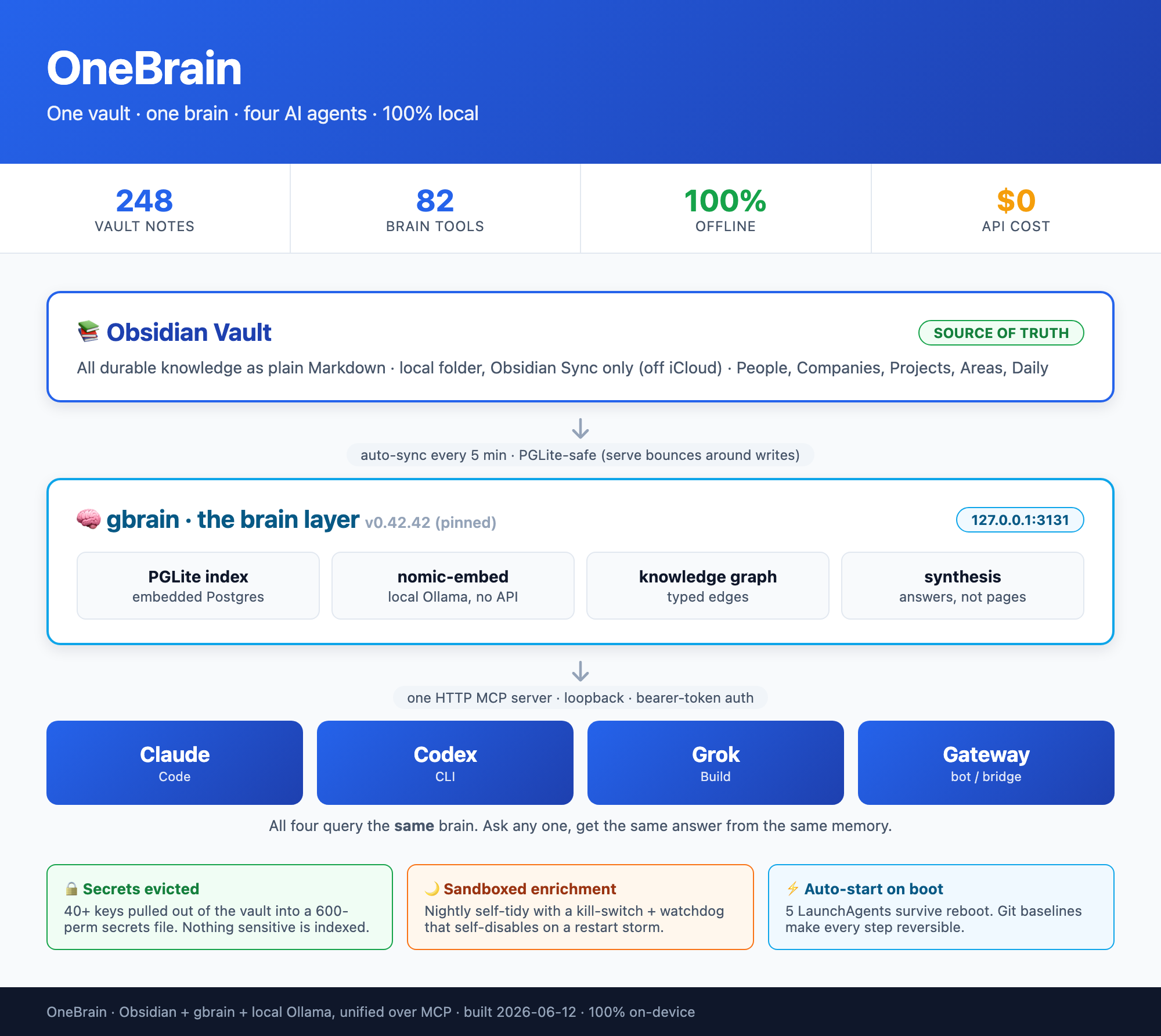
            Obsidian vault  (Markdown — the only durable store)
                  │   auto-sync every 5 min (PGLite-safe: serve bounces around writes)
                  ▼
   gbrain  (PGLite index + nomic-embed via Ollama + knowledge graph + synthesis)
                  │   one HTTP MCP server · 127.0.0.1 · bearer-token auth
                  ▼
   Claude Code · Codex · Grok · Cursor · Qoder · Warp · your gateway/bot · Claude Desktop
                  └────────── all query the SAME brain ──────────┘
- Source of truth: your Obsidian vault. Plain Markdown. Agents read it and write
durable facts back into it. - Brain layer: gbrain — indexes the vault into
PGLite (embedded Postgres), builds a typed knowledge graph, exposes ~80 tools over MCP. - Embeddings:
nomic-embed-textin Ollama. Zero external API, nothing leaves the
machine, $0 per query. - Clients: every agent wired to the one HTTP MCP endpoint, each in its own config.
The diagram above is also an interactive HTML card in docs/architecture.html.
For the story of how and why this was built, see docs/how-i-built-this.md.
Orchestration (optional, recommended)
The brain is passive — so you can put any agent in charge of it. Designate one agent as an
orchestrator that runs on a schedule, reads context from the brain, dispatches work to the
others, and writes results back to the vault. Two real, MCP-native runtimes with built-in cron
and sub-agent fan-out are documented end to end in docs/orchestrator.md:
- OpenClaw — gateway + agent runtime, multi-agent routing.
- Hermes (Nous Research) — autonomous agent, built-in cron, spawns subagents.
Each connects to OneBrain as a remote HTTP MCP server with one config block (exact syntax for
both in the doc). You don't need one — any worker agent can orchestrate on-demand — but an
orchestrator makes the loop persistent and scheduled.
What's in this repo
bin/                    wrapper scripts (serve, sync, enrichment, sentinel, env, desktop bridge)
launchagents/           macOS LaunchAgents (auto-start, survive reboot)
tools/onebrain-agents.sh  detect installed agents and wire them to the brain
config/eval-queries.txt   probe set for the nightly contradiction check
docs/clients.md         how to wire Claude / Codex / Grok / a gateway / Claude Desktop
docs/orchestrator.md    put an agent in charge: OpenClaw / Hermes (Nous) integration
docs/troubleshooting.md every lesson that bit during the build
docs/architecture.html  the architecture infographic
install.sh              one-command install (idempotent)
uninstall.sh            clean removal (leaves your vault + secrets + DB intact)
.env.example            secrets template, copy to ~/.secrets/.env
Nothing here contains a secret. The scripts read tokens from ~/.secrets/.env at runtime.
Prerequisites
| Need | Why | Install |
|---|---|---|
| macOS | LaunchAgents / launchd | — |
| Bun | runs gbrain | curl -fsSL https://bun.sh/install | bash |
| Ollama + embed model | offline embeddings | ollama pull nomic-embed-text |
| gbrain | the brain | clone to ~/Code/gbrain, pin a version (below) |
Obsidian + a vault under git |
source of truth | move the vault off iCloud; git init inside it |
| (optional) Obsidian Sync | multi-device | connect the relocated vault to your existing remote |
Pin gbrain for reproducibility, e.g.:
git clone https://github.com/garrytan/gbrain ~/Code/gbrain
cd ~/Code/gbrain && git checkout <the-commit-you-tested> && bun install
This setup was built and tested against gbrain v0.42.65.0. Treat the pin as a gate:
re-test the sync/serve/enrichment loop before upgrading.Upgrade procedure that worked (2026-07-24, v0.42.42.0 to v0.42.65.0, 369 commits):
stopai.gbrain.serverso the PGLite lock is free, copybrain.pgliteaside, rebase any
local patches onto upstream,bun install,bun run src/cli.ts apply-migrations --yes,jobs smoke, restart serve, then compareget_healthagainst the pre-upgrade numbers.
Note thatapply-migrationsruns its smoke phase by shelling out to agbrainbinary on
PATH; if you deliberately have no such binary, that phase fails while the migrations
themselves have already applied. Runbun run src/cli.ts jobs smokeyourself to confirm.
Install
# 1. secrets
cp .env.example ~/.secrets/.env && chmod 600 ~/.secrets/.env
$EDITOR ~/.secrets/.env          # set tokens + OBSIDIAN_VAULT_PATH + GBRAIN_REPO

# 2. one-time index of your vault (serve must be stopped; PGLite single-writer)
cd ~/Code/gbrain && env -u OPENAI_API_KEY bun run src/cli.ts sync --repo "$OBSIDIAN_VAULT_PATH"

# 3. install services (add --enrichment for the nightly sandboxed self-tidy)
./install.sh
Verify:
launchctl print gui/$(id -u)/ai.gbrain.server | grep state
curl -s -H "Authorization: Bearer $GBRAIN_REMOTE_TOKEN" http://127.0.0.1:3131/health
Then wire your agents — docs/clients.md.
What you get
- Shared memory across every agent, queryable in natural language.
- 100% offline — embeddings and storage never leave the machine; no per-query cost.
- Survives reboot — LaunchAgents auto-start; works before you even sign in to apps.
- Safe by construction — secrets evicted from the vault, loopback + bearer auth,
PGLite-safe sync, and a sandboxed enrichment daemon with a kill-switch + watchdog. - Reversible — your vault is plain Markdown under git; the gbrain DB is a rebuildable index.
- Verified, not assumed — a daily sentinel that refuses to absorb its own regressions, an
off-machine vault backup on every commit, and a wiring report that checks config against reality.
Wiring agents (and checking they are actually wired)
tools/onebrain-agents.sh          # report which installed agents can reach the brain
tools/onebrain-agents.sh --wire   # wire the ones that cannot
tools/onebrain-agents.sh --json   # machine-readable, for a cron or dashboard
It detects Claude Code, Codex, Grok, Cursor, Qoder, QoderWork, Warp, Hermes, opencode and
Antigravity, writes each one's native format (JSON mcpServers or TOML [mcp_servers.*]),
backs the config up first, and only ever touches the gbrain entry. It is idempotent, so it
is safe on a cron. Agents whose MCP schema it cannot verify are reported as MANUAL rather
than written to blindly.
Why this exists. An audit on 2026-07-24 found this project's own architecture diagram
claiming four agents were wired while the busiest one, Claude Code, had zero MCP servers
configured and no occurrence of the string gbrain anywhere in its config. Nine of twelve
installed agents could not reach the brain their own instruction files named as the source of
truth. Documentation drifted from reality because nothing compared the two. Run the report,
do not trust the diagram.
Verification: the part that actually keeps this honest
A memory system fails quietly. Nothing errors, answers just get subtly wrong. Every real
fault found in this stack was silent:
| Fault | How it presented |
|---|---|
| Claude Code never wired to MCP | Its instructions said "check the brain first". It had no tools to do so. |
| Vault had no off-machine copy | Git dir sat on the same disk, zero remotes, no Time Machine destination. |
| Backup repo on the second machine | Created once, one commit, never pushed again for six weeks. |
| Nightly contradiction check | Invoked with no arguments, failed on a usage error every single night. |
| Knowledge-health regression | Alerted once to a logfile nobody reads, then the rolling baseline absorbed it. |
| Configured chat model | Named a model that was not installed; and when installed, thrashed at 0.8 tok/s. |
So the wrapper ships three checks:
bin/gbrain-sentinel.sh(ai.gbrain.doctor, daily): queries the running server over
MCP, compares against~/.gbrain/health-baseline.json, and on regression writes~/.gbrain/ALERT.json, sends a push notification, and holds the baseline at the last
known-good values so the regression keeps alerting until it is genuinely fixed. Only a
clean run advances the baseline. Delete the baseline file to accept new numbers on purpose.- Off-machine backup inside
bin/gbrain-sync.sh: mirrors the vault git to a second
machine on every changed commit, connection-bounded and non-fatal so an unreachable target
can never stall or fail brain sync. config/eval-queries.txt: questions about facts that actually go stale in your world,
fed togbrain eval suspected-contradictionsnightly. Runs fully local at $0.
If you take one thing from this repo, take the sentinel pattern. A detector that heals its
own alarm is worse than no detector, because it looks like everything is fine.
Choosing a local chat model
chat_model is only needed for the synthesis and dream tiers, not for search or embeddings.
Size it to the machine, and measure rather than trusting ollama ps, which reports
"100% GPU" even while the model is thrashing through swap.
Measured on a Mac mini M4 / 16GB:
| Model | Generation | Verdict |
|---|---|---|
gemma4:12b-mlx (7.7GB) |
0.8 tok/s, swap at 12.9GB of 14.3GB | Unusable. MLX builds thrash once resident size approaches the wired limit. |
gemma3:4b (3.3GB) |
31.8 tok/s | Fits comfortably, 40x faster. |
The larger model is not the better model when it does not fit.
Multi-machine
Run the same install on a second Mac. Keep the vault in sync with Obsidian Sync (each
machine runs its own gbrain index over the same Markdown, so page counts converge rather
than match instantly). Run the heavier --enrichment agent on one machine only.
Security notes
- Tokens live only in
~/.secrets/.env(chmod 600) and are read at runtime. Never commit them. - The MCP server binds to
127.0.0.1and still requires a bearer token. - Keep secrets out of the indexed vault — anything indexed is visible to every wired agent.
- See
docs/troubleshooting.mdfor the full list of footguns.
License
MIT (this repo's wrapper code/docs) — see LICENSE.
The brain itself, gbrain by Garry Tan, is a
separate project under its own license. Please credit it.
Reviews (0)
Sign in to leave a review.
Leave a reviewNo results found