Research-Agent-Harness
Health Warn
- No license — Repository has no license file
- Description — Repository has a description
- Active repo — Last push 0 days ago
- Low visibility — Only 5 GitHub stars
Code Pass
- Code scan — Scanned 12 files during light audit, no dangerous patterns found
Permissions Pass
- Permissions — No dangerous permissions requested
No AI report is available for this listing yet.
Autonomous research agent: literature review, ideas, experiments, paper writing, and review. Built for OpenProgram.
Research Agent Harness
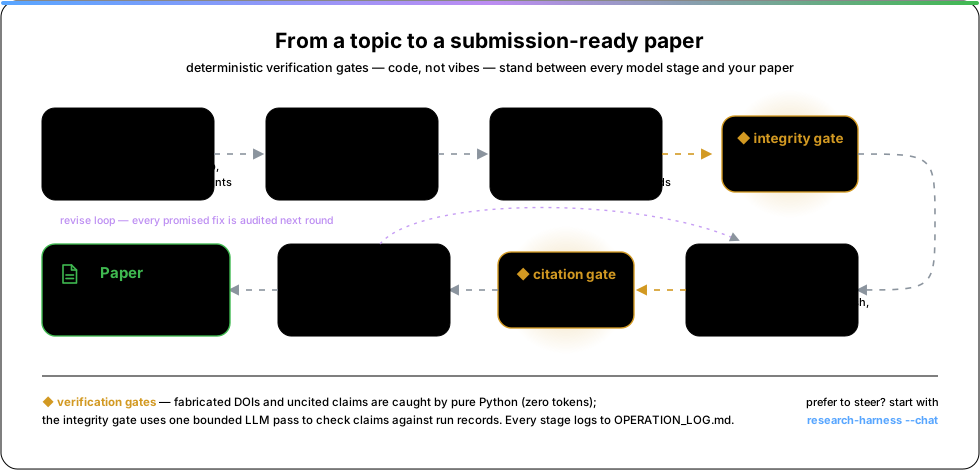
An autonomous research agent that takes a topic to a submission-ready paper — and doesn't trust itself.





Built with OpenProgram (Agentic Programming): Python controls the workflow, the LLM provides the judgment — 89 functions across 10 research stages, with a deterministic verification layer standing between the model and your paper.
This harness is an OpenProgram program — it runs inside OpenProgram.
Install OpenProgram first, then add this harness to it.
Why this harness
- ⚖️ Built for cross-model review — your paper can be written by one model and reviewed by a different one (e.g. Claude as author, GPT via Codex as reviewer) so it isn't self-grading. Cross-model is the default in the dedicated
research-reviewCLI and one flag away in the autonomous run (--review-provider openai-codex). Athard/nightmaredifficulty the reviewer keeps memory across rounds and debates the author under a strict concession protocol; at every difficulty it audits whether promised revisions actually happened. - 🔍 Trust-but-verify, deterministically — fabricated citations are caught by code, not vibes: every BibTeX entry is checked against four bibliographic indexes (Crossref / OpenAlex / Semantic Scholar / arXiv). Quantified claims without citations, citation-dump abuse, and paper numbers with no experiment provenance are flagged by pure-Python lints and gates.
- 🗣️ Dialogue when you want it, autonomy when you don't —
--chatstarts a Socratic planning mentor that asks you one question at a time until your research plan converges, then hands the brief to the autonomous run. Same framework, no slash commands. - 🧠 9-persona reviewer pool — empiricist, theorist, novelty hawk, methodologist, statistician, reproducibility auditor, devil's advocate, clarity critic, balanced — each a concrete, checkable lens, not a costume. The default round draws four (empiricist, theorist, novelty hawk, devil's advocate).
- 🧰 Everything is an editable function — every step is a plain Python file whose docstring is the prompt. Open it, read it, change it. No hidden chains.
- 📜 Everything leaves a trace — operation log, cumulative review log with full transcripts, PRISMA flow report computed from the literature loop's real ledger (every number auditable), commitment ledgers, integrity reports.
What's inside — 89 functions, 10 stages
| Stage | # | Highlights |
|---|---|---|
📚 literature |
11 | run_literature taxonomy loop (seed surveys → framework → search → annotate → evolve → synthesize, resumable state), prisma_report with real ledger counts, arXiv / Semantic Scholar search |
💡 idea |
5 | generate → novelty check → rank, refine_research direction sharpening |
🧪 experiment |
6 | design, bridge-to-code, run with run_record.json provenance, training monitor, ablation planner |
✍️ writing |
25 | section writing, rigorous/natural polish, EN⇄ZH translation, figures & captions, LaTeX compile, integrity_gate, deterministic lints, style profiles, AI-usage disclosure |
⚖️ review |
16 | review_loop (personas, grounding, debate, ledger, trajectory), verify_citations, venue-calibrated scoring, revision plans that keep papers compilable |
🛡️ rebuttal |
5 | parse reviews → strategy → draft, with an anti-sycophancy audit |
🎤 presentation |
3 | Beamer slides, poster, speaker notes |
📐 theory |
3 | honest derivations, proofs, grant proposals |
🧠 knowledge |
12 | persistent research wiki (ingest / survey / refactor / lint), harness meta-optimizer |
🚀 project |
3 | project init, fixed 8-stage pipeline, Socratic dialogue mode |
research-harness --list is the always-current catalog. Every function is a plain Python file — the docstring is the prompt; edit it and the behavior changes.
The verification layer
Checkpoints sit between the model and your paper. Four are pure Python, zero tokens; the integrity gate uses one bounded LLM pass to map each extracted claim to machine-readable run_record.json provenance:
| Checkpoint | What it catches | How |
|---|---|---|
integrity_gate |
Paper numbers with no experiment behind them | Audits every empirical claim against machine-readable run_record.json provenance: ALIGNED / OVERSTATED / NOT_SUPPORTED / NO_PROVENANCE |
verify_citations |
Fabricated references | DOI/arXiv-ID resolution against Crossref + OpenAlex + Semantic Scholar + arXiv, 3-class verdicts, SQLite-cached. A bogus DOI is hard evidence; a title-only miss is only advisory |
uncited_assertion_check |
"improved by 23%" with no citation or own-result reference | Pure-regex LaTeX lint, zero tokens |
citation_context_check |
Citation dumps, \cite-as-noun misuse, cargo-cult cites |
Pure-regex LaTeX lint, zero tokens |
| repetition guard | A stage spinning on identical calls | Loop-level cutoff with a logged reason |
The review loop (ARIS design, upgraded)
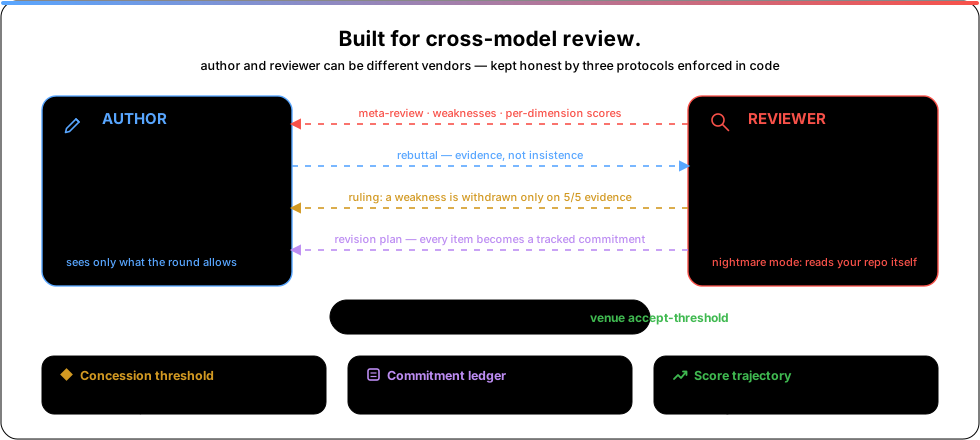
Three protocols keep multi-round review honest (enforced in code, adapted from ARS protocol specs). The concession-threshold debate and reviewer memory activate at hard/nightmare difficulty; the commitment ledger and score trajectory run at every difficulty:
- Concession threshold — a weakness is withdrawn only when the rebuttal scores 5/5 on evidence; after any concession the bar rises. Pressure doesn't move scores.
- Commitment ledger — every revision-plan item is re-audited next round; unaddressed items are carried forward verbatim and cannot silently drop.
- Score trajectory — per-dimension deltas across rounds; a regression (e.g. soundness fell while presentation rose) is flagged and fed back to the author model.
Difficulty controls information asymmetry: medium (author curates what the reviewer sees) → hard (+ reviewer memory & debate) → nightmare (reviewer reads the repo itself; the author can hide nothing).
Quick Start
1. Install
# 1. Install the OpenProgram host (one command)
git clone https://github.com/Fzkuji/OpenProgram && cd OpenProgram
./scripts/install.sh            # Windows: .\scripts\install.ps1

# 2. Add this harness — clones it into OpenProgram's programs/agentic_functions/
#    and installs its deps. The first-run wizard also offers this.
openprogram programs install research
Restart OpenProgram and research_agent appears in the Functions page / chat. That's the whole install.
OpenProgram walks openprogram/programs/agentic_functions/ at startup and loads
any cloned repo that satisfies the harness contract:
Research-Agent-Harness/              ← cloned into programs/agentic_functions/
├── pyproject.toml                   ← declares THIS repo's own deps only
└── research_harness/                ← importable package
    ├── __init__.py                  ← kept dependency-light
    └── agentics/
        └── __init__.py              ← exposes AGENTIC_FUNCTIONS = [research_agent]
Importing research_harness.agentics fires the @agentic_function
decorators, which self-register the functions. Two rules keep this safe:
the top-level __init__ must import cleanly on a machine without the
harness's optional deps, and pyproject.toml must NOT declareopenprogram as a dependency (the host already provides it; declaring it
re-installs the host from git). Full contract:
docs/installing-harnesses.md.
git clone https://github.com/Fzkuji/OpenProgram.git && pip install -e OpenProgram
git clone https://github.com/Fzkuji/Research-Agent-Harness.git
pip install -e Research-Agent-Harness
pip install -e hard-codes absolute paths into site-packages/*.pth — if
you rename a parent folder, rerun pip install -e . from the new location.
2. Pick LLM providers
Providers are configured on the OpenProgram host, not here — run openprogram providers configure (or the first-run wizard) and follow OpenProgram's provider setup. This harness just chooses which configured provider plays each role:
--provider |
Role fit | Session | File access |
|---|---|---|---|
claude-code |
executor (recommended) — uses your Claude subscription via the OpenProgram host | yes | full file system |
openai-codex |
reviewer (recommended) — cross-model review with GPT | yes | repo access |
anthropic / openai / gemini |
either role, via API key | stateless | none |
For cross-model review, point the two roles at different vendors: --provider claude-code --review-provider openai-codex.
The full autonomous experience (functions that save their own artifacts) needs a file-capable executor — claude-code or openai-codex. Pure-API providers still run every Python-side orchestrator (literature loop, citation gate, lints, PRISMA, review parsing).
3. Run
# Autonomous: the agent picks stages and functions to satisfy the task
research-harness --work-dir /abs/path "Survey recent work on LLM uncertainty"

# Dialogue first: Socratic planning, then hand the brief to the autonomous run
research-harness --work-dir /abs/path --chat "LLM uncertainty"

# Cross-model: Claude writes, GPT reviews
research-harness --work-dir /abs/path --provider claude-code --review-provider openai-codex \
    "Review the paper at ./my-project/"

# Focused paper review CLI: one paper in, one structured review out
research-review paper.pdf --venue NeurIPS -o review.json
research-review paper.pdf --venue NeurIPS --mode revise --auto-fix --max-rounds 4

# Deterministic citation check, no LLM
python -m research_harness.citation_gate paper/references.bib

# Everything registered
research-harness --list
In Python:
from research_harness.main import research_agent
from openprogram.providers import create_runtime

rt = create_runtime(provider="claude-code")
rt.set_workdir("/abs/path/to/work-dir")
result = research_agent(task="Survey LLM uncertainty", runtime=rt)
Dialogue mode
$ research-harness --work-dir ~/research/unc --chat "LLM uncertainty quantification"

— Socratic planning dialogue (answer in the terminal; type 'done' to finish early) —

[follow-up] When you say "uncertainty", do you mean the model's calibration
on its own predictions, or epistemic uncertainty about facts?
> calibration on QA tasks

[follow-up] What evidence would convince a skeptical reviewer that your
calibration metric is better than expected calibration error?
> ...
The mentor asks one question at a time (clarifying → probing → structuring → challenging), never answers for you, extracts [INSIGHT] commitments in your own words, and writes RESEARCH_BRIEF.md + the full transcript when the plan converges — then offers to start the autonomous run with the brief. Registered oversight="interactive", so the unattended loop can never wander into it.
Under the hood
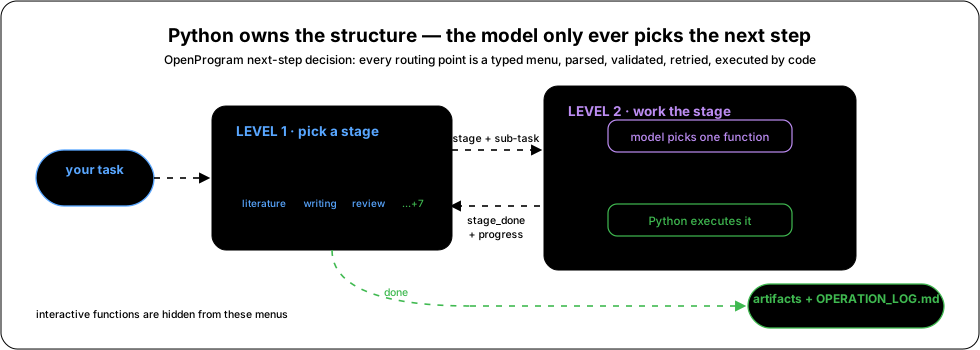
Two nested decision loops on OpenProgram's next-step decision mechanism (exec(choices=...)): every routing point hands the model a typed menu, and the framework parses, validates, retries once, and executes the pick. Misbehavior is handled by code — an unresolvable pick fails loudly (never silent success), a model that re-picks the same function with the same arguments is warned and then cut off, and human-in-the-loop functions are hidden from the autonomous catalogs by oversight metadata.
Project structure
Research-Agent-Harness/
├── research_harness/
│   ├── main.py                  # two-level loop + CLI (+ --chat)
│   ├── registry.py              # 89 functions, stages, oversight metadata
│   ├── pipeline.py              # fixed 8-stage pipeline + integrity gate wiring
│   ├── citation_gate/           # deterministic 4-index citation verification (vendored, CC BY-NC 4.0)
│   ├── writing_lint/            # uncited-assertion + citation-context lints
│   ├── references/              # venue scoring, writing principles, citation discipline
│   └── stages/                  # literature / idea / experiment / writing / review /
│                                #   rebuttal / presentation / theory / wiki / integrity /
│                                #   interactive / submission / external / meta
├── skills/                      # Claude Code skill shims (/peer-review, /self-review, …)
└── tests/                       # 288 tests, no network, mocked LLM
Design principles
- Python controls the loop, the LLM makes the decisions — every routing point is a typed next-step decision with retry and loud failure; every guard (repetition, oversight, gates) is code.
- The docstring is the prompt — no hidden prompt files; reading a function tells you exactly what the model is told.
- Different models should disagree — cross-model review is the default in the
research-reviewCLI and one flag (--review-provider) away in the autonomous run; the review protocols are designed for an adversary, not a collaborator. - Verify with code wherever code can verify — citation existence, claim provenance, assertion lints, PRISMA counts: deterministic, free, and immune to model mood.
- Everything leaves a trace — operation log, review transcripts, commitment audits, integrity reports; no work is lost, no decision is unexplained.
Acknowledgments
This harness stands on several open projects. Thank you to their authors:
- OpenProgram — the runtime framework underneath everything here:
@agentic_function,Runtime.exec(), and the next-step decision mechanism (exec(choices=...)/decision.make) that drives both levels of the autonomous loop. Agentic Programming is the paradigm it ships. - ARIS (wanshuiyin) — the cross-model review design this harness's review loop is built on: a GPT reviewer and a Claude author kept adversarial by construction, with difficulty levels controlling information asymmetry.
- awesome-ai-research-writing (Leey21) — the battle-tested writing/polish/translation prompts that seeded the writing stage's 20+ functions.
- Academic Research Skills (Cheng-I Wu, CC BY-NC 4.0) — the deepest single influence on the harness's verification layer, fully absorbed into the harness's own design: the vendored deterministic citation-existence gate (
research_harness/citation_gate/) and writing lints; the re-implemented protocols — concession-threshold debate, revision commitment ledger, score-trajectory regression detection, the experiment→writing integrity gate, the enriched reviewer persona pool, oversight-level metadata; and the Socratic mentor strategy behind--chat. ARS itself credits The AI Scientist (Lu et al.) for the autonomous-research failure-mode catalog and PaperOrchestra (Song et al.) for verification ideas — both indirectly shaped this harness too.
License
The harness's own code is MIT. Directories vendoring ARS content (research_harness/citation_gate/, parts of research_harness/writing_lint/) carry CC BY-NC 4.0 (see their LICENSE files), which makes the combined distribution non-commercial.
Reviews (0)
Sign in to leave a review.
Leave a reviewNo results found