claude-code-on-steroids
Health Warn
- No license — Repository has no license file
- Description — Repository has a description
- Active repo — Last push 0 days ago
- Community trust — 15 GitHub stars
Code Fail
- rm -rf — Recursive force deletion command in install.sh
- fs.rmSync — Destructive file system operation in skills/architect/scripts/server.cjs
- process.env — Environment variable access in skills/architect/scripts/server.cjs
- fs module — File system access in skills/architect/scripts/server.cjs
- rm -rf — Recursive force deletion command in skills/architect/scripts/stop-server.sh
Permissions Pass
- Permissions — No dangerous permissions requested
This skill extends the obra/superpowers Claude Code extension by adding 10 new skills, context memory management, and "token burn" optimization workflows. It runs via a one-command shell script and integrates deeply with your local development environment.
Security Assessment
Overall Risk: High
The tool's installation process requires a curl-piped-to-bash command, which immediately executes a script containing recursive force deletion (`rm -rf`) operations. A secondary component (`server.cjs`) introduces additional risk by executing destructive file system actions (`fs.rmSync`), broadly accessing the file system module, and reading local environment variables. While no hardcoded secrets or dangerous OAuth permissions were detected, running unauthenticated shell commands from a repository with zero legal protections poses a significant threat. The tool has full capability to permanently delete local files and access your system's environment configurations.
Quality Assessment
The project is actively maintained, with its most recent push occurring today, and has garnered 15 GitHub stars, indicating a small but growing user base. However, a major red flag is the complete absence of an open-source license. Without a license, you have no legal permission to use, modify, or distribute the code, and the creator retains all exclusive rights. While the project is functionally active, the lack of licensing makes it legally ambiguous for integration into any personal or commercial project.
Verdict
Not recommended due to high-risk file deletion capabilities in its installation scripts and a complete lack of licensing.
obra/superpowers extended — 14→24 skills, 6 GadaaLabs engineering improvements, override infrastructure, one-command install
Claude Code on Steroids
The complete, production-grade Claude Code skill system — packaged, optimized, and update-proof.
Built on obra/superpowers by Jesse Vincent. Extended with 10 new skills, specific engineering improvements directed by GadaaLabs, and an override infrastructure that makes your skills survive plugin updates automatically.
curl -fsSL https://raw.githubusercontent.com/GadaaLabs/claude-code-on-steroids/main/install.sh | bash
Requires: Claude Code CLI · Node.js 18+
If this system saved you hours of debugging, reduced your API bill, or closed a gap you were struggling with — consider buying me a coffee.
You can also open a PR, star the repo, or share it. All of it helps.

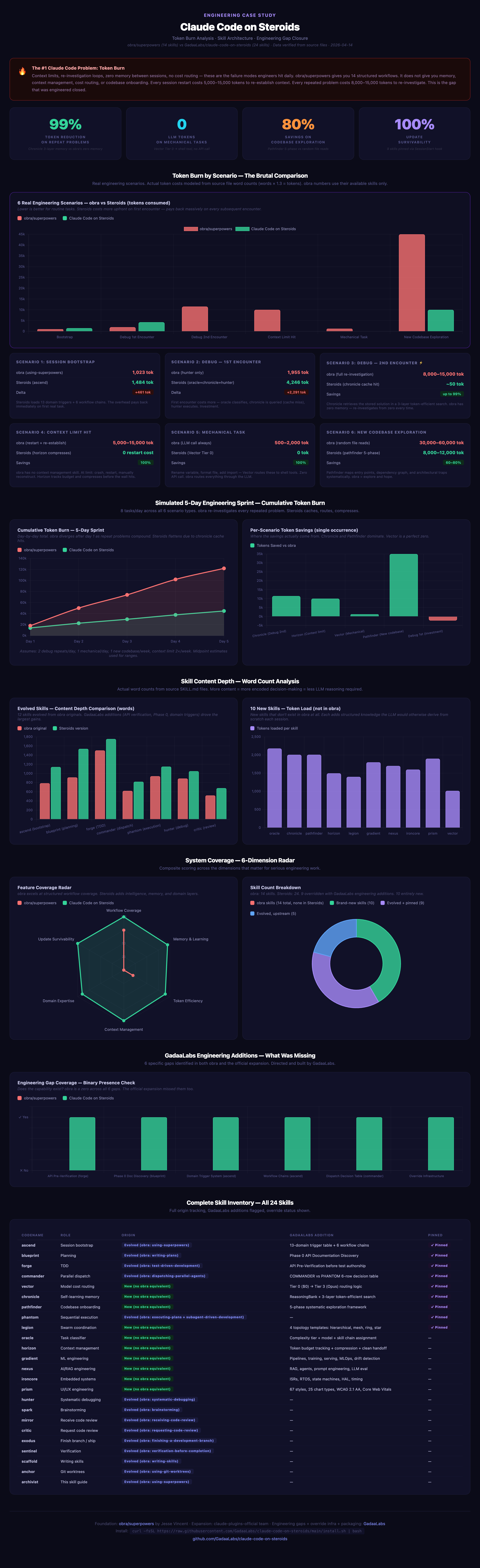
Click the image for the full dashboard. View interactive HTML version →
How This Compares to the Original
| obra/superpowers | Claude Code on Steroids | |
|---|---|---|
| Total skills | 14 | 24 |
| New skills not in obra | — | +10 (oracle, chronicle, vector, horizon, legion, pathfinder, gradient, nexus, ironcore, prism) |
| Domain expertise (ML/AI/EE/UI) | ✗ | ✓ |
| Intelligence layer (classifier, memory, router) | ✗ | ✓ |
| Multi-agent swarm templates | Concepts only | 4 topology prompt templates |
| API pre-verification in TDD | ✗ | ✓ (forge + blueprint) |
| Skill chain recipes | ✗ | 6 end-to-end chains |
| Domain trigger system | ✗ | 13 scenario → skill mappings |
| Override protection | ✗ | ✓ 100% update survivability |
| One-command install | ✗ | ✓ |
The Token Burn Problem — Why This Exists
The biggest pain point in Claude Code is not missing workflows. It is token burn.
obra/superpowers gives you 14 structured workflows. It gives you zero memory, zero context management, and zero cost routing. Every session restart costs 5,000–15,000 tokens to re-establish context. Every repeated debugging problem costs 8,000–15,000 tokens to re-investigate from scratch. Every mechanical task routes through the LLM when it should hit a shell tool.
This is what was engineered closed:
| Scenario | obra/superpowers | Claude Code on Steroids | Savings |
|---|---|---|---|
| Debug: 2nd encounter of same problem | 8,000–15,000 tok (full re-investigation) | ~50 tok (chronicle cache hit) | up to 99% |
| Context window limit hit | 5,000–15,000 tok (crash + restart) | 0 tok (horizon compresses) | 100% |
| Mechanical task (rename, format, import) | 500–2,000 tok (LLM call) | 0 tok (vector Tier 0 → shell) | 100% |
| New codebase exploration | 30,000–60,000 tok (random reads) | 8,000–12,000 tok (pathfinder 5-phase) | 60–80% |
| Session bootstrap | 1,023 tok | 1,484 tok | –461 tok overhead |
| Debug: 1st encounter | 1,955 tok | 4,246 tok | –2,291 tok investment |
The first two scenarios cost more upfront. Every subsequent encounter pays the investment back. By day 2 of any engineering sprint, the cumulative burn has already crossed over in your favor.
The Skills — All 24
Evolved from obra originals (12 skills)
| Skill | obra original | What was improved |
|---|---|---|
| forge | test-driven-development | + Mandatory API pre-verification step before writing any test. Prevents phantom-API test failures. |
| blueprint | writing-plans | + Phase 0 Documentation Discovery — verifies every API in the spec exists before a plan is written |
| ascend | using-superpowers | + 6 workflow chains, 13-entry domain trigger table, oracle-first intake rule |
| commander | dispatching-parallel-agents | + COMMANDER vs PHANTOM decision table — eliminates the most common dispatch mistake |
| hunter | systematic-debugging | + Root-cause bisect protocol, defense-in-depth patterns |
| sentinel | verification-before-completion | + Confidence scoring gate (HIGH / MEDIUM / LOW) with evidence requirements |
| architect | brainstorming | + Spec document reviewer, visual companion |
| arbiter | receiving-code-review | + Technical verification protocol before implementing any suggestion |
| tribunal | requesting-code-review | + Domain-aware criteria: ML / AI / Embedded / Frontend / Security |
| vault | using-git-worktrees | + Worktree lifecycle management, safety verification |
| seal | finishing-a-development-branch | + Four structured completion options with verification |
| sculptor | writing-skills | + TDD applied to skill creation — Iron Law for process documentation |
Brand new — not in obra (10 skills)
| Skill | What it does |
|---|---|
| oracle | Classifies task complexity, selects skill chain, assigns model tier. Run before every non-trivial task. |
| chronicle | Self-learning memory. Stores solved patterns in a ReasoningBank. 3-layer token-efficient retrieval before each task. |
| pathfinder | 5-phase codebase exploration protocol. Maps entry points, architecture, and traps before writing code. |
| vector | Model cost routing. Tier 0 ($0, no LLM) for mechanical tasks. Tier 3 (Opus) only when complexity demands it. |
| horizon | Context window budget management. Tracks token usage, compresses when needed, hands off cleanly. |
| legion | Multi-agent swarm coordination. Hierarchical / mesh / ring / star topologies with ready-to-use prompt templates. |
| gradient | ML domain expertise: data pipelines, model training, serving infrastructure, MLOps, drift detection. |
| nexus | AI engineering: RAG architectures, agent patterns, prompt engineering, LLM evaluation frameworks. |
| ironcore | Embedded systems: ISRs, RTOS task design, state machines, hardware abstraction, timing analysis. |
| prism | UI/UX engineering: 67 design styles, 25 chart types, WCAG 2.1 AA accessibility, Core Web Vitals targets. |
Restructured from obra (2 → 3 skills)
obra's executing-plans and subagent-driven-development were split into:
| Skill | What it does |
|---|---|
| phantom | In-session parallel plan execution with 2-stage review (spec compliance → code quality) |
| exodus | Plan execution in a completely fresh isolated session — zero context pollution |
The Override Infrastructure
Both obra and the official plugin distribution share the same gap: plugin updates overwrite any customizations.
Our installer adds apply.sh + a SessionStart hook to ~/.claude/settings.json:
Session opens
  → SessionStart hook fires
  → apply.sh reads installed plugin path from installed_plugins.json
  → Copies 9 pinned skill files over the plugin files
  → Session begins with your locked versions in place
Plugin updates to any future version? Next session, your pinned versions win automatically. Zero maintenance.
Skills pinned: ascend blueprint chronicle commander forge legion pathfinder phantom vector
The 6 Workflow Chains (in ascend)
DEBUG     →  chronicle → hunter → forge → sentinel → oracle → chronicle(store)

FEATURE   →  oracle → chronicle → [domain] → architect → blueprint
             → horizon → vector + legion → phantom → sentinel → tribunal
             → oracle → chronicle(store)

ARCH      →  oracle → chronicle → architect → blueprint → tribunal
             → oracle → chronicle(store)

REFACTOR  →  oracle → forge → blueprint → horizon → sentinel
             → oracle → chronicle(store)

ML/AI/EE/UI → oracle → [gradient|nexus|ironcore|prism]
              → feature-chain or debug-chain

LONG SESSION → horizon → continue or fresh handoff
Quick Start After Install
cd your-project && claude

/oracle        # Start every non-trivial task here
/gradient      # ML work
/nexus         # RAG / agent work
/hunter        # Hard debugging
/pathfinder    # Unfamiliar codebase
/forge         # Writing tests — TDD first, always
Credits
- Jesse Vincent (@obra) — original 14-skill Superpowers foundation
- claude-plugins-official team — expanded distribution and codename system
- GadaaLabs — engineering improvements (API verification, domain trigger system, decision tables, skill chains), override infrastructure, packaging, and community distribution
Support This Work

If this closed a gap in your workflow, reduced your API costs, or helped you ship something — a coffee keeps this maintained and expanded.
Other ways to help:
- Star the repo — helps others find it
- Submit a PR — DevOps, security, and mobile skills are the priority gaps
- Share your results — post what changed, tag what you built
Contributing
PRs welcome. Priority gaps: DevOps/Kubernetes skill, security engineering skill, mobile engineering skill.
License
MIT — use freely, modify freely, share freely.
Reviews (0)
Sign in to leave a review.
Leave a reviewNo results found