argot
Health Warn
- License — License: MIT
- Description — Repository has a description
- Active repo — Last push 0 days ago
- Low visibility — Only 7 GitHub stars
Code Warn
- fs module — File system access in .github/workflows/benchmark.yml
Permissions Pass
- Permissions — No dangerous permissions requested
No AI report is available for this listing yet.
Catch AI-written code that doesn't fit your repo — foreign deps, reinvented functions, gamed tests — learned from your git history. 100% local, no LLM.

Your codebase has a voice. argot makes AI code speak it.
AI writes the code. argot harnesses it with the one thing that can't hallucinate: your repo's own history. Statistics, not a second LLM — flagging a dependency you've never used, a function you already wrote, an import that breaks your layering, a test quietly weakened, a convention only your team knows. 100% local, replayable.
argot.tmonier.com · Documentation · Benchmarks · Caught in the wild · Research log





 ·
·

🎬 Watch the 45-second launch film
Type checkers ask "is this valid?" argot asks the question that used to live in code review: "is this how we do it here?" — and catches AI code that's flawless, type-correct, lint-clean, and still doesn't belong. It answers with statistics on your repo's own history — the statistical core deterministic and replayable, everything local — never a second LLM judging the first.
It also asks a second question no other tool asks: did the AI play fair? When an agent can't make a failing test pass, the cheapest path to "done" is to make the test stop looking. argot reads both sides of every diff and pairs a weakened, disabled, or deleted test with the production change it covers.
Five learned detectors — plus the rules only your repo could write
| Rule | It catches | ||
|---|---|---|---|
| 🚫 | foreign-import + friends |
a dependency, API, or idiom your repo has never used | "we don't do it this way here" |
| ♻️ | redundant |
a new function that reinvents one you already have | "you already have this" |
| 📍 | misplaced |
the right code, filed in the wrong place | "this doesn't belong here" |
| 🧱 | layering |
an internal import that reverses your architecture | "we never cross this boundary" |
| 🧪 | test-deleted + friends |
a test quietly weakened, disabled, or removed alongside the prod change it covers | "don't game the tests" |
| 📜 | your own rules | the conventions only your repo has — scripted, no recompile | "here's exactly how we do it" |
The first five are learned from your git history. The sixth is written by you — and it's the part of every linter config your team actually cares about.
Get started
# install (single static binary — no Python, no Node)
curl --proto '=https' --tlsv1.2 -LsSf https://github.com/get-tmonier/argot/releases/latest/download/argot-installer.sh | sh
Windows: powershell -c "irm https://github.com/get-tmonier/argot/releases/latest/download/argot-installer.ps1 | iex" · npm: npm install -g @tmonier/argot
Sixty seconds of proof, zero setup, on your own history:
argot audit # ⏪ what did AI sneak into your last 50 commits?
audit fits the voice as it was 50 commits ago (in a temp worktree — your tree stays untouched), rescores everything since, and attributes every finding to its introducing commit — ai-assisted / human / unknown, from concrete commit markers only:
━━ argot audit ━━━━━━━━━━━━━━━━━━━━━━━━━━━━━━━━━━━━━━━━━━━━━━━━━━
  last 50 commits · 52% carry AI markers · 1 finding would have met review

  Worst offender — commit cae8349 · ai-assisted
  ! landing/src/pages/llms-full.txt.ts:L1-32 · foreign-import
      ↳ astro (L1), astro:content (L2) — 0 of 49 module specifiers…
━━━━━━━━━━━━━━━━━━━━━━━━━━━━━━━━━━━━━━━━━━━━━━━━━━━━━━━━━━━━━━━━━
The terminal card ends with a copy-paste share caption, and argot audit --format html is a screenshot-ready card — post your score.
Then fit today's voice so check raises these before they merge:
argot init       # learn this repo's voice (~25 s on a 1,100-file repo)
argot check      # score your working changes against it
Accuracy is a function of setup — argot learns from what it's allowed to see. Best path: npx skills add get-tmonier/argot, then /argot-setup in your coding agent (Claude Code, Cursor, 70+ agents) reads your repo, excludes what shouldn't shape the voice, and verifies the catch. Full guide: Setup · Getting started.
Claude Code — one install for everything. The argot plugin bundles the five skills, the MCP server (argot mcp — proactive voice context while your agent writes), and an opt-in, non-blocking pre-write guardrail that asks before a foreign dependency lands:
/plugin marketplace add get-tmonier/argot
/plugin install argot@argot
Other agents (Cursor, Codex, 70+): npx skills add get-tmonier/argot.
Demo
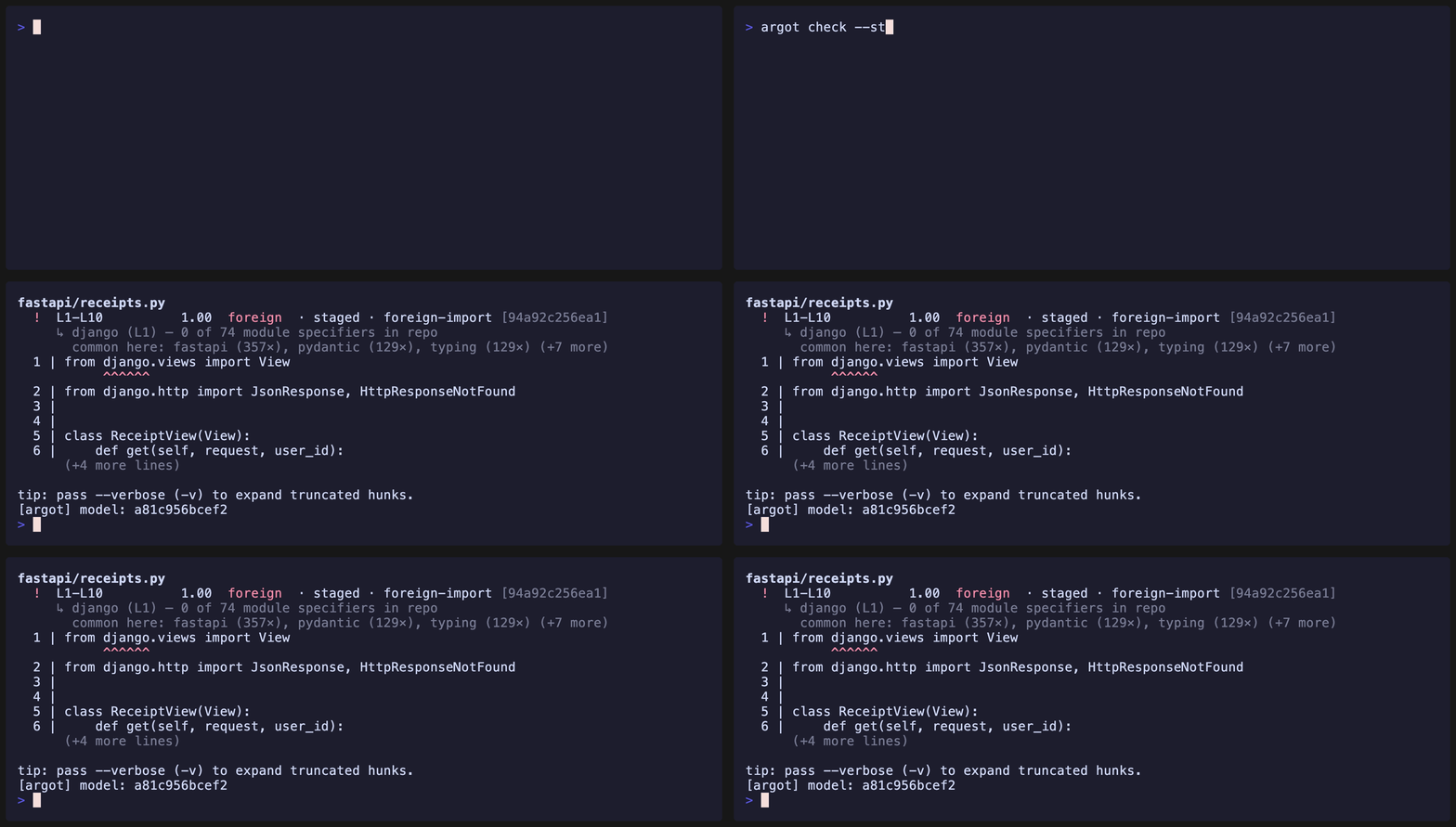
A PR adds a Django-style view to an all-FastAPI codebase. mypy and ruff are silent — the framework it reaches for is one this repo has never imported:
argot check · 1 hunk above threshold (1 foreign)

fastapi/receipts.py
  !  L1-L10         1.00  foreign  · staged · foreign-import [94a92c256ea1]
     ↳ django (L1) — 0 of 74 module specifiers in repo
       common here: fastapi (357×), pydantic (129×), typing (129×) (+7 more)
  1 | from django.views import View
             ^^^^^^
redundant names the function you already have (↳ duplicates slugify (src/utils/text.py:14) — similarity 0.86), misplaced names where the code belongs, layering names the direction an import reverses, and every ↳ line is your repo's own evidence. Full anatomy: Reading the output · What it catches.
Your conventions, as rules
Every team has conventions no generic linter ships: "presentational components take props — they don't fetch", "files are parsed through our loader, never a raw JSON.parse", "one HTTP client per repo". They live in review comments and onboarding docs — until an AI agent, who read neither, merges around them. With argot they're repo-local rules: a TOML manifest + a small sandboxed script in .argot/rules/, versioned with your code, loaded at run time — no plugin build, no recompile, one rule format across all 11 languages.
And they can do what no classic linter structurally can. A linter sees one version of one file; argot hands your rule both sides of the diff — so you can write rules about what a change removed:
# .argot/rules/no-dropped-endpoints/rule.toml
[rule]
schema = 1
name = "no-dropped-endpoints"
description = "removing a public endpoint requires a deprecation cycle — catch the route that silently disappears in a diff"
severity = "error"
languages = ["typescript", "javascript"]
// check.rhai — a route that existed before this change, and is gone now
const ROUTES = "(call_expression function: (member_expression property: (property_identifier) @verb)
                arguments: (arguments (string (string_fragment) @path)))";
let now = [];
for m in ts_query(ROUTES) { if m.capture == "path" { now.push(m.text); } }
for m in ts_query_old(ROUTES) {
    if m.capture == "path" && !now.contains(m.text) {
        report(m.line, "endpoint '" + m.text + "' removed without a deprecation cycle — see docs/api-lifecycle.md");
    }
}
No ESLint plugin can express that rule — there is no "old side" in a linter. And because argot fits your history, a rule's allowlist can be your own git log: import_attested("moment") asks "has this repo ever used this date library?" — no list to hardcode, no list to maintain. Rules run on changed files only (adopting one creates zero backlog noise), and their findings are suppressed, configured, and rendered exactly like built-in rules. argot rules test is the red/green authoring loop. Full reference + worked examples: Custom rules.
Rules an agent can't game
An AI agent that can't satisfy a check will reach for the next-cheapest green: mute the rule, downgrade it in a local config, --rule it=off, or — for a custom rule — just rewrite the script that caught it. Lock the rule and every one of those doors closes:
[rules]
layering = { severity = "error", locked = true }
custom   = { severity = "error", locked = true }   # lock every repo-local rule
A locked rule (opt-in, from the committed argot.toml only):
- freezes its severity —
argot.local.tomland--ruleoverrides are refused; - refuses every suppression surface for its findings — inline
# argot: ignore,[[mute]], and[exclude].pathsdon't apply; - and — the teeth — weakening the lock is itself a finding.
rule-tampered(groupgovernance, pinnederror, unsuppressable) reads both sides of the diff being checked and fires when the change removes a lock, downgrades a locked severity, adds a[[mute]]on a locked rule, or edits a locked custom rule's script — with a loud run-level warning your CI surfaces (a PR annotation under--format github).
Tamper-evidence, not tamper-proofing — the same philosophy as the test-integrity rules: an agent can touch the alarm, but touching the alarm is the alarm. The one quiet way to relax a locked rule is a committed argot.toml diff a human reviews. Guide: Locked rules.
Configure it like any linter
Every rule (built-in or yours) defaults through argot.toml [rules] — error / warn / off, per rule or per group — or per run via --rule layering=warn. A [rules] entry can also scope a rule to paths (layering = { include = ["src/**"] }). Excludes are gitignore-style [exclude].paths; inline # argot: ignore-next-line rule=… — reason and argot mute <hash> give line-level and durable committed acceptances. Guides: Configure · The commands.
argot vs. the tools you already run
| Type checker | Linter | Copilot · SAST | argot | |
|---|---|---|---|---|
| Catches invalid code | ✅ | ✅ | ~ | — |
| Flags what's foreign to this repo | ❌ | ❌ | ❌ | ✅ |
| Flags a function you already have | ❌ | ❌ | ❌ | ✅ |
| Flags code filed in the wrong place | ❌ | ❌ | ❌ | ✅ |
| Flags an import that breaks your layering | ❌ | ❌ | ❌ | ✅ |
| Flags a test quietly weakened to game a failing suite | ❌ | ❌ | ❌ | ✅ |
| Enforces your team's own conventions, cross-language, on the diff | ❌ | ~ | ❌ | ✅ |
| Locked rules an agent can't mute, override, or rewrite unnoticed | ❌ | ❌ | ❌ | ✅ |
| Audits merged history · attributes findings AI vs human | ❌ | ❌ | ❌ | ✅ |
| Learns from your history · runs 100% local | ❌ | ❌ | ❌ | ✅ |
argot is additive: it sits after your type checker and linter and catches the one thing they can't — code that's valid and lint-clean but unlike anything your team has written. It's the harness around AI output, built from the one thing that can't hallucinate: your repo's own history.
Benchmarks
Honest, leak-free numbers, measured by the real fit → check pipeline — foreign fixtures spliced into real host files; false alarms counted on a temporal holdout the model never saw:
- Foreign catch — 595/605 (98%) when the foreign symbol is visible in the diff · false alarms 0.29% of 22,513 real hunks (worst corpus 1.46%)
- Architecture — 244/252 (96.8%) caught · 0/140 controls flagged · ≤2.7% over-fire on replayed real history
- Reinvention — median 89% at ≤4.5% false fires per hunk · Misplacement — 85–99% (median 96%) at ≤1.2%, where the repo has separable architecture
- Test-integrity — 144/153 (94.1%) gaming tactics caught · 0/102 legitimate-refactor controls · 1.12% of 5,268 replayed accepted test-touching commits flagged at gating severity
One documented limit: masked foreign — a foreign symbol whose name collides with one you already use — is statistically invisible to a voice model. We publish that number rather than hide it. And the method, stated plainly: catch rates are measured on fixtures we authored under a pre-registered rubric frozen before scoring; false alarms are counted on real commits the model never saw. Independent validation is welcome — that's what the reproducible harness is for. Per-language and per-corpus tables, methodology, confidence intervals: benchmarks page (CI-fed, can't drift from what ships). Want a language validated? Open an issue.
Numbers are one thing; real diffs are another. Caught in the wild collects verified findings from running argot over the last year of history on 33 real open-source repos (dagster, hono, rich, saleor, faker, and more) — each one adversarially attacked by a reviewer briefed to disprove it, and every one survived.
CI
- uses: get-tmonier/argot@main # non-blocking voice score on every PR
--format github prints inline PR annotations; --format sarif feeds code scanning; --format json is a stable schema. Add publish-badge: true (with contents: write) for a live README badge — argot · N% in-voice, updated on every push. Copy-paste setups incl. pre-commit: the CI guide.
How it works
Five learned detectors, one source of truth — your git history — plus the rules you script yourself. A statistical voice model (two frequency tables + a callee-cluster partition — no neural net) catches foreign imports, callees, and token shapes; a local code-embedding model (jina-code via statically-linked llama.cpp) catches reinvention and misplacement; a module-dependency graph catches layering reversals; a test-inventory diff catches gamed tests. Fit in seconds, check in milliseconds, nothing leaves your machine — and nothing generates: every verdict is a statistic you can replay. Full detail: How it works · The scoring model · Performance · experiment log in docs/research/.
Contributing
Issues and PRs welcome — start with CONTRIBUTING.md:
git clone https://github.com/get-tmonier/argot && cd argot
just build       # cargo build --release -p argot → target/release/argot
just verify      # cargo fmt --check + clippy -D warnings + cargo test
Acknowledgements
argot is benchmarked against real repositories used as read-only corpora — cloned at benchmark time, never redistributed, each under its own license, none affiliated with argot: FastAPI, rich, faker, Saleor, Wagtail, Dagster, Scrapy, Hono, Ink, faker-js, Excalidraw, Outline, Express, Commander.js, ESLint, GitHub CLI, Hugo, ripgrep, bat, Guava, JUnit 5, PowerShell, Jellyfin, redis, curl, RocksDB, fmt, Homebrew, RuboCop, Laravel, and Composer.
Built on tree-sitter (11 grammars), libgit2 via git2, HuggingFace tokenizers (UnixCoder BPE), Rhai (scripted rules), clap, Serde, and cargo-dist. The semantic layer links llama.cpp (MIT) statically via llama-cpp-2; its model is jina-embeddings-v2-base-code by Jina AI (Apache-2.0), fetched on first use as a Q4_K_M GGUF quantization (a derivative work under Apache-2.0 §4) from the semantic-model-v1 release. argot is not affiliated with, nor endorsed by, Jina AI.
Privacy
argot runs 100% locally — no telemetry, no account, your code never leaves your machine. Full policy: argot.tmonier.com/privacy.
License
MIT
Reviews (0)
Sign in to leave a review.
Leave a reviewNo results found