cursor-handbook
Health Warn
- License — License: MIT
- Description — Repository has a description
- Active repo — Last push 0 days ago
- Low visibility — Only 5 GitHub stars
Code Fail
- rm -rf — Recursive force deletion command in .cursor/hooks/shell-guard.sh
Permissions Pass
- Permissions — No dangerous permissions requested
No AI report is available for this listing yet.
Open-source rules engine for Cursor IDE — 110 rules, agents, skills, commands that give AI permanent memory of your standards. Demo: 30%+ token savings, blocks hardcoded secrets, type-check instead of 100K-token test runs, consistent code across team.







cursor-handbook
The open-source rules engine for Cursor IDE — 117 components (rules, agents, skills, commands, hooks) that turn your AI into a senior engineer who follows your standards, knows your codebase, and never wastes a token.
Stop teaching your AI the same things every session. cursor-handbook gives Cursor permanent memory of your standards, security policies, and workflows — across every project, every team member, every prompt.
If cursor-handbook helps you, consider giving it a ⭐ — it helps others discover it.
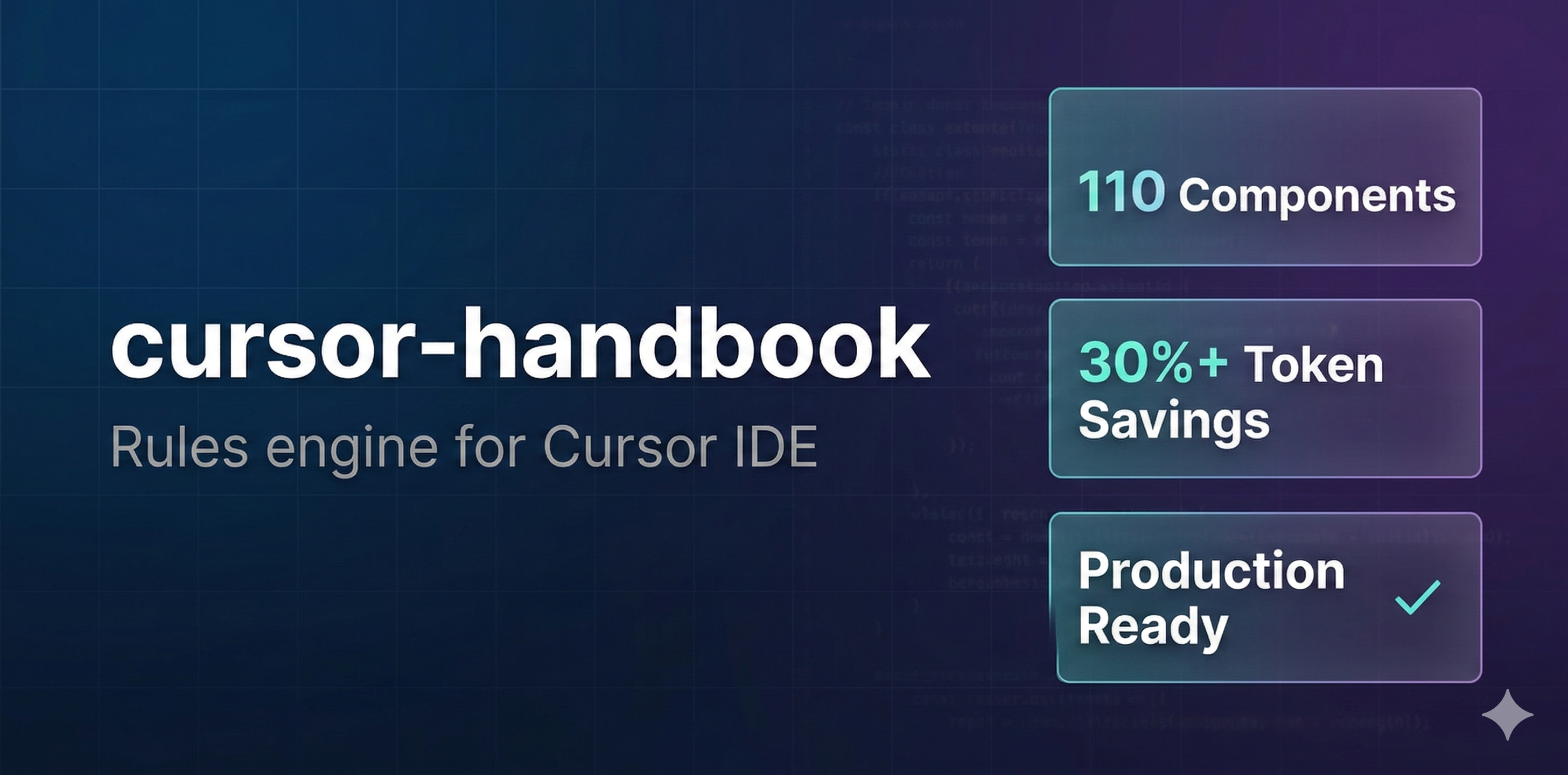
Table of Contents
Ways to use cursor-handbook
Pick the option that fits your workflow:
| Option | Best for |
|---|---|
| 1. Clone & copy | Use the full rules engine in your repo. Clone this repo, copy the .cursor folder into your project, then edit project.json and tailor rules/agents/skills to your stack. |
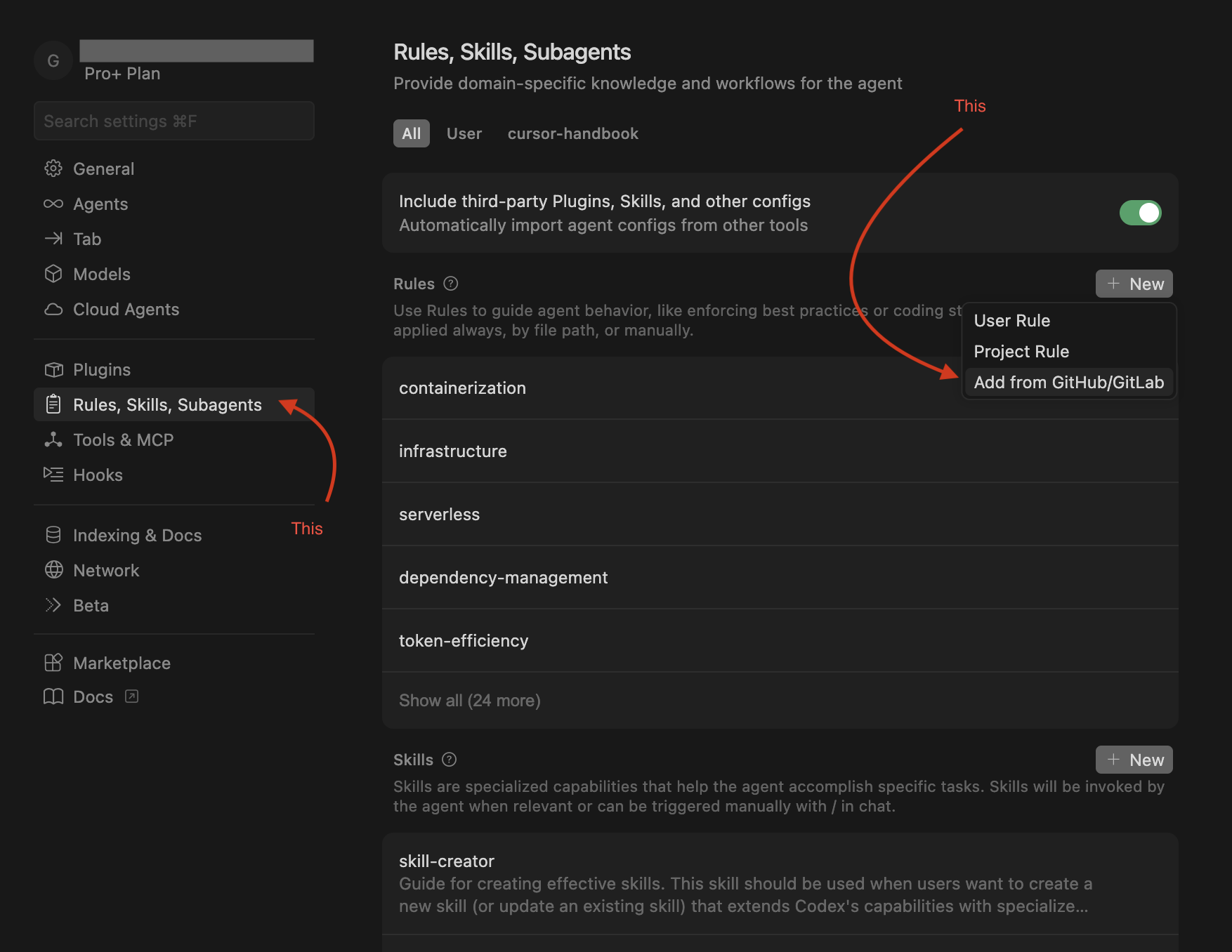
| 2. Add from GitHub (Cursor UI) | Use rules, skills, or agents without cloning. In Cursor IDE go to Settings → Rules / Skills / Agents, click Add new → Add from GitHub, and paste this repo’s clone URL. Add only what you need. |
| 3. Fork & customize | Maintain your own version. Fork this repo, adapt the .cursor files for your team or product, then use that fork across your projects or share it internally. |
| 4. Pick and choose | Use individual components. Download only the production-ready, generic rules, skills, agents, commands, or hooks you need from this repo and drop them into your existing .cursor setup. |
| 5. Handbook website | Browse components or read Guidelines (Cursor IDE topics) in the browser — GitHub Pages (optional; clone, ZIP, and command line still work). |
Improvements welcome. If you want to add or improve rules, skills, hooks, agents, or commands, see CONTRIBUTING.md and open an issue or PR.
Forking? Replace
girijashankarjwith your GitHub org/username in badges, clone URLs,scripts/setup-cursor.sh,.github/CODEOWNERS, and docs before pushing.
The Problem
Every time you open Cursor IDE, your AI assistant starts from zero. It doesn't know your:
- Code conventions and architecture patterns
- Security policies (and happily hardcodes your API keys)
- Testing thresholds (and runs the full 100K-token test suite when you just wanted a type check)
- Handler patterns, naming conventions, or folder structure
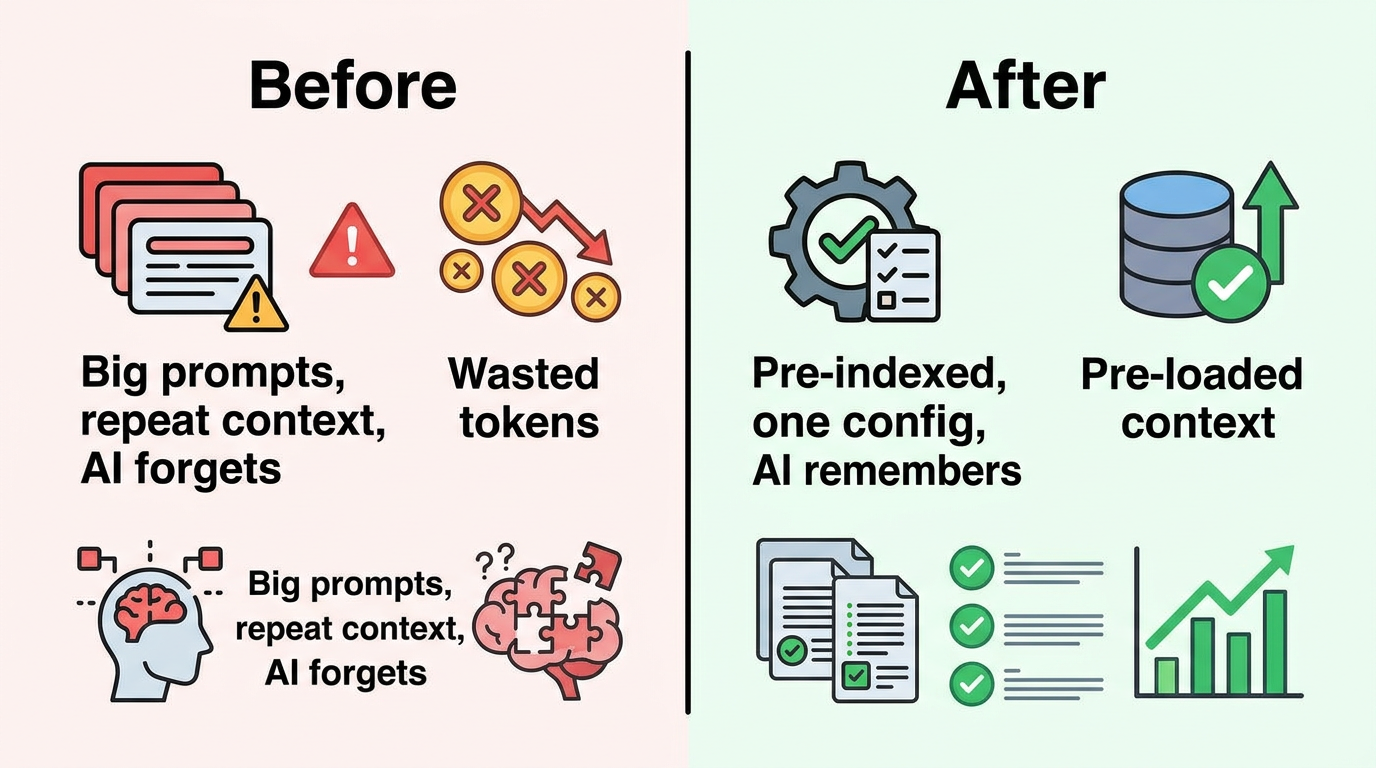
You end up repeating yourself, burning tokens, and fixing the same mistakes. cursor-handbook fixes this permanently.
Before vs After
| Before cursor-handbook | After cursor-handbook |
|---|---|
| AI hardcodes API keys | Security rules block it |
| AI runs full test suite (~100K tokens) | Uses type-check (~10K) or single-file tests |
| You repeat conventions every session | Rules remember them — always on |
| Inconsistent code across team | One rules engine, one standard |
| No guardrails on expensive ops | Hooks warn or block dangerous commands |
Who is this for?
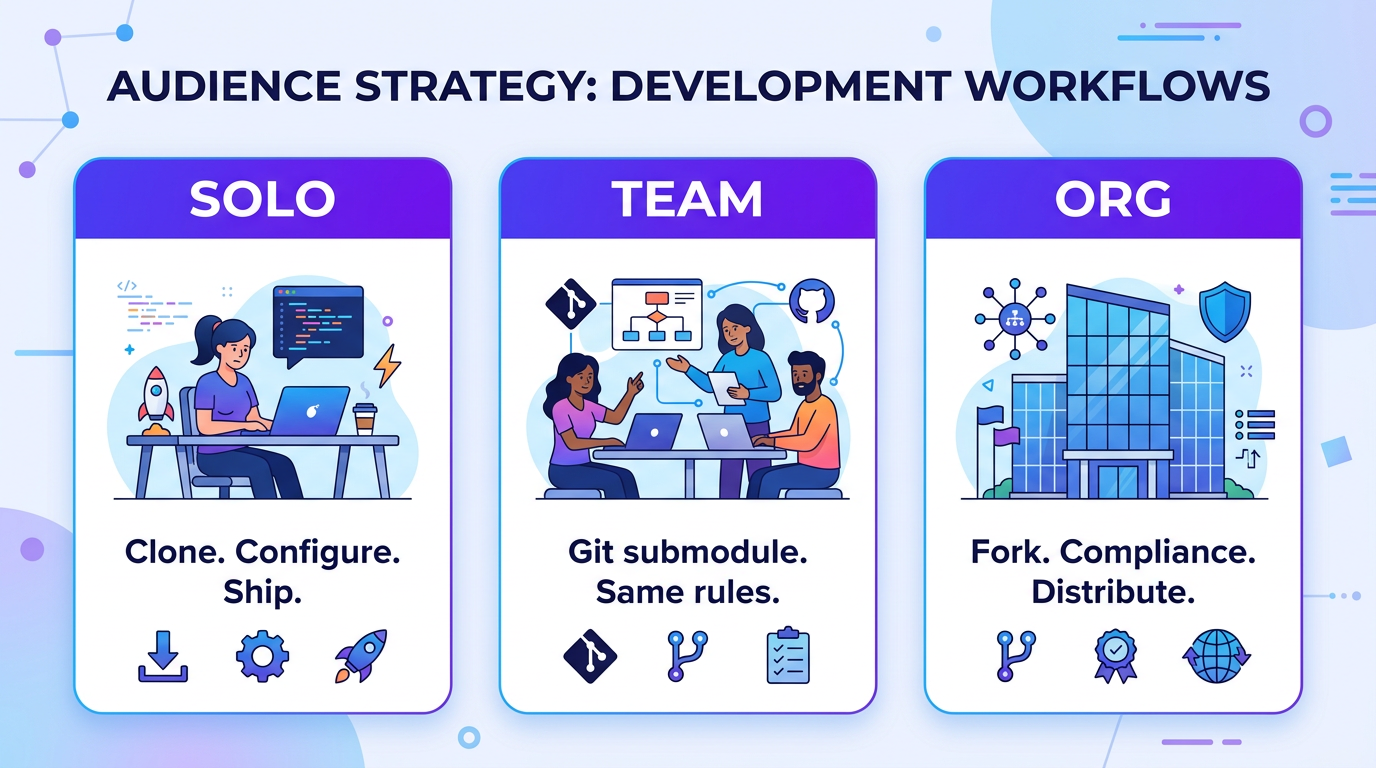
| Audience | Benefit |
|---|---|
| Solo developers | Consistent AI behavior without repeating yourself every session |
| Teams | Shared standards; everyone gets the same guardrails and conventions |
| Enterprises | Security, compliance, and token efficiency built in from day one |
How It Works
graph TB
    subgraph INPUT ["Your Prompt"]
        A[Developer types a prompt in Cursor]
    end

    subgraph HOOKS_PRE ["Pre-Processing Hooks"]
        B[context-enrichment.sh<br/>Injects project context]
        C[shell-guard.sh<br/>Blocks dangerous commands]
    end

    subgraph ENGINE ["cursor-handbook Engine"]
        D[30 Rules<br/>Always-applied standards]
        E[34 Agents<br/>Specialized AI assistants]
        F[22 Skills<br/>Step-by-step workflows]
        G[14 Commands<br/>Quick actions]
    end

    subgraph CONFIG ["Project Settings"]
        H[project.json<br/>Your project settings]
    end

    subgraph HOOKS_POST ["Post-Processing Hooks"]
        I[post-edit-check.sh<br/>Validates changes]
        J[auto-format.sh<br/>Formats code]
        K[coverage-check.sh<br/>Verifies thresholds]
    end

    subgraph OUTPUT ["AI Response"]
        L[Code that follows YOUR standards<br/>with 30%+ fewer tokens]
    end

    A --> B --> C --> D
    D --> E & F & G
    H -.->|configures| D & E & F & G
    E & F & G --> I --> J --> K --> L

    style INPUT fill:#1a1a2e,stroke:#e94560,color:#fff
    style HOOKS_PRE fill:#16213e,stroke:#0f3460,color:#fff
    style ENGINE fill:#0f3460,stroke:#533483,color:#fff
    style CONFIG fill:#533483,stroke:#e94560,color:#fff
    style HOOKS_POST fill:#16213e,stroke:#0f3460,color:#fff
    style OUTPUT fill:#1a1a2e,stroke:#00d2ff,color:#fff
What's Inside
%%{init: {'theme': 'neutral'}}%%
mindmap
  root((cursor-handbook<br/>117 Components))
    Rules — 30
      Architecture — 3
      Backend — 6
      Frontend — 4
      Security — 3
      Database — 3
      Cloud — 3
      Testing — 3
      DevOps — 3
      Core — 1
    Agents — 34
      Architecture — 3
      Backend — 7
      Frontend — 4
      Testing — 4
      Database — 2
      Security — 3
      Cloud — 3
      DevOps — 3
      Business — 2
      AI/ML — 1
      Docs — 1
      Platform — 1
    Skills — 21
      Backend — 4
      Frontend — 2
      Testing — 2
      Database — 3
      Cloud — 3
      DevOps — 4
      Docs — 3
    Commands — 14
    Hooks — 12
    Templates — 9
| Layer | Count | What It Does | How It's Triggered |
|---|---|---|---|
| Rules | 30 | Enforces coding standards on every AI interaction | Automatically — always on |
| Agents | 34 | Specialized assistants for complex tasks | On demand — /agent-name |
| Skills | 22 | Step-by-step guided workflows with checklists | Contextually — when patterns match |
| Commands | 14 | Lightweight, token-efficient quick actions | On demand — /command |
| Hooks | 12 | Automation scripts in the AI loop | Event-driven — before/after actions |
| Templates | 9 | Scaffolding for handlers, components, tests, etc. | Referenced by skills and agents |
Note: The 117 component count = Rules + Agents + Skills + Commands + Hooks. Templates (9) are supporting assets referenced by skills and agents.
Quick Start (5 minutes)
graph LR
    A["1. Clone"] --> B["2. Setup"] --> C["3. Restart"] --> D["4. Verify"]

    style A fill:#22c55e,stroke:#16a34a,color:#fff,stroke-width:2px
    style B fill:#3b82f6,stroke:#2563eb,color:#fff,stroke-width:2px
    style C fill:#f59e0b,stroke:#d97706,color:#fff,stroke-width:2px
    style D fill:#8b5cf6,stroke:#7c3aed,color:#fff,stroke-width:2px
One-line install
git clone https://github.com/girijashankarj/cursor-handbook.git .cursor && make -f .cursor/Makefile init
Then edit .cursor/config/project.json and restart Cursor.
Step 1 — Clone
# Into your existing project
git clone https://github.com/girijashankarj/cursor-handbook.git .cursor
Step 2 — Configure
# Option A: One-command setup
make init

# Option B: Interactive generator
./scripts/init-project-config.sh

# Option C: Manual copy
cp .cursor/config/project.json.template .cursor/config/project.json
Edit .cursor/config/project.json — replace placeholders with your project details:
{
	"project": { "name": "my-api", "description": "Order management service" },
	"techStack": {
		"language": "TypeScript",
		"framework": "Express.js",
		"database": "PostgreSQL",
		"testing": "Jest",
		"packageManager": "pnpm"
	},
	"testing": {
		"coverageMinimum": 90,
		"testCommand": "pnpm run test",
		"typeCheckCommand": "pnpm run type-check"
	}
}
Step 3 — Restart Cursor IDE
Close and reopen Cursor. All 117 components are now active.
Step 4 — Verify
Try any of these:
/type-check          → Runs type checking (saves ~90K tokens vs full tests)
/code-reviewer       → AI reviews your code like a senior engineer
/generate-handler    → Scaffolds a complete API handler
Alternative: One-Line Setup
curl -fsSL https://raw.githubusercontent.com/girijashankarj/cursor-handbook/main/scripts/setup-cursor.sh | bash
Alternative: Git Submodule (for teams)
git submodule add https://github.com/girijashankarj/cursor-handbook.git .cursor
make init
# Or: cp .cursor/config/project.json.template .cursor/config/project.json
User Flow
Here's what happens at every stage of your development workflow:
sequenceDiagram
    actor Dev as Developer
    participant C as Cursor IDE
    participant H as Hooks
    participant R as Rules (30)
    participant A as Agents/Skills
    participant Code as Codebase

    Dev->>C: Types prompt or command
    C->>H: beforeSubmitPrompt
    H->>H: Enrich with project context
    H->>H: Guard against expensive ops
    H->>R: Pass enriched prompt
    R->>R: Apply 30 always-on rules
    Note over R: Token efficiency<br/>Security guardrails<br/>Code standards<br/>Architecture patterns
    R->>A: Route to agent/skill/command
    A->>Code: Generate or modify code
    Code->>H: afterFileEdit
    H->>H: Post-edit checks
    H->>H: Auto-format
    H->>H: Secret scan
    H-->>Dev: Clean, standards-compliant code

    Note over Dev,Code: Every interaction is governed by your rules.<br/>No exceptions. No token waste.
Typical Workflows
| What You Want | What You Type | What Happens |
|---|---|---|
| Build a new endpoint | "Create a POST /orders endpoint" | Skill triggers full handler scaffolding (9 files, 7-step flow) |
| Review code | /code-reviewer |
Agent checks security, performance, correctness, tests |
| Fix broken tests | /testing-agent fix these tests |
Skill diagnoses failures, fixes mocks, verifies coverage |
| Quick validation | /type-check |
Runs type check (~10K tokens) instead of full tests (~100K) |
| Deploy safely | /deployment-agent |
Agent generates deployment checklist with rollback plan |
| Optimize a query | /query-opt-agent |
Agent runs EXPLAIN ANALYZE, rewrites query, adds indexes |
Processing Pipeline
Every prompt flows through a layered processing pipeline that ensures quality, security, and efficiency:
graph TD
    subgraph L1 ["Layer 1: Pre-Processing"]
        direction LR
        A1[Context Enrichment] --> A2[Shell Guard] --> A3[Pre-Commit Check]
    end

    subgraph L2 ["Layer 2: Rules Engine — Always Active"]
        direction LR
        B1[Token Efficiency] --> B2[Security Guardrails] --> B3[Code Standards]
        B3 --> B4[Architecture] --> B5[Testing Standards]
    end

    subgraph L3 ["Layer 3: Specialized Processing"]
        direction LR
        C1[Agents<br/>Complex tasks]
        C2[Skills<br/>Guided workflows]
        C3[Commands<br/>Quick actions]
    end

    subgraph L4 ["Layer 4: Post-Processing"]
        direction LR
        D1[Edit Validation] --> D2[Auto-Format] --> D3[Coverage Check]
    end

    L1 --> L2 --> L3 --> L4

    style L1 fill:#1e293b,stroke:#475569,color:#fff
    style L2 fill:#0c4a6e,stroke:#0284c7,color:#fff
    style L3 fill:#3730a3,stroke:#6366f1,color:#fff
    style L4 fill:#1e293b,stroke:#475569,color:#fff
Layer Breakdown
Layer 1 — Pre-Processing (Hooks)
Before your prompt even reaches the AI, hooks inject your project context, block dangerous shell commands, and validate git operations.
Layer 2 — Rules Engine (30 Rules, Always Active)
Every AI response is shaped by your rules. These aren't suggestions — they're hard constraints:
| Rule Category | What It Enforces |
|---|---|
| Token Efficiency | No auto-running full tests/lint; confirm 50K+ ops |
| Security | No hardcoded secrets; no PII in logs; parameterized queries |
| Architecture | Handler pattern; dependency direction; error hierarchy |
| Code Organization | Naming conventions; import order; folder structure |
| Database | Soft delete only; required columns; migration safety |
| Testing | 90%+ coverage; mock patterns; AAA pattern |
Layer 3 — Specialized Processing
Based on your prompt, the right component activates: an agent for complex tasks, a skill for guided workflows, or a command for quick operations.
Layer 4 — Post-Processing (Hooks)
After code is generated, hooks validate the output, auto-format files, scan for leaked secrets, and verify test coverage.
Token Savings
cursor-handbook is engineered to cut your AI token costs by 30% or more:
pie title Token Usage Comparison (per operation)
    "Type Check (cursor-handbook)" : 10
    "Saved vs Full Tests" : 90
| Without cursor-handbook | With cursor-handbook | Tokens Saved |
|---|---|---|
| Full test suite: ~100K tokens | /type-check: ~10K tokens |
~90K (90%) |
| Full lint run: ~50K tokens | /lint-check (read_lints): ~2K tokens |
~48K (96%) |
| Full test suite: ~100K tokens | /test-single: ~5K tokens |
~95K (95%) |
| Unfiltered context: ~30K tokens | Context layering: ~10K tokens | ~20K (67%) |
| Verbose AI output: ~15K tokens | Concise guidelines: ~5K tokens | ~10K (67%) |
Conservative estimate: A developer making 50 AI interactions/day saves ~200K tokens/day — that's real money at scale.
Customization
cursor-handbook is 100% project-driven. Every component adapts to your project through a single file:
How It Adapts to Your Project
graph TB
    PJ["project.json<br/>Your Configuration"]

    PJ --> R["Rules<br/>{{CONFIG.techStack.language}}<br/>{{CONFIG.testing.coverageMinimum}}"]
    PJ --> A["Agents<br/>{{CONFIG.techStack.framework}}<br/>{{CONFIG.paths.handlerBasePath}}"]
    PJ --> S["Skills<br/>{{CONFIG.patterns.handlerFlow}}<br/>{{CONFIG.fileNames.handlerEntry}}"]
    PJ --> CMD["Commands<br/>{{CONFIG.testing.testCommand}}<br/>{{CONFIG.testing.typeCheckCommand}}"]
    PJ --> H["Hooks<br/>{{CONFIG.project.name}}<br/>{{CONFIG.database.softDeleteField}}"]

    style PJ fill:#f59e0b,stroke:#d97706,color:#000,stroke-width:3px
    style R fill:#3b82f6,stroke:#2563eb,color:#fff
    style A fill:#8b5cf6,stroke:#7c3aed,color:#fff
    style S fill:#22c55e,stroke:#16a34a,color:#fff
    style CMD fill:#ef4444,stroke:#dc2626,color:#fff
    style H fill:#06b6d4,stroke:#0891b2,color:#fff
What You Can Customize
| Section | What It Controls | Example |
|---|---|---|
project |
Project identity | Name, description, repo URL |
techStack |
Language, framework, tools | TypeScript + Express or Python + FastAPI |
paths |
Directory structure | Where handlers, services, and common code live |
domain |
Business entities | Order, Product, Customer + lifecycle states |
patterns |
Code patterns | 7-step handler flow, error handling strategy |
testing |
Quality gates | 90% coverage, test/lint/type-check commands |
database |
DB conventions | Soft delete field, timestamp columns, naming |
packages |
Internal packages | @your-org scope, registry URL |
conventions |
Git and workflow | Branch prefixes, commit format, PR templates |
Ready-Made Stack Presets
Don't start from scratch — pick your stack:
| Stack | File | Language | Framework |
|---|---|---|---|
| TypeScript/Express | examples/typescript-express/ |
TypeScript | Express.js |
| TypeScript/NestJS | examples/typescript-nest/ |
TypeScript | NestJS |
| Python/FastAPI | examples/python-fastapi/ |
Python | FastAPI |
| Go/Chi | examples/go-chi/ |
Go | Chi |
| React SPA | examples/react/ |
TypeScript | React |
| Next.js | examples/nextjs/ |
TypeScript | Next.js |
| Rust/Actix | examples/rust-actix/ |
Rust | Actix Web |
| Kotlin/Spring | examples/kotlin-spring/ |
Kotlin | Spring Boot |
| Flutter | examples/flutter/ |
Dart | Flutter |
# Use a pre-made preset
cp examples/typescript-express/project.json .cursor/config/project.json
# Then customize with your project specifics
Component Deep Dive
Rules (30) — Your AI's Permanent Memory
Rules are the backbone. They load on every interaction, every time, with zero effort.
graph LR
    subgraph MAIN ["Core"]
        M[main-rules]
    end

    subgraph ARCH ["Architecture"]
        A1[token-efficiency]
        A2[core-principles]
        A3[dependency-mgmt]
    end

    subgraph BE ["Backend"]
        B1[handler-patterns]
        B2[code-organization]
        B3[error-handling]
        B4[api-design]
        B5[typescript]
        B6[nodejs]
    end

    subgraph FE ["Frontend"]
        F1[components]
        F2[accessibility]
        F3[state-mgmt]
        F4[performance]
    end

    subgraph SEC ["Security"]
        S1[guardrails]
        S2[secrets]
        S3[compliance]
    end

    subgraph DB ["Database"]
        D1[query-patterns]
        D2[schema-design]
        D3[migrations]
    end

    subgraph CLD ["Cloud"]
        C1[infrastructure]
        C2[serverless]
        C3[containers]
    end

    subgraph TST ["Testing"]
        T1[standards]
        T2[mocks]
        T3[integration]
    end

    subgraph OPS ["DevOps"]
        O1[ci-cd]
        O2[monitoring]
        O3[documentation]
    end

    M --> ARCH & BE & FE & SEC & DB & CLD & TST & OPS
Agents (34) — Your On-Demand Specialists
| Domain | Agent | Invocation | Best For |
|---|---|---|---|
| Architecture | Design Agent | /design-agent |
System design, trade-off analysis |
| Refactoring Agent | /refactoring-agent |
Safe incremental refactoring | |
| Migration Agent | /migration-agent |
Framework upgrades, migrations | |
| Backend | Code Reviewer | /code-reviewer |
PR reviews, security checks |
| Implementation Agent | /implementation-agent |
Building features end-to-end | |
| Debugging Agent | /debugging-agent |
Root cause analysis | |
| API Agent | /api-agent |
REST API design | |
| Performance Agent | /performance-agent |
Bottleneck identification | |
| Database Agent | /database-agent |
Schema design, queries | |
| Event Handler Agent | /event-handler-agent |
Async event processing | |
| Frontend | UI Component Agent | /ui-component-agent |
Accessible components |
| State Agent | /state-agent |
State management decisions | |
| Styling Agent | /styling-agent |
CSS architecture, theming | |
| Frontend Perf Agent | /frontend-perf-agent |
Core Web Vitals optimization | |
| Testing | Testing Agent | /testing-agent |
Write comprehensive tests |
| E2E Agent | /e2e-agent |
End-to-end test flows | |
| Load Test Agent | /load-test-agent |
Performance benchmarking | |
| Security Test Agent | /security-test-agent |
Vulnerability scanning | |
| Database | Schema Agent | /schema-agent |
Schema design, ER diagrams |
| Query Opt Agent | /query-opt-agent |
Query performance tuning | |
| Security | Security Audit Agent | /security-audit-agent |
Comprehensive security audit |
| Auth Agent | /auth-agent |
Auth flows, RBAC | |
| Compliance Agent | /compliance-agent |
GDPR, SOC 2, HIPAA | |
| Cloud | Infra Agent | /infra-agent |
IaC, cloud architecture |
| Deployment Agent | /deployment-agent |
Zero-downtime deployments | |
| Cost Agent | /cost-agent |
Cloud cost optimization | |
| DevOps | CI/CD Agent | /ci-cd-agent |
Pipeline design |
| Monitoring Agent | /monitoring-agent |
Observability setup | |
| Incident Agent | /incident-agent |
Incident response | |
| Business | Requirements Agent | /requirements-agent |
User stories, specs |
| Estimation Agent | /estimation-agent |
Effort estimation | |
| AI/ML | Prompt Agent | /prompt-agent |
Prompt engineering |
| Docs | Docs Agent | /docs-agent |
Technical documentation |
| Platform | DX Agent | /dx-agent |
Developer experience |
Commands (17) — Token-Efficient Quick Actions
graph LR
    TC["/type-check<br/>~10K tokens"] ---|saves 90K vs| FT["Full Tests<br/>~100K tokens"]
    TS["/test-single<br/>~5K tokens"] ---|saves 95K vs| FT
    LC["/lint-check<br/>~2K tokens"] ---|saves 48K vs| FL["Full Lint<br/>~50K tokens"]

    style TC fill:#22c55e,stroke:#16a34a,color:#fff
    style TS fill:#22c55e,stroke:#16a34a,color:#fff
    style LC fill:#22c55e,stroke:#16a34a,color:#fff
    style FT fill:#ef4444,stroke:#dc2626,color:#fff
    style FL fill:#ef4444,stroke:#dc2626,color:#fff
| Command | What It Does | Why It's Better |
|---|---|---|
/type-check |
TypeScript type validation | 10K tokens vs 100K for full tests |
/lint-check |
Use read_lints tool |
2K tokens vs 50K for full lint |
/lint-fix |
Auto-fix lint issues | One-step lint resolution |
/format |
Format code files | Consistent formatting |
/generate-handler |
Scaffold API handler | Full 9-file handler in seconds |
/test-single |
Test one file only | 5K tokens vs 100K for full suite |
/test-coverage |
Coverage report | Targeted coverage analysis |
/coverage |
Quick coverage check | Fast coverage snapshot |
/build |
Build the project | Validated production build |
/deploy |
Deploy the application | Guided deployment flow |
/docker-build |
Build Docker image | Correct multi-stage build |
/audit-deps |
Vulnerability scan | Catch CVEs before shipping |
/audit |
Full security audit | Comprehensive security check |
/check-secrets |
Secret detection | Find leaked keys before commit |
Sharing & Team Adoption
cursor-handbook is designed to scale from solo developer to enterprise teams:
graph TD
    subgraph SOLO ["Solo Developer"]
        S1[Clone cursor-handbook<br/>into .cursor/]
        S2[Customize project.json]
        S3[Commit to your project]
    end

    subgraph TEAM ["Team Sharing"]
        T1[Fork cursor-handbook]
        T2[Add team-specific rules]
        T3[Share as Git submodule<br/>in all team repos]
    end

    subgraph ORG ["Organization-Wide"]
        O1[Maintain internal fork]
        O2[Add org standards<br/>& compliance rules]
        O3[Distribute via<br/>internal package registry]
    end

    subgraph OSS ["Open Source"]
        OS1[Contribute rules & agents<br/>back to cursor-handbook]
        OS2[Share stack-specific<br/>examples]
        OS3[Build community<br/>components]
    end

    SOLO --> TEAM --> ORG
    SOLO --> OSS
    TEAM --> OSS

    style SOLO fill:#22c55e,stroke:#16a34a,color:#fff
    style TEAM fill:#3b82f6,stroke:#2563eb,color:#fff
    style ORG fill:#8b5cf6,stroke:#7c3aed,color:#fff
    style OSS fill:#f59e0b,stroke:#d97706,color:#000
Adoption Hierarchy
| Level | Method | Best For |
|---|---|---|
| Personal | Clone directly into .cursor/ |
Solo developers, personal projects |
| Team | Git submodule in shared repos | Small teams (2-10 developers) |
| Organization | Internal fork with org-specific rules | Companies with coding standards |
| Community | PR contributions to this repo | Open source stack-specific configs |
Team Setup (Git Submodule)
# One team member sets it up
git submodule add https://github.com/your-org/cursor-handbook.git .cursor
git commit -m "feat: add cursor-handbook for team standards"
git push

# Every other team member gets it automatically
git pull
git submodule update --init
make init

# Update across the team
cd .cursor && git pull origin main && cd ..
git add .cursor && git commit -m "chore: update cursor-handbook"
Organization Fork Strategy
# 1. Fork cursor-handbook to your org
# 2. Add org-specific rules
# 3. All teams use the org fork as their submodule
git submodule add https://github.com/girijashankarj/cursor-handbook.git .cursor
Project Structure
cursor-handbook/
├── .cursor/
│   ├── config/                    # project.json, schema, templates
│   │   ├── project.json.template  #   Template (start here)
│   │   ├── project.json.example   #   Complete example
│   │   └── project-schema.json    #   JSON Schema validation
│   ├── rules/                     # 30 always-applied rules
│   │   ├── main-rules.mdc        #   Master rules
│   │   ├── architecture/          #   3 architecture rules
│   │   ├── backend/               #   6 backend rules
│   │   ├── frontend/              #   4 frontend rules
│   │   ├── security/              #   3 security rules
│   │   ├── database/              #   3 database rules
│   │   ├── cloud/                 #   3 cloud rules
│   │   ├── testing/               #   3 testing rules
│   │   └── devops/                #   3 devops rules
│   ├── agents/                    # 34 specialized AI agents
│   │   ├── architecture/          #   3 agents
│   │   ├── backend/               #   7 agents
│   │   ├── frontend/              #   4 agents
│   │   ├── testing/               #   4 agents
│   │   ├── database/              #   2 agents
│   │   ├── security/              #   3 agents
│   │   ├── cloud/                 #   3 agents
│   │   ├── devops/                #   3 agents
│   │   ├── business/              #   2 agents
│   │   ├── ai-ml/                 #   1 agent
│   │   ├── documentation/         #   1 agent
│   │   └── platform/              #   1 agent
│   ├── skills/                    # 22 guided workflows
│   ├── commands/                  # 14 quick actions
│   ├── hooks/                     # 12 automation scripts
│   ├── templates/                 # 9 code templates
│   └── settings/                  # IDE settings
├── docs/                          # Full documentation
│   ├── getting-started/           #   Quick start & setup
│   ├── components/                #   Component guides
│   ├── guides/                    #   Best practices
│   ├── security/                  #   Security guide
│   └── reference/                 #   Schema & reference
├── examples/                      # 9 stack-specific presets
├── scripts/                       # Setup scripts
├── .cursorignore                  # AI context exclusions
├── AGENTS.md                      # Agent instructions
├── CLAUDE.md                      # Claude-specific instructions
├── CONTRIBUTING.md                # Contribution guide
├── COMPONENT_INDEX.md             # Full component reference
├── LICENSE                        # MIT License
└── README.md                      # You are here
Why You Should Use This
For Individual Developers
- Save money — 30%+ reduction in token costs adds up fast
- Save time — Stop repeating your standards every session
- Better code — AI follows your patterns, not random internet patterns
- Security by default — Guardrails prevent accidental secret leaks
- Instant scaffolding — Full handler/component in seconds, not minutes
For Teams
- Consistency — Every developer gets the same AI behavior
- Onboarding — New team members get productive on day one
- Standards enforcement — Rules apply automatically, no code review friction
- Institutional knowledge — Your patterns are codified, not tribal knowledge
- Cost control — Token savings compound across the whole team
For Organizations
- Compliance — Security and data handling rules are always enforced
- Scalability — Same standards across 10 projects or 1,000
- Governance — Central control over AI behavior across all teams
- ROI — Measurable token savings and developer time savings
- Risk reduction — No more hardcoded secrets or PII in logs
By The Numbers
| Metric | Value |
|---|---|
| Components | 117 |
| Supported tech stacks | 9 |
| Token savings per operation | 67-96% |
| Setup time | ~5 minutes |
| Files to customize | 1 (project.json) |
| Lines to edit | ~50 |
| Price | Free (MIT License) |
Contributing
We welcome contributions. Whether it's a new rule for a framework we don't cover, a new agent for a workflow you've mastered, or a bug fix — every contribution helps the community.
See CONTRIBUTING.md for guidelines.
graph LR
    A[Fork] --> B[Branch] --> C[Build] --> D[Test in Cursor] --> E[PR]

    style A fill:#22c55e,stroke:#16a34a,color:#fff
    style B fill:#3b82f6,stroke:#2563eb,color:#fff
    style C fill:#8b5cf6,stroke:#7c3aed,color:#fff
    style D fill:#f59e0b,stroke:#d97706,color:#000
    style E fill:#ef4444,stroke:#dc2626,color:#fff
High-impact areas for contribution:
- New stack-specific examples (Vue, Django, Rails, Spring, etc.)
- Specialized agents for niche domains (ML pipelines, game dev, embedded)
- Translations of documentation
- Performance benchmarks and case studies
Documentation
| Document | Description |
|---|---|
| Architecture | System design, data flow, extension points |
| Quick Start | Get running in 5 minutes |
| Project Setup | Customize rules to your stack |
| Component Overview | How components work together |
| Component readiness | Production-ready, generic components list |
| Best Practices | Get the most out of cursor-handbook |
| Cursor usage | Token usage, agent review, BugBot setup |
| Claude IDE support | Use with Claude Code and other IDEs |
| Security Guide | Security features and policies |
| Schema Reference | Full project.json schema |
| Component Index | Complete list of all 117 components |
| Handbook website | Browse (components) and Guidelines (Cursor IDE topics); search; copy paths (GitHub Pages) |
| Cursor guidelines | Settings, rules, skills, agents, hooks, token efficiency, security, MCP, comparisons, workflow examples |
| Non-technical guide | Using cursor-handbook without writing code |
| SDLC role map | Components by role (PM, QA, DevOps, …) |
| Contributing | How to contribute |
| Contribution Examples | Concrete examples of adding components |
Handbook website (GitHub Pages): girijashankarj.github.io/cursor-handbook is built from main by .github/workflows/pages.yml. In the repository Settings → Pages, set Source to GitHub Actions once so deployments appear.
License
MIT License — use freely in personal and commercial projects. No attribution required (but appreciated).
Stop teaching your AI the same things twice.
Clone cursor-handbook, set your project once, and let 117 components work for you — every prompt, every project, every day.
Get Started • Browse Components • Contribute • Documentation
Reviews (0)
Sign in to leave a review.
Leave a reviewNo results found