Ragkno
Health Warn
- License — License: Apache-2.0
- Description — Repository has a description
- Active repo — Last push 0 days ago
- Low visibility — Only 5 GitHub stars
Code Warn
- network request — Outbound network request in frontend/functions/api/[[path]].js
Permissions Pass
- Permissions — No dangerous permissions requested
No AI report is available for this listing yet.
RAGKNO — A production-grade RAG system with semantic reranking, hybrid retrieval, multi-source ingestion (Google Drive, PDF, URL), persistent multi-session memory, and source-cited answers. Built with FastAPI, FAISS, and Google Generative AI.
RagKno
Ask naturally. Verify every answer.
An open-source retrieval-augmented generation workspace for turning documents, websites, and Google Drive files into cited, streaming answers.





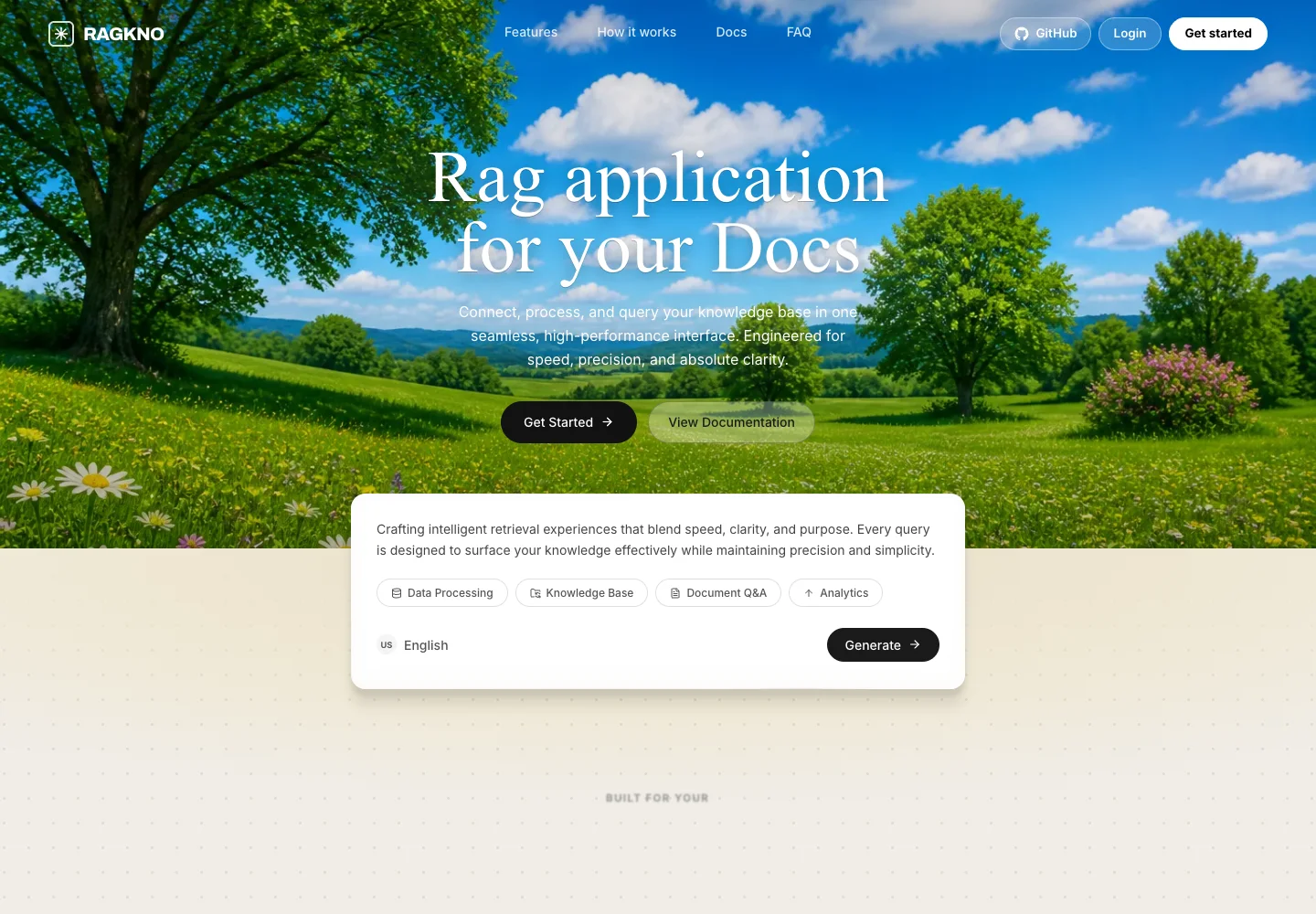
What RagKno does
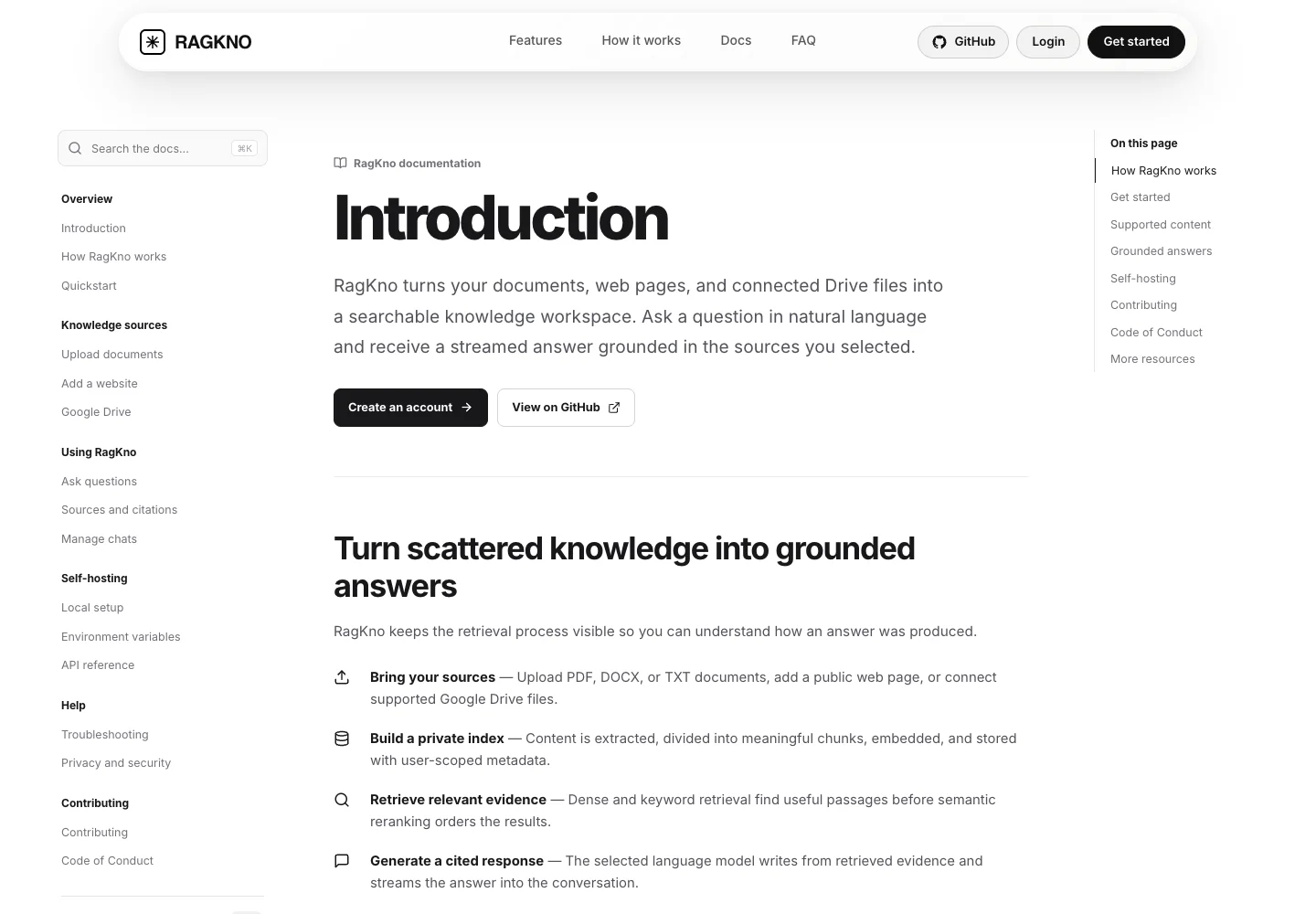
RagKno gives each user a private knowledge workspace. Add supported files, a public web page, or selected Google Drive documents; RagKno extracts and chunks the content, indexes it with user-scoped metadata, retrieves and reranks relevant evidence, and streams an answer with citations back to the conversation.
- Multiple knowledge sources — PDF, DOCX, TXT, public URLs, and Google Drive
- Grounded conversations — dense and keyword retrieval, semantic reranking, parent-context expansion, and inline citations
- Streaming interface — token streaming over server-sent events with visible retrieval progress
- Private workspaces — authenticated users, scoped threads, messages, sources, vectors, and Drive credentials
- Conversation management — persistent chat history, rename/delete controls, Markdown, and responsive UI
- Evaluation — a RAGAS-based evaluation command and sample dataset
- Self-hosting — Docker backend, Cloudflare Pages proxy, health endpoints, and environment templates
Product preview
How it works
flowchart LR
    A[Files, URLs, Drive] --> B[Extract and chunk]
    B --> C[Chroma vector index]
    Q[User question] --> D[Dense + BM25 retrieval]
    C --> D
    D --> E[Cross-encoder reranking]
    E --> F[AgentRouter or Google model]
    F --> G[Streaming answer + citations]
    P[(PostgreSQL)] --- Q
    P --- G
The React client talks to FastAPI through /api. In production, a Cloudflare Pages Function forwards that path to the backend, keeping sessions first-party while streaming the response. PostgreSQL stores accounts, threads, messages, source metadata, and encrypted Drive credentials. Chroma stores the vector index on a persistent volume.
Stack
- Frontend: React 18, Vite, React Router, Motion, GSAP
- API: FastAPI, Uvicorn, Pydantic
- Retrieval: ChromaDB, sentence-transformers, BM25, CrossEncoder reranking
- Generation: AgentRouter by default; Google Generative AI is supported as an alternative
- Persistence: PostgreSQL in production, SQLite for local development, and Chroma on disk
- Hosting target: Cloudflare Pages + Pages Functions for the frontend; Docker on Hugging Face Spaces for the API
Quickstart
Requirements
- Python 3.13
- uv
- Node.js 22 and npm
- An AgentRouter key or Google AI key
1. Clone and configure
git clone https://github.com/GitHpriyanshu23/Ragkno.git
cd Ragkno
cp .env.example .env
For a minimal local run, set one model provider in .env:
LLM_PROVIDER=agentrouter
AGENTROUTER_API_KEY=your_key
AGENTROUTER_MODEL=deepseek-v4-flash
FRONTEND_URL=http://localhost:5173
ENV=development
PORT=8000
When DATABASE_URL is omitted locally, RagKno uses an ignored SQLite database. Google OAuth variables are only required for Google sign-in and Drive sync.
2. Install dependencies
uv sync --dev
npm --prefix frontend ci
3. Run the application
In terminal one:
uv run uvicorn backend.main:app --host 127.0.0.1 --port 8000 --reload
In terminal two:
npm --prefix frontend run dev
Open http://localhost:5173. API documentation is available at http://localhost:8000/docs.
Environment variables
Start from .env.example. The production-critical settings are:
| Variable | Purpose |
|---|---|
DATABASE_URL |
PostgreSQL connection used for users, sessions, chats, metadata, and OAuth tokens |
AGENTROUTER_API_KEY |
Primary model-provider credential |
LLM_PROVIDER |
agentrouter or google |
RAGKNO_SESSION_SECRET |
Random secret of at least 32 characters |
RAGKNO_ENCRYPTION_KEY |
Optional Fernet key that encrypts stored Drive tokens; derived from the session secret when unset. Changing the active key requires users to reconnect Drive |
FRONTEND_URL |
Canonical HTTPS frontend origin |
GOOGLE_CLIENT_ID / GOOGLE_CLIENT_SECRET |
Google login and Drive OAuth credentials |
GOOGLE_APP_REDIRECT_URI |
Google sign-in callback, normally https://app.example.com/api/login/google/callback |
GOOGLE_REDIRECT_URI |
Drive callback, normally https://app.example.com/api/auth/callback |
RAGKNO_DATA_DIR |
Durable runtime directory; /data in the Docker deployment |
CHROMA_PERSIST_DIR |
Optional explicit Chroma location |
Never commit .env, provider keys, OAuth credentials, database files, uploaded documents, or vector-store data. The repository ignore rules cover these artifacts; run the readiness checks below before every public release.
Deployment
The supported deployment path is:
- Cloudflare Pages builds
frontend/and serves the application. - Cloudflare Pages Functions proxies
/api/*to the backend so cookies and OAuth callbacks remain first-party. - Hugging Face Docker Space runs FastAPI on port
7860with one worker. - Persistent storage mounted at
/datapreserves embeddings and model cache across Space restarts. - Managed PostgreSQL preserves user and conversation data.
For Cloudflare Pages with an AWS EC2 backend, follow AWS deployment guide. It includes the new-account free-plan limits, server setup, HTTPS, persistent storage, OAuth callbacks, and launch checks. The alternative Hugging Face deployment guide describes Spaces setup and its hosting limitations.
API
FastAPI publishes an interactive OpenAPI reference at /docs. Common routes include:
GET /health/liveandGET /health/readyPOST /auth/register,POST /auth/login, andPOST /auth/logoutGET|POST /threadsandGET /threads/{id}/messagesPOST /ingest/files,POST /ingest/url, andPOST /drive/syncPOST /queryandPOST /query/streamGET /ingest/sourcesandPOST /ingest/unindex
Mutation routes validate the session and CSRF token. Retrieval and source operations are scoped to the authenticated user.
Quality checks
uv lock --check
uv run pytest -q
uv sync --group evaluation
uv run python evaluation/ragas_eval.py --help
npm --prefix frontend test
npm --prefix frontend run build
git diff --check
Run the sample RAGAS evaluation after indexing a representative dataset:
uv sync --group evaluation
uv run python evaluation/ragas_eval.py \
  --dataset evaluation/testset.sample.json \
  --user-id YOUR_USER_ID \
  --top-k 3
Repository layout
backend/                 FastAPI routes, auth, ingestion, and streaming
frontend/                React application and Cloudflare Pages Function
src/                     Retrieval, storage, ingestion, and Drive integration
evaluation/              RAGAS evaluation command and sample dataset
deploy/huggingface/      Hugging Face Space metadata template
docs/                    Deployment guide and repository screenshots
.github/workflows/       CI checks
Documentation
The app includes a responsive documentation experience at /docs. Repository documentation includes:
Contributing
Issues and pull requests are welcome. Read CONTRIBUTING.md for setup, branch, commit, test, and pull-request guidance. Please follow the Code of Conduct. Report vulnerabilities privately using the process in SECURITY.md.
License
RagKno is available under the Apache License 2.0.
Reviews (0)
Sign in to leave a review.
Leave a reviewNo results found