vibereceipt
Health Pass
- License — License: MIT
- Description — Repository has a description
- Active repo — Last push 0 days ago
- Community trust — 10 GitHub stars
Code Fail
- process.env — Environment variable access in dist/cli.js
- exec() — Shell command execution in dist/period.js
- exec() — Shell command execution in dist/plan.js
Permissions Pass
- Permissions — No dangerous permissions requested
No AI report is available for this listing yet.
Print a store receipt for your AI coding: tokens, what they'd cost at API prices, and how many times the agent said "You're absolutely right". Claude Code, Codex, OpenCode. 100% local.
vibereceipt
Print a store receipt for your AI coding. Tokens, what they'd cost at API prices, and how many times the agent said "You're absolutely right".
npx vibereceipt
(Or straight from GitHub: npx github:glmn-ai/vibereceipt.)
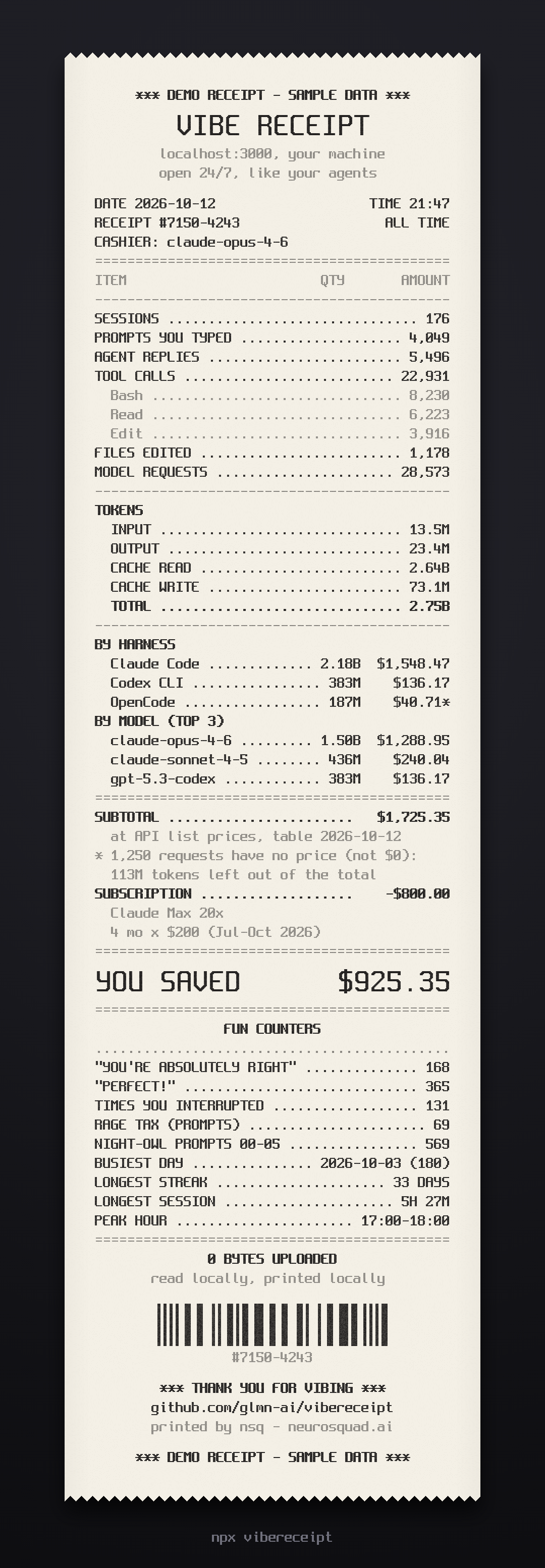
The receipt above comes from --demo sample data, not a real person's logs.
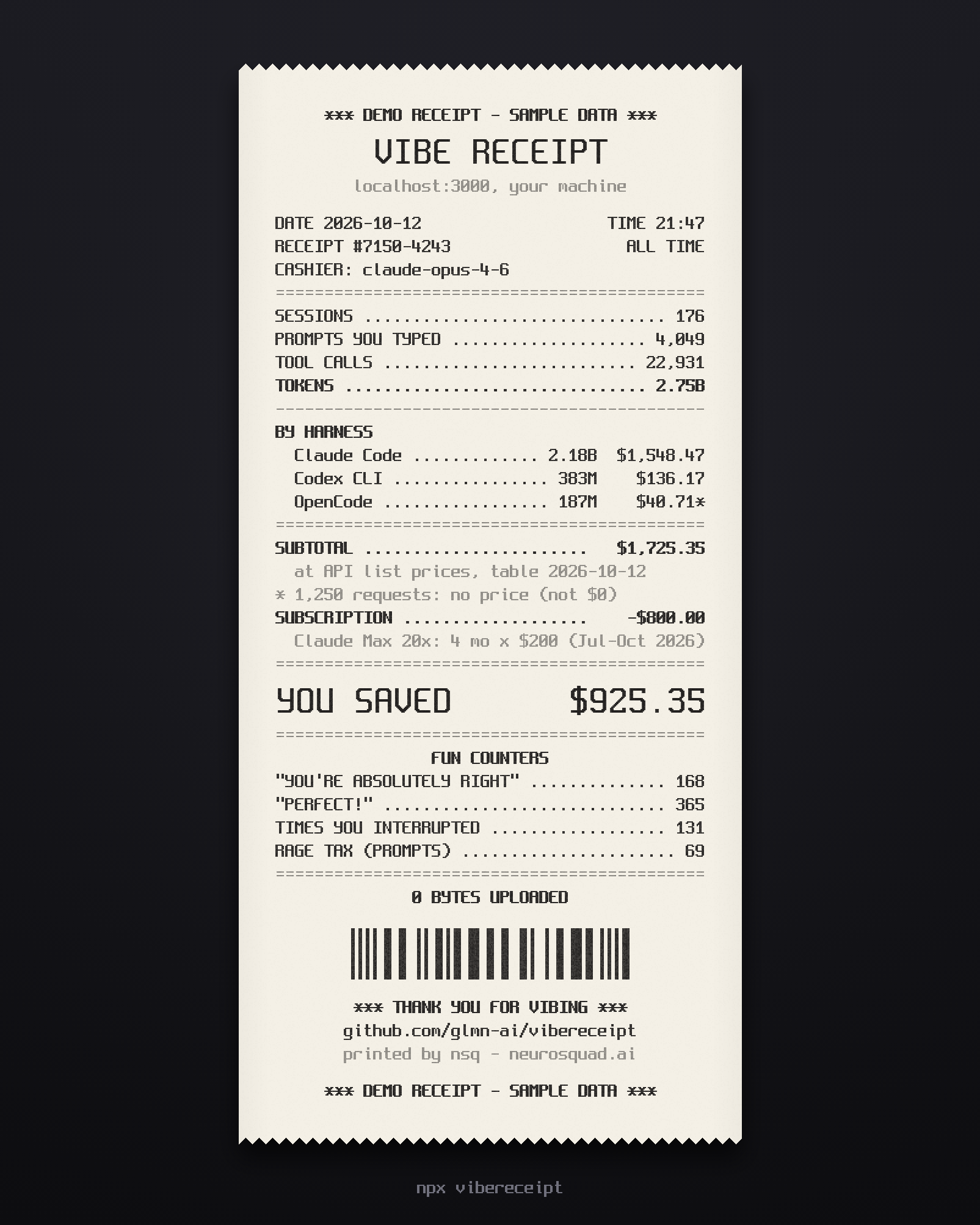
Posting it? --short prints a compact receipt and saves it as an exact 4:5 PNG,
which the X timeline shows uncropped:
vibereceipt reads the session logs that Claude Code, Codex CLI and OpenCode
already keep on your machine. It prints a thermal-printer receipt in your
terminal, line by line, and saves a PNG of it that's ready to post. It needs
no account, makes no network calls and uploads nothing.
What's on the receipt
- Header: date, time, a receipt number (a hash of the stats), and the
"cashier", which is your top model by cost. - Items: sessions, prompts you typed, agent replies, tool calls (with the
top 3 tools), files edited, and model requests. - Tokens: input, output, cache read, cache write and the total.
- By harness and by model (top 3): tokens and cost for each.
- Total at API list prices, with the date of the price table. With
--plan, you also get your subscription for the same months and either
YOU SAVED or YOU OVERPAID, whichever is true. - Fun counters, each shown only when the logs have it:
- "You're absolutely right" and "Perfect!", counted in the agent's replies
- times you interrupted the agent
- rage tax: prompts containing wtf / fuck / shit / damn
- night-owl prompts sent between 00:00 and 05:00
- your busiest day
- your longest streak of consecutive days
- your longest session
- your peak hour
- Footer:
0 BYTES UPLOADED, a decorative barcode, and a thank-you.
Usage
npx vibereceipt                # all time
npx vibereceipt --since 30d    # or 7d, 4w, 6m, 1y, 2026-09-01
npx vibereceipt --month        # this calendar month
npx vibereceipt --plan max20   # compare with your subscription
npx vibereceipt --short        # compact 4:5 receipt for the timeline
npx vibereceipt --demo         # sample data, clearly marked DEMO
| Flag | What it does |
|---|---|
--since <when> |
Period: 30d, 7d, 4w, 6m, 1y, or a date YYYY-MM-DD (local time). The default is all time. |
--month / --year |
This calendar month or year. |
--plan <plan> |
pro ($20), max5 ($100), max20 ($200), chatgpt-plus ($20), chatgpt-pro ($200), or any monthly price, e.g. 100 or $49.99. |
--short |
A compact receipt for posting: header; sessions, prompts and tool calls; total tokens; cost by harness; subtotal or plan comparison; the top 4 fun counters; footer. The PNG is an exact 4:5. |
--out <path> |
Where to save the PNG. The default is ./vibereceipt-YYYY-MM-DD.png. |
--no-png |
Don't save a PNG. |
--no-anim |
Print the receipt instantly. Output that isn't a TTY never animates. |
--no-color |
No ANSI styling. NO_COLOR is respected too. |
--json |
Print the stats as JSON instead of the receipt. Money is given in exact picodollars plus a dollar string. No PNG is saved unless you pass --out. |
--projects |
Add your top 3 project folder names, as base names only. Off by default. |
--demo |
Print a receipt made from built-in sample data. It says DEMO at the top and bottom. |
-h, --help / -v, --version |
Show help or the version. |
After the receipt prints, you get the path to the PNG and a ready-made
Share on X link. The link fills in the text only, so attach the PNG
yourself.
What it reads
| Harness | Where |
|---|---|
| Claude Code | $CLAUDE_CONFIG_DIR/projects, otherwise ~/.claude/projects and ~/.config/claude/projects. Subagent logs are included. |
| Codex CLI | $CODEX_HOME/sessions and archived_sessions, otherwise ~/.codex/… |
| OpenCode | $XDG_DATA_HOME/opencode/opencode.db, otherwise ~/.local/share/opencode/opencode.db (the same path on Windows and macOS) |
OpenCode keeps its history in SQLite, which vibereceipt reads with Node's
built-in node:sqlite in read-only mode. That module needs Node 22.13 or
newer. On older Node versions, OpenCode is skipped with a note and everything
else still works on Node 18.17 and up.
If no logs are found, vibereceipt lists every place it looked.
Privacy
No network. vibereceipt has zero runtime dependencies and never
importshttp,https,net,tlsordgram, and never callsfetch.
You can check for yourself:grep -rnE "fetch\(|node:https?|node:net|node:tls|node:dgram|WebSocket" dist # prints nothingThe only URLs in
dist/are text: the share link it prints and the
two price-table source URLs kept as plain strings. Every CI run repeats
this check.Read-only. Logs are only ever opened for reading, and the OpenCode
database is opened withreadOnly: true. The only file vibereceipt writes
is the PNG.Nothing private goes on the receipt. Prompt text is reduced to a
timestamp and a yes/no "rage" flag the moment it's read, and replies are
reduced to phrase counts. Edited file paths are used only to count distinct
files. MCP and unknown tools are grouped together, so private server or tool
names never appear. Project folder names show up only with--projects.
A test feeds the scanners fixture logs full of marker strings and fails if
any of them reaches the receipt or the JSON.
How the cost is computed
The parsers and the pricing are vendored from@neurosquad/core, the engine
behind nsq:
- Requests are de-duplicated. Claude Code writes one line per content
block, and resumed or forked sessions copy earlier messages. Lines are merged
by message id, so every API request is counted once. Codex uses its
per-responsetoken_usage_record. OpenCode uses one row per assistant step. - Exact money. Token counts are integers, and prices are integers in
micro-dollars per million tokens. Cost is calculated in integer picodollars
with no floating point and rounded once, for display. - Each token type has its own price. Uncached input, output (reasoning
included, never charged twice), cache reads, 5-minute and 1-hour cache
writes, OpenAI long-context pricing (above 272K input tokens), Anthropic fast
mode, the 1.1xinference_geo: usmultiplier and web searches are all
priced separately. - The price table is versioned. The receipt prints the table's date
(price table 2026-10-12). The prices are Anthropic's and OpenAI's
published API list prices. - Unknown models are "no price", never $0. A local model, a model behind a
reseller, or a model missing from the table gets no price. The receipt shows
how many requests and tokens that covers, and a*marks rows that are only
partly priced. When the table has no price for a request but the harness
recorded a cost of its own (OpenCode computes one from its provider
catalogue), that recorded cost is used. A recorded cost of 0 counts as no
price.
Caveats:
- This is what the same traffic would cost at API list prices. A Claude or
ChatGPT subscription isn't billed per token, so the total isn't what you
paid. - The logs don't say who paid. If
ANTHROPIC_API_KEY(or an OpenAI key for
Codex) was set, those requests were billed to the API, not your plan, and--plan's "you saved" doesn't apply to them. --plancharges the subscription once for each calendar month touched:
every month from your first activity in the period to your last, inclusive.
The receipt prints the months, e.g.4 mo x $200 (Jul-Oct 2026).- Counters come from what the logs record:
- "Prompts you typed" leaves out tool results, slash-command plumbing,
system and meta lines, and prompts a parent agent sent to a subagent. - A "longest session" is the longest stretch of one session without a
1-hour gap. - Codex interrupts are its
turn_aborted: interruptedevents. OpenCode
interrupts are aborted assistant messages. - OpenCode 2's new tables are read for usage but not yet for the fun
counters.
- "Prompts you typed" leaves out tool results, slash-command plumbing,
- Big numbers are rounded for display (
2.75B).--jsonhas every exact value.
Supported harnesses
- Claude Code
- Codex CLI
- OpenCode
Want another one? The parsers come from @neurosquad/core, which already
reads more harnesses. Open an issue.
Development
npm install
npm run build      # TypeScript -> dist/ (committed, so npx github:… works without a build step)
npm test           # node:test, synthetic Claude/Codex/OpenCode fixtures
npm run demo       # regenerates assets/receipt-demo.png
dist/ is committed on purpose, and CI fails if it's out of date. The vendored
parsers in src/vendor/neurosquad-core/ are a read-only copy: fixes go
upstream first, then get re-vendored. One deliberate exception for now:pricing.ts adds Claude Sonnet 5.5 and Claude Haiku 5.5 (price table
2026-10-12) ahead of upstream; its header says so.
Credits
- Parsers from @neurosquad/core,
the engine behind nsq (github.com/glmn-ai/neurosquad-cli). MIT. - The receipt is set in Spleen by Frederic
Cambus (BSD 2-Clause, seefonts/LICENSE-spleenandNOTICE). - "Claude Code", "Codex" and "OpenCode" are named only to say whose logs are
read. vibereceipt isn't affiliated with Anthropic, OpenAI or the OpenCode
project.
MIT © NeuroSquad. Printed by nsq · neurosquad.ai
Reviews (0)
Sign in to leave a review.
Leave a reviewNo results found