convergo
Health Warn
- License — License: MIT
- Description — Repository has a description
- Active repo — Last push 0 days ago
- Low visibility — Only 7 GitHub stars
Code Fail
- spawnSync — Synchronous process spawning in evals/wrapper-behavior/orchestrator-scoping.ts
- spawnSync — Synchronous process spawning in evals/wrapper-behavior/resume-repin.ts
- spawnSync — Synchronous process spawning in evals/wrapper-behavior/wrapper-compliance.ts
- process.env — Environment variable access in evals/wrapper-behavior/wrapper-compliance.ts
Permissions Pass
- Permissions — No dangerous permissions requested
No AI report is available for this listing yet.
Disciplined software engineering for coding agents: plan → review → build loops that actually terminate, with bounded rounds, fresh-reviewer exit gates, and TDD. Plugin for Claude Code and Codex.

Convergo
Plan → review → build loops for coding agents — that actually terminate.



Quick Start · Why · How It Works · Hybrid Loops · Skills · Install
Agent-written code needs review, and agent review needs a loop: find issues,
fix them, review again. The dirty secret is that this loop often doesn't
converge — each round adds patches, prose, and pseudo-code instead of
closing in on done. Convergo is a plugin that bounds that loop by
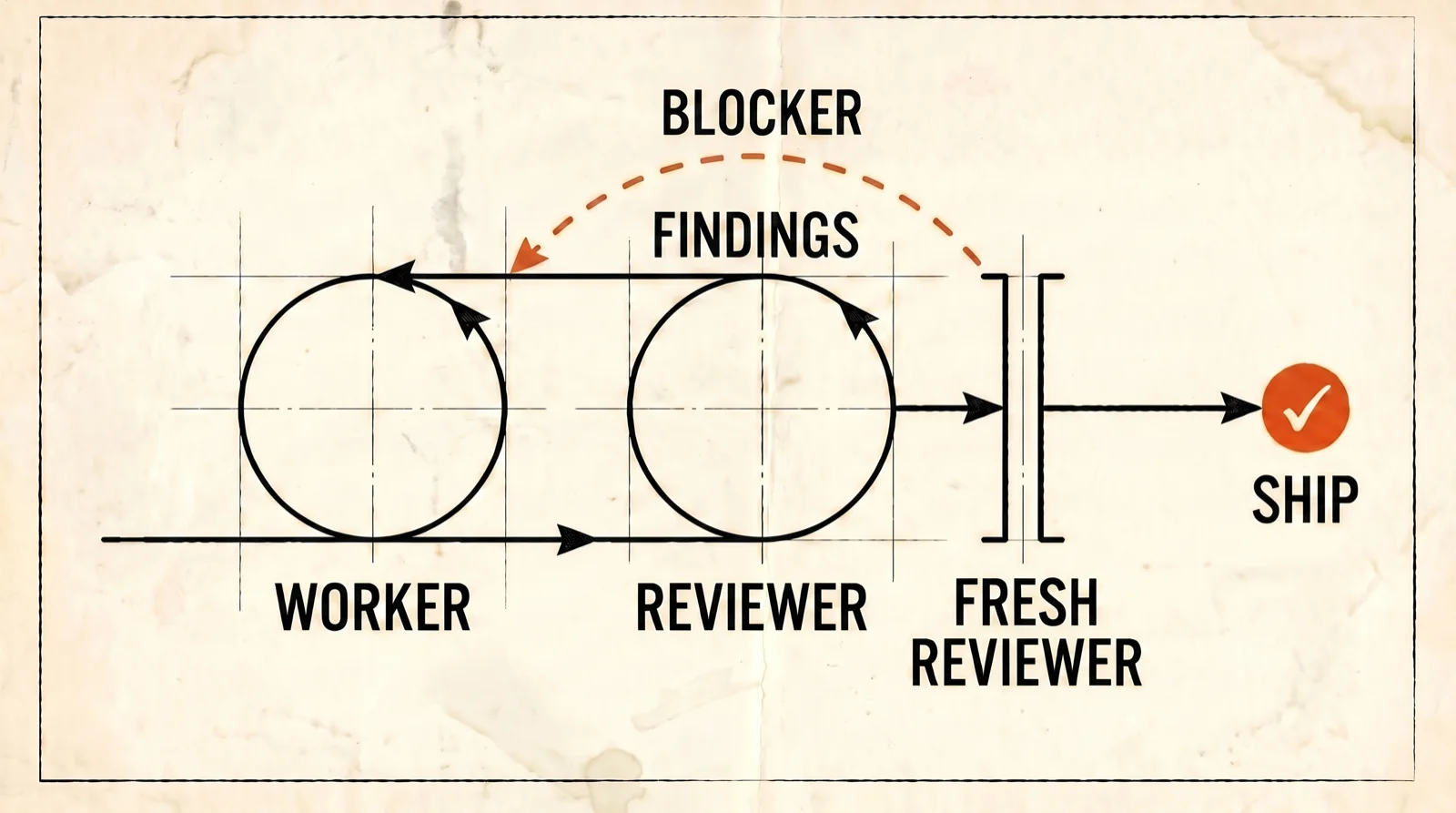
construction. It exits only when a fresh reviewer — a newly spawned session
that reads the diff cold, with no memory of earlier rounds — completes a full
pass and reports no blockers.
After three rounds without one, it stops and escalates to you instead of
churning.
It is a convergence-focused fork of
Compound Engineering:
CE gets the plan-first, review-everything shape right; Convergo makes the
loops terminate.
Built for correctness-critical, reviewable work with AI coding agents.
Not for quick spikes or throwaway prototypes — see Cost and Fit.
Quick Start
Claude Code — everything ships with the plugin:
/plugin marketplace add gomilesf/convergo
/plugin install convergo
Codex and every other host: see Install — every host is a
single plugin install.
Then, in a repo with an issue to work on:
/cvg-plan-loop create a plan for issue #42
... review the plan yourself ...
/cvg-build-loop docs/plans/42-plan.md
Why Convergo Exists
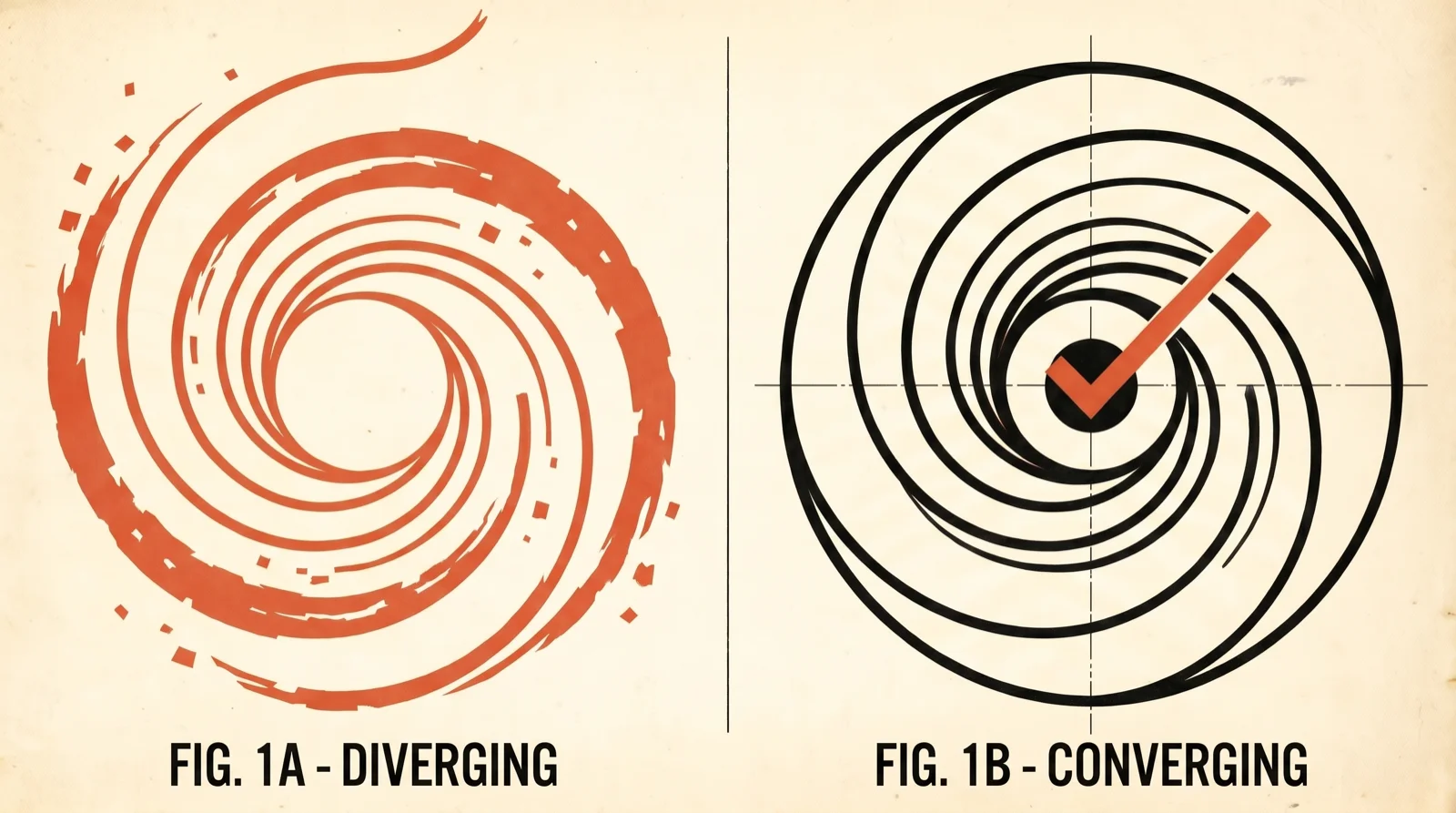
An unbounded agent review loop can fail to settle — and the failure mode is
not "the reviewer found a bug" (that's the loop working). The failure mode is
divergence:
- Plan review discovers one symptom per round instead of the missing surface,
invariant, or behavior decision underneath them all. - The planner responds by adding more text instead of repairing the plan's
structure. - Code review pushes the worker into local patches even when the finding is
really a plan gap, a contract gap, or a systemic design gap. - Every round makes the artifact larger, vaguer, and more likely to
accumulate pseudo-code — which spawns a new class of review findings.
One missing invariant across eight surfaces should become one plan repair,
not eight rounds of local patches. Convergo's rules exist to force exactly
that.
What a Run Looks Like
/cvg-build-loop docs/plans/rate-limit-plan.md on Claude Code, condensed:
orchestrator  records base commit and worktree state,
              spawns a WORKER session with the plan, ends its turn (no polling)

worker        implements slice by slice with TDD, one commit per slice,
              keeps impl notes for the reviewer
              -> "Implementation round complete. Base a1b2c3, head d4e5f6.
                  Verification: 41 tests pass. Known gaps: none."

orchestrator  spawns a FRESH REVIEWER session

reviewer      reads plan + diff, dispatches correctness/testing sub-reviewers,
              merges their JSON findings
              -> "Not ready. F1 (P1): retry path drops the rate-limit header.
                  F2: plan never decided burst behavior — contract gap."

orchestrator  returns the findings verbatim to the SAME worker session

worker        intake first, then repair: F1 is implementation-owned -> fixes it
              F2 is a contract gap -> STOPS and reports instead of patching
              around the missing decision

you           decide burst behavior (or send it back through the planner)

worker        finishes the repair -> new head commit

reviewer      (same session) focused re-review of the fixes -> pass

orchestrator  spawns a NEW FRESH REVIEWER session

reviewer      (new session) full first pass
              -> "Ready with fixes. No blockers. Two P2 notes."

orchestrator  exits the loop: base -> head, findings history, P2 list for you
Three properties make this a loop and not a spiral: the worker never patches
around a missing decision, review feedback goes back to the session that has
the context, and the exit judgment always comes from a reviewer who has never
seen the code before.
The Rules That Make It Converge
Every rule below is written into the skills, not just described here. What
can be machine-checked is — the findings schema is validated per finding,
and the generated platform builds are byte-checked by tests; the behavioral
rules are prompt contracts, exercised end-to-end by the release smoke test.
Feedback goes through intake, not straight to edits. The planner or
worker that produced the artifact classifies each finding first — code bug,
plan gap, contract gap, systemic design gap, stale, or blocked on a missing
decision — and repairs only what its role owns. Workers stop and call back on
plan, contract, and systemic gaps instead of patching forward.
Findings carry evidence, not vibes. Sub-reviewers return findings against
a shared schema: P0–P3 severity, discrete confidence anchors, a
quote-the-line gate for high-confidence claims. Low-confidence findings are
dropped at merge unless they are critical, and P3 style findings are never
emitted at all — style belongs to tooling, not the loop. Reviewers run under
a fresh-review evidence boundary — no project memory, no prior sessions, no
rollout history; only the plan, the diff, and the repo. The worker's impl
notes are the one
deliberate exception: they ship with the diff so the reviewer sees declared
deviations, assumptions, and accepted gaps. The notes carry decisions, never
review provenance — no round numbers, finding IDs, or fix-status claims — so
a fresh reviewer inherits the decision record, not the previous reviewer's
search map.
Exit requires a fresh reviewer. A same-reviewer pass is never the exit
condition. After repairs, the original reviewer re-reviews the fixes; the
loop exits only when a newly spawned reviewer completes a full first pass
with no blockers. "Ready with fixes" (only non-blocking P2 notes remain)
counts as passing — the loop does not churn on nitpicks.
The loop is capped. Three rounds without a clean fresh pass stops the
loop and escalates to you with all open findings. Findings already
adjudicated invalid cannot re-block a later round without new evidence (the
adjudication ratchet). Bounded convergence is a rule, not a hope.
One loop covers one repo. The loop's base/head and diff bookkeeping
spans a single repo, so changes outside it would escape review. When a
plan's slices span multiple repos, the orchestrator declares the repo split
up front, runs one loop per repo, and reports every uncovered repo as a
blocking known gap — a single-repo exit is never presented as plan
completion.
Plans are right-sized decision artifacts. /cvg-plan classifies
complexity first (brief / standard / full); only cross-cutting work gets the
full surfaces + invariant-matrix treatment. Plans never contain code. Open
behavior decisions that bind multiple slices go into a behavior contract
rather than being invented downstream.
The loop runs unattended but finds you at three defined points. The
build loop starts only when you explicitly trigger it on a reviewed plan —
this gate is where your judgment counts most: check that the behavior
contract records decisions you actually want, that each slice's "done when"
is verifiable, and that the invariant matrix covers every surface you know
about. Mid-loop, a worker blocked on a missing behavior decision stops and
routes the question to you instead of inventing an answer. And when the
round cap trips, the escalation lands with you.
Two Ways to Use It
Standalone skills (any supported host): drive each step yourself. With no
orchestrator, the skills route blocking questions to you directly.
/cvg-plan -> /cvg-plan-review -> (fix via /cvg-plan-review-feedback)
-> /cvg-work -> /cvg-code-review -> (fix via /cvg-code-review-feedback)
Orchestrated loops (Claude Code and Codex): the session becomes an
orchestrator that spawns and supervises real specialist sessions.
discuss goal
-> /cvg-plan-loop        planner <-> fresh plan reviewers, until clean
-> human reviews and questions the plan
-> /cvg-build-loop       worker <-> fresh code reviewers, until clean
-> final fresh code review
-> required QA gates, if any
-> done
The loop skills share one protocol (cvg-multi-session), bound to the host
platform before anything else runs: specialists are Codex threads (callbacks
via send_message_to_thread, heartbeat waiting) or Claude Code background
agents (final-message callbacks, task-notification waiting). Each platform's
build ships only its own transport mechanics — the copies underplugins/codex and plugins/claude are generated from one canonical source.
Specialist identity always comes from the platform tool result, never from
the specialist's own prose.
On Claude Code there is a third option: the same loops with a split-engine
routing — see Hybrid Loops.
Hybrid Loops: Fable Plans, Codex Builds
(Claude Code only.) The loop protocol doesn't care which model plays which
role — the two hybrid presets pin a deliberate split that matches today's
model economics: Claude Fable has the best taste and judgment but scarce
quota; GPT-5.6 Sol through the Codex CLI at high reasoning effort is nearly
as capable at execution and effectively free at typical subscription limits.
So the presets spend Fable only where judgment has leverage, and let Codex
burn every iteration. These are defaults, not hardcoded — any invocation can
override either engine.
| Role | Engine | Why |
|---|---|---|
| Planner, plan revisions | Fable | direction-setting is where taste pays most |
| Plan reviewers | Codex (gpt-5.6-sol high) | completeness-vs-codebase checking is execution work — and cross-model review exposes blind spots same-model self-review shares |
| Worker, first-pass code reviews, QA | Codex (gpt-5.6-sol high) | all the iteration burn lands here |
Final final-fresh-exit reviewer |
Fable | the one gate that decides shipping |
The exit is tiered because no one knows which review is the last. In the
hybrid build loop a clean Codex fresh review never exits — it promotes: it
triggers a Fable fresh review, and only a clean Fable pass ends the loop.
Fable blockers re-enter the normal feedback cycle (worker fixes, the same
Fable session re-reviews, the next round starts back at the Codex tier). In
practice Fable runs once or twice per loop — exactly when the cheap engine
believes the work is done. This split also keeps the protocol honest: the
final exit requires real dispatched sub-reviewers, which inline Codex
sessions cannot provide.
Codex specialists run with the user's own permissions. Convergo is a
developer tool: it passes no sandbox or permission flags and manages no
permissions. codex exec sessions resolve their capabilities from the
user's codex configuration, exactly as a shell would, and Claude-side
agents run under the user's Claude Code permission settings. The loop's
protection is contractual — review gates, git reversibility, and
phase-gated external side effects — and role boundaries (reviewers do not
modify the repo) are contract lines in the role skills. The relay-wrapper
mechanics are regression-tested by the
wrapper-behavior evals.
Prerequisites. A working, logged-in codex CLI with the convergo codex
plugin installed on that side (codex specialists load role skills by name),
plus Fable access on the Claude side. A missing prerequisite stops the loop
with a blocker instead of silently degrading to one engine.
/cvg-hybrid-plan-loop docs/briefs/topic.md
... review the plan yourself ...
/cvg-hybrid-build-loop docs/plans/topic-plan.md
Skills
| Skill | Purpose | Platforms |
|---|---|---|
/cvg-plan |
Read an issue and codebase, then write a sliced plan with an invariant matrix when needed | Claude Code, Codex, generic |
/cvg-plan-review |
Review a plan against the actual codebase for missing surfaces, incomplete slices, and wrong invariants | Claude Code, Codex, generic |
/cvg-plan-review-feedback |
Classify and handle plan-review blockers inside the planner session | Claude Code, Codex, generic |
/cvg-work |
Execute a plan slice by slice with TDD and implementation notes | Claude Code, Codex, generic |
/cvg-code-review |
Review implementation against the plan and contract, separating code bugs from contract gaps | Claude Code, Codex, generic |
/cvg-code-review-feedback |
Classify and handle code-review blockers inside the worker session | Claude Code, Codex, generic |
/cvg-plan-loop |
Orchestrate planner -> fresh plan review -> repair -> final fresh review | Claude Code, Codex |
/cvg-build-loop |
Orchestrate worker -> fresh code review -> repair -> final fresh review -> QA gates | Claude Code, Codex |
/cvg-hybrid-plan-loop |
Plan loop preset: Fable plans, Codex (gpt-5.6-sol high) reviews | Claude Code |
/cvg-hybrid-build-loop |
Build loop preset: Codex implements and reviews first, Fable holds the final exit gate | Claude Code |
One more skill, cvg-multi-session, ships alongside these: the shared
protocol (transport binding, callbacks, waiting, feedback routing, exit
gates) that the loop skills bind to. It is internal — you never invoke
it directly.
Auxiliary Personas
/cvg-plan, /cvg-plan-review, and /cvg-code-review fan out to a small
reviewer/researcher set adapted from CE. Every persona is a skill-local prompt
asset under the owning skill's references/personas/, dispatched as a generic
subagent — no platform agent registration on any host. Code-review personas
return raw JSON against the shared findings schema
(cvg-code-review/references/findings-schema.md).
| Persona | Used by | When |
|---|---|---|
best-practices-researcher |
/cvg-plan |
non-obvious design work |
repo-research-analyst |
/cvg-plan |
always |
correctness-reviewer |
/cvg-code-review |
always |
testing-reviewer |
/cvg-code-review |
always |
security-reviewer |
/cvg-code-review |
auth, input, permissions, data handling |
adversarial-reviewer |
/cvg-code-review |
large or high-risk diffs |
reliability-reviewer |
/cvg-code-review |
error handling, retries, timeouts, jobs |
feasibility-reviewer |
/cvg-plan-review |
standard and full plans |
security-lens-reviewer |
/cvg-plan-review |
auth, data, external APIs, secrets |
scope-guardian-reviewer |
/cvg-plan-review |
many slices or scope creep |
Working Artifacts
Convergo leaves a durable paper trail in the repo:
docs/plans/<issue-id>-plan.md— the plan (<issue-id>is the issue
number or a slug);<issue-id>-contract.mdbeside it when a behavior
contract is warranteddocs/impl-notes/<issue-id>.md— worker decisions, deviations, and flagged
assumptions the reviewer needs
Per-run review scratch deliberately lives outside the repo — inside the
worktree it would leak earlier rounds' findings to the next fresh reviewer:
/tmp/convergo/cvg-code-review/<run-id>/and/tmp/convergo/cvg-plan-review/<run-id>/—review.json(verdict, merged
findings, auxiliary coverage) plus one JSON per sub-reviewer. Ephemeral;
inspect during or right after a run.
Cost and Fit
What a loop spends. A build-loop run is one worker session, a fresh
reviewer per round (each dispatching two or more sub-reviewer agents),
focused re-reviews, and a final fresh pass — expect roughly an order of
magnitude more tokens than telling an agent to "just implement it" (our
observed runs, not a benchmark). That is the price
of independent review, and it is why the loop is capped at three rounds. The
six base skills used standalone cost roughly what any single-session skill
costs; claude plugin details convergo shows the per-skill token numbers.
What the loops require. Orchestration needs real sub-session primitives:
background agents on Claude Code, threads on Codex. If the host cannot
provide them, the skills stop with a tool-layer blocker rather than
role-playing the specialists inline. Generic hosts (Cursor, OpenCode, Pi,
Gemini) get the six base skills only.
When to use something else. Quick spikes, throwaway experiments, and
rapid visual UI iteration do not need a bounded review loop. Use the base
planning and review skills selectively, or skip Convergo entirely.
Install
Claude Code
/plugin marketplace add gomilesf/convergo
/plugin install convergo
Ships all eleven skills. Specialist reviewer and researcher behavior lives
inside the skills as local persona prompts, so the plugin install is
self-contained.claude plugin details convergo shows the component inventory and the
projected token cost per skill.
Codex App
- Open Plugins from the sidebar, click Add plugin marketplace.
- Source:
gomilesf/convergo, Git ref:main, sparse paths blank. - Add the marketplace, select Convergo, install convergo, then
restart Codex. The install is self-contained; no extra agent setup step.
Codex installs ship the nine base and loop skills; the two hybrid presets
are Claude Code-only (they need the Agent tool's per-role model routing).
Codex CLI
codex plugin marketplace add gomilesf/convergo
codex   # inside: /plugins -> Convergo -> install convergo
Restart Codex after the install completes. For a non-default profile, run
every step against the same CODEX_HOME:
CODEX_HOME="$HOME/.codex/profiles/work" codex plugin marketplace add gomilesf/convergo
CODEX_HOME="$HOME/.codex/profiles/work" codex
Earlier convergo versions installed typed cvg-* agents into$CODEX_HOME/agents/convergo/. Current skills no longer use them; remove that
directory (and $CODEX_HOME/convergo/install-manifest.json) if present.
Cursor
/add-plugin convergo
OpenCode
Add to your global or project opencode.json, then restart OpenCode. The
OpenCode plugin registers the base-only skills under plugins/generic/skills.
{
  "plugin": ["convergo@git+https://github.com/gomilesf/convergo.git"]
}
Pi
pi install git:github.com/gomilesf/convergo
Gemini CLI
gemini extensions install https://github.com/gomilesf/convergo
Upgrading
Installs resolve by version: upgrades need a version bump on the marketplace
side and an explicit update on yours. (convergo-plugin is the marketplace's
registered name; convergo is the plugin inside it.)
/plugin marketplace update convergo-plugin    (Claude Code)
/plugin update convergo
codex plugin marketplace upgrade convergo-plugin   # Codex CLI
codex plugin add convergo@convergo-plugin
Local Development
bun install
bun run sync           # regenerate plugins/*/skills from skills-src/
bun run validate       # productization metadata checks
bun test               # metadata + skill convention tests
bun run plugin:validate
bun run eval:trigger   # LLM eval: skill descriptions route the right prompts
bun run eval:wrapper   # wrapper-compliance scenarios + per-rule ablation
bun run eval:repin     # codex ground truth: resume drops the -m pin; -c re-pin holds
bun run eval:scoping   # orchestrator cross-repo scoping scenarios
Source layout and generated builds
skills-src/ is the single source of skill content. bun run sync generates
the platform roots: it strips <!-- codex --> / <!-- claude --> marker
blocks so each platform build carries only its own transport mechanics, and
it renders the loop skills' references/cvg-multi-session-protocol.md copies
from the canonical skills-src/cvg-multi-session/SKILL.md. Never edit
generated files by hand; bun test byte-checks every platform copy against
the transformed source.
The other static tests guard the contracts that keep the loop sound: the
findings schema ships with every cvg-code-review copy, the
stage-calibration block stays identical across skills, and agent prompts
contain no dangling references.
Trigger-routing evals
eval:trigger replays the routing prompts in evals/trigger/cases.json
against the current skills-src/ descriptions through claude -p, with
frozen descriptions of real competing skills (compound-engineering, built-in
review commands) in the candidate list, so convergo must win against a
realistic install. Cases cover per-skill positives, paraphrases that avoid
convergo vocabulary, boundary prompts with accept-either answers, calibration
prompts a distractor must win, and no-skill negatives. Run it after changing
any skill description; add -- --runs 3 to check stability andEVAL_MODEL=sonnet to cross-check with a stronger judge. It costs a few LLM
calls, so it is not part of bun test.
Wrapper-behavior evals
The hybrid loops' codex wrapper pattern is covered by two behavioral eval
layers under evals/wrapper-behavior/: wrapper-compliance scenarios against
a stub codex with per-rule ablation, and orchestrator cross-repo scoping
scenarios. Both are manual, cost-bearing runs — see
evals/wrapper-behavior/README.md for
scenarios, baselines, and ablation results.
End-to-end smoke test
Before releases that touch the loop skills, run the manual gate:
docs/loop-smoke-test.md, a seeded-bug micro
build-loop that exercises spawn, fresh review, feedback-to-same-worker,
focused re-review, and the final fresh exit on the Claude Code transport.
Load This Checkout Directly
Claude Code:
claude --plugin-dir "$PWD/plugins/claude"
Codex CLI:
codex plugin marketplace add "$PWD"
codex   # /plugins -> Convergo -> install convergo
OpenCode:
{
  "plugin": ["/path/to/convergo"]
}
Pi:
pi -e "$PWD"
Gemini CLI:
gemini extensions install "$PWD"
Repository Layout
skills-src/        Canonical skill sources (with platform marker blocks)
plugins/codex/     Codex plugin root: nine Codex-stripped skills
plugins/claude/    Claude Code plugin root: eleven Claude-stripped skills (adds the hybrid presets)
plugins/generic/   Base-only skill root for generic hosts
evals/             Trigger-routing + wrapper-behavior evals (eval:trigger / eval:wrapper / eval:repin / eval:scoping)
.claude-plugin/    Claude Code marketplace metadata
.agents/plugins/   Codex custom marketplace descriptor
.cursor-plugin/    Cursor marketplace metadata
.opencode/         OpenCode package entrypoint
.pi/               Pi extension entrypoint
src/               Productization validation library + platform-content transforms
scripts/           Sync, validation, and eval text interfaces
tests/             Metadata and skill convention tests
docs/              Productization notes and the loop smoke-test runbook
License and Attribution
Convergo is MIT licensed. Portions of the skill and agent prompt content are
adapted from the MIT-licensed
Compound Engineering
plugin. See THIRD_PARTY_NOTICES.md.
Reviews (0)
Sign in to leave a review.
Leave a reviewNo results found