agentic-retail-foundations
Health Pass
- License — License: MIT
- Description — Repository has a description
- Active repo — Last push 0 days ago
- Community trust — 26 GitHub stars
Code Pass
- Code scan — Scanned 12 files during light audit, no dangerous patterns found
Permissions Pass
- Permissions — No dangerous permissions requested
No AI report is available for this listing yet.
Companion code for Foundations of Agentic AI for Retail, Third Edition (2026): agent architectures, decision frameworks, multi-agent protocols, guardrails, evaluation and runnable demos, as printed in the book.
Foundations of Agentic AI for Retail: Companion Code (Third Edition)
The runnable companion to Foundations of Agentic AI for Retail, Third Edition. Agent architectures, decision frameworks, coordination protocols, guardrails, evaluation and end-to-end demos, as the book prints them, with a regression test for each.
|
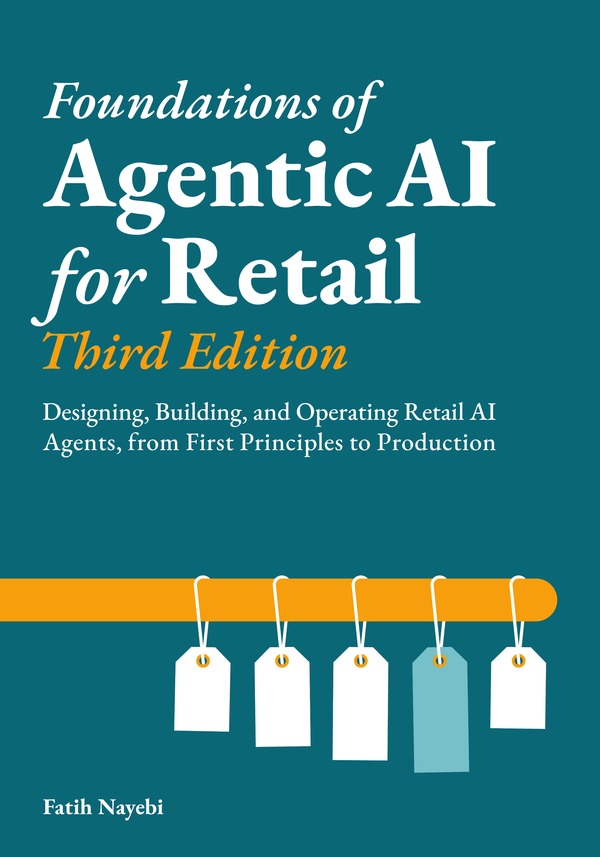
Foundations of Agentic AI for Retail: Designing, Building, and Operating Retail AI Agents, from First Principles to Production, Third Edition (October 2026), by Fatih Nayebi.
A pricing agent marks down a winter coat in one region, exactly as its rules allow, and by morning the brand owns the outcome. The book asks when a retailer should hand a decision to software, and what evidence and controls make the handover worthwhile, from first principles to production. In paperback and hardcover, in full color. The Kindle edition will follow. Buy on Amazon: US | CA | UK | DE | FR | IT | ES | JP Earlier editions: second (2026) | first (2025) |
|
Start Here
git clone https://github.com/gradient-divergence/agentic-retail-foundations.git
cd agentic-retail-foundations
uv sync --frozen                                    # Python 3.13, the locked environment

uv run --frozen python -m demos.intro_inventory_book_demo   # Chapter 1's reorder agent
uv run --frozen python -m demos.capstone_scaffold_demo      # the capstone's approval-and-receipt record
uv run --frozen python -m demos.capstone_gate_review_demo   # Chapter 14's simulated gate review
The tag third-edition is the code exactly as printed. For the full test suite, install every extra (uv sync --frozen --all-extras) and run MPLBACKEND=Agg uv run --frozen python -m pytest: 1,029 tests.
The Book, Chapter by Chapter
Where each chapter's printed listings live. Every runnable listing in the book comes from this repository.
| Ch. | Chapter | Main files |
|---|---|---|
| 1 | Introduction: The Age of Agency | demos/intro_inventory_book_demo.py |
| 2 | Agent Architectures and Operating Models | agents/raom_minimal.py, agents/bdi.py, agents/ooda.py, demos/bdi_inventory_demo_short.py |
| 3 | Decision Frameworks I: Probabilistic Reasoning and Optimization | demos/bayesian_reco_book_demo.py, demos/bayes_uplift_demo.py |
| 4 | Decision Frameworks II: Sequential Decision-Making | demos/mdp_dynamic_pricing_book_demo.py, demos/capstone_mdp_simulator_demo.py |
| 5 | Decision Frameworks III: Learning and Planning | demos/agent_optimization_ladder_demo.py, demos/store_fulfillment_book_demo.py |
| 6 | Core Technologies Enabling Agentic Retail | demos/structured_output_schema_demo.py, demos/tool_calling_rag_demo.py, demos/shelf_monitoring_book_demo.py |
| 7 | Physical Perception and Sensor Intelligence | agents/sensor.py, demos/knowledge_graph_book_demo.py, demos/promotion_causal_book_demo.py |
| 8 | Multi-Agent Coordination and Interoperability | demos/agent_communication_demo.py, demos/task_allocation_cnp_demo.py, demos/procurement_auction_demo_short.py, demos/inventory_sharing_demo_short.py |
| 9 | End-to-End Agent Integration | demos/order_orchestration_demo.py, demos/inventory_event_api_demo.py, demos/api_gateway_book_demo.py, demos/inventory_crdt_demo.py |
| 10 | Building Production Agents | demos/agent_session_state_demo.py, demos/inventory_agent_unit_test_demo.py, demos/monitoring_dashboard_api_demo.py |
| 11 | Operating Agents (AgentOps) | demos/agent_eval_hook_demo.py, demos/agentops_latency_middleware.py, demos/preference_pair_builder_demo.py |
| 12 | Governance and Responsible Autonomy | demos/hitl_approval_api_demo.py, demos/pricing_explainability_shap_demo.py |
| 13 | Playbooks and Case Studies | demos/inventory_agents_sdk_demo.py, demos/dynamic_pricing_agents_sdk_demo.py, demos/virtual_shopping_responses_demo.py |
| 14 | Strategy, Maturity, and Futures | demos/capstone_gate_review_demo.py |
What's New in the Third Edition
- Repaired code. The demos, agents and utilities were repaired for this edition, and the book's printed listings are drawn from this code.
- Regression tests. Each repair came with a test; the suite grew from 36 test files to 113, and all 1,029 tests pass.
- Demos that say what they need. A demo that needs an API key or a running service now names it and stops, instead of failing midway.
- Current stack. Python 3.13 and the latest compatible releases of every dependency, locked in
uv.lock. - Tags.
third-edition(andv3.1.0) marks the code as printed in the published third edition;v3.0.0is the 7 October pre-release state, andv2.0.0is the second edition's.
- Retail Agent Operating Model (RAOM) as the narrative spine across chapters and code.
- Capstone workflow that accumulates across chapters (inventory risk → supplier outreach → price protection → customer messaging → audit trail).
- Three-plane architecture: capability, control, and integration planes for system design.
- Contract-first schemas with runnable companion code and drift controls.
- Evaluation pyramid + red-team packs for safety, regression control, and release readiness.
- Agent learning ladder: prompt/tool tuning → SFT/PEFT → DPO/GRPO → RLHF/RLAIF → RFT.
- Interoperability & standards: MCP, agent-to-agent messaging, and emerging commerce protocols (ACP, AP2).
- Context engineering as a first-class design discipline (memory, retention boundaries, policies).
- Expanded coverage: offline RL, constrained RL, conformal prediction, GNNs, Mamba/SSM.
- Teaching assets: case packets, notation guide, glossary, and companion resources.
Table of Contents
- Start Here
- The Book, Chapter by Chapter
- What's New in the Third Edition
- Companion Code Highlights
- Directory Structure
- Setup Instructions
- Usage
- Development Best Practices
- Contribution Guidelines
- Documentation
Companion Code Highlights
- Retail Agent Operating Model (RAOM): Minimal RAOM implementation and examples (
agents/raom_minimal.py). - Capstone Workflow: End-to-end orchestration scaffolding with schemas, policies, tools, and tracing (
capstone/). - Agent Architectures: BDI, OODA, Q-learning, Bayesian, causal, and LLM-based agents (
agents/). - Coordination Protocols: Contract Net, auctions, and inventory sharing (
agents/protocols/). - Interoperability & Standards: MCP tooling contracts and commerce protocols (ACP/AP2) via demos and manifests (
demos/). - Evaluation & Red Teaming: Scenario packs and scoring rubrics (
evals/,redteam/). - Retail Data Models: Pydantic models for core retail concepts (
models/). - Utilities & Observability: Monitoring, event bus, planning, CRDTs, and NLP helpers (
utils/). - Notebooks & Demos: Marimo notebooks and runnable demos aligned to the book (
notebooks/,demos/). - Testing & Tooling: Pytest suite, Ruff, MyPy, and Makefile automation (
tests/,Makefile).
Directory Structure
agentic-retail-foundations/
├── agents/               # Core agent logic, protocols, and specific agent types
│   ├── coordinators/     # Coordinator agent implementations
│   ├── cross_functional/ # Agents spanning multiple business functions
│   ├── protocols/        # Coordination protocols (CNP, Auction, Inventory Sharing)
│   └── ...
├── assets/               # Diagrams and static assets (book cover, figures)
├── capstone/             # End-to-end capstone workflow scaffolding
├── config/               # Configuration helpers
├── connectors/           # Interfaces to external systems (mocked connectors)
├── demos/                # Standalone demo scripts and protocol examples
├── docs/                 # MkDocs documentation source files
├── environments/         # Simulation environments (e.g., MDP for RL)
├── evals/                # Evaluation scenarios and scoring rubrics
├── models/               # Pydantic data models for retail concepts
├── notebooks/            # Marimo notebooks for exploration and visualization
├── redteam/              # Red-team scenarios for safety testing
├── tests/                # Unit and integration tests (pytest)
├── utils/                # Utilities (monitoring, planning, NLP, event bus, etc.)
├── .env.example          # Example environment variables template
├── .gitignore
├── .pre-commit-config.yaml
├── LICENSE
├── Makefile
├── mkdocs.yml
├── pyproject.toml
└── README.md
Setup Instructions
Prerequisites:
- Git
- Python 3.13 (the current dependency stack excludes 3.14)
uv(recommended for fast environment/package management)
Clone the repository:
git clone https://github.com/gradient-divergence/agentic-retail-foundations.git
cd agentic-retail-foundations
Install
uv(if not already installed):
Follow the official instructions: https://github.com/astral-sh/uvCreate Virtual Environment & Install Dependencies:
uv sync --frozen
# Complete test environment:
uv sync --frozen --all-extras
Activate the Virtual Environment:
source .venv/bin/activateRun commands with
uv run --frozento use the locked environment without activation.Set up Environment Variables:
- Copy the example environment file:
cp .env.example .env - Edit
.envand add your necessary API keys or configuration secrets (e.g.,OPENAI_API_KEY). - Important:
.envis listed in.gitignoreand should never be committed.
- Copy the example environment file:
Optional: OpenAI Agents SDK demos
- The SDK dependencies are included in the frozen installation above.
- SDK-specific demos (for example,
demos/*_agents_sdk_demo.py) import the SDK viademos/openai_agents_sdk_import.pyto avoid collisions with this repo's localagents/package.
Optional: Protocol SDKs and reference implementations
- Install protocol SDK dependencies:
uv sync --frozen --extra agent_protocols - ACP is treated as a spec-only protocol reference (no SDK dependency).
- Other optional stacks have named extras:
streaming(Redis/Kafka),spark,gnn,monitoring(Prometheus),cloud(Postgres/Supabase),auth, andexplainability(SHAP).
Install one withuv sync --frozen --extra <name>; useuv sync --frozen --all-extrasfor the complete test environment.
- Install protocol SDK dependencies:
Install Pre-commit Hooks (Recommended):
make precommit
# or: pre-commit install
Usage
Common development tasks are streamlined using the Makefile. Ensure your virtual environment is active (source .venv/bin/activate or make shell) when running Python scripts or tools like marimo directly.
Run Marimo Notebooks:
marimo edit notebooks/<notebook_name>.py
# e.g., marimo edit notebooks/multi-agent-systems-in-retail.py
Use
marimo run ...for a read-only view.Run Demo Scripts:
Run from the companion repository root:python -m demos.<demo_name> # e.g., python -m demos.task_allocation_cnp_demoChapter 8's complete
approval_requestindemos/book_pricing_contracts.json
proposes ending SKU-123's discount from Friday 16 October 2026 at 00:00 UTC
until Monday 19 October at 00:00 UTC (exclusive), covering the promotion's
remaining Friday-to-Sunday window. Its unit-margin check is gross margin:(price - unit_cost_usd) / price, about 45.45% at the proposed $22 price
against $12 merchandise cost, above the 40% floor. Contribution per unit
also deducts $4 in other variable selling costs: $20 - $12 - $4 = $4
currently, or $22 - $12 - $4 = $6 if approved. These per-unit contributions
exclude the transfer's $20 transport/handling cost and the donor's $8
expected contribution loss, deducted separately in the decision record.Run Linters / Formatters / Type Checks:
make lint          # Run Ruff linter
make format        # Run Ruff formatter
make format-check  # Check formatting without making changes (for CI)
make type-check    # Run MyPy static type checker
Run Tests:
make test          # Run offline pytest tests with the existing .venv
make test PYTHON=/path/to/python  # Use an existing interpreter; installs nothing
make check         # Run Ruff on packages/tests, then offline tests
make coverage      # Run tests and generate coverage report
make ci            # Run format-check, type-check, tests, coverage, docs build
Build / Serve Documentation:
make docs-build    # Build MkDocs site (outputs to site/)
make docs-serve    # Serve docs locally with live reload (http://127.0.0.1:8000)
Manage Environment:
make shell         # Start a new shell with venv activated
make clean         # Remove cache files (__pycache__), build artifacts
make clean-venv    # Remove the .venv directory entirely
make venv          # Recreate the virtual environment (if deleted)
make install       # Sync dependencies into the existing venv
List All Commands:
make help
Development Best Practices
- Modularity: Keep agent logic, data models, utilities, and connectors in their respective directories.
- Configuration: Use environment variables (
.envfile loaded viapython-dotenv) for secrets and environment-specific settings. - Typing: Use Python type hints extensively. Run
make type-check(mypy) regularly. - Linting & Formatting: Adhere to styles enforced by
ruff. Runmake formatandmake lintfrequently. - Testing: Write unit tests (
pytest) for individual functions/classes and integration tests for components working together.make testandmake checkuse installed tools and never create an environment or install packages.
Full-suite tests require the locked extras (uv sync --all-extras); provider calls use fake clients.
Coroutine tests with synchronous fixtures can run offline usingasyncio.runwhenpytest-asynciois absent.
Coverage is opt-in (make coverage, requirespytest-cov); normal tests use the installed runtime dependencies. - Documentation: Maintain docs in
docs/and keep this README in sync with the book and code.
Contribution Guidelines
Please refer to CONTRIBUTING.md for details on how to contribute to this project.
Documentation
Build and browse the MkDocs documentation locally:
make docs-serve # http://127.0.0.1:8000
Repository: https://github.com/gradient-divergence/agentic-retail-foundations
Reviews (0)
Sign in to leave a review.
Leave a reviewNo results found