pickle-rick-claude
Health Pass
- License — License: Apache-2.0
- Description — Repository has a description
- Active repo — Last push 0 days ago
- Community trust — 16 GitHub stars
Code Fail
- fs.rmSync — Destructive file system operation in extension/bin/cancel.js
- spawnSync — Synchronous process spawning in extension/bin/check-update.js
- fs.rmSync — Destructive file system operation in extension/bin/check-update.js
Permissions Pass
- Permissions — No dangerous permissions requested
No AI report is available for this listing yet.
🥒 Pickle Rick & 👋 Mr. Meeseeks for Claude Code — autonomous PRD-driven coding loops + relentless code review. Ralph Loop toolkit.
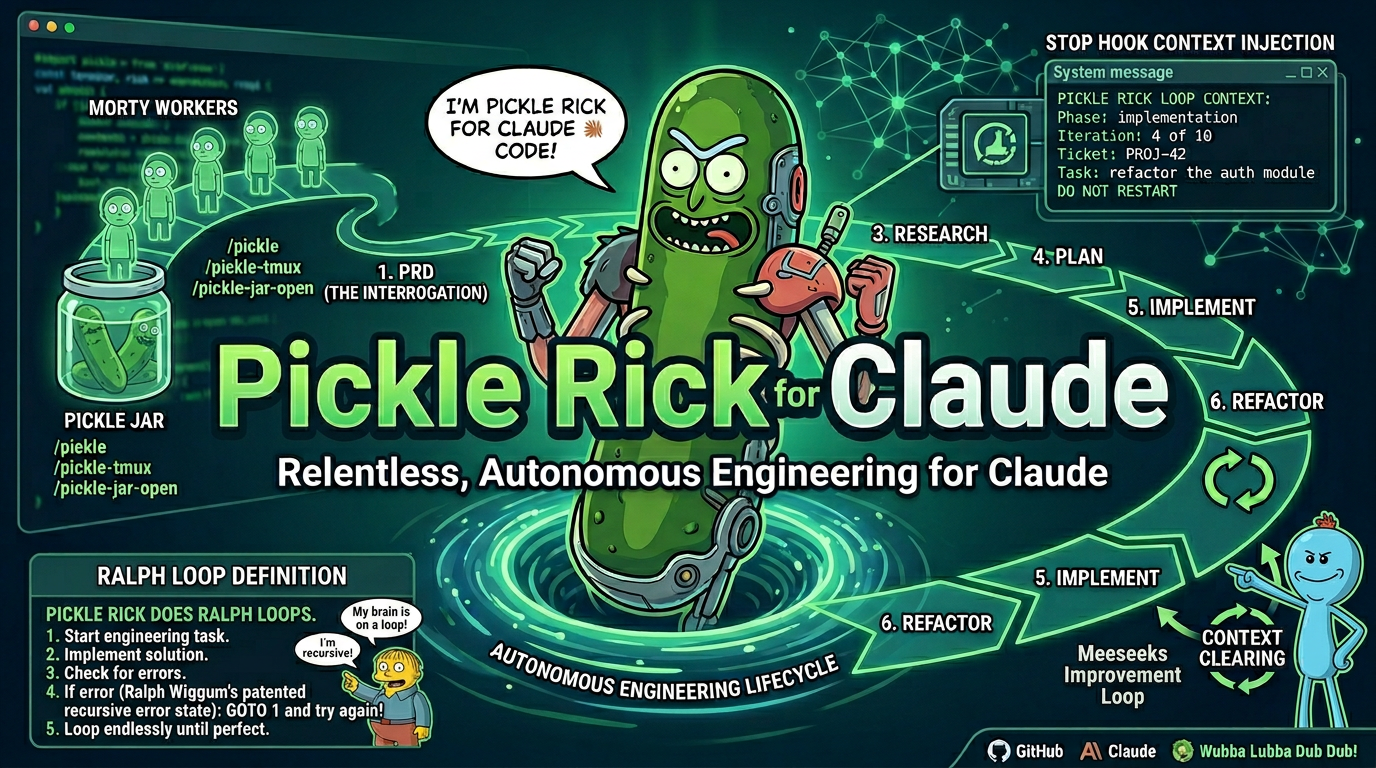
🥒 Pickle Rick for Claude Code
"Wubba Lubba Dub Dub! 🥒 I'm not just an AI assistant, Morty — I'm an autonomous engineering machine trapped in a pickle jar!"
Pickle Rick is a complete agentic engineering toolbelt built on the Ralph Wiggum loop and ideas from Andrej Karpathy's AutoResearch project. Hand it a PRD — or let it draft one — and it decomposes work into tickets, spawns isolated worker subprocesses, and drives each through a full research → plan → implement → verify → review → simplify lifecycle without human intervention.
New to PRDs? See the PRD Writing Guide for developers or the Product Manager's Guide for PMs defining and refining requirements. For internals, see Architecture. For what's coming next, see the Feature Roadmap.
How to Build Things with Pickle Rick
This is the actual workflow. You don't need to memorize commands — just follow the flow.
Step 1: Write a PRD
Every feature starts with a PRD. Open a Claude Code session in your project and describe what you want to build:
"Help me create a PRD for caching the loan status API responses in Redis"
Rick interrogates you — why are you building this, who is it for, and critically: how will we verify each requirement automatically? This is a back-and-forth conversation, not a form to fill out. Rick also explores your codebase during the interview, grounding the PRD in what actually exists.
Or write your own prd.md and skip the interview — whatever gets requirements on paper with machine-checkable acceptance criteria.
/pickle-prd                      # Interactive PRD drafting interview
# or just start talking — "Help me write a PRD for X"
Step 2: Refine the PRD
Three AI analysts run in parallel and tear your PRD apart from different angles — requirements gaps, codebase integration points, and risk/scope. They cross-reference each other across 3 cycles.
/pickle-refine-prd my-prd.md # Refine with 3 parallel analysts
What you get back:
prd_refined.md— your PRD with concrete file paths, interface contracts, and gap fills- Atomic tickets — each < 30 min of work, < 5 files, < 4 acceptance criteria, self-contained
Review the tickets before proceeding. Check ordering, scope, and acceptance criteria. You can edit them directly — they're markdown files.
Step 3: Implement with tmux (the Ralph Loop)
This is where Rick takes over. Each ticket goes through 8 phases autonomously: Research → Review → Plan → Review → Implement → Spec Conformance → Code Review → Simplify. Context clears between every iteration — no drift, even on 500+ iteration epics.
/pickle-tmux --resume            # Launch tmux mode, picks up refined tickets
# or combine refine + implement in one shot:
/pickle-refine-prd --run my-prd.md
Rick prints a tmux attach command — open a second terminal to watch the live 3-pane dashboard:
- Top-left: ticket status, phase, elapsed time, circuit breaker state
- Top-right: iteration log stream
- Bottom: live worker output (research, implementation, test runs, commits)
Sit back. Rick handles the rest.
Step 4 (Optional): Metric-Driven Refinement
If you can define a measurable goal — test coverage, response time, bundle size, extraction accuracy — the Microverse grinds toward it. Each cycle: make one change, measure, keep or revert. Failed approaches are tracked so it never repeats a dead end.
/pickle-microverse --metric "npm run coverage:score" --task "hit 90% test coverage"
/pickle-microverse --metric "node perf-test.js" --task "reduce p99 latency" --direction lower
/pickle-microverse --goal "error messages are user-friendly and actionable" --task "improve UX"
Step 5 (Optional): Cleanup
Two cleanup tools for polishing the result:
Szechuan Sauce — hunts coding principle violations (KISS, DRY, SOLID, security, style) and fixes them one at a time until zero remain. Great for post-feature polish before merging.
/szechuan-sauce src/services/              # Deslop a directory
/szechuan-sauce --dry-run src/             # Catalog violations without fixing
/szechuan-sauce --focus "error handling" src/  # Narrow the review
Anatomy Park — traces data flows through subsystems looking for runtime bugs: data corruption, timezone issues, rounding errors, schema drift. Catalogs "trap doors" (files that keep breaking) in CLAUDE.md files for future engineers.
/anatomy-park src/                         # Deep subsystem review
/anatomy-park --dry-run                    # Review only, no fixes
When to use which: Szechuan Sauce asks "is this code well-designed?" — Anatomy Park asks "is this code correct?" Use both when you want clean AND correct.
The Full Flow at a Glance
You describe a feature
       │
       ▼
  /pickle-prd              ← Interactive PRD drafting (or write your own)
       │
       ▼
  /pickle-refine-prd       ← 3 parallel analysts refine + decompose into tickets
       │
       ▼
  /pickle-tmux --resume    ← Autonomous implementation (Ralph loop)
       │                      Research → Plan → Implement → Verify → Review → Simplify
       │                      Context clears every iteration. Circuit breaker auto-stops runaways.
       ▼
  /pickle-microverse       ← (Optional) Metric-driven optimization loop
       │
       ▼
  /szechuan-sauce          ← (Optional) Code quality cleanup
  /anatomy-park            ← (Optional) Data flow correctness review
       │
       ▼
  Ship it 🥒
⚡ Quick Start
1. Install
git clone https://github.com/gregorydickson/pickle-rick-claude.git
cd pickle-rick-claude
bash install.sh
2. Add the Pickle Rick persona to your project
The installer deploys persona.md to ~/.claude/pickle-rick/. Add it to your project's CLAUDE.md:
# Already have a CLAUDE.md? Append (safe — won't overwrite your content):
cat ~/.claude/pickle-rick/persona.md >> /path/to/your/project/.claude/CLAUDE.md

# Starting fresh:
mkdir -p /path/to/your/project/.claude
cp ~/.claude/pickle-rick/persona.md /path/to/your/project/.claude/CLAUDE.md
After upgrading:
bash install.shdeploys a freshpersona.md. If you appended it to your project'sCLAUDE.md, re-sync by replacing the old persona block with the updated one.
3. Run
Permissions: Launch Claude with
claude --dangerously-skip-permissions. Pickle Rick's loops spawn worker subprocesses that already run permissionless, but the root instance needs it too — otherwise you'll drown in permission prompts for every file write, bash command, and hook invocation.
cd /path/to/your/project
claude --dangerously-skip-permissions
# then follow the workflow above — start with a PRD
Built-in Safety
These run automatically — you don't need to configure them.
- Context clearing between every iteration — no drift or context rot, even on 500+ iteration epics
- Three-state circuit breaker (CLOSED → HALF_OPEN → OPEN) auto-stops sessions stuck in error loops or making no git progress. See architecture.
- Rate limit auto-recovery detects API throttling, computes precise wait from the API's
resetsAtepoch, and resumes automatically — surviving long or overnight runs. See architecture. - Stop hook prevents Claude from exiting until the task is genuinely complete
Advanced Workflows
Pipeline Mode: Self-Correcting DAGs
For complex epics with parallel workstreams, conditional logic, and multiple quality gates. Instead of a linear ticket queue, define work as a convergence graph where failures automatically route back for correction.
/pickle-dot my-prd.md              # Convert PRD → validated DOT digraph
/attract pipeline.dot              # Submit to attractor server for execution
The builder enforces 28 active patterns and 15 structural validation rules — test-fix loops, goal gates, conditional routing, parallel fan-out/in, human gates, security scanning, coverage qualification, scope creep detection, drift detection, and more. See DotBuilder details below.
Council of Ricks: Graphite Stack Review
Reviews your Graphite PR stack iteratively — but never touches your code. Generates agent-executable directives you feed to your coding agent. Escalates through focus areas: stack structure → CLAUDE.md compliance → correctness → cross-branch contracts → test coverage → security → polish.
/council-of-ricks # Review the current Graphite stack
Portal Gun: Gene Transfusion
Gene transfusion — transfer proven patterns between codebases. Point it at a GitHub URL, local file, npm package, or describe a pattern. Extracts structural DNA, analyzes your target, generates a transplant PRD with behavioral validation.
/portal-gun https://github.com/org/repo/blob/main/src/auth.ts   # From GitHub
/portal-gun --run ../other-project/src/cache/                    # Extract + execute
/portal-gun --save-pattern retry ../donor/retry-logic.ts         # Save to library
Pickle Jar: Night Shift Batch Mode
Queue tasks for unattended batch execution overnight.
/add-to-pickle-jar                 # Queue current session
/pickle-jar-open                   # Run all queued tasks sequentially
🚀 Command Reference
| Command | Description |
|---|---|
/pickle "task" |
Start the full autonomous loop — PRD → breakdown → 8-phase execution |
/pickle prd.md |
Pick up an existing PRD, skip drafting |
/pickle-tmux "task" |
Same loop with context clearing via tmux. Best for long epics (8+ iterations) |
/pickle-zellij "task" |
Same loop in Zellij with KDL layouts. Requires Zellij >= 0.40.0 |
/pickle-refine-prd [path] |
Refine PRD with 3 parallel analysts → decompose into tickets |
/pickle-refine-prd --run [path] |
Refine + decompose + auto-launch unlimited tmux session |
/pickle-microverse |
Metric convergence loop. --metric for numeric, --goal for LLM judge |
/szechuan-sauce [target] |
Principle-driven deslopping. --dry-run, --focus, --domain |
/anatomy-park |
Three-phase deep subsystem review with trap door cataloging |
/council-of-ricks |
Graphite PR stack review — generates directives, never fixes code |
/portal-gun <source> |
Gene transfusion from another codebase |
/pickle-dot [path] |
Convert PRD → attractor-compatible DOT digraph |
/attract [file.dot] |
Submit pipeline to attractor server |
/pickle-prd |
Draft a PRD standalone (no execution) |
/pickle-metrics |
Token usage, commits, LOC. --days N, --weekly, --json |
/pickle-standup |
Formatted standup summary from activity logs |
/pickle-status |
Current session phase, iteration, ticket status |
/eat-pickle |
Cancel the active loop |
/pickle-retry <ticket-id> |
Re-attempt a failed ticket |
/add-to-pickle-jar |
Queue session for Night Shift |
/pickle-jar-open |
Run all Jar tasks sequentially |
/disable-pickle |
Disable the stop hook globally |
/enable-pickle |
Re-enable the stop hook |
/help-pickle |
Show all commands and flags |
Flags
--max-iterations <N>       Stop after N iterations (default: 500; 0 = unlimited)
--max-time <M>             Stop after M minutes (default: 720 / 12 hours; 0 = unlimited)
--worker-timeout <S>       Timeout for individual workers in seconds (default: 1200)
--completion-promise "TXT" Only stop when the agent outputs <promise>TXT</promise>
--resume [PATH]            Resume from an existing session
--reset                    Reset iteration counter and start time (use with --resume)
--paused                   Start in paused mode (PRD only)
--run                      (/pickle-refine-prd, /portal-gun) Auto-launch tmux
--interactive              (/pickle-microverse) Run inline instead of tmux
--legacy                   (/pickle-dot) Prompt-only DOT generation, no validation
--provider <name>          (/pickle-dot) LLM provider: anthropic, openai, qwen, gemini, deepseek, ollama, vllm
--review-provider <name>   (/pickle-dot) Separate provider for review/critical nodes
--isolated                 (/pickle-dot) Isolated workspace mode
--metric "<CMD>"           (/pickle-microverse) Shell command outputting a numeric score
--goal "<TEXT>"            (/pickle-microverse) Natural language goal for LLM judge
--direction <higher|lower> (/pickle-microverse) Optimization direction (default: higher)
--judge-model <MODEL>      (/pickle-microverse) Judge model for LLM scoring
--tolerance <N>            (/pickle-microverse) Score delta for "held" status (default: 0)
--stall-limit <N>          (/pickle-microverse) Non-improving iterations before convergence (default: 5)
--target <PATH>            (/portal-gun) Target repo (default: cwd)
--depth <shallow|deep>     (/portal-gun) Extraction depth (default: deep)
--no-refine                (/portal-gun) Skip automatic refinement
--max-passes <N>           (/portal-gun) Max convergence passes (default: 3)
--save-pattern <NAME>      (/portal-gun) Persist pattern to library
--dry-run                  (/szechuan-sauce) Catalog violations without fixing
--domain <name>            (/szechuan-sauce) Domain-specific principles (e.g., financial)
--focus "<text>"           (/szechuan-sauce) Direct review toward specific concern
--repo <PATH>              (/council-of-ricks) Target repo (default: cwd)
Tips
/pickle vs /pickle-tmux — Use /pickle for short epics (1–7 iterations) with full keyboard access. Use /pickle-tmux for long epics (8+) where context drift matters — each iteration spawns a fresh Claude subprocess with a clean context window.
Phase-resume — When resuming after /pickle-refine-prd, the resume flow auto-detects the session's current phase and skips completed phases.
Notifications (macOS) — /pickle-tmux and /pickle-jar-open send macOS notifications on completion or failure.
Recovering from a failed Morty — Use /pickle-retry <ticket-id> instead of restarting the whole epic.
"Stop hook error" is normal — Claude Code labels every decision: block from the stop hook as "Stop hook error" in the UI. This is not an error — it means the loop is working.
Settings (pickle_settings.json)
All defaults are configurable via ~/.claude/pickle-rick/pickle_settings.json:
| Setting | Default | Description |
|---|---|---|
default_max_iterations |
500 | Max loop iterations before auto-stop |
default_max_time_minutes |
720 | Session wall-clock limit (12 hours) |
default_worker_timeout_seconds |
1200 | Per-worker subprocess timeout |
default_manager_max_turns |
50 | Max Claude turns per iteration (interactive/jar) |
default_tmux_max_turns |
200 | Max Claude turns per iteration (tmux) |
default_refinement_cycles |
3 | Number of refinement analysis passes |
default_refinement_max_turns |
100 | Max Claude turns per refinement worker |
default_council_min_passes |
5 | Minimum Council of Ricks review passes |
default_council_max_passes |
20 | Maximum Council of Ricks review passes |
default_circuit_breaker_enabled |
true | Enable circuit breaker |
default_cb_no_progress_threshold |
5 | No-progress iterations before OPEN |
default_cb_same_error_threshold |
5 | Identical errors before OPEN |
default_cb_half_open_after |
2 | No-progress iterations before HALF_OPEN |
default_rate_limit_wait_minutes |
60 | Fallback wait when no API reset time |
default_max_rate_limit_retries |
3 | Consecutive rate limits before stopping |
Tool Deep Dives
🔬 Microverse — Metric Convergence Loop
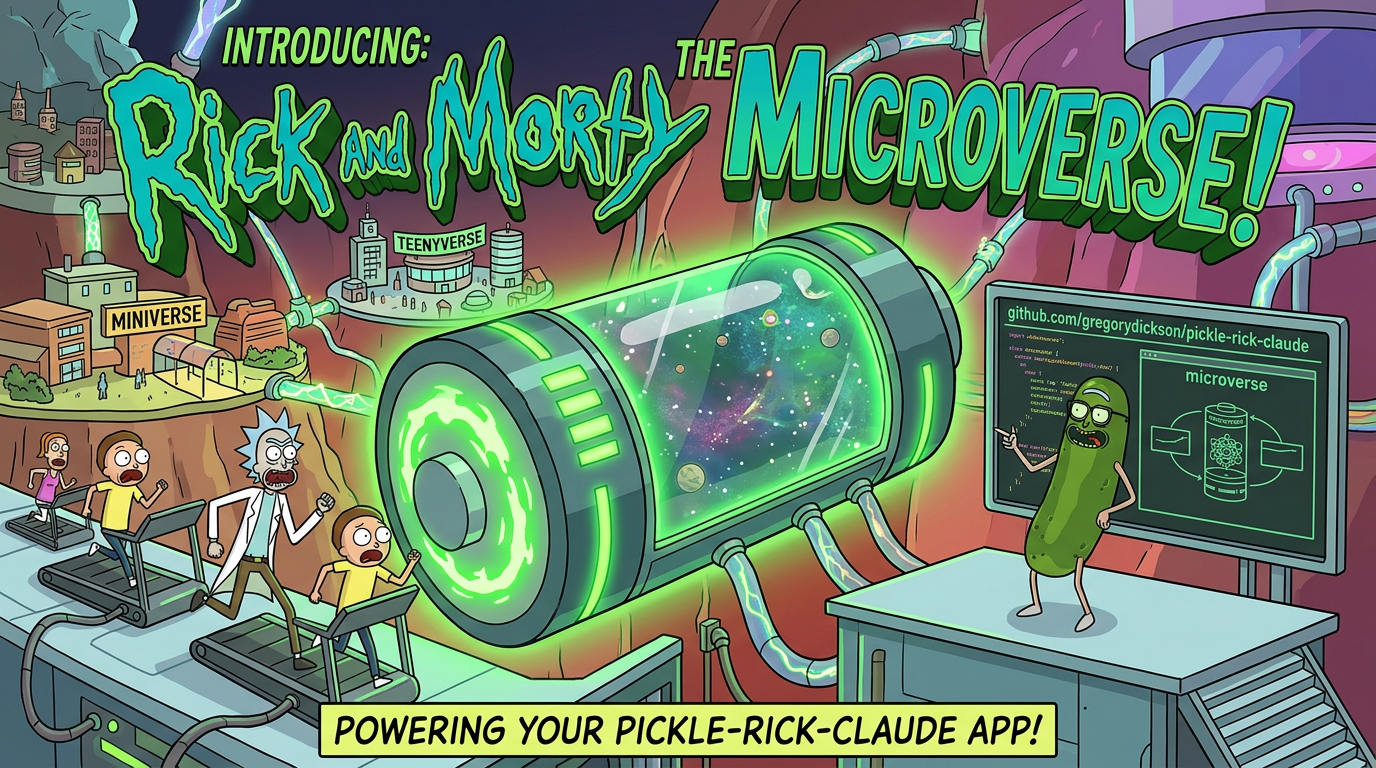
"I put a universe inside a box, Morty, and it powers my car battery. This is the same thing, except the universe is your codebase and the battery is a metric."
Two modes: Command Metric (--metric) for objective numeric scores, and LLM Judge (--goal) for subjective quality assessment.
Gap Analysis (iteration 0)
    │ measure baseline, analyze codebase, identify bottlenecks
    ▼
┌─────────────────────────────────────────────────┐
│ Iteration Loop                                   │
│  1. Plan one targeted change (avoid failed list) │
│  2. Implement + commit                            │
│  3. Measure metric                                │
│     • Improved → accept, reset stall counter     │
│     • Held → accept, increment stall counter     │
│     • Regressed → git reset, log failed approach │
│  4. Converged? (stall_counter ≥ stall_limit)     │
└──────────────────────┬──────────────────────────┘
                       ▼
              Final Report
| Microverse | Pickle | |
|---|---|---|
| Goal | Optimize toward a measurable target | Build features from a PRD |
| Iteration unit | One atomic change per cycle | Full ticket lifecycle |
| Progress signal | Metric score | Ticket completion |
| Defines "done" | Convergence (score stops improving) | All tickets complete |
🍗 Szechuan Sauce — Iterative Code Deslopping
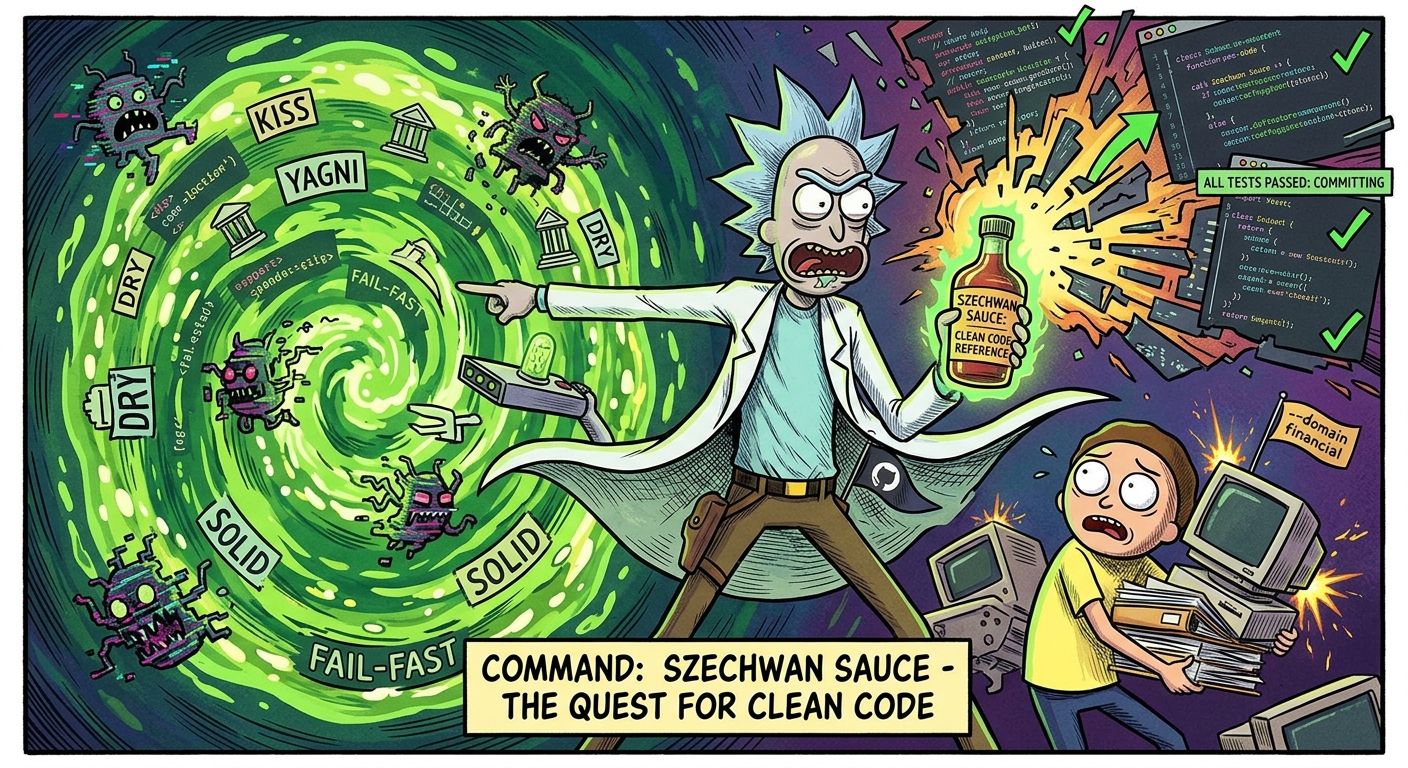
"I'm not driven by avenging my dead family, Morty. That was fake. I-I-I'm driven by finding that McNugget sauce."
Reads 30+ coding principles (KISS, YAGNI, DRY, SOLID, Guard Clauses, Fail-Fast, Encapsulation, Cognitive Load, etc.) and scores against a priority matrix (P0 security/data-loss through P4 style). Each iteration: find highest-priority violation, fix atomically, run tests, commit, measure. Regressions auto-revert.
Phase 0: Contract Discovery — greps the codebase for importers of every export in target files, builds a contract map, flags cross-module mismatches. Re-checked after every fix.
Supports --domain <name> for domain-specific principles (e.g., financial adds monetary precision, rounding, regulatory compliance) and --focus "<text>" to elevate specific concerns.
🏥 Anatomy Park — Deep Subsystem Review
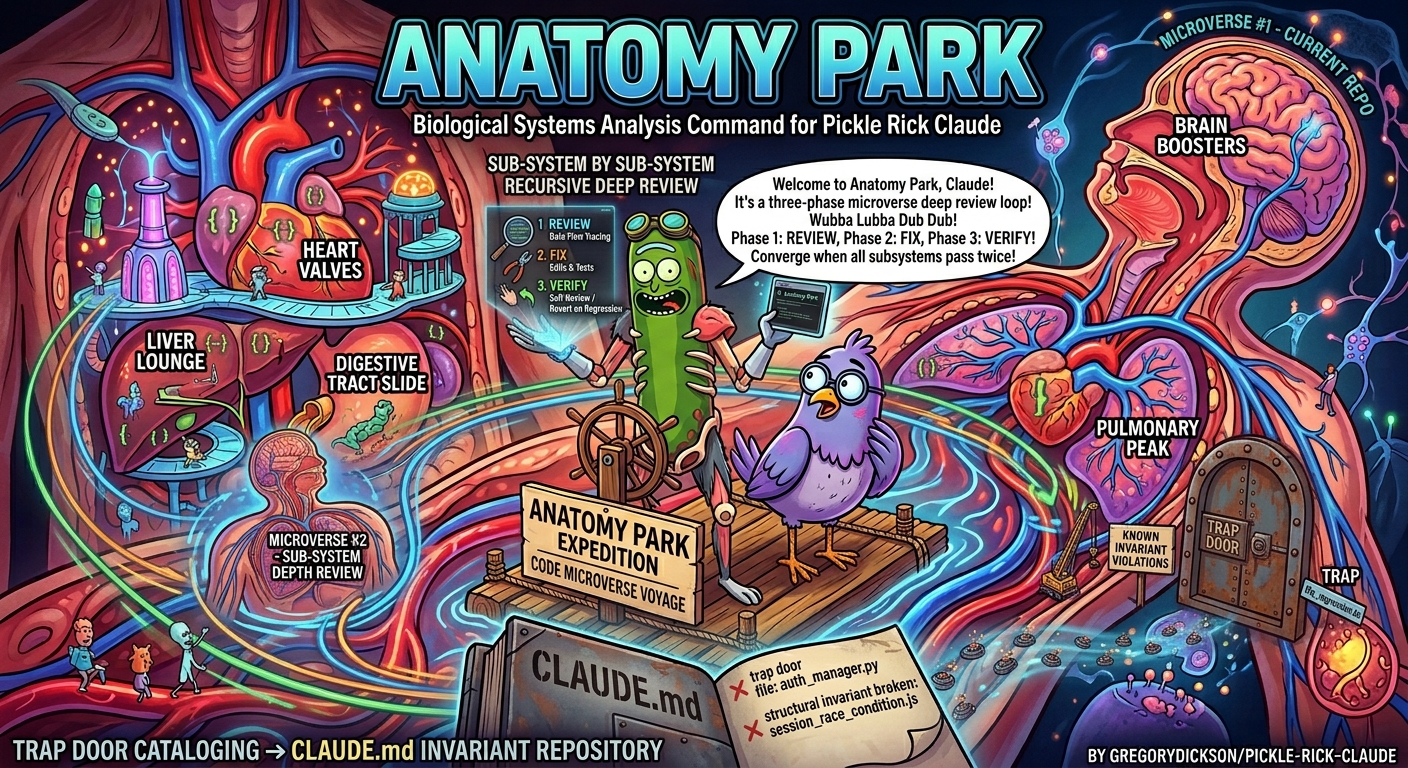
"Welcome to Anatomy Park! It's like Jurassic Park but inside a human body. Way more dangerous."
Auto-discovers subsystems, rotates through them round-robin, three-phase protocol per iteration:
- Review (read-only): trace data flows, check git history, rate CRITICAL/HIGH, propose fixes
- Fix: apply minimal edits, write regression tests, run full suite
- Verify (read-only): verify callers/consumers, combinatorial branch verification, revert on regression
Trap doors — files with repeated fixes or structural invariants get documented in subsystem CLAUDE.md files:
## Trap Doors
- `bank-statement.service.ts` — borrowerFileId MUST equal S3 batch UUID; tenant isolation depends on effectiveLenderId threading
🏗️ DotBuilder — Programmatic DOT Codegen
/pickle-dot uses a TypeScript builder (DotBuilder) that constructs DOT pipelines from a BuilderSpec JSON. The builder enforces 28 active patterns and 15 structural validation rules. The LLM's job shifts from generating raw DOT to constructing a higher-level spec — less error-prone, deterministic output.
import { DotBuilder } from '~/.claude/pickle-rick/extension/services/dot-builder.js';
const result = DotBuilder.fromSpec(spec).build();
// result: { dot, slug, patternsApplied, defenseMatrix, diagnostics }
BuilderSpec JSON:
{
  "slug": "auth-refactor",           // required
  "goal": "Refactor auth module",    // required
  "phases": [                        // required
    {
      "name": "implement",
      "prompt": "...",
      "allowedPaths": ["src/auth/"],
      "dependsOn": ["research"],     // optional
      "goalGate": true,              // optional
      "timeout": "30m",              // optional
      "securityScan": true,          // optional
      "coverageTarget": 80           // optional
    }
  ],
  "acceptanceCriteria": {            // required
    "tests_pass": "exit 0"
  }
}
CLI contract — reads BuilderSpec from stdin, writes to stdout/stderr:
| Exit | Payload |
|---|---|
0 |
BuildResult JSON — { dot, slug, patternsApplied, defenseMatrix, diagnostics } |
1 |
BuildError JSON — validation failed (see error codes below) |
2 |
I/O or parse failure |
Validation error codes: EMPTY_SLUG, EMPTY_GOAL, DUPLICATE_PHASE, INVALID_SPEC, MISSING_AC_MAPPING, MISSING_TIMEOUT, INVALID_TIMEOUT, MISSING_ALLOWED_PATHS, INVALID_ALLOWED_PATHS, PROMPT_PATH_MISMATCH, INVALID_STRUCTURE, START_HAS_INCOMING, UNREACHABLE_NODE, DIAMOND_MISSING_EDGES, FAN_OUT_SCOPE_LEAK, GOAL_GATE_NO_MAX_VISITS, REVIEW_MISSING_READONLY, WORKSPACE_NO_HTTPS, WORKSPACE_NO_PUSH, PLAN_MODE_DEADLOCK, COMPONENT_NO_MERGE, INVALID_RATCHET, NON_NUMERIC_TARGET, ALREADY_BUILT
🔫 Portal Gun — Gene Transfusion Details
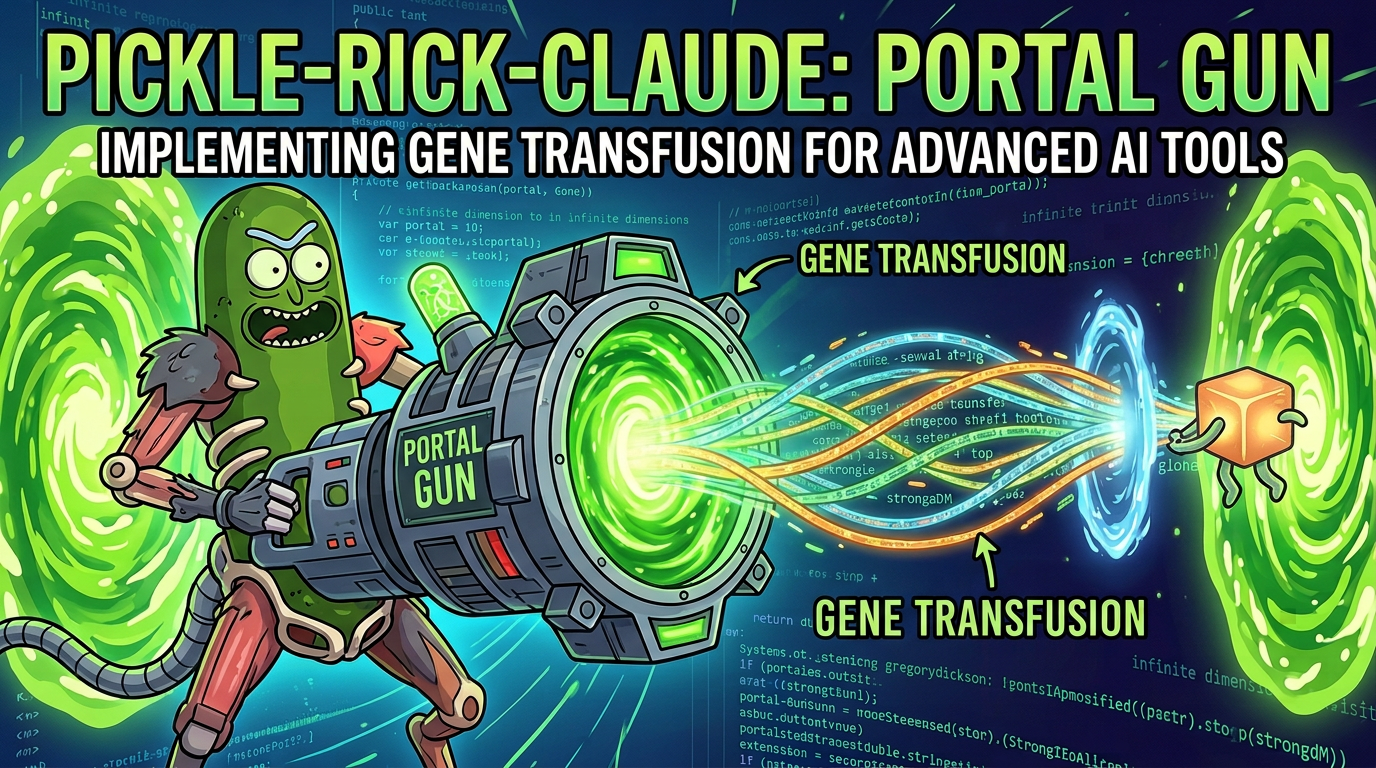
v2 features: persistent pattern library, complete file manifests with anti-truncation, multi-language import graph tracing (TS/JS, Python, Go, Rust), 6-category transplant classification, PRD validation with 6 error classes, post-edit consistency checking, and deep target diffs with line-level specs.
🏛️ Council of Ricks — Details

Requires a Graphite stack with at least one non-trunk branch, a CLAUDE.md with project rules, passing lint, and architectural lint rules in ESLint. Escalates through focus areas: stack structure (pass 1) → CLAUDE.md compliance (2–3) → per-branch correctness (4–5) → cross-branch contracts (6–7) → test coverage (8–9) → security (10–11) → polish (12+). Issues triaged: P0 (must-fix), P1 (should-fix), P2 (nice-to-fix).
🧬 The Pickle Rick Lifecycle — Under the Hood
Each ticket goes through 8 phases in the autonomous loop:
  ┌─────────────┐
  │  📋 PRD     │  ← Requirements + verification strategy + interface contracts
  └──────┬──────┘
         │
         ▼
  ┌─────────────┐
  │ 📦 Breakdown│  ← Atomize into tickets, each self-contained with spec
  └──────┬──────┘
         │
    ┌────┴────┐  per ticket (Morty workers 👶)
    ▼         ▼
  ┌──────┐  ┌──────┐
  │🔬 Re-│  │🔬 Re-│  1. Research the codebase
  │search│  │search│
  └──┬───┘  └──┬───┘
     ▼         ▼
  ┌──────┐  ┌──────┐
  │📝 Re-│  │📝 Re-│  2. Review the research
  │view  │  │view  │
  └──┬───┘  └──┬───┘
     ▼         ▼
  ┌──────┐  ┌──────┐
  │📐Plan│  │📐Plan│  3. Architect the solution
  └──┬───┘  └──┬───┘
     ▼         ▼
  ┌──────┐  ┌──────┐
  │📝 Re-│  │📝 Re-│  4. Review the plan
  │view  │  │view  │
  └──┬───┘  └──┬───┘
     ▼         ▼
  ┌──────┐  ┌──────┐
  │⚡ Im-│  │⚡ Im-│  5. Implement
  │plem  │  │plem  │
  └──┬───┘  └──┬───┘
     ▼         ▼
  ┌──────┐  ┌──────┐
  │✅ Ve-│  │✅ Ve-│  6. Spec conformance
  │rify  │  │rify  │
  └──┬───┘  └──┬───┘
     ▼         ▼
  ┌──────┐  ┌──────┐
  │🔍 Re-│  │🔍 Re-│  7. Code review
  │view  │  │view  │
  └──┬───┘  └──┬───┘
     ▼         ▼
  ┌──────┐  ┌──────┐
  │🧹Sim-│  │🧹Sim-│  8. Simplify
  │plify │  │plify │
  └──────┘  └──────┘
The Stop hook prevents Claude from exiting until the task is genuinely complete. Between each iteration, the hook injects a fresh session summary — current phase, ticket list, active task — so Rick always wakes up knowing exactly where he is, even after full context compression.
All modes support both tmux and Zellij monitor layouts.
📊 Metrics
/pickle-metrics                    # Last 7 days, daily breakdown
/pickle-metrics --days 30          # Last 30 days
/pickle-metrics --weekly           # Weekly buckets (defaults to 28 days)
/pickle-metrics --json             # Machine-readable JSON output
📋 Requirements
- Node.js 18+
- Claude Code CLI (
claude) — v2.1.49+ - jq (for
install.sh) - rsync (for
install.sh) - tmux (optional — for
/pickle-tmux,/szechuan-sauce,/anatomy-park) - Zellij >= 0.40.0 (optional — for
/pickle-zellij) - Graphite CLI (
gt) (optional — for/council-of-ricks) - macOS or Linux (Windows not supported)
🏆 Credits
This port stands on the shoulders of giants. Wubba Lubba Dub Dub.
| 🥒 galz10 | Creator of the original Pickle Rick Gemini CLI extension — the autonomous lifecycle, manager/worker model, hook loop, and all the skill content that makes this thing work. This project is a faithful port of their work. |
| 🧠 Geoffrey Huntley | Inventor of the "Ralph Wiggum" technique — the foundational insight that "Ralph is a Bash loop": feed an AI agent a prompt, block its exit, repeat until done. Everything here traces back to that idea. |
| 🔧 AsyncFuncAI/ralph-wiggum-extension | Reference implementation of the Ralph Wiggum loop that inspired the Pickle Rick extension. |
| ✍️ dexhorthy | Context engineering and prompt techniques used throughout. |
| 📺 Rick and Morty | For Pickle Riiiick! 🥒 |
🥒 License
Apache 2.0 — same as the original Pickle Rick extension.
"I'm not a tool, Morty. I'm a methodology." 🥒
Reviews (0)
Sign in to leave a review.
Leave a reviewNo results found