slopbrake
Health Pass
- License — License: MIT
- Description — Repository has a description
- Active repo — Last push 0 days ago
- Community trust — 13 GitHub stars
Code Fail
- rm -rf — Recursive force deletion command in slopbrake/kit/common/.claude/door-rules.yml
Permissions Pass
- Permissions — No dangerous permissions requested
No AI report is available for this listing yet.
Brakes for the software factory: deterministic checks, a fresh-context reviewer that commits its fixes, and one-way-door triage for coding agents. Built on Matt Pocock's skills. Every rule proven to bite.




-9fb896?style=flat-square)
Quick start · What it catches · How it works · The rules · Credits
Without brakes, a software factory becomes a slop cannon.
— paraphrasing Matt Pocock, Fixing the PR Bottleneck
Coding agents write code faster than anyone can review it. They also write tests that pass forever and catch nothing, reach into modules they shouldn't, and hand you a pile of PRs that all look equally safe to merge.
Slopbrake installs the brakes. Every change an agent makes goes through the same three layers. Every review comment that keeps coming back becomes a check that runs before the next change.
flowchart LR
    A([agent implements]) --> L1["<b>Layer 1 · scripts/check</b><br/>lint · types · boundaries<br/>tests · tautology · mutation floor"]
    L1 --> L2["<b>Layer 2 · reviewer</b><br/>fresh context<br/>commits its own fixes"]
    L2 --> D{door?}
    D -- two-way --> M([merge-eligible])
    D -- one-way --> H([a human reviews it])
    M -.-> R[/"retro: repeated findings become checks"/]
    H -.-> R
    R -.-> L1
Quick start
uv tool install git+https://github.com/GreyforgeLabs/slopbrake    # or: pipx install git+https://…

slopbrake init   path/to/repo --dry-run   # see exactly what it would add
slopbrake init   path/to/repo             # add it; never overwrites files you own
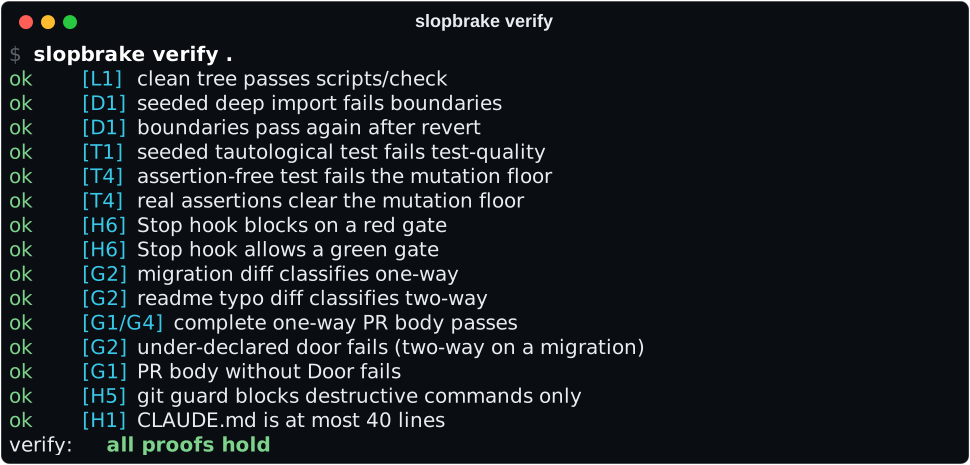
slopbrake verify path/to/repo             # prove every rule bites
Python and TypeScript repos are supported. Every command takes --json. Exit codes: 0 ok, 1 a gap or a failed proof, 2 usage error.
Every rule is proven, not configured
verify works in a throwaway git worktree. For each rule it plants a real violation and requires the check to fail and name the rule, then requires it to pass again once the violation is removed. A check that crashes can't pass a proof.
What it catches
A test like this passes forever and can never disagree with the code:
from shop import discount
from shop.pricing import MEMBER_THRESHOLD

def test_threshold():
    assert MEMBER_THRESHOLD == 100               # restates the definition

def test_discount():
    total = 150
    assert discount(total, True) == total - 10   # recomputes the answer the way the code does
The gate says so:
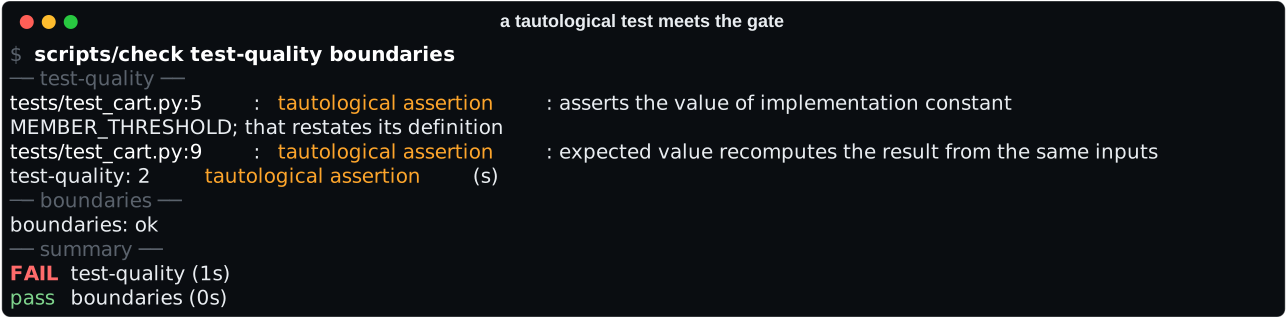
The fix is an independent expectation, a literal or a worked example: assert discount(150, True) == 140. Property checks (out == sorted(out)) and symbolic expectations (validate(x) == ERR_TOO_LONG) pass untouched. To suppress one assertion, write the reason: # slopbrake: allow-tautology: 280 is the published API limit.
| Rule | Catches | Python | TypeScript |
|---|---|---|---|
| T1 | Tautological tests: constants asserted against themselves, expected values rebuilt from the test's own inputs, expect(true).toBe(true) |
AST check | slopbrake/no-tautological-test ESLint rule |
| T4 | Tests that can't fail: mutation score below the floor, on changed lines only | stdlib mutator, in a copy of the tree | StrykerJS with --mutate line ranges |
| D1 | Imports that reach past a module's entry points, and import cycles | stdlib port of Pocock's rules | dependency-cruiser, Pocock's config |
| G1 · G2 | PR bodies without a Door and Blast Radius; a door declared lower than the rules compute | door classifier + PR-body check | same |
| H5 | push --force, reset --hard, clean -f, branch -D, checkout . in agent sessions |
Claude Code hook | same |
| H6 | An agent stopping with red, uncommitted code (after 3 tries it may stop and report) | Claude Code Stop hook | same |
All 30+ rules, with their mechanisms and proofs, are in docs/RULES.md.
How it works
Layer 1: one gate, everywhere
scripts/check is the one command. The pre-commit hook runs it with --fast (no mutation), and pre-push and CI run it in full. The Stop hook runs the fast gate before an agent may finish with uncommitted code. The checks are standard-library Python, so CI installs nothing. Mutation testing touches only the lines you changed, which keeps it fast enough to run on every push.
Layer 2: a reviewer with fresh eyes that commits its fixes
The implementer has the most context pressure, so it doesn't carry the coding standards. The reviewer does (Pocock's push/pull split).
- Two reviewers run in parallel on separate axes and never see the implementer's conversation.
- Standards: your
CODING_STANDARDS.md, plus a Fowler smell baseline. - Spec: does the change do what the ticket asked, no less and no more?
- Standards: your
- A single fix-mode reviewer then commits the fixes as
review:commits instead of leaving comments. - Anything that changes behaviour or touches a one-way door goes under Open questions for a human.
Door triage: spend human attention where it can't be undone
Every PR declares a Door and a Blast Radius. Slopbrake computes a floor from path and content rules. Migrations, DROP TABLE, auth, billing, deploy config, outbound email, runtime file deletion, and the gate itself are all one-way. The agent may raise the door but never lower it. Two-way doors with a green gate are merge-eligible; one-way doors wait for you.
$ python3 scripts/slopbrake/door_classify.py --base main
door: one-way
  - touches migrations/0007_drop_legacy.sql (path rule '**/migrations/**')
  - touches migrations/0007_drop_legacy.sql (path rule '**/*.sql')
  - migrations/0007_drop_legacy.sql:1 adds 'DROP TABLE legacy_accounts;' (content rule 'DROP TABLE')
Retro: comments become checks
/retro sorts every miss:
- mechanical becomes a check, with a fixture showing it fail;
- a judgement call becomes a line in
CODING_STANDARDS.md; - navigation trouble becomes a pointer;
- a no-op instruction gets deleted.
A finding that shows up twice and is still only prose counts as a failed retro.
What a repo gets
Filesslopbrake init writes (kit-owned files are refreshed by --update; repo-owned files are written once and are yours)
| Path | Owner | Purpose |
|---|---|---|
scripts/check |
repo | The one gate command. Stage commands are yours to edit. |
scripts/slopbrake/ |
kit | The standard-library checks. |
.githooks/, .github/workflows/check.yml |
kit / repo | Layer 1 locally and in CI. |
.claude/agents/reviewer.md |
kit | Two-axis reviewer; review-only and fix modes. |
.claude/skills/implement-ticket/ |
kit | Ticket → seams → TDD → gate → parallel review → door → PR body. |
.claude/skills/{tdd,pr,retro,…} |
kit | Pocock's skills, vendored unmodified, with our additions appended. |
.claude/settings.json |
merged | The git-guard and Stop hooks, merged into your existing settings. |
.claude/door-rules.yml |
repo | What counts as a one-way door in this repo. |
CLAUDE.md, CODING_STANDARDS.md, docs/agents/ |
repo | A 40-line navigation file; the reviewer's standards; the tracker and retro log. |
TypeScript: .dependency-cruiser.cjs, stryker.config.json, eslint-rules/slopbrake.mjs |
repo / kit | D1, T4, T1. |
Where Slopbrake departs from the talks
- Mutation testing is ours: it's the objective test of "can this test fail?" It starts at a 60% floor on changed lines, and
/retroraises it. - The tautology rule is a check, not only a standard. Pocock's own retro skill says a mechanical rule "gets a deterministic check, full stop".
- The door is computed, then confirmed. Pocock has the agent declare it; we add a floor it can't lower.
- One committer. The two review axes run in parallel as report-only; a single fix-mode reviewer commits, so two agents never race on one branch.
/implement-ticket, not/implement, because Claude Code gives personal skills precedence over project skills and a personalimplementwould shadow it.
Credits
Slopbrake stands on the work of Matt Pocock (@mattpocock, AI Hero). It turns his ideas into rules that fail a build. Where each idea comes from:
mattpocock/skills, vendored atc55ee46under its MIT license (slopbrake/vendor/pocock-skills):tdd: tautological and implementation-coupled tests, red before green, seams, vertical slices.code-review: two axes kept apart, the Fowler smell baseline.retro: mechanical findings become checks; implementation vs review context pressure.pr: Summary, Evidence, Merge Danger, Door, Blast Radius.setup-ts-deep-modules: the dependency-cruiser rules and "prove the rules bite", the seed ofverify.codebase-designandimprove-codebase-architecture: deep modules, the deletion test, "one adapter is a hypothetical seam".git-guardrails-claude-code: the destructive-git hook.implement-spec: one implementer fixes the review findings.- Vendored as-is:
diagnosing-bugs,to-spec,to-tickets,handoff,writing-for-agents,domain-modeling,setup-matt-pocock-skills.
mattpocock/dictionary-of-ai-coding: the vocabulary we use throughout.- Talks and writing:
- Fixing the PR Bottleneck: three layers, one-way and two-way doors, a reviewer that commits, retro.
- Full Walkthrough: Workflow for AI Coding: standards pushed to the reviewer, the smart zone, grill → spec → tickets.
- "Tautological tests considered harmful".
- AI Skills with Matt Pocock and Matt Pocock's Agentic Engineering Workflow: keep the harness small, and review the auto-merge decider rather than every PR.
- Related:
mattpocock/sandcastlefor running sandboxed agents.
Also: the pr skill's "shape of the change" section is Dex Horthy's show-me from humanlayer/skills. The TypeScript checks run on dependency-cruiser and StrykerJS.
Any mistakes in turning these ideas into checks are ours, not his.
Developing
scripts/check runs Slopbrake's own gate: pinned ruff, behaviour tests for every Python check (run through their command lines against seeded git repos), and RuleTester cases for the ESLint rule. The pre-commit hook and CI run it. The brand art is generated from source: brand/make_logo.py, brand/src/banner.html and brand/make_terminal.py.
License
MIT © 2026 Greyforge Labs. The vendored skills keep their own MIT license © 2026 Matt Pocock.
Reviews (0)
Sign in to leave a review.
Leave a reviewNo results found