mino-agent
Health Warn
- License — License: MIT
- Description — Repository has a description
- Active repo — Last push 0 days ago
- Low visibility — Only 5 GitHub stars
Code Pass
- Code scan — Scanned 6 files during light audit, no dangerous patterns found
Permissions Pass
- Permissions — No dangerous permissions requested
No AI report is available for this listing yet.
One binary. One SQLite file. Your own AI assistant.
Mino — personal AI agent
One binary. One SQLite file. Your own AI assistant.

- Dashboard — chat, memory, tools, file browser
- Telegram — chat on the go
- Tools — file ops, calendar, notes, web search, image generation, recall
- Extensions — plug in external tools via HTTP
- MCP — Model Context Protocol servers (filesystem, databases, etc.)
- Skills — save repeatable workflows as markdown files
Quickstart
# Download (requires Go 1.22+)
git clone https://github.com/H4fizWasabie/mino-agent.git
cd mino-agent
go build -tags sqlite_fts5 -o mino .

# Run — dashboard opens in your browser automatically
./mino
No API key? The onboarding page lets you add one. No terminal needed.
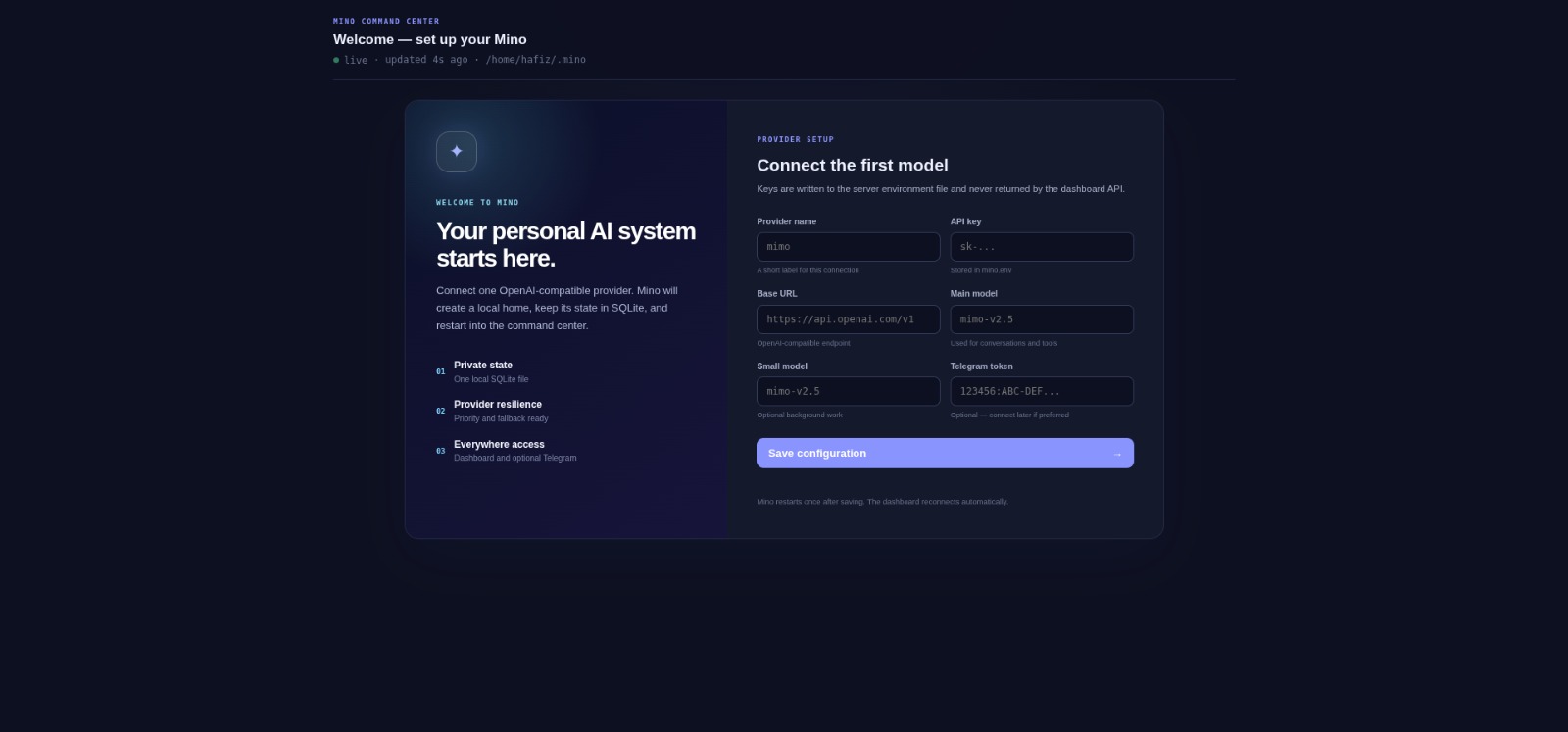
Want it available everywhere?
sudo cp mino /usr/local/bin/
hash -r
mino
Advanced: CLI mode
export MINO_API_KEY=sk-...
export MINO_BASE_URL=https://api.openai.com/v1
export MINO_MODEL=gpt-4.1-mini
./mino cli
Commands
| Command | What |
|---|---|
mino |
Launch dashboard (default) |
mino cli |
Terminal chat |
mino version |
Show version |
mino update |
Self-update from GitHub releases |
No API keys? The dashboard has an onboarding page to set them up. No more panics.
Configuration
| Env | Default | Description |
|---|---|---|
MINO_HOME |
~/.mino |
State directory (DB, config, traces) |
MINO_API_KEY |
— | OpenAI-compatible API key |
MINO_BASE_URL |
https://api.openai.com/v1 |
API base URL |
MINO_MODEL |
gpt-4o-mini |
Main model |
MINO_SMALL_MODEL |
gpt-4o-mini |
Model for background tasks |
MINO_DASHBOARD_PORT |
7779 |
Dashboard port |
MINO_DASHBOARD_HOST |
(all interfaces) | Bind address (e.g. 127.0.0.1 or Tailscale IP) |
MINO_MAX_ITERATIONS |
10 |
Max tool calls per turn |
MINO_MAX_TOKENS |
4096 |
Max output tokens |
MINO_CONTEXT_CHARS |
100000 |
Context window budget in chars |
TELEGRAM_BOT_TOKEN |
— | Optional Telegram bot token |
HF_TOKEN |
— | HuggingFace token (for FLUX.1-schnell, optional) |
TAVILY_API_KEY |
— | Optional — enriches web search (falls back to DuckDuckGo) |
MINO_OPENROUTER_KEY |
— | OpenRouter key (for embeddings, fallback search) |
See .env.example for a copy-paste template.
Architecture
Mino is ~2000 lines of Go:

main.go          — entry point, wires everything
loop.go          — agent loop: reason → act → observe
session.go       — SOUL.md, system prompt, context assembly
memory.go        — SQLite + FTS5 retrieval, consolidation
tools.go         — built-in tools (file, calendar, notes, search, image gen)
provider.go      — OpenAI-compatible client + SSE streaming
provider_manager.go — priority, retry, fallback, circuit breaking
telegram.go      — Telegram bot gateway
telegram_format.go — Markdown→HTML formatting for Telegram
dashboard.go     — web UI + REST API
mcp.go           — MCP bridge (stdio-based servers)
skill.go         — skill loader (SKILL.md files)
extensions.go    — HTTP extension protocol
checkpoint.go    — task survival across restarts
scheduler.go     — cron engine for proactive tasks
artifacts.go     — large output management
Free AI stack
Mino can run entirely on free tiers:
- LLM: Google Gemma 4 (free on OpenRouter, no cost)
- Image gen: Pollinations.ai (free, no key)
- Embeddings: via OpenRouter (free tier available)
- Web search: DuckDuckGo (built-in, keyless). Optional Tavily upgrade for richer results.
- URL fetch: pipes HTML through markitdown — preserves tables, headings, links for better LLM reading
Local LLMs
Run models on your own hardware — no API keys, no internet:
Ollama
# Install: https://ollama.com
ollama pull llama3.1:8b
Create ~/.mino/providers.json:
{
  "providers": [
    {
      "name": "ollama",
      "priority": 1,
      "base_url": "http://localhost:11434/v1",
      "api_key_env": "",
      "model": "llama3.1:8b",
      "small_model": "llama3.1:8b"
    }
  ]
}
"" for api_key_env means no auth required. Works with LM Studio, vLLM, and any OpenAI-compatible local server too.
Extensions
External tools connect via HTTP. Create ~/.mino/extensions.json:
[
  {"name": "my-tool", "url": "http://localhost:9100"}
]
Mino discovers tools via GET /tools and proxies calls via POST /execute.
minowrap — universal tool adapter
Add any CLI command as a tool in one JSON line. Ships with Mino:
// ~/.minowrap/tools.json
[
  {"name": "disk_usage", "description": "Show disk usage for a path", "run": "df -h {path}"},
  {"name": "deploy", "description": "Deploy the app", "run": "curl -X POST https://api.example.com/deploy"}
]
Template args like {path} auto-generate JSON Schema. Mino discovers them on next reload_plugins call. No restart, no coding, any language.
See the extension protocol for details.
MCP servers
Drop JSON configs in ~/.mino/mcp.d/:
{"name": "fs", "command": "npx", "args": ["-y", "@modelcontextprotocol/server-filesystem", "/path/to/dir"]}
Tools are prefixed as MCP_<server>_<tool>.
License
MIT
Reviews (0)
Sign in to leave a review.
Leave a reviewNo results found