claude-wave-plugin
Health Pass
- License — License: MIT
- Description — Repository has a description
- Active repo — Last push 0 days ago
- Community trust — 12 GitHub stars
Code Pass
- Code scan — Scanned 12 files during light audit, no dangerous patterns found
Permissions Pass
- Permissions — No dangerous permissions requested
No AI report is available for this listing yet.
Stop vibe-coding. A wave-based execution framework for Claude Code where discipline is the speed.
claude-wave-plugin




Run Claude Code like an engineering org. Wave-based execution with dedicated sub-agents per phase, computed-style visual verification, no "tsc passes" lies.
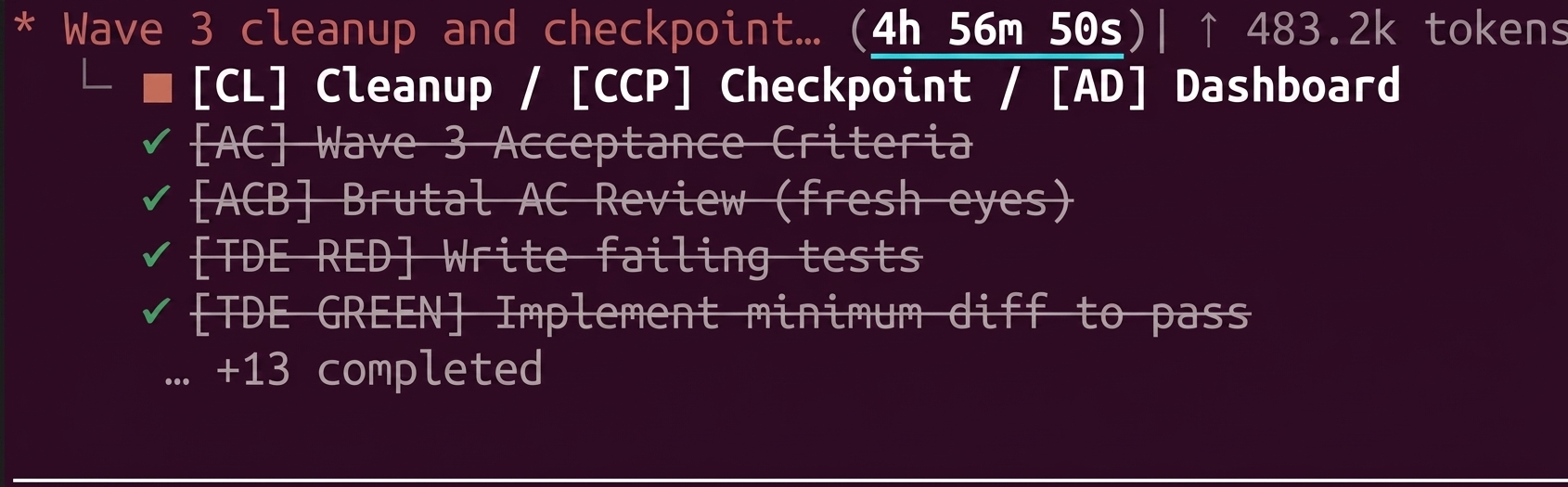
A real /wave-start run end-to-end: 17 phases dispatched through dedicated sub-agents, TDD-RED → GREEN → visual gates → cleanup → checkpoint. Unattended.
The defaults of "vibe-coding" optimise for time-to-first-demo. This plugin optimises for time-to-shippable.
Table of contents
- How is this different?
- Why this exists
- Prerequisites
- Install
- Quickstart — your first wave
- What you get
- Hook enforcement (v0.2.0)
- The 10 invariants
- The 5 hard-won rules
- Repository structure
- Community
- Listed on
- Used in production by
- Talks & writing
- Status
- Contributing
- License
How is this different?
| claude-wave-plugin | Superpowers | Vanilla Claude Code | |
|---|---|---|---|
| Workflow philosophy | Evidence-first verification | Brainstorm → plan → execute | One-shot prompts |
| Phases per feature | 17 base + 2 conditional | 7 stages | None |
| TDD enforcement | Hooks gate RED → GREEN order and evidence-file markers | Recommended | None |
| Visual verification gates | ✅ Computed-style assertions | ❌ | ❌ |
| Sub-agent isolation | ✅ Per-phase, lean context | ✅ | ❌ |
| Auto-compact recovery | ✅ Checkpoint resume | ❌ | ❌ |
| Best for | Production codebases where bugs cost money | Greenfield features, creative flow | Prototypes |
Both claude-wave-plugin and Superpowers are serious frameworks built by people shipping real code with Claude Code. They optimise for different problems. If you're brainstorming a new product feature, Superpowers' creative flow is excellent. If you're shipping into a production codebase where "the agent said it's done" is not acceptable evidence, this plugin is for you.
Why this exists
Most Claude Code workflows are one-shot: type a prompt, get a diff, ship it. That works for prototypes. It produces piles of fake-done features in production codebases — features whose tests pass but whose pages render blank, whose configs validate but whose runtime never reads them, whose data-theme="dark" attribute gets set on <html> while the screenshot stays light.
Wave-based execution treats Claude Code as an orchestration layer, not an autocomplete. Every phase of shipping a feature gets its own dedicated sub-agent with lean context — and the orchestrator gates each hand-off on real evidence (live stack screenshots, computed-style assertions, true end-to-end runs), not on "build clean".
This plugin packages that workflow.
Prerequisites
- Claude Code installed and authenticated. See the official docs.
- A project to run waves against (any language / stack).
- For hook enforcement: Bash, Git,
jq,flock,realpathand standard shell utilities.
Missing hook prerequisites warn and allow; install them for the gates to operate. - For UI waves: a browser-driving setup such as Playwright. The framework's TEET phase uses Playwright via the official MCP.
- Optional but recommended: the CodeRabbit plugin if you want the
[CR]Code Review gate at Phase 3.5.
Install
# Add this repo as a plugin source
/plugins marketplace add https://github.com/Harshvardhan86/claude-wave-plugin

# Then install the plugin
/plugins install claude-wave-plugin
After installation you should see two new slash commands available:
/wave-start/wave-checkpoint
…and six skills registered: wave-orchestrator, ac-writer, design-reviewer, red-tests, green-impl, teet-verify.
Manual install (no marketplace)
If you'd rather install directly:
git clone https://github.com/Harshvardhan86/claude-wave-plugin.git \
  ~/.claude/plugins/local/claude-wave-plugin
Restart Claude Code. The plugin should be picked up automatically.
Quickstart — your first wave
In any project you want to ship a feature in:
/wave-start --demo "make the save button show a loading spinner"
What you'll see:
- The orchestrator dispatches the AC sub-agent.
.wave/ac.mdlands with brutal, testable criteria. - DR sub-agent audits your design system's installed dist files, writes a per-route mockup, defines computed-style visual ACs. Any design-system gap becomes an OPEN item that pauses the wave.
- RED writes failing tests against those ACs and prints the failure output. That's the point.
- GREEN writes the minimum code, starts the live stack, runs the full test suite, takes a Playwright screenshot.
- Visual approval gate. The orchestrator stops, shows you the screenshot, asks you to confirm before proceeding.
- TEET runs cross-system computed-style assertions and produces the final verdict.
If the agent says "done" without showing you a screenshot, refuse the hand-off — that's the failure mode the plugin exists to prevent.
Once you've shipped two or three waves with --demo successfully, drop the flag:
/wave-start "implement the new payment flow"
This invokes the canonical pipeline: 17 base phases plus [DR] (auto-engaged for UI waves) and optional [CR] (opt-in via cr_enabled). Brutal AC, Silent Error Analysis, Brutal SEA, Dependency Audit, Output Alignment, Brutalised E2E, version bump, commit, cleanup, checkpoint, dashboard — all dispatched as separate Agents with proper Opus / Sonnet / Haiku model routing.
If context fills before completion, /wave-checkpoint writes resume state to .wave/checkpoints/. A fresh session picks up exactly where you left off.
What you get
The full v2 framework (framework/)
This plugin vendors the complete Wave Execution Framework v2 — refined over months of production engineering work where bugs cost real money. 17 base phases plus two conditional gates: [DR] Design Review at Phase 1.5 (mandatory whenever the wave ships UI — web, mobile, Storybook, CLI-TUI) and [CR] Code Review at Phase 3.5 (optional, opt-in). Maximum surface per wave: 19 phases. Model-routed across Opus / Sonnet / Haiku, with hook-enforced invariants and worktree isolation for writing dispatches.
Demo on-ramps (skills/)
For first-time users, small features, and live-demo segments, the plugin ships five polished entry skills plus the orchestrator:
| Skill | Phase | Owns |
|---|---|---|
wave-orchestrator |
Router | Full/demo dispatch and hand-off gates; solo mode for direct tasks |
ac-writer |
1. Acceptance Criteria | Brutal, testable ACs grounded in real visual vocabulary |
design-reviewer |
UI: pre-RED gate (matches Phase 1.5) | Component API audit, per-route mockup, visual ACs |
red-tests |
RED | Failing tests first, prove they fail before any code is written |
green-impl |
GREEN | Minimum implementation, verify-before-scan: live stack + tests + screenshot |
teet-verify |
TEET | True end-to-end with computed-style assertions, not toBeVisible() lies |
These run as /wave-start --demo "<feature>". The recommended starting point.
Commands (commands/)
/wave-start <feature>— runs the full v2 pipeline (17 base + conditional[DR]and[CR]gates)/wave-start --demo <feature>— runs the trimmed 5-phase entry subset/wave-start --solo <feature>— runs a direct task with explicit models, commit guard,
PreCompact checkpoint and token ledger/wave-checkpoint— saves wave state to disk so an auto-compact (or laptop battery dying) doesn't kill the run
Hook enforcement (v0.2.0)
An active wave now has executable gates: phase order, valid phase/role/model,
hand-off artifacts and markers, scope answers, design-review resolutions, UI
screenshot approval and bug-fix strategy approval. Hooks keep the full/demo
orchestrator focused on dispatch by gating tracked source edits, source reads,
recognised build/test commands, nested dispatches and forks. Third phase/role
rounds and output-token budget overruns require recorded approval.
Every main-session full/demo Agent dispatch starts its description with:
[W:<wave> P:<PHASE> R:<lead|executor|reviewer|scanner|writer>]
For example: [W:1 P:TDE-GREEN R:executor] implement AC-3. The tag is
case-sensitive, begins at byte 0 and has exactly one space between fields. The
first line of prompt is accepted as a fallback. Name model explicitly;
full/demo routing requires at least the tier in hooks/phases.tsv.
- Full applies the full phase table and all process gates. DR runs for UI
or behaviour-changing waves; CR is conditional on its scope flag. - Demo applies the same rules to
AC,DR,TDE-RED,TDE-GREEN,TEET.
Skipped conditional or out-of-mode rows are looked through transitively so
unfinished applicable predecessors cannot be bypassed. - Solo (
/wave-start --solo) keeps only the explicit-model rule, commit
guard, PreCompact checkpoint and ledger. No tag, prompt caps, phase order,
tiers, orchestrator-only rules, rounds or budgets are enforced.
/wave-start creates .wave/state.json before dispatch and records full/demo
scope answers with scripts/wave-set.sh. The state defaults to enforce: "block".
Escape hatch: use --enforce warn when invoking scripts/wave-init.sh, or
set enforce to warn in the active .wave/state.json. Event-hook denials become
warnings with the same rule id and remedy. wave-set.sh changes scope flags only.
Close the wave with scripts/wave-close.sh when finished. With no active state,
plugin event hooks are silent; unreadable inputs and missing prerequisites warn
and allow.
Approvals, reports and checkpoints live under .wave/, excluded locally through.git/info/exclude. Approval files record the user's decision; they are not
signatures or durable audit history. The commit guard checks staged planning
paths and message hygiene; .wave/approvals/commit-doc.md permits an intentional
planning-document exception. wave-init.sh also installs a Git commit-msg
guard when one is absent. That separate message guard remains active after a
wave closes and does not consult enforce.
The append-only .wave/ledger.jsonl records requested/resolved models and
input/output/cache tokens per agent, including failed hand-offs.scripts/wave-scorecard.sh writes .wave/scorecard.md with spend, budget ratios,
rework and GREEN output per changed line. Model downgrades warn and are recorded. Long prompts
warn; copying ≥4,000 characters from a .wave/ file into a prompt is denied.
Pass a report path and return a summary under 2,000 characters.
PreCompact now writes .wave/checkpoints/<ts>-precompact.md automatically;/wave-checkpoint is the manual form. The checkpoint is enforced, the stop is
advised: Claude Code cannot block compaction through this hook. Start a fresh
terminal from the recorded resume instructions.
These gates check evidence files and markers, not the truth of test results.
Reviewers still verify the evidence. A Bash source write is outside the edit
guard; the build/test filter does not interpret shell indirection or aliases.
Main-session edit/read/build restrictions do not apply inside worktree
subagents, where the commit guard still inspects the worktree's index.
The plugin auto-loads hooks/hooks.json; do not add hooks to the plugin
manifest, because duplicate registration can drop all hooks. See the
hook reference for wiring,
stdin fields, every rule id and remedy, approval paths, load verification and rollback.
Release gates, from the repository root:
bash tests/run.sh
bash tests/run.sh --coverage
WV_PINNED_NOW=2026-11-01T00:00:00Z bash tests/run.sh --coverage
bash tests/clean-clone-check.sh
bash tests/tools/mutants-all.sh
bash tests/tools/reason-corpus.sh
bash tests/e2e.sh
The first runs the cases; --coverage also fails missing positive/negative rule
controls. The pinned-clock run is the time-bomb gate: every case reads the clock
through one injectable source (WV_NOW, pinned once per run bytests/lib/assert.sh), so moving that pin to any instant must leave the suite green.
It must be run at a pin far past the fixtures' own timestamps — a wall-clock-dependent
case reds there and nowhere else, months before the calendar would find it, with no
commit to blame. The clean-clone check covers the committed tree. mutants-all.sh runs
every mutation driver under tests/tools/ — one per hook script plus the 78
phase-table tier cells — and fails on any surviving mutant or failed restore; a
green suite over a rule no mutant can break has proved nothing about that rule.reason-corpus.sh drives every rule id in hooks/reasons.tsv to its positive
case and checks the reason a user actually reads: one rule token, a remedy, a
length bound, no unrendered placeholder, and template arity matching every call
site. The end-to-end gate verifies an actual plugin load and headless wave; it
reports a skip when claude is unavailable. A filtered pass, skipped live test or
successful manifest validation alone is not a release gate.
The 10 invariants (verbatim from v1, preserved in v2)
- Lean context per unit — no "just in case" dumps.
- Strict TDD — tests first, watch them fail, then implement.
- Strict build order — build → app startup → tests.
- Never assume on bugs — present options, user decides.
- Save learnings globally after every bug fix (no duplicates, enhance existing).
- Planning docs never committed to the code repo.
- Auto-compact = STOP. Fresh terminal. Resume from checkpoint.
- No team self-declares success — internal reviewer signs off first.
- No hanging the system — teams must not deadlock or block indefinitely.
- The orchestrator is the single throat to choke — all decisions and user interactions flow through it.
Invariant 6 is hook-enforced in v0.2.0. Invariant 7’s checkpoint is enforced;
its fresh-terminal stop is advised because PreCompact cannot block compaction. See framework/references/11-hooks-and-automation.md.
The 5 hard-won rules the demo skills add on top
These complement the invariants for UI work specifically:
- Verify before scan. Never run BC/SEA/BSEA scanners on un-verified GREEN. Live stack + full test suite + screenshot first; then scan.
- Visual effect over DOM presence.
toBeVisible()returns true for a 0×0 element. AssertgetComputedStyle().backgroundColor,boundingBoxdimensions, and effective CSS bytes. - Visual vocabulary grounding. Never invent a color or token the app doesn't already render. Audit compiled CSS, not theoretical class names.
- Never implement without wiring. Trace config → runner → handler end-to-end. A "catalog without dispatch" is a lie.
- Permissions once, upfront. Ask for all permissions in a single consolidated request at session start. Never again.
Each rule was learned from a specific incident, not from a blog post.
Repository structure
claude-wave-plugin/
├── .claude-plugin/
│   ├── plugin.json                              # plugin manifest (no hooks field)
│   └── marketplace.json                         # marketplace listing
├── README.md                                    # you are here
├── LICENSE                                      # MIT
├── CHANGELOG.md                                 # release history
├── CONTRIBUTING.md                              # PR / issue norms
├── .gitignore
│
├── framework/                                   # full Wave Execution Framework v2
│   ├── SKILL.md                                 # canonical pipeline + 10 invariants
│   └── references/                              # 12 load-on-demand reference docs
│       ├── 01-architecture.md
│       ├── 02-standing-teams.md
│       ├── 03-wave-pipeline.md
│       ├── 04-meta-orchestration.md
│       ├── 05-language-binding-rules.md
│       ├── 06-team-quick-reference.md
│       ├── 07-invariant-rules.md
│       ├── 08-worktree-strategy.md
│       ├── 09-platform-deltas.md
│       ├── 10-model-routing.md
│       ├── 11-hooks-and-automation.md
│       └── 12-mcp-and-plugins.md
│
├── skills/                                      # demo on-ramps + orchestrator
│   ├── wave-orchestrator/SKILL.md
│   ├── ac-writer/SKILL.md
│   ├── design-reviewer/SKILL.md
│   ├── red-tests/SKILL.md
│   ├── green-impl/SKILL.md
│   └── teet-verify/SKILL.md
│
├── commands/
│   ├── wave-start.md                            # /wave-start [--demo|--solo] "<feature>"
│   └── wave-checkpoint.md                       # /wave-checkpoint
│
├── hooks/                                       # auto-loaded wiring + rule data
│   ├── hooks.json                              # events, matchers, command timeouts
│   ├── phases.tsv                              # order, tiers, artifacts, markers
│   ├── models.tsv
│   ├── roles.tsv
│   ├── budgets.tsv
│   ├── planning-paths.tsv
│   ├── orchestrator-writable.tsv
│   └── reasons.tsv                             # rule ids, precedence, remedies
│
├── scripts/
│   ├── hooks/                                  # 11 event scripts + shared lib.sh
│   ├── wave-init.sh                            # state, local exclude, commit-msg guard
│   ├── wave-set.sh                             # scope answers
│   ├── wave-close.sh                           # wave lifetime
│   ├── wave-scorecard.sh                       # ledger report
│   └── qr.html                                 # parametric QR-code generator
│
└── tests/
    ├── run.sh                                  # cases; --coverage release gate
    ├── clean-clone-check.sh                     # committed-tree verification
    ├── e2e.sh                                   # plugin load + live headless checks
    ├── cases/                                  # JSON fixtures and shell cases
    ├── fixtures/                               # payloads, state and transcripts
    ├── golden/                                 # independent phase/tier and budget data
    ├── lib/                                    # harness assertions
    └── tools/mutants-*.sh                       # focused mutation drivers
Community
- X / Twitter: @Anim1986 — DM open for questions, suggestions, war stories
- Issues & ideas: Open an issue with the
.wave/<phase>.mdexcerpt that surfaced the question - Discussions: GitHub Discussions for design questions and patterns
Listed on
- Flowy — plugin directory entry with skills, commands and repo listed
- Vibed Lab Plugins — weekly-curated Claude Code plugin directory listing
- MCP Market — skill listing for
ac-writer, the brutal acceptance criteria phase
Used in production by
This plugin is in early public release. If you're shipping with claude-wave-plugin in a real engineering org, open an issue or DM @Anim1986 — I'll add your team here and would love to hear what's working, what's not, and what's missing.
Talks & writing
- 🎤 Beyond Vibe Coding — Claude Builders Delhi NCR, May 2026 — the talk that introduced this framework. Recap with photos and the core thesis.
- ✍️ Coming soon: TDD with sub-agents — the patterns from
claude-wave. Acceptance criteria, evidence-first verification, brutal silent-error scans.
Status
v0.2.0 — hook enforcement for active waves, three modes, token accounting and
automatic recovery checkpoints. See the contract and declared bounds above.
Issues and PRs are welcome.
Contributing
See CONTRIBUTING.md. Short version:
- Bug reports and rule clarifications: open an issue with the
.wave/<phase>.mdexcerpt that surfaced the problem - New rules to the framework: come with a real incident behind them
- Skill changes: include a before/after showing the new guidance in action
Author
Harshvardhan Singh Chouhan
- X: @Anim1986
- LinkedIn: harshvardhan-chouhan
- Email: [email protected] / [email protected]
License
MIT — fork it, ship it, mutate it.
Reviews (0)
Sign in to leave a review.
Leave a reviewNo results found