taskflow
Health Pass
- License — License: MIT
- Description — Repository has a description
- Active repo — Last push 0 days ago
- Community trust — 33 GitHub stars
Code Warn
- fs module — File system access in .github/workflows/publish.yml
Permissions Pass
- Permissions — No dangerous permissions requested
No AI report is available for this listing yet.
A declarative, verifiable graph of task nodes for coding-agent subagents — not a workflow you script, but a DAG you declare: statically verified before it runs, with dynamic fan-out, gates, isolated subagent context, and resumable runs. Runs on Pi, OpenAI Codex, Claude Code, and OpenCode. Zero deps.
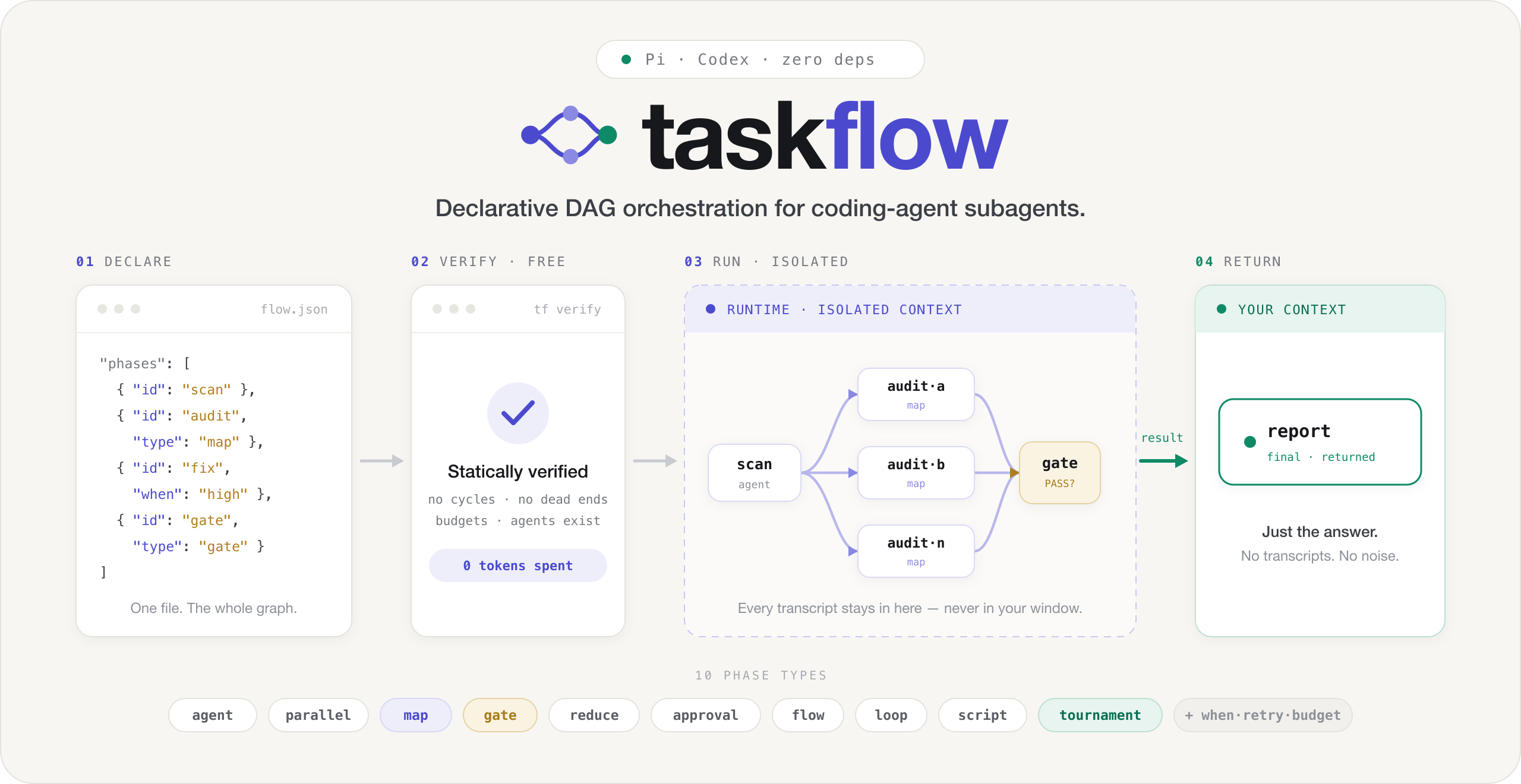


Build multi-agent systems you can inspect before they run.
taskflow turns agent plans into compiled task graphs: declared once, verified before model spend, executed in isolated subagents, resumed across sessions, replayed without tokens, and recomputed from the smallest stale frontier.
It runs on the coding agent you already use:
Pi · Codex · Claude Code · OpenCode · Grok Build
JSON or .tf.ts
      │
      ▼
 validate ──► Taskflow JSON ──► FlowIR + content hash
                                      │
                                      ▼
                           isolated DAG runtime
                                      │
                         ┌────────────┼────────────┐
                         ▼            ▼            ▼
                      resume        replay      recompute
Your host receives the final result. Intermediate transcripts stay inside the runtime unless you explicitly inspect them.
Why taskflow?
Built-in subagent tools are excellent for one turn. The moment the work branches, retries, crosses sessions, or needs a quality gate, the plan becomes infrastructure.
| Ad-hoc agents / scripts | taskflow | |
|---|---|---|
| Plan | Re-derived from prose or hidden in a script | An explicit, versionable DAG |
| Before execution | Discover mistakes while spending | Verify structure at zero model calls |
| Intermediate output | Floods the host context | Stays isolated in the runtime |
| Failure | Start over or reconstruct state | Resume from persisted phase state |
| Changed input | Re-run broadly | Explain staleness and re-run the affected frontier |
| Portability | Coupled to one agent | One JSON contract across five hosts |
The trade is deliberate: less arbitrary orchestration code, more verifiability, observability, recovery, and reuse.
60-second start
Install taskflow on Pi:
pi install npm:pi-taskflow
Then ask naturally:
Use taskflow to audit
src/apiin parallel and return one prioritized report.
The routing skill uses the same familiar task / tasks / chain shape:
{
  "chain": [
    { "agent": "scout", "task": "Map the public API under src/api." },
    {
      "agent": "security-reviewer",
      "task": "Audit this surface for missing auth and unsafe input boundaries:\n{previous.output}"
    },
    {
      "agent": "reviewer",
      "task": "Turn these findings into one prioritized report:\n{previous.output}"
    }
  ]
}
That already gives you an isolated, tracked run. When the job needs real topology, declare the graph:
{
  "name": "audit-api",
  "args": { "dir": { "default": "src/api" } },
  "concurrency": 4,
  "phases": [
    {
      "id": "discover",
      "type": "agent",
      "agent": "scout",
      "task": "List source files under {args.dir}. Output ONLY a JSON array of {\"path\":\"...\"} objects.",
      "output": "json"
    },
    {
      "id": "audit-each",
      "type": "map",
      "over": "{steps.discover.json}",
      "as": "file",
      "agent": "security-reviewer",
      "task": "Audit {file.path}. Cite evidence and assign severity.",
      "dependsOn": ["discover"]
    },
    {
      "id": "report",
      "type": "reduce",
      "from": ["audit-each"],
      "agent": "reviewer",
      "task": "Synthesize one prioritized report:\n{steps.audit-each.output}",
      "dependsOn": ["audit-each"],
      "final": true
    }
  ]
}
Save it as .pi/taskflows/audit-api.json, then run:
/tf:audit-api dir=src/api
On Codex, Claude Code, OpenCode, and Grok Build, run the same saved definition by name through taskflow_run.
See the graph run
This is real output from a Pi run—not a mock dashboard:
⊗ taskflow self-improve  6/7 · blocked · $0.095
    ✓ discover            agent   deepseek-v4-flash  10t ↑38k ↓6.7k $0.011
  ┌ ✓ write-runner-tests  agent   claude-sonnet-4-6  10t ↑13 ↓6.6k $0.020
  ├ ✓ write-store-tests   agent   claude-sonnet-4-6  10t ↑11 ↓10k $0.018
  ├ ✓ write-agents-tests  agent   claude-sonnet-4-6  10t ↑28 ↓13k $0.030
  └ ✓ fix-stability       agent   claude-sonnet-4-6  10t ↑13 ↓3.9k $0.012
    ✓ verify              gate    BLOCK 3 type errors in test files
    ⊘ report              reduce  skipped · Gate blocked  ↳ fix-stability
The layout is the DAG. Parallel rails expose concurrency; long edges expose dependencies; the gate explains why downstream work stopped. No separate control plane is required to understand the run.
0.2 is the compiler turn
Before 0.2, taskflow executed declarative graphs. Now the graph also has a compile-time frontend, a canonical intermediate representation, an append-only decision trace, offline replay, and incremental recompute.
Author in JSON or TypeScript
JSON remains the portable runtime contract. For larger flows, taskflow-dsl adds a compile-time TypeScript authoring layer:
import { agent, flow, json, map, reduce } from "taskflow-dsl";

export default flow("audit", (ctx) => {
  ctx.budget({ maxUSD: 2 });

  const files = agent("List files under {args.dir}", {
    agent: "scout",
    output: json<{ path: string }[]>(),
  });

  const audits = map(files, (file) =>
    agent(`Audit ${file.path}`, { agent: "security-reviewer" }),
  );

  return reduce(
    [audits],
    (parts) => agent(`Write one report:\n${parts.audits.output}`),
    { final: true },
  );
});
pnpm add -D taskflow-dsl
taskflow-dsl check audit.tf.ts
taskflow-dsl build audit.tf.ts --emit both
# → audit.taskflow.json + audit.flowir.json
.tf.ts is compile-time only. Hosts execute the emitted Taskflow JSON; they never interpret TypeScript.
Compile to a contract you can reason about
FlowIR canonicalizes the graph and gives it a content hash. That compiled identity makes provenance and stale analysis inspectable, while the runtime adds content-addressed caching and deterministic tools:
| Operation | What it answers | Model calls |
|---|---|---|
verify / compile |
Is the graph structurally safe to run? | 0 |
ir |
What is the canonical graph and content hash? | 0 |
resume |
What unfinished work remains? | Only unfinished phases |
trace |
What calls and runtime decisions actually happened? | 0 to inspect |
replay |
What if thresholds or budgets had been different? | 0 |
why-stale |
What changed, and what depends on it? | 0 |
recompute |
What is the smallest observable affected frontier? | Only affected phases |
Explore the compiler and runtime →
One runtime, 12 phase types
| Family | Phases | Use them for |
|---|---|---|
| Work | agent · parallel · map · reduce · script |
Single tasks, static fan-out, dynamic fan-out, aggregation, zero-token shell steps |
| Control | gate · approval · flow · loop |
Quality decisions, human checkpoints, composition, iterative refinement |
| Selection | tournament · race |
Best-of-N quality or first-success latency |
| Dynamic graph | expand |
Validate and execute a runtime-produced fragment, nested or grafted |
Across those phase types, the DSL provides dependencies, conditions, retries, timeouts, output contracts, budgets, workspace isolation, and explicit final-output selection. Each kind accepts only the fields that are safe and meaningful for it; freshness-sensitive phases are excluded from cross-run caching.
Runtime guarantees, not prompt conventions
Verify before spend
Cycles, dangling dependencies, invalid references, impossible joins, unsafe dynamic fragments, and configuration hazards are rejected or surfaced before the expensive work starts.
Keep intermediate work out of the host context
Agent-running phases execute in isolated subagent processes; control and script phases stay inside the runtime. Upstream outputs are wired into downstream inputs internally. Only finalOutput returns to the host unless you explicitly use peek or trace.
Survive sessions and failures
Phase state is persisted atomically. Resume skips unchanged completed work; detached Pi runs can outlive the initiating session; an idle watchdog terminates stalled subagents.
Reuse work honestly
Within-run resume is content-addressed. Cross-run caching is opt-in and can fingerprint Git commits, files, globs, environment variables, and TTLs. Change one declared input and only its dependents become stale.
Bound the blast radius
Budgets, concurrency caps, retries, timeouts, nesting limits, dynamic-graph breadth caps, path containment, non-idempotent phase classification, and fail-closed approval behavior are runtime semantics—not suggestions in a prompt.
Install on your host
All packages require Node.js ≥ 22.19.0.
Pi
pi install npm:pi-taskflow
Pi provides the richest local experience: the taskflow tool, /tf commands, live DAG rendering, interactive approvals, background runs, and model-role setup.
OpenAI Codex
codex plugin marketplace add heggria/taskflow
codex plugin add taskflow@taskflow
Claude Code
claude plugin marketplace add heggria/taskflow
claude plugin install claude-taskflow@taskflow
OpenCode
opencode mcp add taskflow -- \
  npx -y -p [email protected] opencode-taskflow-mcp
Grok Build
grok mcp add taskflow -- \
  npx -y -p [email protected] grok-taskflow-mcp
Grok Build support is new in 0.2. Its CLI stream does not report token/cost usage, so budget-declaring flows are rejected rather than silently running without enforcement.
Built to survive real work
9 packages · 5 hosts · 12 phase types · 18 built-in agents · 1,500+ tests · MIT
                              taskflow-core
                 ┌──────────────┼───────────────┐
                 │              │               │
           taskflow-dsl   pi-taskflow   taskflow-mcp-core ─┐
                                       taskflow-hosts ─────┼─ codex-taskflow
                                                          ├─ claude-taskflow
                                                          ├─ opencode-taskflow
                                                          └─ grok-taskflow
taskflow-core is host-neutral and imports no host SDK. taskflow-mcp-core implements stdio JSON-RPC without an MCP SDK dependency; taskflow-hosts owns the shared host process runners. The four MCP delivery packages bind both layers (and core), while Pi keeps its native adapter.
The test suite covers orchestration semantics, persistence and file-lock races, cache freshness, path traversal, dynamic graph hardening, cancellation, budgets, all 12 phase kinds, FlowIR/replay/recompute, TypeScript DSL erasure, host argv contracts, MCP servers, and packed consumer imports.
Documentation
| Start here | When you need |
|---|---|
| Getting Started | Your first successful run |
| Concepts | DAGs, isolation, verification, resume, shared context |
| Syntax | Phase fields, control flow, budgets, caching, scorers |
| Compiler & Runtime | TypeScript DSL, FlowIR, replay, recompute, background runs |
| Host Guides | Pi, Codex, Claude Code, OpenCode, and Grok setup |
| Reference | Commands, shorthand, and exact tool surfaces |
| Showcase | Real flows and case studies |
Also see examples/, the changelog, and the release guide.
Contributing
pnpm install
pnpm run typecheck
pnpm test
pnpm run build
pnpm run test:pack
Contributions are welcome. Start with CONTRIBUTING.md for the workflow and AGENTS.md for architecture and coding conventions.
License
Declare once. Verify first. Recompute only what changed.
Reviews (0)
Sign in to leave a review.
Leave a reviewNo results found