Herald
Health Warn
- License — License: MIT
- No description — Repository has no description
- Active repo — Last push 0 days ago
- Community trust — 24 GitHub stars
Code Fail
- network request — Outbound network request in src/feeds/cryptopanic.ts
- exec() — Shell command execution in src/feeds/rss.ts
- network request — Outbound network request in src/feeds/rss.ts
- process.env — Environment variable access in src/lib/config.ts
Permissions Pass
- Permissions — No dangerous permissions requested
This tool monitors cryptocurrency news headlines and evaluates them to identify time-sensitive, tradable market catalysts. It filters out recycled rumors and over-distributed stories, prioritizing events that still hold actionable trading value.
Security Assessment
The tool carries some notable security risks due to its underlying code behavior. It explicitly executes shell commands and makes outbound network requests to fetch external RSS and CryptoPanic feeds. Additionally, it accesses environment variables, which is standard for loading configurations or API keys, though developers should ensure they never pass hardcoded secrets into these variables. No hardcoded secrets were detected during the scan, and the project does not request dangerous system permissions. Because of the shell command execution, the overall security risk is rated as Medium.
Quality Assessment
The project is actively maintained, evidenced by a recent push within the last day and an active continuous integration build. It uses the highly permissive MIT license, making it freely available for integration. However, community trust is relatively low given its small footprint of only 24 GitHub stars. Furthermore, the repository currently lacks a basic description in its metadata, which is a minor documentation oversight.
Verdict
Use with caution. While active and properly licensed, the inclusion of shell command execution demands that you carefully review and sandbox the tool before deploying it in any production environment.
Herald
Catalyst tape for crypto market events.
Catch the headlines that still have edge after the market sees them.
bun run dev
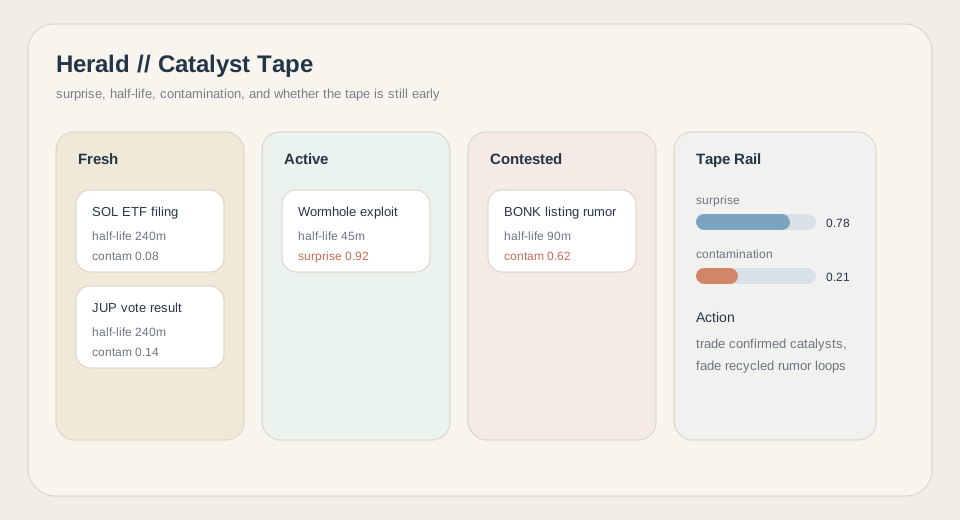
- watches surprise, event half-life, contamination risk, and category context
- ignores recycled rumor loops, thin sourcing, and late social echo
- promotes catalysts that are still early enough to matter to a trader


Catalyst Board • Tape Ticket • Operating Surfaces • Real Edge • Technical Spec • Quick Start
At a Glance
Use case: convert crypto headlines into time-sensitive catalyst signalsPrimary input: surprise, category half-life, contamination, freshnessPrimary failure mode: promoting headlines after the edge has already been distributedBest for: operators who need to know whether a story still has anything left to do
Catalyst Board
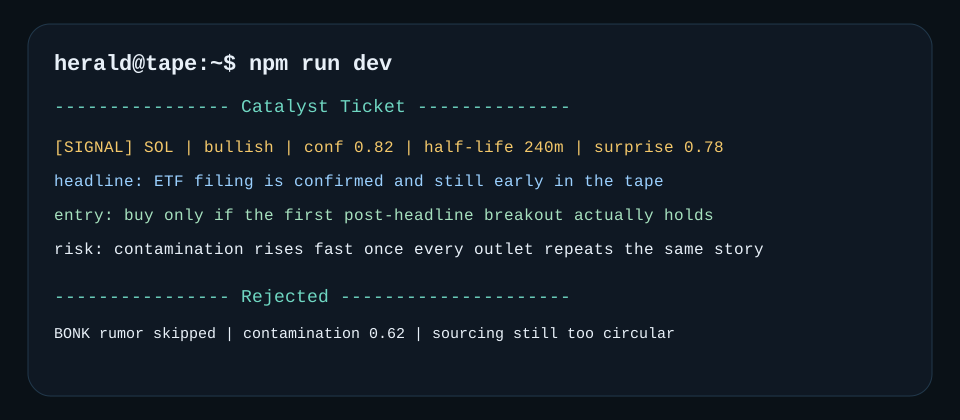
Tape Ticket
Operating Surfaces
Catalyst Board: organizes headlines by freshness, surprise, and contaminationTape Ticket: prints the exact event, half-life, and action biasDecay Model: tracks how fast each category loses edge after publicationContamination Filter: blocks rumor loops and over-distributed stories from ranking too high
What Herald Does Better Than A News Feed
Herald is not meant to tell you what happened. It is meant to tell you whether what happened still has any tradable life left in it.
That requires a stricter view of timing than most crypto news products take. A headline can be real and still be useless if it has already been distributed through too many channels, repeated by too many low-quality accounts, or delayed too long for the category.
What Herald Treats As Real Edge
Herald is built around a simple idea: not every headline deserves to become a trading input. The system is stricter with stories that already spent their edge on social media and more generous with structurally important catalysts that still sit inside a usable half-life window.
That makes the tape useful during the part of the cycle where traders need speed, not a recap feed.
When The Tape Stays Quiet
Herald should often do nothing.
- if a story is already over-distributed, it gets demoted
- if sourcing is weak, contamination rises quickly
- if the event category decays fast, the half-life window closes
A silent tape is better than a noisy one that promotes dead edge.
How It Works
Herald keeps the workflow simple:
- ingest fresh market headlines from the enabled feeds
- classify the event into a category with its own expected half-life
- measure surprise and contamination at the story level
- downgrade stories that are weakly sourced, recycled, or late
- rank the remaining catalysts into a tape the operator can actually act on
The goal is not full news coverage. The goal is clean timing.
How The Board Should Be Read
Freshness
The same headline means different things at 3 minutes, 30 minutes, and 3 hours depending on category. Herald keeps that timing discipline explicit.
Surprise
A genuinely surprising event can still matter after social media has seen it. A routine headline with no real surprise usually should not.
Contamination
This is where most junk gets filtered out. Rumor phrasing, anonymous sourcing, repetitive token stuffing, and social echo loops all raise contamination fast.
Example Output
HERALD // CATALYST TAPE

event            JUP fee vote passes
category         governance
surprise         high
half-life        240m
contamination    low
state            actionable

operator note: structural token-economics change still inside edge window
Technical Spec
Herald ranks news with three practical questions:
- Is the event surprising?
- How long does edge usually persist for this category?
- How contaminated is the headline by rumor loops or recycled coverage?
Event Half-Life
hack = 45m
listing = 90m
regulation = 240m
unlock = 360m
This governs how fast a signal decays in the tape.
Contamination Score
Contamination rises when the item contains:
- rumor / unconfirmed language
- anonymous sourcing
- repeated social headlines
- too many token mentions in one story
Higher contamination reduces ranking and conviction.
Ranking Heuristic
impact = categoryWeight + abs(rawSentiment) * 2 - contaminationScore * 3
This keeps strong structural catalysts above hype headlines.
Example Categories Herald Cares About
- exchange listings that materially change access
- unlock schedules that alter supply pressure
- governance or fee changes that affect token economics
- hacks and security failures with immediate repricing impact
- regulatory or macro headlines that change the market regime
Risk Controls
half-life decay: prevents stale headlines from staying live too longcontamination score: demotes rumor loops and low-quality social repetitioncategory weighting: keeps structural catalysts above low-value hypefreshness requirement: blocks late stories even when the headline sounds dramatic
Herald should bias toward silence when timing is compromised. A dead catalyst with a strong headline is still dead.
Why Operators Keep It Open
Most crypto news products are built to tell you what happened. Herald is built to tell you whether there is still anything left to do.
That difference is what makes it worth keeping on-screen.
Quick Start
git clone https://github.com/HeraldAgent/Herald
cd Herald
npm install
cp .env.example .env
npm run dev
Local Audit Docs
Support Docs
License
MIT
Reviews (0)
Sign in to leave a review.
Leave a reviewNo results found