nvidia-ai-hub
Health Warn
- License — License: NOASSERTION
- Description — Repository has a description
- Active repo — Last push 0 days ago
- Low visibility — Only 6 GitHub stars
Code Pass
- Code scan — Scanned 12 files during light audit, no dangerous patterns found
Permissions Pass
- Permissions — No dangerous permissions requested
No AI report is available for this listing yet.
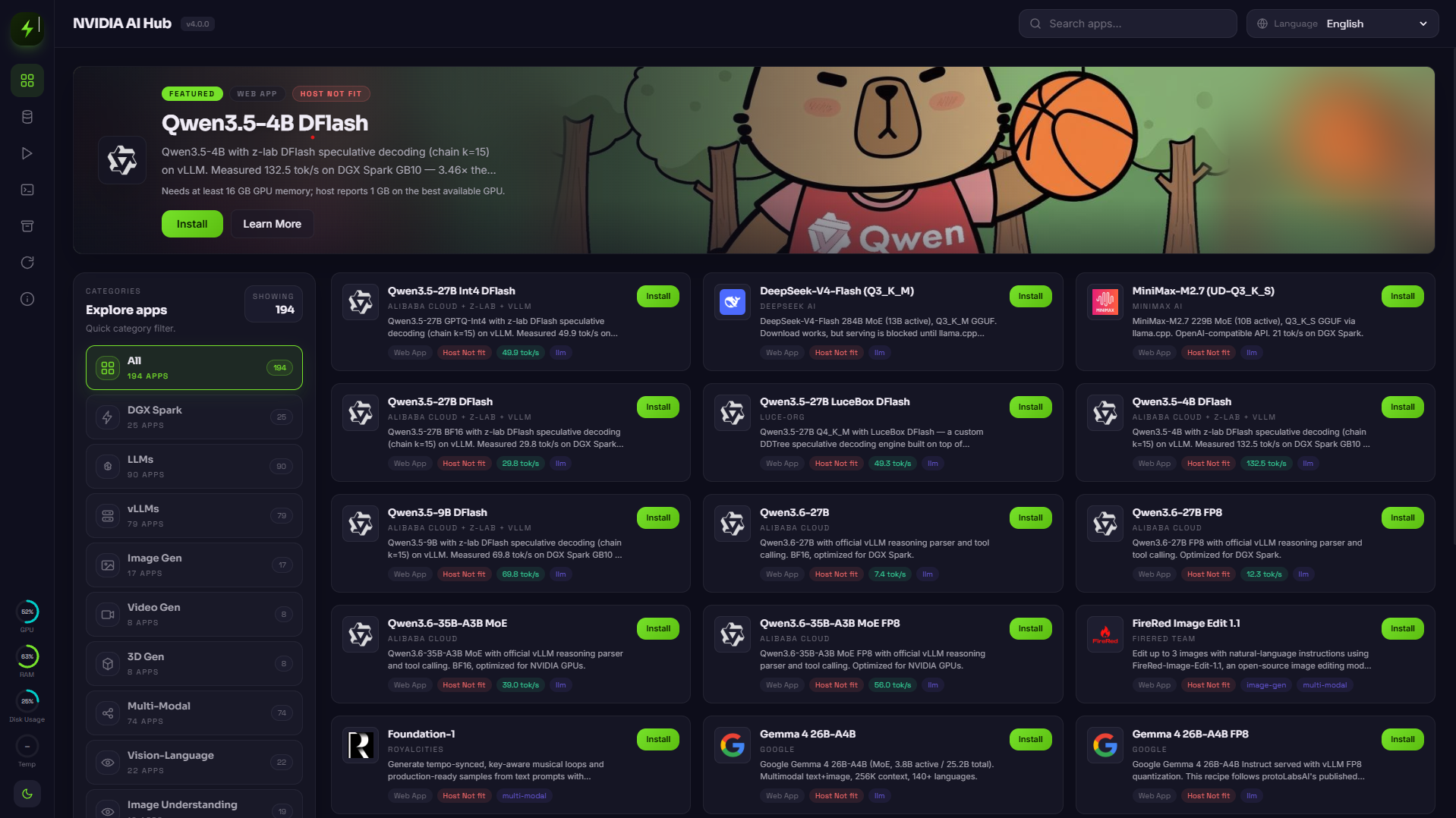
NVIDIA AI Hub — One-click AI app launcher for NVIDIA DGX GPU. Install, run, and manage GPU-accelerated AI apps from a modern web UI.
NVIDIA AI Hub by Pho Tue SoftWare Solutions JSC
A major update is coming in August 2026.














Quick links: Overview · Installation · Production deployment · Local development · Planning · Contributing · Security · Community · Licensing
Your AI app store for NVIDIA GPU platforms. Browse, install, and launch AI apps with one click.
Overview
NVIDIA AI Hub by Pho Tue SoftWare Solutions JSC provides a web UI and API for managing curated AI application recipes across NVIDIA GPU workstations, servers, and DGX-class systems.
The project includes:
- A
FastAPIbackend for recipe, system, and container management - A
React + Vitefrontend served as static files by the backend - An optional
Electrondesktop shell for packaged Windows, macOS, and Linux builds - A Docker-based runtime model for AI applications in
registry/recipes
Local development
For a complete local dev workflow (backend + frontend), production build validation, and white-page troubleshooting, see docs/local-development.md.
Desktop packaging
The repository now includes optional Electron packaging assets under frontend/electron/.
Desktop packaging currently follows this model:
- the web UI is still built from source with Vite
- the desktop app launches a bundled local FastAPI backend on
127.0.0.1 - packaged builds target Windows, macOS, and Linux through
electron-builder - Linux artifacts are intended to include the desktop app bundle rather than rely on the shell installer alone
Frontend desktop commands:
npm run desktop:devnpm run desktop:packnpm run desktop:dist
These commands are run from frontend/ and require local Python plus repository backend dependencies to package successfully.
Desktop packaging notes:
- app icons are generated from
frontend/public/brand/spark-ai-hub-mark.svgduring desktop packaging - frontend production builds now split large vendor dependencies into dedicated chunks to reduce the main bundle size for web and desktop output
- desktop pack/dist commands now clear
frontend/release/before packaging to avoid stale locked output directories on Windows npm installinfrontend/now re-checks and repairs an incomplete Electron binary install automatically- Windows signing is designed to be driven by
CSC_LINKandCSC_KEY_PASSWORD - macOS signing and notarization additionally expect
CSC_NAME,APPLE_ID,APPLE_APP_SPECIFIC_PASSWORD, andAPPLE_TEAM_ID - transient Electron download failures from upstream mirrors can surface as HTTP
504duringnpm run desktop:dist; retrying the build is the expected first mitigation
Installation and deployment
For Linux deployment, Windows and macOS setup boundaries, Docker and NVIDIA runtime prerequisites, and optional PM2 process management, see docs/installation.md.
For repository automation, release packaging, and installer builds, see docs/github-actions.md.
For production-style Linux service management, reverse proxy setup, TLS, and network exposure guidance, see docs/deployment-production.md.
For tracked deployment example files, see deploy/systemd/[email protected], deploy/nginx/nvidia-ai-hub.conf, deploy/caddy/Caddyfile, and deploy/pm2/ecosystem.config.cjs.
Contributing
See CONTRIBUTING.md for contribution workflow, development setup, recipe guidance, and pull request expectations.
Security and Conduct
- Security policy:
SECURITY.md - Community and collaboration rules:
CODE_OF_CONDUCT.md
Community
- Contribution guide:
CONTRIBUTING.md - Security policy:
SECURITY.md - Code of conduct:
CODE_OF_CONDUCT.md - Support guide:
SUPPORT.md - Governance index:
docs/community.md - GitHub Actions rollout guide:
docs/github-actions.md - Repository maintenance guide:
docs/maintenance.md - Pull request process:
docs/pull-request-process.md - Licensing guide:
docs/licensing.md - Discussions: enable GitHub Discussions in repository settings for support questions, ideas, and roadmap conversations
- Sponsorships and commercial licensing:
COMMERCIAL-LICENSE.md
Repository Operations
For repository automation, governance maintenance, and review routing, use:
- GitHub Actions rollout guide:
docs/github-actions.md - Repository maintenance guide:
docs/maintenance.md - Pull request process:
docs/pull-request-process.md
Planning and roadmap
The repository keeps product direction, implementation sequencing, and catalog growth planning in tracked planning documents.
- Product blueprint:
planning/sparkdeck-project-blueprint.md - Execution backlog and phased delivery plan:
planning/development-execution-plan.md - Registry sourcing and batch expansion plan:
planning/registry-expansion-roadmap.md
Use these documents together:
sparkdeck-project-blueprint.mddefines the long-range product model and feature architecturedevelopment-execution-plan.mdconverts that model into bounded implementation workstreams and phasesregistry-expansion-roadmap.mdgoverns recipe expansion batches, banner coverage, and category balance
When product scope, legal positioning, or rollout priorities change, keep the planning files synchronized with README.md, docs/community.md, and the relevant governance documents.
Legal Notice and Trademark Attribution
NVIDIA AI Hub by Pho Tue SoftWare Solutions JSC is a software solution developed and distributed by Pho Tue SoftWare And Technology Solutions Joint Stock Company (including the HiTechCloud brand).
Company information:
- Legal entity: CÔNG TY CỔ PHẦN GIẢI PHÁP CÔNG NGHỆ VÀ PHẦN MỀM PHỔ TUỆ
- English name: Pho Tue SoftWare And Technology Solutions Joint Stock Company
- Tax code:
0318222903 - D-U-N-S Number:
557339920 - Address:
128 Binh My Street, Binh My Commune, Ho Chi Minh City
NVIDIA AI Hub by Pho Tue SoftWare Solutions JSC, related repository branding, and associated product presentation in this repository are proprietary identifiers used for this solution.
NVIDIA, the NVIDIA logo, DGX, CUDA, and other NVIDIA product or program names are trademarks and/or registered trademarks of NVIDIA Corporation and its affiliates in the United States and other countries.
Any reference to NVIDIA hardware, software, platforms, runtimes, or ecosystem technologies in this repository is provided solely to describe compatibility, deployment requirements, or integration context.
No statement in this repository should be interpreted as:
- granting any license to use NVIDIA trademarks except for lawful nominative reference;
- implying sponsorship, endorsement, certification, partnership, or approval by NVIDIA Corporation, unless such relationship is expressly stated in writing; or
- transferring any ownership in the names, logos, trade dress, or brand assets of Pho Tue SoftWare And Technology Solutions Joint Stock Company, NVIDIA Corporation, or any other third party.
The short product name NVIDIA AI Hub and the detailed product name NVIDIA AI Hub by Pho Tue SoftWare Solutions JSC both refer to the same software solution described in this repository.
All other trade names, trademarks, service marks, logos, and brand features mentioned in this repository remain the property of their respective owners.
For controlling legal terms, review LICENSE, NOTICE, COMMERCIAL-LICENSE.md, docs/licensing.md, docs/legal-notice.md, and the Vietnamese reference notice docs/legal-vi.md.
Quick install
curl -fsSL https://raw.githubusercontent.com/hitechcloud-vietnam/nvidia-ai-hub/main/install.sh | bash
Install without starting the server:
curl -fsSL https://raw.githubusercontent.com/hitechcloud-vietnam/nvidia-ai-hub/main/install.sh | bash -s -- --no-start
Install on a custom port:
curl -fsSL https://raw.githubusercontent.com/hitechcloud-vietnam/nvidia-ai-hub/main/install.sh | bash -s -- --port 9010
Install on a custom host and port:
curl -fsSL https://raw.githubusercontent.com/hitechcloud-vietnam/nvidia-ai-hub/main/install.sh | bash -s -- --host 127.0.0.1 --port 9010
Windows local setup
Use the local development guide for Windows-compatible commands:
For supported platform boundaries and deployment guidance, see docs/installation.md.
After installation, open:
http://localhost:9000- or
http://<your-host-ip>:9000from another device on the same network
Run the same command again to update.
What the installer does
The installer is designed to provision both backend and frontend automatically.
It will:
- Install
gitif missing - Install
python3,python3-venv, andpipif missing - Install Docker Engine if missing
- Install Node.js 22.x if the system version is not suitable for the frontend build
- Clone or update the
nvidia-ai-hubrepository in$HOME/nvidia-ai-hub - Create a Python virtual environment in
.venv - Install backend dependencies from
requirements.txt - Install frontend dependencies from
frontend/package.json - Build the production frontend into
frontend/dist - Create
.envfrom.env.examplewhen needed - Persist
NVIDIA_AI_HUB_HOSTandNVIDIA_AI_HUB_PORTin the root.env - Start the backend with
./run.shusing the configured host and port
Because the backend serves the built frontend from frontend/dist, the UI is available immediately after install.
If --no-start or -NoStart is used, the installer completes all setup steps but skips launching the API server.
If --port, --host, -Port, or -Host is used during install, the chosen values are written into the shared root .env file.
run.sh also supports --host and --port for one-off overrides and will otherwise read the persisted values from .env.
Features
- Browse a catalog of AI apps ready for NVIDIA GPU platforms
- Install any app with one click — no terminal needed
- Launch, stop, and monitor running apps from the dashboard
- Track GPU, RAM, disk, and temperature in real time
Available apps
| App | What it does | GPU |
|---|---|---|
| Open WebUI + Ollama | Chat with local LLMs | Yes |
| vLLM (Qwen 3.5) | High-performance LLM inference (8 model sizes) | Yes |
| ComfyUI | Image & video generation workflows | Yes |
| FaceFusion | Face swap & enhancement | Yes |
| Hunyuan3D 2.1 | Image to 3D model generation | Yes |
| TRELLIS 2 | Text/image to 3D generation | Yes |
| LocalAI | OpenAI-compatible API server | Yes |
| AnythingLLM | RAG & AI agents | No |
| Flowise | Drag-and-drop LLM workflows | No |
| Langflow | Visual LLM app builder | No |
Apps are delivered as Docker-based workloads with NVIDIA runtime integration. Architecture and GPU requirements vary by recipe.
Requirements
Minimum
- Linux host with a supported NVIDIA GPU, Docker Engine, and NVIDIA Container Toolkit or equivalent NVIDIA runtime integration
- Ubuntu/Debian-based Linux environment with
apt-get - Internet access during installation
- Permission to use
sudofor package installation
Installed automatically
- Git
- Python 3 + venv
- Docker Engine
- Node.js 22.x
Manual operation
Update an existing installation
Run the installer again:
curl -fsSL https://raw.githubusercontent.com/hitechcloud-vietnam/nvidia-ai-hub/main/install.sh | bash
Start manually from an existing clone
If the repository is already available locally:
./run.sh
Before starting, you can validate the machine state with:
./check.sh
run.sh now checks whether frontend/dist is missing or outdated. If needed, it rebuilds the UI automatically before starting the backend.
You can also start on a custom port for a single run:
./run.sh --port 9010
You can also override host and port for a single run:
./run.sh --host 127.0.0.1 --port 9010
If .env is present, run.sh uses NVIDIA_AI_HUB_HOST and NVIDIA_AI_HUB_PORT as defaults.
If the frontend must be rebuilt, ensure the machine has:
node>= 22npm
Default service URL
- UI:
http://localhost:9000 - API root:
http://localhost:9000
Windows notes
Local development on Windows is supported through standard Python and npm commands. Use docs/local-development.md for setup and run instructions.
Windows is documented as a development environment rather than the primary local GPU deployment target. See docs/installation.md for platform boundaries.
Shared configuration
The repository now includes a shared root .env local file format, with .env.example checked in as the template, used by:
daemon/config.pyinstall.shrun.shcheck.sh
Default values include:
NVIDIA_AI_HUB_HOSTNVIDIA_AI_HUB_PORTNVIDIA_AI_HUB_NODE_MAJORNVIDIA_AI_HUB_REGISTRY_PATHNVIDIA_AI_HUB_DATA_DIRNVIDIA_AI_HUB_DB_PATH
To create a local configuration manually:
cp .env.example .env
or in PowerShell:
Copy-Item .env.example .env
install.sh creates .env from .env.example automatically when needed.
Update .env if you want to keep a custom default host, port, or path layout across runs.
Troubleshooting
The page opens but has no styling or JavaScript
This usually means the frontend build was not generated. Re-run the installer so it rebuilds frontend/dist.
You can also run ./check.sh to confirm whether the frontend bundle is missing or stale.
Docker works only with sudo
The installer adds the current user to the docker group. Log out and log back in, or run:
newgrp docker
python3 -m venv .venv fails
Ensure python3-venv is installed. The installer attempts to install it automatically.
Frontend build fails because of Node.js version
The installer installs Node.js 22.x when the detected version is too old. Re-run the installer if the system Node version changed unexpectedly.
run.sh exits with a frontend build requirement message
This means the checked-in or generated UI bundle is missing or stale, and the current machine does not have a compatible Node.js toolchain. Run install.sh to provision Node.js and rebuild the frontend.
check.sh reports Docker daemon is not reachable
Start Docker Desktop or the Docker service, then re-run ./check.sh. NVIDIA AI Hub by Pho Tue SoftWare Solutions JSC can start without Docker only in a limited UI/API state.
Windows dependency installation fails
Install Git, Python 3.11+, Node.js 22+, and Docker Desktop manually, then follow docs/local-development.md.
Uninstall
curl -fsSL https://raw.githubusercontent.com/hitechcloud-vietnam/nvidia-ai-hub/main/uninstall.sh | bash
Preserve local runtime data during uninstall:
./uninstall.sh --keep-data
The uninstaller now removes, in order:
- NVIDIA AI Hub by Pho Tue SoftWare Solutions JSC recipe containers, images, and volumes
- Backend cache/runtime paths such as
.venvanddata/ - Frontend cache/build paths such as
frontend/node_modulesandfrontend/dist - Generated recipe
.envfiles - Python cache directories such as
__pycache__ - The installation directory itself
It does not uninstall Docker itself.
For repository contribution standards and templates, see CONTRIBUTING.md.
License
This repository is licensed for strictly non-commercial use under the terms of LICENSE.
Copyright (c) 2026 HiTechCloud by Pho Tue SoftWare Solutions JSC.
Commercial use, client delivery, paid services, SaaS distribution, marketplace redistribution, and other revenue-generating usage require separate written permission from the copyright holder. See COMMERCIAL-LICENSE.md and docs/licensing.md.
Reviews (0)
Sign in to leave a review.
Leave a reviewNo results found