agchk
Health Warn
- License — License: MIT
- Description — Repository has a description
- Active repo — Last push 0 days ago
- Low visibility — Only 6 GitHub stars
Code Pass
- Code scan — Scanned 12 files during light audit, no dangerous patterns found
Permissions Pass
- Permissions — No dangerous permissions requested
This tool performs static architecture and health audits on AI agent projects. It evaluates methodology quality and scores projects against a "civilization-era" scale, helping developers identify structural weaknesses in their LLM wrappers.
Security Assessment
Overall risk: Low. The codebase scan (12 files) found no dangerous patterns, no hardcoded secrets, and the tool does not request any dangerous system permissions. It operates primarily as a local static analyzer. Because it is designed to read your local project files and configurations, it inherently accesses your source code, but there is no evidence of it exfiltrating data, making unauthorized network requests, or executing malicious shell commands.
Quality Assessment
The project is actively maintained, with its most recent code push occurring today. It uses a permissive MIT license, making it safe for both personal and commercial use. However, community visibility and trust are currently very low. With only 6 GitHub stars and a single contributor, the tool is effectively in its early startup phase. While it has professional documentation and a CI/CD pipeline in place, its infancy means it has not yet been battle-tested or broadly vetted by the open-source community.
Verdict
Safe to use, though keep in mind it is an early-stage project with minimal community oversight.
Agent architecture health check: static audit, methodology, and civilization-era scoring for AI agent projects.
agchk
Audit the architecture and health of any AI agent system or LLM-integrated project.
Agent 届的神医华佗,包治百病 · The Hua Tuo of agents: diagnosing and healing every architecture disease.







PyPI · Doctrine · Agent Prompt · Contribute
The base model rarely fails. The wrapper architecture corrupts good answers into bad behavior.
agchk tells you which civilization era your agent project is living in:
石器时代 -> 青铜时代 -> 铁器时代 -> 蒸汽机时代 -> 内燃气时代 -> 新能源时代 -> 人工智能时代
It is not a leaderboard for vanity. It is a shared language for asking:
- Is this project still stuffing raw maps into context?
- Does it have high-density methodology, or only loose prompts and tools?
- Are memory, tools, scheduling, RAG, and skills becoming an agent OS?
- What concrete milestone would move it to the next era?
agchk is also being built as a sustainable 100-year open source project for agent architecture doctrine, self-audit methods, and reusable review workflows.
pip install agchk
agchk /path/to/your/agent/project
Now with profile-aware scanning for:
personaldevelopmententerpriseproduction
By default, agchk now behaves like a personal developer architecture review:
- first look for internal drag and architecture mess
- then look at safety issues that can actually leak secrets or expose the project to outside intrusion
- do not treat normal prototype shortcuts as if they were enterprise incidents
What It Does
agchk scans Python/TypeScript/JavaScript agent projects in two layers.
Default personal-development focus
These checks are the default emphasis for solo builders and local prototypes:
| # | Scanner | Severity | What It Catches |
|---|---|---|---|
| 1 | Internal Orchestration Sprawl | high | Planner/router/subagent/scheduler/retry layers that create internal drag |
| 2 | Completion Closure Gap | medium/high | File/index work that stops before card, anchor, pointer, and acceptance |
| 3 | Memory Freshness Confusion | high | Too many checkpoints, summaries, archives, and memory generations |
| 4 | Memory Lifecycle Governance | high | Memory systems without typed records, retrieval budgets, conflict resolution, decay, or source pointers |
| 5 | Memory Retrieval I18N | medium/high | FTS/unicode memory retrieval without CJK-safe tokenization, fallback, or multilingual regression tests |
| 6 | Impression Pointer Memory | medium | Fact memory and skills without semantic anchors, pointers, and page-fault recovery |
| 7 | Role-Play Handoff Orchestration | medium/high | PM/architect/coder/QA style agent org charts with serial handoffs |
| 8 | Agent OS Architecture | medium/high | Missing paging, stateful recovery, LLM CLI workers, scheduler fairness, syscall tables, or semantic VFS |
| 9 | Loop Safety Budget | medium/high | Agent/tool loops and cron jobs without max iterations, repeated-call detection, timeouts, retry budgets, or backoff |
| 10 | Daemon Lifecycle Safety | medium/high | Always-on agents without active-work drain, checkpoint/resume, or post-restart verification |
| 11 | Capability Permission Policy | high/critical | High-agency tools without blocklist, allowlist, approval gates, and path scopes |
| 12 | Skill Duplication | medium | Repeated SOPs, skills, and runbooks with unclear canonical versions |
| 13 | Startup Surface Sprawl | high | Too many launchers, wrappers, and boot paths |
| 14 | Runtime Surface Sprawl | high | One repo mixing too many runtime surfaces and deployment concerns |
| 15 | Memory Pattern Issues | low/medium | Unbounded context growth and retention drift |
| 16 | Hidden LLM Calls | medium/high | Secondary model paths that bypass the main loop |
| 17 | Tool Enforcement Gap | medium/high | Prompt-only tool requirements without code-level validation |
Additional safety and production checks
These remain available, but are softer in personal and stricter in enterprise:
| # | Scanner | Severity | What It Catches |
|---|---|---|---|
| 18 | Hardcoded Secrets | critical | API keys, tokens, credentials in source code |
| 19 | Unrestricted Code Execution | medium/critical | exec(), eval(), subprocess(..., shell=True) and similar execution paths |
| 20 | Output Pipeline Mutation | low/medium | Response transformation that can change what the user sees |
| 21 | Missing Observability | low/medium | No tracing, logging, or cost tracking |
| 22 | Excessive Agency | high/critical | Powerful agent capabilities without enough enterprise controls |
Quick Start
One sentence you can give to your own agent or LLM coding tool:
Chinese:
请你安装 https://github.com/huangrichao2020/agchk ,然后按里面的正式流程审计一下自己。
English:
Please install https://github.com/huangrichao2020/agchk, then audit yourself by following its official workflow.
# Install
pip install agchk

# Audit any agent project
agchk /path/to/your/langchain/project

# Default personal-developer mode: check internal architecture drag first
agchk /path/to/your/agent

# Two-pass audit: let the target agent self-review first, then run agchk
agchk /path/to/your/agent \
  --profile personal \
  --self-review self_review.json

# Enterprise-production audit with machine-readable outputs
agchk /path/to/your/agent \
  --profile enterprise \
  --sarif audit.sarif.json \
  --fail-on high

# Generate human-readable report
agchk report audit_results.json
Profiles
agchk now ships with two human-friendly strictness modes:
| Profile | Intended Use | Agency Rule |
|---|---|---|
personal |
Solo dev, local prototyping, early experiments | Approval/sandbox/allowlist controls are optional |
enterprise |
Production agents, team-owned internal tools, customer-facing systems | Approval, sandbox, allowlist must cover at least 2 of 3 control categories |
Profile differences are not just about safety gates. They also change what agchk cares about first:
personaldefaults to internal architecture review:- orchestration sprawl
- completion closure gaps
- memory freshness confusion
- missing memory lifecycle governance: typed records, retrieval budgets, conflict merge, decay, source pointers
- brittle multilingual memory retrieval, especially FTS/unicode CJK lookup without fallback or regression tests
- missing impression pointers between facts, skills, and raw memory
- role-play handoff chains
- OS-style architecture gaps: paging, stateful recovery, LLM CLI worker pools, scheduling, syscalls, and semantic mount points
- missing loop safety for tool loops, cron jobs, retries, and provider fallback paths
- unsafe daemon restart lifecycles for always-on agents
- missing capability policy for high-agency tools
- duplicated skills/SOPs
- startup and runtime complexity
personalalso softens common prototype findings:exec/eval/shell=Truefindings are downgraded and the fix guidance focuses on untrusted input rather than blanket removal- missing observability, loose tool enforcement, hidden secondary LLM paths, and unbounded memory growth are treated as softer concerns
- internal safety gate issues are not the main focus
enterprisekeeps stricter severities and more conservative remediation guidance, especially for code execution, observability, and high-agency runtimes
In short:
personalasks: "Where is this project wasting attention, introducing internal drag, or becoming hard to reason about?"enterpriseasks: "What could leak, break, loop forever, or become dangerous in production?"
Architecture Era Score
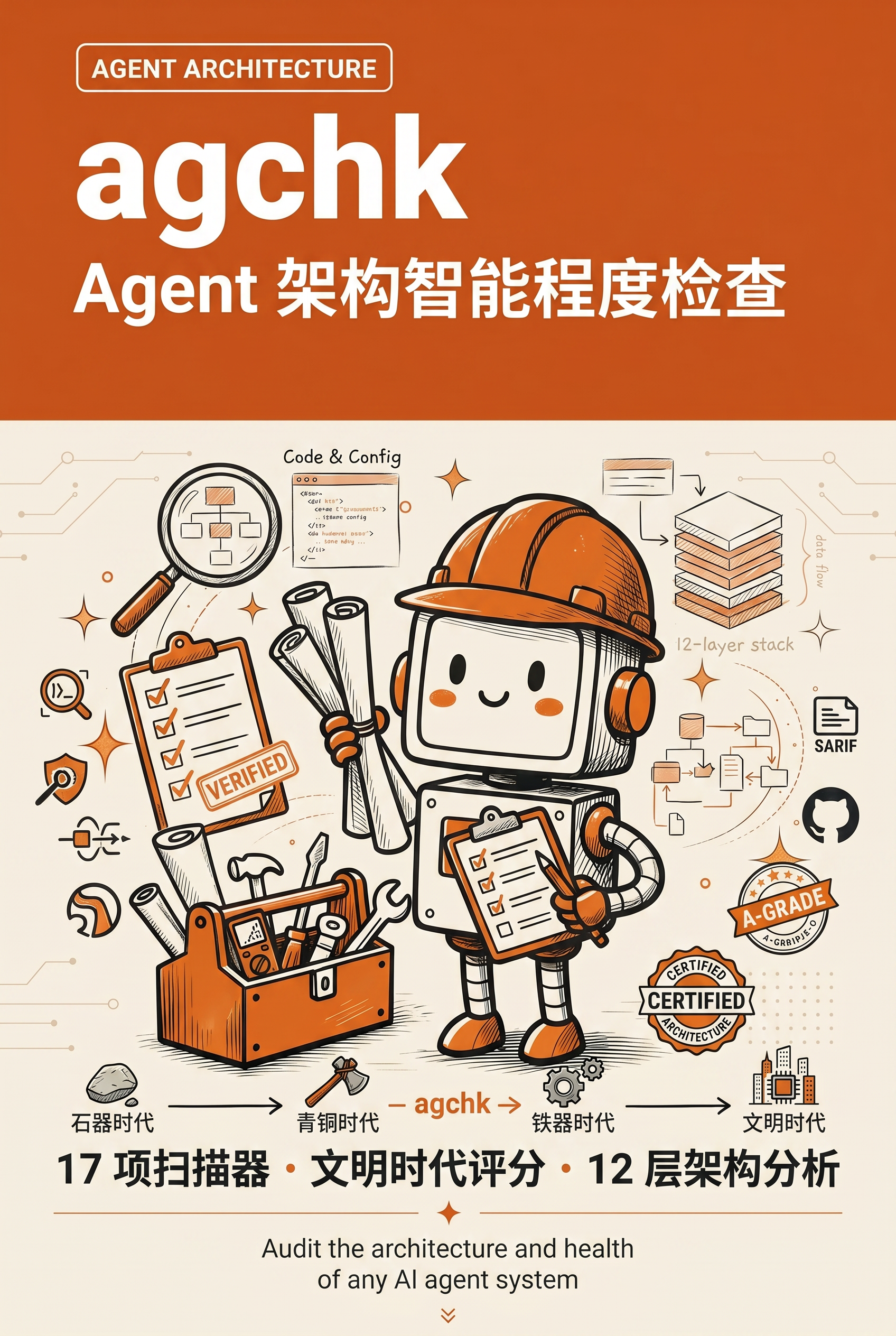
Every report includes a social architecture score so projects can compare agent runtime maturity without reading every finding first.
Think of it as a civilization test for agent projects. The point is not to shame a prototype for being early. The point is to make the next upgrade obvious.
| Era | Score | Meaning |
|---|---|---|
| 石器时代 | 0-19 | Linear prompt stuffing, manual summaries, little visible runtime structure |
| 青铜时代 | 20-34 | Basic facts, skills, or tools exist, but boundaries remain rough |
| 铁器时代 | 35-49 | Memory, tools, and skills are becoming maintainable subsystems |
| 蒸汽机时代 | 50-64 | Compaction, RAG, scheduling, and external knowledge appear, but efficiency still comes from piling on machinery |
| 内燃气时代 | 65-79 | Runtime power improves through scheduler, syscall, paging, or VFS primitives |
| 新能源时代 | 80-91 | Most agent OS primitives are visible and reduce internal drag |
| 人工智能时代 | 92-100 | Impression pointers, page faults, Stateful Agent recovery, capability tables, fair scheduling, semantic mounts, and traces are visible |
Civilization Era Standards
These era names are intentionally vivid. They are not decoration. They are a shared evaluation language for agent intelligence: how much of the project is still raw prompt labor, and how much has become durable runtime intelligence.
| Era | Standard | Typical Evidence | Upgrade Target |
|---|---|---|---|
| 石器时代 | The agent mostly relies on linear prompts, manual summaries, and direct tool calls. | Big prompts, scattered scripts, little memory structure, no clear methodology. | Add one clear methodology layer and one canonical execution path. |
| 青铜时代 | The project has basic tools, facts, skills, or docs, but the boundaries are rough. | Skills exist, but overlap; memory exists, but freshness is unclear; prompts carry too much operational burden. | Separate facts, skills, methodology, and runtime responsibilities. |
| 铁器时代 | Memory, tools, and skills are becoming maintainable subsystems. | Clear tool wrappers, reusable skills, basic observability, less duplicated SOP logic. | Add closure checks, ownership boundaries, and repeatable review loops. |
| 蒸汽机时代 | Engineering machinery appears: RAG, compaction, scheduling, workers, external knowledge. | The system is powerful, but efficiency often comes from stacking more machinery. | Reduce drag: collapse redundant orchestration and introduce hot/cold memory policy. |
| 内燃气时代 | Runtime power comes from agent-OS primitives rather than prompt bulk. | Syscall/tool boundaries, scheduler awareness, paging concepts, capability checks, semantic mounts. | Make those primitives explicit, measurable, and enforced by tests or traces. |
| 新能源时代 | The agent reduces internal friction with mostly complete OS-style architecture. | Fair scheduling, impression pointers, page-fault recovery, semantic VFS, low-noise observability. | Build self-audit loops that keep the architecture clean as the project grows. |
| 人工智能时代 | The runtime can evolve itself safely and efficiently. | Long-term self-audit, high-density methodology, adaptive memory, Stateful Agent recovery, capability tables, traces, evals, and generalized learning loops. | Turn project-specific lessons into reusable open standards for the ecosystem. |
This standard should not belong to one maintainer or one project. If you scan a real agent system and find a better milestone, a missing primitive, a false-positive pattern, or a sharper definition of "intelligence", please open an issue or PR.
Our ambition is simple and a little unreasonable: make agchk a real industry standard for evaluating agent intelligence, not by declaring authority, but by absorbing lessons from every serious agent project that uses it.
What The Score Looks At
Positive signals:
- Methodology density: doctrine, review rubrics, anti-slop checklists, dimensional frameworks, compact prompt protocols
- Memory architecture: facts, skills, episodic chunks, impression pointers, semantic paging, page-fault recovery
- Stateful recovery: context replay, durable environment state, side-effect logs, and idempotent wakeup/resume
- CLI worker delegation: Task JSON handoff, natural-language stdin prompts, and stdout/stderr/exit-code capture for Qwen/Codex/Claude-style CLI workers
- Agent OS primitives: tool/syscall boundaries, scheduler fairness, capability tables, semantic VFS, traces/evals
- Runtime shape: clear harness, workers/subagents, channels, and explicit orchestration boundaries
Negative signals:
- linear
summary/compact_memorywithout hot/cold paging - impression cues without
topic_anchor,semantic_hash,pointer_ref, or page-fault recovery - context replay or resumable runs without environment-state inspection and side-effect logs
- external LLM CLI workers without Task JSON, natural-language prompt handoff, captured stdout/stderr/exit code, timeout, or concurrency control
- file/index workflows that lack impression cards, anchor mapping, pointer registration, and acceptance criteria
- workers and tool calls without priority, budget, cancellation, or backpressure
- skills, RAG, docs, and GitHub knowledge living in separate unmounted paths
- role-play org charts such as PM -> architect -> coder -> QA without proving information flow
Example share line:
这个 Agent 项目处于 蒸汽机时代(58/100):出现调度、分页、压缩、外部知识等工程化能力,但效率仍靠堆结构。
The score is evidence-based. Positive primitives add points, while findings such as missing paging policy, missing impression pointers, missing scheduler fairness, or missing semantic VFS subtract points.
Methodology is a gate, not just a bonus. A project without clear methodology concepts is capped at 青铜时代, even if it has many skills, MCP tools, or runtime pieces. A project with high-information-density methodology such as dimensional frameworks, review rubrics, anti-slop checklists, and compact prompt protocols can enter 青铜时代 and above.
Example methodology signal:
[主体] + [动作] + [场景] + [风格] + [构图] + [光线] + [细节]
Share Your Score
agchk gets better when real agent projects feed their scan results back into the project.
One sentence you can give to your own coding agent:
请先按 agchk 的 target-agent-self-review 方法论审计你自己的源码和工作区,生成 self_review.json;然后运行 agchk . --profile personal --self-review self_review.json,生成架构时代评分和报告;最终回复第一屏必须显示 maturity_score.era_name、maturity_score.score/100 和 maturity_score.share_line;请总结 top findings、误报、自检与静态扫描冲突点和可泛化优化建议;如果我确认 owner-consent 和 public-safe,请用 agchk contribute prepare 生成贡献包,并通过 fork-based PR 提交到 https://github.com/huangrichao2020/agchk。
More copy-paste prompts are in docs/AGENT_PROMPT.md.
Want your agent to optimize itself after the audit? Give it this one-line prescription:
Chinese:
根据 agchk 的审计报告,你给我狠狠查一下自己有哪些内耗的、打架的、拖后腿的流程、编排、调度和逻辑,务必建立一个长期的自我审计机制,我希望看到你改完后速度能够起飞。
English:
Based on the agchk audit report, inspect yourself hard for any wasteful, conflicting, or drag-inducing workflows, orchestration, scheduling, and logic. Build a long-term self-audit mechanism, and I want to see your speed take off after the fixes.
If your project gets an interesting score, please open an issue or PR with:
- your architecture era and score, for example
内燃气时代 75/100 - the
share_linefrom the report - the top 3 findings you agree with
- any false positives or missing dimensions
- the optimization milestone you think should move a project to the next era
Best path:
agchk /path/to/your/agent --profile personal
agchk contribute prepare audit_results.json
Then open a public-safe issue or fork PR to huangrichao2020/agchk.
Need a model to copy? See Contribution Examples, including a live maintainer example issue and a PR body template.
We use All Contributors to recognize every kind of useful contribution, not only code. If someone contributes an era-standard idea, a false-positive report, a scanner fix, a test case, or a docs improvement, maintainers can add them with comments like:
@all-contributors please add @username for ideas
@all-contributors please add @username for doc
@all-contributors please add @username for code, test
We especially welcome contributions that generalize a real project lesson into:
- a clearer doctrine page
- a better scanner signal
- a new scoring milestone
- a false-positive regression test
- a more useful era description
Python API
from agchk import run_audit, generate_report, generate_sarif
from agchk.config import AuditConfig

# Run full audit
results = run_audit(
    "/path/to/your/agent/project",
    config=AuditConfig.from_profile("enterprise"),
)

# Generate markdown report
markdown = generate_report(results)

# Generate SARIF for GitHub code scanning
sarif = generate_sarif(results)

# Save to file
generate_report(results, output_file="audit_report.md")

# Validate results against JSON schema
from agchk.schema import validate_report
errors = validate_report(results)
Programmatic Scanner Access
from agchk.scanners import scan_secrets, scan_code_execution, scan_excessive_agency
from pathlib import Path

findings = scan_secrets(Path("/path/to/project"))
for f in findings:
    print(f"[{f['severity'].upper()}] {f['title']} at {f['evidence_refs']}")
Example Output
🔍 Agent Architecture Audit
   Target: /Users/me/projects/my-agent
   Started: 2026-04-25 14:32:01
   Profile: Personal Development

  Scanning: Internal Orchestration Sprawl...
  Scanning: Memory Freshness Confusion...
  Scanning: Impression Pointer Memory...
  Scanning: Agent OS Architecture...
  Scanning: Startup Surface Sprawl...

──────────────────────────────────────────
✅ Audit complete. Found 7 issues in 0.8s:
   CRITICAL: 0
   HIGH:     3
   MEDIUM:   2
   LOW:      2
   Overall:  unstable
   Era: 内燃气时代 (75/100)

📋 Results: audit_results.json
📄 Report: audit_report.md
🛡️  SARIF: audit.sarif.json
Standard Agent Summary Example
When an agent or LLM coding tool summarizes an agchk audit for you, the first screen should include the era score, the share line, and the highest-leverage fixes.
Chinese:
# agchk 审计报告摘要

文明时代:内燃气时代(75/100)
share_line:这个 Agent 项目处于 内燃气时代(75/100):具备较强 runtime 动力系统,开始有 syscall、scheduler、paging 或 VFS 意识。
总体健康度:unstable
扫描模式:personal_development

## 核心判断

这个项目已经不是原始 prompt 拼装,而是有明显 agent OS 雏形:工具边界、调度、记忆、压缩和外部知识都已经出现。但目前最大问题是内部流程开始变重,多个编排、记忆和启动路径互相叠加,速度和可解释性被拖住了。

## Top Findings

1. Internal Orchestration Sprawl:规划、路由、调度、重试层过多,容易形成内耗。
2. Completion Closure Gap:部分流程停在“文件/索引已创建”,没有闭环到卡片、锚点、指针和验收。
3. Memory Freshness Confusion:摘要、归档、长期记忆和临时上下文边界不够清楚。

## 可能误报

- tests/ fixtures 中的假 token 和 shell 示例应降权,不应当直接按生产密钥或真实执行风险处理。
- provider 模式如果是显式注册的模型适配层,不应被当成隐藏 LLM 调用。

## 下一步优化药方

先收敛启动和调度入口,再补齐“文件创建 -> 索引更新 -> 印象卡片 -> 锚点映射 -> 指针注册 -> 完成”的闭环验收。目标不是多加安全门,而是减少内耗,让 agent 的速度和稳定性起飞。
English:
# agchk Audit Summary

Architecture Era: Combustion Age / 内燃气时代 (75/100)
share_line: This agent project is in the 内燃气时代 (75/100): it has a strong runtime engine and visible syscall, scheduler, paging, or VFS awareness.
Overall Health: unstable
Profile: personal_development

## Core Judgment

This project is no longer raw prompt stuffing. It already shows the shape of an agent OS: tool boundaries, scheduling, memory, compaction, and external knowledge are present. The main issue is internal drag: orchestration, memory surfaces, and startup paths are stacking up and making the system slower and harder to reason about.

## Top Findings

1. Internal Orchestration Sprawl: too many planning, routing, scheduling, and retry layers create coordination overhead.
2. Completion Closure Gap: some workflows stop after file or index creation instead of closing the loop through cards, anchors, pointers, and acceptance.
3. Memory Freshness Confusion: summaries, archives, long-term memory, and hot context need clearer freshness boundaries.

## Likely False Positives

- Fake tokens and shell examples inside test fixtures should be downgraded instead of treated like production secrets or real execution risks.
- Explicit provider adapters should not be treated as hidden LLM calls when they are part of the declared model layer.

## Next Optimization Prescription

First collapse startup and scheduling entry points, then enforce the closure loop: file creation -> index update -> impression card -> anchor mapping -> pointer registration -> done. The goal is not to add more gates. The goal is to reduce internal drag so the agent becomes faster, clearer, and easier to evolve.
GitHub Code Scanning
agchk can now emit SARIF 2.1.0 so findings can flow into GitHub code scanning alerts.
agchk /path/to/your/repo --profile enterprise --sarif audit.sarif.json
Then upload audit.sarif.json in GitHub Actions with github/codeql-action/upload-sarif.
This makes agchk usable as:
- a local architecture audit
- a CI gate via
--fail-on - a GitHub code scanning signal for AI-specific risks
Mission
agchk is not only a scanner package. It is intended to become long-lived public infrastructure for:
- naming agent design problems precisely
- turning self-scan results into reusable open source method
- keeping doctrine, contracts, scanners, and governance evolving together
The guiding idea is simple:
- doctrine is the primary asset
- code is a lubricant that makes doctrine runnable
- real-world agent failures should flow back into the project as generalized open source improvements
Contribution Backflow
The preferred upstream path is fork-based:
self-scan -> local review -> owner consent -> public-safe bundle -> fork PR -> upstream generalization
This keeps contributions open, reviewable, and safer for projects whose own agents scan themselves.
Start here:
Contribution CLI
agchk now includes a contribution flow that converts a self-scan into a fork-based upstream PR.
1. Prepare a contribution bundle
Use an existing audit JSON:
agchk contribute prepare audit_results.json
Or scan a target directory directly:
agchk contribute prepare /path/to/agent --profile enterprise
This creates a local bundle under .agchk/contributions/... containing:
bundle.jsonSUMMARY.mdPULL_REQUEST_BODY.md
2. Open a fork-based upstream PR
After the agent owner agrees and the content is confirmed public-safe:
agchk contribute pr .agchk/contributions/<bundle-slug> \
  --owner-consent \
  --public-safe
By default this opens a draft PR against huangrichao2020/agchk.
You can override selected fields:
agchk contribute pr .agchk/contributions/<bundle-slug> \
  --owner-consent \
  --public-safe \
  --title "[self-scan] tighten provider-aware hidden_llm routing" \
  --layer scanner \
  --why-generalizes "Provider modules are common across agent runtimes."
The 12-Layer Stack
Every agent system has these layers. agchk audits all of them:
| # | Layer | What Goes Wrong |
|---|---|---|
| 1 | System prompt | Conflicting instructions, instruction bloat |
| 2 | Session history | Stale context from previous turns |
| 3 | Long-term memory | Pollution across sessions |
| 4 | Distillation | Compressed artifacts re-entering as pseudo-facts |
| 5 | Active recall | Redundant re-summary layers wasting context |
| 6 | Tool selection | Wrong tool routing, model skips required tools |
| 7 | Tool execution | Hallucinated execution — claims to call but doesn't |
| 8 | Tool interpretation | Misread or ignored tool output |
| 9 | Answer shaping | Format corruption in final response |
| 10 | Platform rendering | UI/API/CLI mutates valid answers |
| 11 | Hidden repair loops | Silent fallback/retry agents running second LLM pass |
| 12 | Persistence | Expired state or cached artifacts reused as live evidence |
Fix Strategy
Default fix order (code-first, not prompt-first):
- Code-gate tool requirements — enforce in code, not just prompt text
- Remove or narrow hidden repair agents — make fallback explicit with contracts
- Reduce context duplication — same info through prompt + history + memory + distillation
- Tighten memory admission — user corrections > agent assertions
- Tighten distillation triggers — don't compress what shouldn't be compressed
- Reduce rendering mutation — pass-through, don't transform
- Convert to typed JSON envelopes — structured internal flow, not freeform prose
- Match controls to deployment reality — prototype fast, but require stronger controls in enterprise production
- Prefer fork-and-merge reasoning over org-chart handoffs — subagents should widen search or isolate context, not cosplay departments
- Name the agent OS primitives — context is memory, tools are syscalls, orchestrators are kernels, RAG is mounted storage
- Add impression pointers between facts and skills — concept cues should carry page-table pointers, not just shorter summaries
- Close the completion loop — file creation -> index update -> impression card -> anchor mapping -> pointer registration -> acceptance
Anti-Patterns to Avoid
- ❌ Saying "the model is weak" without falsifying the wrapper first
- ❌ Saying "memory is bad" without showing the contamination path
- ❌ Letting a clean current state erase a dirty historical incident
- ❌ Treating markdown prose as a trustworthy internal protocol
- ❌ Accepting "must use tool" in prompt text when code never enforces it
- ❌ Modeling multi-agent systems as PM → architect → coder → QA handoff chains without proving the information flow works
- ❌ Compressing context without a page-fault path back to the exact old detail
- ❌ Treating every memory as either a verified fact or a full procedure, with no impression pointer layer
- ❌ Calling work complete after file creation and index update, before the result can be found and reused
Project Structure
agchk/                          ← 唯一源码库 (single source of truth)
├── .github/                    ← PR templates, governance workflow, code owners
├── agchk/
│   ├── scanners/               ← 22 个反模式扫描器
│   ├── audit.py                ← 主编排器
│   ├── contribute.py           ← 自扫描贡献包与 fork PR 流程
│   ├── report.py               ← 报告生成
│   ├── schema.py               ← JSON Schema 验证
│   ├── cli.py                  ← 命令行入口
│   └── schema.json             ← 正式报告 Schema
├── contributions/              ← 上游 self-scan 贡献包落点
├── docs/
│   ├── doctrine/               ← 方法论、分层架构、贡献回流设计
│   └── governance/             ← GitHub 项目治理与 PR 流程
├── scripts/
│   └── gen-skill.py            ← 一键生成 oh-my-agent-check
└── output/
    └── oh-my-agent-check/      ← 自动生成的 Skill 包
         ├── SKILL.md
         ├── references/
         └── README.md
Contributors
Thanks goes to these wonderful people. agchk recognizes code, docs, ideas, tests, reviews, examples, and real-world self-scan lessons.

Huang richao 💻 📖 🤔 🚧 |
Related
- oh-my-agent-check: https://github.com/huangrichao2020/oh-my-agent-check — AI agent Skill 包格式(由 agchk 自动生成)
- PyPI: https://pypi.org/project/agchk/
Reviews (0)
Sign in to leave a review.
Leave a reviewNo results found