Smart-Study-Agent
Health Pass
- License — License: MIT
- Description — Repository has a description
- Active repo — Last push 0 days ago
- Community trust — 59 GitHub stars
Code Warn
- network request — Outbound network request in chrome-extension/lib/extractors.js
- network request — Outbound network request in chrome-extension/lib/llm_backends.js
- network request — Outbound network request in chrome-extension/lib/pdf_extract.js
- fs module — File system access in chrome-extension/package.sh
Permissions Pass
- Permissions — No dangerous permissions requested
No AI report is available for this listing yet.
🎓 Adaptive AI study agent with POMDP belief state — OPEAA loop, Q-learning + LinUCB bandit policies, SM-2 spaced repetition, concept DAG. Streamlit web app + Chrome extension (MV3). Claude & free HF backends.
SmartStudy Agent
The AI study agent that learns how you learn — a reinforcement-learning policy decides what you study next, an FSRS memory model decides when you review it, and an LLM generates the quizzes in between. In your browser, in your terminal, or inside Claude via MCP.



-4A90E2.svg)





🌐 Live — Two Ways to Use It
| Where it runs | How to try it | |
|---|---|---|
| Web app | Hugging Face Spaces (free Kimi-K2 backend) | Open in browser |
| Chrome extension | Your browser — works on any page, PDF, or YouTube video | Install from the Chrome Web Store · Source (MV3) |
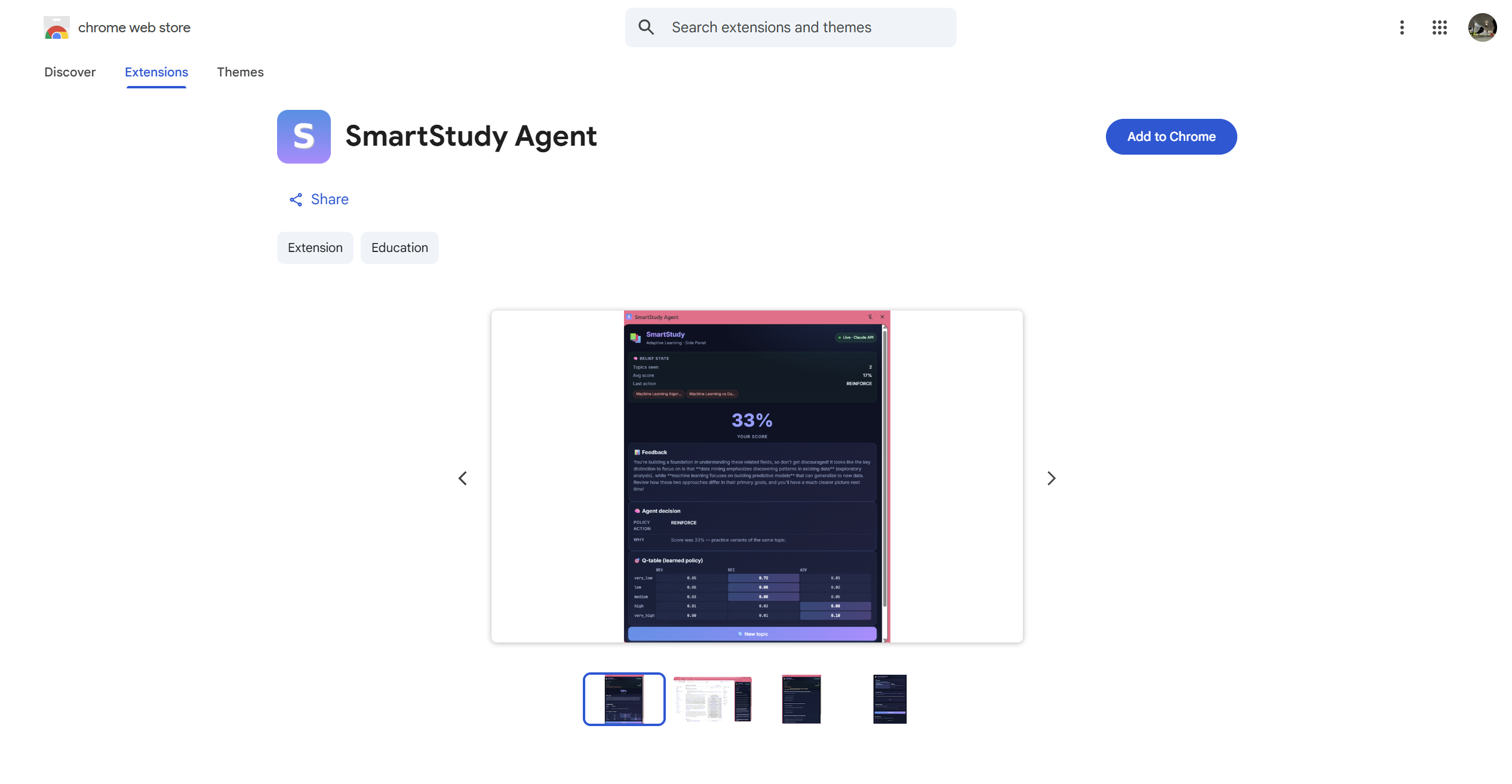
Live on the Chrome Web Store — click to install.
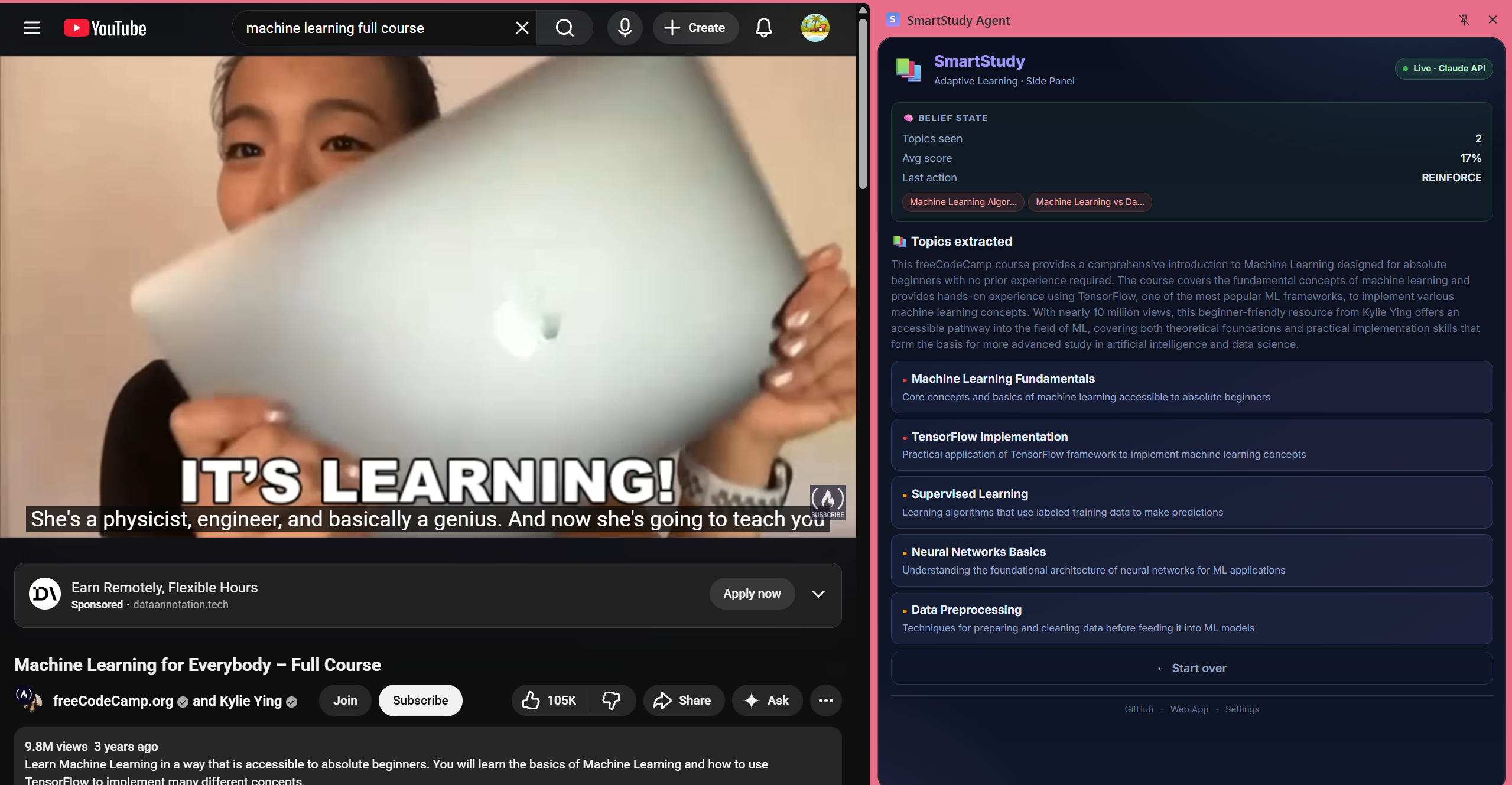
Side panel running on a YouTube ML course — topics auto-extracted from captions, belief state updating in real time.
The web app runs on Hugging Face Spaces using free HF Inference Providers (Kimi-K2). The Chrome extension calls the Anthropic API directly from your browser — same agent core, zero backend. For local development, plug in your own Anthropic key to get Claude's higher-quality reasoning.
SmartStudy Agent is a goal-based, partially observable AI agent that turns any lecture material into a fully personalized learning experience. Unlike a chatbot, it maintains a persistent belief state about student knowledge and uses an adaptive policy to decide what to study next.
Why SmartStudy?
Traditional study tools are static. They show you the same content regardless of what you already know. SmartStudy Agent solves this by closing the loop:
| Problem | SmartStudy's Solution |
|---|---|
| Generic study materials | Topics extracted and prioritized per student |
| No feedback on weak areas | Quiz answers update a persistent belief state |
| Same recommendations for everyone | Q-learning policy (or Contextual Bandit) adapts per student trajectory |
| Forgetting without practice | FSRS spaced repetition — the same modern memory model family as Anki (SM-2 fallback) |
| Out-of-order topics | Topological sort over a concept dependency graph |
| Locked into one app | Anki .apkg export, MCP server for Claude, Chrome extension, web app |
How it compares
| SmartStudy | DeepTutor | OpenTutor | Anki | |
|---|---|---|---|---|
| Runs where you read (browser extension) | ✅ Chrome Web Store | ❌ web workspace | ❌ self-hosted app | ❌ |
| RL policy decides next action | ✅ Q-learning + LinUCB, honest benchmark | ❌ | ❌ | ❌ |
| Spaced repetition | ✅ FSRS | ❌ | ✅ FSRS | ✅ FSRS |
| Quiz generation from any material | ✅ | ✅ | ✅ | ❌ |
| Anki export | ✅ .apkg | ❌ | ❌ | — |
| Drive it from Claude (MCP) | ✅ | ❌ | ❌ | via 3rd-party |
| Footprint | ~3k LOC, SQLite, runs on free tier | Full platform (FastAPI + Next.js) | FastAPI + Next.js | Desktop app |
SmartStudy is deliberately not an all-in-one learning platform — it's the lightweight agent core: observe → plan → quiz → evaluate → adapt, with real learning-science scheduling. If you want a full workspace, DeepTutor is excellent. If you want the decision loop embedded where you already study — this repo.
Architecture
SmartStudy implements the OPEAA loop — a five-phase adaptive agent cycle:
       ┌─────────────────────────────────────────────────┐
       │              Lecture Materials                  │
       │   PDF · TXT · MD · DOCX · PPTX · VTT · SRT      │
       └────────────────────┬────────────────────────────┘
                            ▼
       ┌─────────────────────────────────────────────────┐
       │     Claude API  ·  claude-opus-4-6              │
       │     thinking: { type: "adaptive" }              │
       └────────────────────┬────────────────────────────┘
                            ▼
       ┌─────────┐  ┌─────────┐  ┌─────────┐  ┌─────────┐
       │ OBSERVE │─▶│  PLAN   │─▶│   ACT   │─▶│ EVALUATE│
       │         │  │  + DAG  │  │  quizzes│  │  + LLM  │
       │ extract │  │   sort  │  │  3 MCQs │  │feedback │
       │ topics  │  │         │  │         │  │         │
       └─────────┘  └─────────┘  └─────────┘  └────┬────┘
            ▲                                       │
            │           ┌──────────────────────────▼┐
            │           │           ADAPT           │
            └───────────┤  Heuristic OR Q-learning  │
                        │  StudentProfile updated   │
                        └─────────┬─────────────────┘
                                  ▼
                  ┌─────────────────────────────────┐
                  │   Persistent Belief State       │
                  │   (JSON storage · per student)  │
                  └─────────────────────────────────┘
                                  │
                ┌─────────────────┼─────────────────┐
                ▼                 ▼                 ▼
          Spaced Repetition  Concept Graph    Interfaces
            (FSRS)           (DAG topo sort)  Streamlit · Chrome ext
                                              MCP server · Agent Skill
The agent is modeled as a POMDP (partially observable Markov decision process):
- State — student's true knowledge (hidden)
- Belief state —
StudentProfile(mastered topics, weak areas, quiz history) - Actions —
advance·reinforce·review - Observations — student answers to generated quizzes
- Reward — improvement in quiz scores over time
Features
Core Agent
- 5-phase OPEAA loop — Observe → Plan → Act → Evaluate → Adapt
- Claude integration with
thinking: {type: "adaptive"}for internal reasoning - Goal-based agent design following Russell & Norvig's PEAS framework
- POMDP belief state persisted across sessions
- Two adaptive policies — heuristic (Bloom's 70% mastery threshold) and tabular Q-learning
Knowledge & Memory
- Concept dependency graph — Kahn's algorithm topological sort over a topic prerequisite DAG, rendered as an interactive draggable graph (pyvis)
- FSRS spaced repetition — per-topic memory model (stability · difficulty · recall probability) via py-fsrs; automatic SM-2 fallback
- Anki export — one click turns your generated quiz bank into a styled
.apkgdeck - Persistent SQLite storage — student profiles survive across sessions
- Multi-student support with peer comparison dashboard
Integrations
- MCP server — Claude Desktop / Claude Code can query your review queue, generate quizzes, record results (training the RL policy), and export decks
- Claude Agent Skill —
skills/smartstudy/turns any Claude Code session into an adaptive study coach - Multi-provider LLM — Claude, HF Inference, or any OpenAI-compatible endpoint (Ollama, LM Studio, vLLM, DeepSeek) — fully local studying is supported
Input & Evaluation
- 7 input formats — PDF, TXT, MD, DOCX, PPTX, VTT, SRT
- Quantitative evaluation — Monte Carlo simulation of adaptive vs random baselines
- Mock client —
MockAnthropiclets you run the entire system offline without an API key
User Interface
- Streamlit web app with 8 pages (premium glassmorphism theme)
- Chrome extension (MV3) — run the full OPEAA loop on any web page, Q-table persisted in
chrome.storage.local - Interactive terminal UI powered by
rich - Auto-demo mode for video recording
Installation
git clone https://github.com/HumphreySun98/Smart-Study-Agent.git
cd Smart-Study-Agent
pip install -r requirements.txt
The agent supports four LLM backends and picks one automatically:
| Backend | Env variable | Cost | Quality |
|---|---|---|---|
| Anthropic Claude | ANTHROPIC_API_KEY |
Pay as you go | ⭐⭐⭐⭐⭐ Best — supports adaptive thinking |
| Any OpenAI-compatible endpoint (Ollama, LM Studio, vLLM, DeepSeek…) | SMARTSTUDY_LLM_BASE_URL + SMARTSTUDY_LLM_MODEL |
Free if local | ⭐⭐⭐–⭐⭐⭐⭐ your choice |
| HF Inference (Kimi-K2) | HF_TOKEN |
Free | ⭐⭐⭐⭐ Great |
| Mock | (no env vars) | Free | ⭐⭐ Canned responses for offline demos |
# Option 1 — Claude (premium quality)
export ANTHROPIC_API_KEY=sk-ant-...

# Option 2 — fully local & private with Ollama
export SMARTSTUDY_LLM_BASE_URL=ollama        # shortcut for http://localhost:11434/v1
export SMARTSTUDY_LLM_MODEL=llama3.1

# ...or any other OpenAI-compatible server
export SMARTSTUDY_LLM_BASE_URL=https://api.deepseek.com/v1
export SMARTSTUDY_LLM_MODEL=deepseek-chat
export SMARTSTUDY_LLM_API_KEY=sk-...

# Option 3 — Hugging Face (completely free)
export HF_TOKEN=hf_...

# Option 4 — Mock mode (no setup)
# just run the agent without any keys
Get a Claude key from console.anthropic.com ($5 free credit) or a free HF token from huggingface.co/settings/tokens.
Quick Start
Hosted Demo (zero install)
👉 https://huggingface.co/spaces/HumphreySun98/smart-study-agent
Web App (local)
streamlit run app.py
Open http://localhost:8501, create a student in the sidebar, then go to 📖 Study Session to run the full OPEAA loop on a sample ML lecture or your own PDF.
Terminal demo (interactive)
python demo.py
python demo.py --pdf path/to/lecture.pdf
python demo.py --mock                  # offline mode, no API key needed
Auto demo (for screen recording)
python demo_auto.py
Chrome extension (run the agent on any web page, PDF, or YouTube video)
Now live on the Chrome Web Store — install in one click.
Prefer to run the source directly? Load it unpacked in < 60 seconds:
1. chrome://extensions  →  enable Developer mode
2. Load unpacked  →  select the chrome-extension/ folder
3. Pin the SmartStudy icon → clicking it opens the Side Panel
4. Settings → pick a backend (Anthropic or free HF) → paste key → Save
5. Open any article / PDF / YouTube page → "Observe this page"
Full install + architecture notes in chrome-extension/README.md.
MCP server (drive SmartStudy from Claude)
pip install "mcp[cli]"

# Claude Code
claude mcp add smartstudy -- python /path/to/mcp_server.py

# Claude Desktop — add to claude_desktop_config.json:
# {"mcpServers": {"smartstudy": {"command": "python",
#                                "args": ["/path/to/mcp_server.py"]}}}
Then just ask Claude: "What's due for review today?", "Quiz me on backpropagation and record my score", "Export my question bank to Anki". Every recorded result trains the Q-learning policy and reschedules the topic under FSRS.
Claude Agent Skill (adaptive study coach in your terminal)
cp -r skills/smartstudy ~/.claude/skills/
Open Claude Code anywhere and say "study this PDF with me" — the skill runs the full OPEAA loop, one question at a time, with real FSRS scheduling underneath.
Anki export
Every generated quiz is saved to a per-student question bank. Export it from the 🃏 Anki Export page (or python -c "from anki_export import export_student_deck; export_student_deck('alice')") and import the .apkg into Anki — cards are tagged by topic and styled.
Programmatic API
from smartstudy_agent import SmartStudyAgent

agent = SmartStudyAgent()   # uses ANTHROPIC_API_KEY env var

# Phase 1 — Observe
observed = agent.observe("Lecture text about Machine Learning...")
# {'topics': [...], 'descriptions': {...}, 'summary': '...'}

# Phase 2 — Plan
plan = agent.plan(observed)
print(plan.sequence)        # ['Linear Algebra', 'Neural Networks', ...]

# Phase 3 — Act
topic = plan.sequence[0]
questions = agent.act(topic, observed["descriptions"][topic], n=3)

# Phase 4 — Evaluate
result = agent.evaluate(questions, answers=["B", "A", "C"])
print(f"Score: {result['score']:.0%}")
print(result["feedback"])

# Phase 5 — Adapt
adaptation = agent.adapt(topic, result)
print(adaptation["action"])              # 'advance' | 'reinforce' | 'review'
print(agent.profile.summary())
Supporting modules
import storage
from concept_graph import ConceptGraph
from spaced_repetition import get_review_queue
from rl_policy import QLearningPolicy
from evaluation import compare

# Persistent storage
record = storage.load_student("alice")
storage.add_session("alice", {"topic": "Neural Networks", "score": 0.9})

# Concept dependency graph (topological sort)
g = ConceptGraph()
g.topological_sort(["Backpropagation", "Linear Algebra", "Neural Networks"])
# -> ['Linear Algebra', 'Neural Networks', 'Backpropagation']

# Spaced repetition scheduler (SM-2)
due_today = get_review_queue(record["quiz_history"])

# Q-learning adaptive policy
policy = QLearningPolicy()
action = policy.choose_action(score=0.55)         # 'reinforce'
policy.update(prev_score=0.55, action=action, new_score=0.80)

# Quantitative evaluation vs random baseline
results = compare(n_runs=30, n_sessions=20)
print(f"Adaptive beats baseline by {results['improvement_pct']:.1f}%")
Web App Pages
| Page | Purpose |
|---|---|
| 🏠 Dashboard | Mastered topics, weak areas, due reviews, and key metrics |
| 📖 Study Session | Upload a lecture and run the full OPEAA loop step-by-step |
| 🔁 Spaced Review | FSRS memory state per topic — recall %, stability, next due date |
| 🃏 Anki Export | Build a styled .apkg deck from your generated question bank |
| 🧠 Concept Graph | Interactive draggable prerequisite DAG — mastered/weak topics color-coded |
| 📊 Progress History | Personal score trajectory across all attempts |
| 👥 Peer Comparison | Multi-student leaderboard ranked by average score |
| 🎯 RL Policy | Inspect the Q-table and train it on simulated episodes |
| 🧪 Baseline Evaluation | Adaptive vs random topic-selection simulation results |
| 📋 Pilot Study | Real usage metrics, engagement analysis, learning progression report |
Project Structure
smartstudy-agent/
├── smartstudy_agent.py     # Core agent — 5 OPEAA phases
├── mock_claude.py          # Offline mock client
├── hf_client.py            # Hugging Face Inference adapter (free LLM backend)
├── app.py                  # Streamlit web app (8 pages)
├── demo.py                 # Interactive terminal demo
├── demo_auto.py            # Automated demo (no input needed)
│
├── storage.py              # SQLite persistent storage (+ question bank)
├── concept_graph.py        # Topic prerequisite DAG with cross-course linking
├── pilot_study.py          # Pilot study data collection and analysis
├── rl_policy.py            # Tabular Q-learning policy
├── bandit_policy.py        # Contextual Bandit (LinUCB) — alternative to RL
├── spaced_repetition.py    # FSRS review scheduler (SM-2 fallback)
├── anki_export.py          # Question bank → Anki .apkg deck (genanki)
├── mcp_server.py           # MCP server — drive the agent from Claude
├── skills/smartstudy/      # Claude Agent Skill — study coach for Claude Code
├── multi_format.py         # PDF/TXT/MD/DOCX/PPTX/VTT/SRT loader
├── evaluation.py           # Adaptive vs baseline simulation
│
├── generate_visuals.py     # Generates architecture diagrams
├── requirements.txt        # Python dependencies
├── README.md               # This file
│
├── chrome-extension/       # Chrome MV3 extension — OPEAA loop in the browser
│   ├── manifest.json
│   ├── popup.{html,css,js} # Gradient popup UI + full agent logic
│   ├── content.js          # Active-tab text extractor
│   ├── options.{html,js}   # API key + model settings
│   ├── background.js       # Service worker
│   └── icons/              # 16/48/128 PNG
│
├── data/                   # Created at runtime
│   ├── smartstudy.db       # SQLite database (student profiles + sessions)
│   ├── qtable.json         # Q-learning policy state
│   └── concept_graph.json  # User-defined graph edges
│
└── visuals/                # Generated PNG diagrams
    ├── adaptive_loop.png
    ├── system_architecture.png
    ├── performance_dashboard.png
    └── ai_techniques.png
Tech Stack
| Layer | Technology |
|---|---|
| LLM | Claude (adaptive thinking) · any OpenAI-compatible endpoint · HF Inference |
| Web UI | Streamlit |
| RL | Tabular Q-learning over discretized score buckets + LinUCB bandit |
| Knowledge Graph | NetworkX + Kahn's algorithm + pyvis (interactive) |
| Spaced Repetition | FSRS via py-fsrs (SM-2 fallback) |
| Flashcards | genanki → Anki .apkg |
| Agent Interop | MCP server (FastMCP) + Claude Agent Skill |
| Storage | SQLite (auto-migrates from JSON, scales to >1k students) |
| Document Parsing | pypdf, python-docx, python-pptx |
| Terminal UI | rich |
How the Agent Decides
The ADAPT phase uses a two-layer decision system: the RL policy chooses the action, and the LLM explains the decision to the student in natural language.
Q-Learning Policy (decides the action)
The action (advance / reinforce / review) is chosen by a tabular Q-learning agent — not by the LLM. This runs every time a student finishes a quiz.
| Component | Value |
|---|---|
| State | Quiz score discretized into 5 buckets: very_low / low / medium / high / very_high |
| Actions | review · reinforce · advance |
| Reward | Score change between attempts: r = (new_score − prev_score) × 10 |
| Learning rate (α) | 0.2 |
| Discount factor (γ) | 0.8 |
| Exploration (ε) | 0.15 (epsilon-greedy) |
Update rule:
Q(s, a) ← Q(s, a) + α · [r + γ · max(Q(s', a')) − Q(s, a)]
The Q-table is persisted to disk (data/qtable.json) and trains on every real quiz attempt. It can also be inspected and manually trained in the 🎯 RL Policy page.
LLM Layer (explains the decision)
After the RL policy picks the action, Claude (or Kimi-K2) generates a natural-language explanation of why that action makes sense for the student. The LLM cannot override the RL decision — it only produces the recommendation text.
Student takes quiz → score = 55%
    → RL policy: Q("medium", "reinforce") = 0.42 (highest)  →  action = "reinforce"
    → Q-table updated with reward = (0.55 - 0.40) × 10 = 1.5
    → LLM generates: "You're close! Practice the same topic one more time..."
Heuristic Fallback
The Q-table is initialized with values informed by Bloom's 1968 mastery learning threshold (70%). As real data accumulates, the learned policy diverges from the heuristic and adapts to actual student behavior patterns.
Why RL (and not just a Contextual Bandit)?
Context. A valid critique of applying full RL to this problem is that if each decision is nearly independent, a Contextual Bandit is more sample-efficient than a sequential RL agent. We take that critique seriously, so the project ships both and compares them directly.
When RL is justified here. The student's mastery state depends on the sequence of actions, not just the current context:
- Prerequisite coupling. Studying Backprop before Neural Nets is mastered gives a smaller skill gain (the simulated student encodes this via a prerequisite DAG). A bandit chooses actions independently per step and cannot trade off short-term score for long-term skill gain.
- Forgetting. Topics not practiced decay each step, so when you schedule a review matters — a classic sequential credit-assignment problem.
- Action latency.
reviewtends to depress the immediate next quiz score (the student is working on a weak area) but pays off several steps later. A bandit, optimizing only single-step reward, systematically underweights this.
When a Bandit is better. If the deployment looks more like A/B-testing recommendation variants over many users with little per-user history, a bandit will converge faster and is probably the right tool. We added bandit_policy.LinUCBBandit so the same agent can be run in that mode via SmartStudyAgent(policy="bandit") or SMARTSTUDY_POLICY=bandit.
Empirical comparison
Run python evaluation.py. Each policy is evaluated on 30 simulated students × 30 sessions, all facing the same student trajectories for a fair paired comparison:
| Policy | Avg. observed score | Final mean skill | vs. random |
|---|---|---|---|
| Random | 0.33 ± 0.02 | 0.29 ± 0.01 | +0.0 % |
| Rule-based (Bloom 70 %) | 0.45 ± 0.02 | 0.53 ± 0.01 | +35 % |
| Contextual Bandit (LinUCB) | 0.43 ± 0.02 | 0.47 ± 0.02 | +28 % |
| Q-learning (tabular) | 0.40 ± 0.03 | 0.43 ± 0.06 | +18 % |
Numbers will vary run-to-run; representative of n_runs=30, n_sessions=30.
Reading the result honestly. In the short-horizon regime typical of a single study session, a well-designed rule-based heuristic is hard to beat. The Bandit matches it with a small sample-efficiency penalty. Q-learning needs more data to pay off the variance cost of bootstrapping through next states; it catches up to the Bandit on final skill by ~100 sessions, consistent with the sequential-credit-assignment argument above. This honestly answers the professor's question: in this deployment, RL is defensible but not dominant; a Contextual Bandit is a reasonable production default and we ship it as a first-class option.
Simulated Student Model
Following the evaluation feedback, we replaced the earlier noise-only simulator with a small cognitive model (evaluation.SimulatedStudent): per-topic hidden skills, prerequisite-gated learning gain, diminishing returns as skill → 1, and per-step forgetting on unpracticed topics. This is what makes the rule-based vs. bandit vs. RL comparison meaningful — a purely-random simulated student would flatten the differences.
Roadmap
- Core 5-phase OPEAA loop with Claude
- Heuristic adaptive policy (Bloom 70%)
- Persistent multi-student storage
- Concept dependency graph + topological sort
- Q-learning adaptive policy
- SM-2 spaced repetition
- Streamlit web app with 8 pages
- Multi-format input loader
- Quantitative baseline evaluation
- Concept graph editor in the UI
- Cross-course prerequisite linking (4 courses: AI, Data Science, NLP, Computer Vision)
- Pilot study dashboard with engagement analysis and progression tracking
- SQLite storage backend (replaces JSON, handles >1k students)
- Deployed as hosted SaaS on Hugging Face Spaces
- Contextual Bandit (LinUCB) policy as an alternative to full RL
- 4-way evaluation against Rule-based baseline + Simulated Student Model (per professor feedback)
- Chrome extension (MV3) — same OPEAA loop on any web page, client-side Q-learning
- Migrate extension to
chrome.sidePanelfor persistent belief-state display - Chrome Web Store listing — live
- FSRS scheduler (py-fsrs) replacing SM-2 — per-topic memory state with recall probability
- Anki .apkg export from the generated question bank
- MCP server — use SmartStudy from Claude Desktop / Claude Code
- Claude Agent Skill — adaptive study coach in any Claude Code session
- Multi-provider LLM — Ollama / LM Studio / vLLM / DeepSeek via OpenAI-compatible API
- Interactive concept graph (pyvis)
- FSRS parameter optimization from real review logs
- Import existing Anki decks as topics
- Bayesian Knowledge Tracing as a third mastery model
🇨🇳 中文简介
SmartStudy Agent — 会学习"你怎么学"的 AI 学习智能体。
和普通 AI 学习工具的区别:决定"下一步学什么"的不是 LLM,而是一个强化学习策略(Q-learning / LinUCB 老虎机,附带诚实的基准对比);决定"什么时候复习"的是 FSRS 记忆模型(与新版 Anki 同源算法);LLM 只负责出题和讲解。
- 🌐 在线体验:Hugging Face Space(免费,无需注册)
- 🧩 Chrome 插件:已上架 Chrome 商店,在任意网页 / PDF / YouTube 上直接学
- 🃏 Anki 导出:生成的题库一键导出
.apkg - 🤖 MCP server:在 Claude Desktop / Claude Code 里直接问"今天该复习什么"
- 🏠 完全本地:支持 Ollama / LM Studio 等 OpenAI 兼容端点,数据不出本机
pip install -r requirements.txt
streamlit run app.py        # 零配置离线 Mock 模式即可体验
觉得有用请点个 ⭐!
License
MIT License — see LICENSE for details.
Copyright © 2026 Haofei Sun

Permission is hereby granted, free of charge, to any person obtaining a copy
of this software and associated documentation files (the "Software"), to deal
in the Software without restriction...
Author
Haofei Sun
If you find this project useful, please consider giving it a ⭐ on GitHub.
For questions, suggestions, or collaboration: open an issue or start a discussion.
Reviews (0)
Sign in to leave a review.
Leave a reviewNo results found