Low-Poly-Modeling-Skill
Health Warn
- License — License: MIT
- Description — Repository has a description
- Active repo — Last push 0 days ago
- Low visibility — Only 5 GitHub stars
Code Fail
- exec() — Shell command execution in examples/minimal_character.py
- exec() — Shell command execution in tests/smoke_weld.py
- exec() — Shell command execution in tests/test_measure_stub.py
Permissions Pass
- Permissions — No dangerous permissions requested
No AI report is available for this listing yet.
As it says, a low-poly modeling skill for AI agents, Mostly in PS1/PSX style.
Low-Poly-Modeling-Skill
A skill for AI coding agents that model PS1/PSX-style low-poly assets in Blender.
Not a modeling tutorial. It is the working method that converges fast: block with lofts,
judge in clay, correct numbers instead of vertices, weld the joints into one surface, and
verify with the same gate every time. It also carries the list of failure modes that cost
the most round trips, so the next attempt doesn't rediscover them.
The body doctrine is one welded surface: limbs grow out of the torso through cut
sockets and shared rings, not pushed into it and hidden under a garment. Butted shells are
a blockout stage, not a result — they show a seam in close-up and tear when rigged.
Built from a study of three real PS1-era reference models and one finished character.
What's here
| file | what it is |
|---|---|
SKILL.md |
the skill: conventions, API, welding doctrine, workflow, traps, review gate |
scripts/psx_build.py |
the library — superellipse rings, lofts, bridge() seam stitching, extrude() welded digits, mirroring, finish, geometry gate |
scripts/preview.py |
ortho clay renders; shots derived from the object's bounding box |
scripts/compare.py |
stats table + side-by-side render against reference models |
scripts/measure_silhouette.py |
width-at-height scan of a reference image |
examples/minimal_character.py |
~60 line end-to-end blockout |
tests/smoke_weld.py |
exercises bridge() + extrude() and asserts 0 boundary edges (run inside Blender) |
tests/test_measure_stub.py |
runs the measuring tool against a synthetic image, no Blender needed |
Install
Copy or link this folder into your agent's skills directory so that SKILL.md sits at its
root:
~/.config/opencode/skills/ps1-modeling/     # OpenCode
~/.claude/skills/ps1-modeling/              # Claude Code
On Windows a junction is enough and keeps one copy:
cmd /c mklink /J "%USERPROFILE%\.config\opencode\skills\ps1-modeling" "F:\path\to\Low-Poly-Modeling-Skill"
Use
The scripts run inside Blender (they need bpy). From the repo root:
import sys; sys.path.insert(0, "scripts")

exec(open("examples/minimal_character.py").read())   # build
exec(open("scripts/preview.py").read())              # render clay views
exec(open("scripts/compare.py").read())              # after setting REFS
Each harness has its config at the top: OBJECT, OUT, and for compare.py a REFS list
of reference models to scale and line up against the build.
What it produces
Renders taken during development of the character this skill was written on — all clay,
all straight out of preview.py, no retouching. That is the point: a build is judged on
silhouette and where the surfaces meet, not on surface detail.
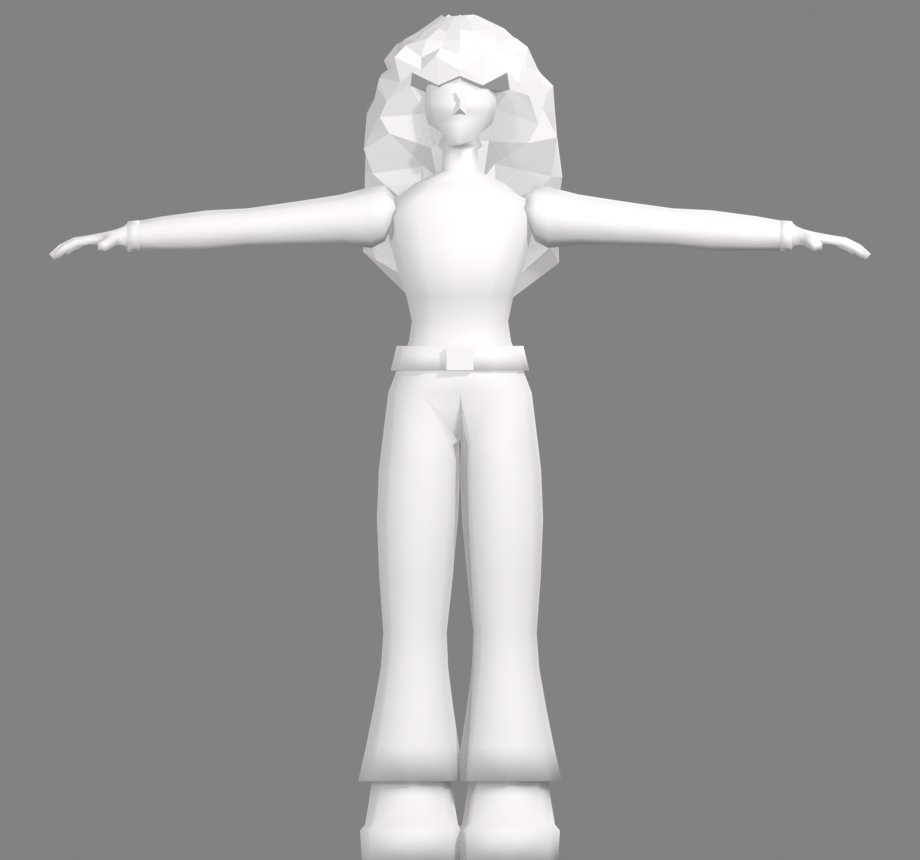 |
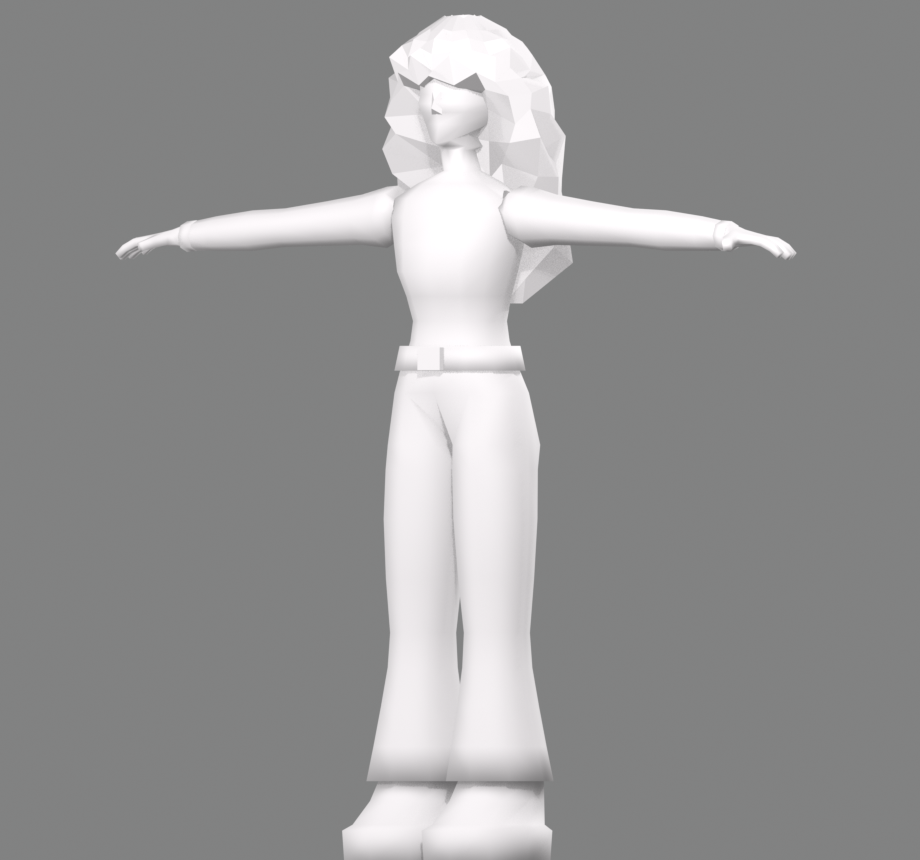 |
| Front, 1.72 m, T-pose, 1127 v / 2228 tris | Three-quarter view |
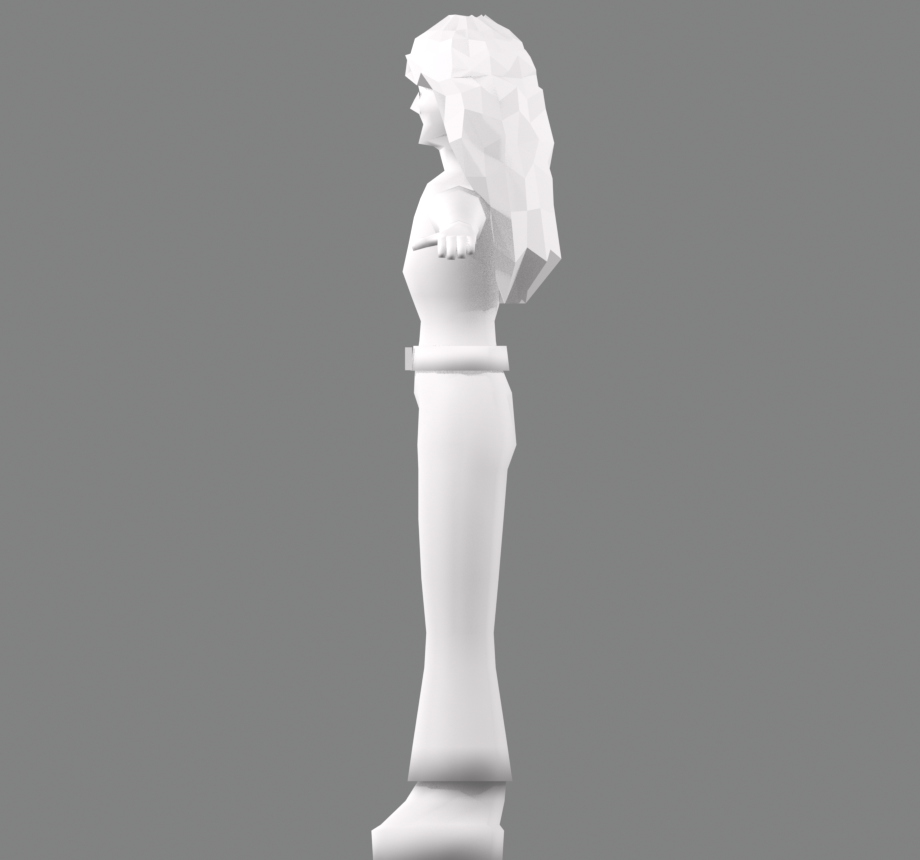 |
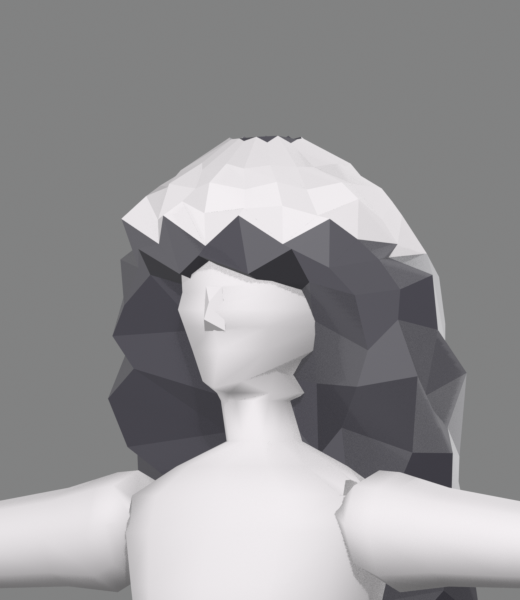 |
| Profile — silhouette and hair mass | Head: smooth skull, faceted mane, stitched neck |
 |
|
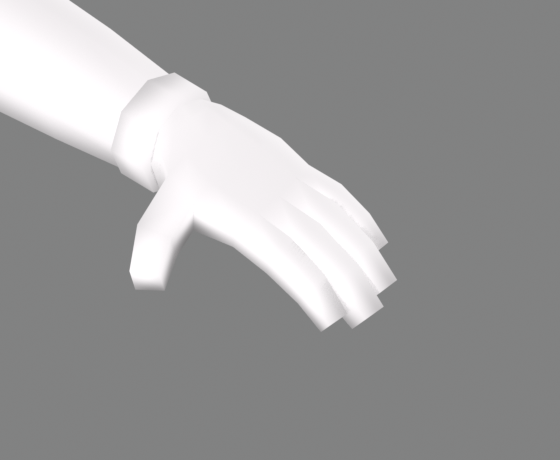
| Welded hand: 4 fingers of 3 segments extruded off the knuckle ring, thumb out of the palm's own wall quad |
Future plans
- Geometry correction — tighten the remaining stitch seams (shoulder cap, crotch
triangles) and give the face modelled eye sockets so painted features have something to
sit in. - Animating — a skeleton on the welded surface: shoulders, hips and wrists now share
edges with the torso, which is what makes that possible without tearing. - Texturing — one 256²/512² atlas: painted face, dark inner-hair region so the mane's
facets read as depth, and the clothes as paint over the same mesh. - UV map correction — replace the
smart_projectplaceholder with a real layout: one
island per stitched band, no overlapping shells, seams placed where the texture hides
them.
The conventions it enforces
+Z up · character faces −Y · feet on Z=0 · metres · one object · one material · one
256²–512² atlas · smooth-shaded body with faceted hair · no normal maps, PBR or shape keys ·
one welded surface — no coincident vertices, no boundary edges on the body, no
non-manifold edges, no n-gons · 600–1600 tris for a bare body, more once hair and
accessories are added.
License
MIT — see LICENSE.
Reviews (0)
Sign in to leave a review.
Leave a reviewNo results found