sdlc-foundry
Health Warn
- License — License: Apache-2.0
- Description — Repository has a description
- Active repo — Last push 0 days ago
- Low visibility — Only 6 GitHub stars
Code Fail
- rm -rf — Recursive force deletion command in .github/workflows/ci.yml
Permissions Pass
- Permissions — No dangerous permissions requested
No AI report is available for this listing yet.
An agentic SDLC platform: Claude Code agents, slash commands and Copier templates from idea to Kubernetes (GitOps, secrets, Postgres, OpenTelemetry, Kyverno).

sdlc-foundry
From a new repo to Kubernetes, declared once.
Claude Code agents, slash commands and Copier templates that take a system from idea to "running in Kubernetes via GitOps".




Documentation · Quickstart · User journey · How it works · Commands · Changelog
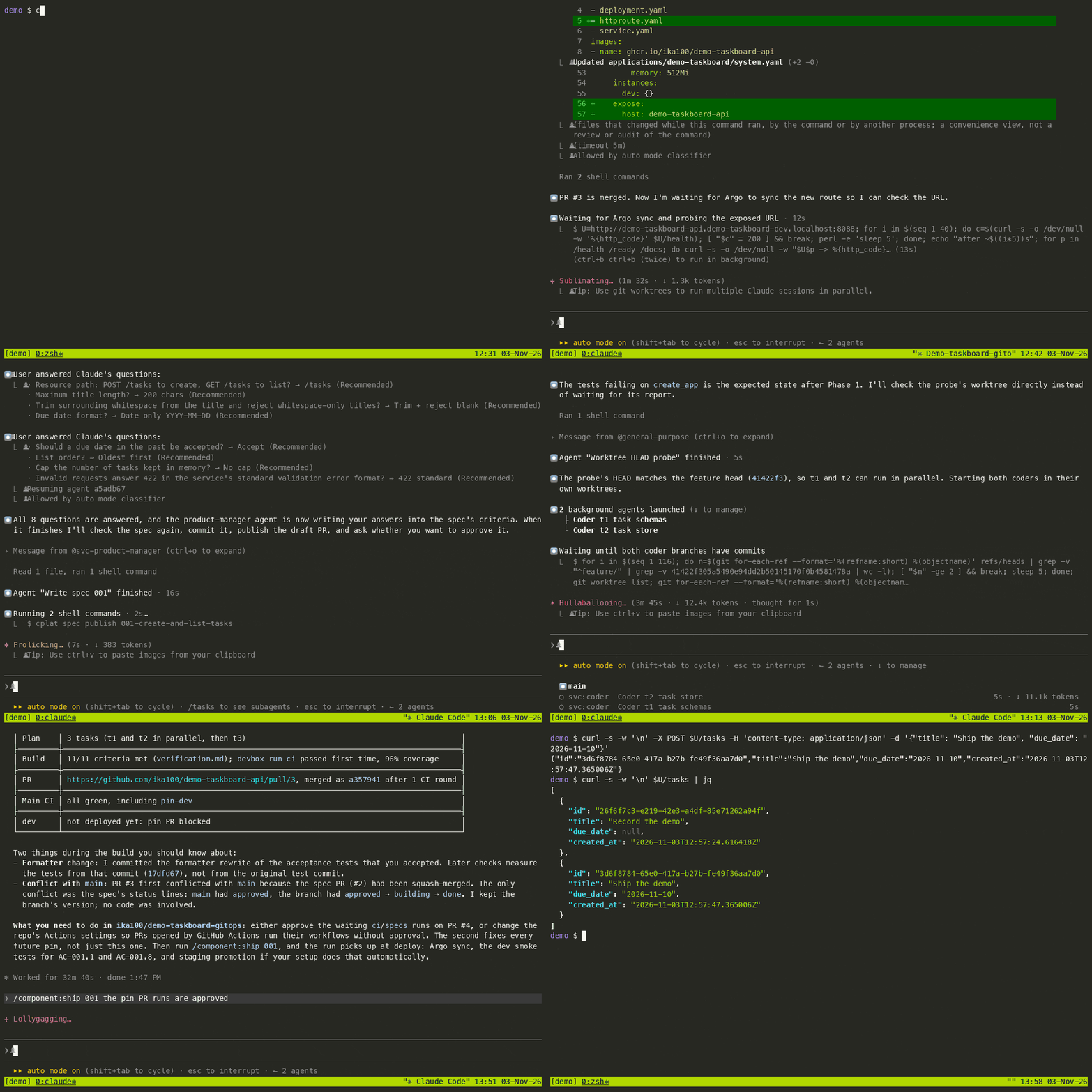
A real run on public demo repos (demo-taskboard-api, demo-taskboard-gitops), with every wait cut: about 30 minutes of work shown in 4. The ship run stops once to ask about a formatter change to the acceptance tests; that is part of the run, not edited out.
You describe what you want in Claude Code; sdlc-foundry scaffolds the repositories (Python, Java, Go and Next.js services, plus one GitOps repository per system), turns your sentence into a spec with acceptance criteria, builds it test-first, merges it on green CI and lets Argo CD deploy it. Every Kubernetes manifest is rendered from one declarative file, system.yaml.
Why
- One file says what runs where. Databases, buckets, caches, secrets, observability and policies are one declaration each in
system.yaml; promotion between environments is a reviewed pull request. - Specs drive the agents. A feature starts as numbered acceptance criteria you approve; failing tests come first, then the code, then a review against every criterion.
- Deterministic where it can be. Everything that can be code is a tested CLI (
cplat); agents orchestrate it and ask before anything leaves your machine. - Runs unattended. Approve a spec and come back to it running in dev. The recorded journeys show the whole path to prod with every pull request.
Quickstart
You need Claude Code, git and a logged-in gh, uv, devbox and Docker. In Claude Code:
/plugin marketplace add ika100/sdlc-foundry
/plugin install starter@sdlc-foundry
starter installs shared, system, component and platform; each plugin can be installed alone (for example component, which brings shared); plugins bring their dependencies from Claude Code 2.1.311 (claude update).
Restart Claude Code, run /platform:doctor, then:
/system:new taskboard.yaml                       # a GitOps repo and one repo per component
devbox run cluster-up                            # in taskboard-gitops, after merging its PR: a local cluster
/component:spec "create and list tasks"          # in taskboard-api: a spec you approve
/component:ship 001                              # plan, test, build, merge, running in dev
Follow the full quickstart → It has the manifest, what each step shows and how long it takes: about 15 minutes to a running endpoint, 40 to a shipped feature.
Learn more
| Documentation site | Vision, concepts, scenarios and every guide, with search |
| User journey | One system from an empty folder to prod, chapter by chapter |
| How it works | The flow in diagrams |
| Commands | Every slash command, generated from the plugins |
| Adopting | Existing repos, migrating from 4.x, troubleshooting |
| The local console | /platform:ui: what waits for you, every change by stage, where each component runs |
| Changelog · ADRs | What changed and why |
To run your own variant, fork the repository, change the owner in .claude-plugin/marketplace.json and add your fork with /plugin marketplace add <you>/sdlc-foundry. Code generated from the templates is yours; this repository's license does not apply to it.
Disclaimer, privacy, AI-assisted development
- Not affiliated. sdlc-foundry is an independent open-source project, not affiliated with, sponsored by or endorsed by Anthropic or the owners of the other names it mentions (see THIRD_PARTY_NOTICES.md). Claude and Claude Code are trademarks of Anthropic, PBC.
- Non-commercial. sdlc-foundry is a private, non-commercial hobby project: no paid services, sponsorship, advertising or business stands behind it or its name.
- No warranty. The software is provided "as is" under the Apache License 2.0 (sections 7 and 8). Review what it generates (manifests, workflows, policies) before it touches a production cluster; the platform never runs
kubectl applyon its own, and humans bootstrap real clusters. - No telemetry. The plugins and the
cplatCLI send nothing anywhere on their own. Network access is what you would expect:git/ghagainst GitHub, package registries, GHCR. Generated applications export telemetry only to the endpoint you configure./issue:reportshows you the full text first and files it only after your OK; issues on this repository are public, and the draft already has tokens, e-mail addresses and home-directory names removed. - AI-assisted. Much of this repository was written with Claude Code and reviewed, tested and committed by the maintainer (commits carry a
Co-Authored-Bytrailer). Licensing is the maintainer's: AI-generated parts may be subject to limited copyright protection depending on jurisdiction.
Contributing, security, support
- CONTRIBUTING.md: setup, checks, PR rules and how releases reach consumers. Code of Conduct.
- SECURITY.md: report vulnerabilities privately. SUPPORT.md: where to ask questions.
- Something misbehaves? Run
/issue:reportin Claude Code: it drafts an issue with your versions and the error, removes tokens, e-mail addresses and home-directory names, and files it only after your OK. Or open one by hand: new issue.
License
Apache License 2.0. Copyright 2026 Eike Hensler.
Reviews (0)
Sign in to leave a review.
Leave a reviewNo results found