svipall
Health Pass
- License — License: AGPL-3.0
- Description — Repository has a description
- Active repo — Last push 0 days ago
- Community trust — 13 GitHub stars
Code Pass
- Code scan — Scanned 12 files during light audit, no dangerous patterns found
Permissions Pass
- Permissions — No dangerous permissions requested
No AI report is available for this listing yet.
Local-first MCP server and CLI in Rust: any page as LLM-ready Markdown, whole-site crawls, keyless search, and local captcha solving. No cloud, no API keys.

A different face at every gate.
Web reading for your AI agent, running on your own machine.
An MCP server and CLI, in Rust, that extracts web pages into Markdown,
crawls sites within configured limits, searches without an API key,
and attempts supported challenges, then says plainly which ones it could not.


Install · Use cases · Proof · Tools · Captcha · REST API · Compare · FAQ
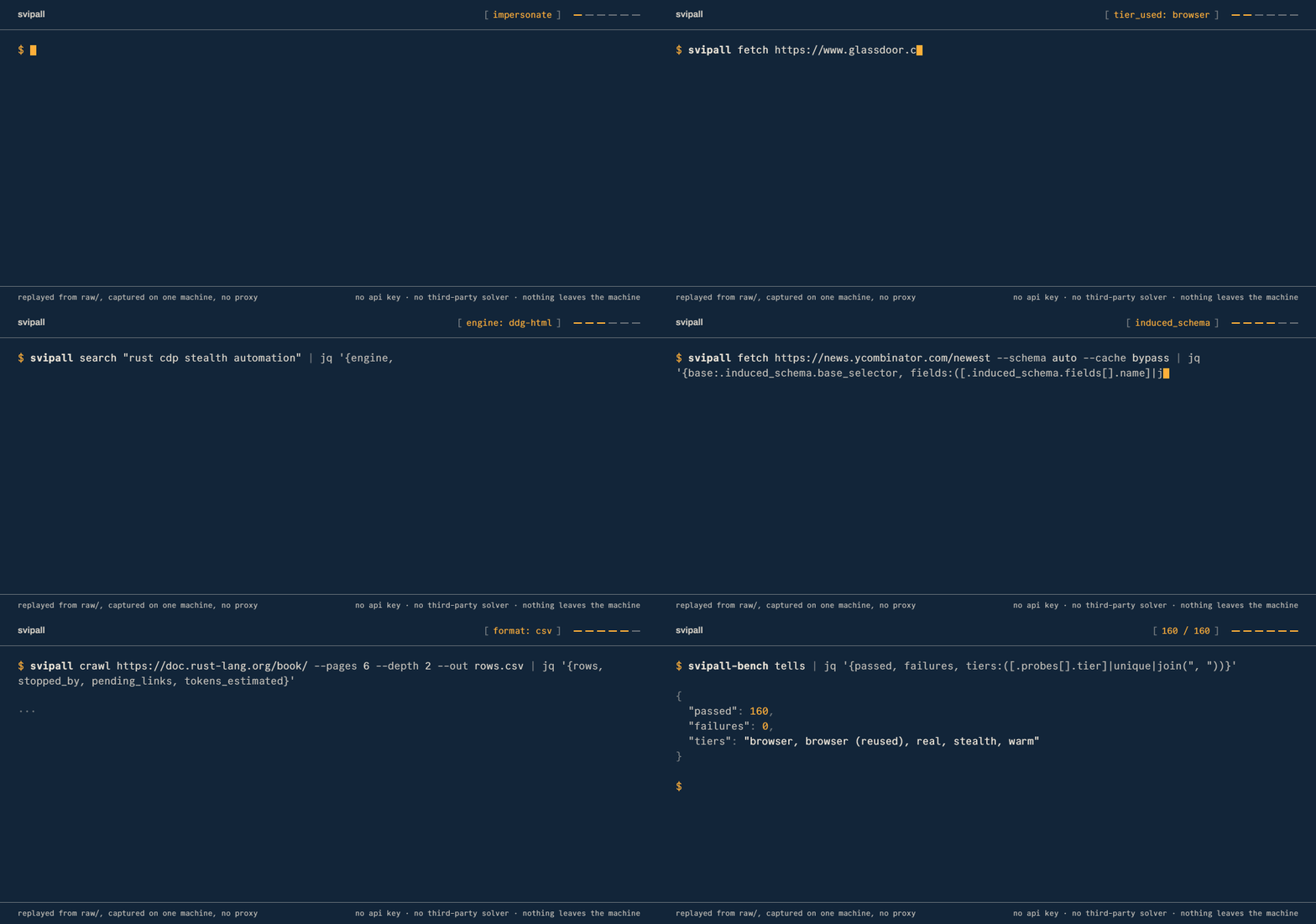
Replayed from real runs on one machine. How it was recorded, and the raw captures.
Everything runs locally. There are no third-party API keys, no paid captcha services and no
telemetry.
Web requests reach the sites you visit, and results reach the agent or client you connect.
Svipall fetches and renders pages locally, extracts their content, and reports detected challenges
and extraction-quality labels. Some sites still block it, and an apparently successful response
can contain incomplete records or a page shell. The published comparisons therefore audit useful
content separately from HTTP status and the tool's own verdict.
Why Svipall
| What goes wrong | Svipall |
|---|---|
Your agent reads a "checking your browser" screen and summarises it as the article. It was a 200, so nothing flagged it |
Twelve wall kinds, each naming the move it implies. Detected blocks carry an explicit verdict; classification is heuristic details |
| You crawl 5,000 pages and can't tell which are worth keeping | Assessed pages carry quality and duplicate observations, and quality labels never discard a page details |
| One page = 300,000 tokens of raw HTML. The fixes are four manual jobs you now own | Clean Markdown by default; opt into tables as rows, out_file to disk, or capture of the site's own JSON API details |
| You want to attempt a supported captcha without a paid solver | Fifteen widget families and eleven answer modalities, all local, optional vision models depending on the build, and a human dashboard for unresolved challenges details |
It records successful visits, failures, incomplete extraction and rejected changes. Historical
benchmark logs and the current comparison use different scoring rules and configurations;
the results section distinguishes them.
Rust · MCP + CLI + REST · no Node, no Python, no API key · local storage and processing
The comparison table describes other projects' documented scope.
Install
Every channel below installs the latest release,
built from the tree this README describes. svipall doctor reports what an installed build can do
on the machine it is on.
The README factual audit
records the source checks, documentation corrections and limits of this review.
Choose agent-assisted setup, the Claude Code plugin, or a manual installation.
Ask the agent you already have
Paste this into Claude Code, Cursor, Codex, opencode, or anything else that can run a command:
Install and configure Svipall by following the instructions here:
https://raw.githubusercontent.com/ilien-dev/svipall/main/docs/install.md
That page guides an agent through platform detection and verification, then asks which integration
you want: CLI + Skill (recommended, lower context use) or MCP + Skill (the full MCP tool
surface). It also asks whether to configure every project or only the current one, and verifies the
chosen result instead of treating a skill as MCP registration. When Svipall already exists, it
shows the installed and latest versions and asks whether to update the shared user installation or
keep the current version before it writes the integration. Completion depends on the agent, client
configuration and available permissions.
Claude Code: install the plugin
/plugin marketplace add ilien-dev/svipall
/plugin install svipall@svipall
/svipall:setup
/svipall:setup installs the binary if it is missing, checks the server answers, and offers to make
Svipall the way Claude reaches the web in every project. It asks before each of those./svipall:doctor reports the installation's capabilities. /svipall:update shows the installed
and latest releases, then updates the binaries only if you choose to. /svipall:uninstall offers
removal of setup's registration, memory and strict-mode changes. Removing the binary and the data
are separate choices.
Install it yourself
One line, with no toolchain and nothing to compile:
curl -fsSL https://raw.githubusercontent.com/ilien-dev/svipall/main/install.sh | sh   # macOS, Linux
irm https://raw.githubusercontent.com/ilien-dev/svipall/main/install.ps1 | iex        # Windows
Or a package manager, or the container image:
brew install ilien-dev/svipall/svipall               # macOS, Linux
scoop bucket add svipall https://github.com/ilien-dev/scoop-svipall && scoop install svipall
docker pull ghcr.io/ilien-dev/svipall:latest         # or :slim, the http tier only; see container notes
npx --yes svipall doctor                             # if node is already there
cargo install svipall                            # from source; add `svipall models install` for the models
The installers verify checksums where they can, and a mismatch stops the install. A missing
checksum file, entry or hashing utility only warns, so a successful exit is not by itself proof
the archive was verified: read the output. If the destination already contains another version,
the installer states that the binaries are shared by every harness and asks before replacing them.
Check for a release without changing anything, or update after reviewing the report:
svipall update --check
svipall update --install       # only after choosing to update the shared installation
Platform builds, what ships where, building from source and wiring it into any MCP client are all
in docs/install.md. If you have never installed anything from a terminal,
GET-STARTED.md is this section with nothing assumed.
Then ask for something
There is no key to paste and no account to create.
"Read this page and summarise the pricing."
"Crawl these docs and write me anllms.txt."
"Watch this listing and tell me when the price moves."
"Get me every row of that table as CSV."
The assistant can choose among the exposed tools. Supported challenges that need a pair of eyes
go to a human dashboard at http://localhost:8787/human.
Or drive it from a shell
svipall fetch https://example.com/article
svipall fetch https://shop.example/item --query "shipping costs"
svipall fetch https://docs.example/api --schema auto        # rows from a listing you've never seen
svipall crawl https://docs.example/ --pages 50 --out pages.csv
svipall search "rust async runtime" --engine all
svipall snapshot https://news.ycombinator.com                # the page as roles and refs, not markup
svipall serve --port 8788                                    # the same server as a local REST API
Completed data commands print one JSON object to stdout and diagnostics to stderr, so the
output can be piped to jq. serve is a long-running server, and help is written to stderr.
What comes back
A historical run of svipall fetch https://example.com, with the content string cut short.
Current automatic fetches also report identity_used, and the fallback fields described below when
they have something to report:
{
  "attempts": ["http: 200 (170ms) OK"],
  "chars": 167,
  "content": "# Example Domain\n\nThis domain is for use in documentation examples…",
  "final_url": "https://example.com/",
  "optimization": "ordinary",
  "quality": "thin",
  "quality_reasons": ["thin_text"],
  "status": 200,
  "tier_used": "http",
  "title": "Example Domain",
  "tokens_estimated": 42,
  "url": "https://example.com"
}
tier_used says how hard it had to try and quality says what actually arrived. When a page does
not arrive, the same object carries blocked_reason, wall_kind, wall_vendor, wall_evidence
and a note telling your agent what to do next. Straight from a committed benchmark record:
{ "wall_kind": "vendor", "wall_vendor": "kpsdk.io", "wall_evidence": "header x-kpsdk-ct" }
A detected block carries a verdict alongside the returned content. A clear verdict still needs a
content check, because the classifier cannot show that the requested records arrived intact.
What you can actually do with it
| You want to… | It looks like this |
|---|---|
| Read one page cleanly | web_fetch → Markdown with heuristic boilerplate removal and sanitization; query= ranks text by lexical relevance |
| Turn a listing into rows | schema: "auto" reads the page's own repeated structure, names the columns and hands back typed rows, with no model and no API call, in one parse |
| Pull a data table | tables=true → typed rows; out_file: rows.csv writes them to disk so thousands of rows never touch your context |
| Read what a video says | web_video → captions and chapters as one [m:ss] timeline, from a watch page, a page that embeds a player, <video> tracks or the stream manifest |
| Skip the scraping entirely | web_capture returns the JSON the page fetched while loading, usually the site's real API, with ?page=2 waiting for you |
| Turn a docs site into a corpus | web_crawl with llms.txt output, near-duplicate labels, resumable frontier and lexical saturation stopping, subject to page/token/traffic limits |
| Search without a key | web_search scrapes DuckDuckGo, Bing and Brave; engine="all" merges them by agreement |
| Let the agent click things | web_snapshot (roles + refs, a fraction of the tokens) then web_act to click, type, scroll and wait, all through human-like input |
| Attempt a browser challenge | Automatic routing can escalate to a patient browser tier; unresolved challenges and detected blocks are reported, but the remote cause is not always identifiable |
| Attempt a captcha locally | Fifteen widget families and eleven answer modalities, model support where available and a phone-friendly human dashboard. No paid solver; local budgets and remote restrictions still apply |
| Log in once and stay in | web_login opens a real window; you sign in; the cookies are kept in a profile you can export |
| Watch a page | web_watch checks the whole page or one CSS region while the server runs; saved selector fingerprints can help recover some redesigns |
| Read PDFs and Office files | docx, xlsx, pptx, odt, epub, rtf, csv and pdf come back as Markdown, from the web or from file:// |
| Drive it from any language | svipall serve → 20 local REST routes, one per tool, behind a bearer key it generates for you |
Who it is for
| You are… | Svipall gives you… |
|---|---|
| A Claude Code, Claude Desktop or Cursor user | One line of setup and tools your assistant picks by itself. Research, documentation, price comparison, monitoring |
| A developer building AI agents | A local web layer with structured output, token budgets, file export and resumable crawls; live web outcomes remain variable |
| A RAG or dataset builder | Bounded site crawls to Markdown, near-duplicate labels, llms.txt, and quality observations for assessed pages |
| A data or research person | Pages that sit behind "checking your browser" walls, and an honest answer when your address cannot open one |
| A privacy-conscious operator | No scraping API, no captcha farm, no geolocation lookup, no update check, no telemetry. Additional downloads are the managed browser when needed (automatic provisioning can be disabled) and the blocklists you enabled |
| A security or QA engineer testing your own site | A reproducible benchmark whose raw run logs are committed in this repository, and a request log that names which tier answered and which wall appeared |
Svipall runs on your own hardware. If you want a URL you can curl from a serverless function,
use a hosted scraping service instead. If you want the web inside your own agent, Svipall does that
processing locally; browser traffic and optional downloads are described under
Privacy and safety.
How it works, in plain words
The steps below describe the emulated tiers. The current automatic policy can promote a supported
emulated route and append one eligible native fallback. Wall verdicts can end the attempt.
Content-quality labels alone do not trigger escalation.
- Ask for the page through HTTP first on a new route. The default engine emulates selected
Chrome network characteristics. In the historicalpublic31runs above, 59 of 93 cells stopped at this tier, and
44 of those scoredokunder that benchmark's rule. A route that stops here has still not
necessarily delivered the page. - If the page needs JavaScript, open a browser. Headless Chromium runs the scripts and hands
back the rendered document. - If the site checks for robots, wear a disguise. The stealth tier patches known browser
surfaces to match the emulated identity. The offline probes check those surfaces; they cannot
prove that an arbitrary detector will accept them. - If the site wants a real person, act like one. The
realtier is a visible-but-offscreen
browser with a persistent profile. It moves the pointer along curves and scrolls with a wheel. - If there is a challenge, answer it or wait it out. The
warmtier runs the captcha strategy
loop during its bounded wait and avoids pointer activity on recognized self-verifying
interstitials. This does not guarantee clearance. - Use native only as a last resort. When eligible and within the remaining budgets, try one
native browser attempt. It exposes real device characteristics and reports a privacy notice. - Remember what worked. Two supporting observations can promote a useful emulated route for
later visits in the same context. Native stays last even when it succeeds. - Report the observed failure. Where available, a blocked result includes
blocked_reason,
the classified wall, recognized vendor/evidence and a suggested next step. Classification is
heuristic. Transport errors and local budget deferrals may have less page evidence.
MCP tools
Twenty-nine tools, all local.
| Tool | What it does |
|---|---|
web_fetch |
Fetch a page as Markdown or structured JSON. mode=auto climbs the ladder. schema (self-healing), tables, scroll, query, max_tokens/cursor, cache, include_metadata, include_links, include_quality, use_site_template, robots, out_file, mobile, text_only, isolated, css_selector, profile, proxy, method/body/headers. URLs may be raw:<html> or file:// under local_roots |
web_fetch_many |
Bounded-parallel fetch of many URLs, with schema and tables as on web_fetch. Reports corroboration (how many distinct documents the set actually is), marks each duplicate with same_text_as, and moves the different ones up. It says reordered_for_diversity when it did, because a set that comes back in a different order without saying so will mislead the caller |
web_search |
DuckDuckGo / Bing / Brave without an API key; engine="all" merges by agreement |
web_site_search |
Discover a site's search form and learn its query-URL pattern when possible; later fetches still follow normal routing and policy |
web_crawl |
Same-domain crawl with robots.txt, dedup, boilerplate removal, strategy=dfs, scroll, schema/tables for rows, llms.txt, file export, a saturation stop, and a crawl_id to resume |
web_map |
A site's URLs without crawling it: robots.txt, sitemaps (nested indexes and .gz included), RSS/Atom feeds and homepage links, a few hundred tokens of structure instead of the thousands a crawl costs |
web_snapshot |
The page as roles, accessible names and short refs that web_act accepts. Deterministic, no vision model |
web_act |
click, type, fill, press, hover, select, scroll, wait, eval, goto, screenshot, hold, verify, console; supported pointer/keyboard/wheel actions use the behavior layer, while eval runs caller-supplied JavaScript |
web_capture |
Observe matching JSON/network responses during a bounded browser visit; API usability and completeness are not guaranteed |
web_video |
A video's captions (a person's first, else the platform's automatic ones, in lang when asked) and chapters as one timeline. Reads a known player's boot JSON, JSON-LD VideoObject, <track>, and HLS/DASH caption renditions; a player whose caption addresses only answer its own requests is read through a borrowed request in a live page. frames adds keyframes where the picture changes, found in the player's storyboard or by comparing sampled frames, captured from the page's own <video> and returned as PNG paths inside the timeline. A video with no captions and a media file behind it is transcribed on this machine when the speech model is installed (svipall models install). Encrypted streams are reported as drm and never read |
browser_open / browser_do / browser_close |
Persistent session with cookies and page state across calls |
web_screenshot |
PNG of the rendered page, full_page or mobile |
web_diff |
What changed on a page since Svipall last saw it |
web_watch |
Persist a watch and check it while the server runs; list or check to retrieve changes. Region recovery after a redesign is heuristic |
web_notes |
Key-value memory that outlives the session |
web_log |
Which tier answered, which wall appeared, how long it took, per domain |
web_login |
Visible window for a manual login or challenge; cookies saved to a profile |
web_route |
Per-domain proxy, or a pool of proxies with countries; subdomains inherit; exit_strategy sticky or round-robin; check=true tests the exits (liveness, latency, DNS leak) with no third-party service |
web_profile |
Export/import an encrypted browser profile between machines |
web_status |
Learned tiers, cooldowns, routes, per-exit health and latency, profiles, open browsers, solver stats, which models answer and from where, whether the host has a real GPU, h3_offered_by |
browser_setup |
Download or manage Chrome for Testing |
solve_and_continue |
Attempt a captcha on the blocked page and return the resulting content or unresolved state |
solve_image_captcha / solve_recaptcha_v2 / solve_turnstile / solve_hcaptcha / captcha_status / report_captcha |
Local captcha attempts; the dashboard also exposes in.php / res.php / createTask / getTaskResult compatibility endpoints for supported tasks. This is not full compatibility with every solver-client option |
The CLI
svipall fetch | crawl | snapshot | capture | search | map | log | notes | watch
        profile | browser | route | status | serve | doctor | update | hook
        config show | set | preset
        solver export-corpus
        quality ask | export-training | train
A test asserts the usage text names every command the binary answers to, and a second test keepsskill/SKILL.md in step with both.
The REST API
The same server, over HTTP, so any language can drive it without an MCP client or a shell.
svipall serve --port 8788        # the bearer key is printed once, and kept in ~/.svipall/api_key
curl -sH "Authorization: Bearer $KEY" -H 'content-type: application/json' \
     -d '{"url":"https://example.com","query":"pricing"}' localhost:8788/v1/fetch
svipall-mcp mounts the same router when rest_port is set, on its own listener, and shares its
browser pools, page cache and route evidence with the MCP tools.
Nineteen routes, one per tool, each taking that tool's own JSON as the body:
POST /v1/fetch /v1/fetch_many /v1/crawl |
pages |
POST /v1/search /v1/site_search /v1/map |
finding things |
POST /v1/snapshot /v1/act /v1/capture /v1/screenshot |
a real browser |
POST /v1/solve_and_continue |
the captcha, answered on the blocked page |
POST /v1/diff /v1/watch /v1/notes /v1/log |
memory |
POST /v1/route /v1/profile /v1/browser_setup |
configuration |
GET/POST /v1/status |
what this installation has learned. GET is read-only by construction: the three clearing fields are reachable only by POST |
GET /v1/health |
the one route with no key, so a container healthcheck does not need one |
A blocked page is a 200: the call ran, the page did not. blocked_reason, wall_kind andnote can appear in the body as over MCP. Non-2xx responses include a malformed body (400), a bad key
(401), a browser Origin or a rebound Host (403), a body over 2 MB (413) or a broken
installation (500). An unknown job can return 404, and routing can reject unsupported paths
or methods. A client must inspect both the HTTP status and the tool result before deciding to retry.
Every tool and job route needs the key, including on loopback. Only /v1/health is exempt.
A local port is not a boundary on its own: Svipall carries logged-in profiles, cookies and your
exit address, so anything that reaches the port can make requests as you.
Two more checks sit in front of the key, because binding to 127.0.0.1 does not stop a page in your
own browser being served a DNS answer of 127.0.0.1 and posting to it: any request carrying anOrigin header is refused, and on a loopback bind so is any Host that is not loopback. There is no
CORS layer and there will not be one, because no browser page is a client of this API.
Ten tools are deliberately not routes, in three groups, and rest.rs records why next to each:browser_open/browser_do/browser_close, whose persistent session lifecycle is outside this
REST interface's current design; web_login, whose interactive window is also excluded; and the sixsolve_*/captcha_status/report_captcha tools, which already answer on the dashboard port in the
classic solver wire shape. Twenty-nine tools minus those ten is the nineteen routes above. A new#[tool] fails the test suite until it is listed as a route or as a named exclusion.
A long crawl runs as a job and does not hold the connection. "async": true answers 202 with an id. GET /v1/jobs/{id} polls it, GET /v1/jobs/{id}/stream follows it as Server-Sent Events, DELETE stops
it. The id is the crawl_id, so there is one handle to learn and resuming is {"crawl_id": "…"},
the same word the MCP tool and the CLI already use. A cancelled crawl stops between pages after
that page's links are queued, so its frontier is kept. It is never aborted, because that would leak a
browser page. A job whose process was killed becomes interrupted, and interrupted is resumable.
The first frame of a stream is always a snapshot from the store, so a subscriber that joins at page
forty is never told the job started at zero. And a queued job whose site already has one running is
held back: two crawls of one site would spend one address's reputation with that host twice as fast,
which is the scarcest thing a local-only tool has. Full contract in docs/rest.md.
How Svipall compares
The following describes project scope from primary documentation checked on 2026-09-07.
It is not a feature-exhaustive comparison or a head-to-head performance test.
| Project | Documented focus |
|---|---|
| Svipall | Local Rust CLI, MCP and REST server; bounded automatic routing, content labels and local challenge attempts with human fallback |
| Firecrawl | Web scraping/crawling API with hosted and self-hosted options; the open-source and cloud offerings differ |
| Crawl4AI | Python crawler with browser extraction and a Docker server offering API and MCP access |
| Scrapling | Python adaptive parsing, fetchers and spiders, with session/proxy controls and MCP integration |
| Playwright MCP | Browser automation through MCP using structured accessibility snapshots |
The historical benchmark above does not establish current superiority over these
projects. Choose based on your required integration and validate your own target pages.
Everything else
This file is the short version. Everything it leaves out is in the documents below.
| Install | Every platform, what ships where, building from source, wiring it into any MCP client |
| Proof | Every published number, with the command and the log that reproduce it, failures included |
| Features | The whole surface, tool by tool |
| Captcha | Fifteen widget families, eleven answer modalities, and what happens when none of them work |
| Configuration | Every key in ~/.svipall, and what changing it costs |
| The REST API | Nineteen routes, the job routes, and what a status code means |
| Extraction | How a page becomes Markdown, and how well, measured against three corpora |
| Privacy and safety | What leaves this machine, and what does not |
| Limits | Stated on purpose |
| Architecture | The crates, and why they are separate |
| Development | Building, testing, and the benchmarks |
| FAQ | |
| Exit codes | What the binary returns, for scripts |
| Models | The embedded weights, their licences and their sizes |
| Firefox · HTTP/3 · Benchmarks | The engineering notes |
| Changelog · Contributing · CLA · Disclaimer |
About the name
Svipall is one of Odin's names in Grímnismál, stanza 47. Bellows renders it as
"The Changing" in his translation notes.
The project uses that name as an image of changing appearance, not as a promise of invisibility.
That is the idea behind its emulated identities: keep the machine, browser, network fingerprint
and input behaviour coherent within a session, and retire sessions when they are refused.
Native fallback instead uses real browser/device characteristics. Neither policy guarantees that
a site will accept the visit or be unable to link it to an earlier one.
License
AGPL-3.0-only, subject to the terms in LICENSE, including its conditions for
distribution and section 13 on remote network interaction. The component licences and linking
exception below also apply. This paragraph is not a substitute for those terms.
crates/svipall-extract, the extraction engine, is deliberately MIT OR Apache-2.0 so that a
project under any licence can depend on it. crates/svipall-cdp keeps its upstream terms
(chromiumoxide, MIT OR Apache-2.0) and crates/svipall-quic keeps its own (quiche, BSD-2-Clause). The default build links BoringSSL under an explicit AGPL section 7 linking
exception. These are set out in NOTICE andTHIRD-PARTY-NOTICES.md.
Contributions are taken under CLA.md: contributors keep the copyright in their work and
grant the maintainer a licence broad enough to also release it under other terms. The public
release stays AGPL-3.0-only. For a licence other than the AGPL, write to [email protected].
Trademark
The name Svipall and the Svipall logo are trademarks of the author. They are not licensed
under the AGPL, and nothing in this repository grants a licence to them.
The licence gives you the code. It does not give you the name. Run it, study it, modify it, fork it
and redistribute it freely under the AGPL. Distribute a modified version under a different name
and without the logo, so that nobody who downloads it is misled about who produced it or what is
in it.
The project permits descriptive references such as saying that your project uses Svipall,
works with Svipall, or is a fork of Svipall, without implying endorsement.
Disclaimer
Svipall is provided as is, with no warranty and no liability, and it grants you no
authorisation with respect to any system you point it at. Complying with the law, with
data-protection rules and with a site's terms is the operator's responsibility, not the author's.
Read DISCLAIMER.md before you run it against something that is not yours.
Keywords: web scraping · web crawler · MCP server · Model Context Protocol · Claude Code · Claude Desktop · Cursor · AI agent tools · LLM web browsing · LLM-ready markdown · html to markdown · RAG data pipeline · anti-bot bypass · Cloudflare bypass · Turnstile · Akamai · PerimeterX · DataDome · Kasada · captcha solver · local captcha solving · headless browser · stealth browser · browser fingerprint · TLS fingerprint JA4 · Chrome impersonation · HTTP/3 QUIC · proxy rotation · Rust · Playwright alternative · Firecrawl alternative · Crawl4AI alternative · Scrapling alternative · local-first · self-hosted · privacy · no API key
Reviews (0)
Sign in to leave a review.
Leave a reviewNo results found