home-memory
Health Pass
- License — License: AGPL-3.0
- Description — Repository has a description
- Active repo — Last push 0 days ago
- Community trust — 57 GitHub stars
Code Pass
- Code scan — Scanned 3 files during light audit, no dangerous patterns found
Permissions Pass
- Permissions — No dangerous permissions requested
This MCP server acts as a persistent, structured memory bank for your AI assistant, allowing you to document and query details about your home, rooms, devices, and personal belongings using natural language.
Security Assessment
Overall Risk: Low. The tool functions as a local database interface that keeps your personal data stored in a single file directly on your machine. An automated code scan of the core files found no dangerous patterns, hardcoded secrets, or requests for elevated system permissions. It does not appear to execute arbitrary shell commands or make unauthorized external network requests. The only inherent risk is that you are explicitly choosing to feed highly sensitive data (details about your home, expensive items, and invoices) to your AI client, which is the intended functionality.
Quality Assessment
The project is highly transparent and actively maintained, with its most recent code push occurring just today. It uses the standard AGPL-3.0 open-source license, ensuring the code remains free to use and inspect. With 57 GitHub stars, it is building a solid foundation of community trust for an early-stage, niche tool. Furthermore, the repository is well-documented, providing clear instructions and examples for users.
Verdict
Safe to use — it is an active, well-documented, and locally-contained tool that keeps your sensitive data strictly on your own machine.
MCP server that lets your AI assistant remember everything about your home.
Home Memory
Ask your home.
Your AI assistant's memory for everything in and around your home.



Website with demo video, screenshots, and examples
Home Memory is an MCP server that gives your AI assistant structured, persistent knowledge about your home — every room, every device, every pipe and cable, every item you own. It plugs into Claude, OpenAI Codex, or any MCP-compatible AI and turns natural conversation into a living, queryable documentation of your home and everything in it.
No app to learn. No forms to fill out. Your home data stays in a single file on your machine — the AI is your interface.
Tell your AI about your heat pump, your car, your power tools, or your wine collection — it extracts the relevant details and stores them as structured data in your local database. Snap a photo of a device or hand it an invoice — same thing. Ask "What's in the basement?" or "When is my car due for inspection?" and get real answers from real data, not hallucinations.
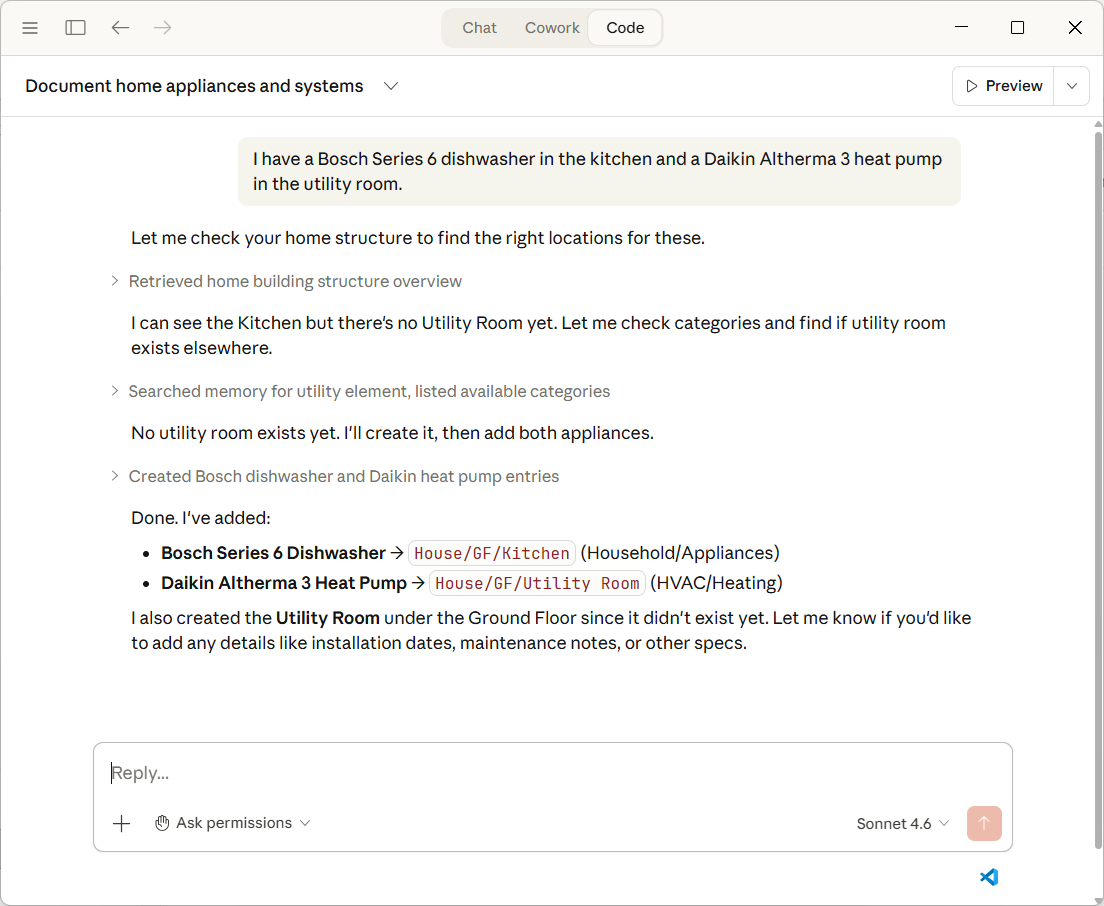
Claude Desktop (Anthropic)
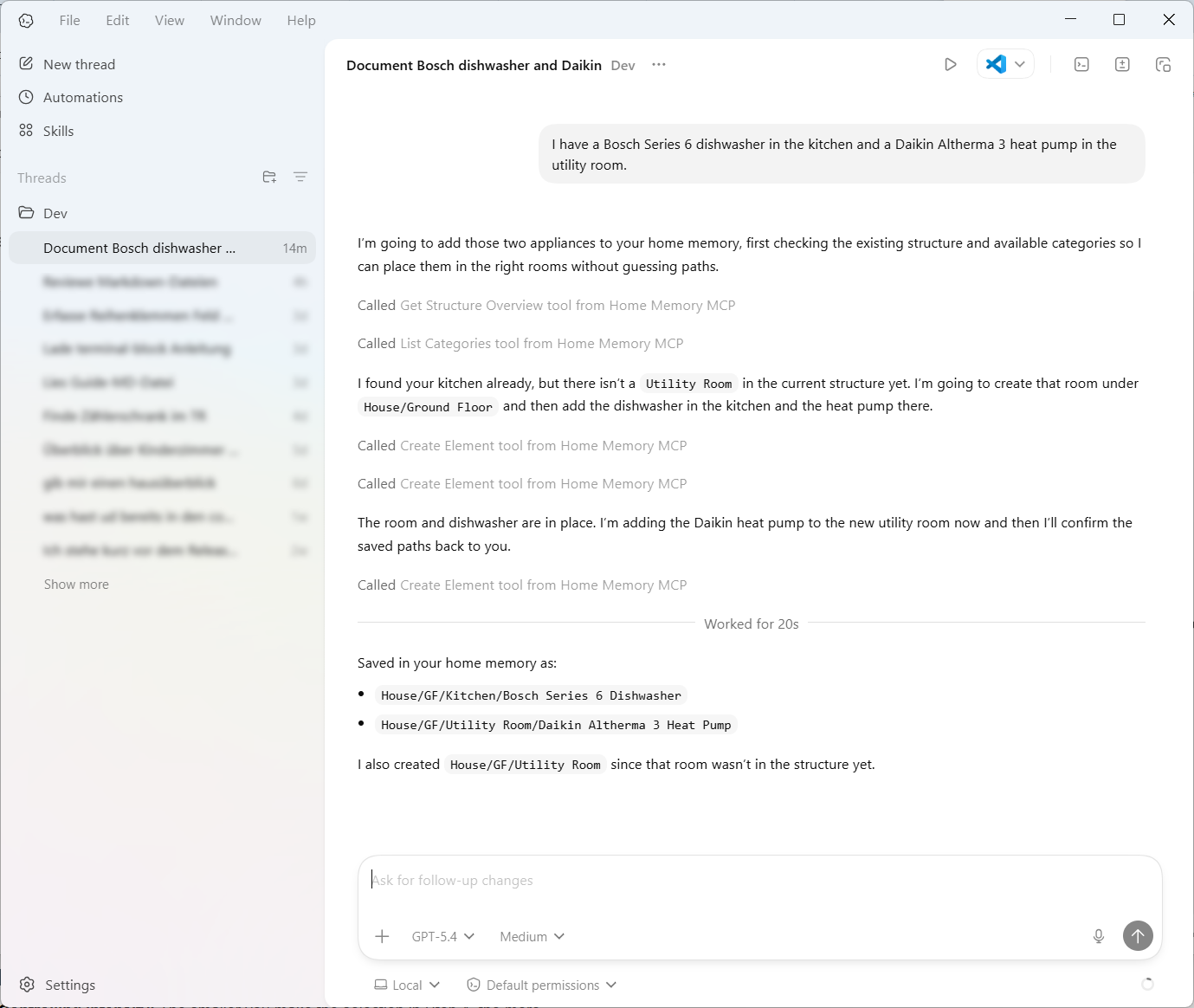
Codex App (OpenAI)
What you can do
Document anything by just talking:
"I have a Daikin Altherma heat pump in the utility room."
Your AI finds the right category, resolves the location, and creates the element — no manual data entry.
"My car is a 2023 Toyota Corolla Hybrid — next inspection is due in March."
Not just building infrastructure — vehicles, tools, appliances, valuables, anything that belongs to you.
Ask questions about your home:
"What's in the basement?" · "Show me all planned purchases." · "Where is my washing machine?"
Upload a photo and let your AI identify it:
(attach a photo of a device) "What is this? Add it to the utility room."
Vision-capable AIs recognize the device and create the element via MCP.
Read an invoice and extract devices:
(attach a PDF invoice) "Extract the installed devices and add them to my home."
Track connections between elements:
"The circuit breaker panel feeds the kitchen outlet via NYM-J 3x1.5."
Cable routes, pipe runs, duct paths — documented as connections between elements.
Plan renovations:
"We're planning a PV system on the roof." · "The old oil heater was removed last year."
Track what's planned, what exists, and what's been removed.
Quick Start (Windows)
The release ZIP is self-contained — no .NET, no Firebird, no other software to install.
1. Download & Extract
- Download the latest release ZIP from GitHub Releases
- Extract to a folder, e.g.
C:\HomeMemory\
2. Connect to your AI
Choose one of the following clients:
Codex App (OpenAI)- Open the Codex App
- Click File > Settings, then select MCP servers on the left
- Click + Add server
- Name:
home-memory - Command to launch:
C:\HomeMemory\HomeMemoryMCP.exe - Leave transport on STDIO (default)
- Click Save — restart the app if needed
Or via Codex CLI:
codex mcp add home-memory -- "C:\HomeMemory\HomeMemoryMCP.exe"
- Open Claude Desktop
- Click the Claude menu → Settings → Developer → Edit Config
- This opens the config folder with
claude_desktop_config.jsonselected — open it in any text editor - Add
home-memoryinside the"mcpServers"object:
{
  "mcpServers": {
    "home-memory": {
      "command": "C:\\HomeMemory\\HomeMemoryMCP.exe"
    }
  }
}
If you already have other MCP servers configured, add the "home-memory" entry next to them inside the existing "mcpServers" block.
- Save the file and restart Claude Desktop
Home Memory is available in both the Chat tab and the Code tab. The Code tab is recommended — it runs in agentic mode with no tool-call limits, which works much better for MCP-heavy workflows.
Claude Code (CLI)claude mcp add home-memory --scope user -- "C:\HomeMemory\HomeMemoryMCP.exe"
3. Try it
On first launch, Home Memory automatically creates a local database with over 100 categories and a default house structure (floors, rooms, garage, outdoor areas). No setup wizard needed.
Try these prompts in order:
"Show me the structure of my home."
You should see your default house structure: ground floor, upper floor, basement, each with rooms. This confirms everything is working.
"I have a Bosch washing machine in the basement."
Your AI creates the element, finds the right category, and places it in the basement — all in one step. Ask "What's in the basement?" to verify.
"We're planning to install a heat pump in the utility room."
Creates a planned element — so you can track what exists and what's coming.
If it works, you're done. Everything from here is just talking to your AI. Add rooms, rename floors, document your electrical panel, upload a photo of a device — the AI handles the rest.
Build from Source (advanced)
Requires .NET 10 SDK and Firebird 3.0.
git clone https://github.com/impactjo/home-memory.git
cd home-memory
dotnet publish HomeMemoryMCP -c Release
See Setup Guide for details on Firebird configuration and environment variables.
How it works
You ──── AI Assistant ──── Home Memory MCP ──── Local Database
              (natural language)      (20+ tools)       (Firebird, single file)
Home Memory implements the Model Context Protocol (MCP), an open standard that lets AI assistants use external tools. When you talk to your AI about your home, it calls Home Memory's tools behind the scenes — reading, creating, updating, and searching your home data.
Your data stays local. The database is a single file on your machine. Nothing is sent anywhere except to the AI you're already talking to.
Features
22 MCP Tools
| Tools | What they do | |
|---|---|---|
| Explore | get_structure_overview, find_element, list_elements, get_element_details |
Browse your home, search by name/path/status, get full details |
| Manage Elements | create_element, update_element, delete_element, move_element |
Add devices, furniture, fixtures — or entire rooms and floors |
| Connections | get_connections, get_connection_details, create_connection, update_connection, delete_connection |
Document physical lines: cables, pipes, ducts, conduits |
| Categories | list_categories, get_by_category, create_category, update_category, delete_category |
Over 100 built-in categories across all domains |
| Status | list_statuses, create_status, update_status, delete_status |
Track what's existing, planned, or removed |
Covers every domain
Electrical (circuits, PV, wallbox, home automation) · HVAC · Plumbing · IT & Communications · Security (alarm, fire, surveillance) · Building Materials · Landscaping (garden, pool, irrigation) · Household (appliances, furniture, valuables) · Vehicles · Tools · Health · Sports & Leisure
Smart defaults
- Over 100 categories organized by trade and domain — from circuit breakers to garden sprinklers to vehicles
- Default house structure with floors, rooms, garage, and outdoor areas — customize by talking to your AI
- Auto-setup on first run — no manual database creation needed
- Flexible naming — your AI can use "Ground Floor" or "GF", the server resolves both
Compatibility
| Client | Status |
|---|---|
| Codex App (OpenAI) | Tested, production-ready |
| Claude Desktop (Chat tab + Code tab) | Tested, production-ready |
| Claude Code (CLI) | Tested, production-ready |
| Codex CLI (OpenAI) | Tested, production-ready |
| Any MCP-compatible client | Should work (stdio transport) |
The release ZIP is a self-contained Windows build with all dependencies included (no .NET or Firebird installation required). On macOS and Linux, you can build from source with .NET 10 and Firebird 3 — see the Setup Guide for details.
Configuration
| Environment Variable | Purpose | Default |
|---|---|---|
HOME_MEMORY_DB_PATH |
Database file location | %LOCALAPPDATA%\HomeMemory\homememory.scd (Windows) · ~/.local/share/HomeMemory/homememory.scd (Linux) · ~/Library/Application Support/HomeMemory/homememory.scd (macOS) |
HOME_MEMORY_FBCLIENT |
Path to Firebird client library | Bundled with release / Firebird installation |
Architecture
- .NET 10 with ModelContextProtocol SDK
- Firebird Embedded — zero-install database engine, single-file storage
- Raw SQL with recursive CTEs — no ORM overhead, transparent and auditable
Contributing
Home Memory is in its early stages and we'd love to hear from you! Right now, the best way to contribute is:
- Open an issue for bug reports, feature ideas, or questions
- Share your use case — how are you using Home Memory? What's missing?
- Spread the word if you find it useful
If you'd like to build and explore the code locally, see the Setup Guide.
Background
Home Memory builds on a proven data model from Smartconstruct, a desktop application for documenting physical assets — refined through real-world use in residential construction projects.
License
For commercial licensing options, please open an issue.
Reviews (0)
Sign in to leave a review.
Leave a reviewNo results found