ironclaw
Health Warn
- License — License: AGPL-3.0
- Description — Repository has a description
- Active repo — Last push 0 days ago
- Low visibility — Only 6 GitHub stars
Code Pass
- Code scan — Scanned 12 files during light audit, no dangerous patterns found
Permissions Pass
- Permissions — No dangerous permissions requested
No AI report is available for this listing yet.
Security-first, self-hosted AI agents - isolation you can prove, not just promise.

Security-first, self-hosted AI agents — isolation you can prove, not just promise.





IronClaw is an open-source platform for running personal AI assistants on infrastructure you
control. You talk to them through the chat apps you already use; each assistant runs as a real,
autonomous agent that can read, write, schedule, and reply. What makes it different is the threat
model: it assumes the agent — and the box it runs in — could be compromised at any moment, and
builds hard, provable walls so that even a misbehaving agent can't reach your data or your machine.
The security model, in one line: each sandboxed agent runs with
network=none, reaches the
model only through a host proxy, and cannot change its own configuration — every capability
change is held at a gateway for a human decision. The full design is in the
architecture overview and the threat model.
[!WARNING]
Alpha software — work in progress. Please read before relying on it.
- It's an alpha. Flags, the on-disk format, and the HTTP/contract surfaces can still change without notice or a migration path. Don't point it at anything you can't afford to lose.
- Not every feature is tested end-to-end. The control-plane, gateway, and encrypted-queue core have real coverage (800+ Go tests plus a black-box parity suite); channel adapters, some tools, multi-provider routing, and a live sandbox launch are exercised more lightly. Treat anything outside the tested core as experimental.
- macOS doesn't get the full isolation story. The production sandbox is gVisor (
runsc), which is Linux-only. The whole host side runs on macOS natively, but a real agent sandbox there falls back to--runtime docker— runc inside Docker Desktop's Linux VM, a weaker kernel-shared boundary. Details in Platform support.
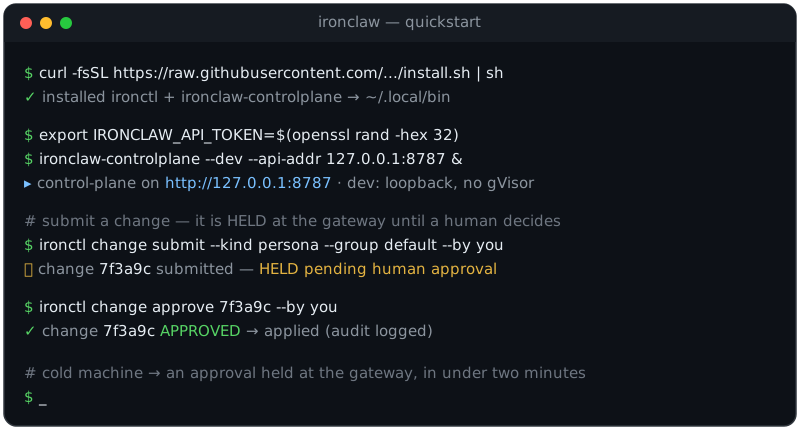
Get running in under two minutes
One command installs the two host binaries (ironctl + ironclaw-controlplane); in dev mode the
control-plane serves its API at http://127.0.0.1:8787. From a cold machine, you'll have a
capability change waiting at the security gateway in under two minutes:
# 1. Install — detects your OS/arch and verifies the SHA-256 checksum before installing
curl -fsSL https://raw.githubusercontent.com/IronSecCo/ironclaw/main/scripts/install.sh | sh

# 2. Start the control-plane in dev mode — API base URL: http://127.0.0.1:8787
export IRONCLAW_API_TOKEN=$(openssl rand -hex 32)
ironclaw-controlplane --dev --api-addr 127.0.0.1:8787 &

# 3. Your first command — submit a change; it is HELD at the gateway for a human decision
ironctl change submit --kind persona --group default --by you
ironctl change pending                       # see it waiting
ironctl change approve <change-id> --by you   # apply it
On Windows, install with irm https://raw.githubusercontent.com/IronSecCo/ironclaw/main/scripts/install.ps1 | iex.
Version pinning, system-wide installs, and building from source are all in Installation.
CLI-first and API-first
This is a feature, not a missing dashboard. Every capability is a documented HTTP endpoint and anironctl subcommand, so IronClaw is scriptable, auditable, and CI-friendly from the first command —
with no public web surface to phish, misconfigure, or leave exposed. (There is now a private,
mesh-only web console at /ui/ — but it's additive, never the only way in, and rides the same
Tailscale-bound API, so it adds no public port.)
Table of contents
- Get running in under two minutes
- CLI-first and API-first
- Why it's different
- How it works
- Platform support
- Project status
- Prerequisites
- Installation
- Quickstart
- Examples
- Usage
- Model providers
- Configuration
- Development
- Repository layout
- Security
- Roadmap
- Contributing
- License
Why it's different
| Pillar | What it is | Attack surface it removes |
|---|---|---|
| Sealed runtime | The agent ships as a compiled Go binary | Agent self-modification — there's no source inside the box to rewrite |
| Approved by humans | Every change to the harness clears a deterministic gateway | Silent setting changes — nothing changes without a human seeing and approving it |
| Encrypted queues | Per-session encrypted message queues; read-only inbound | Data theft at rest, and cross-session reads |
| Sealed sandbox | gVisor container, no network, host-proxied model calls | Data exfiltration and sandbox escape |
| Private control panel | Admin access over a private mesh (Tailscale) only | Remote attacks on the controls |
The throughline: treat the agent as untrusted, and make the security boundary something you can
verify — not something you take on faith.
How it works
Two compiled Go programs that never share memory and talk only through a pair of encrypted SQLite
files per conversation:
                    ┌──────────────────────────────────────────────┐
   chat platforms   │            CONTROL-PLANE (host)              │
   ───────────────▶ │  api · gateway · router · delivery · sweep   │
   (Tailscale only) │  keys · channels · modelproxy · isolation    │
                    └───────┬───────────────────────────┬──────────┘
                            │ inbound.db (ro)            │ outbound.db (rw, host reads)
                            ▼ encrypted, per-session     ▲ encrypted, per-session
                    ┌──────────────────────────────────────────────┐
                    │           SANDBOX (gVisor, network=none)      │
                    │   loop · provider · tools · queue             │
                    │   model calls ─▶ host modelproxy unix socket  │
                    └──────────────────────────────────────────────┘
- The control-plane receives chats, routes them, holds the keys, runs the approval gateway, and
performs every privileged action on the agent's behalf — after its own checks. - The sandbox — one per conversation, wrapped in gVisor with no network of its own — reads its
encrypted inbox (read-only), calls the AI model through the host proxy, and writes its encrypted
outbox. It can request a capability change but can never apply one. - The frozen contract (
internal/contract) is the only package both sides import: typed IDs,
row shapes, the embedded SQL schema, pinned cipher params, and the gateway protocol.
For the full design, see docs/architecture.md,docs/threat-model.md, and the plain-language tour indocs/ironclaw-explained.md.
Platform support
IronClaw's security model rests on gVisor (runsc) — a user-space kernel that intercepts the
agent's Linux syscalls and is the layer that actually enforces network=none, the seccomp
syscall allowlist, dropped Linux capabilities, and a read-only rootfs. gVisor is Linux-only, and
that one fact drives the whole platform story:
| Capability | Linux + gVisor (production target) | macOS / Windows |
|---|---|---|
Host side — control-plane, gateway, API, ironctl, web console |
✅ native | ✅ native |
| Real agent sandbox | ✅ gVisor (runsc) |
⚠️ --runtime docker only — runc in Docker Desktop's Linux VM |
| Per-sandbox syscall interception | ✅ | ❌ not available |
| Seccomp syscall allowlist | ✅ enforced | ❌ not applied on the Docker path |
network=none |
✅ enforced by the OCI spec | ⚠️ not auto-enforced — you must point IRONCLAW_DOCKER_NETWORK at a no-egress network |
| Dropped capabilities · read-only rootfs | ✅ enforced by the runtime | ⚠️ only as strong as the Docker Desktop VM kernel |
On macOS you can build, script, demo, and develop against the entire system natively, and you
can even run agents through Docker Desktop — but understand that the sandbox boundary then comes from
runc inside the Docker Desktop Linux VM, not gVisor. There is no per-sandbox syscall
interception, the curated seccomp profile is not applied, and network=none is not enforced for you
(the Docker isolator passes whatever network you configure straight through — setIRONCLAW_DOCKER_NETWORK to a no-egress bridge yourself). That is weaker than the posture the
threat model assumes. Windows is in the same position — gVisor can't run
there either.
For anything past local development, run the sandbox host on Linux with gVisor. The control
plane can live wherever you like; it's the agent sandbox that needs the Linux + gVisor substrate to
give you the boundary IronClaw is built around.
Project status
Alpha. The architecture is settled and the full control-plane and sandbox pipelines are
implemented and tested. The encrypted-queue binding is now wired:
- Encrypted-SQLite queue binding — ✅ wired (RFC-0001 applied).
contract.Open*open
per-session SQLCipher databases via cgo (github.com/mutecomm/go-sqlcipher/v4); a round-trip test
covers write→read, read-only-write rejection, wrong-key failure, and no-plaintext-on-disk. The
build now requiresCGO_ENABLED=1(a C toolchain).internal/host/queueuses the live binding;
in-memory backends remain for--devand tests. - Sandbox rootfs provisioning — ✅ wired via a pluggable provisioner:
isolationbuilds the
hardened OCI spec, provisions the bundle rootfs (with image digest/signature verification against a
trust policy), and execsrunsc. A real launch still needsrunscand a provisioned/signed image
present in the environment. - Production hardening (Wave 4) — durable/pluggable master-key custody, a Prometheus
/metrics
surface, structured logging, host respawn + sandbox provider backoff, and model-proxy rate
caps/audit/redaction have landed and are composed intocmd/controlplane. The API-server
hardening knobs (optional TLS, rate-limit, body limits,/readyzreadiness gate) exist asapi.With*options but aren't attached in the entrypoint yet (see the roadmap).
See the roadmap for what remains. You can build, test, and run the control-plane today;
a live sandbox launch needs runsc plus a provisioned image.
Prerequisites
| Requirement | For | Notes |
|---|---|---|
| Go 1.23+ and a C toolchain | building everything | CGO_ENABLED=1 is required — the encrypted-SQLite binding builds via cgo |
containerd + gVisor (runsc) |
production sandboxing | runtime io.containerd.runsc.v1; not needed for --dev |
| Tailscale | remote admin access | the control-plane API binds to the tailnet IP; no public port |
| SQLCipher (vendored) | encrypted queues | the SQLCipher C amalgamation is vendored by the driver; no system lib needed |
| A model credential | live model calls | an Anthropic / OpenAI / OpenRouter key, or a gateway like OneCLI — injected host-side into the model proxy, never into the sandbox (Model providers) |
The three external runtime dependencies (gVisor, Tailscale, the encrypted-SQLite binding) are
intentionally not vendored. See deploy/README.md for host setup.
Installation
Prebuilt binaries
One command installs the latest release — ironctl and ironclaw-controlplane. The script
detects your OS/arch, downloads the matching archive from
GitHub Releases, and verifies its SHA-256
checksum before installing.
macOS / Linux
curl -fsSL https://raw.githubusercontent.com/IronSecCo/ironclaw/main/scripts/install.sh | sh
Windows (PowerShell)
irm https://raw.githubusercontent.com/IronSecCo/ironclaw/main/scripts/install.ps1 | iex
A fresh release is published on every push to main, with prebuilt archives for:
| OS | Architectures |
|---|---|
| macOS | Intel (amd64) · Apple Silicon (arm64) |
| Linux | amd64 · arm64 |
| Windows | amd64 |
The installer reads a few environment variables (pass them on the sh side of the pipe):
# Pin a version instead of latest
curl -fsSL https://raw.githubusercontent.com/IronSecCo/ironclaw/main/scripts/install.sh | IRONCLAW_VERSION=v0.1.66 sh

# Install system-wide (a normal user defaults to ~/.local/bin)
curl -fsSL https://raw.githubusercontent.com/IronSecCo/ironclaw/main/scripts/install.sh | sudo sh

# Choose the install directory
curl -fsSL https://raw.githubusercontent.com/IronSecCo/ironclaw/main/scripts/install.sh | IRONCLAW_BINDIR="$HOME/bin" sh
Then confirm what you installed:
ironctl --version
Prefer to grab files by hand? Download the archive and SHA256SUMS for your platform from the
latest release.
Verifying a release
Releases are signed and attested — a keyless cosign
signature over SHA256SUMS, an SBOM (SPDX + CycloneDX), and build-provenance attestations for
every archive and the container image.
Each release carries SHA256SUMS plus SHA256SUMS.sig + SHA256SUMS.pem (the cosign signature and
its certificate), *.spdx.json / *.cdx.json SBOMs, and per-archive + image attestations.
Verify the checksum signature (no key to manage — the identity is the release workflow):
cosign verify-blob SHA256SUMS \
  --signature SHA256SUMS.sig --certificate SHA256SUMS.pem \
  --certificate-identity-regexp '^https://github.com/IronSecCo/ironclaw/' \
  --certificate-oidc-issuer https://token.actions.githubusercontent.com
sha256sum -c SHA256SUMS        # then confirm your archive matches
Verify build provenance for a binary archive or the image:
gh attestation verify ironclaw_<version>_<platform>.tar.gz --repo IronSecCo/ironclaw
gh attestation verify oci://ghcr.io/ironsecco/ironclaw-controlplane:latest --repo IronSecCo/ironclaw
From source
Requires Go 1.23+ and a C toolchain (CGO_ENABLED=1 — the encrypted-SQLite binding builds via cgo).
# Clone
git clone https://github.com/IronSecCo/ironclaw.git
cd ironclaw

# Build all binaries
make build            # == go build ./...

# Or install the two host binaries onto your PATH
go build -o /usr/local/bin/ironclaw-controlplane ./cmd/controlplane
go build -o /usr/local/bin/ironctl               ./cmd/ironctl
For a full system install — build and install the binaries, provision /etc/ironclaw
and /var/lib/ironclaw, and enable the service (systemd on Linux, launchd on macOS) —
run sudo deploy/install.sh. It needs root to write under /etc
and /var/lib. The external runtime dependencies it relies on (containerd + gVisor and
Tailscale) are set up separately — see deploy/README.md.
With Docker (docker compose)
Self-host the control-plane in one command. From a clone:
cp .env.example .env          # fill in ANTHROPIC_API_KEY (optional to boot)
docker compose up -d          # builds locally on first run, or pulls the GHCR image
docker compose logs -f controlplane   # CLAIM the admin token printed once on first run
The admin/API token is minted on first run and printed once in the logs (there is
no recovery) unless you set IRONCLAW_API_TOKEN yourself. The admin API is published
on 127.0.0.1:8787 only — front it with Tailscale for remote access.
Prefer the published image? It is pushed to GitHub Container Registry on every release:
docker pull ghcr.io/ironsecco/ironclaw-controlplane:latest
# or pin a release: docker pull ghcr.io/ironsecco/ironclaw-controlplane:v0.1.0
Set IRONCLAW_IMAGE in .env to pin that tag for docker compose. Every variable the
control-plane reads is documented in .env.example. The agent sandboxes
themselves are not compose services — the control-plane launches them as gVisor
(runsc) children with network=none; running real sandboxes needs a runsc-capable
host (see deploy/README.md).
Quickstart
A fuller local walkthrough — run the control-plane from source in dev mode (no gVisor, binds to
loopback) and drive it with the admin CLI:
# Terminal 1 — start the control-plane in dev mode
export ANTHROPIC_API_KEY=sk-ant-...        # held host-side; never enters the sandbox
export IRONCLAW_API_TOKEN=$(openssl rand -hex 32)
go run ./cmd/controlplane --dev --api-addr 127.0.0.1:8787

# Terminal 2 — talk to the gateway with ironctl
export IRONCLAW_API_TOKEN=<same token as above>

# Submit a capability change — it is HELD pending a human decision (the gateway choke point)
ironctl change submit --kind persona --group default --by alice

# See what's waiting for approval, then approve or reject by id
ironctl change pending
ironctl change approve <change-id> --by alice

# Inspect the append-only audit log
ironctl audit --limit 20
Every mutation — persona, enabled tools, packages, wiring, permissions, mounts — flows through this
same gateway. There is no file-edit path that bypasses it.
Examples
Runnable templates that configure a real agent against a running control-plane live inexamples/ — each is a directory with a README.md and a setup.sh:
personal-assistant/— a private 1:1 assistant on Telegram, plus a walk-through of the mandatory change-approval flow.channel-triage/— a Slack triage bot that engages only on@mention, only for known senders.multi-agent-team/— two agents sharing one channel, separated by engage mode and priority.
Usage
ironclaw-controlplane — the host daemon
ironclaw-controlplane \
  --api-addr "$(tailscale ip -4):8787" \            # bind to the tailnet IP (no public port)
  --model-proxy-socket /run/ironclaw/modelproxy.sock \
  --runtime runsc \                                 # container runtime for sandboxes
  --state-dir /var/lib/ironclaw \
  --sweep-interval 60s
| Flag | Default | Purpose |
|---|---|---|
--api-addr |
127.0.0.1:8787 |
control-plane API address; set to the tailnet IP in production |
--model-proxy-socket |
/run/ironclaw/modelproxy.sock |
unix socket bound into each sandbox for model egress |
--state-dir |
OS-specific | gateway change store, audit log, keystore |
--runtime |
runsc |
OCI runtime for sandboxes |
--bundle-root |
<state-dir>/bundles |
per-session OCI bundles |
--sweep-interval |
60s |
stale-sandbox / due-message sweep cadence |
--egress-socket |
"" (sealed) |
opt-in: host unix socket for the egress broker, bound into each sandbox so an agent can reach approved external hosts (deny-by-default, audited) |
--egress-allow |
"" |
comma-separated hostnames the egress broker permits (only with --egress-socket) |
--search-backend |
"" (off) |
give each sandbox the web_search tool: duckduckgo (keyless) or brave[:cred] (keyed via the vault). Requires --egress-socket; the backend's host is auto-added to the allowlist |
--mcp-catalog |
"" (off) |
opt-in: enable MCP servers — a per-session host broker, the mcp_access change kind, and the MCP console tab. The 0600 JSON catalog of configured servers |
--mcp-isolation |
container |
how local (stdio) MCP servers run: container (hardened, network=none — production) or none (bare host process — dev only) |
--mcp-runtime / --mcp-image |
"" |
OCI runtime (e.g. runsc for gVisor) and default image for isolated local MCP servers |
--dev |
false |
loopback bind, no gVisor — local development only; also opens a DuckDuckGo-only egress path so web_search works out of the box, and enables MCP with --mcp-isolation=none |
MCP servers
Extend an agent with the tools of a Model Context Protocol server — local (a stdio
subprocess) or remote (an HTTPS endpoint) — without weakening the sandbox. MCP runs
host-side only: a local server is isolated in a hardened network=none container, a
remote one is dialed over TLS, and the sandbox reaches neither directly — it talks to a
per-session broker socket where every call is checked against a per-tool,
human-approved grant and audited. This closes the "blind MCP approval" gap the
reference design had. Enable it with --mcp-catalog, add servers + grant agents on the
console's MCP tab, and try it end to end with the bundled cmd/mcp-sample server.
Full guide: docs/mcp.md.
Environment: ANTHROPIC_API_KEY (model proxy credential, host-only) and IRONCLAW_API_TOKEN
(bearer token required on every API call when set).
Web search
The sandbox is network=none; it can only reach hosts through the host-mediated, audited
egress broker. The web_search tool rides that broker, so it is off by default and turns
on only with both --egress-socket and --search-backend:
duckduckgo— keyless, no secret. The quickest way to a working search, but DuckDuckGo's
keyless API returns instant answers / related topics rather than a full ranked web index, so
specific lookups (e.g. a person's name) can come back thin.brave[:cred]— Brave Search reached by name through the credential vault
(vault://<cred>/…), so the API key stays host-side in the injector and never enters the
sandbox. Requires--vault-endpointwith a matching credential.
--dev enables the DuckDuckGo backend automatically (placing the egress socket next to the
model-proxy socket so it rides the same sandbox mount). Under the Docker isolator, make sure the
directory holding those sockets is in IRONCLAW_DOCKER_BINDS so the sandbox can reach it.
ironctl — the admin CLI
A thin client of the control-plane API. --addr defaults to http://127.0.0.1:8787; the bearer
token comes from IRONCLAW_API_TOKEN or --token.
ironctl change submit  --kind <k> --group <g> --by <user>   # k: persona|enabled_tools|packages|wiring|permissions|mounts
ironctl change pending                                       # list changes awaiting a decision
ironctl change history                                       # all changes and their outcomes
ironctl change approve <id> --by <user>
ironctl change reject  <id> --by <user>
ironctl audit [--limit N]                                    # append-only gateway audit log
Define an agent the easy way
You don't have to know tool names or hand-write JSON. Pick a starter template, tweak it, and go —
in one step, from the CLI or the web console's Agents → Create builder:
ironctl tools                                  # browse every built-in tool, grouped, with descriptions
ironctl agent templates                        # list starter presets (assistant, researcher, …)

# Guided wizard (run in a terminal with no flags): name → template → persona → tools → confirm
ironctl agent create

# Or one-shot/scriptable — template + a couple extra tools, persona override, default model:
ironctl agent create --name "Research Bot" --template researcher --tool schedule_task
ironctl agent create --name "Helper" --template assistant --all-tools --yes

ironctl agent list                             # all agents, with model + live session/channel counts
ironctl agent show research-bot                # persona, model, enabled tools, installed skills
Persona as separate documents. Rather than one opaque prompt, an agent's persona is split by
concern — IDENTITY.md (who it is), SOUL.md (personality/voice), and AGENTS.md (how it
works) — which compose into the system prompt. Set them inline, or point at a directory of those
files (the builder shows the same three fields):
ironctl agent create --name "Atlas" \
  --identity "You are Atlas, a research assistant for the data team." \
  --soul     "Curious and precise. You cite sources and admit uncertainty." \
  --instructions "Search before answering; prefer primary sources; summarize with links."

ironctl agent create --name "Atlas" --persona-dir ./atlas/   # loads IDENTITY.md / SOUL.md / AGENTS.md
This defines the agent (name + persona docs + model + tools) in a single operator-direct write.
Enabling a web/API tool only makes it visible to the agent — actual egress still requires an
approved host through the gateway, so the network posture is unchanged.
sandbox — the in-sandbox agent
Launched by the control-plane's isolator, not by hand. It receives its session key and queue paths
and runs the reasoning loop. Key flags (cmd/sandbox): --inbound, --outbound, --key,--workspace, --heartbeat, --model-socket, --model-host, --model.
Control-plane HTTP API
| Method & path | Purpose |
|---|---|
GET /healthz |
liveness (unauthenticated) |
POST /v1/changes |
submit a ChangeRequest |
GET /v1/changes/pending |
list pending changes |
GET /v1/changes/history |
list all changes |
POST /v1/changes/{id}/decision |
record an approve/reject decision |
GET /v1/audit |
read the audit log |
Model providers
By default every agent talks to Anthropic (Claude). You can point an agent at OpenAI or
OpenRouter instead, or — without IronClaw holding any model key at all — route through an
operator-run credential gateway such as OneCLI, which injects the real credential at request
time. In every case the sandbox stays network=none and credential-free: it reaches the model
only through the host model-proxy unix socket, and the host proxy authenticates the call and enforces
the egress allowlist. The backend is chosen per agent group, host-side — a sandbox can never pick
or change its own provider.
Direct provider keys
Set one or more keys host-side (daemon env, or .env for docker compose). A provider's upstream
host is allowlisted only when its key is present:
export ANTHROPIC_API_KEY=sk-ant-...     # default / primary
export OPENAI_API_KEY=sk-...            # optional
export OPENROUTER_API_KEY=sk-or-...     # optional
Via a credential gateway like OneCLI (ChatGPT/Codex — no key inside IronClaw)
A credential gateway is a host-local HTTP CONNECT proxy that holds the real credential and injects
it per request, so neither the control-plane nor the sandbox ever sees a model key. This is how
you power an agent with a ChatGPT/Codex account via OneCLI: IronClaw's codex provider
speaks the ChatGPT Codex Responses API (chatgpt.com) and OneCLI attaches the OAuth credential.
Run OneCLI on the host (its default address is 127.0.0.1:10255), then point the model-proxy at it
and allowlist the host it serves:
# The gateway URL carries your per-agent OneCLI token as Basic userinfo — Go's HTTP
# client sends it as Proxy-Authorization on CONNECT. The gateway terminates TLS with
# its own CA, so upstream TLS verification is skipped (intended for a loopback gateway).
export IRONCLAW_MODEL_GATEWAY_URL="http://x:aoc_<your-onecli-agent-token>@127.0.0.1:10255"
export IRONCLAW_MODEL_GATEWAY_HOSTS="chatgpt.com"

# No ANTHROPIC_API_KEY needed — the gateway is the only credential path. Make the
# default backend Codex so every agent uses it out of the box:
export IRONCLAW_DEV_PROVIDER=codex
export IRONCLAW_DEV_MODEL=gpt-5.5

ironclaw-controlplane --api-addr 127.0.0.1:8787   # (+ your other flags)
When a gateway is set, don't also set a key for the host it serves — the gateway is the credential
path, and the control-plane injects nothing for the gateway's hosts. Under docker compose the
gateway must be reachable from the container, so use host.docker.internal:10255 (Docker Desktop)
or put OneCLI and the control-plane on a shared Docker network instead of 127.0.0.1.
Choosing the provider per agent
IRONCLAW_DEV_PROVIDER / IRONCLAW_DEV_MODEL set the deployment-wide default for any agent group
that doesn't pin one (the env names keep their DEV_ prefix but apply deployment-wide). To choose
per agent instead — a gateway-approved change, like any other config:
ironctl agent create --name "Codex Bot" --provider codex  --model gpt-5.5
ironctl agent create --name "GPT Bot"   --provider openai --model gpt-4o
Valid --provider values: anthropic (default), openai, openrouter, codex, and mock (a
deterministic, offline backend for demos and tests). Each maps to a model-proxy-allowlisted upstream;codex targets chatgpt.com and defaults to the gpt-5.5 model.
Configuration
- State lives under
--state-dir: the durable gateway change store (survives restart), the
append-only JSONL audit log, and the host keystore. - Secrets are host-only. The model credential (an Anthropic / OpenAI / OpenRouter key, or a
credential gateway like OneCLI — see Model providers) is applied to outbound
model calls by the hostmodelproxy; the sandbox never sees it and hasnetwork=none. Per-session 256-bit keys are
generated and held by the host and handed to the sandbox via tmpfs at launch — never via an env
var, never baked into the image. - Mesh. Bind
--api-addrto the Tailscale interface and firewall the API port on every other
interface. Seedeploy/README.md.
Development
make build     # go build ./...
make test      # go test ./...
make vet       # go vet ./...
make fmt       # gofmt -w .
All tests pass on a stdlib-only tree (the encrypted-SQLite CGo path is gated). The black-box
behavioral suite lives in test/parity/ and exercises routing fan-out, engage
modes, session resolution, delivery dedup, the gateway's mandatory-approval flow, and a cross-mount
live-poll spec — over the observable surfaces (the two queues + the API) only.
The frozen contract. internal/contract/** is the single seam both sides import and is
frozen: changing it requires a dated RFC in docs/contract.md and both
CODEOWNERS' approval. Drift here surfaces at runtime as a silent decrypt or routing failure, not a
build error — which is why the freeze is strict. See CONTRIBUTING.md.
Repository layout
ironclaw/
  cmd/
    controlplane/   # host daemon entrypoint
    sandbox/        # in-sandbox agent entrypoint
    ironctl/        # admin CLI
  internal/
    contract/       # FROZEN SEAM — shared types, schema, crypto, gateway protocol
    host/           # control-plane: api gateway isolation router delivery sweep keys channels modelproxy registry scheduling queue
    sandbox/        # sandbox: loop provider tools queue
  api/              # control-plane API reference
  deploy/           # host install script + notes (gVisor, containerd, Tailscale, systemd)
  docs/             # architecture, threat-model, contract (+ RFC log), building
  test/parity/      # black-box behavioral suite over the queues + API
Security
IronClaw assumes the sandboxed agent is potentially compromised and designs the boundary so it
cannot escalate. The full threat-and-mitigation table is indocs/threat-model.md. Highlights:
- Compiled Go, no interpreter in the sandbox → the agent cannot read or edit its own source.
- All config mutations flow through the mandatory gateway → deterministic verifier chain → human
approval → idempotent apply. There is no unapproved action path (the legacyscript-field RCE
class is designed out). - Per-session encrypted queues; least-privilege access enforced three ways (Go interface
segregation,PRAGMA query_only, read-only OS bind mount). network=nonesandboxes; model calls only via the host proxy with a destination allowlist.
To report a vulnerability, please open a private security advisory rather than a public issue.
Roadmap
- Architecture and threat model
- Compiling skeleton: frozen contract, control-plane and sandbox stubs, CI
- Control plane (routing, gateway, isolation spec, key custody, delivery, sweep) on in-memory backends
- Sandbox (agent loop, model provider, queue access, tools)
- Encrypted-SQLite queue binding (RFC-0001) — live encrypted per-session queues
- Cross-mount live-poll integration on the encrypted backend
- Sandbox rootfs provisioning (pluggable) + durable per-group workspace/memory + image trust-policy verification
- Concrete channel adapters: Telegram, Slack, Discord
- Registry admin HTTP API +
ironctlresource subcommands - Interactive
ask_user_question+ task-management tools (list/cancel/pause/resume/update) - End-to-end lifecycle integration test (fake isolator/provider over the real stack)
Production hardening (Wave 4) — composed into the daemon:
- Durable / pluggable master-key custody (file-sealed keystore + KMS seam) — wired
- Prometheus metrics (
/metrics) and structured (slog) logging — wired - Host respawn crash-loop backoff + sandbox provider backoff/circuit breaker — wired
- Model-proxy rate caps + audit logging + secret redaction — wired
- Daemon wiring — the subsystems above are composed into
cmd/controlplane - Production deployment units: systemd service + launchd plist, installer, container image,
docker compose - Attach the API-server hardening knobs (TLS, rate-limit, body limits,
/readyzgate) in the entrypoint — theapi.With*options exist but aren't wired yet - Real
runsclaunch in a provisioned, signed-image environment
Beyond the reference design — landed:
- Egress broker for approved external hosts — deny-by-default, audited, and the sandbox stays sealed
network=none(host-brokered over a unix socket); powers theweb_searchtool - Kata Containers isolation backend behind the same hardened
Isolatorinterface - Agent-to-agent (a2a) messaging + approval-gated
create_agent(RFC-0004) - Multiple model providers — Anthropic, OpenAI, OpenRouter — selectable per agent group
- MCP servers — host-brokered, with per-tool human-approved grants
- Private, mesh-only web console at
/ui/
Design-gated (built, off by default):
- Gateway auto-approval policy + RBAC — implemented as a verifier/approver, but inert by default: the mandatory-human floor is the only active path until an operator opts in
Contributing
See CONTRIBUTING.md for the contract-freeze rule, the code layout
(the control-plane and sandbox trees build against the frozen seam), and how to open a pull request.
License
IronClaw is dual-licensed — see LICENSING.md:
- GNU AGPLv3 for open-source use. Running a modified IronClaw as a network
service triggers the AGPL's copyleft — you must offer your users the corresponding source. - Commercial license for closed-source / proprietary use without the AGPL
obligations — contact a maintainer on LinkedIn (Omer Zamir or Topaz Aharon).
© 2026 IronSecCo
Reviews (0)
Sign in to leave a review.
Leave a reviewNo results found