hermes-cron
Health Uyari
- License — License: MIT
- Description — Repository has a description
- Active repo — Last push 0 days ago
- Low visibility — Only 6 GitHub stars
Code Gecti
- Code scan — Scanned 5 files during light audit, no dangerous patterns found
Permissions Gecti
- Permissions — No dangerous permissions requested
Bu listing icin henuz AI raporu yok.
Hermes Agent skill for careful cron work, plus a read-only doctor that finds cron failures that look like success. Stdlib-only Python, no network.
hermes-cron

A skill that teaches Hermes Agent to run its cron
scheduler like a careful operator: pick the right lifecycle action, keep jobs cheap and quiet, verify
every change and find the broken layer when a reminder does not arrive. It ships with a read-only
doctor script that complements the built-in hermes cron doctor.
Why
Cron failures in an agent look like success. The tool answers success: true, the record sayspaused, last_status is ok — and the messages keep coming, or never arrive. Typical causes:
- a bare
30mwas meant as "in 30 minutes" but schedules a job every 30 minutes; - the prompt says "send a summary", so the agent sends it and the scheduler delivers it again;
deliver: originpoints at the chat where the job was created, not at the person it is for;- a record with
enabled: trueand a pause marker never fires, yet the list shows it as scheduled; - a pinned model ignores
hermes modeland skips the fallback chain when its provider is down.
The skill turns each of these into a rule the agent follows, and the doctor makes them visible.
What you get
| Part | What it does |
|---|---|
SKILL.md |
When to use, lifecycle table, cheap modes, procedure, pitfalls, verification |
scripts/cron-doctor.py |
Read-only health check: scheduler, jobs, delivery, incidents |
references/reference.md |
CLI, cronjob tool fields, schedules, statuses, markers, cron: settings |
references/troubleshooting.md |
Symptom runbook: missed, late, duplicated, misrouted, silent jobs |
Wake the model only when needed
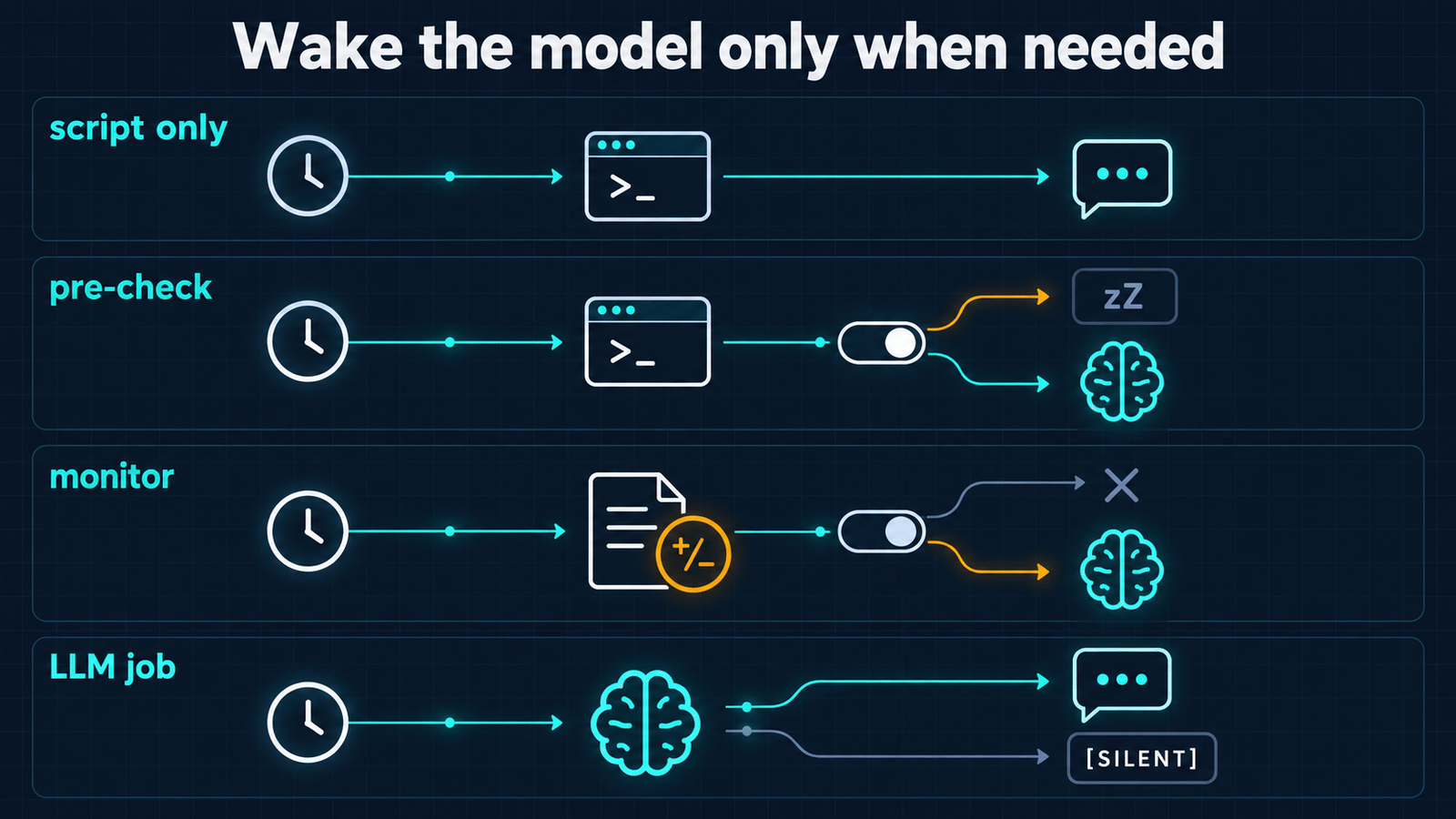
| Situation | Mode | How it stays silent |
|---|---|---|
| Text is known in advance; alert watchdog | no_agent: true + script |
empty stdout or {"wakeAgent": false} |
| Fresh data needed, real work is rare | script pre-check |
last line {"wakeAgent": false} |
| "Tell me when this changes" | monitor (script or URL) |
unchanged output skips the agent run |
| The model decides, but not always reports | LLM job | reply exactly [SILENT] |
Debug by layers
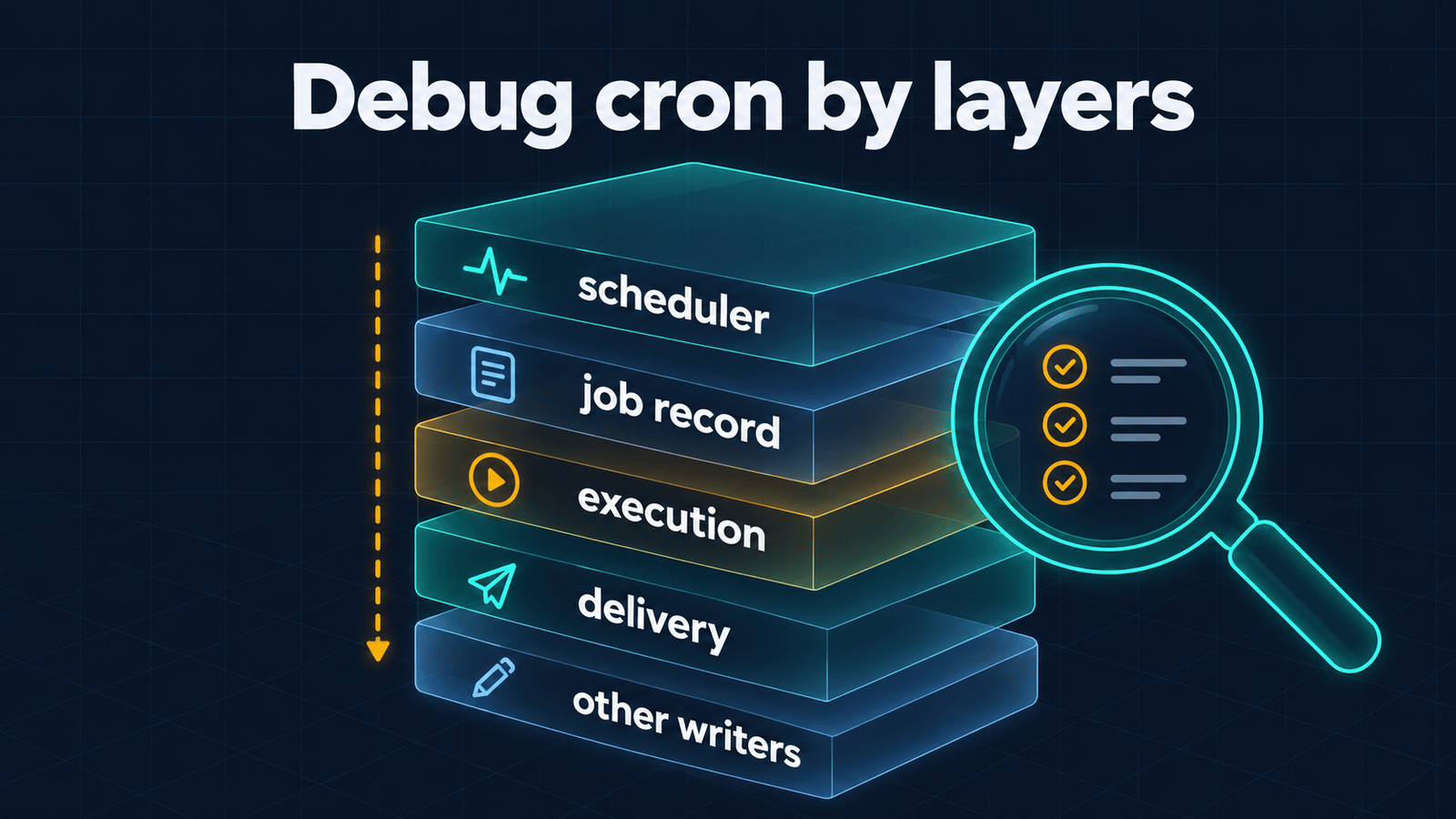
When a job misbehaves, the skill walks the layers top to bottom instead of rewriting the schedule:
is the scheduler ticking, is the record consistent, was there an attempt, was the result delivered,
and did a sync or deployment overwrite the change.
Install
Pick one. Option 1 is the usual choice: the skill lands in ~/.hermes/skills/ and the agent picks it
up from its description.
1. As a regular skill (recommended)
hermes skills install itpartypattaya/hermes-cron/skills/hermes-cron
2. As a portable plugin (Agent Plugins v1 package: plugin.json + skills/)
hermes plugins install itpartypattaya/hermes-cron --no-enable
hermes plugins enable hermes-cron
Plugin skills are read-only and namespaced. They are not listed in the system prompt; the agent finds
them through skills_list and loads them with skill_view.
3. Manually
git clone https://github.com/itpartypattaya/hermes-cron.git
cp -r hermes-cron/skills/hermes-cron ~/.hermes/skills/
Use it
Ask the agent in plain words; the skill covers the rest.
- "Remind me in 30 minutes to call the bank." → a one-shot
in 30m, verified, with the exact time. - "Pause the morning digest until Monday." →
pause, plus who resumes it on Monday — Hermes has no
scheduled resume for recurring jobs — and no new duplicate job. - "Ping me only if the disk is over 90 %." → a script-only watchdog, tested for silence and for alert.
- "Why didn't the 9 am report arrive?" → doctor first, then the layer that broke, then the fix.
The doctor
python3 ~/.hermes/skills/hermes-cron/scripts/cron-doctor.py              # all jobs
python3 ~/.hermes/skills/hermes-cron/scripts/cron-doctor.py --job <id>   # one job + recent runs
python3 ~/.hermes/skills/hermes-cron/scripts/cron-doctor.py --json       # for automation
python3 ~/.hermes/skills/hermes-cron/scripts/cron-doctor.py --no-builtin # skip `hermes cron doctor`
python3 ~/.hermes/skills/hermes-cron/scripts/cron-doctor.py --profile work # jobs of a named profile
Inside the skill the path is "${HERMES_SKILL_DIR}/scripts/cron-doctor.py", so it works wherever the
skill is installed. The doctor runs the built-in hermes cron doctor when the CLI is found (PATH,~/.local/bin or HERMES_BIN) and adds what it does not check:
- ticker heartbeat and last successful tick, with the PID that wrote the stamp, and the error of a
failed tick (ticker_last_error); - a one-line count of jobs by state (
summaryin--json); - disabled, paused and half-paused jobs — the built-in check looks at active jobs only;
- duplicate ids, malformed entries, unknown schedule kinds,
no_agentwithout a script, failure streaks; - the delivery outcome of each job's latest completed run and open failure incidents from
executions.db(ordered by the real instant, not by timestamp text); - the same error in three or more jobs within 24 hours, reported once as a scheduler or host fault
(shared_failuresin--json). Per-job fields hide it: they reset on the next good run, and a
failed dispatch may open no incident at all. Run ids, timestamps, measured durations and PIDs are
masked before grouping; interruptions by a gateway restart are not counted; - pinned models and thread-less delivery into chats that use threads;
- a cron store this user cannot write, or one with less than 100 MB free: Hermes 0.21.6+ skips due
jobs it cannot record. The check reads permission bits and free space and creates no file; - the sticky
last_failure(0.21.6+) of a job that has recovered since, as a note; - a pause Hermes 0.22.4+ set itself after a fire it could not verify — resuming it by hand before
readinghermes cron runs <id>may run the job twice; - agent jobs that a headless
hermes cron tickskipped because no gateway was ready: two or more are
one fault (skipped_firesin--json), and their overdue slots are not reported one by one; - a delivery still
queuedan hour after its run (0.22.4+ writes the outcome back once the gateway
drains), as a note; - a
bot-chat:<profile>delivery parked until the target profile runs, which Hermes books asdelivery_failed, as a note instead of "not delivered"; - a
scriptthat is a shell command line (echo hi), which 0.22.4+ refuses on create and update.
Without the CLI, and always for --job, it performs the basic checks itself: failed last run, undelivered
result, a missing or overdue next_run_at, a failed dispatch, a script outside the scripts directory or
missing (with a hint when it is a command line), a missing working directory. A built-in doctor that crashes, or a run history that exists but
cannot be read, is a finding, not a note. Exit codes: 0 healthy, 1 findings (--job
included), 2 unreadable runtime state, 3 invalid arguments or an unknown job; with --json, errors
are JSON too.
== Scheduler ==
  heartbeat: 12 s ago, PID 41873
  successful tick: 12 s ago

== Built-in hermes cron doctor ==
  ✓ Cron doctor found no issues
    Checked 5 active job(s).

== Jobs ==
  7 total · 4 enabled · 1 half-paused · 1 paused · 1 completed
  …

== Findings ==
  🔴 3f2a9c1d7e44 "Weekly report": enabled=true with a pause marker — Hermes will not run it,
     yet `cron list` shows it as scheduled; pause or resume it properly

== Notes ==
  ℹ️ 8b1e6d0a2f93 "Nightly digest": pinned model (model-x · provider-y) — does not follow
     `hermes model` and does not use the global fallback chain
Safety and privacy
- Read-only. The doctor never ticks, runs, edits or removes a job.
- No network access and no API keys. The only subprocess is the local
hermes cron doctor, started
as an argument list without a shell. Hermes' own job loader, like every scheduler tick, may repair
malformed entries injobs.json. - It reads
~/.hermes/cron/jobs.json, the ticker stamps andexecutions.db(opened read-only). It
writes nothing and does not read the gateway's admission journals or parked deliveries. Like any
SQLite reader of a WAL database it may create the-shm/-walfiles Hermes itself uses; without
write access tocron/it reads the main file without locks and says so in its notes. A database
that is locked by a writer is reported as unreadable, not read around. - The skill registers no tools, hooks or middleware and needs no environment variables.
Compatibility
Written against Hermes Agent 0.21.5 and checked against 0.21.6, 0.22.0, 0.22.2, 0.22.4, 0.22.5 and 0.23.3:
in 30mis one-shot;30mandevery 30mrepeat;every monday 9amandweekdays at 9ambecome
cron expressions;- jobs follow
cron.modelor the main model at fire time unless pinned; - since 0.21.6,
enabled_toolsets: []means a job with no tools, not the default set; such a job goes
back to the default set only by recreating it (since 0.23.2 the web dashboard keeps a stored[]); - the agent tool is
cronjob_manage(old namecronjob) and is loaded on demand throughtool_search; - one gateway serves every profile; a named profile's jobs live in
~/.hermes/profiles/<name>/—--profile <name>points the doctor there; - a job runs only when
enabledis true and it carries no pause marker; - the ticker heartbeat is
<epoch> <pid>(older<epoch>stamps are still read); - since 0.22.4 agent jobs run through the gateway that owns the store:
hermes cron tickfrom an external
scheduler runs onlyno_agentjobs while no gateway is ready, and a fire Hermes cannot verify pauses
the job until it is reconciled; - since 0.22.4
scriptmust be a file underscripts/; a command line is refused; - since 0.22.6 a manual run is an extra fire (it spends neither the next slot nor a
repeatcount),hermes cron cancelstops a live run, a job can carry its owntimezone,catch_upandgrace_minutes, and skipped slots are booked asmissedruns, which the doctor does not count as
failures; - since 0.23.2 error text in
jobs.jsonandexecutions.dbis redacted and cut to 2000 characters, so
the doctor shows it that way.
On an older Hermes, check flags with hermes cron create --help before following the examples.
Scope
The skill covers the standard Hermes cron contract and assumes no repository, user, chat, timezone or
delivery target. GitOps snapshots, three-way merges, persistent configuration and organization-specific
alert routing are out of scope; keep them in a separate local skill loaded alongside this one.
Repository layout
plugin.json                      # Agent Plugins v1 manifest
skills/hermes-cron/
  SKILL.md
  scripts/cron-doctor.py
  references/reference.md
  references/troubleshooting.md
tests/test_cron_doctor.py        # stdlib unittest, no network
contract/test_core_contract.py   # the doctor on a store real Hermes core wrote
docs/                            # images used by this README
Development
python3 -m unittest discover -s tests -v
The unit tests build jobs.json and executions.db by hand. CI also runs contract/ against the latest Hermes
release: the core itself creates, pauses and runs no-agent jobs, and the doctor must read that store with no
false findings and with every planted fault found. Locally it needs Hermes core installed in the same Python:
python3 -m unittest discover -s contract -v
Issues and pull requests are welcome.
Author
Anton Vaskov — Telegram @passone, GitHub itpartypattaya.
License
Yorumlar (0)
Yorum birakmak icin giris yap.
Yorum birakSonuc bulunamadi