tokenchit
Health Warn
- License — License: MIT
- Description — Repository has a description
- Active repo — Last push 0 days ago
- Low visibility — Only 5 GitHub stars
Code Fail
- rm -rf — Recursive force deletion command in .github/workflows/ci.yml
- network request — Outbound network request in apps/site/app/api/auth/github/route.ts
- exec() — Shell command execution in apps/site/app/api/card/[handle]/route.ts
Permissions Pass
- Permissions — No dangerous permissions requested
No AI report is available for this listing yet.
Read your local AI coding agent logs and render a stat card into your repo.
tokenchit
Turn your local AI coding agent logs into a stat card you commit to your README.
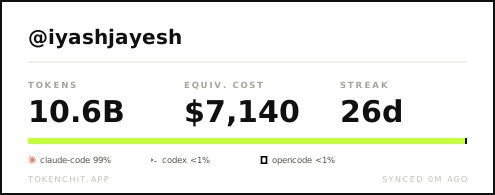
That card is this repository's own, generated by the command below and committed as a file.
It is not a screenshot and not a hosted image — which is the whole point.
npx -y @tokenchit/cli@latest generate
One command: it finds your agents, shows your stats, writes the card, and puts you on the
board — announcing each step before it happens. The scan names each agent and counts as it
goes, so a slow disk looks like progress rather than a hang.
Running it often? npm i -g @tokenchit/cli and then tokenchit generate, which skips npx's
registry check on every run.
  ┃ [1/3]  DETECT AGENTS
  ┃   ● claude-code   ~/.claude*/projects/**/*.jsonl
  ┃ ✓ 3 agents, written to .tokenchit.json
  ────────────────────────────────────────────────────────────

  ┃ [2/3]  YOUR STATS
  ┃   10.6B    $7,140        25d      49
  ┃   TOKENS   EQUIV. COST   STREAK   ACTIVE DAYS
  ┃
  ┃   30d  ▅▁▁··▄▆▆▆▅▁▃▅█▃▂▄▂▁▅█▆▂█▇█▅▄█▇  3.4B in 7d
  ┃ ✓ wrote tokenchit.svg
  ────────────────────────────────────────────────────────────

  ┃ [3/3]  THE BOARD
  ┃ ✓ published as @iyashjayesh — tier: verified
Why this one
The card is a file, not a URL. Every comparable tool serves cards from a hosted endpoint,
so the image in your README depends on someone else's uptime and rate limits. The canonical
project in this genre says of its own service: "best-effort and can be unreliable due to rate
limits and traffic spikes", and clamps cards to 12–48 hour caches to survive its API budget.
A committed SVG has none of that. GitHub serves it directly, it renders instantly, and it
keeps working if this site goes away.
Nothing leaves your machine unless you ask. sync and recap make no network request at
all. publish is the only command that uploads, it sends daily totals and model names, and--dry-run prints the exact bytes so you can check that yourself rather than take our word.
The reading is honest about what it cannot see. Agent logs get rotated, prices change, and
some models have no public price at all. Where a number is incomplete, the tool says so
instead of quietly rounding the gap away.
npx -y @tokenchit/cli@latest recap # the year in review, a second committable SVG
What it reads
| Agent | Source |
|---|---|
| Claude Code | ~/.claude/projects/**/*.jsonl |
| Codex | ~/.codex/sessions/**/rollout-*.jsonl |
| OpenCode | ~/.local/share/opencode/opencode.db |
All Claude Code configuration directories are read, not just ~/.claude. Anyone with more
than one account has several — ~/.claude-work, ~/.claude-personal and so on — and reading
only the first silently omitted most of the usage. CLAUDE_CONFIG_DIR is added to that scan
rather than replacing it: it names the directory the current session uses, which is a
different question from where all your usage lives.
Why the total differs from Claude Code's Stats panel
Expect Claude Code's panel to read roughly twice as high. Two separate things cause that,
and only one of them is a limitation on this side.
The Stats panel counts each API call once per streaming rewrite. Claude Code rewrites an
assistant message in the transcript as it streams, so one call leaves several usage records
carrying the same growing figures. stats-cache.json sums them as written. On one machine,
51,373 usage records represented 23,644 real API calls, and the cache matched the naive sum of
all 51,373 to the exact token on 28 of 57 days — and matched the deduplicated total on none.
tokenchit collapses those to one row per call. That is safe to do: every message id observed
more than once carried exactly one requestId, without exception, and deduplicating bymessage.id and by requestId independently agreed to within 0.002%. Counting them again
would invent tokens nobody was billed for.
Claude Code also deletes old transcripts. The Stats panel keeps reading the cumulative
cache after the underlying transcripts are gone, so it covers a longer period than any
transcript parser can see. On the same machine the cache reached back to June while the
oldest surviving transcript was early July.
That second one is a real limitation, not a bug: a number derived from logs cannot include
logs that no longer exist. The cache is not a usable substitute, because it carries the
inflation described above and the factor varies day to day — between 1.15x and 2.18x on the
days measured — so there is no constant to divide out.
Why not just report the panel's number? Three reasons, and each is enough on its own.
It is not billed tokens — it is records summed. Adopting it would mean publishing a figure
nobody was charged for.
It exists only for Claude Code. Codex and OpenCode have no equivalent cache, so a total that
mixed one inflated agent with two honest ones would be incoherent, and on the board someone
whose cache happened to survive would outrank someone whose did not, for identical work.
It would fail this project's own validation. Submissions are bounded by cost per token, with a
floor at the cheapest cache-read rate any model offers. Roughly doubling the tokens while the
cost stays real pushes that ratio below the floor, and the payload is rejected.
What is reported is the coverage gap, because it can be stated exactly: sync prints how
many days of transcripts are on disk against how many days the cache remembers.
And there is one correction that can be made honestly. On days where both sources exist, the
cache's figure divided by the deduplicated figure is how much this machine's cache
overstates. Apply that median ratio to the days only the cache has, and the result estimates
what the deleted transcripts held — derived from the machine's own overlap rather than from a
constant:
    its panel  27.8B
    this       10.7B  claude-code only
    days       41 of 98
    estimate   ~14.4B  including 35 deleted days, at this machine's own 1.87x overlap
               per-day ratios ranged 1.04x to 4.92x, so treat it as a range
Days that cannot calibrate are excluded rather than averaged in: a ratio below 1 means the
cache lagged, and a very large one means that day's transcripts are already partly rotated, so
it measures the loss being estimated rather than the inflation. Without at least five
calibratable days there is no estimate at all — silence beats a guess.
The estimate is shown and never published. The board ranks what can be checked.
Copilot CLI and Gemini CLI are detected but cannot be counted. Copilot records only a
live context-window gauge, never a cumulative total; Gemini's chat transcripts carry no token
counts at all. init says so out loud rather than silently omitting them — if either starts
writing usage, they become adapters.
Nothing but token counts, model ids and timestamps is read. No prompts, no completions, no
file contents, no paths leave the aggregation.
Equivalent API cost is not spend
The dollar figure is what your tokens would cost at list API rates — not what you paid.
Most agent usage runs under a subscription where no per-token charge ever happens. Models
with no public price (bundled or self-hosted ones) are counted in the token total and left
out of the cost, and sync tells you what share of tokens the figure actually covers:
! Cost covers 99.6% of tokens — no public price for: qwen3-coder-next, big-pickle
Prices are vendored from LiteLLM and refreshed by a
maintainer with node packages/core/scripts/refresh-prices.mjs. The CLI itself never makes
a network request.
Commands
One command does the lot:
npx @tokenchit/cli@latest generate
It detects your agents, shows your stats, writes the card, and puts you on the board — each
step announced before it happens. --no-publish stops after the card.
The steps are also commands in their own right, and generate is a composition of exactly
those, so running them separately does identical work. sync shows you everything before
anything leaves the machine.
tokenchit generate       the whole flow, below, in order
  --no-publish           stop after writing the card

tokenchit init           say who you are
  --handle <name>        GitHub handle (default: guessed from your origin remote)

tokenchit sync           read your logs, show your stats, write the card
  --out <path>           where to write it (default: tokenchit.svg)
  --layout default|compact
  --theme auto|light|dark
  --json                 print the aggregate instead of writing an SVG
  --dry-run              report what would be written, write nothing

tokenchit publish        put your row on the public board
  --anonymous            publish without signing in; the row is marked unverified
  --dry-run              print the exact bytes and send nothing
  --api <url>            default https://tokenchit.app
  --handle <name>

tokenchit recap
  --out <path>           default: tokenchit-recap.svg
  --year <yyyy>          label the recap with a different year
  --theme auto|light|dark
  --json                 print the recap model instead of writing an SVG
  --dry-run

tokenchit schedule       print a cron or launchd entry; installs nothing
  --every daily|hourly   how often to publish (default: daily)
  --cron                 force a crontab line even on macOS

tokenchit login          prove your GitHub handle (device flow, no password)
tokenchit logout         forget this machine
tokenchit whoami         who this machine is signed in as
tokenchit help <command> explains one command on its own. NO_COLOR=1 drops colour and
animation.
publish signs you in on the way through, so login is rarely needed on its own — an
unverified row is seldom what anyone wants, and being told to go and run another command
first is how people end up with one. That only happens at a terminal: in CI or a cron job
nobody can read a device code, so it publishes unverified rather than hanging. --anonymous
is the same choice made deliberately.
Keeping a row current
Publishing is not automatic, and it cannot be made automatic anywhere but this machine: the
logs are local and exist nowhere else, so a GitHub Action has nothing to read. tokenchit schedule prints a launchd or cron entry that runs publish on a timer.
It prints and stops. Installing a background job that survives reboots and keeps sending data
is not something to do on someone's behalf because they typed a word that sounded convenient.
The recap
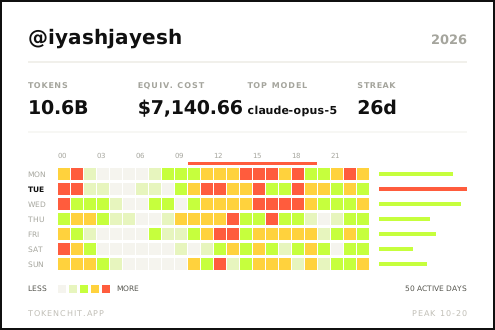
recap renders a weekday-by-hour heatmap of when you actually work, alongside your totals,
top model and streak — in the terminal and as a second committable SVG:
       00    06    12    18
  MON  ▓▓     ░░▓▒░▓▓▒▒█▓▓▒░▒▓▒   71%
  TUE  ▒▒░░  ░░ ░░█████▓▓█▓░      86%
  WED  ░░        ░██▓░████▒░  ░   89%
  SUN  ███▓░     █▓█▒▓█ ▒▒█▒▒▒▓  100%

  peak 11:00-20:00  ·  37 active days
Cells are coloured by rank across the distinct values, the way GitHub's contribution
graph works, not by magnitude. Token counts are violently skewed — one long session can hold
more than a quiet week — so a linear scale paints a single square hot and leaves the rest
indistinguishable.
Codex only records a running total per session, so its hours land on the session's last
turn. Claude Code and OpenCode are exact to the message.
sync writes the SVG and stops — committing on your behalf is your call, not the tool's.
Publishing to the board
publish is the only command that sends anything anywhere. sync and recap are local
forever, and there is deliberately no config switch to change that: .tokenchit.json is a
committed file, and a committed file must never be able to cause a network call on somebody
else's machine.
--dry-run prints the exact bytes that would be uploaded — the same string, not a rendering
of it, which dryrun.exact in the test suite enforces by comparing against what a real
publish puts on the wire. The payload is aggregates only: totals, per-day token counts, agent
and model ids. No prompts, no replies, no branch names, no paths.
How the board ranks
Verified rows first, then tokens over the selected window.
Signing in is the only thing that ties a row to a GitHub account, so it is the only thing that
can carry a position. An unverified row still appears and still shows its figures; it simply
cannot outrank a verified one. A tier that is displayed but never affects the ordering is
decoration — it told you nothing about the ranking you were reading.
Submissions far outside the range of real usage are held for review: stored, returned to
their owner, and kept off the board until a person looks. The threshold is half the hard
rejection limit — about 1.6x the busiest day in the corpus these figures were measured
against — and publish says so out loud rather than leaving someone refreshing a board they
will never appear on.
The flagged column has existed since the first migration and, until this was added, nothing
ever wrote to it. The board query already refused to show flagged rows; there was simply no
code path that could set one.
Signing in
$ tokenchit login
  Open  https://github.com/login/device
  Code  WDJB-MJHT
  opened your browser, copied the code — the code should already be filled in
✓ signed in as @octocat
GitHub's device flow — no password, no token to paste, and no localhost callback server,
which matters because the usual OAuth-in-a-CLI approach breaks over SSH, in containers and on
remote dev boxes: exactly where people run coding agents.
Why not the redirect flow. GitHub requires a client_secret at the token exchange even
with PKCE, which it added in July 2025 — it does not distinguish public from confidential
clients. Shipping that flow in a public npm package would mean publishing the secret. GitHub's
own gh reaches for a localhost callback only as a fallback for Enterprise hosts without
device flow, and embeds a secret to do it.
The code is copied and the page is opened with it pre-filled, so there is nothing to
retype. Both are conveniences layered over output that stands on its own: the URL and the code
are printed first, and stay correct when a container has no clipboard tool or xdg-open opens
a window nobody is looking at. --no-clipboard and --no-browser turn them off; neither runs
without a TTY.
The code is always shown, even when the page is pre-filled. RFC 8628 §3.3.1 requires it, and
§5.4 explains why: confirming the code is how you know the device asking for access is the one
in front of you.
GitHub does not return verification_uri_complete, so the pre-filled URL uses a user_code
query parameter the verification page accepts but does not document. That is why it is used
for the browser launch only, and never printed in place of the URL GitHub actually sent.
No scopes are requested. GitHub answers GET /user for an unscoped token, and your login
and numeric id are all we need.
The GitHub token is handed to the server once, so that the server — not the client — is
what asks GitHub who you are; a client that simply asserted {"handle": "octocat"} would be
forgeable. It is then discarded, never written to disk on either side. What you keep is a
tokenchit API key in ~/.config/tokenchit/auth.json, mode 0600, stored server-side only as
a SHA-256 hash. Never in .tokenchit.json, which is committed.
Without signing in, submissions land as the unverified cli tier. Those rows appear on the
board with a badge rather than being hidden — a transparency signal, not a gate. Signing in
upgrades the handle to verified, and takes it over from any unverified row that claimed it
first.
Running the board locally
The board runs against Supabase — there is no local database to start.
cp apps/site/.env.example apps/site/.env.local   # then fill in the password
npm run db:migrate                               # idempotent; safe to re-run
npm run dev

npx @tokenchit/cli login   --api http://localhost:3000
npx @tokenchit/cli publish --api http://localhost:3000
.env.local is gitignored; apps/site/.env.example documents the shape. Next reads.env.local automatically and the migration runner reads the same file, so the site and the
migrations cannot end up pointing at different databases.
Use the shared (transaction) pooler on port 6543, not the direct connection on 5432.
Serverless functions open a connection per invocation and exhaust a direct connection limit
quickly; Supavisor exists for exactly that. The pool in apps/site/lib/db.ts is capped at 5
to match.
Rate limits
Writes are limited per hour, in Postgres rather than in memory — serverless functions share
no memory, so an in-process counter would reset on every cold start and count separately per
instance.
| bucket | limit |
|---|---|
| anonymous publish, per IP | 10/h |
| signed-in publish, per user | 60/h |
| publish, per handle | 30/h |
| sign-in, per IP | 20/h |
| board reads, per IP | 300/h |
Signed-in callers get more headroom than anonymous ones: they have proved who they are and
their rows carry their name. The per-handle bucket exists because the per-IP one alone is
defeated by spreading requests across addresses.
Every response carries x-ratelimit-limit and x-ratelimit-remaining, refusals addretry-after, and the CLI prints the wait rather than a bare status code.
Notes on the database
003_rls.sqlis not optional on Supabase. Supabase exposes everypublictable
through PostgREST using the anon key, which is public by design. Without row level security
enabled, that key would readapi_tokensand the entire submissions history. The migration
enables RLS with no policies, which closes that surface completely and changes nothing for
our server, which connects directly as the table owner.- Free Supabase projects pause after 7 days of low activity and need a human to click
Resume in the dashboard, with a 90-day window before the backup expires. A few requests a
day avoids it, so it bites a quiet project rather than a busy one. That is whydocs/research.md§4 prefers Neon, whose idle behaviour is
scale-to-zero with automatic resume. - Migrations are plain SQL in
apps/site/db/migrations/, applied in filename order and
tracked in a_migrationstable. There is no local Postgres: a contributor who only needs
the CLI or the card never touches a database, andnpm testrequires none.
The site
| route | what it is |
|---|---|
/ |
the pitch, with a live card preview and a board teaser |
/board |
the full ranking, with headline totals, over any of four windows |
/u/<handle> |
one developer: contribution graph, agent split, model breakdown, their card |
/api/card/<handle>.svg |
the card endpoint |
/api/submissions |
publish (POST) and read the board (GET) |
The site is measured; the CLI is not. Page views and one copy event go to Firebase
Analytics from tokenchit.app — not from previews, not from localhost. The privacy
guarantees in packages/cli/test/privacy.test.js are about the CLI, which makes exactly one
network call, to publish, and carries no analytics of any kind. Saying so here rather than
leaving someone to find a Google request in devtools and wonder what else is unstated.
The Firebase web config in apps/site/lib/firebase.ts is checked in on purpose: it is
shipped to every browser that loads the page, and Google documents the API key as a project
identifier rather than a credential.
Every column on the board and the profile is summed over the same window, which is whyuser_days carries an agent and a cost per day. Streak is the exception and is not windowed:
it is a current-streak count, and "your streak, but only counting last week" is not a thing
anyone means.
Profile pages are shareable, so they carry a PNG og:image rendered from the same figures —og:image is deliberately not set in generateMetadata, because doing so overrides the
file-based opengraph-image convention and the page would then advertise the SVG card, which
Twitter, Slack and Facebook all decline to render.
Releasing
CI runs on every pull request: build and tests on Node 22 and 24 (the OpenCode adapter
uses node:sqlite, experimental on 22 and stable on 24 — the place they are most likely to
disagree), plus lint, the standalone site build Vercel performs, and an install of the packed
tarballs, because the tarball is a different artifact from the working tree.
One published package. @tokenchit/core stays a workspace package — it is what keeps
the site and the CLI rendering the same card — but it is private and esbuild inlines it
into the CLI's single bundled file. Publishing a second package would mean maintaining a
public API surface nobody has asked for, and every rename inside it would become a
compatibility decision for strangers. Publishing core later is easy; unpublishing is not.
Publishing is version-driven. The release workflow runs on every push to main but
publishes only when packages/cli/package.json names a version npm does not already have.
Bumping the version is the release:
npm run version:set 0.2.0   # both packages, and the dependency between them
npm install
git commit -am "Release v0.2.0"
git push
CI then builds, tests, lints, creates the v0.2.0 tag and publishes. Merging anything that
leaves the version field alone publishes nothing, which is most merges — docs, the site, a
dependency bump.
This keeps what a tag-only trigger was protecting. An unpublished npm name can never be
reused by anyone, so releasing has to be deliberate; it is now an explicit edit to a version
field rather than an explicit tag. What it removes is the failure mode where the bump lands
and the tag never gets pushed, so a fix sits on main for a week believing it shipped.
The registry, not the tag, is the source of truth: the workflow asks npm whether that exact
version exists, so a re-run, a revert, or a manually pushed tag all stop quietly instead of
failing over work already done. Tests run before the tag is created, because a tag pointing
at a commit that does not build is worse than no tag.
It attaches npm provenance so the package carries a signed link back to the commit that
produced it. CI
installs the packed tarball into an empty project on every pull request and asserts nothing
but @tokenchit/cli lands, which is what stops the bundle silently regressing into a broken
dependency on the private package.
Requires an NPM_TOKEN repository secret with publish rights.
Repo layout
apps/site/          Next.js marketing site + the board API
packages/core/      adapters, aggregation, price table, SVG builder
packages/cli/       the tokenchit binary
docs/research.md    positioning, competitive landscape, infrastructure decisions
scripts/           version bump, and QA for behaviours real data cannot reach
tokenchit.svg      this project's own card, committed like anyone else's
The site and the CLI render through the same buildCardSvg(), so they cannot drift.
npm install
npm run build     # core, then cli, then site
npm test          # adapter and aggregation tests
npm run dev       # the site at http://localhost:3000
Requires Node 22 or newer — OpenCode support uses the built-in node:sqlite.
The hosted endpoint
apps/site also serves GET /api/card/<handle>.svg with layout, theme, agents, hide
and cache parameters. It renders sample data and exists to demonstrate the builder. The
supported path is the committed SVG: it costs nothing to run, cannot be abused, and — unlike
an external image — GitHub serves it directly rather than through its camo proxy.
Measured on a live public repository rather than assumed:
| in a README | rendered as | proxied |
|---|---|---|
committed SVG, relative ./card.svg |
/owner/repo/raw/main/card.svg |
no |
committed SVG, absolute raw.githubusercontent.com |
unchanged | no |
| any external image | camo.githubusercontent.com/… |
yes |
this project's own /api/card/… endpoint |
camo.githubusercontent.com/… |
yes |
Both committed forms work, so sync printing a relative path costs nothing. The <style>
block survives too — a committed theme=auto card really does follow GitHub's dark mode,
which the original design brief assumed was impossible.
Design and research
Positioning, the competitive landscape and infrastructure decisions are researched and cited
in docs/research.md. The original design prototype has been removed —packages/core/src/card-svg.ts is the card's definition now, and a second copy of the geometry
could only ever disagree with it.
Site conventions: border radius is 0 everywhere, shadows are hard offsets only, there are no
media queries, and the blinking ▌ after the install command is the only animation.
Not built, deliberately
Spend-based tier ladders, pricing, a blog, a site dark-mode toggle, and scheduled-Action
automation.
A browser session, deliberately. Sign-in happens in the terminal, and nothing on the site
is per-user — no settings, no upload form, no private page. Identity exists to stamp a row on
the board, and only the CLI can produce a row. Adding browser OAuth would mean GitHub's web
flow, which is the one flow that needs a client secret, in exchange for a header pill.
Reviews (0)
Sign in to leave a review.
Leave a reviewNo results found