roer
Health Pass
- License — License: Apache-2.0
- Description — Repository has a description
- Active repo — Last push 0 days ago
- Community trust — 10 GitHub stars
Code Fail
- rm -rf — Recursive force deletion command in .github/macos/fetch-tmux.sh
- network request — Outbound network request in .github/macos/fetch-tmux.sh
- rm -rf — Recursive force deletion command in .github/macos/prepare-bundle.sh
- rm -rf — Recursive force deletion command in .github/windows/package-cli.sh
- rm -rf — Recursive force deletion command in .github/windows/prepare-installer.sh
Permissions Pass
- Permissions — No dangerous permissions requested
No AI report is available for this listing yet.
A workspace for terminal coding agents: run any agent CLI, review its changes from diff to merged PR, and let it draw the UI you need beside the session.

roer
Roer is a workspace for terminal coding agents.
- Run any agent CLI.
- Review its changes, from diff to merged PR.
- Let it draw the UI you need, beside the session.
Latest build: v0.8.4.
Install
- Download
Roer_<version>_universal.dmgfrom the release (one build, Apple silicon + Intel, macOS 15+). - Drag
Roer.appto Applications. - Open Roer once. It puts the
roercommand on yourPATH, and a new terminal can runroer shell.
Nothing else to install: the app carries roer and the tmux it drives. On launch it links roer into ~/.local/bin, where Claude Code's installer puts claude. If your shell cannot find it there, the app asks once for your password and links it into /usr/local/bin instead. A roer you installed yourself as a regular file is left alone.
MCP server
roer mcp is Roer's MCP server, on stdio. Its tools show a UI in a session's Generative UI panel and read back the clicks on it:
- In a Roer session (Claude Code run in a Roer terminal):
show_uiandread_ui_actionsact on that session, andsave_ui/load_uikeep UIs with the project. - Any other MCP client it is added to by hand:
show_uiandread_ui_actionsonly, each naming the session to act on. - Claude Code in a plain terminal: nothing. The server connects but offers no tools and no instructions, so that session carries none of Roer in its context.
The first time the app finds Claude Code, it offers agent integrations. Roer › Agent Integrations… opens the same controls later: shared extension authoring for Codex, Pi and Junie, plus Claude Code skills and MCP. Set up, the MCP server is registered with Claude Code as roer (claude mcp add-json --scope user). It leaves the Claude app alone; roer mcp install --client claude-desktop adds it there (restart the Claude app to pick it up).
roer mcp statussays where it is registered.roer mcp installregisters it yourself, or after an uninstall.roer mcp uninstallremoves roer's entries. Removing the entry in the client itself also sticks.
Skills
Roer's Claude Code skill roer-handoff (in .claude/skills) ships with roer. Set up from the app, as above, it is linked into ~/.claude/skills, so a session in any project can hand itself over. The link points into the app, so updating Roer updates it; the app never installs anything you have not said yes to.
roer skills install installs both Roer skills for Claude Code and the portable roer-extension-authoring skill for Codex, Pi and Junie. The latter three read it from the shared ~/.agents/skills directory. --agent claude|codex|pi|junie selects one target; Codex, Pi and Junie select the same shared installation, so removing it for one removes it for all three. The authoring skill tells agents to create extension drafts outside the project's source tree. The roer ext CLI works without an MCP connection.
roer skillslists them and whether each is installed.roer skills installinstalls them yourself: from the Linux or Windows CLI, or after an uninstall.roer skills uninstallremoves them. Deleting one link by hand also sticks: the app never reinstalls a skill you removed.
A skill of the same name that you made yourself is never replaced or removed, and neither is a roer MCP entry you wrote yourself. Before deleting Roer.app, run roer skills uninstall and roer mcp uninstall; afterwards, rm ~/.claude/skills/roer-handoff and claude mcp remove --scope user roer.
From a checkout
cargo build --manifest-path cli/Cargo.toml builds roer into cli/target/debug/roer; a debug build finds scripts/roer-tmux.conf on its own. export ROER_BIN=$PWD/cli/target/debug/roer points npm run tauri dev at it.
Linux
The Linux app is not published to releases yet (the roer command is); the roer-linux artifact of a Nightly bundles run has a .deb, .rpm and .AppImage.
- Install the
.debor.rpm(it pulls intmux), or installtmuxyourself and use the.AppImage. - Unpack
roer-cli-<version>-linux-x86_64.tar.gzand symlinkroeronto yourPATH. Keeproer,roer-tmux.confandskills/together in the directory you unpack them into:roerfinds them beside itself.roer skills installthen links the skills for Claude Code, Codex, Pi and Junie, androer mcp installregisters the MCP server with Claude Code. - Using the AppImage:
export ROER_APP=/path/to/Roer.AppImage, soroer handoffcan start the app. The packages install it asroer-app, whichroerfinds on its own.
Shortcuts use Ctrl+Shift instead of ⌘ (Ctrl+Shift+T new session, Ctrl+Shift+O Go to File) and Alt+←/Alt+→ to step through commits, leaving plain Ctrl keys to the terminal.
Windows
A preview, natively in PowerShell (no WSL). Sessions run on psmux, a tmux reimplementation on ConPTY. The installers, roer-app.exe and roer.exe are signed by JetBrains.
- Run
Roer_<version>_x64-setup.exe. It installs the app and theroercommand together (roer.exewithpsmux.exe, in the app'sroer\folder) and adds that folder to your userPATH. - In a new terminal:
roer shell, thenM-hto hand the session to the app.
The .msi installs the same files but does not touch PATH: add <install folder>\roer yourself. roer-cli-<version>-windows-x64.zip is the command alone, for use without the app; keep its four files together, since roer.exe finds roer-tmux.conf and psmux.exe beside itself.
Shortcuts are as on Linux. Not there yet on Windows: C-b is taken off psmux's prefix but not yet checked with real keypresses. Between releases, the roer-windows artifact of a Nightly bundles run has the installers and the CLI zip, unsigned, so SmartScreen warns on install.
Agents
roer new starts the default agent in the new session's shell; roer new --agent <id> starts another, and --model/--effort override it once. Every installed CLI is an agent as it comes (claude, codex, pi, junie). A saved agent is a Markdown file with YAML frontmatter, the format Claude Code, opencode and Copilot use for their own agents:
---
name: Reviewer
description: Careful reviewer for PR feedback
cli: codex              # claude | codex | pi | junie | custom
model: gpt-5.5
effort: high            # translated to each CLI's own flag
permissions: ask        # ask | auto | full
args: ["--search"]
---
Review the diff. Report bugs first, style last.
~/.roer/agents/<id>.md is yours alone; <project>/.roer/agents/<id>.md is committed and shared. The body is added to the agent's instructions where the CLI takes extra ones: Claude Code and pi read it from a file, Junie gets it as --system-prompt and Codex as developer_instructions, both read in by the shell ($(cat …)) so the text itself is never typed. Keys roer does not know are kept when the app saves the file.
roer agentslists them,*marking the default;roer agents default <id>changes it (ROER_AGENToverrides it for one shell).roer agents command <id>prints exactly what the agent types into its session.roer resume <id> --agent codexresumes a Codex conversation; the Resume list shows Codex conversations beside Claude Code's.
Screenshots
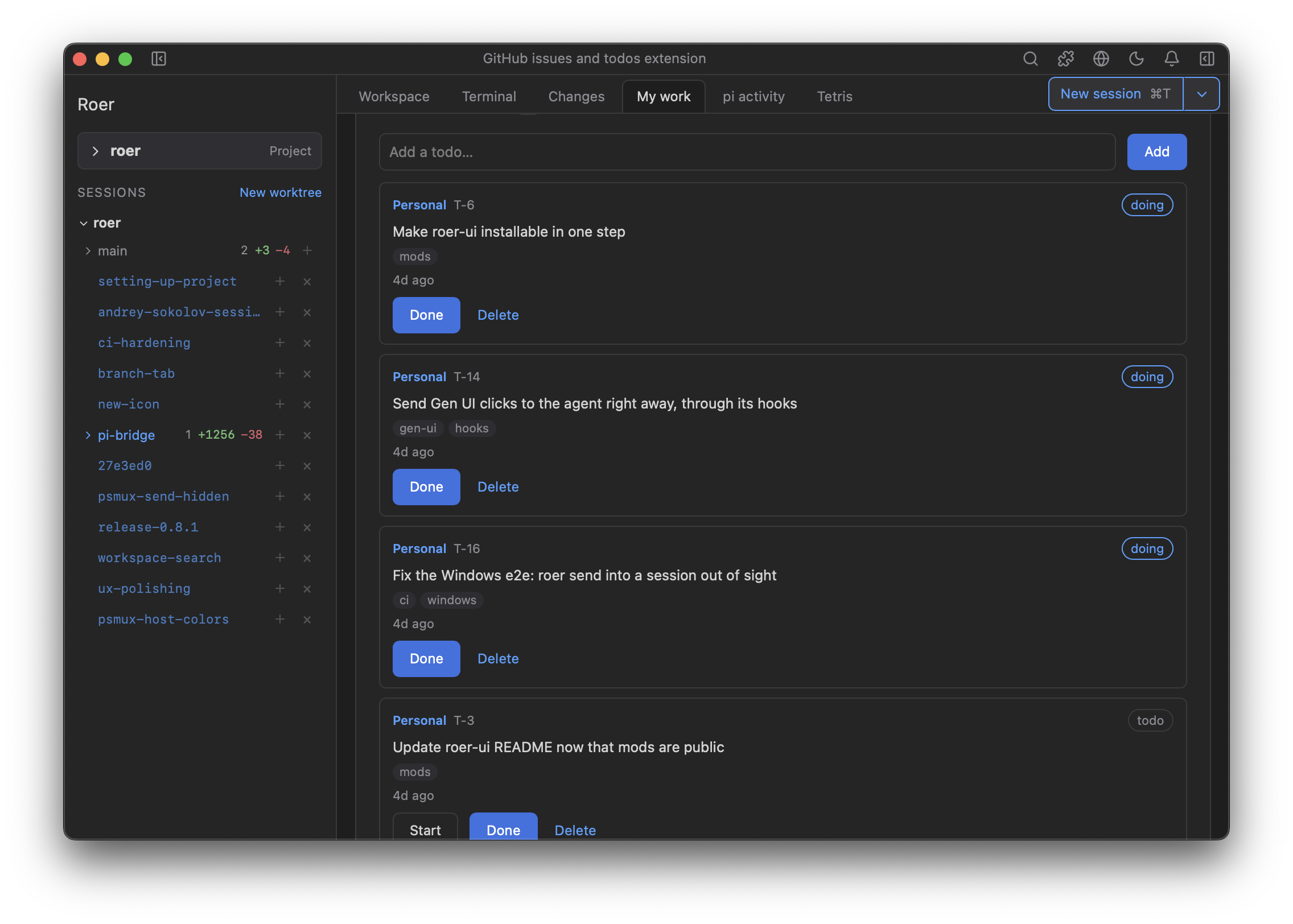
Extensions — ask an agent for a tab ("make me a tab that…") and it writes one, built from Roer's own UI components; Roer reloads it on every save. Here, a tab with GitHub issues and todos.
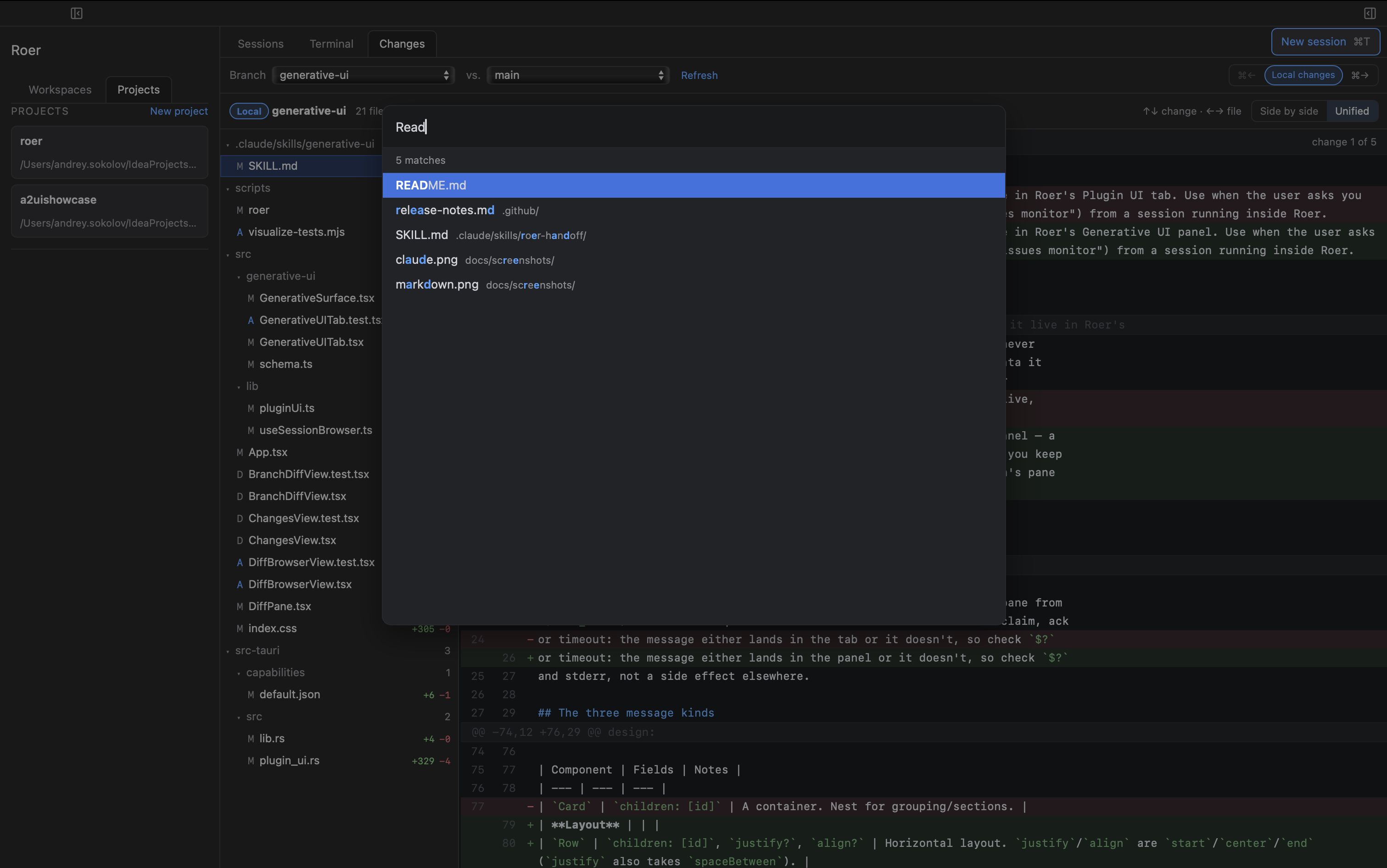
Go to File (⌘⇧O) — blazing fast, fuzzy-matched jump to any changed file straight from the diff view.
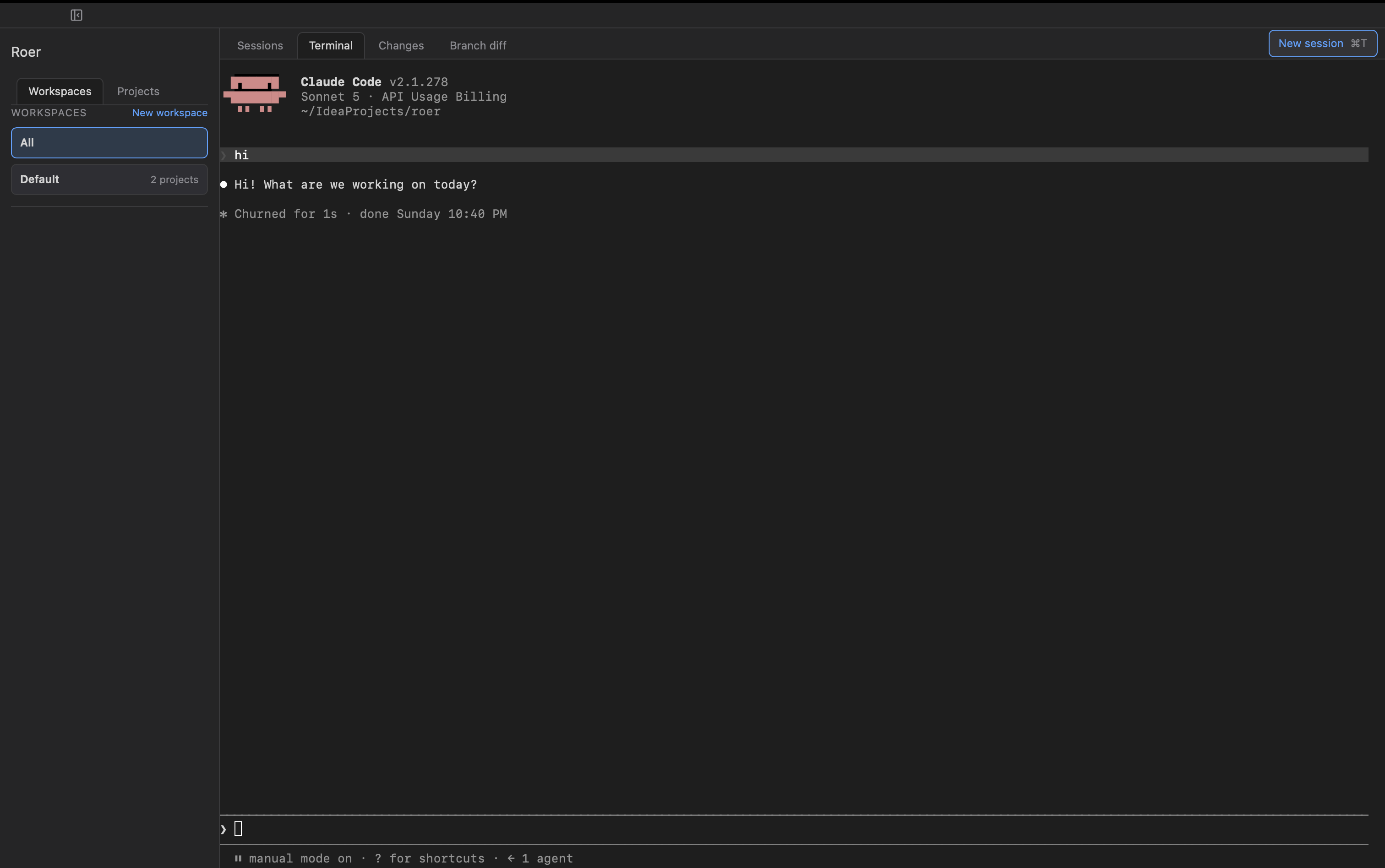
Teleported claude session — a running session hands off from the terminal to the Roer app without restarting.
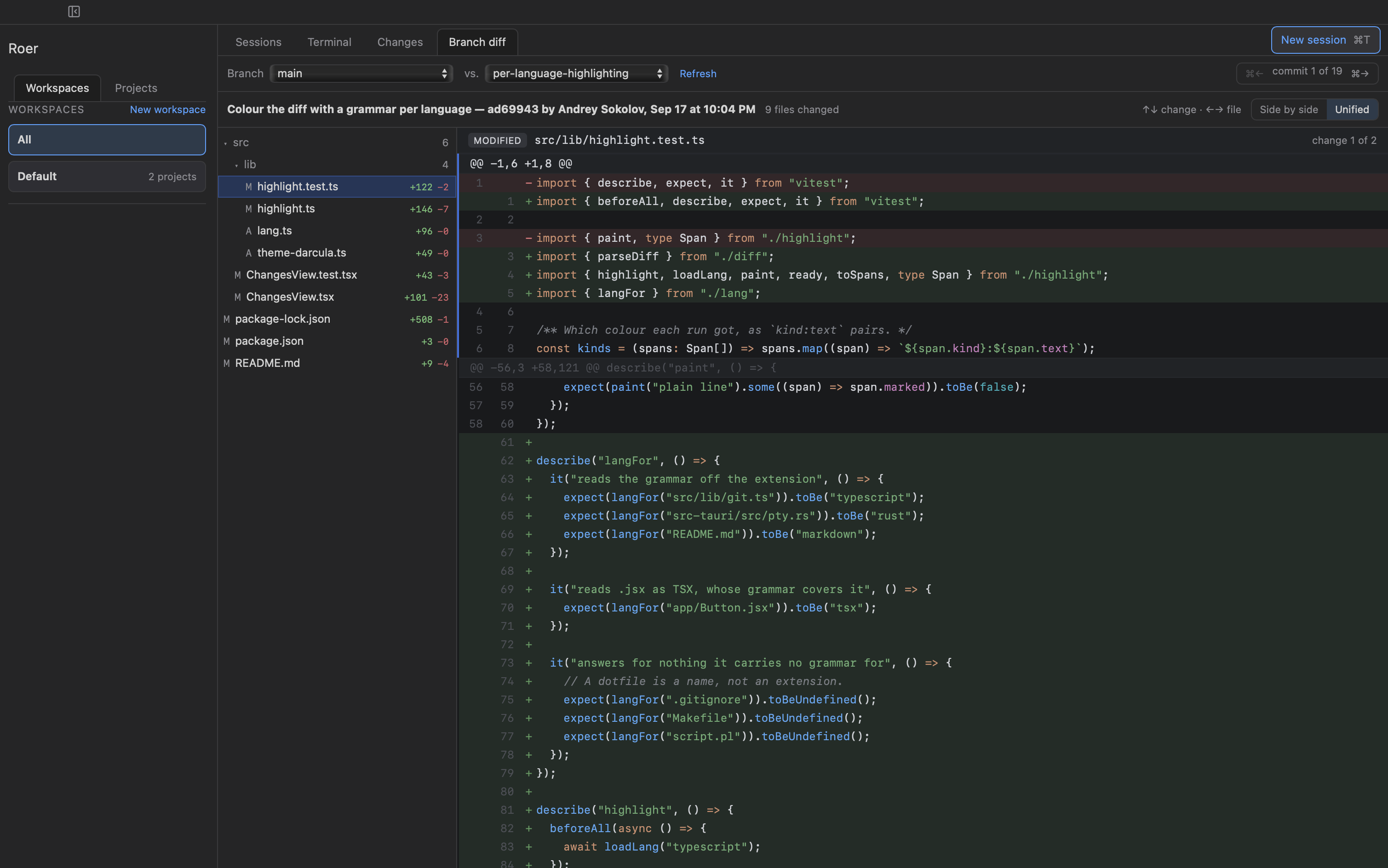
Branch diff view — step through a branch's commits against its base and view each commit's file diff.
Markdown preview — view rendered Markdown for any changed file straight from the diff view.
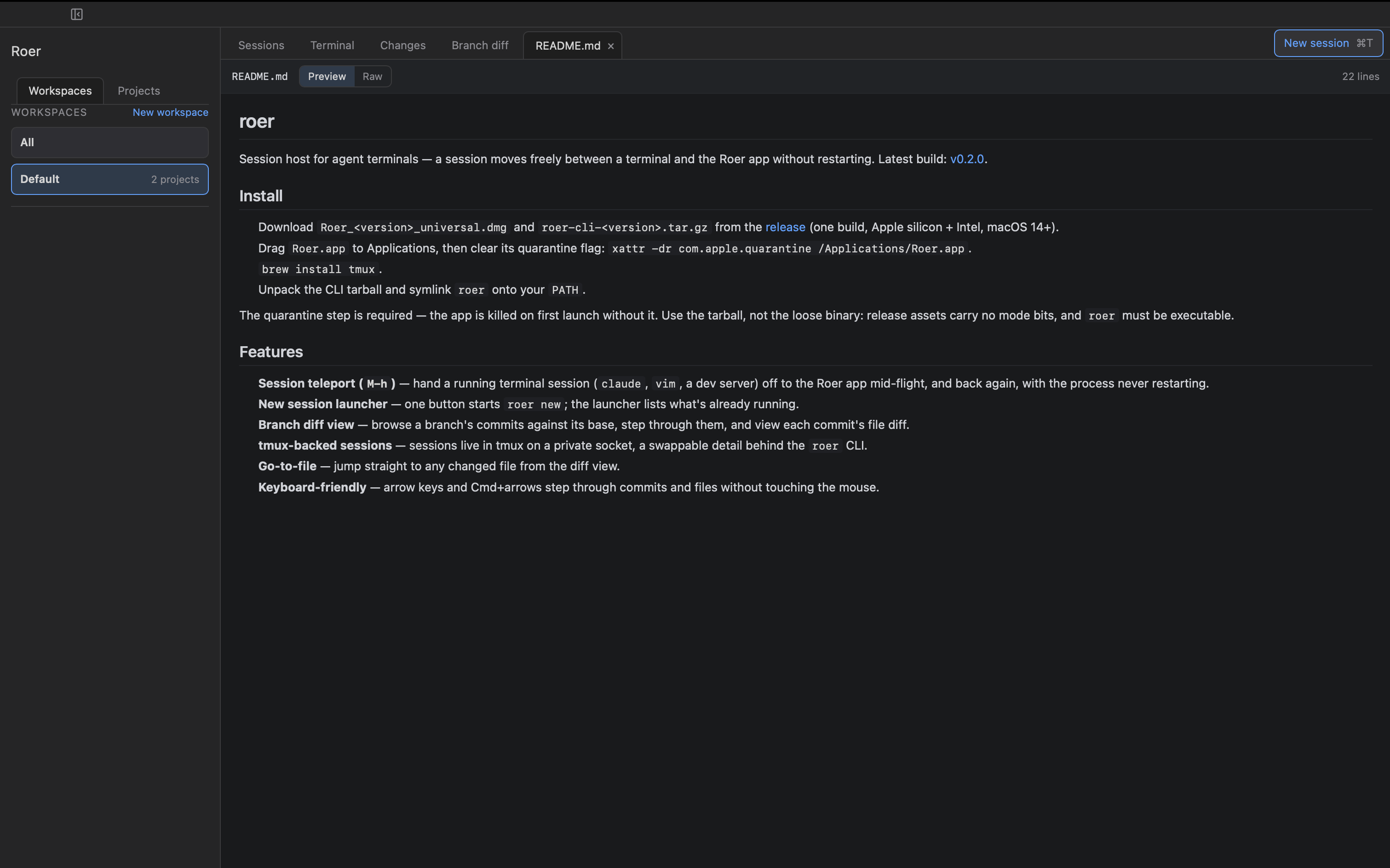
Features
- Roer extensions — ask an agent for a tab ("make me a tab that…") and it writes one, and Roer reloads it on every save. The plugins reuse the Roer UI components
- Worktrees support — start your agent in any worktree
- Agents — New session starts Claude Code, Codex, pi or Junie; the chevron beside it (
⌥⌘T) picks one, and Roer › Agents… (⌘,) saves named setups with a model, reasoning effort, permissions and instructions. See Agents. - Branch diff view — pick any branch, checked out or not, browse its commits against its base with each one's whole message, step through them, and view each commit's file diff. On the branch checked out, commit the local changes from there: leave the message empty and Claude writes one for you to read first (
roer commit-draft). - Pull request, in Changes — for the session's branch, or any other picked in Changes, through your own
ghlogin: let Claude draft the title and description, push and open the PR, request a Copilot review (Roer polls until it lands), accept, decline or instruct on each review thread right on the diff and send the decisions to the session, then merge. Under the hood it usesroer send(type a prompt into a session) androer pr-draft(the agent hands a draft back). - tmux-backed sessions — sessions live in tmux on a private socket, a swappable detail behind the
roerCLI. - Go-to — jump straight to any changed file from the diff view or to the session
- Keyboard-friendly — arrow keys and Cmd+arrows step through commits and files without touching the mouse.
Reviews (0)
Sign in to leave a review.
Leave a reviewNo results found