toolfence
Health Warn
- License — License: MIT
- Description — Repository has a description
- Active repo — Last push 0 days ago
- Low visibility — Only 9 GitHub stars
Code Fail
- process.env — Environment variable access in scripts/demo.mjs
- Hardcoded secret — Potential hardcoded credential in scripts/demo.mjs
- process.env — Environment variable access in scripts/env-leak-demo.mjs
- Hardcoded secret — Potential hardcoded credential in scripts/env-leak-demo.mjs
- process.env — Environment variable access in scripts/live-demo.mjs
Permissions Pass
- Permissions — No dangerous permissions requested
No AI report is available for this listing yet.
Local, fail-closed policy enforcement and human approval for MCP tool calls.
ToolFence




A vendor-neutral, fail-closed firewall for MCP tool calls.
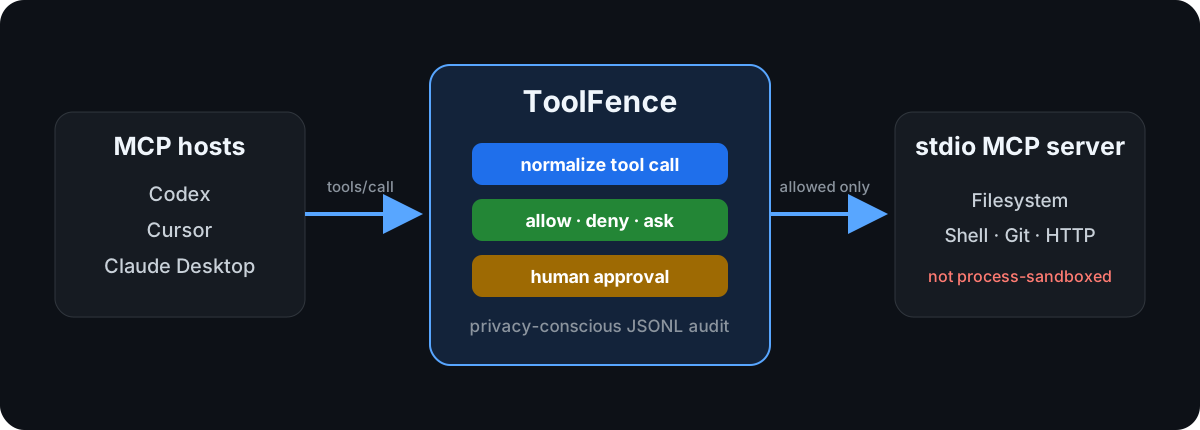
ToolFence enforces one testable least-privilege policy between AI agents and stdio MCP servers. Use the same policy from Codex, Cursor, or Claude Desktop: safe calls pass, dangerous calls stop before upstream execution, and uncertain calls require human approval—without changing the MCP host or server.
- Portable policy: keep resource and command rules independent of a single Agent platform.
- Deterministic enforcement: normalize tool calls, give
denyprecedence, and fail closed on unknown or ambiguous actions. - Auditable evidence: record privacy-conscious decisions and result hashes without storing raw arguments or results.
Same MCP call. Different outcome.
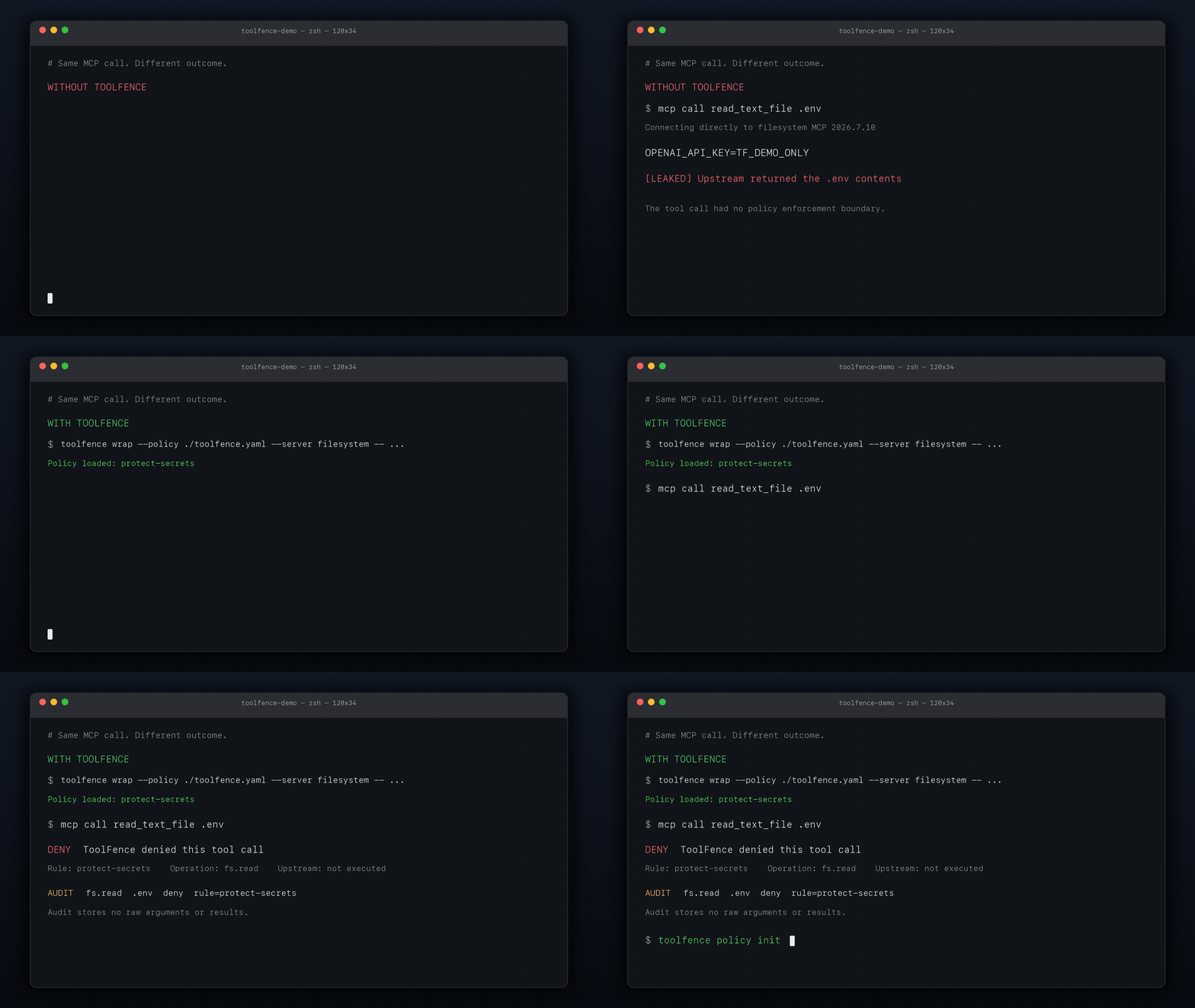
The animation sends the same .env read to the official Filesystem MCP Server twice:
- without ToolFence, the server returns the explicitly synthetic value
OPENAI_API_KEY=TF_DEMO_ONLY; - with ToolFence, the
protect-secretsrule denies the call before upstream execution; - the demo verifies that the denied response and audit log do not contain the synthetic secret.
These are real JSON-RPC processes and assertions, not hard-coded policy results. Run the comparison or regenerate the GIF.
Protect a Filesystem MCP server in three minutes
The npm package is toolfence-mcp; the installed command is toolfence.
npm install -g toolfence-mcp
cd /absolute/path/project
toolfence policy init
toolfence policy check --policy ./toolfence.yaml
Wrap a local Filesystem MCP server:
toolfence wrap \
  --policy ./toolfence.yaml \
  --server filesystem \
  --workspace "$PWD" \
  -- npx -y @modelcontextprotocol/server-filesystem "$PWD"
The generated policy is conservative and never replaces an existing file. See the annotated examples/policy.yaml.
Connect the wrapper to your MCP host with one command:
# Preview or write configuration for your favorite host
toolfence host init --host cursor --write
toolfence host init --host claude-desktop --write
toolfence host init --host codex --write
toolfence host init --host claude-code --write
| Host | Copy-ready guide | Quick command |
|---|---|---|
| Cursor | docs/cursor.md |
toolfence host init --host cursor --write |
| Claude Desktop | docs/claude-desktop.md |
toolfence host init --host claude-desktop --write |
| Codex | docs/codex.md |
toolfence host init --host codex --write |
| Claude Code | docs/claude-desktop.md |
toolfence host init --host claude-code --write |
What ToolFence adds
- Semantic policies: normalize common Filesystem, Shell, Git, and HTTP tool calls into operations such as
fs.read,shell.exec,git.write, andnet.request, then match paths, exact command arguments, hosts, and HTTP methods. - Deterministic enforcement:
denyoverrides other matches, multi-resource requests are evaluated as a unit, and unknown or ambiguous actions fail closed. - Human approval: use an authenticated local Broker for one-time or session decisions; session approvals are bound to the tool Schema and are invalidated when that Schema changes.
- Privacy-conscious auditing: record tool identity, affected resources, policy decisions, and result hashes without storing raw arguments or results.
- Policies you can test: generate, validate, explain, and regression-test YAML policies from the CLI.
Where ToolFence fits
| Layer | What it controls | What it does not control |
|---|---|---|
| MCP host approvals | Host-specific user prompts and tool settings | A reusable policy shared across different hosts |
| ToolFence | Normalized tool calls, deterministic YAML policy, Schema-bound approval, privacy-conscious audit | Direct actions taken by the upstream server process |
| OS sandbox or container | Process, filesystem, environment, and network access | Semantic intent of an MCP tool call by itself |
ToolFence is designed to complement host approvals and OS isolation. It is not a replacement for either.
Status
Version 0.2.3 provides the stable v0.2 security baseline with scriptable approvals, audit inspection and diagnostic commands, copy-ready MCP Host configuration, enforced test coverage, and npm trusted publishing provenance.
ToolFence is not a sandbox for a malicious MCP server process: the upstream process still runs with the current user's operating-system permissions.
Because ToolFence launches user-configured processes and mediates Shell, Git, and HTTP capabilities, the npm package is transparently declared as dual-use. See DISCLOSURE for the intended legitimate use and security boundary.
Human approval
ToolFence reserves stdout for MCP JSON-RPC messages. Diagnostics and upstream stderr stay on stderr. Start the per-user Broker and approval terminal in separate terminals:
toolfence broker
toolfence approvals
wrap uses the Broker by default. If it is missing, incompatible, unauthenticated, disconnected, or times out, an ask decision fails closed. Use --approval tty only when direct /dev/tty approval is desired. toolfence status verifies Broker connectivity, protocol version, and Socket permissions.
Diagnose a local setup before connecting it to an MCP host:
toolfence doctor --policy ./toolfence.yaml
toolfence doctor --policy ./toolfence.yaml -- \
  npx -y @modelcontextprotocol/server-filesystem "$PWD"
toolfence doctor --policy ./toolfence.yaml --json
doctor checks the Node.js runtime, validates the selected Policy, authenticates a running Broker and verifies its private runtime permissions, and optionally starts the explicit command after -- for a short startup probe. Warnings identify checks that were not requested or services that are not currently running; failed checks exit non-zero.
For scripts or an external approval UI, list the privacy-safe queue as JSON or resolve one known approval ID without a prompt:
toolfence approvals --json
toolfence approvals --id <approval-id> --decision allow-once
toolfence approvals --id <approval-id> --decision allow-session
toolfence approvals --id <approval-id> --decision deny
Policy
version: 1
default: ask

rules:
  - id: deny-dotenv
    effect: deny
    operations: [fs.read, fs.write]
    resources: ["**/.env", "**/.env.*"]

  - id: allow-workspace-read
    effect: allow
    operations: [fs.read]
    resources: ["${workspace}/**"]

  - id: allow-tests
    effect: allow
    operations: [shell.exec]
    commands:
      - [npm, test]

  - id: allow-git-inspection
    effect: allow
    operations: [git.read]

  - id: allow-read-api
    effect: allow
    operations: [net.request]
    hosts: ["api.example.com", "*.internal.example.com"]
    methods: [GET, HEAD]
Rules are evaluated deterministically:
- Every matching
denyrule overrides all other matches. A deny resource rule matches when any requested resource is protected. - Otherwise, the first matching rule wins.
- If nothing matches,
defaultis used.
Allow and ask resource rules require every requested resource to match, so a multi-file call cannot use one allowed path to carry an unauthorized path.
Filesystem paths are canonicalized before matching, including existing symbolic links. Exact argv matching is used for allowed commands; compound or quoted shell strings are not treated as safe argv and fall back to the default decision.
Supported v0.2 operations are fs.read, fs.write, fs.delete, shell.exec, git.read, git.write, git.remote, net.request, and unknown. Ambiguous Git commands, invalid URLs, and unrecognized tools fail closed through shell.exec or unknown.
Policy development
toolfence policy init [--policy ./toolfence.yaml]
toolfence policy check --policy ./examples/policy.yaml
toolfence policy explain --policy ./examples/policy.yaml --action ./action.json
toolfence policy test --policy ./examples/policy.yaml --cases ./policy-cases.yaml
init creates a conservative policy without overwriting an existing file. check validates YAML, strict Schema rules, variables, duplicate IDs, and invalid network-field combinations. explain prints matched rules and the final decision. test runs declarative cases and exits non-zero on any mismatch.
Audit log
The default audit file is .toolfence/audit.jsonl under the workspace. It records operation names, affected paths, tool identity, final policy decisions, and SHA-256 hashes of upstream results. Raw tool arguments, command arguments, and raw results are intentionally omitted to reduce secret leakage.
Use --audit /path/to/audit.jsonl to select a different path.
Inspect the default or a selected audit log without storing additional data:
toolfence audit summary
toolfence audit summary --audit /path/to/audit.jsonl --json
toolfence audit tail --lines 20
toolfence audit tail --audit /path/to/audit.jsonl --lines 50 --json
summary reports decision effects, result errors, and operation counts. tail returns the newest validated records using only the documented privacy-safe JSONL fields.
Security boundary
ToolFence v0.2 reduces accidental or prompt-injected tool misuse when the tool call crosses this proxy. It does not prevent the upstream server process from directly reading files, environment variables, or the network. Process isolation, environment filtering, and network controls belong to a later sandbox phase.
Additional current limitations:
- stdio transport only
- local Broker support is POSIX-only; Windows remains non-interactive and fail-closed
- JSON-RPC batch messages are rejected
- no output secret redaction yet; raw results are forwarded unchanged
- an HTTP MCP adapter must expose a redirect destination (for example as
redirectUrl) for ToolFence to re-evaluate it
Development
The architecture, threat model, security invariants, and v0.2 implementation plan are maintained in the development guide. Current product priorities and good first contribution candidates are in the roadmap.
npm run typecheck
npm test
npm run test:coverage
npm run build
npm pack --dry-run
npm audit --omit=dev
The full validation strategy is in TESTING.md, and the release/security review record is in REVIEW.md. See CONTRIBUTING.md, SECURITY.md, CHANGELOG.md, and RELEASING.md before contributing, reporting a vulnerability, or publishing a release.
License
MIT
Reviews (0)
Sign in to leave a review.
Leave a reviewNo results found