Apify-Congressional-Trading-Data-Scraper
Health Warn
- License — License: MIT
- Description — Repository has a description
- Active repo — Last push 0 days ago
- Low visibility — Only 6 GitHub stars
Code Pass
- Code scan — Scanned 2 files during light audit, no dangerous patterns found
Permissions Pass
- Permissions — No dangerous permissions requested
No AI report is available for this listing yet.
Congress Trading API on Apify: a Python + MCP quick-start example. Pull US Congressional stock trades and financial disclosures (House and Senate) from Python (uv) or as an MCP tool in Claude Cowork, Claude Code, Claude.ai, Cursor, and ChatGPT. Returns structured JSON.
🏛️ Congress Trading API: US Congressional Stock Trades and Disclosures in Clean JSON
The most efficient, reliable, and developer-friendly way to use the Congress Trading API.
Actor page: apify.com/johnvc/us-congress-financial-disclosures-and-stock-trading-data
Input schema: apify.com/johnvc/us-congress-financial-disclosures-and-stock-trading-data/input-schema
The Congress Trading API returns US Congressional Periodic Transaction Reports (PTRs) as clean, structured JSON. Each row is one disclosed transaction: the member name and chamber, state and district, asset and ticker, transaction type, reported amount range, transaction and notification dates, ownership, and filing IDs. Filter by member name, ticker, an exact date, or a date range. Data is normalized from official US House and Senate financial disclosure filings under the STOCK Act.
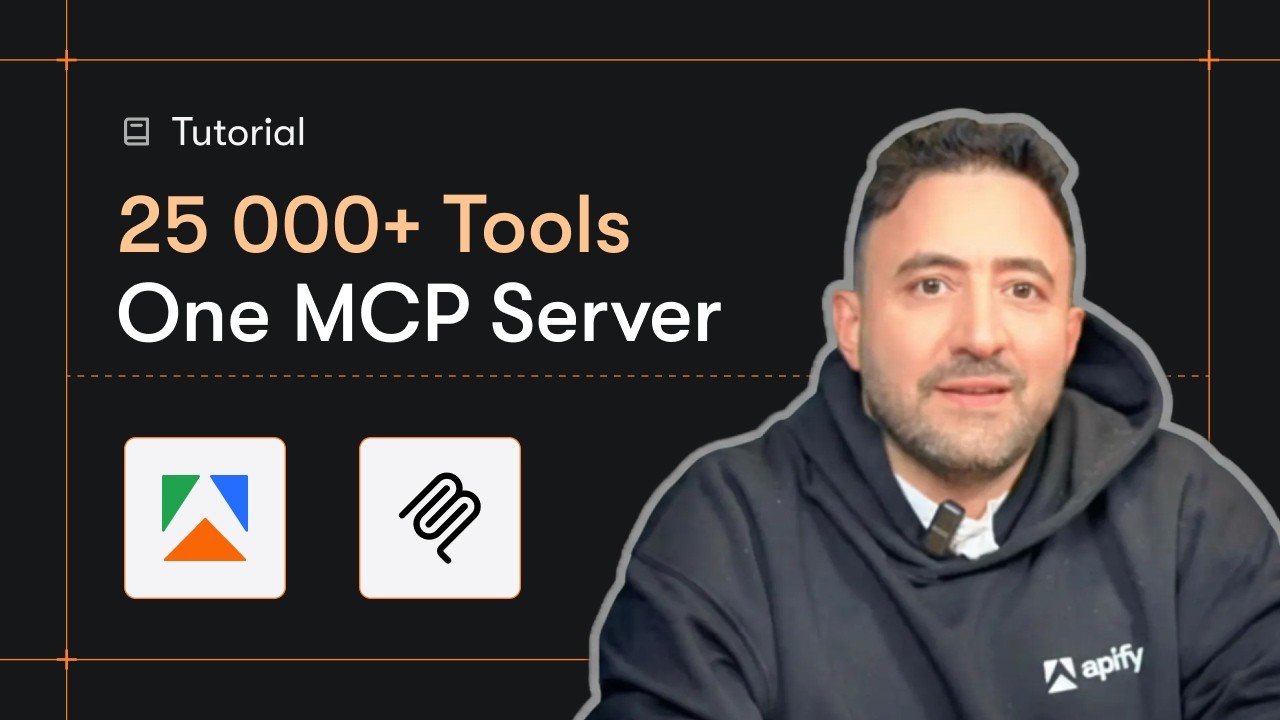
Video Walkthrough
Quick Start
Prerequisites
- Python 3.10 or higher
- An Apify account and API key (get a free key here)
Clone the repository
git clone https://github.com/johnisanerd/Apify-Congressional-Trading-Data-Scraper.git
cd Apify-Congressional-Trading-Data-Scraper
Install dependencies with UV
# Install UV if you do not have it:
curl -LsSf https://astral.sh/uv/install.sh | sh

# Install project dependencies:
uv sync
Configure your API key
cp .env.example .env
# Edit .env and add your Apify API key
# Get your free API key at: https://apify.com?fpr=9n7kx3
Run the example
uv run python congress-stock-trades-scraper.py
Alternative: set the API key directly
export APIFY_API_TOKEN="your_api_key_here"
uv run python congress-stock-trades-scraper.py
Why Use This Congress Trading API?
Both chambers, one schema. House and Senate Periodic Transaction Reports are normalized into a single, queryable shape, so you analyze all of Congress with one parser instead of two filing systems.
Powerful filters. Narrow by member first or last name, by stock ticker, by an exact transaction date, or by a date range. Combine them to answer questions like "every NVDA trade this member made in 2024."
Audit-ready structured JSON. One row per transaction, with the reported amount range exactly as filed, plus filing and document IDs and per-run search metadata for traceable, reproducible pulls.
Predictable, pay-per-use pricing. Billing is per run plus per transaction returned, with no monthly rental. You control cost directly with Max_Results.
Easy to automate. Call it from Python in a few lines, or load it as an MCP tool so assistants like Claude and Cursor can pull Congressional trades for you on demand.
Features
Core Capabilities
- Filter by member, ticker, or date (exact date or range)
- Both chambers: House and Senate filings in one dataset
- Asset types including stock, options, ETF, mutual fund, bond, and crypto
- Ownership attribution for member, spouse, dependent child, or joint holdings
- Pre-built dataset views for purchases, sales, options trades, and stock trades
Data Quality
- One row per PTR transaction with member, chamber, asset, ticker, type, amount range, and dates
- Amount ranges exactly as filed (members report brackets, not exact values)
- Filing and document IDs for tracing back to the source disclosure
- Per-run search metadata (timestamp, query timing, result count) for audit trails
- Normalized from official US House Clerk and Senate eFD filings under the STOCK Act
Usage Examples
Basic Example
The most recent disclosures across all members. This is the cheapest way to try the API.
{
  "Max_Results": 10
}
By member and date range
Every disclosed transaction for a member within a date window.
{
  "Last_Name": "Pelosi",
  "Start_Date": "2024-01-01",
  "End_Date": "2024-12-31",
  "Max_Results": 50
}
By ticker
Every Congress member who traded a given ticker.
{
  "Stock_Symbol": "AAPL",
  "Max_Results": 50
}
Input Parameters
All parameters are optional. Run with no input to get the most recent transactions; combine fields to narrow results.
| Parameter | Type | Required | Default | Description |
|---|---|---|---|---|
First_Name |
string |
No | (none) | Member first name (case-insensitive partial match). |
Last_Name |
string |
No | (none) | Member last name (case-insensitive partial match). |
Date_Reported |
string |
No | (none) | Exact transaction date, YYYY-MM-DD. Use Start/End for a range instead. |
Start_Date |
string |
No | (none) | Earliest transaction date to include (inclusive), YYYY-MM-DD. |
End_Date |
string |
No | (none) | Latest transaction date to include (inclusive), YYYY-MM-DD. |
Stock_Symbol |
string |
No | (none) | Ticker filter, e.g. AAPL, MSFT, NVDA (case-insensitive partial match). |
Max_Results |
integer |
No | 100 |
Maximum rows to return per run (1 to 1000). |
Output Format
One transaction returned as a single dataset row.
{
  "id": "3b454411-9bfb-5545-8568-b14e596503e3",
  "Owner": "SP",
  "Asset": "Palo Alto Networks, Inc. (PANW)",
  "Ticker": "PANW",
  "Asset_Type_Code": "OP",
  "Transaction_Type": "P",
  "Date": "2024-02-21",
  "Notification_Date": "2024-02-21",
  "Amount_Range": "$100,001 - $250,000",
  "Capital_Gains_Over_200": "No",
  "Details": "Purchased 20 call options with a strike price of $200 and an expiration date of 1/17/25.",
  "First_Name": "Nancy",
  "Last_Name": "Pelosi",
  "State_District": "CA11",
  "House": "House",
  "Filing_ID": "20024542",
  "DocID": "20024542",
  "Year": "2024",
  "PDF_Quality": "text",
  "created_at": "2025-09-04T13:08:13.253936+00:00",
  "search_metadata": {
    "last_name": "Pelosi",
    "max_results": 100,
    "search_timestamp": "2025-09-05T11:08:47.827456",
    "total_results_found": 10,
    "query_execution_time": 5.30
  }
}
Field reference
| Field | Meaning |
|---|---|
Transaction_Type |
P = purchase, S = sale, S (partial) = partial sale, E = exchange |
Asset_Type_Code |
ST stock, OP options, MF mutual fund, BD bond, ET ETF, CT crypto |
Owner |
SP spouse, DC dependent child, JT joint, blank = the member |
Amount_Range |
Reporting bracket, e.g. $1,001 - $15,000. Members report ranges, not exact values |
House |
House or Senate |
PDF_Quality |
text (machine-readable filing) or image (OCR-required filing) |
Use as an MCP tool
You can load the Congress Trading API as an MCP tool so assistants call it for you. The MCP server URL preloads just this one Actor:
https://mcp.apify.com/?tools=actors,docs,johnvc/us-congress-financial-disclosures-and-stock-trading-data
Authenticate with OAuth in the browser when offered, or with your Apify API token (the same APIFY_API_TOKEN used by the Python example). Get a token at https://console.apify.com/settings/integrations and a free Apify account at https://apify.com?fpr=9n7kx3 .
Install in Claude Cowork Desktop
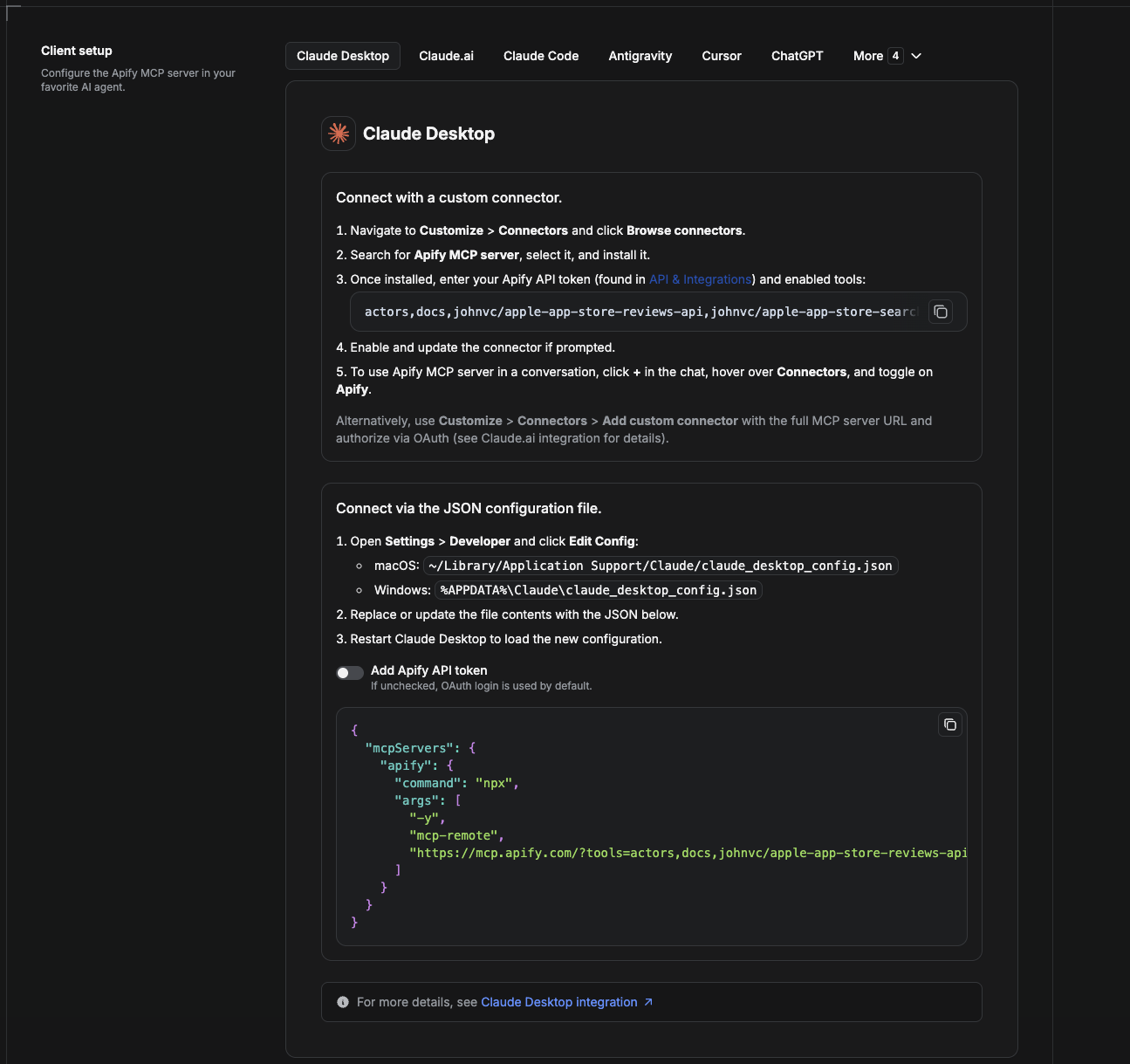
Cowork is the desktop app's automation mode. To give it the Congress Trading API as a tool, add the Apify MCP server as a connector.
- Open the Claude desktop app and go to Settings → Connectors (or Settings → Developer → Edit Config to edit
claude_desktop_config.jsondirectly).- macOS:
~/Library/Application Support/Claude/claude_desktop_config.json - Windows:
%APPDATA%\Claude\claude_desktop_config.json
- macOS:
- Add the Apify MCP server, preloaded with only this Actor:
{
  "mcpServers": {
    "apify": {
      "command": "npx",
      "args": [
        "-y",
        "mcp-remote",
        "https://mcp.apify.com/?tools=actors,docs,johnvc/us-congress-financial-disclosures-and-stock-trading-data"
      ]
    }
  }
}
- Restart the app. When Cowork first calls the tool, complete the OAuth prompt in your browser, or add your Apify API token in the connector settings to skip OAuth.
- In a Cowork chat, confirm the tool is available and ask it to run the Congress Trading API.
Download the desktop app and start a free trial: https://claude.ai/referral/uIlpa7nPLg
More help: https://docs.apify.com/platform/integrations/claude-desktop
Install in Claude Code
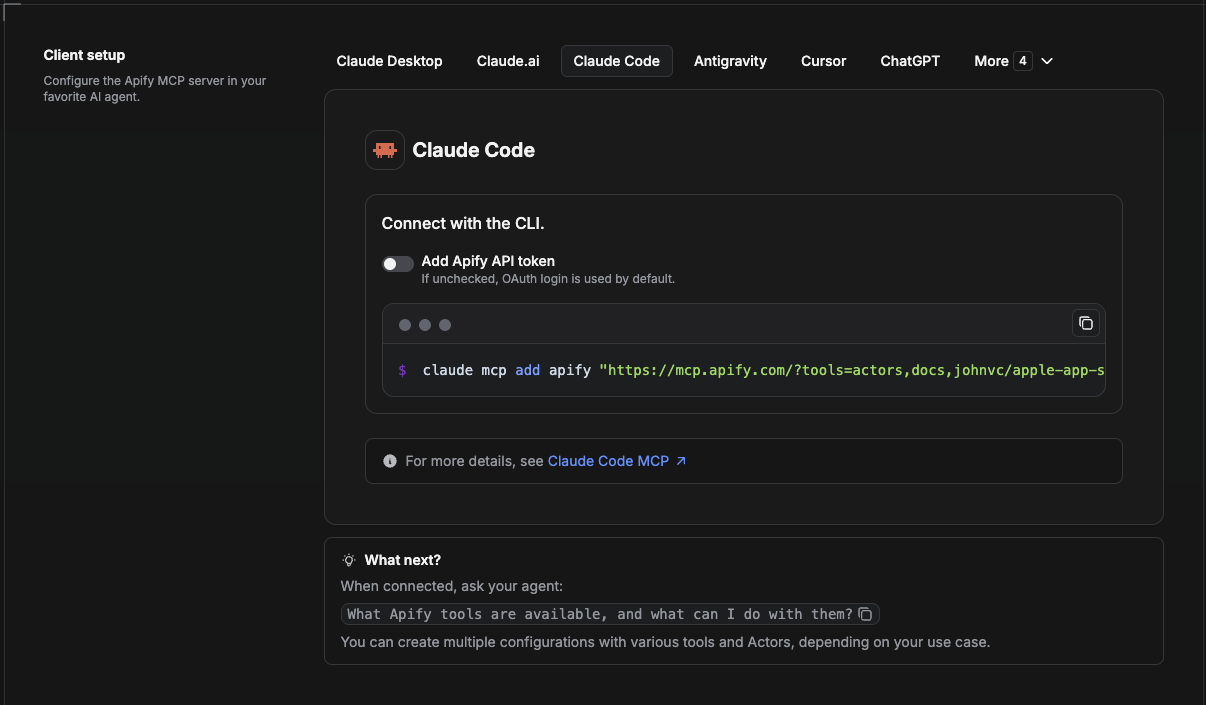
Claude Code is the command-line tool. Add the Actor's MCP server with one command:
claude mcp add --transport http apify \
  "https://mcp.apify.com/?tools=actors,docs,johnvc/us-congress-financial-disclosures-and-stock-trading-data"
To use a token instead of browser OAuth:
claude mcp add --transport http apify \
  "https://mcp.apify.com/?tools=actors,docs,johnvc/us-congress-financial-disclosures-and-stock-trading-data" \
  --header "Authorization: Bearer YOUR_APIFY_TOKEN"
Then verify with claude mcp list, or run /mcp inside a session. Ask Claude Code to call the Congress Trading API.
Try Claude Code free: https://claude.ai/referral/uIlpa7nPLg
Claude Code MCP docs: https://code.claude.com/docs/en/mcp
Install in Claude (website)
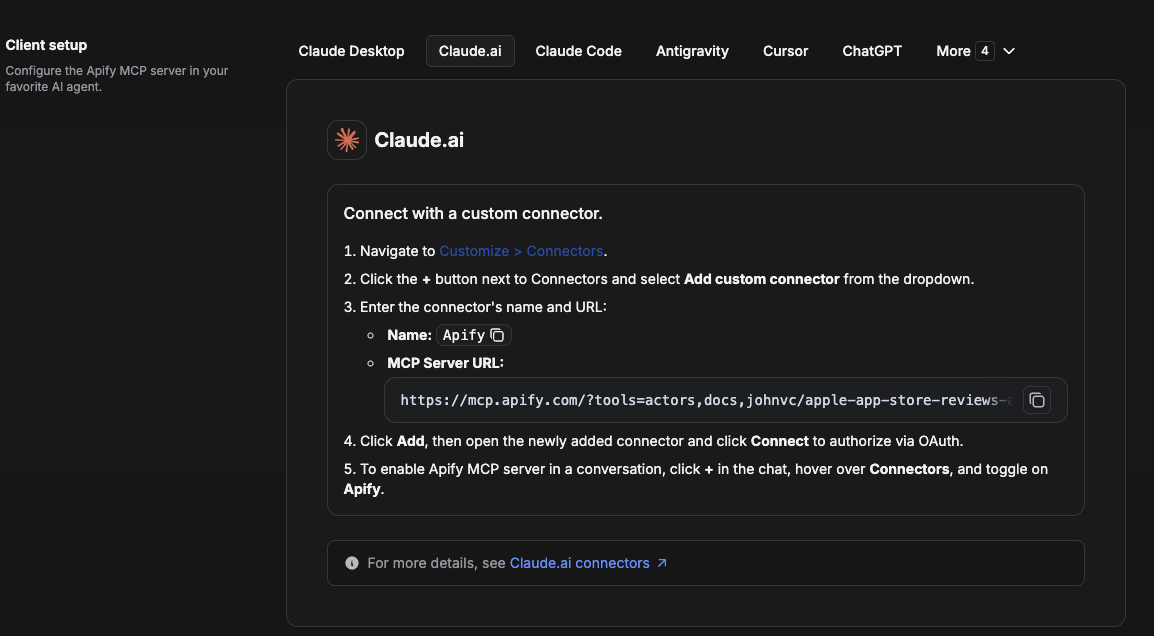
On claude.ai you add Apify as a connector, then enable just this Actor's tool.
- Go to Settings → Connectors → Browse connectors and search for Apify MCP server. Install it (enable or update if prompted).
- When connecting, authenticate with your Apify API token, and enable the tool
johnvc/us-congress-financial-disclosures-and-stock-trading-data. - In any chat, open + → Connectors and turn on Apify.
- Alternatively, choose Add custom connector and paste the full MCP URL
https://mcp.apify.com/?tools=actors,docs,johnvc/us-congress-financial-disclosures-and-stock-trading-data, using OAuth when prompted. - Ask Claude to run the Congress Trading API.
Open Claude on the web: https://claude.ai
Install in Cursor
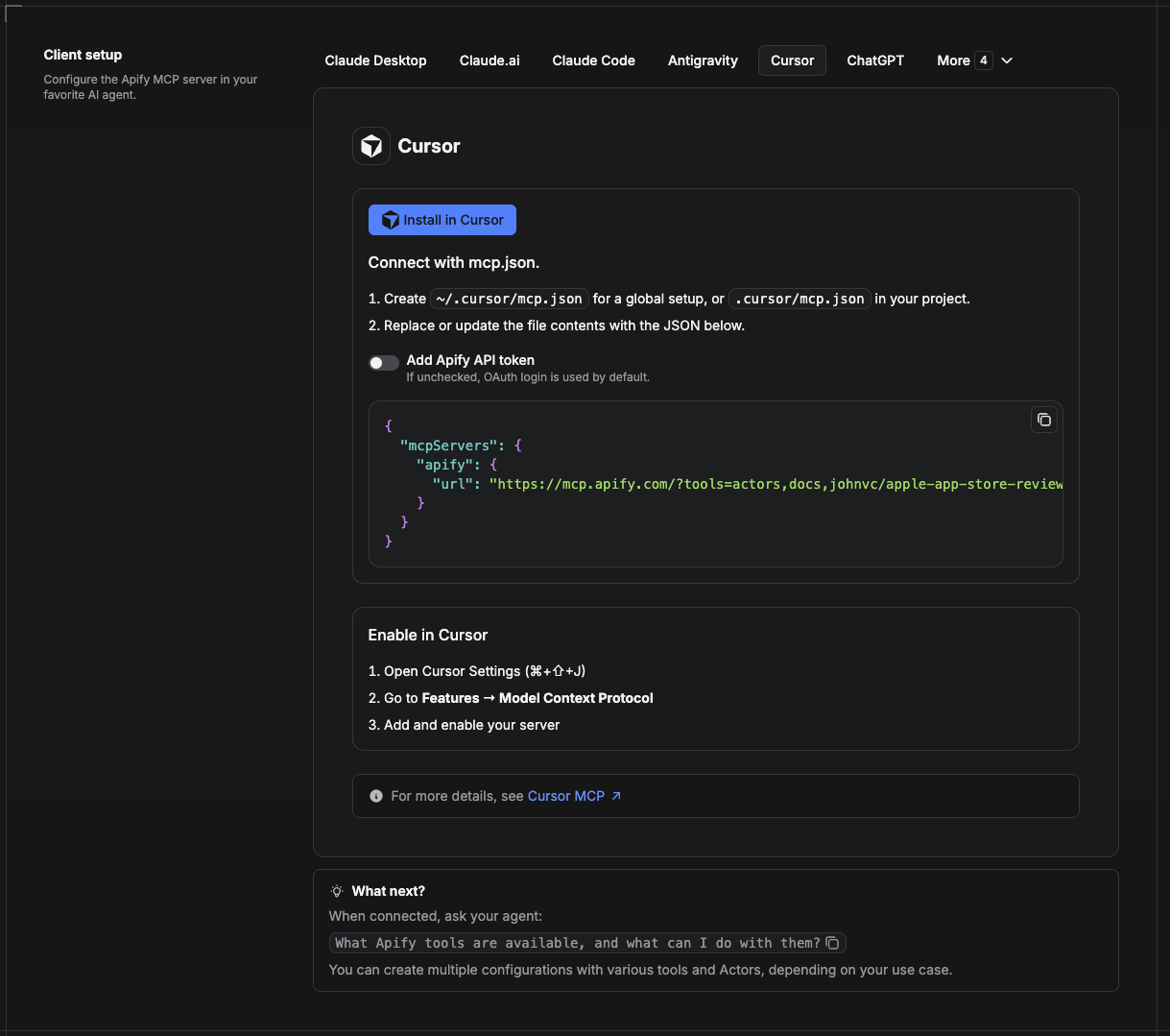
Cursor reads MCP servers from a project file at .cursor/mcp.json.
- In your project, create
.cursor/mcp.json:
{
  "mcpServers": {
    "apify": {
      "url": "https://mcp.apify.com/?tools=actors,docs,johnvc/us-congress-financial-disclosures-and-stock-trading-data"
    }
  }
}
- If you prefer token auth over browser OAuth, add a header:
{
  "mcpServers": {
    "apify": {
      "url": "https://mcp.apify.com/?tools=actors,docs,johnvc/us-congress-financial-disclosures-and-stock-trading-data",
      "headers": { "Authorization": "Bearer YOUR_APIFY_TOKEN" }
    }
  }
}
- Open Cursor → Settings → MCP and confirm the apify server is connected (green dot).
- In Composer or Chat, ask Cursor to call the Congress Trading API.
New to Cursor? Get it here: https://cursor.com/referral?code=XQP4VBLI3NNX
Install in ChatGPT
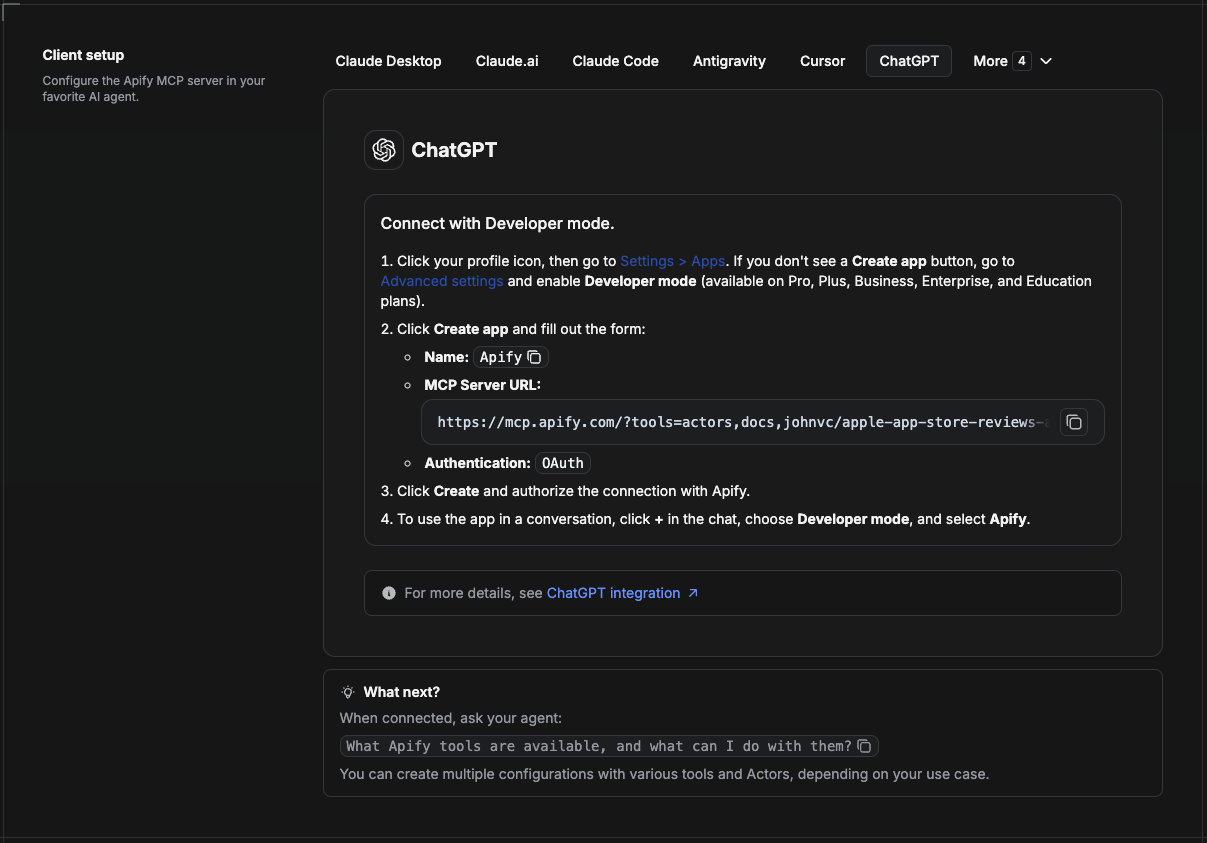
ChatGPT connects to the Apify MCP server through Developer mode (available on ChatGPT Pro, Plus, Business, Enterprise, and Education plans).
- Click your profile icon, then go to Settings > Apps. If you do not see a Create app button, open Advanced settings and enable Developer mode.
- Click Create app and fill out the form:
- Name: Apify
- MCP Server URL:
https://mcp.apify.com/?tools=actors,docs,johnvc/us-congress-financial-disclosures-and-stock-trading-data - Authentication: OAuth
- Click Create and authorize the connection with Apify.
- To use the app in a conversation, click + in the chat, choose Developer mode, and select Apify.
More help: https://docs.apify.com/platform/integrations/mcp
Use the Congress Trading API to power transparency, research, and compliance workflows with reliable, structured results.
Last Updated: 2026.05.29
Reviews (0)
Sign in to leave a review.
Leave a reviewNo results found