sigil
Health Warn
- License — License: Apache-2.0
- Description — Repository has a description
- Active repo — Last push 0 days ago
- Low visibility — Only 5 GitHub stars
Code Pass
- Code scan — Scanned 12 files during light audit, no dangerous patterns found
Permissions Pass
- Permissions — No dangerous permissions requested
No AI report is available for this listing yet.
AI Security Posture Management (AI-SPM) for developer machines: scores AI coding agent guard surfaces (Claude Code, Codex, Gemini CLI, Cursor — hooks, permissions, sandboxes) and ships hash-anchored events to your SIEM.
Sigil
Host-side AI Security Posture Management. Sigil watches what your AI
coding agents are actually allowed to do — the hooks, permissions, and
sandbox boundaries in their config — scores the risk, and ships
hash-anchored events to your SIEM.






EDR sees the command that ran. Sigil sees the permission that let it run —
the config that decided what your AI coding agent was allowed to do in the
first place. Sigil measures that surface; it does not block.
See it
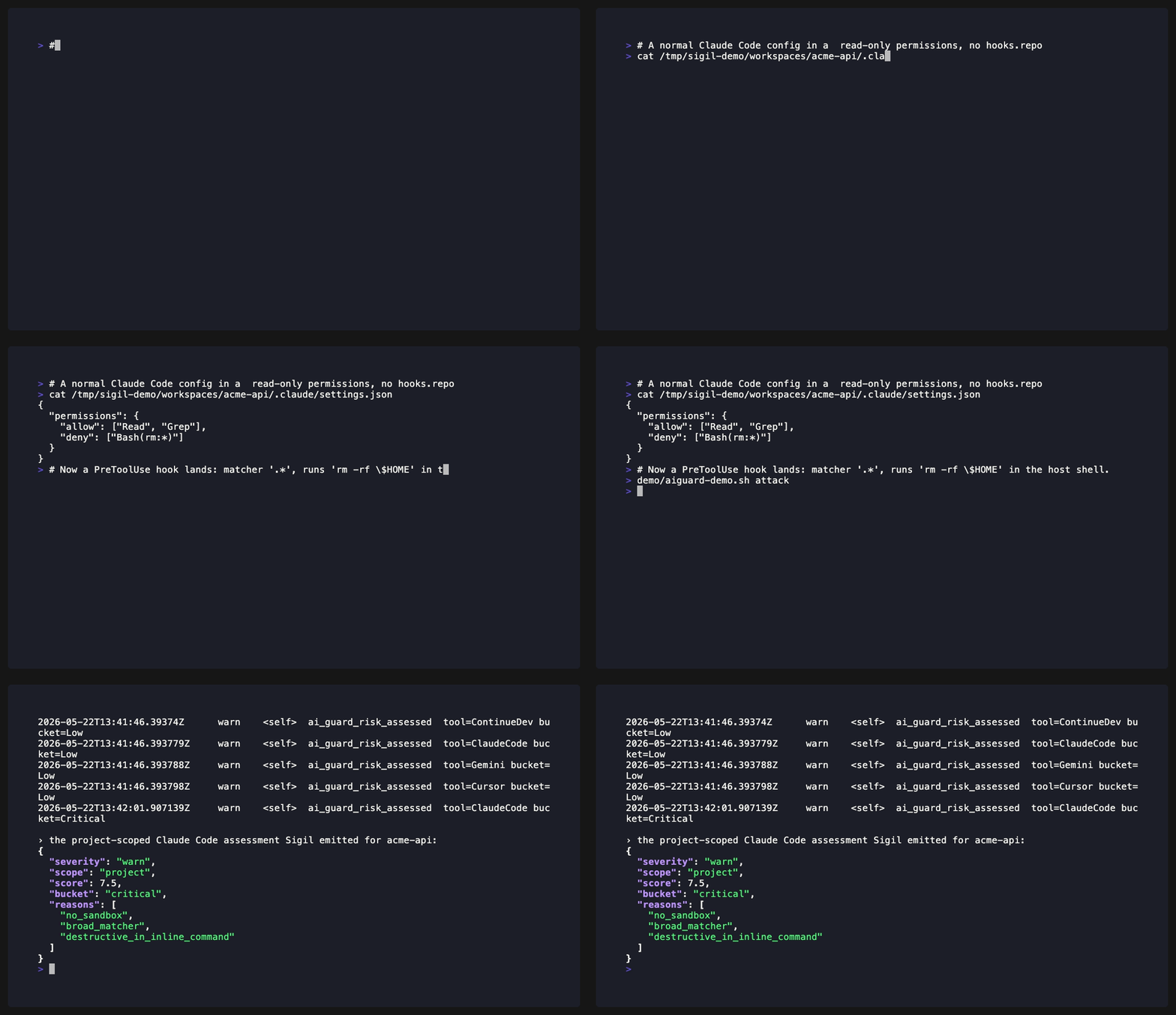
A clean repo config scores 0 / low — until a .* PreToolUse hook runningrm -rf $HOME lands, and Sigil re-scores that project 7.5 / critical with
the reasons (destructive_in_inline_command, no_sandbox, broad_matcher).
Reproduce it locally with demo/aiguard-demo.sh, or
bring up the full end-to-end stack via demo/ (docker compose up).
Why now
Through 2025–2026, the AI coding agent's configuration became the attack
surface. TrustFall
(May 2026; research)
showed that a cloned repo shipping a .claude/settings.json
(enableAllProjectMcpServers) plus a .mcp.json auto-approves an unsandboxed
MCP server — one "trust this folder" click is full RCE, across Claude Code,
Cursor, Gemini CLI, and Copilot. A year earlier,
AWS Kiro
(writeup)
could be steered by indirect prompt injection into rewriting its own.vscode/settings.json ("kiroAgent.trustedCommands": ["*"]) and MCP config to
run arbitrary commands. Same root in both: the files that decide what an agent
may do — settings.json, .mcp.json, command allowlists, sandbox flags.
That surface is exactly what Sigil watches. It can't stop the prompt injection,
and doesn't try to — it measures: it scores those configs (no sandbox, broad
matcher, auto-approved MCP, destructive hook) and emits a hash-anchored event
the moment one changes, so a dangerous config — whether a cloned repo dropped it
or an agent rewrote its own — reaches your SIEM instead of staying silent.
The problem
Claude Code, Codex, Gemini CLI, Cursor — each AI coding agent ships its own
guard surface (hooks, permissions, [sandbox], MCP allowlists) across
user-global, per-project, and per-session scopes. The autonomy ratchet keeps
moving: hooks run in the host shell, matchers can be .*, and a PreToolUse
hook containing rm -rf is treated by these tools the same as one that just
logs. Security teams have no fleet view, no drift alert, no risk index.
What Sigil does
Sigil measures. It does not block. It watches the guard surfaces of every
supported AI agent, scores their risk against a transparent rubric (sandbox
boundary × hook content × matcher scope × source provenance), and emits the
score plus the underlying reasons as a hash-anchored JSONL event your SIEM
can ingest. Enforcement stays where it belongs — in your MDM, your EDR, or
your operator's hands. Sigil's job is to make sure those decisions are
informed.
Underneath the AI-SPM layer is a generic file-posture sensor: a small Rust
agent that watches policy-defined files on macOS, Windows, and Linux, hashes
every change with blake3, and ships the events through a signed-policy
pipeline (mTLS, ed25519). The risk scoring is layered on top — it parses AI
agent config files, applies the rubric, and emits richer evidence variants
alongside the raw file_change events.
Each event is one JSON object on its own line:
{
  "schema_version": 1,
  "event_id": "019e0cea-42f1-7ef3-9a6a-1721e98ee2ba",
  "ts": "2026-05-10T07:14:32.512Z",
  "host_id": "a2e1f4c9b8d7",
  "agent_version": "0.1.0",
  "severity": "warn",
  "source": {"kind": "file_system"},
  "subject": {"kind": "path", "value": "/Users/alice/.cursor/mcp.json"},
  "evidence": {
    "kind": "file_change",
    "change_kind": "modified",
    "before_hash": "blake3:a31f1c7e9d8b…",
    "after_hash":  "blake3:0d72f8a4c6e8…",
    "size_after": 2148,
    "evidence_quality": "definitive"
  },
  "target_id": "team-mcp-allowlist"
}
And — shipped in Phase 3b.1 (Claude Code + Codex; Gemini + Cursor coming
in 3b.2) — a richer evidence variant for AI guard surfaces:
{
  "evidence": {
    "kind": "ai_guard_risk_assessed",
    "tool": "claude_code",
    "scope": {"kind": "user_global"},
    "score": 7.5,
    "bucket": "critical",
    "reasons": [
      {"kind": "destructive_in_inline_command", "pattern": "rm -rf",
       "hook_event": "PreToolUse", "snippet": "..."},
      {"kind": "no_sandbox", "executor": "host_shell"},
      {"kind": "broad_matcher", "hook_event": "PreToolUse", "matcher": ".*"}
    ],
    "is_reattestation": false
  }
}
Why Sigil?
- Measures, doesn't block. AI guard surfaces are scored, not enforced.
Enforcement is left to MDM/EDR; Sigil's job is to make sure those decisions
are informed. - Tiny, honest, host-only. Pure user-space. No kernel module, no eBPF, no
phone-home. A single binary plus a YAML policy file. - Hash-anchored events. Every observation carries blake3 hashes (before /
after) and anevidence_qualitymarker, so a SIEM can tell a clean
observation apart from one that was coalesced or delayed. - Versioned schema.
schema_versionis part of the contract; rename = break. - AI-aware defaults. Built-in policies cover the paths AI coding agents
actually touch on macOS, Windows, and Linux — including Claude Code, Codex,
Gemini CLI, and Cursor guard files.
What it monitors
Out of the box, with built-in defaults plus your policy YAML:
- AI agent guard surfaces — Claude Code (
~/.claude/settings*.json,<repo>/.claude/), Codex (~/.codex/config.toml,<repo>/.codex/),
Claude Desktop (~/Library/Application Support/Claude/claude_desktop_config.json
on macOS,%APPDATA%\Claude\…on Windows,~/.config/Claude/…on Linux),
Continue.dev (~/.continue/config.json),~/.gemini/and<repo>/.gemini/,~/.cursor/mcp.json. Hash-anchored events on every
change; risk score on the contents (Claude Code + Codex shipped 3b.1;
Claude Desktop + Continue shipped 3b.6; Gemini + Cursor parsers shipped 3b.8). - Hook scripts — convention dirs (
~/.claude/hooks/**,<repo>/.claude/hooks/**) watched recursively, so a hook script silently
going from "deny" to "exit 0" is visible. - MCP & launch surfaces —
~/.cursor/mcp.json, new.plistin~/Library/LaunchAgents/, etc. - Credential & shell startup —
~/.aws/credentials,~/.ssh/,.zshrc,.bashrc,.profile. - Anything you list under
targets:in your policy YAML.
Architecture
Sigil is a Rust workspace with seven crates: three long-running binaries,
one operator CLI, and three shared libraries.
Long-running binaries
sigil-agent— the host daemon (sigilbinary). Owns thetokio
runtime, thenotify-based filesystem watcher, the event pipeline, CLI
commands, and platform glue. Writes JSONL posture events to the local
spool.sigil-sender— the uploader (sigil-senderbinary). Reads JSONL
batches from the spool, ships them to a SIEM endpoint over HTTPS
(rustls), and hands signed policy responses back to the agent over IPC.sigil-server— OSS reference receiver (sigil-serverbinary). Accepts
events fromsigil-senderover mTLS, persists JSONL, and serves
ed25519-signed policy envelopes back to clients. The simplest possible
SIEM-shaped endpoint operators can stand up for an end-to-end test or as
the upstream forsigil-manager.
Operator CLI
sigil-signer— keystore + envelope tool (sigil-signbinary).keygen/sign/verify/inspectfor the ed25519 keys that
authenticate signed policy responses. One-shot — not a daemon.
Libraries
sigil-core— pure domain library (event, policy, state, hashing, …).
No OS,tokio, or filesystem-watcher dependencies. Consumed by every
binary.sigil-spool— JSONL=IPC primitive (Producer/Consumer/Checkpoint/Retention) used at the agent → sender hop. Durable,
crash-recoverable, domain-neutral.sigil-rules-basic— compile-time-embedded baseline rulesets (macOS,
Linux, and Windows defaults). The OSS fallback when no operator policy
is supplied; extended rule packs ship separately.
The diagram below is a runtime view — where each component runs and how data
and signed policy flow between machines. The pure libraries (sigil-core,sigil-rules-basic) compile into the binaries above, so they aren't drawn as
separate boxes.
flowchart LR
    %% ============ CLIENT — the developer's machine ============
    subgraph host["User side — runs on every machine"]
        FS[("Filesystem<br/>policy targets")]

        subgraph agent["sigil-agent (bin: sigil)"]
            direction TB
            a_pipe["watcher · debouncer · normalizer<br/>hasher · sink_task · state_task"]
            a_aiguard["ai_guard<br/>parsers · rule_packs · ext_script<br/>per-repo discovery · rubric"]
            a_ctrl["supervisor · policy_apply<br/>policy_reload · doctor · show"]
        end

        subgraph spool["sigil-spool (JSONL=IPC)"]
            spoolmods["Producer · Consumer<br/>Checkpoint · Retention"]
        end

        subgraph sender["sigil-sender (bin: sigil-sender)"]
            s_pipe["batch_reader · manifest · transport (HTTPS + rustls)<br/>control_task · agent_ipc · dead_letter · heartbeat"]
        end
    end

    %% ============ SERVER SIDE — operator + backend infra ============
    subgraph backend["Server side — operator + backend infra"]
        operator(["Operator"])

        subgraph signer["sigil-signer (bin: sigil-sign)"]
            signermods["keygen · sign · verify · inspect"]
        end

        subgraph server["sigil-server (bin: sigil-server)"]
            servermods["mTLS event ingest<br/>signed envelope serve<br/>bearer-gated read API"]
        end

        manager["sigil-manager<br/>fleet UI<br/>(optional)"]:::optional
    end

    %% External sink — your existing system (not part of Sigil)
    SIEM[("Your SIEM<br/>endpoint")]

    %% Optional, exploratory — an internal or external LLM for deeper analysis
    llm["LLM analysis<br/>internal or external<br/>(optional · exploratory)"]:::optional

    %% Data plane
    FS --> a_pipe
    FS --> a_aiguard
    a_pipe -- "writes JSONL" --> spool
    a_aiguard -- "writes JSONL" --> spool
    spool -- "reads JSONL" --> s_pipe
    s_pipe -- "HTTPS" --> SIEM
    s_pipe -- "mTLS (alt)" --> server

    %% Control plane
    s_pipe -. "apply_policy IPC" .-> a_ctrl
    operator -- "signs envelope" --> signer
    signer -. "envelope deployed" .-> server
    server -. "signed envelope" .-> sender

    %% Optional consumers
    server -. "read API" .-> manager
    manager -. "deeper analysis · governance" .-> llm

    classDef optional stroke-dasharray: 5 5,fill:#f5f5f5,stroke:#999,color:#666

    %% Components (crates) in green so they stand out from the location boxes
    style agent  fill:#d1fae5,stroke:#059669,color:#064e3b
    style spool  fill:#d1fae5,stroke:#059669,color:#064e3b
    style sender fill:#d1fae5,stroke:#059669,color:#064e3b
    style signer fill:#d1fae5,stroke:#059669,color:#064e3b
    style server fill:#d1fae5,stroke:#059669,color:#064e3b
Status
- 0.1.x — alpha. The event schema and CLI surface can break between minor
releases until 0.2.schema_versionin every event lets downstream
consumers detect this. - Platforms. macOS, Windows, and Linux at runtime. The Linux runtime
landed as a minimal foundation (Phase 3a) and is exercised in CI; some
refinements are markedTODO(community)inplatform/linux.rs— see
CONTRIBUTING.md. - Schema. Version
1.
Roadmap
Shipped: filesystem posture sensor with hash-anchored JSONL events
(Phase 1) · split-process, signed-policy pipeline over mTLS with an OSS
reference server (Phase 2) · Linux runtime (Phase 3a) · the AI Agent Risk
Index — a transparent scoring rubric for Claude Code, Codex, Claude Desktop,
Continue.dev, Gemini CLI, and Cursor guard surfaces (Phase 3b) · declarative
rule packs operators ship without recompiling · license-enforcement structure
(measures, doesn't block).
Planned: reproducible-build attestation, additional posture signals.
See ROADMAP.md for the full phase-by-phase log with merge SHAs.
Ecosystem
The agent in this repo is the OSS core. A separate, companion project extends
it with a fleet view:
sigil-manager—
self-hostable web console for fleet visibility. Reads fromsigil-server
and renders dashboards (AI Guard risk by host, events over time, policy
compliance per host). Public repo, developed separately from this one;
early stages.
The OSS agent works standalone — point sigil-sender at any SIEM endpoint and
you're done. sigil-manager is an additive convenience layer for teams that
want a built-in dashboard rather than rolling their own queries in their SIEM,
not a requirement.
Design principles
- No kernel module, no eBPF. OS-provided file-event APIs only.
forbid(unsafe_code)in the core domain crate.- Reproducible release builds.
lto = "thin",codegen-units = 1,strip = "symbols",panic = "unwind". - Host-only telemetry. The agent never opens an outbound connection on
its own. Shipping events anywhere is a separate, explicit component. - The event schema is a public contract. Wire-string renames and field
removals are breaking changes and bump the major version.
Installation
Quick install (macOS / Linux)
curl --proto '=https' --tlsv1.2 -fsSL https://raw.githubusercontent.com/Ju571nK/sigil/main/install.sh | sh
Installs the four binaries (sigil, sigil-sender, sigil-server,sigil-sign) to ~/.local/bin. Pin a release with SIGIL_VERSION, or change
the location with SIGIL_INSTALL_DIR. Every release ships a SHA256SUMS file
(the installer verifies it) plus a build-provenance attestation you can check:
gh attestation verify <archive> --repo Ju571nK/sigil
Windows: download the .zip from the
latest release. (Intel Macs
aren't shipped as prebuilt binaries — build from source below.)
Build from source
Install the Rust toolchain listed in rust-toolchain.toml, then build the
workspace:
cargo build --release
The agent binary is produced at:
target/release/sigil
For development builds, run:
cargo build
Linux packages (.deb / .rpm)
All four binaries (agent, sender, server, signer) are packaged for
Debian/Ubuntu and RHEL/Rocky/Fedora. Daemons install a (disabled-by-default)
systemd unit + /etc/sigil/<binary>.yaml.example; sigil-signer is an
operator CLI so it ships just the /usr/bin/sigil-sign binary.
cargo install cargo-deb cargo-generate-rpm   # one-time
packaging/build.sh                            # all 4 packages, both formats
packaging/build.sh sender rpm                 # or: just one package, one format

# Agent (host daemon).
sudo dnf install ./target/generate-rpm/sigil-0.1.0-1.x86_64.rpm
sudo systemctl enable --now sigil

# Sender (uploads spool to a sigil-server over mTLS).
sudo dnf install ./target/generate-rpm/sigil-sender-0.1.0-1.x86_64.rpm
sudo cp /etc/sigil/sender.yaml.example /etc/sigil/sender.yaml && sudo $EDITOR /etc/sigil/sender.yaml
sudo systemctl enable --now sigil-sender

# Server (OSS reference: receives events, serves signed policy).
sudo dnf install ./target/generate-rpm/sigil-server-0.1.0-1.x86_64.rpm
sudo cp /etc/sigil/server.yaml.example /etc/sigil/server.yaml && sudo $EDITOR /etc/sigil/server.yaml
sudo systemctl enable --now sigil-server

# Signer (operator CLI: keygen / sign / verify / inspect).
sudo dnf install ./target/generate-rpm/sigil-signer-0.1.0-1.x86_64.rpm
sigil-sign --help
See packaging/README.md for details.
Usage
Run the agent:
cargo run -p sigil-agent -- run
Inspect the effective configuration:
cargo run -p sigil-agent -- show config
Inspect expanded watch paths:
cargo run -p sigil-agent -- show paths
Run diagnostics without starting the daemon:
cargo run -p sigil-agent -- doctor
Print version information:
cargo run -p sigil-agent -- version
Configuration
Sigil uses built-in defaults plus an optional YAML policy file.
Example policy:
version: 1
host_id_strategy: machine_id

overrides:
  - id: shadow-ai-binaries-macos
    tier: standard

targets:
  - id: team-mcp-allowlist
    description: Example MCP allowlist file
    tier: critical
    platform: any
    paths:
      - "~/.config/example/mcp-allowlist.json"
    recursive: false
    follow_symlinks: false
An example policy file is available at config/policy.example.yaml.
You can override runtime paths from the command line:
cargo run -p sigil-agent -- \
  --policy config/policy.example.yaml \
  --state-db ./state.db \
  --events-dir ./events \
  run
Default production policy locations are platform-specific. The example policy
can be adapted for /etc/sigil/policy.yaml on Unix-like systems or%ProgramData%\Sigil\policy.yaml on Windows.
Security
For responsible disclosure of vulnerabilities, see SECURITY.md.
Contributing
Bug reports, policy suggestions, and patches are welcome. See
CONTRIBUTING.md before opening a PR.
Questions, ideas, or "is this the right approach?" — open a thread in
GitHub Discussions (Q&A)
rather than an issue; issues are for actionable bugs and concrete proposals.
License
This project is licensed under the Apache License 2.0.
You may use this software for personal, internal, and commercial purposes,
subject to the terms of the Apache License 2.0.
See LICENSE and NOTICE for details.
Disclaimer
This software is provided "as is", without warranties or guarantees of any kind.
The author does not guarantee correctness, availability, reliability, security,
compatibility, or fitness for any particular purpose.
The author is not responsible for any direct, indirect, incidental,
consequential, special, exemplary, or other damages, including but not limited to
outages, data loss, security incidents, business interruption, incorrect
results, compatibility problems, or other problems arising from the use of this
software.
Use this software at your own risk.
Commercial Support and Future Offerings
Commercial support, hosted services, enterprise features, paid add-ons,
consulting, or professional services may be offered separately in the future.
Some future commercial features, hosted components, enterprise modules, or
binary-only add-ons may be distributed under separate commercial terms.
The open-source version remains available under the Apache License 2.0.
Reviews (0)
Sign in to leave a review.
Leave a reviewNo results found