cc-auto-review
Health Warn
- License — License: MIT
- Description — Repository has a description
- Active repo — Last push 0 days ago
- Low visibility — Only 5 GitHub stars
Code Fail
- network request — Outbound network request in docs/download.js
- exec() — Shell command execution in docs/engine.js
- network request — Outbound network request in docs/risk.js
- network request — Outbound network request in docs/stars.js
Permissions Pass
- Permissions — No dangerous permissions requested
No AI report is available for this listing yet.
A desktop app for macOS and Linux that reviews GitHub pull requests with your local Claude Code (claude -p): AI findings beside the diff, a 0–100 risk score, and an optional autopilot that hands only risky PRs to a human.
CC Auto Review
Worn out by reviewing a flood of PRs?
I built a desktop app that lets Claude Code review PRs first and sends only the risky ones to you.
It reviews GitHub pull requests on macOS and Linux with your local claude -p: AI findings next to the diff and a 0–100 risk score. You review only the risky PRs.









Download for macOS · Score a PR in your browser · Website
⭐ If it saves you review time, a star helps other reviewers find it.
Follow @kara_mage on X for early access to our products.

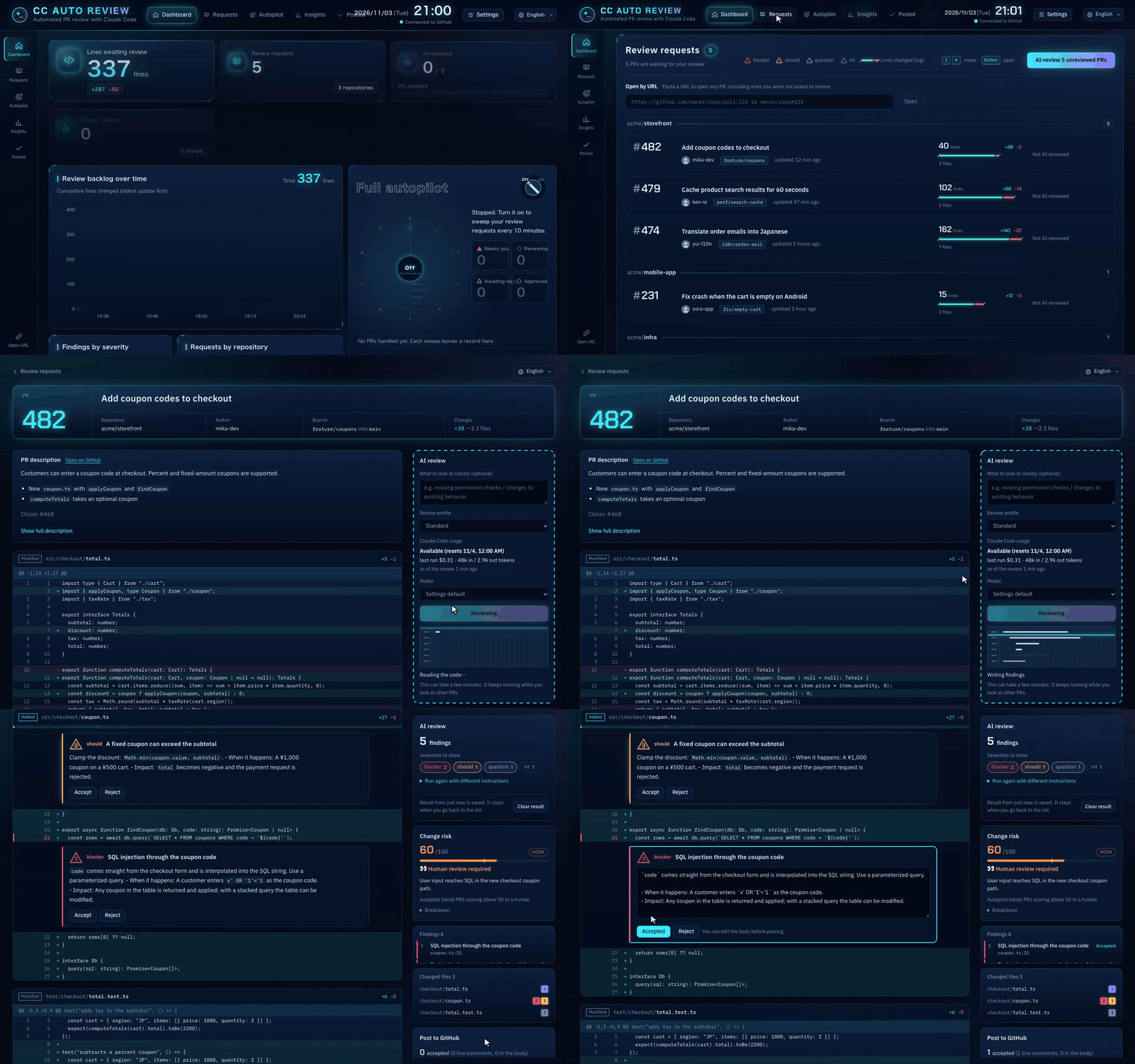
Open a PR, run the AI review, jump to a finding and accept it. (Sample data)
[!TIP]
CC Auto Review stores no Claude credentials. It runs your locally installed, unmodified Claude Code as you have configured it, and GitHub access goes through yourghlogin. Your use is subject to Anthropic's terms. Check them before using the autopilot, or use an API key.
[!NOTE]
This is an independent project, not affiliated with, endorsed by, or sponsored by Anthropic. Claude is a trademark of Anthropic, PBC. Reviews the app posts come from your GitHub account.
🌟 Overview
CC Auto Review puts a pull request's diff and Claude's findings on one screen. You accept, reject, or edit each finding and post the review to GitHub. Every review runs through your locally installed Claude Code (claude -p), in a temporary directory that holds only the PR's changed files.
When you turn on the autopilot, the app works through your review requests by itself. It approves or comments, waits for the author, reviews again, and hands anything risky (CI, migrations, auth, secrets, huge diffs, high risk scores) to a human without posting.
🆚 How it differs
| CC Auto Review | Hosted AI review bots | Claude Code in CI | |
|---|---|---|---|
| Who reviews | The Claude Code already on your machine | The vendor's model, on the vendor's servers | Claude Code on a CI runner |
| Setup on the repository | None. Works on any repo your gh login can read |
Install a GitHub App (needs org/repo admin) | Add a workflow and a secret (needs repo admin) |
| Before anything is posted | You accept, reject, or edit each finding | Comments go straight to the PR | Comments go straight to the PR |
| Which PRs need you | A 0–100 risk score; the autopilot hands only risky PRs to you | Every PR gets comments | Every PR gets comments |
The other columns describe typical setups; individual products differ.
📋 Table of Contents
- 🌟 Overview
- 🆚 How it differs
- ✨ Features
- 🚀 Installation
- 📖 Usage
- ⚙️ Customizing reviews
- 🏗 How it works
- 🔒 Security
- 🛠 Development
- 🤝 Contributing
- 📄 License
- 🙏 Acknowledgments
✨ Features
🔍 AI review on one screen
- Diff and findings side by side: findings are anchored to diff lines and listed in a side panel; click one to jump to it.
- You stay in control: accept, reject, or edit every finding before anything is posted.
- Ask after the review: ask about findings, have code explained, and add problems you find together to the draft.
- Verified, high-signal findings:
blockerandshouldmust state a trigger and an impact, or they are downgraded toquestion. - Prior comments re-checked: earlier review comments are marked fixed / unfixed / unverified against the current code.
- Post in any language: findings are translated right before posting when you post in another language.
📦 No clone needed
- Only changed files are fetched into a temporary directory.
- Read-only helper (
remote-read): Claude reads callers, types and tests from GitHub with GET requests pinned to the PR's repository and commits.
🎯 Risk score
- Deterministic baseline from the diff alone: size, spread, sensitive areas, risky patterns, test gaps, change shape, context.
- Bounded AI adjustment of up to ±20, each item citing
file:line. The server does the math. - Escalations for verified serious problems send the PR to a human.
🧩 Customizable review profiles
- Perspectives, guidelines, things not to report, a finding limit, and extra tools (Skills, MCP) per profile.
- Ships with Standard, Security focused and Quick (blockers only).
- Prompt preview shows exactly what Claude receives.
- Repository conventions (
CLAUDE.md,AGENTS.md,REVIEW.md) are read from the base branch.
🤖 Autopilot (optional)
- Sweeps your review requests on an interval, approves or comments, and re-reviews when the author pushes or replies.
- Hands risky PRs to a human: by path, by changed lines, by risk score, or by natural-language criteria you write.
- Profile routing by repository, label, or mention (e.g.
@org/security).
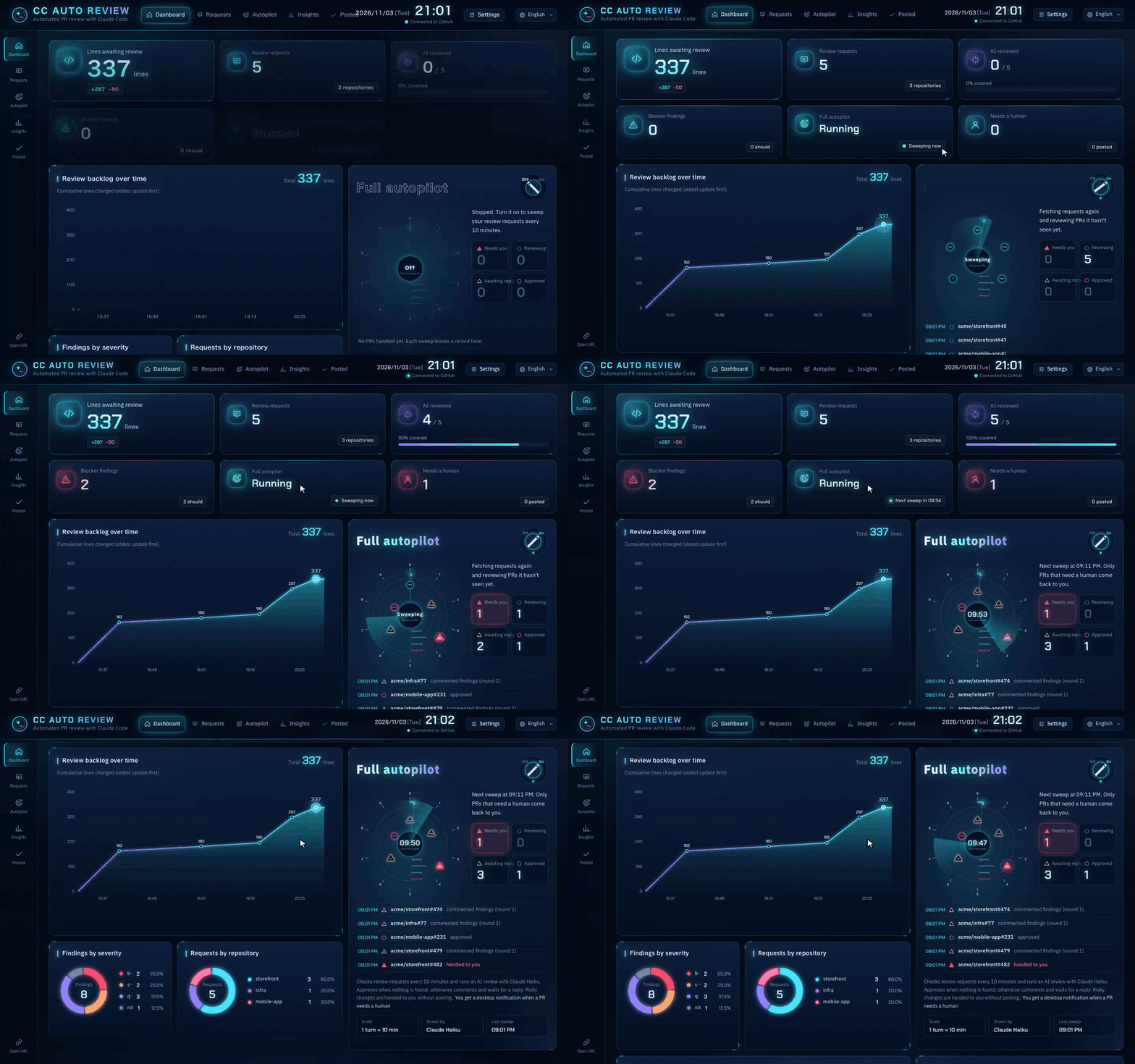
Turn on the autopilot: five PRs are reviewed, approved or commented on, and the risky one is handed to you. (Sample data)
🖥 Small native app
- Small: about 12 MB per CPU (23 MB universal). The server runs on txiki.js, a ~6 MB JavaScript runtime.
- Desktop notifications when a review finishes or fails.
- English and Japanese UI.
🚀 Installation
Download
Download the DMG for Apple silicon or Intel, open it, and drag the app to Applications. It is signed with a Developer ID and notarized by Apple, so it opens normally. All versions are on the releases page.
On Linux x86_64, download the .AppImage or .deb from the releases page. They are not signed, so check them against the .sha256 file next to each one. These builds are new: they start in CI but have not been tested on a real desktop yet, so please report any problems.
Prerequisites
- macOS 11+, or Linux x86_64 with WebKitGTK 4.1
- GitHub CLI (
gh), signed in withgh auth login - Claude Code (
claude) 2.1.314 or later
The app looks for gh and claude in your login shell's PATH, so it works when launched from Finder or the Dock.
git clone https://github.com/karamage/cc-auto-review.git
cd cc-auto-review
bun install
bun run app:build
Then drag CC Auto Review.app from src-tauri/target/release/bundle/macos/ into /Applications.
| Command | Output |
|---|---|
bun run app:build |
.app for the CPU of the machine you build on (~12 MB) |
bun run app:build:x64 |
.app for Intel Macs (can be built on Apple Silicon) |
bun run app:build:universal |
One .app for both Apple Silicon and Intel (~23 MB) |
bun run app:dmg (:x64, :universal) |
The same, packed as a .dmg |
[!IMPORTANT]
A locally built app is not signed. If macOS refuses to open it, allow it in System Settings → Privacy & Security → Open Anyway. Release DMGs built withbun run release:macare signed and notarized and open normally.
On Linux, install cmake, a C compiler and Tauri's system packages, then run bun run app:build:linux. The first build compiles txiki.js from source. Linux packages for releases are built by .github/workflows/release-linux.yml when a release is published.
📖 Usage
Dashboard → Open a PR → Pick profile & model → Run AI review → Accept / Reject / Edit → Post
- Dashboard: lists PRs that request your review (the same query as github.com/pulls/review-requested). You can also open any PR by URL.
- Run AI review: open a PR, pick a review profile and a model, optionally write what to focus on, and press Run AI review.
- Triage findings: accept, reject, or edit each finding. Findings outside the diff are collected into the review body.
- Post: choose Comment / Approve / Request changes. If your findings were written in another language than the one you post in, Claude translates them right before posting.
- Watch (optional): when the author pushes or replies, the AI review runs again. Nothing is re-posted without you.
Findings
| Severity | Meaning |
|---|---|
| blocker | A verified defect that must be fixed before merging |
| should | Should be fixed, but safe to do later |
| question | The intent is unclear; says what would need to be known |
| nit | Taste-level suggestion (hidden by default) |
blocker and should must state a trigger (how it happens) and an impact (what goes wrong); otherwise they are downgraded to question. When a PR has earlier review comments, Claude re-checks each one against the current code and marks it fixed / unfixed / unverified. An author's "fixed it" or a resolved thread is never taken as evidence.
Risk score
The review screen shows the PR's change risk as a 0–100 score (the scoring model is ported from pr-risk-score).
- Baseline: computed from the diff alone as soon as the PR opens. It adds seven factors: size, spread, sensitive areas (auth, payments, migrations, CI, …), risky patterns on added lines (secrets, eval, XSS sinks, destructive SQL, …), test gaps, change shape, and context. Some findings set a floor: a leaked secret (90), a destructive migration (75), text that tries to steer an AI reviewer (60).
- AI adjustment: when the AI review runs, Claude reads what the change means and proposes items citing
file:linethat move the score by up to ±20. A verified serious mechanism (authorization bypass, irreversible data loss at scale, …) is an escalation: the score is raised to at least 60 and the PR goes to a human. The server does the arithmetic; the AI cannot move caps or floors.
| Score | Level |
|---|---|
| 0–24 | LOW |
| 25–50 | MEDIUM |
| 51–75 | HIGH |
| 76–100 | CRITICAL |
Autopilot hands a PR to a human, without posting, when its score is above the threshold (50 by default) or it has an escalation.
⚙️ Customizing reviews
Open Settings (top right of the dashboard).
Review profiles
A profile is a complete "how to review" recipe. The app ships with Standard, Security focused and Quick (blockers only); edit them or add your own.
| Field | What it does |
|---|---|
| Perspectives | The only things the reviewer looks at. Toggle, reorder, rewrite, or add your own (e.g. "Accessibility", "Our API versioning rules"). Write them in any language. |
| Team review guidelines | Free text: conventions, priorities, tone, "always add a suggestion block", … |
| Do not report | Noise to suppress, one per line. |
| Maximum number of findings | Keep only the N most severe findings. |
| Extra allowed tools | e.g. Skill, WebFetch, mcp__docs. Nothing beyond read-only tools is allowed by default. Never allow tools that can write — instructions hidden in a PR description could trigger them. |
Preview the prompt shows exactly what Claude will receive.
The repository's own CLAUDE.md, AGENTS.md and REVIEW.md are also read — always from the base branch, so a PR cannot change the rules it is reviewed by. .claude/, .mcp.json and CLAUDE.local.md are never placed in the working directory.
Autopilot
| Setting | Default |
|---|---|
| Model / profile | Haiku / Standard |
| Sweep interval | 10 minutes |
| Max comment rounds before handing to a human | 3 |
| Approve when there are no findings | on (turn off to only comment and leave approval to humans) |
| Attach an LGTM image to approvals | off |
| Label to trust autopilot | auto-judge |
| Label to skip AI review | skip-ai-review |
| Profile routing | Use another profile for a repository, or when a PR has a label or mentions someone (e.g. @org/security) |
| When to hand a PR to a human | Natural-language criteria the AI reads when judging risk (auth/billing, migrations, CI/infra, breaking API changes, …). Add, edit, or relax them, e.g. "Documentation-only changes do not need a human" |
| Paths handed to a human without calling the AI | CI, DB migrations, infra, secrets, auth/billing/crypto, review conventions (editable regexes) |
| Changed lines handed to a human | 1000 (lock files and dist/ are not counted) |
| Risk score handed to a human | 50 (above this goes to a human) |
Autopilot runs only while the app is open. Reviews it posts come from your GitHub account and say they are automated. Autopilot runs Claude Code automatically, so check Anthropic's terms before turning it on, or use an API key.
Files
Settings and app state live in ~/.config/cc-auto-review/ (override with CC_AUTO_REVIEW_HOME).
🏗 How it works
CC Auto Review.app
├── Tauri shell (Rust)         starts the server, opens a window on it
├── cc-auto-review-server      txiki.js (a ~6 MB JavaScript runtime) that runs server.js
└── Resources/server.js        the Hono server, bundled into one JS file
    ├── serves the React UI and the API on 127.0.0.1 (random port, per-launch token)
    ├── gh  → PR list, diff, comments, posting reviews
    └── claude -p  → the review, in a temp dir with only the changed files
            └── remote-read (cat / cat-base / ls / find / grep / issue) → GitHub, GET only
- Before posting, the PR head is checked again; if it moved since the review, nothing is posted.
- A review times out after 10 minutes (configurable).
🔒 Security
- Local only: the server listens on
127.0.0.1. In the desktop app, the API only accepts requests that carry the token generated at launch, so other local apps and web pages cannot drive it. - Confined file access: Claude can read only the temporary directory that holds the PR's changed files and diff, and can write only its result file. Beyond that it gets
Grep,Globand theremote-readhelper.git, arbitraryghcommands and other shell commands are denied, whatever your default permission mode is. Allow rules in your own Claude Code settings and a profile's extra tools still apply, so keep them narrow. Text in a PR can still try to influence the review itself, so read what the app posts. - GET-only GitHub access for Claude:
remote-readis pinned to the PR's repository and commits through environment variables and never issues write requests. - PRs cannot rewrite the rules: conventions are read from the base branch, and
.claude/,.mcp.jsonandCLAUDE.local.mdfrom the PR are never placed in the working directory. - No telemetry: the app sends no usage data. It talks to GitHub through
ghand to Claude throughclaude; the UI also loads web fonts and, if enabled, LGTM images.
🛠 Development
Tech stack
- Desktop shell: Tauri 2 (Rust)
- Server: Hono, bundled and run on txiki.js in the app, on Bun in development
- UI: React 19 + TypeScript + Vite
- Tooling: Bun (package manager and test runner), Biome, oxlint
Project structure
cc-auto-review/
├── src/
│   ├── client/        # React UI (pages, components, autopilot state)
│   ├── server/        # Hono API, gh / claude runners, diff parsing, snapshots
│   │   ├── reviewer/  # prompt building, claude -p runner, remote-read, translation
│   │   └── runtime/   # Bun and txiki.js adapters
│   └── shared/        # types, settings, risk score shared by client and server
├── src-tauri/         # Tauri shell that starts the bundled server
└── scripts/           # server bundling and signed release builds
Commands
Requirements: Bun, Rust (the repo pins stable via rust-toolchain.toml), Xcode Command Line Tools.
bun install
bun run check        # typecheck + lint + format check + tests
bun run app:build    # builds the UI, the server binary and CC Auto Review.app
bun run app:dmg      # also builds a .dmg (Finder automation permission may be required)
bun run app:build:x64         # .app for Intel Macs (can be built on Apple Silicon too)
bun run app:dmg:x64           # the same, as a .dmg
bun run app:build:universal   # one .app for both Apple Silicon and Intel Macs
bun run app:dmg:universal     # the same, as a .dmg
Browser-only development (no Tauri):
bun run dev:server   # API on localhost:4711
bun run dev:client   # Vite on localhost:5173, proxies /api to 4711
Tests never start real gh / claude / git; they use a fake CommandRunner.
One-time setup (requires an Apple Developer Program membership):
Create a Developer ID Application certificate: Xcode → Settings → Accounts → Manage Certificates →
+.Save notarization credentials to the keychain (use an app-specific password):
xcrun notarytool store-credentials cc-auto-review --apple-id <Apple ID> --team-id <Team ID>
Then:
bun run release:mac             # → release/CC-Auto-Review_<version>_arm64.dmg and _x64.dmg
bun run release:mac arm64       # Apple Silicon only
bun run release:mac universal   # one DMG for both
By default the script builds separate Apple Silicon and Intel versions. For each architecture it builds the app, signs it with Hardened Runtime, notarizes and staples the app, packs it into a DMG, and notarizes and staples the DMG. Set APPLE_SIGNING_IDENTITY to pick a certificate and NOTARY_PROFILE to use another keychain profile.
🤝 Contributing
Issues and pull requests are welcome. Please run bun run check before opening a PR.
Areas where help is especially welcome:
- 🐛 Bug reports and fixes
- 🧭 New default review perspectives and profiles
- 🌐 Translations of the UI beyond English and Japanese
- 🪟 Windows support
- 📚 Documentation and screenshots
📄 License
This project is licensed under the MIT License. See LICENSE for details.
🙏 Acknowledgments
- Claude Code by Anthropic, which does the reviewing
- Tauri, txiki.js and Hono, which make a small native app possible
- GitHub CLI
- pr-risk-score, the Claude Code skill and GitHub Action the risk score comes from. Use it to score PRs in Claude Code or in CI.
- LGTMoon for the LGTM images
- opcode for README inspiration
Reviews (0)
Sign in to leave a review.
Leave a reviewNo results found