rote
Health Warn
- License — License: MIT
- Description — Repository has a description
- Active repo — Last push 0 days ago
- Low visibility — Only 5 GitHub stars
Code Pass
- Code scan — Scanned 12 files during light audit, no dangerous patterns found
Permissions Pass
- Permissions — No dangerous permissions requested
No AI report is available for this listing yet.
An efficiency-first browser-agent system. Fewer observation tokens, lower latency, and browser memory that compounds with every run.
 ____        _
|  _ \ ___  | |_ ___
| |_) / _ \ | __/ _ \
|  _ < (_) || ||  __/
|_| \_\___/  \__\___|
The memory manager for browser agents.
Every harness has memory. None of them manages it.
The one-liner
Agent harnesses have no memory manager. Rote is the memory manager.
Browser agents forget at three timescales, and pay again at every one. Rote treats the
context window as a managed resource: a budget, an eviction policy, a layout contract, and
a trust gate on the way back in.
Quickstart
Prerequisites: Node 20+, Chrome/Chromium, and an OpenAI key.
export OPENAI_API_KEY=...
npx --yes @rotehq/[email protected] run \
  "Confirm that the page says Rote quickstart ready." \
  --url 'data:text/html,<h1>Rote quickstart ready</h1>' \
  --verify-text 'Rote quickstart ready' \
  --model gpt-4.1-mini --max-steps 3
The data URL is a local smoke. Only automate pages you are authorized to use, and provide
an independent terminal-state verifier. See T28
for the frozen empty-directory registry run.
The problem
A typical browser agent loop is expensive and serialized:
observe page → model thinks → act → wait → observe again
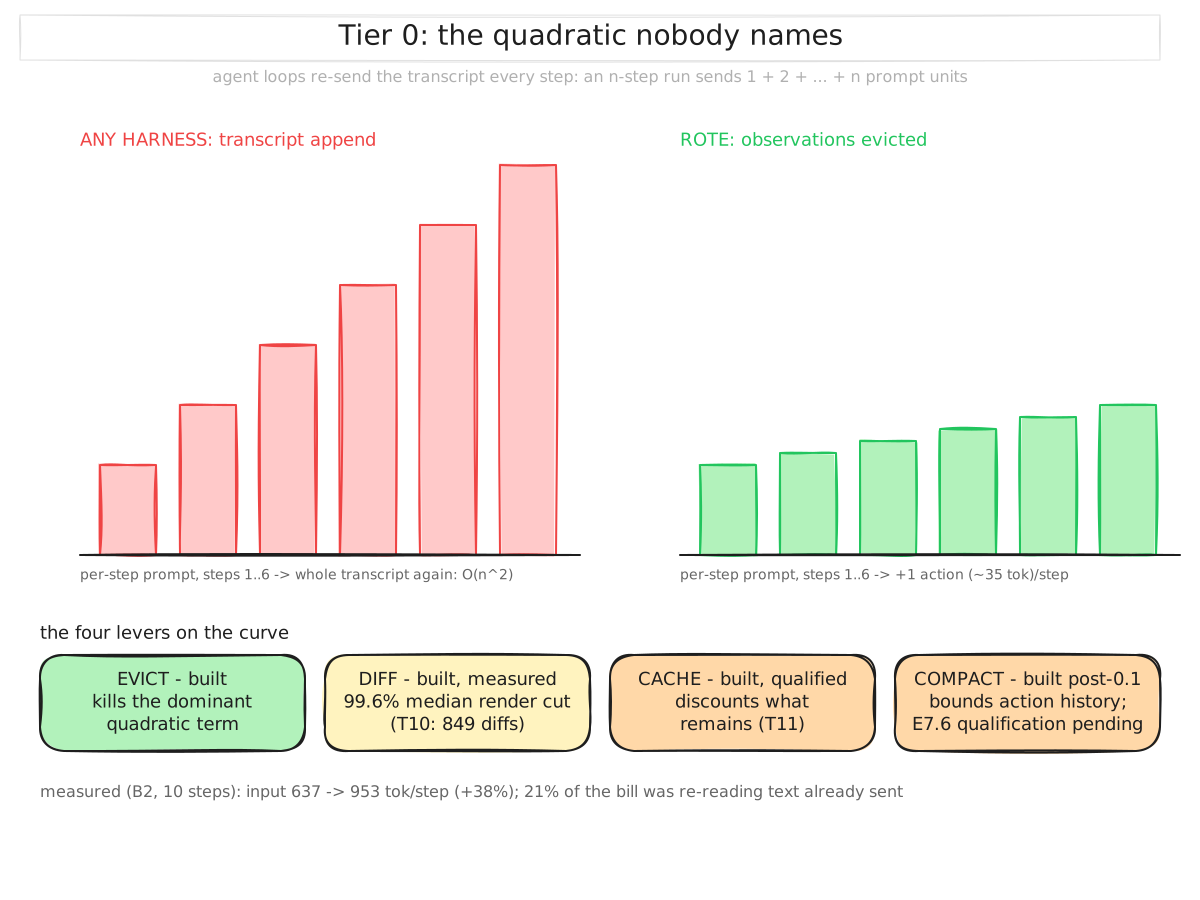
And it re-sends its whole transcript every step. A run of n steps sends 1 + 2 + … + n
prompt-units, so cost is O(n²) in task length. Measured on our own runs, input tokens
climb every step:
B2 (10 steps): 637 → 677 → 716 → 759 → 800 → 839 → 876 → 917 → 953 (+38%)
21% of that run's input bill is re-reading text it already sent — on a page that
distills to 10 nodes. Everything the field competes on (DOM serializers, element filtering,
vision-vs-a11y) shrinks the per-step prompt, and the better harnesses now evict old
observations too. What no major harness ships is the next step: stop re-sending the
current page in full when a 24-character diff describes what changed
(04 — Competition, source-surveyed 2026-07-25).
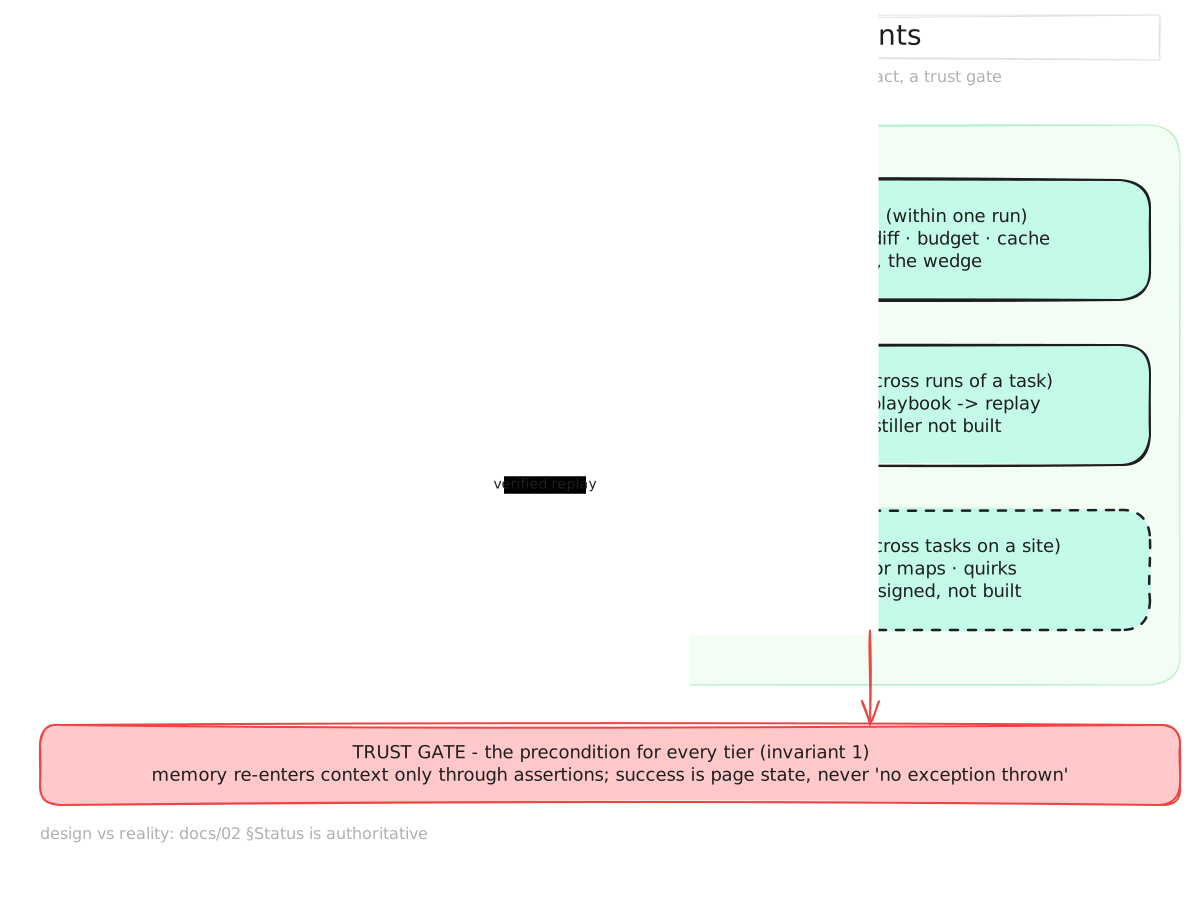
The three amnesias
| Tier | Scope | What it forgets | The bill |
|---|---|---|---|
| 0 — Working | within a run | what it already sent this run | O(n²) in task length |
| 1 — Episodic | across runs of a task | the procedure that worked yesterday | run #50 costs what run #1 cost |
| 2 — Semantic | across tasks on a site | how the site behaves at all | every task re-learns the portal |
And the precondition: memory that might be wrong is worse than no memory. Every tier is
assertion-gated on the way back in — success is decided by page state, never by the absence
of an exception.
What Rote does
Rote is a complete browser-agent harness with four efficiency planes (see
docs/02):
- Perception — capture pages through CDP, distill them into compact interactive trees,
assign stable element IDs, and send diffs instead of full page dumps when possible. - Decision — own the context layout, route routine steps to cheaper models, and skip
model calls entirely when memory/replay can safely act. - Action — use typed browser actions, settledness detection, self-healing element
resolution, per-step assertions, and later speculative pre-execution. - Learning — record every run, learn playbooks/site memory/transition models, and feed
that knowledge back into replay, hints, resolution, and prediction.
The P1 launch target was intentionally narrow and measurable:
same browser tasks as Browser Use → fewer tokens → success parity → raw benchmark data
Measured working-memory curve
Across 15 independently reset runs per harness/checkpoint on a real WordPress page,
Rote's cumulative logical-input curve grows 37.2% more slowly than Browser Use 0.13.6
(95% seeded-bootstrap CI: 35.6–38.8%), with 75/75 verified successes on each side.
Logical input counts uncached + cache-read + cache-write tokens, so provider caching cannot
masquerade as memory reduction.
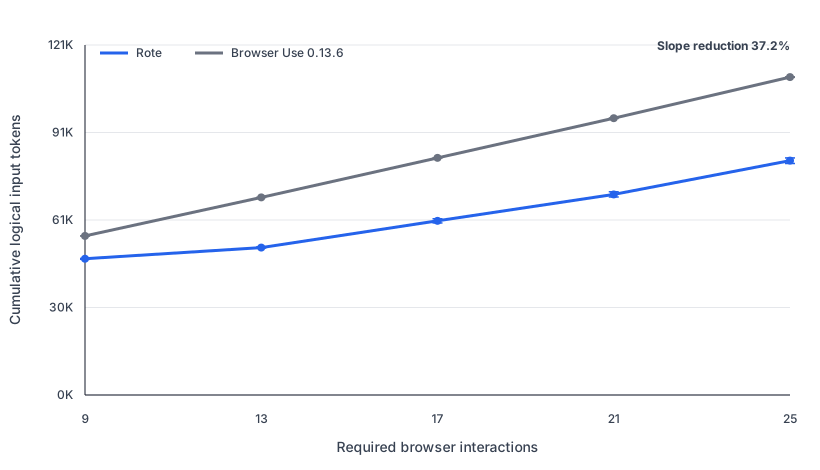
At 25 required interactions, Rote uses 26.3% fewer logical-input tokens. In this frozen
pre-cache-key matrix, that is not a cost or latency win: Browser Use receives more
discounted cache reads, so Rote's mean bill is 5.4% higher and p50 latency 6.4% higher. G1 proves slower logical
context growth, not cheaper execution under today's prompt-cache economics.
Method and full table ·
Rote JSONL ·
Browser Use raw receipts ·
normalized Browser Use JSONL ·
machine-readable summary
Cache economics follow-up
After freezing G1, Rote began sending a SHA-256-derived prompt_cache_key for the exact
immutable planner prefix. A fresh, identically ordered 15-run paired matrix preserves the
logical curve (37.6% slower growth) while moving more of Rote's prompt into OpenAI's
discounted cache bucket:
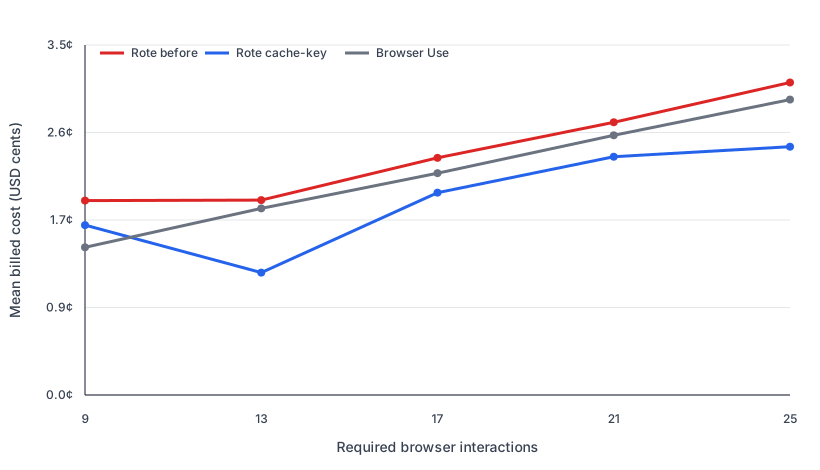
At WP-N25, mean Rote cost falls 20.5% (95% CI: 11.3–30.3%) and is 16.0% lower than
Browser Use (95% CI: 6.2–26.2%). The shortest WP-N09 cell still loses cost and its
comparison interval crosses parity; this is a long-task cache win, not a universal one.
Logical tokens are never relabeled as savings.
Cache method and table ·
optimized curve ·
optimized Rote JSONL ·
Browser Use raw receipts ·
cache summary
Tokens-per-task level
The frozen v1 matrix supports 91.8% lower logical tokens on B1 (95% CI 91.8–91.9%)
and 93.3% on B3 (92.4–93.9%) at independently verified parity. Its historical B2
estimate was withdrawn because the oracle proved only generic completion. A fresh
protocol-v2 matrix now independently proves all eight requested values and reduces B2
logical tokens by 83.6% (95% CI 82.7–84.6%) at 18/18 success per harness.
These are controlled local fixtures, while G1 is the real-WordPress length result. They
do not establish production-site, learned-memory, or cross-provider wins.
Historical G2 method and correction ·
B2 exact-verification correction ·
corrective B2 certification
Deterministic drift recovery
On 90 real-Chrome B5 attempts, Rote recovered 72/72 selector-drifted replays without
an LLM or full fallback (100%, 95% Wilson interval 94.9–100.0%), observed 0/90 silent
failures, and failed closed on 18/18 ambiguous-control attempts. Repair used 0 logical
tokens versus an 8,354-token corrected B2 cold baseline. This covers semantic target
resolution, not arbitrary workflow repair or rollback.
B5 method, limitations, and raw receipts ·
multi-harness comparison plan
Competitor expansion status
The first Stagehand feasibility cell was stopped rather than success-hunted: pinned
Stagehand 3.7.1 reached the exact B2 oracle on 1/6 cold attempts despite declaring 6/6
successes, and its public diagnostics did not retain complete raw cold-provider receipts.
The sole warm/drift pair is retained as diagnostic evidence, not a comparative rate or cost claim. Pinned Skyvern 1.0.47 then generated reusable artifacts and completed every non-abandoned B2/B5 qualification attempt exactly, but every completed warm/drift run triggered AI fallback and its self-hosted logs did not provide complete raw provider receipts. T23 therefore stops before comparative token/cost certification; it is not a Rote superiority claim. Browser Use 0.13.7 subsequently passed bounded T24 feasibility—3/3 corrected B2 cold attempts and 5/5 B5 cold diagnostics, all with complete receipts. T25 then recollected both harnesses in 18 fresh ordered corrected-B2 pairs: both passed 18/18 exact attempts, while Rote reduced logical tokens by 83.1% (95% CI 82.1–83.9%), billed cost by 68.2% (66.3–69.9%), and latency by 43.6% (39.0–48.1%). This is a single pinned local cold-agent cell; it does not test replay or learning. Magnitude 0.3.1 then stopped at bounded feasibility in T27: 0/6 corrected-B2 attempts reached a harness conclusion or exact oracle before the frozen 90-second timeout, and 0/6 retained complete raw provider receipts. No B5 run or Magnitude-vs-Rote ranking followed.
Stagehand method and stop decision · Skyvern method and stop decision · Browser Use refresh qualification · Browser Use 0.13.7 paired certification · Magnitude method and stop decision
Reproduce and watch
Reproduce the historical v1 report byte-for-byte (this preserves the record; it does not
restore the withdrawn B2 claim):
npm ci
npm run reproduce:g2
npm run reproduce:b5
npm run reproduce:stagehand
npm run reproduce:skyvern
npm run reproduce:browser-use-refresh
npm run reproduce:browser-use-0137-certification
npm run reproduce:post-action-evidence
npm run reproduce:magnitude
The paid 18-repetition collection is also one resumable command; see the
head-to-head runbook. To watch the current product
boundary—cold exploration, explicit zero-token replay, then selector drift detected and
sent to the plain agent—open the terminal recording or run:
export OPENAI_API_KEY=...
scripts/demo/run-launch-demo.sh
The candidate in this demo is hand-written, not learned, and drift uses full fallback,
not scoped repair. Method and raw demo artifacts.
To see why a full cosmetic redesign costs ~6 tokens while a real change still
surfaces — the production distiller and adaptive renderer on three versions of one
page, no API key needed — run:
npx tsx scripts/demo/cosmetic-diff-demo.ts
Edit the HTML inside the script to try your own drift.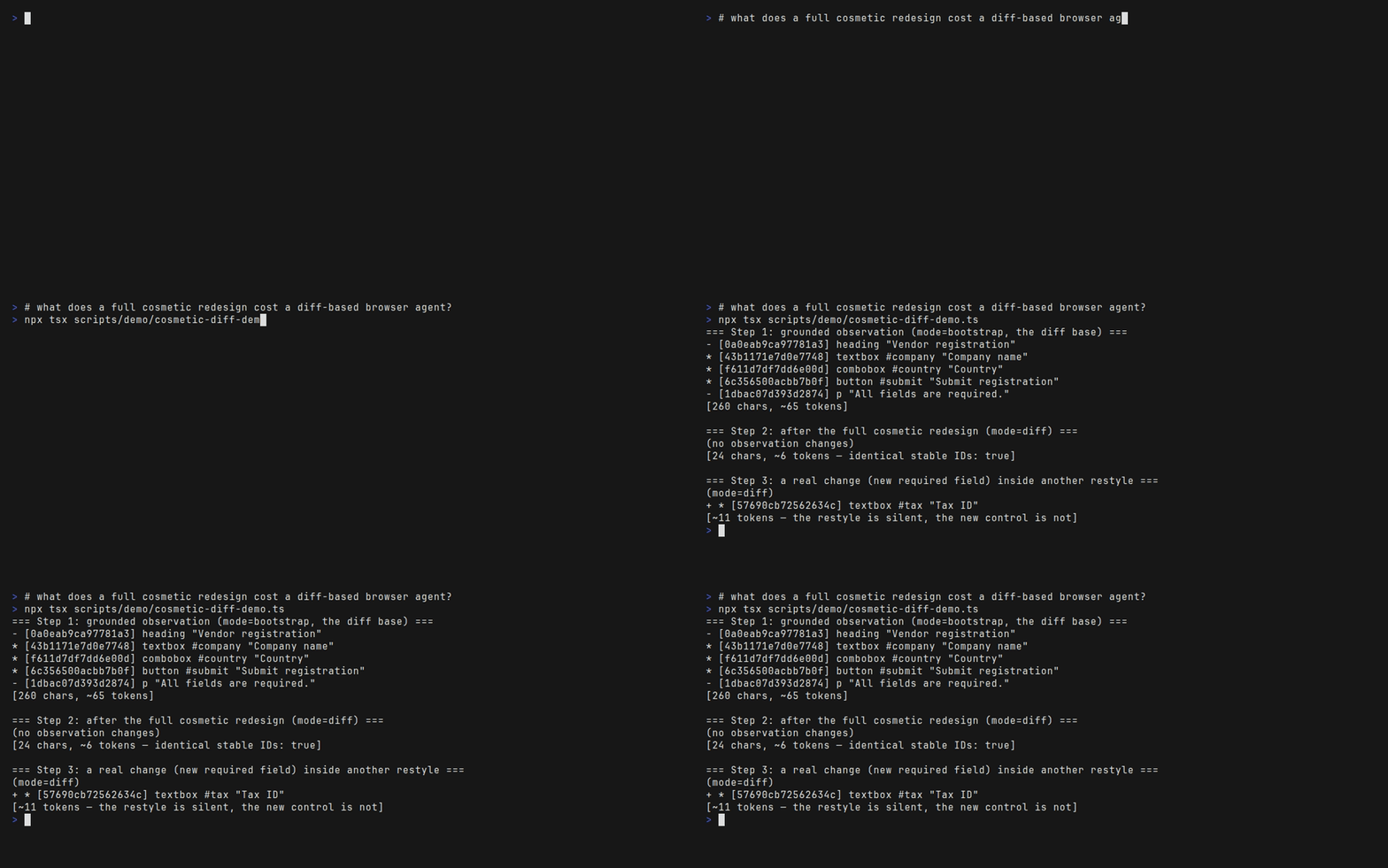
Design invariants
- Never silently wrong — every replayed step is assertion-gated; a final verify block
must pass or the run escalates the repair ladder. - Never worse than baseline — a mismatched, failed, or errored explicit replay returns
to the plain agent with a recorded classification. Generic rollback of prior server-side
effects is not built. - Never cross environments — a structural fingerprint (tool inventory, target-system
identity) is a hard gate. A playbook learned on staging can't fire on prod. - Everything versioned — playbooks and repair patches are append-only, auditable,
diffable, and exportable as human-readable YAML.
Why "Rote"
Rote: doing something from memory, by repetition, without re-deriving it. For browser
agents, that means the harness remembers how sites behave — observations, stable elements,
procedures, and verification signals — so the next run starts warmer.
Status
Early build — G1, corrected G2, and deterministic B5 drift gates pass.
Built and working end to end: core schemas + Expect DSL, lossless recorder, verified
replay executor, CDP browser backend, perception (distill → stable IDs → budget),
observation eviction, the agent loop, tagged LLM accounting, and the benchmark +
head-to-head gate. First live run against a real browser and model
(T1) completed B1 in the minimum four actions; B2 now
passes 11/11 after #49.
P1 tier-0 working memory launched on 2026-08-08; P2 is current. The four tier-0 levers, honestly:
| Lever | State |
|---|---|
| Observation eviction — keep what you did, not what you saw | built and recall-stress tested — missing earlier-page facts fail as recall_unavailable; fabricated comparisons fail verification (T18) |
| Diff observations | built and real-page measured — 849 certification diffs have a 24-character median; median reduction vs. the preceding grounded base is 99.6% (T10) |
| Cache layout | built and economically qualified — immutable-prefix routing cuts WP-N25 mean cost 20.5% and clears Browser Use by 16.0%, both with 95% intervals above zero (T11) |
| History compaction | built deterministically on main; long-run qualification pending — planner-visible action history is bounded on cache-amortized boundaries, but the frozen P1 curve and published 0.1.0 predate it |
Not built: the playbook distiller (V1 replays hand-written playbooks), the matcher, site
memory, model routing, speculation. Tier 1 is table stakes and we are late to it —
Skyvern ships record → generated code → code replay with automatic AI fallback today; its documented zero-reasoning path must not be assumed for every generated artifact (docs/04). docs/02-architecture.md §Status is authoritative.
No number, no launch was enforced. G1 passes its public 30% slope-reduction floor: 37.2%
(95% CI 35.6–38.8%) at success parity. B1/B3 retain their original level evidence and T20 restores B2/full G2 with an exact
eight-value oracle. Cache economics still
lose at G1's shortest cell. The CLI tarball, demo, and one-command reproduction pass;@rotehq/[email protected] is registry-published. Its audited integrity, clean no-key bin invocation, and provider-backed empty-directory quickstart pass; T28 retains the exact manifest, trajectory, and raw receipt. Read the known limitations before trying Rote and see
T14 for packaging evidence.
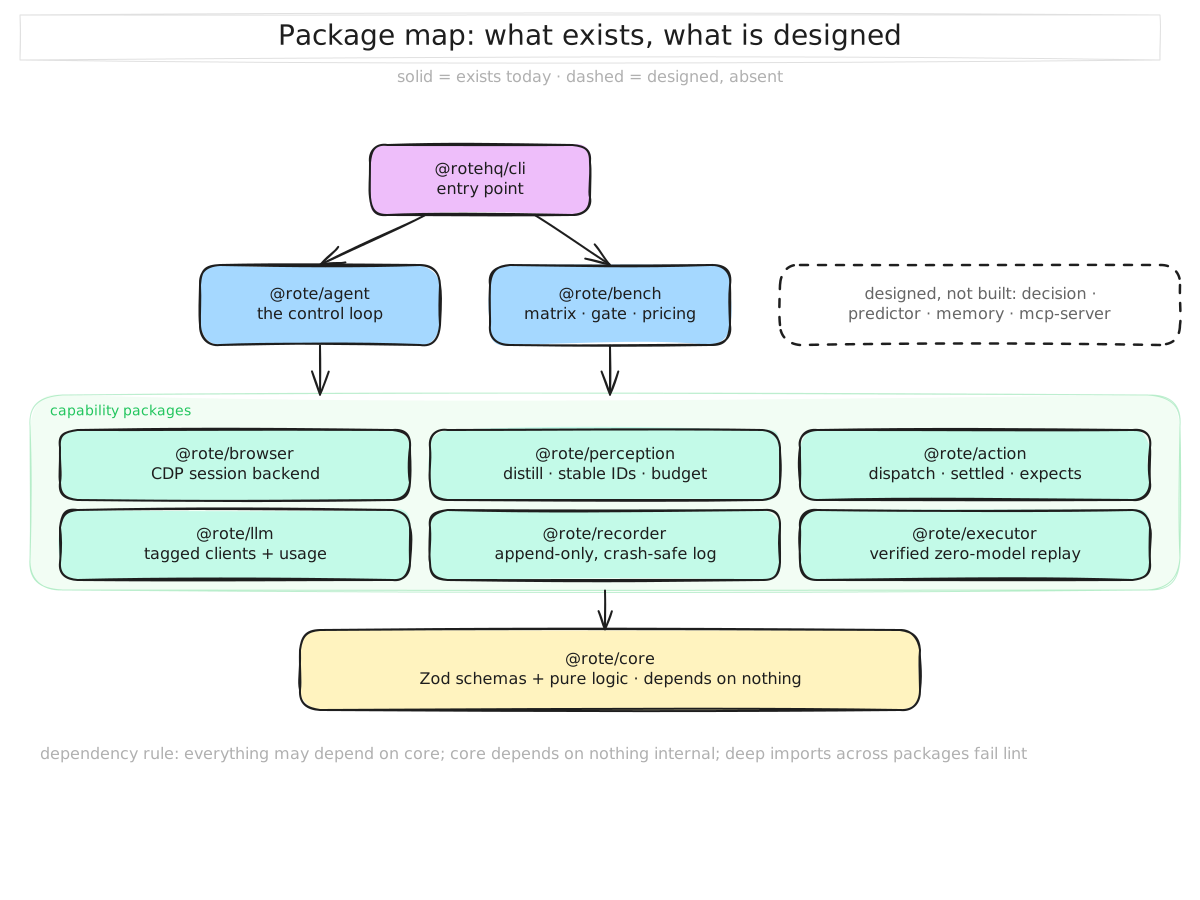
Solid packages exist today; dashed packages are the target composition described in
docs/02 — Architecture.
Docs
| Doc | Contents |
|---|---|
| 01 — Problem | Why agents re-derive everything; the reuse-path gap; where Rote fits and where it doesn't |
| 02 — Architecture | What is built vs designed; the four planes; control loop; playbooks; repair ladder; memory; speculation; invariants |
| 03 — Benchmark | Task suite, metrics, fairness rules, the variance rule, the launch gate, generalization |
| 04 — Competition | The field, per-competitor teardown, capability matrix, steelmanned objections |
| 05 — Roadmap | Where we are; V1 scope and gates; P0–P5; open questions |
| 06 — Optimizations | The master catalog: every optimization, tier, status, evidence |
| 07 — Execution plan | The work breakdown: epics, tasks, dependencies, acceptance criteria, RAID |
| Launch readiness | Final P1 gate walk, sole registry blocker, and exact release-closure procedure |
| Known limitations | What is not built, weak-fit tasks, safety/operations boundaries, and the exact evidence scope |
| Third-party licenses | CLI and benchmark dependency/fork review plus release obligations |
| testing/ | Records of tests against real Rote — live browser, live model, live key |
Contributing
See CONTRIBUTING.md for the dev workflow and PR conventions,
and CLAUDE.md for the full engineering ruleset. Please also read
our Code of Conduct. Found a security issue? See
SECURITY.md — please don't file it as a public issue.
License
MIT — see LICENSE.
Reviews (0)
Sign in to leave a review.
Leave a reviewNo results found