skills
Health Warn
- License — License: MIT
- Description — Repository has a description
- Active repo — Last push 0 days ago
- Low visibility — Only 9 GitHub stars
Code Warn
- process.env — Environment variable access in bin/install.mjs
Permissions Pass
- Permissions — No dangerous permissions requested
No AI report is available for this listing yet.
You say the job; the playbook runs. 143 agent skills + 55 commands for Cursor, Claude Code, Codex, Gemini. React / Next.js / Supabase.

kenji skills
You say the job. The playbook runs. Agent skills, slash commands, and subagents for Claude Code, Cursor, Codex CLI, and Gemini CLI.
158 agent skills · 63 slash commands · 16 MCP servers · 12 Cursor skills · 6 subagents — for React / Next.js / Supabase, usable on almost any stack.


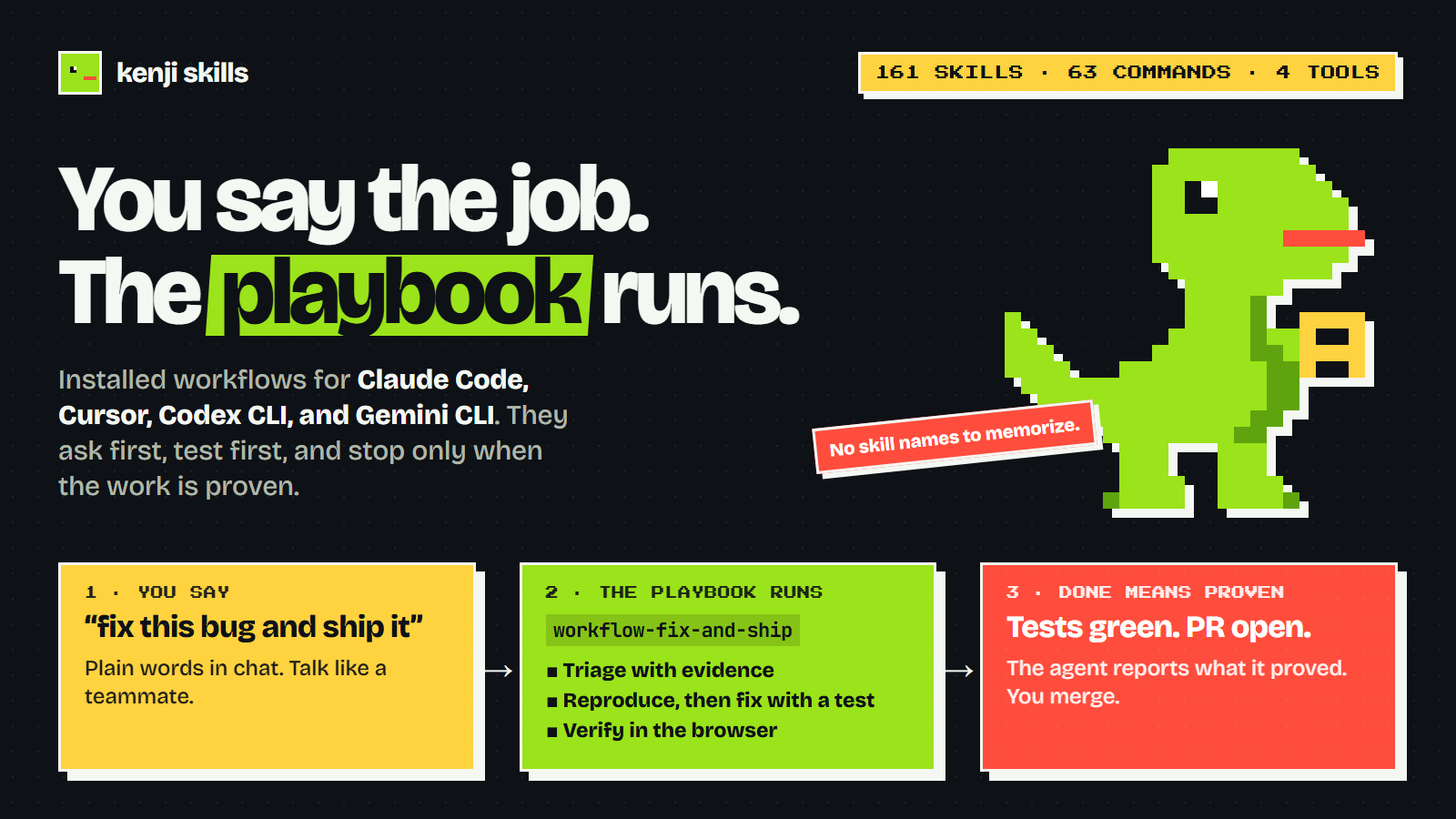
↑ what happens after install · follows your GitHub theme · not a hosted app
Why it exists — Coding agents skip the unglamorous parts: interview you first, write the failing test, watch production, refuse “done” with leftovers. These playbooks don’t skip.
Who it’s for — People shipping in Cursor, Claude Code, Codex CLI, or Gemini CLI. Tuned for React / Next.js / Supabase. Works on other stacks.
What it’s not — A Cursor replacement, a prompt paste-bin, or 157 names to memorize. Install once. Talk like a teammate.
Install (30 seconds)
npx @kensaurus/skills --all
That merge-installs skills and slash commands (and agents/rules) into every tool it supports, then hash-checks the copies. Restart Cursor. Done.
Skills only (no
/commands)?npx skills add kensaurus/skills— Vercel skills CLI, project-local by default (-gfor~/.cursor/skills). Its--allmeans “all skills to all agents”, not Cursor+Claude+Codex+Gemini.No Cursor yet? Download it. Claude Code plugin:
/plugin marketplace add kensaurus/skillsthen/plugin install kenji@kenji. Flag list and clone install → Quick Start. Brand new? Plain-language guide →.
Renamed from
cursor-kenjiin 2.0.0 — same pack, now tool-neutral. Upgrading →
What should I say?
| You say… | What kicks in | What you get |
|---|---|---|
| "orient me" | workflow-onboard |
A short tour of the codebase |
| "grill me before I build" | workflow-grilling |
One question at a time until you're aligned |
| "build this feature" | workflow-build-feature |
Spec → tests → code → smoke → PR |
| "fix this bug and ship it" | workflow-fix-and-ship |
Debug → fix → verify → PR → deploy |
| "audit my security" | audit-security |
OWASP-style findings with file:line |
| "is this production-ready?" | audit-resilience + audit-realworld |
Timeouts, retries, parity checks |
| "complete everything" | complete-everything |
No parked leftovers — judge verifies "done" |
| "ship it and watch it" | workflow-ship-and-observe |
Deploy → verify live → observe / rollback |
| "take this to market" | workflow-gtm |
Interview + GTM plan → approve → analytics, hero, onboarding, SEO, launch kit, weekly loop |
| "what should I charge?" | plan-pricing |
Value metric, tiers, price corridor, research plan — no price changes until you approve |
Highest-impact combo: monkey-test as guest and logged-in, ticket every real bug, then lock a Playwright pass on the worst ones → test-exploratory → workflow-feedback-to-closure → test-playwright.
Full menu → Every skill. Trigger phrases → docs/CATALOG.md. Combos → docs/CATALOG.md — Skill Composition.
Tour
Four rooms. Same rule: you talk, a named playbook runs.
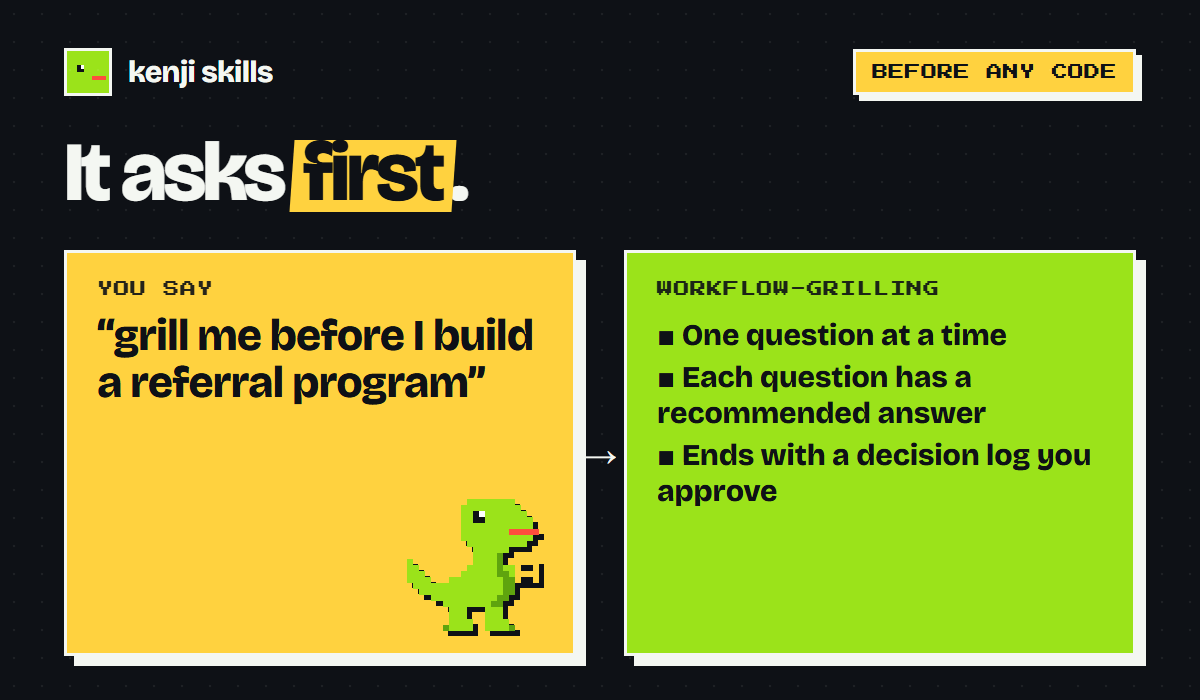
Grill · workflow-grilling — one question at a time until you share a decision log
|
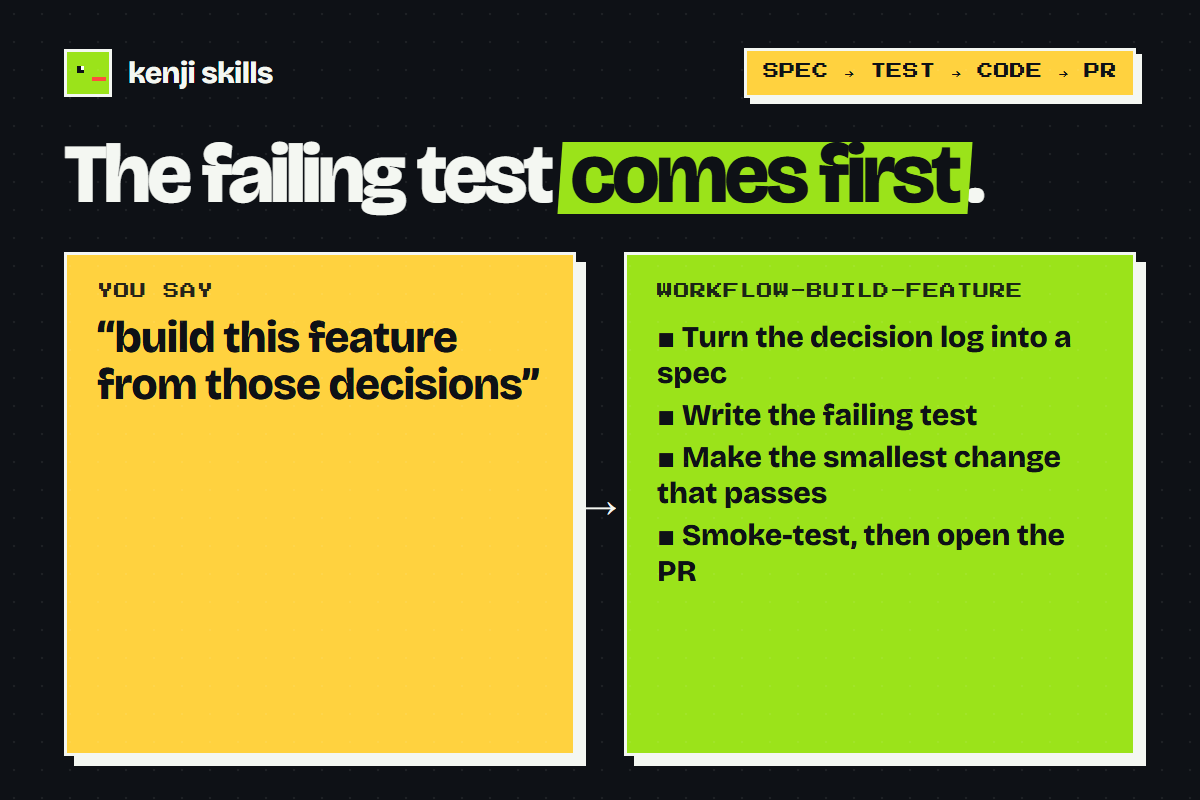
Build · workflow-build-feature — spec → failing test → code → smoke → PR
|
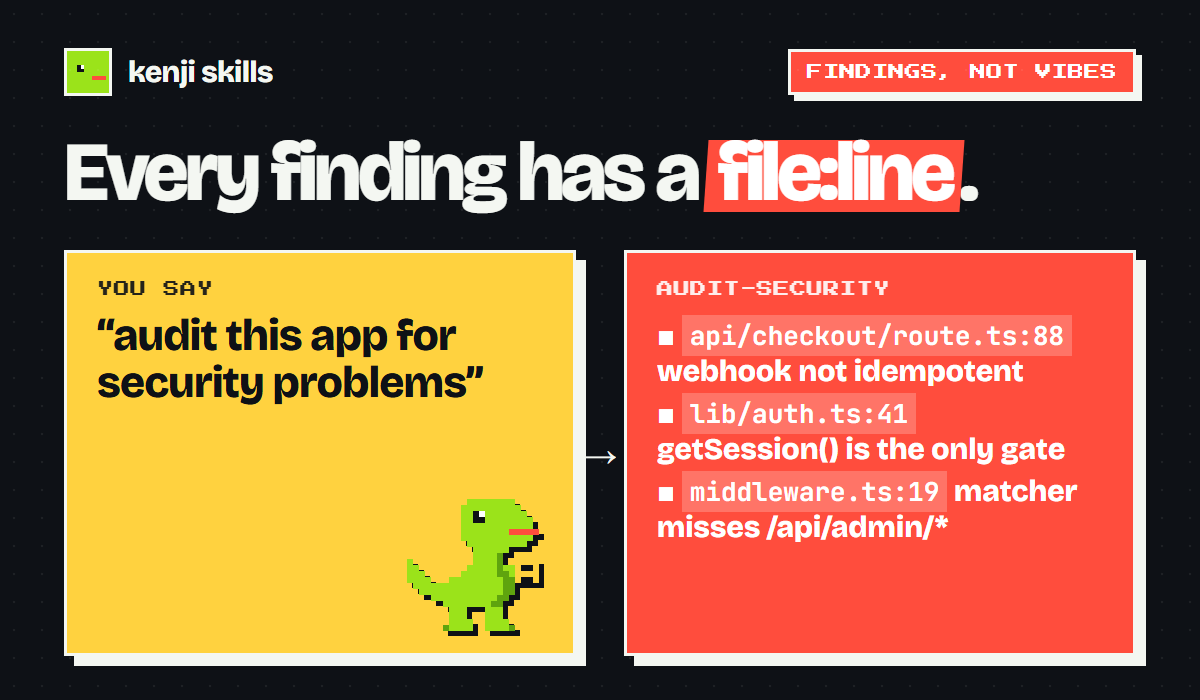
Audit · audit-security — OWASP-style findings with file:line, not a vibe check
|
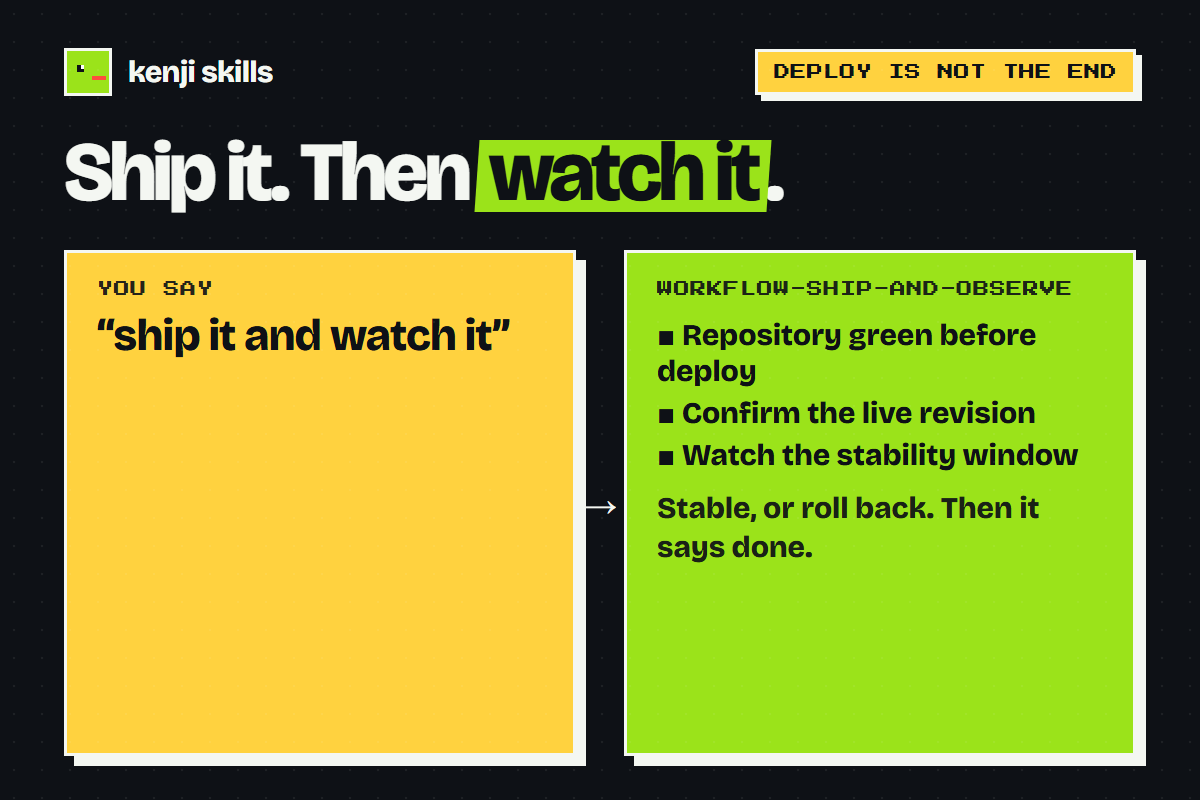
Ship · workflow-ship-and-observe — confirm the live SHA, watch, rollback if it breaks
|
The building blocks
| Thing | What it is | How you use it |
|---|---|---|
| Skill | A playbook for one job | Describe the job in chat |
| Command | A shortcut | Type /commit, /pr, /plan-mode |
| Subagent | A helper that peels off one task | Say "review this PR" |
| Rule | A house rule the AI always obeys | Drop a .mdc into your project |
| MCP server | A connection to your database / GitHub / browser | Copy a template + set env vars |
Everything follows the Agent Skills spec and is checked on every commit (npm test covers all 170 installable skills). MCP templates pin exact versions against package-hallucination attacks.
How it works
Look → change → prove → ship, with guardrails on the whole time:
   Orient          Assess           Change           Prove            Ship
(get to know) → (measure first) → (build/fix) → (test for real) → (go live)
| Stage | Skill families |
|---|---|
| Orient | workflow-onboard, /research |
| Assess | audit-*, plan-*, /grill-me |
| Change | design-*, enhance-*, backend-*, housekeep-* |
| Prove | test-*, complete-everything, completion-judge |
| Ship | workflow-ship-and-observe, deploy-*, debug-* |
| Guardrails | rules, completion hook, enhance-agent-guardrails, /handoff |
Assess before you change. Prove before you ship.
The 23 plan-* skills audit first and wait for your approval. See docs/PLAN-LOOPS.md.
What's Inside
| Count | What it does | |
|---|---|---|
| Skills | 158 | Auto-triggering playbooks (audit, enhance, debug, test, build, plan) |
| Cursor Skills | 12 | IDE tools (canvas, hooks, rules, PR splitter) |
| Commands | 63 | Slash shortcuts (/commit, /pr, /burndown-full, …) |
| Subagents | 6 | Background helpers (code-reviewer, debugger, db-migrator…) |
| Completion hook | 1 | Opt-in stop gate: continues only unfinished durable closure state |
| MCP Servers | 16 | Full template: Supabase · GitHub · Playwright · AWS · Slack (essential is 3) |
| Project Rules | 7 | Drop-in .mdc for .cursor/rules/ (plus 5 global, 5 RN bundle optional) |
| Notepads | 2 | Context templates (architecture, design tokens) |
| Shell Aliases | 8 | newskill, cursor-sync, gc, gp |
Trigger phrases → docs/CATALOG.md · quick lookup → docs/TRIGGER-CHEATSHEET.md.
Quick Start
| Method | Command | What it installs |
|---|---|---|
| npm installer (full pack) | npx @kensaurus/skills --all |
Skills + commands + agents + rules. --all = Cursor + Claude + Codex + Gemini |
| skills.sh (skills only) | npx skills add kensaurus/skills |
SKILL.md folders only. Default is the current project; add -g for ~/.cursor/skills. Does not write ~/.cursor/commands |
| Clone | git clone … && ./install.sh |
Same as the npm installer (--cursor --claude with no args) |
| Claude Code plugin | /plugin marketplace add kensaurus/skills then /plugin install kenji@kenji |
This repo as a marketplace. Not the Anthropic community catalog until they list it |
npm installer modes:
npx @kensaurus/skills            # merge — add/overwrite this repo's items (Cursor)
npx @kensaurus/skills --auto     # detect installed tools and install to each
npx @kensaurus/skills --claude   # install for Claude Code (~/.claude/) instead
npx @kensaurus/skills --codex    # install for Codex CLI (~/.codex/AGENTS.md + prompts)
npx @kensaurus/skills --gemini   # install for Gemini CLI (~/.gemini/GEMINI.md + commands)
npx @kensaurus/skills --all      # install for all four supported tools in one run
npx @kensaurus/skills --clean    # mirror ~/.cursor to match this repo (backup first)
npx @kensaurus/skills --dry-run  # preview
npx @kensaurus/skills --verify   # hash-check dests against this package (no writes)
npx @kensaurus/skills --skill audit-ux   # single skill
npx @kensaurus/skills --link     # dev: symlink for live skill authoring
More flags (--restore, --only, --no-agents-mirror): npx @kensaurus/skills --help.
Use more than one AI tool? Reach for --auto. It checks ~/.cursor, ~/.claude, ~/.codex, and ~/.gemini, then installs the right files to each one it finds. The bare command stays Cursor-only.
From a clone: npm run install:cursor · node bin/install.mjs --all · npm test validates skills + count + install smoke test.
From any folder: npx @kensaurus/skills --all. From a clone, node bin/install.mjs --all also works (Windows ships kenji.cmd so npx from the repo folder works too).
Optional — Mushi Mushi bug-report triage (pairs with mushi-health, test-playwright):
npx skills add kensaurus/mushi-mushi
After install: (1) Restart Cursor (2) Copy mcp/mcp.json.template → ~/.cursor/mcp.json and set FIRECRAWL_API_KEY, CONTEXT7_API_KEY, SUPABASE_ACCESS_TOKEN, SUPABASE_PROJECT_REF (3) Describe any task — skills match on keywords.
Authoring skills? Each skill must pass Agent Skills spec validation (npm run validate:skills): name matches directory, description ≤ 320 chars (house budget; spec max 1024), body < 500 lines.
Claude Code
npx @kensaurus/skills --claude   # Claude Code only
npx @kensaurus/skills --all      # all four supported tools
All skills, commands, agents, and rules install to Claude Code (~/.claude/), with .mdc rules installed as .md. Skills appear as /slash-commands.
From a clone:
./install.sh --claude    # Claude Code only
./install.sh             # Cursor + Claude Code (default)
# Inside Claude Code
/workflow-build-feature
/debug-error the login endpoint returns 401
/plan-security-audit
Skills are read from ~/.claude/skills/<name>/SKILL.md. No restart required when you re-run the installer — Claude Code picks up file changes at the start of each new session.
Model and effort. Claude Code 2.1.280+ defaults to Claude Opus 5.5 (opus alias). Its effort default is medium — the level Anthropic measured at or above Opus 5 high on agentic coding, in fewer steps and about half the tokens — and thinking cannot be switched off, so effort is the only thinking control. The top-level effortLevel setting does not apply to it; set effort with /effort <low|medium|high|xhigh|max>, per-model modelSettings, or a skill's effort: frontmatter key. Pack convention: audit, plan, judge, debug and security skills at high; ordinary implementation at the medium default; read-only inventory, formatting, and /handoff at low. Cursor ignores the effort: key. Full story → docs/MODEL-AND-EFFORT.md.
Codex CLI & Gemini CLI
Codex CLI and Gemini CLI don't have a skills system yet. Each reads a single global context file instead:
npx @kensaurus/skills --codex    # Codex CLI
npx @kensaurus/skills --gemini   # Gemini CLI
| Codex CLI | Gemini CLI | |
|---|---|---|
| Rules → context file | ~/.codex/AGENTS.md |
~/.gemini/GEMINI.md |
| Portable commands | ~/.codex/prompts/*.md |
~/.gemini/commands/*.toml |
Your rules/ get merged into that one auto-loaded file (the skill-routing index is skipped). Three standalone playbooks — plan-mode, research, and fix-issue — ship as native prompts/commands. Skills and subagents aren't written out, because neither tool can load them. Existing AGENTS.md or GEMINI.md is backed up as .bak-<stamp> first.
The bash
install.sh --codex/--geminidelegates to the Node installer (needs Node ≥ 18).
Manual install
git clone https://github.com/kensaurus/skills.git && cd skills && ./install.sh
curl -sSL https://raw.githubusercontent.com/kensaurus/skills/main/install.sh | bash
Keep fresh: npx @kensaurus/skills --all && npx @kensaurus/skills --verify --all or git pull && ./install.sh
Every skill, in plain English
You don't memorize names — describe the job in chat. Exact trigger phrases → docs/CATALOG.md. Prefix / stage table → docs/CATALOG.md — Skill Taxonomy.
Auto-generated from each skill's SKILL.md — run npm run gen:skill-index after adding a skill. 170 skills listed below.
Skills marked /name only are user-invoked rituals; reference only skills are loaded by other skills; every other skill auto-routes from a plain request.
Skill families at a glance
| Family | Count | In one sentence |
|---|---|---|
| Audit — inspect; some then fix | 32 | Check the codebase — security, UX, analytics, IAP, the skill pack… |
| Plan — audit first, change only after you approve | 23 | Write a fix plan you approve before any code changes |
| Enhance — improve what already exists | 21 | Polish UI, forms, motion, SEO, PWA, email deliverability |
| Design — build something new | 10 | Create new UI, APIs, emails, themes from scratch |
| Backend — server & data patterns | 5 | Auth, caching, queues, realtime, observability |
| Mobile — React Native / Capacitor | 5 | RN screens, emulators, Capacitor, App Store prep |
| Data — charts & pipelines | 2 | Charts, dashboards, ETL / cron jobs |
| Docs — write it down clearly | 6 | READMEs, PRDs, RFCs with a reader-first voice |
| Housekeeping — consolidate or clear one drifted register | 5 | Consolidate one drifted register (gates, backlog, design tokens, dead code) |
| Workflows — multi-step recipes | 21 | End-to-end recipes (build, fix, ship, green the repo) |
| Test & QA — prove it works | 8 | Unit, Playwright, visual regression, load, red-team |
| Deploy — ship & verify | 2 | npm release + post-deploy smoke tests |
| Debug — find & fix what's broken | 3 | Errors, Sentry, frontend↔backend mismatches |
| Iterate — close the loop after launch | 3 | Post-launch feedback loops and agent-harness iteration |
| Mushi Mushi — bug triage helpers | 2 | Integrate the Mushi Mushi bug-report pipeline |
| Protocols — session guardrails | 1 | Keep browser automation from freezing |
| Authoring — build skills & MCP | 2 | Author new skills or MCP servers |
| Third-party (upstream-maintained) | 3 | Vendored upstream skills (Emil, UI/UX Pro Max, Vercel WIG) |
| Core & cross-cutting | 4 | Close everything, burndown, research, handoff |
| Cursor IDE skills | 12 | Canvas, hooks, rules, PR splitter, CLI helpers |
| Total | 170 |
Full list (every skill)
Audit — inspect; some then fix (32)
| Skill | What it does |
|---|---|
audit-accessibility |
WCAG 2.2 audit via playwright-cli: crawl every page, inject axe-core, test keyboard nav, contrast, ARIA labels, heading order |
audit-agent-speed |
Measure and fix a slow coding-agent setup: status line, hooks, instruction bloat, effort, worktree pile-up, antivirus and indexer scans |
audit-analytics |
Read-only audit of product-analytics events (PostHog, Amplitude, Mixpanel, GA4): taxonomy, funnels, consent-gated firing, dead or duplicate… |
audit-auth-flows |
Read-only audit of app-layer auth: route×gate matrix, session lifecycle, OAuth, provider traps (getSession vs getUser, middleware-only… |
audit-backend-architecture |
Read-only backend-architecture audit and pattern advisor, gated by stack |
audit-bundle-size |
Analyse and shrink a web app's JavaScript bundle |
audit-cicd |
Audit GitHub Actions CI/CD for cost, speed, and safety |
audit-code-quality |
Detect and fix repo-wide anti-patterns and consistency drift (naming, organisation, repeated smells) |
audit-code-review |
Review a PR or diff for correctness, security, and maintainability |
audit-codemod-safety |
Read-only check that a codemod or bulk transform preserved behavior — compiling is not proof |
audit-db-schema |
Audit a database schema for consistency, constraints, naming, indexes, and migrations |
audit-doctrine |
Read-only audit of custom lint and ratchet rules: is each rule right on the merits, not just enforced |
audit-env-parity |
Read-only audit of config parity across dev, staging, and prod: missing or misnamed vars, drifted flags, hardcoded values, reused secrets |
audit-fe-api |
Audit frontend API calls against backend implementation for contract alignment and network shape |
audit-gate-logic |
Read-only audit of CI gate logic: silent bypass, ratchet gaming, required-but-not, duplicate gates |
audit-i18n |
Audit and fix internationalisation in web or mobile apps |
audit-infra-cost |
Read-only audit of hosting, database, storage, egress, and serverless spend (Supabase, Vercel, S3/R2, edge) |
audit-langfuse-llm |
PDCA quality audit of LLM features: traces, prompts, costs, evals, grounding, hallucination |
audit-llm-security |
Read-only OWASP LLM Top 10 audit of app-facing AI: prompt injection, data leakage, unsafe output or agency, RAG risks, unbounded spend |
audit-monetization-iap |
Read-only audit of mobile IAP and subscriptions (StoreKit 2, Play Billing, RevenueCat): receipt validation, restore, lifecycle sync, grace… |
audit-payment-system |
Read-only audit of payment and money-movement code, scoped from Stripe Checkout to in-house ledgers |
audit-performance |
Audit and fix runtime performance (Core Web Vitals, load priority) |
audit-realworld |
Read-only conformance audit of a full-stack app against RealWorld ("Conduit"): API spec, shared E2E suite, closest-stack reference |
audit-registry-listing |
Read-only audit of where a repo is found: README first screen, npm/PyPI metadata and tarball, GitHub topics, social preview, plugin… |
audit-resilience |
Read-only production-resilience audit: timeouts, bounded retries, circuit breakers, idempotency, rate limits, graceful degradation, PII in… |
audit-responsive |
Audit and fix layouts at every breakpoint — desktop is not a wide phone |
audit-security |
Audit and fix app code against OWASP (injection, headers, dependencies) |
audit-skill-conflicts |
Read-only audit of a skill pack for contradictory directives, overlapping triggers, stale cross-refs, and context bloat |
audit-ui-states |
Read-only audit of unhappy-path UI states — empty, loading, error, offline, zero-results, permission, overflow — then a fix plan |
audit-uiux-design-system |
Audit visual-system coherence: tokens, component variants, color, type, spacing, dark mode |
audit-ux |
Per-page UX audit with NN/g heuristics, microcopy review, and Google HEART |
audit-ux-journeys |
Cross-page UX audit of user stories, task completion, and information architecture |
Plan — audit first, change only after you approve (23)
| Skill | What it does |
|---|---|
plan-aeo-readiness |
Plan-only audit of answer-engine (AEO/GEO) citation readiness for ChatGPT, Perplexity, and AI Overviews |
plan-antislop |
Plan-only authenticity / AI-slop audit across prose, UI, code, and IA |
plan-aso |
Plan-only ASO audit of App Store and Google Play listings: keywords, localized metadata, screenshots, ratings prompts |
plan-backup-dr |
Plan-only audit of whether a project can actually recover from data loss, not just whether backups exist |
plan-capacitor-hardening |
Plan-only Capacitor/Ionic native-layer security audit: WebView, token storage, deep links, OAuth, cleartext traffic, exported activities |
plan-data-integrity |
Plan-only audit of destructive-operation and migration safety |
plan-dead-code |
Plan-only dead-code audit: Knip baseline for unused files, exports, and deps, plus duplication, debug residue, suppressions, orphan assets,… |
plan-dependency-provenance |
Plan-only audit of dependencies for hallucinated or slopsquatted packages, supply-chain risk, and license gaps |
plan-docs-sync |
Plan-only audit of documentation against actual code behavior |
plan-error-handling |
Plan-only audit of silent failures and observability gaps (Sentry, Langfuse) |
plan-gtm |
Plan-only GTM audit: monetization, positioning, activation funnel, SEO/AEO, distribution, and a founder interview |
plan-input-validation |
Plan-only trust-boundary audit for missing validation, injection, XSS, and forged requests across forms, APIs, and webhooks |
plan-llm-cost-guardrails |
Plan-only audit of an LLM app's runaway-cost and quota-abuse exposure |
plan-mobile-readiness |
Plan-only App Store / Google Play submission audit for Capacitor and React Native: manifests, permissions, privacy forms, signing |
plan-perf-audit |
Plan-only performance audit across web, mobile, backend, and data; measures first, fixes nothing |
plan-pricing |
Plan-only pricing audit: value metric, tiers, price points, free-tier boundary, annual and enterprise anchors, and a willingness-to-pay… |
plan-privacy-compliance |
Plan-only audit mapping real personal-data flows to the privacy policy, GDPR, Japan APPI, and store labels |
plan-rls-audit |
Plan-only audit of Supabase/Postgres Row-Level Security and access-control gaps |
plan-secrets-audit |
Plan-only scan of the working tree and git history for exposed or mis-scoped keys, then a rotate-vs-relocate plan |
plan-security-audit |
Plan-only OWASP Top 10 and Supabase-first hardening burndown |
plan-stub-checker |
Plan-only sweep for stubs, dead buttons, fake components, unwired handlers, and dead links, then a wiring plan |
plan-test-coverage |
Plan-only, user-story-driven test coverage audit |
plan-uiux-unification |
Plan-only UI/UX and design-system audit that emits a unification burndown; no code until a phase is approved |
Enhance — improve what already exists (21)
| Skill | What it does |
|---|---|
enhance-agent-guardrails |
Install guardrails as code so AI sessions cannot reintroduce leaked secrets, injection, or untested code |
enhance-arch-boundaries |
Enforce architecture boundaries in CI with dependency-cruiser or eslint-boundaries: layer direction, feature isolation, forbidden imports |
enhance-capacitor-ui |
Separate desktop and mobile UI in hybrid apps shipped as PWA + iOS + Android (Capacitor, Tauri, Expo Web, Ionic, RN-Web) |
enhance-email-deliverability |
Audit and fix email deliverability: SPF, DKIM, DMARC, reputation, bounces and complaints, list hygiene, unsubscribe compliance |
enhance-growth-loops |
Add growth loops to a live product: a "powered by" badge, shareable artifacts, invites and referral credit, each with K-factor events |
enhance-lifecycle-email |
Lifecycle email from product events: activation nudges, trial expiry by activated vs stalled, limit-reached upgrades, win-back, with exits… |
enhance-motion |
Audit an existing app's motion, then apply one coherent, performant, reduced-motion-safe pass |
enhance-onboarding |
Activation pass: define the activation event, cut steps to first value, add templates, sample data, a short checklist, and signup →… |
enhance-pwa |
Add or upgrade PWA features: manifest, service worker, offline mode, install prompt, push, background sync |
enhance-readability |
Audit and fix how easily content is understood: line length (CPL), reading level, grouping, deadspace, icons or tables that cut verbosity |
enhance-readme |
Enhance an existing README: theme-aware hero, feature tour, screenshots or GIF, accurate badges, synced content |
enhance-skill-prompts |
Upgrade how an existing SKILL.md instructs, not what it does: freedom, a classification contract, one worked example, an evidence rubric,… |
enhance-web-conversion |
Conversion pass for landing, pricing, and upgrade paths: positioned hero, one CTA, real proof, anchored tiers, upgrade prompts at value… |
enhance-web-forms |
Build or upgrade web forms: accessible structure, schema-driven validation, client↔server parity |
enhance-web-instant-nav |
Instant in-site navigation: Speculation Rules, View Transitions, bfcache, 103 Early Hints |
enhance-web-landing |
Build landing pages, portfolios, and marketing sites that don't look AI-generated |
enhance-web-redesign |
Upgrade an existing site/app to premium quality |
enhance-web-seo |
Audit and fix SEO for a web app |
enhance-web-ui |
Polish an existing page's hierarchy, spacing, type, and visual personality |
enhance-web-ux |
NN/g-grounded fix of one existing page's flows |
enhance-web-web3d |
Add purposeful 3D/WebGL and scroll choreography to an existing site with Three.js/R3F, GSAP, or Motion |
Design — build something new (10)
| Skill | What it does |
|---|---|
design-api |
Design REST and GraphQL APIs: naming, versioning, error shapes, auth |
design-canvas |
Create museum-quality visual art as .png or .pdf: posters, infographics, certificates, badges, banners, social graphics, print |
design-email |
Design and build transactional and marketing email templates |
design-frontend |
Create a new production-grade UI from scratch, not a polish pass |
design-generative-art |
Create algorithmic visuals with p5.js, Canvas, or SVG using seeded randomness and interactive controls |
design-mobile-first |
Design mobile-first UIs: touch targets, safe areas, gestures, then enhance up |
design-motion |
Build one new animation — micro-interaction, page transition, scroll, or hover — with Framer Motion, CSS, or GSAP |
design-prd |
Generate Product Requirements Documents through structured conversation for any project |
design-system |
Build a new design system (tokens, variants, theming) |
design-theme |
Apply one of 11 preset themes (colors, fonts) to slides, docs, or landing pages |
Backend — server & data patterns (5)
| Skill | What it does |
|---|---|
backend-db-performance |
Optimize slow queries, indexes, and N+1s |
backend-error-handling |
Implement error-handling patterns: boundaries, toasts, one API error shape |
backend-observability |
Implement correlated errors, traces, and structured logs with PII redaction |
backend-patterns |
Apply backend patterns — queues, caching, rate limits, serverless/edge |
backend-realtime |
Implement real-time features with WebSockets, Supabase Realtime, or Server-Sent Events |
Mobile — React Native / Capacitor (5)
| Skill | What it does |
|---|---|
mobile-capacitor-platform |
Capacitor work beyond UI: plugins, OTA, deep links, push, offline, native CI/CD, store submission, Cordova migration |
mobile-emulator-start |
Boot the Android emulator and Metro (Expo or bare RN) in order: check terminals, kill stale ports, pick an AVD |
mobile-emulator-test |
QA a native Android or Expo dev-client build end to end on the emulator, checking UI, Supabase, and Sentry for each CRUD step |
mobile-rn-performance |
Fix React Native / Expo performance, build, and upgrade issues |
mobile-rn-screen |
Polish an existing React Native screen so it feels native and intentional |
Data — charts & pipelines (2)
| Skill | What it does |
|---|---|
data-pipeline |
Wire ETL, ingestion, cron, and queue jobs with idempotency, atomic writes, data contracts, and dead-letters |
data-visualization |
Build interactive, accessible charts and dashboards with Recharts, D3, or Victory |
Docs — write it down clearly (6)
| Skill | What it does |
|---|---|
docs-adr |
Create and maintain lightweight Architecture Decision Records as agent-readable decision memory: what was decided, why, and what was… |
docs-coauthor |
Co-author structured documents (specs, PRDs, RFCs, proposals) in three stages: gather context, draft, reader-test |
docs-comparison-pages |
Write honest "X vs Y", "alternatives to X", and "migrate from X" pages from verified facts, each unique and dated for review |
docs-domain-modeling |
Build a project's domain model: a CONTEXT.md glossary and ubiquitous language |
docs-launch-kit |
Versioned launch kit from the repo's real features: Show HN, Product Hunt, Reddit/X/LinkedIn posts, release notes, a calendar with UTM links |
docs-writer |
Write developer docs: README content, API references, code comments, changelog entries |
Housekeeping — consolidate or clear one drifted register (5)
| Skill | What it does |
|---|---|
housekeep-backlog |
Inventory parked work — unfinished plans, deferred phases, TODO/FIXME, skipped tests, open findings — into a living BACKLOG.md that diffs… |
housekeep-dead-code |
Remove dead code by category — one commit each, typecheck and tests between, bisect on red — then add a Knip ratchet |
housekeep-design |
Consolidate a drifted design system into one token and component source of truth |
housekeep-files |
Copy-not-move organizer for document trees: hash inventory, dry run, labeled copies, search catalog, verify every source survived |
housekeep-gates |
Consolidate accreted CI gates, ratchets, and hooks into one required aggregator check |
Workflows — multi-step recipes (21)
| Skill | What it does |
|---|---|
workflow-build-feature |
Build a feature end to end: spec and TDD, implement, unit tests, Playwright check, PR |
workflow-coding-discipline |
Guardrails for writing, editing, refactoring, or debugging code: surface assumptions, simplicity first, surgical changes |
workflow-environment-ready |
Prove runtimes, installs, tools, services, env names, and the repo's verification commands work before a long run |
workflow-feature-flag |
Plan and run a feature-flag rollout |
workflow-feedback-to-closure |
Turn raw feedback — bug reports, review comments, Sentry, QA, audit output — into deduplicated tickets and drive each to verified closure |
workflow-fix-and-ship |
One bug-fix lifecycle: triage, reproduce, debug, regression test, fix, live check, PR, optional deploy verify |
workflow-git-commit |
Create one conventional commit from an already-scoped change: stage the named files or hunks, write the message, commit, never push |
workflow-green-repo |
Drive a repository to a green baseline — typecheck, lint, tests, and build passing from a clean checkout — when fixing is authorized |
workflow-grilling |
Interview the user about a plan, decision, or idea one question at a time until you agree |
workflow-gtm |
Take a shipped repo to market: plan-gtm audit and interview, approval, then measure, message, activate, get found, launch, and a weekly loop |
workflow-housekeep |
Repository maintenance: sync the README, remove confirmed dead artifacts, update dependencies safely |
workflow-launch-ready |
Launch-preparation sweep for a new app or major release |
workflow-merge-conflicts |
Resolve an in-progress merge or rebase conflict by tracing each side back to its intent |
workflow-onboard |
First-contact orientation for an unfamiliar codebase |
workflow-parallel-agents |
Run multiple agents in parallel via git worktrees, cloud agents, or multi-model comparison |
workflow-pr |
Manage an existing PR lifecycle — review, bot feedback, conflicts, merge |
workflow-quality-gate |
Pre-release quality gate across red-team, security, bundle size, performance, and unit tests |
workflow-refactor |
Scoped, behavior-preserving refactor: map dependencies, change structure, run affected tests |
workflow-release-prep |
Take the local working tree to a merge-ready PR against main: review, split if needed, commit, push, open the PR, drive CI green; never… |
workflow-ship-and-observe |
Take merged, green code to a verified, monitored production release |
workflow-spec-tdd |
A spec → plan → TDD loop before writing a line |
Test & QA — prove it works (8)
| Skill | What it does |
|---|---|
test-exploratory |
Headed exploratory QA of a live app as guest, then logged in, with junk input and navigation abuse |
test-load |
Design and run a k6 or Artillery load profile: throughput, latency percentiles, error rate, breaking point |
test-mutation |
Run mutation testing (StrykerJS, mutmut) to measure whether tests assert behavior, not just execute lines |
test-playwright |
Close the PDCA loop on this session's diff |
test-qa |
Web-app CRUD and story QA when no project-specific skill applies |
test-red-team |
Red-team a running web, React Native, or Capacitor app |
test-unit |
Write unit and integration tests for a named module or change |
test-visual-regression |
Set up Playwright screenshot baselines and CI diffing so UI changes fail pixel by pixel instead of by eye |
Deploy — ship & verify (2)
| Skill | What it does |
|---|---|
deploy-npm |
Release an npm package: version, CHANGELOG, publish, verify — /deploy-npm only |
deploy-verify |
Post-deploy smoke test across browser, Sentry, Supabase, Langfuse, and the public web |
Debug — find & fix what's broken (3)
| Skill | What it does |
|---|---|
debug-error |
Diagnose one bug with hypotheses and runtime evidence before fixing |
debug-fe-be-integration |
Diagnose and fix frontend↔backend contract failures by tracing requests, server logs, validation, auth, and responses on both sides |
debug-sentry-monitor |
Operate Sentry: triage and fix unresolved issues, cut noise, audit instrumentation, monitor after deploy |
Iterate — close the loop after launch (3)
| Skill | What it does |
|---|---|
iterate-agent-harness |
Turn an agent failure (premature stop, false completion, gamed check, missed file) into a rule, hook, or CI guard with a regression test |
iterate-gtm-weekly |
Weekly go-to-market review for a shipped product: funnel by source, activation cohort, top drop-off, launch results, then one experiment… — /iterate-gtm-weekly only |
iterate-post-launch |
Close the feedback loop on a live app: read production signals, rank the top issues, fix, verify live, repeat |
Mushi Mushi — bug triage helpers (2)
| Skill | What it does |
|---|---|
mushi-health |
Pass/fail health check across every Mushi Mushi pipeline component — CLI credentials, API reachability, edge functions, BYOK key pool, QA… — /mushi-health only |
mushi-integration |
Full end-to-end Mushi Mushi integration smoke test: bug capture → AI triage → story mapping → TDD test generation → approval → execution →… — /mushi-integration only |
Protocols — session guardrails (1)
| Skill | What it does |
|---|---|
protocol-browser-anti-stall |
Guardrail for Playwright CLI sessions: headed, named, isolated; prevents parallel collisions and recovers stalls without scripted shortcuts (reference only) |
Authoring — build skills & MCP (2)
| Skill | What it does |
|---|---|
meta-mcp-builder |
Build Model Context Protocol (MCP) servers that expose services, APIs, and data as typed tools for agents |
meta-skill-creator |
Create or update a pack SKILL.md (frontmatter, house limits, T1–T8) |
Third-party (upstream-maintained) (3)
| Skill | What it does |
|---|---|
thirdparty-emil-design-eng |
Third-party skill — Emil Kowalski's design-engineering notes (animation craft, Sonner-style components) |
thirdparty-ui-ux-pro-max |
Third-party skill — searchable style catalog, palettes, typography, and UX guidelines via Python scripts |
thirdparty-web-interface-guidelines |
Third-party skill — Vercel Web Interface Guidelines compliance (focus, forms, animation, copy) |
Core & cross-cutting (4)
| Skill | What it does |
|---|---|
burndown-full |
Drive a planned mechanical change to 100% repo coverage after a run stopped early |
complete-everything |
Closure mode for one approved plan: finish every open item and connected deferral, verify each acceptance criterion, require… |
handoff |
Compact the current conversation into a handoff document a fresh agent can pick up — /handoff only |
research |
Research current practice with Context7, Firecrawl, and official docs before a non-trivial change: gap analysis and a file-mapped plan, no… |
Cursor IDE skills (12)
| Skill | What it does |
|---|---|
babysit |
Keep an already-open PR merge-ready: triage comments, resolve clear conflicts, fix CI |
canvas |
Create a live React canvas beside chat for standalone analytical artifacts that benefit from visual layout: quantitative/security/… (reference only) |
create-hook |
Create Cursor hooks — /create-hook only |
create-rule |
Create Cursor rules for persistent AI guidance — /create-rule only |
create-skill |
Guide users through creating effective Agent Skills for Cursor — /create-skill only |
create-subagent |
Create custom subagents for specialized AI tasks — /create-subagent only |
migrate-to-skills |
Convert 'Applied intelligently' Cursor rules (.cursor/rules/.mdc) and slash commands (.cursor/commands/.md) to Agent Skills format… — /migrate-to-skills only |
shell |
Run the rest of a /shell request as a literal shell command — /shell only |
split-to-prs |
Split current work into small reviewable PRs — /split-to-prs only |
statusline |
Configure a custom status line in the CLI — /statusline only |
update-cli-config |
View and modify Cursor CLI configuration in ~/.cursor/cli-config.json — /update-cli-config only |
update-cursor-settings |
Modify Cursor/VSCode user settings in settings.json — /update-cursor-settings only |
How to Use
| Primitive | Invoke | Example |
|---|---|---|
| Skill | Describe the task | "audit my security" → audit-security |
| Command | /name in chat |
/commit, /research, /pr |
| Subagent | Mention trigger keyword | "review this PR" → code-reviewer |
| Rule | Copy .mdc into project |
Always-on conventions |
Force a skill: "use enhance-web-ux on /dashboard"
Plan → apply pairs.
housekeep-designis the execution arm ofplan-uiux-unification;housekeep-dead-codeis the execution arm ofplan-dead-code;workflow-gtmis the execution arm ofplan-gtm. Theplan-*half audits and stops; the apply half changes the repo only
against an approved list.Third-party skills: prefixed
thirdparty-*withATTRIBUTION.md— see docs/THIRD-PARTY-SKILLS.md.Anthropic
file-docx/pdf/pptx/xlsxskills are not in this public repo.
Cursor-specific skills (12): babysit, canvas, create-hook, create-rule, create-skill, split-to-prs, … — see CATALOG.md.
Commands (63)
Type / in chat to see them all.
| Command | When | What |
|---|---|---|
/burndown-full |
Partial refactor stopped early | Drive plan to 100% repo coverage via MATCH/DONE + verification gate |
/complete-everything |
Plan marked done with deferrals | Close planned, parked, and discovered work; run the full applicable test ladder |
/green-repo |
Whole-repo debt cleanup (authorized) | Drive typecheck/lint/test/build to green from a fresh run |
/ship-and-observe |
Deploy to production | Verify the live revision, observe the stability window, roll back if needed |
/feedback-to-closure |
Incoming reports/QA/Sentry | Dedupe into durable tickets → fix → production-verified closure |
/plan-mode |
Before coding | Research + approved plan (/plan is the host mode switch) |
/commit |
After coding | Lint, typecheck, commit |
/pr |
Ready to ship | Push + open PR |
/fix-issue [#] |
Bug reports | Issue → fix → PR |
/debug-issue |
Tricky bugs | Hypothesis, then runtime evidence |
/review-code |
Before merge | Agent + manual review |
/test |
Before commit | Route to the matching test skill |
/update-deps |
Maintenance | Safe dep updates |
/research |
Before coding | Firecrawl doc research |
/readme |
End of session | Sync READMEs |
/refactor |
Long files | Modular split |
/mcp-guide |
MCP workflow | Tool reference (renamed to avoid Claude Code's built-in /mcp) |
/uiux |
UI review | Design-system enforcement |
/readability |
Dense / hard to read | CPL, Gestalt grouping, visuals that cut verbosity |
/instant-nav |
Fast first page, slow next | Speculation Rules, bfcache, Early Hints |
/responsive-audit |
Desktop looks like a phone | Breakpoint / linearized-layout audit |
/deadcode |
Repo full of unused files/exports/deps | Configured Knip baseline, then delete by category behind a shrink-only ratchet |
/gtm |
Shipped, works, nobody comes | GTM plan → approve → measure, message, activate, be found, launch, weekly loop |
/gtm-weekly |
Every Monday after launch | Funnel by source → one experiment → one post → scorecard row |
/launch-kit |
Announcing a release | Show HN / Product Hunt / Reddit / X copy from verified claims, calendar, UTMs |
/skill-conflicts |
Wrong skill fired / just added skills | Pack contradictions, overlapping triggers, stale refs |
/thirdparty-web-interface-guidelines |
Vercel UI audit | Review files against Web Interface Guidelines |
/*-plan (23 aliases) |
Audit before changing | Thin pointers to the plan-* skills (/uiux-plan, /privacy-plan, /backup-plan, /aso-plan, …) — audit + plan only. See CATALOG |
RN monorepo bundle: copy commands/native-rn-monorepo/ + rules/native-rn-monorepo/ into your project (iOS builds on CI, not locally).
Subagents (6)
| Agent | Triggers on | Output |
|---|---|---|
code-reviewer |
"review", code changes | Quality, security, types |
debugger |
Errors, exceptions | Root cause + fix |
db-migrator |
"migration", "new table" | SQL, RLS, indexes |
deploy-checker |
"deploy", "ship it" | Pre-deploy validation |
perf-monitor |
"slow", "optimize" | Perf audit |
completion-judge |
Plan/burndown closure claim | PASS / CONTINUE / BLOCKED against plan, state, diff, and fresh evidence |
complete-everything also uses a packaged Cursor stop hook. On Claude Code 2.1.139+ you can kick off the same run with /goal.
MCP servers (16)
cp ~/skills/mcp/mcp.json.template ~/.cursor/mcp.json      # essential 3
cp ~/skills/mcp/mcp-full.json.template ~/.cursor/mcp.json  # all 16
Set FIRECRAWL_API_KEY, CONTEXT7_API_KEY, SUPABASE_ACCESS_TOKEN, and SUPABASE_PROJECT_REF in the environment. Slack/Notion in the full template still use YOUR_*. Setup → mcp/README.md
| Tier | Servers | Keys? |
|---|---|---|
| Essential | Firecrawl, Context7, Supabase | Firecrawl + Context7 + Supabase |
| Dev | GitHub, GitHub Official, Playwright, Postgres, Memory, Chrome DevTools | PAT / conn string |
| Cloud | AWS Lambda, S3, CloudWatch, Redis | AWS profile / URL |
| Productivity | Slack, Notion | Bot token / API key |
Project rules
cp ~/skills/rules/project-starter/*.mdc your-project/.cursor/rules/
| Rule | Enforces |
|---|---|
supabase.mdc |
Typed clients, RLS, migrations |
typescript.mdc |
No any, Zod, ActionResult |
components.mdc |
Primitives, Server Components, a11y |
tailwind.mdc |
Tokens, mobile-first |
data-fetching.mdc |
TanStack Query, RSC prefetch, 'use cache' |
web-performance.mdc |
LCP priority, INP yield, bfcache, budgets |
git.mdc |
Conventional commits, no secrets |
Global rules installed by the pack: full-stack-ship-discipline.mdc, approved-plan-execution.mdc, skill-workflows.mdc, senior-engineer.mdc, verification-before-completion.mdc, shell-first-search.mdc.
Plan at high effort, execute at medium, judge in a fresh context. One model does all three — Claude Opus 5.5 is the Claude Code default and a Cursor agent model — so the old strong-planner / fast-implementer split is an effort split. Run the 23
plan-*skills at high (/effort high, or the skill'seffort:key on Claude Code); implement approved plans at the medium default underapproved-plan-execution.mdc(anti-reward-hacking, anti-deletion, checkpoints — model-agnostic); letcompletion-judgeverify at high in a separate context. Details → docs/MODEL-AND-EFFORT.md.
Project constitution: copy docs/AGENTS.template.md to your app repo as AGENTS.md.
Shell helpers
source ~/skills/shell-aliases/cursor-helpers.sh
| Command | Action |
|---|---|
newskill <name> |
Create skill template |
lsskills |
List installed skills |
cursor-sync |
Pull repo + reinstall |
cursor-dev |
Open Chrome (debug port) + Cursor |
newrule <name> |
Create project rule template |
newagent <name> |
Create subagent template |
gc <type> <msg> |
Conventional commit |
gp |
Push current branch |
Full definitions in shell-aliases/cursor-helpers.sh (clone-only; not in npm tarball).
Repository layout
skills/
├── skills/           # 158 Agent Skills (SKILL.md each)
├── skills-cursor/    # 12 Cursor-specific skills
├── commands/         # 63 slash commands
├── agents/           # 6 subagents
├── hooks/            # opt-in completion stop gate
├── rules/            # Global + project-starter rules
├── mcp/              # MCP templates
├── docs/             # CATALOG, PLAN-LOOPS, GETTING-STARTED, …
├── notepads/         # Context templates (clone-only)
├── shell-aliases/    # Bash helpers (clone-only)
├── scripts/          # validate-skills, check-skill-count, install tests
└── bin/install.mjs   # npm installer
Upgrading from cursor-kenji
2.0.0 renamed the pack: repo kensaurus/cursor-kenji → kensaurus/skills, npm @kensaurus/cursor-kenji → @kensaurus/skills, plugin cursor-kenji@cursor-kenji → kenji@kenji, slash namespace /cursor-kenji: → /kenji:. Old GitHub URLs redirect.
| You installed with | Do this once |
|---|---|
npx @kensaurus/cursor-kenji |
npx @kensaurus/skills --all (or your old flags). The installer moves its Stop hook from cursor-kenji-hooks/ to kenji-hooks/ and removes the old copy; your other hooks and settings are kept. |
npx skills add kensaurus/cursor-kenji |
npx skills add kensaurus/skills. Old installs still update through the GitHub redirect. |
| Claude Code plugin | Existing installs keep loading under the new plugin name (renames map). For the clean kenji@kenji ID: /plugin marketplace remove cursor-kenji, /plugin marketplace add kensaurus/skills, /plugin install kenji@kenji. |
| A clone | git remote set-url origin https://github.com/kensaurus/skills.git. |
CURSOR_KENJI_GATE_STATE_DIR and CURSOR_KENJI_DIR still work; the new names are KENJI_GATE_STATE_DIR and KENJI_SKILLS_DIR.
Contributing
mkdir -p skills/my-skill && vim skills/my-skill/SKILL.md
npm run test   # validate + count + install smoke
See CONTRIBUTING.md, docs/README.md, docs/DISTRIBUTION.md, llms.txt, docs/CATALOG.md, docs/TRIGGER-CHEATSHEET.md.
FAQ
What is kenji?
You say the job in chat; a playbook runs. Agent Skills plus slash commands, subagents, and MCP templates. One command installs them into ~/.cursor/ and ~/.agents/skills/.
How do I install?npx @kensaurus/skills --all for skills and slash commands. npx skills add kensaurus/skills installs skills only. Claude Code as a plugin: /plugin marketplace add kensaurus/skills. Restart Cursor after install. Re-check with npx @kensaurus/skills --verify --all.
How many skills?
158 agent skills in skills/ plus 12 Cursor-specific skills in skills-cursor/ (170 total). Counts come from the filesystem via npm run check:skills. See the family counts table.
How do skills trigger?
You talk normally. Cursor matches your words to each skill's YAML description. To force one: "use `audit-security` on this repo". Full trigger list: docs/CATALOG.md.
What's the difference between audit-* and plan-*?audit-* reports findings and stops by default. Six audit-and-fix skills (audit-responsive, audit-code-quality, audit-performance, audit-security, audit-i18n, audit-bundle-size) fix what they find, and a few others end with an explicit apply step, such as audit-langfuse-llm's prompt-improvement cycle and audit-cicd's confirmed cache cleanup. plan-* only writes a plan-{name}.md burndown — you approve each phase before any code changes. See docs/PLAN-LOOPS.md.
Where do MCP API keys go?
Copy mcp/mcp.json.template to ~/.cursor/mcp.json and set the env vars above — never commit real keys. See SECURITY.md and mcp/README.md.
Is there machine-readable docs for AI crawlers?
Yes — llms.txt at the repo root.
Alternatives
- awesome-cursorrules — curated rules collections
- skills.sh — this pack’s live skills page
- SkillsMP — aggregator crawl of this repo
- agentskills.io — Agent Skills spec (not a skill catalog)
kenji ships executable skills, MCP configs, commands, and subagents in one installable package — not static rules alone. What is actually listed vs submitted → docs/DISTRIBUTION.md.
More from KENSAURUS
| App | What it is | |
|---|---|---|
 |
Glot It | Learn Thai — bite-size lessons, smart flashcards, and an AI tutor |
 |
yen-yen | Where did the money go? Now you'll know. A kakeibo for households |
 |
The Wanting Mind | How the Battle Between Extraction and Generation Is Reshaping Our World — a 147,000-word interactive webbook with 268 concepts, 242 citations, and original illustrations |
 |
Help Her Take Photo | Pair phones, direct the pose, nail the photo |
 |
Cooler Heads | Practice hard conversations before you have them |
 |
一人社長 Solo Boss | Bookkeeping and tax-filing co-pilot for one-person companies in Japan |
 |
Tsumagoi Work&Camp 嬬恋牧場 | Coworking camp at 1,444 m — Instagram · Facebook · Maps |
 |
mushi-mushi | Open-source in-app bug reporting SDK |
 |
KENSAURUS | Everything else built under the same roof |
All apps live under kensaur.us.
MIT License · Apache-2.0 portions noted in NOTICE
@kensaurus · Changelog · Discussions
Reviews (0)
Sign in to leave a review.
Leave a reviewNo results found