talkthrough-mcp
Health Warn
- License — License: MIT
- Description — Repository has a description
- Active repo — Last push 0 days ago
- Low visibility — Only 5 GitHub stars
Code Pass
- Code scan — Scanned 12 files during light audit, no dangerous patterns found
Permissions Pass
- Permissions — No dangerous permissions requested
No AI report is available for this listing yet.
MCP server: turn narrated screen recordings into agent-ready data — local Whisper transcript, scene keyframes, OCR, wall-clock anchoring. Record your screen, talk — your AI agent files the bugs.
talkthrough-mcp




Quickstart · Tools · FAQ ·
Troubleshooting · Changelog ·
Contributing
Feedback ingestion for AI agents. Record your screen and talk; your agent
does the rest — files the bugs, writes the spec, builds the backlog.
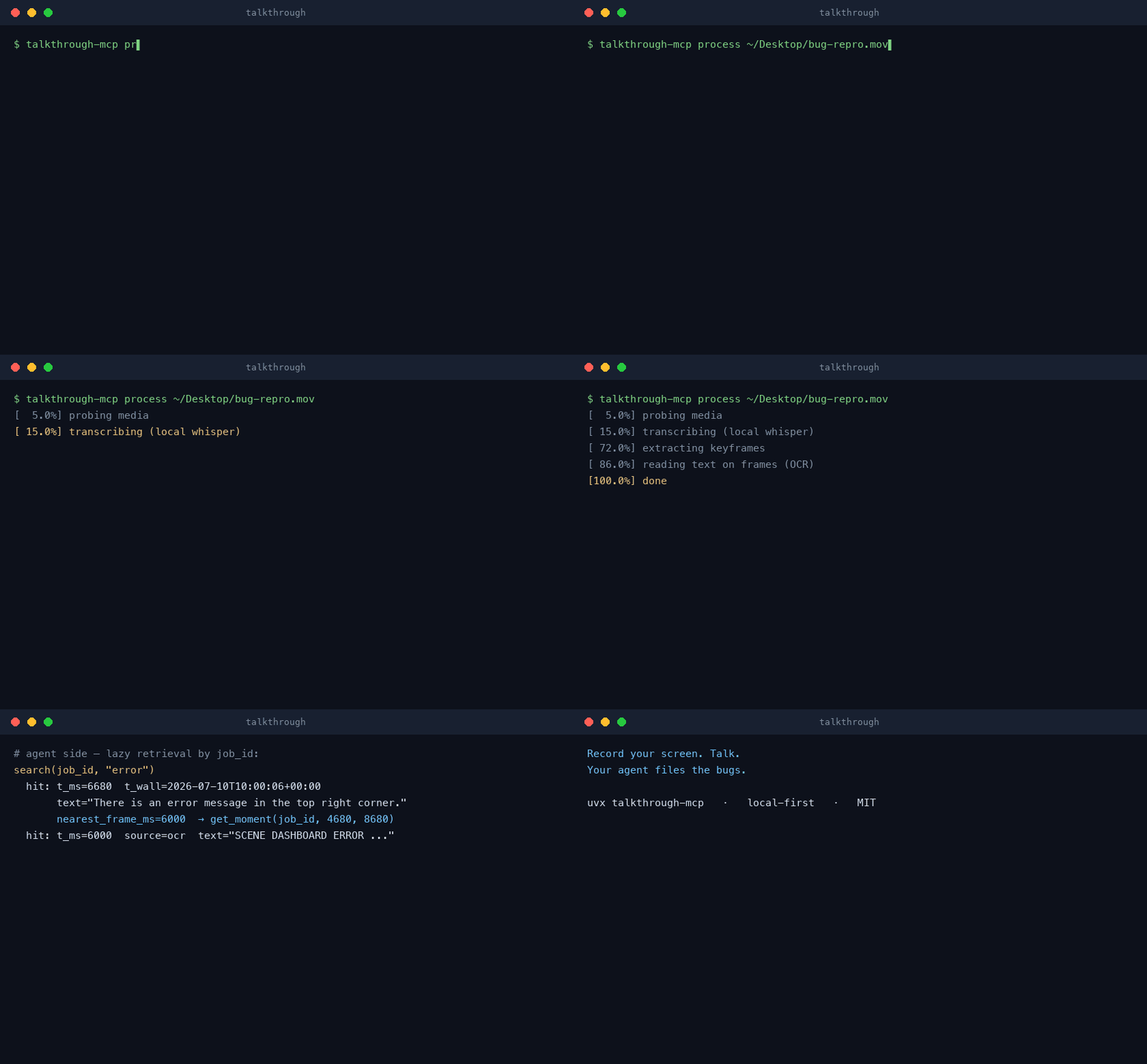
talkthrough-mcp is a local-first MCP server that turns a narrated screen
recording (or any video/audio file) into agent-ready structured data:
timestamped transcript segments, scene-change keyframes, OCR'd on-screen text,
and wall-clock anchoring. Everything is served through lazy retrieval tools, so
a 30-minute recording never floods the model context — the agent pulls exactly
the transcript slice, moment bundle, or frame it needs.
There is no LLM inside the server and no cloud anywhere in the path: ffmpeg,
faster-whisper, and RapidOCR run on your machine, and the calling agent brings
the intelligence. What makes it different from screen-recorder SaaS and
video-analyzer MCPs: it works on arbitrary local files, it ships the agent
workflows (server prompts + example agents), and it anchors every timestamp to
wall-clock time — so "the moment I said the checkout hung" maps straight to
the right window of your server logs.
Quickstart
One command, no system dependencies: ffmpeg falls back to a bundled build,
OCR is pip-only, and whisper models download themselves on first use. The
only prerequisite is uv (brew install uv orcurl -LsSf https://astral.sh/uv/install.sh | sh).





Claude Code
Two install paths — pick one, not both (the plugin already includes
the server; installing both would register it twice):
Server only — the 7 tools + 5 prompts, and nothing else on your
system. Choose this for a minimal setup, or when you manage MCP servers
yourself across several clients:
claude mcp add -s user talkthrough -- uvx talkthrough-mcp
Full plugin — the same server, plus native slash commands
(/talkthrough:triage-recording, …) that handle the ceremony for you,
a ready-made triage subagent, and an agent skill that teaches Claude the
workflow. Choose this for the best out-of-the-box experience:
/plugin marketplace add korovin-aa97/talkthrough-mcp
/plugin install talkthrough@talkthrough
Every other MCP client
Claude Desktopclaude_desktop_config.json:
{
  "mcpServers": {
    "talkthrough": {
      "command": "uvx",
      "args": [
        "talkthrough-mcp"
      ]
    }
  }
}
More: integrations/claude-desktop/
~/.cursor/mcp.json (or project .cursor/mcp.json):
{
  "mcpServers": {
    "talkthrough": {
      "command": "uvx",
      "args": [
        "talkthrough-mcp"
      ]
    }
  }
}
More: integrations/cursor/
~/.codex/config.toml (or project-scoped .codex/config.toml in trusted projects):
[mcp_servers.talkthrough]
command = "uvx"
args = ["talkthrough-mcp"]
More: integrations/codex/
~/.gemini/settings.json:
{
  "mcpServers": {
    "talkthrough": {
      "command": "uvx",
      "args": [
        "talkthrough-mcp"
      ]
    }
  }
}
More: integrations/gemini-cli/
cline_mcp_settings.json (via MCP Servers UI):
{
  "mcpServers": {
    "talkthrough": {
      "command": "uvx",
      "args": [
        "talkthrough-mcp"
      ]
    }
  }
}
More: integrations/cline/
~/.openclaw/openclaw.json:
{
  "mcp": {
    "servers": {
      "talkthrough": {
        "command": "uvx",
        "args": [
          "talkthrough-mcp"
        ]
      }
    }
  }
}
More: integrations/openclaw/
opencode.json (project) or ~/.config/opencode/opencode.json:
{
  "mcp": {
    "talkthrough": {
      "type": "local",
      "command": [
        "uvx",
        "talkthrough-mcp"
      ],
      "enabled": true
    }
  }
}
More: integrations/opencode/
~/.config/goose/config.yaml:
extensions:
  talkthrough:
    enabled: true
    type: stdio
    cmd: uvx
    args: ["talkthrough-mcp"]
More: integrations/goose/
~/.copilot/mcp-config.json:
{
  "mcpServers": {
    "talkthrough": {
      "command": "uvx",
      "args": [
        "talkthrough-mcp"
      ]
    }
  }
}
More: integrations/copilot-cli/
~/.codeium/windsurf/mcp_config.json:
{
  "mcpServers": {
    "talkthrough": {
      "command": "uvx",
      "args": [
        "talkthrough-mcp"
      ]
    }
  }
}
More: integrations/windsurf/
settings.json (Zed):
{
  "context_servers": {
    "talkthrough": {
      "source": "custom",
      "command": {
        "path": "uvx",
        "args": [
          "talkthrough-mcp"
        ]
      }
    }
  }
}
More: integrations/zed/
Any other MCP stdio client uses the same server command: uvx talkthrough-mcp.
Per-engine folders with exactly these snippets plus verification steps live
in integrations/; agents can self-install viallms-install.md.
Local checkout (development)
git clone https://github.com/korovin-aa97/talkthrough-mcp
claude mcp add talkthrough -- uv run --directory /path/to/talkthrough-mcp talkthrough-mcp
Then, in your agent:
Process
~/Desktop/recording.movand triage it — or just invoke thetriage-recordingserver prompt.
Tools
| Tool | What it does |
|---|---|
process_media(path, recorded_at?, vocabulary?, language?, model?, force?) |
Ingest a video/audio file: local STT, keyframes, OCR, wall-clock. Returns a compact summary. Idempotent by content hash — re-calls are instant. |
get_transcript(job_id, start_ms?, end_ms?, format?) |
Paginated transcript as segments, text, or srt; truncation returns next_start_ms. |
get_frames(job_id, at_ms? | start_ms?+end_ms?, max_frames?, include_duplicates?) |
Keyframe images nearest a timestamp or evenly thinned across a range (unique frames by default, max 6/call). |
get_moment(job_id, start_ms, end_ms) |
The "one remark" bundle: transcript slice + up to 3 frames + their OCR text + wall-clock range. |
search(job_id, query) |
Substring search over the transcript AND on-screen OCR text; hits carry t_ms/t_wall and frame refs. |
extract_frame(job_id, at_ms, crop?) |
Exact-timestamp full-resolution re-extract from the source video (optional crop) when keyframes miss the instant. |
list_jobs() |
Recent processed recordings with durations, wall-clock starts, and counts. |
Every tool description ships 10+ usage examples, so agents pick the right tool
without extra prompting.
Server prompts (slash commands in MCP clients)
| Prompt | Workflow |
|---|---|
triage-recording |
Narrated screencast → precise findings JSON (bug/feature/question routing, frame evidence) |
spec-from-workshop |
Recorded workshop → structured spec with quoted decisions and open questions |
backlog-from-demo |
Product demo → prioritized backlog with timestamped evidence |
meeting-actions |
Meeting audio → action items, decisions, open questions |
correlate-with-logs |
Recording remarks ↔ system logs via wall-clock windows |
The same prompts live as plain files in examples/prompts/
if your client doesn't surface MCP prompts. The findings contract used bytriage-recording is examples/output-contract.schema.json.
Works as a skill too (no MCP required)
The same workflow ships as a cross-engine Agent Skill
at .agents/skills/talkthrough/ — Claude Code,
Codex CLI ($talkthrough), Cursor, Copilot, Gemini CLI, Goose and other
SKILL.md-compatible tools read it. Agents without MCP wiring can drive the
CLI directly: talkthrough-mcp process recording.mov --json prints the
same summary the MCP tool returns, and the job store is shared either way.
Wall-clock anchoring
Every timestamped result carries both t_ms (video-relative) and t_wall
(ISO 8601 real time) once the recording start is known. Resolution ladder:
recorded_atparameter (agent/user override) → confidenceexact- QuickTime
com.apple.quicktime.creationdatetag, carries the local
timezone (QuickTime Player recordings; ⌘⇧5 wrote it before macOS 26) →high - Container
creation_timetag (UTC) →medium— macOS 26+ ⌘⇧5/ReplayKit
screen recordings land here (nocreationdatetag anymore); passrecorded_at=when local-tzt_wallmatters - File mtime minus duration (recorders finalize files at recording END) →
low - Nothing → tools still work with relative
t_msonly
Why it matters: "the upload spinner froze here" becomes a ±30 s grep window
in your server logs.
Privacy
Everything runs locally: your recordings never leave your machine, speech is
transcribed by a local whisper model, OCR is local ONNX inference, and there is
no telemetry. The only network access is one-time tool/model downloads (ffmpeg
build, whisper model, OCR models).
Languages
Narration in any of Whisper's ~99 languages works: the language is
auto-detected per recording, and the summary reports both language andlanguage_probability so agents can tell a confident detection from a shaky
one (silence or music at the start can fool the detector — pin it withlanguage="ru" and force=true when that happens).
Pick the model for your languages — per call (model= parameter, agents do
this themselves when a transcript comes back garbled) or as the server
default (TALKTHROUGH_WHISPER_MODEL):
| Model | Size | Best for |
|---|---|---|
small (default) |
464 MB | English and major-language narration on CPU |
large-v3-turbo |
~1.5 GB | recommended for non-English — near-large quality at near-small speed |
medium |
~1.5 GB | conservative alternative to turbo |
tiny / base |
75–145 MB | quick drafts, CI |
*.en variants |
— | English-only, slightly faster/better for EN |
Tips that work in every language: pass product names viavocabulary="Term1, Term2" (biases the decoder so jargon survives), and note
that the workflow prompts instruct agents to write digests in the
narrator's language while keeping quotes verbatim — the server never
translates (exact quotes are evidence; translation is the agent's job).
On-screen text (OCR) defaults to RapidOCR's Latin + Chinese models. For other
scripts set TALKTHROUGH_OCR_LANG to your language — ru/uk (→ theeslav pack), ja, ko, ar, hi, el, th, or any RapidOCR pack name
like cyrillic — and reprocess with force=true; the matching recognition
model downloads once. Spoken-language support is unaffected either way.
Configuration
| Env var | Default | Meaning |
|---|---|---|
TALKTHROUGH_WHISPER_MODEL |
small |
default whisper model (tiny/base/small/medium/large-v3/large-v3-turbo); the model tool param overrides per call |
TALKTHROUGH_OCR |
on |
set off to skip OCR |
TALKTHROUGH_OCR_LANG |
Latin+Chinese | recognition script for on-screen text: a language code (ru, ja, ko, ar, hi, …) or a RapidOCR pack name (eslav, cyrillic, latin, …); the model downloads once |
TALKTHROUGH_OCR_PARAMS |
— | advanced: JSON object of raw RapidOCR params merged over the derived ones, e.g. {"Rec.lang_type": "cyrillic"} |
TALKTHROUGH_MAX_SECONDS |
7200 |
max media duration |
TALKTHROUGH_MAX_FRAMES |
600 |
keyframe cap per job |
TALKTHROUGH_HOME |
~/.talkthrough |
job store root |
CLI
The pipeline is also a CLI — useful for pre-processing long recordings outside
an agent session (the store is content-addressed, so the agent then queries the
same job instantly):
talkthrough-mcp process ~/Videos/long-session.mov   # prints the summary
talkthrough-mcp process demo.mov --json             # machine-readable
talkthrough-mcp gc --keep-days 30                   # clean the job store
talkthrough-mcp serve                               # stdio MCP server (default)
First run notes: missing system ffmpeg triggers a one-time static-ffmpeg
download; the first transcription downloads the whisper model (~460 MB forsmall); both are cached. After that, expect roughly 3× faster than real time
on an Apple-Silicon CPU with the default model, OCR included (a 2-minute clip
processes in ~40 s) — and instant re-runs on the same file. Progress streams
as MCP progress notifications, and the CLI prints stage lines. More:
docs/TROUBLESHOOTING.md.
Windows (best-effort)
CI runs lint, the unit suite, and a full CLI smoke on windows-latest
(static-ffmpeg Windows build, whisper tiny transcription, OCR, and the
instant idempotent re-run). Notes: the per-job lock is POSIX fcntl and
degrades to a no-op on Windows — fine for a single-user machine; quote paths
with spaces (uv run talkthrough-mcp process "C:\Videos\Screen Recording.mp4").
Windows is not a release gate — if something breaks, please open an issue.
Supported inputs
Video: .mov .mp4 .webm .mkv — audio-only: .m4a .mp3 .wav .ogg.flac (transcript tools only; frame tools explain why they're unavailable).
Local files only.
Limitations
Honest edges, so you can decide fast:
- One speaker stream. No diarization yet — "who said it" isn't tracked
(#4). - Local files only. No URL/YouTube ingestion
(#5) — download
first. - Keyframes + transcript, not motion analysis. A glitch between scene
changes can be invisible in the frame set;extract_framere-checks any
instant, but frame-by-frame motion reasoning is your multimodal model's job. - STT quality tracks the model you pick. The default
smallfavors speed;
non-English narration wantsmodel="large-v3-turbo"(see
Languages). - OCR reads crisp UI text well; tiny or low-contrast print is best-effort.
- Wall-clock confidence depends on recorder metadata — worst case pass
recorded_at=(see the ladder above). - Windows is best-effort (see above).
How it compares
| talkthrough | cloud recorder SaaS | meeting notetakers | typical video-analyzer MCPs | |
|---|---|---|---|---|
| Runs fully locally | ✅ | ❌ | ❌ | varies |
| Any local video/audio file | ✅ | browser/app captures | meetings only | ✅ |
| Wall-clock anchoring (log correlation) | ✅ | ❌ | ❌ | ❌ |
| Ships agent workflows (prompts, skill, findings contract) | ✅ | ❌ | ❌ | ❌ |
| OCR of on-screen text, searchable | ✅ | some | ❌ | rare |
FAQ
Why not just upload the video to a multimodal model (e.g. Gemini)?
For a short, non-sensitive clip — do that. The trade-offs appear with length
and sensitivity: an hour of screen recording costs on the order of a million
tokens per question, the file leaves your machine, and you still can't map a
remark to 14:32:07 UTC to grep your server logs. talkthrough indexes once,
locally, then answers any number of follow-ups from the index.
Why not screenpipe?
Different job. screenpipe is an always-on recorder of your machine going
forward (commercial license). It can't open the .mov a teammate or customer
just sent you. talkthrough analyzes any file it's handed — the two compose
fine.
There are agent skills that "watch" videos. Why a server with an index?
Watch-style skills push a budgeted frame dump into the context window (and go
sparse on long videos), often call cloud STT for the audio, and keep nothing.
talkthrough builds a persistent local index — transcript + OCR, full-text
searchable — retrieves exact frames lazily, anchors everything to wall-clock
time, and answers the next question without reprocessing.
I use Jam for bug reports — do I need this?
Keep Jam for browser bugs: console+network captured at record time is great
evidence. talkthrough covers what a browser extension can't — desktop apps,
mobile screencasts, ops incidents, meetings, any file — with no account, and
correlates with server-side logs via wall-clock time.
Can't I just script ffmpeg + whisper myself?
Yes — that's exactly this pipeline. What you'd be rebuilding: scene-change
detection with perceptual dedup, OCR, transcript+OCR search, the wall-clock
ladder, MCP tools with embedded usage examples, five workflow prompts, and a
findings contract. One uvx command instead of an afternoon of glue.
Is it really local? What leaves my machine?
Nothing at runtime. The network is used only for one-time downloads (ffmpeg
build, whisper/OCR models). No telemetry. See Privacy — and
SECURITY.md treats a violation of this promise as a
vulnerability.
For agents & tooling
Machine-readable entry points, so AI agents can install and use this server
without a human reading docs:
llms-install.md— step-by-step install instructions for agentsllms.txt— index of the documentation.agents/skills/talkthrough/SKILL.md— an Agent Skill teaching the tool workflow; discovered automatically inside a checkout by Codex CLI ($talkthrough) and readable by Claude Code, Cursor, Copilot, Gemini CLI and other SKILL.md-compatible toolsAGENTS.md— instructions for coding agents contributing to this reposerver.json— MCP registry manifestintegrations/— per-engine adapters, all generated from one source of truth and drift-tested (incl. the Claude Code plugin underintegrations/claude-code/)
Roadmap (not in v1)
URL/YouTube ingestion · speaker diarization · cloud STT · embeddings/semantic
search · hosted/remote mode · .mcpb bundle · whisper.cpp backend
License
MIT
Reviews (0)
Sign in to leave a review.
Leave a reviewNo results found