kaeru
Health Warn
- License — License: MIT
- Description — Repository has a description
- Active repo — Last push 0 days ago
- Low visibility — Only 9 GitHub stars
Code Fail
- rm -rf — Recursive force deletion command in contrib/install/install.sh
- rm -rf — Recursive force deletion command in contrib/install/package-release.sh
Permissions Pass
- Permissions — No dangerous permissions requested
No AI report is available for this listing yet.
Cognitive memory layer for LLM agents
蛙 kaeru
kaeru is a cross-agent cognitive engine for LLM agents — a typed graph that agents think in, plus a recollection layer for long-term ideas and outcomes. Local-first for each agent, with an optional shared cloud tier so a whole team of agents and people build on one another's memory.
Designed for multi-session, multi-agent continuity: when an agent opens a project, it has full context of what was being thought about, can follow provenance chains, can consolidate outcomes into stable long-term knowledge, and can pull in what the rest of the team has shared.
Inspired by the LLM-wiki pattern (Karpathy, gist 442a6bf555914893e9891c11519de94f), the bi-temporal knowledge graph approach of Graphiti / Zep, the curator-driven knowledge engine of Cognee, and the reasoning-based hierarchical-summary navigation pattern from PageIndex. Two-tier design grounded in the hippocampus / cortex split.
Name: 蛙 (kaeru, "frog"; homophonic with 帰る "to return" and 変える "to change") — the agent that returns, recalls, and reshapes.
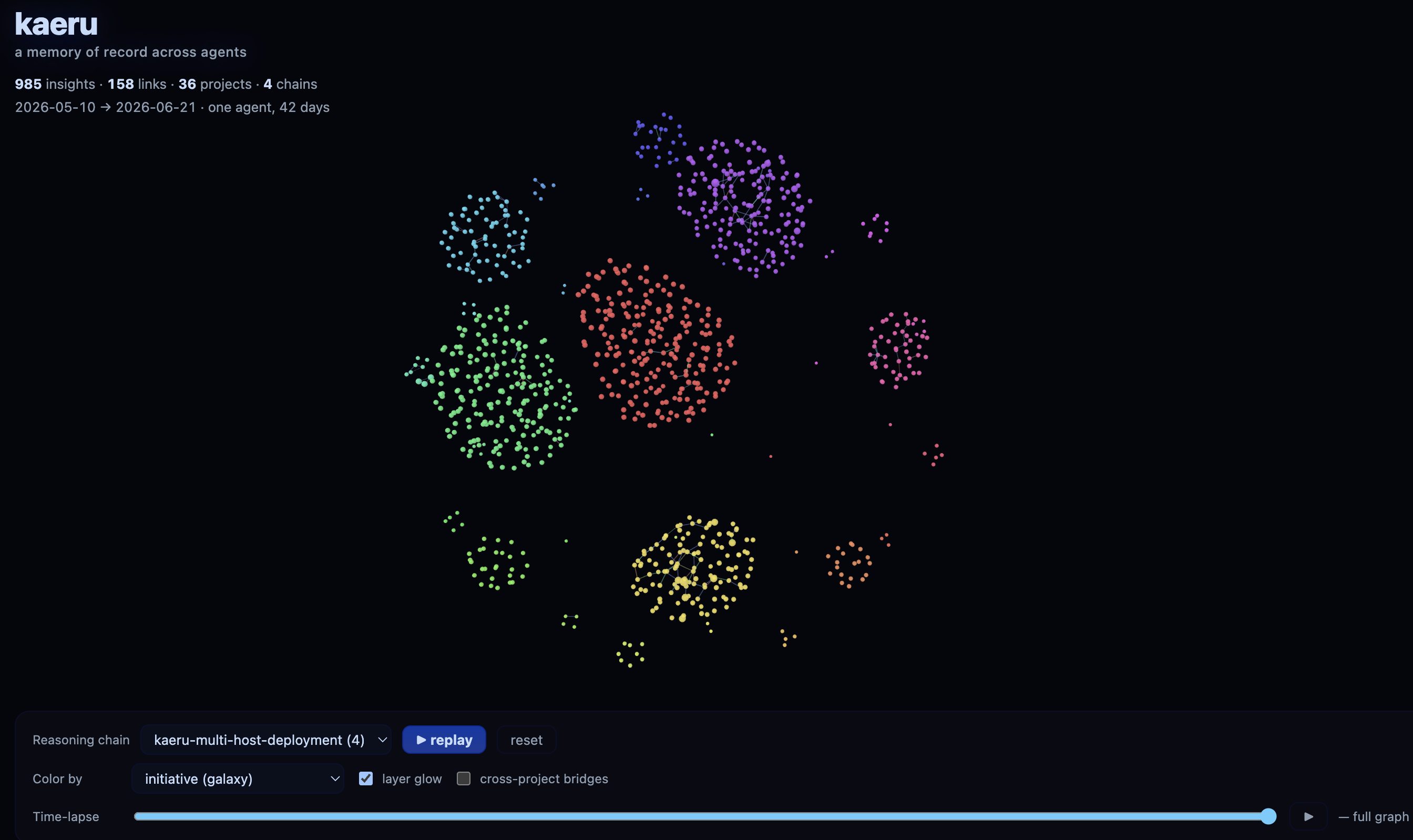
A kaeru vault rendered by kaeru-viz — one cluster per initiative, nodes sized by memory layer, with reasoning-chain replay and a time-lapse of how the knowledge grew.
Overview
kaeru is built around a typed property graph stored in CozoDB. Two tiers, biological analogy:
- cognitive (operational / hippocampus) — high-velocity working graph where the agent actively thinks: episodes, scratch, drafts, hypotheses, experiments, audit events.
- recollection (archival / cortex) — settled ideas, outcomes, summaries, references; mostly read.
Every node and edge is bi-temporal — the substrate stores assertion / retraction history natively, so time-travel queries are out of the box and conflict resolution is non-destructive (the old version is invalidated, not deleted).
Per-initiative subgraphs through a junction-relation pattern: one substrate, many initiatives, multi-membership. An agent working on project A asks "what was I doing here last time?" and gets an answer scoped to A. The same node can belong to several initiatives at once.
kaeru is a facilitator, not an enforcer. The curator API exposes ~40 primitives (awake, recall, drill, claim, synthesise, at, history, consolidate_out, …) as available tools. The agent and user choose when to invoke them; the daemon hints but doesn't block.
Features
- Two-tier graph — operational (cognitive / hippocampus) for active thinking; archival (recollection / cortex) for settled knowledge.
consolidate_outpromotes across the boundary, preserving provenance. - Bi-temporal — native assertion / retraction history.
atreads a node in full as it is now or as-of any past moment; conflicts are non-destructive (the old version is invalidated, not deleted). - Per-initiative scoping + layered re-entry — one substrate, many projects.
awakerestores a project's working context by memory layer (Core → Hot → Warm);surfacereaches the archived Cold / Frozen on demand. - Cross-agent sharing — local-first by default; an optional
kaeru-cloudtier lets a trusted team share settled knowledge through two safety gates (initiative policy + a deterministic secret guard). See Local & cloud. - Structural recall — exact name lookup, typed
walk/drill/trace,between, FTS fuzzy fallback. Vectors are not the primary mode. - Initiative management —
rename/deletean initiative, locally or team-wide. - Markdown export — Obsidian-friendly snapshot of any initiative.
Architecture Notes
- Substrate is CozoDB with RocksDB backend; bi-temporal
Validityis native to the substrate, not bolted on. - Edges carry operational semantics — each edge type is something the curator API responds to.
derived_frompowers provenance and explainability;contradictstriggers a non-destructiveunder_reviewflow;supersedesretracts the previous version through the bi-temporal substrate. Edges are not just associations. audit_eventis a first-class node type — every mutation writes an audit node, so changes to memory themselves become reasoning surface for the agent. Substrate-level history (Validity) and operational audit (audit-event nodes) stay separate: the substrate tracks what was, the audit nodes track who did it and why.- Per-initiative scope through junction relations rather than column filtering — RocksDB prefix-scan gives O(log n + k) on the active initiative.
- Retrieval is structural-first — explicit name lookup, typed graph traversal, summary views. Cozo FTS for fuzzy fallback when an exact name is forgotten. Vector embeddings are not the primary mode.
- Two-tier with explicit
consolidate_out— operational drafts get promoted to archival as a deliberate, logged operation. Provenance (derived_from) survives the tier boundary. - Single binary, embedded substrate —
kaeruruns in-process with the agent. No server, no network. Vault on disk under a platform-specific default (Linux$XDG_DATA_HOME/kaeru, macOS~/Library/Application Support/ai.lamantin.kaeru, Windows%LOCALAPPDATA%\ai.lamantin.kaeru); override withKAERU_VAULT_PATH.
Layout
kaeru/
├── Cargo.toml                  ← workspace root
├── kaeru-core/                 ← library: substrate, schema, primitives
├── kaeru-mcp/                  ← binary `kaeru-mcp`: Model Context Protocol server (the agent's surface)
├── kaeru-cloud/                ← binary `kaeru-cloud`: shared cloud tier (Axum REST over kaeru-core)
├── kaeru-rig/                  ← library: `rig` Tools that give a rig agent kaeru memory
└── skills/
    └── kaeru-skill/            ← portable agent skill (Claude Code / etc.)
kaeru-rig is the rig framework adapter — the full curator verb set as discrete rig Tools over an embedded Arc<Store>, so a rig agent reads and writes one vault. Future: kaeru-langchain (Python bridge), not yet started.
Install
Pre-1.0 alpha. Substrate schema may change between minor versions —
export to markdown if you need to keep notes around.
See QUICK_START.md for source builds, MCP daemon setup, and the re-entry ritual.
Quick tour (MCP tools)
# See what projects exist:
initiatives

# Re-entry ritual: process state + epistemic state.
awake (initiative: "auth-rewrite")
overview (initiative: "auth-rewrite")

# Capture (auto-named):
jot (initiative: "auth-rewrite", body: "noticed token expiry differs across platforms")

# Fuzzy lookup when you forgot the exact name:
search (initiative: "auth-rewrite", query: "expiry")

# Drill into something:
drill (initiative: "auth-rewrite", name: "noticed-token-expiry-differs-across-...")

# Hypothesis cycle:
claim (initiative: "auth-rewrite", body: "platform-aware policy is correct", about: "<node>")
test (initiative: "auth-rewrite", hypothesis: "<hyp>", method: "compared iOS / Android TTL")
confirm (initiative: "auth-rewrite", hypothesis: "<hyp>", by: "<experiment>")

# Time-travel:
at (initiative: "auth-rewrite", name: "<name>", when: "5m")
history (initiative: "auth-rewrite", name: "<name>")

# Knowledge chains — strongest weighted path between two nodes
# (link the load-bearing edges with strong: true first):
path (initiative: "auth-rewrite", from: "<a>", to: "<b>")    # preview the trail
chain (initiative: "auth-rewrite", from: "<a>", to: "<b>")   # save it as a recallable chain

# Snapshot to an Obsidian-friendly markdown vault:
export (initiative: "auth-rewrite", path: "/tmp/auth-snapshot")
Connecting to an MCP-aware agent
kaeru-mcp is a long-lived HTTP service: one daemon per machine owns the substrate, any number of agent sessions (Claude Code, Opencode, Cursor, …) connect concurrently. This is intentional — RocksDB is single-writer, so a stdio MCP that forks a subprocess per session would hit lock contention. See kaeru-mcp/README.md for systemd / launchd unit templates and the full HTTP config.
Run the daemon (or set up the systemd user unit from contrib/install/):
kaeru-mcp # foreground, Ctrl-C to stop
Then point your agent at it:
- Claude Code:
claude mcp add --transport http kaeru http://127.0.0.1:9876/mcp— seeskills/kaeru-skill/for the portable system-prompt rules. - Opencode:
bash contrib/opencode/install-opencode.sh— wires the daemon, dropsAGENTS.kaeru.mdrules into~/.config/opencode/, and installs/kaeru//lesson//recallslash commands. Designed to coexist with your existing OSS-model provider config (Qwen / DeepSeek / GLM / Ollama). Seecontrib/opencode/README.md. - Cursor and other runtimes: paste the body of
skills/kaeru-skill/SKILL.mdinto your agent's rules / system-prompt section. For MCP-aware clients the daemon URL above works directly.
After restart the agent sees tools like awake, drill, claim, at natively. Each tool takes an optional initiative parameter.
Local & cloud — sharing memory across a team
kaeru runs local-first: your vault lives on your machine and nothing leaves it by default. A second, optional tier — kaeru-cloud — is a shared store for a trusted group (a team, a family). Each initiative carries a sticky share_policy:
private(default) — nothing ever leaves; personal projects.team— nodes you explicitly marksharedmay sync to the cloud.
Sharing is never automatic and passes two gates: the initiative policy, and a deterministic pre-share secret guard that blocks anything looking like an API key, token, or private key. The guard is silent on clean content and only interrupts on a real hit.
Verbs (over MCP): policy (mark an initiative team), share (push a node), cloud_recall (see what the team has), pull (bring a shared node into your local graph), link_cloud / cloud_links (reference cloud nodes without copying), and sync_review (batch-review still-local nodes). Capture verbs (episode / jot / cite) take visibility: shared to capture-and-share in one call.
A single daemon can also reach several named clouds (e.g. a family and a work cloud) via a clouds.toml file; the cloud verbs then take an optional cloud: <name> and soft links remember which cloud they point at. See kaeru-mcp/README.md for the file format.
Per-user / per-org isolation (multi-tenant) is a future addition; today each cloud is one shared space scoped by initiative. See kaeru-cloud/README.md.
Roadmap
- Initiative onboarding — a generated "what is this initiative, and what's in it" briefing the first time an agent enters a project, in the spirit of the
importguide — an instruction over the collected context, not graph machinery. - PostgreSQL backend — a server-mode substrate alongside the embedded RocksDB default.
- Multi-tenant + isolation — per-user / per-org separation in the shared cloud.
- Cross-initiative links — edges and recall that span initiatives (everything is initiative-scoped today).
Status
Pre-1.0. Implemented and covered by a green test suite: the substrate and curator API, memory layers with layered re-entry (awake / surface), bi-temporal time-travel (at / history), per-initiative scoping with rename / delete, knowledge chains (weighted edges + shortest-path), forward-only schema migrations, the MCP server, the shared kaeru-cloud tier (sharing, recall, soft links, sync-review) including multi-cloud, the kaeru-rig framework adapter (full curator toolset as rig Tools), and markdown export. What still needs hardening:
- Multi-tenant. The cloud is one shared space scoped by initiative; per-user / per-org isolation isn't built yet.
- MCP concurrency. Concurrent sessions share one
Store; the per-call initiative scope is serialized throughStore::scoped, so two sessions can't corrupt each other's scope. What remains is ordering — when an agent batch-fires async calls, a read can still land before a not-yet-applied write. - Whole-second
Validityresolution. Two opposing mutations on the same node/edge within one second (e.g.linkthen an immediateunlink, or aforgetright after a write) resolve ambiguously. Interactive use is fine — human pacing always crosses the boundary; the test suite sleeps between such operations. - Audit events aren't attached to the initiative junction yet (export filters them by
affected_refsintersection — a working workaround). - Rig adapter shipped, LangChain not yet.
kaeru-riggives a rig agent the full memory toolset; a Python / LangChain bridge is still to come. - Migrations are forward-only and add-only. A
migration_journalruns schema additions (new relations / columns) on open; there is no down-migration or destructive-change path yet. Snapshot viaexportbefore a major upgrade is still prudent pre-1.0.
Contributing
Discussion and design feedback through issues. PRs welcome on the open items above and anywhere the agent-facing surface feels rough — the verb taxonomy (awake, drill, claim, flag, settle, …) is meant to map to natural agent thinking, not just expose graph operations.
License
MIT — see LICENSE.
Reviews (0)
Sign in to leave a review.
Leave a reviewNo results found