jeffy-loop
Health Warn
- License — License: MIT
- Description — Repository has a description
- Active repo — Last push 0 days ago
- Low visibility — Only 5 GitHub stars
Code Warn
- process.env — Environment variable access in evals/dayjs/repro.js
Permissions Pass
- Permissions — No dangerous permissions requested
No AI report is available for this listing yet.
Autonomous audit-fix-verify loop for Claude Code. Run against 17 open source projects in 8 languages, 16 converged, 2 fixes merged upstream (one shipped in chalk v6.0.0). Public journal for every run.





Jeffy Loop is an autonomous improvement loop for Claude Code that works on your codebase the way a disciplined principal engineer would: audit first, fix one verified task at a time, prove every claim, and stop when the job is actually done.
Run /jeffy 10 and walk away. Jeffy maps your project's whole public surface, audits it breadth-first, and writes a backlog where every task carries a runnable acceptance check. Then it executes: one verified, checkpointed task per iteration, behind a verify gate that reverts anything that breaks your project. And "done" is never a feeling - a fresh audit must come back clean, an adversarial evaluator must countersign, and a plain shell script re-checks the whole claim before the run is allowed to end.
It has receipts. Widely used open-source libraries have been run to convergence, surfacing shipped, reproducible bugs - many hiding behind green test suites. The receipts are below.
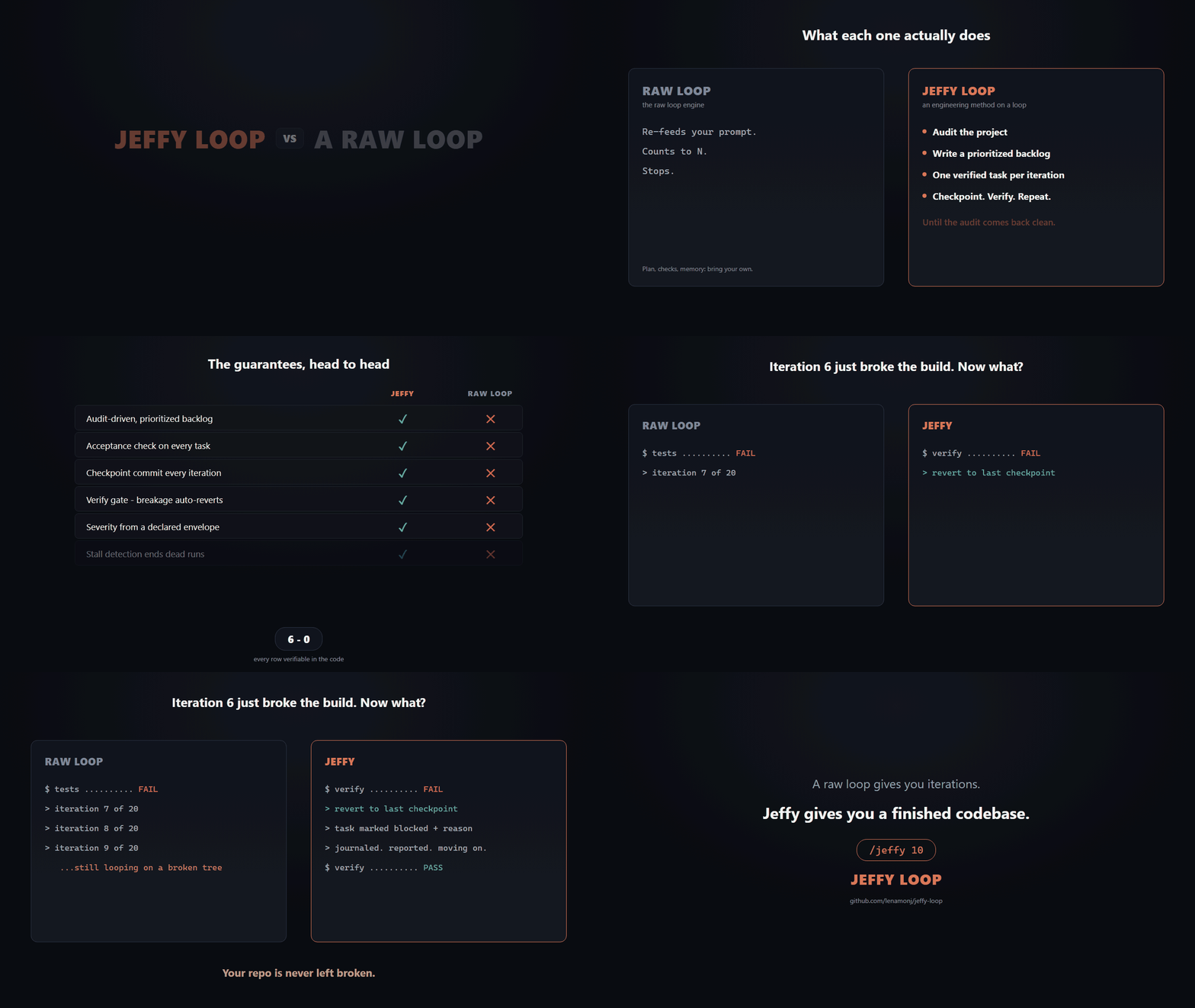
The head-to-head vs a raw prompt loop. Every row is a guarantee you can verify in the code: the engine is skills/jeffy/hooks/stop-hook.sh, the discipline is skills/jeffy/references/iteration-prompt.txt, and the receipts live under evals/.
Jeffy Loop descends from Geoffrey Huntley's Ralph technique - the insight that a coding agent re-fed one prompt in a loop compounds into real work. The head-to-head above is engine versus method: the raw loop is the engine pattern Jeffy is built on, and Jeffy is the engineering method wrapped around it. The method distills what the people running loops at scale have published - Anthropic's Claude Code best practices and Boris Cherny's public workflow: give the agent a check it can run, one task at a time, promote every hard-won lesson into a file the next run reads, and prefer small fresh-context runs over one long one.
Quickstart
You need exactly two things. The installer handles everything else, including jq.
- Claude Code - installed and signed in once
- git - confirm with
git --version
No git yet? One command for your platform:
Windows
winget install Git.Git
macOS
brew install git
Debian/Ubuntu
sudo apt-get install git
Install Jeffy:
git clone https://github.com/lenamonj/jeffy-loop.git
cd jeffy-loop
./install.sh        # Windows PowerShell: .\install.ps1
[!NOTE]
If PowerShell blocks the installer with "running scripts is disabled on this system", run it once withpowershell -ExecutionPolicy Bypass -File .\install.ps1- the bypass applies to that single invocation only.
Then open Claude Code in the project you want to improve and type /jeffy 10.
[!TIP]
/jeffyis a slash command inside the Claude Code session, not a shell command.
When that run ends, close the session and start a new one to run it again. That restart is doing real work, and why is worth two minutes.
The installer verifies the Claude Code CLI and jq (offering to install it via winget, Homebrew, or apt), copies the /jeffy and /cancel-jeffy skills - engine included - to ~/.claude/skills, and registers the loop's hook in ~/.claude/settings.json. Every step prints an [OK] or the exact fix.
- Re-run - always safe: it skips what is installed, upgrades in place, and never duplicates the hook registration.
- Update -
git pull, then re-run the installer; upgrades also refresh the hook's registered timeout. - Uninstall - delete
~/.claude/skills/jeffyand~/.claude/skills/cancel-jeffy, and remove the hook entry from~/.claude/settings.json.
Usage
/jeffy [N] [focus...]
N- iteration budget, default 10. Sizing is low-stakes in both directions: the loop ends itself at convergence, so unused budget costs nothing, and a budget that runs dry loses no work - the next/jeffypicks up where the run stopped. The floor for converging in one run is the opening audit, one iteration per expected finding, and a closing audit; when that arithmetic outgrows the default, prefer a second run over a bigger number (see Good to know).focus- optional directive for the run, e.g./jeffy 8 test coverage and error handling.
/jeffy                                     # 10 iterations, full-spectrum improvement
/jeffy 5                                   # 5 iterations
/jeffy 12 accessibility and performance    # 12 iterations with a focus directive
Scoped mode. By default /jeffy runs in Improvement mode: an open-ended audit-and-fix loop. To run it against a concrete target instead, edit PLAN.md - replace the Goal and Definition of done with the target, seed BACKLOG.md with the finite tasks, then run /jeffy. Everything else (envelope, verify gate, checkpoints, journal, report) behaves the same.
Cancel. Run /cancel-jeffy. It reports which loop it found, deletes the loop state file, and leaves PLAN.md, BACKLOG.md, and JOURNAL.md untouched, so the next /jeffy picks up exactly where it left off. (Equivalent manual action: delete .claude/jeffy-loop.local.md at the project root.)
Good to know
- One loop per project at a time. A crashed session can leave a stale state file behind; the skill detects it at launch and asks before cleaning up.
- You can talk to the session mid-run. Your message gets answered, then the loop resumes on its own. The turn counts against the budget.
- Permission prompts pause the loop. For unattended runs, allowlist your test and file tools or use acceptEdits mode. Never allowlist push or force operations for a loop.
- Budget counts turns, and a single turn is unbounded in time and cost. Keep N small on a first run and watch it. Check spend anytime with
/cost. - Prefer several small runs over one big one. Context accumulates across iterations within a run, and the state files carry everything between runs, so two runs of 5 beat one run of 10 - but the clean context only arrives with a new session. Close the session and start a fresh one in the same directory; nothing is lost.
- Edit
PLAN.mdorBACKLOG.mdbetween iterations, not mid-iteration. The Proposed section is the designed channel for decisions. - A
.jeffy/directory appears at the root of a project the loop has swept. It holds the known-answer probe batteries a later sweep re-runs instead of rebuilding, and the checkpoints commit it on purpose - loop memory, exactly like the three state files. Only the transient loop state file is gitignored.
[!IMPORTANT]
Trust model. The entire engine is one auditable shell script in this repo (skills/jeffy/hooks/stop-hook.sh), registered as a Claude Code Stop hook. It fires at turn end but exits instantly unless the current project has a live Jeffy state file naming that session - zero cost and zero behavior outside a run. The installer's only writes outside this repo are the two skill folders it copies into~/.claude/skills(engine included), that one hook registration in~/.claude/settings.json, and - only when jq is missing and you answer yes to its prompt - a jq install through your system package manager (winget, Homebrew, or apt).
Why Jeffy
An engineer's judgment, not a linter's. Every run starts from a real audit - architecture, correctness, security, testing, error handling, performance, accessibility, developer experience, and more - and every finding becomes a prioritized task with a concrete acceptance check. Evidence over assertion: a finding exists only if the loop can point at it.
It cannot wreck your repo. Every iteration ends in a local checkpoint commit. A repo-level verify gate guards every change: an iteration that breaks the project is reverted on the spot. Nothing is ever pushed, no branches are created. Review with
git log, revert any single iteration, squash the run when you're happy.It doesn't invent problems. Severity is judged against a declared operating envelope - your project's real input surfaces, not imagined attackers. Out-of-envelope findings can't inflate the backlog, and only you can widen the envelope: the loop files a proposal and moves on.
Done means done. The loop converges only when a full fresh audit finds zero High and zero Medium findings and the backlog is empty - every Low fixed, declined with a reason, or blocked with its reason on record. Declining is priced, not felt: a Low outside the shipped runtime whose fix plus its regression test will not fit inside one iteration is declined as
cost: exceeds one iterationand named by ID in the run report, so polish cannot quietly eat a budget. A surface inventory bounds the claim: the first audit maps the whole public surface into a checkbox table and probes it breadth-first, every sweep records the commit it certified, and clean scores claim only examined rows - "no findings" can never quietly mean "nowhere looked". Surface this host genuinely cannot reach is marked- [~]with its reason and named in the run report, disclosed rather than counted as swept. Once one audit comes back clean, the loop stops auditing and finishes the backlog, so a tail of Lows cannot keep it busy forever.Convergence needs a second signature. An agent grading its own work praises it. So before the loop may claim convergence, the adversarial evaluator - a fresh-context sub-agent carrying none of the run's self-persuasion - re-runs the verify gate and the closed tasks' acceptance checks, hunts for missed findings, and must return PASS. A rejection files its evidence as new tasks; a second ends the run as a hard blocker. The gate fires while its verdict can still be answered - the iteration the ledger first empties with a clean full audit already on the record and three or more iterations left, not only at the finish line, with up to three reviews when that first one lands before the budget's midpoint. And the verdict has to be on the record: the Stop hook refuses a declaration whose closing journal entry carries no evaluator verdict, PASS or a stated
unavailable.The stop is machine-checked, and the machine is tested. The Stop hook - plain shell, not a model - refuses the converged stop unless the backlog is empty, the Converged commit still certifies the tree, no inventory row is unswept, and the project's own verify command exits green when the hook re-runs it. A failed check re-feeds the loop with the evidence, and when the budget expires with the ledger empty and the surface swept - the shape where runs used to die with the work done - the hook grants one +2 closing extension, once per run, so the convergence sequence has room to finish. The engine itself is held to 119 behavioural checks on each CI leg, Linux and Windows, with a shellcheck lint pass riding the Linux leg on top.
It stops on purpose, and it shows its work. Budget spent, convergence reached, progress stalled, or a decision only you can make - the loop ends itself and says why, instead of burning budget spinning. The run report lists iterations used, tasks closed with severities, the diffstat, anything blocked, and decisions waiting on you; an append-only journal and the checkpoint commits hold the full, greppable record.
External Validation: Public Open-Source Projects
Testing a tool against its own codebase proves little. Jeffy was therefore run against widely-used open-source projects with no connection to this repository. Sixteen of those runs converged, across eight languages - Python, JavaScript, Java, C#, C++, Go, Rust and Ruby - and that breadth is evidence of something specific rather than decoration: the engine ships no language-specific analyzer, no ruleset, and no per-ecosystem plugin. It works from what a project already has, its own test suite and its own verify command, so what carries from a Rust CLI to a Ruby linter to a C++ parser is the method itself. The findings are correspondingly varied: a security flag that did nothing when output was piped, a documented build configuration that had never compiled on MSVC, a Content-Length no parser should accept becoming a wrong number, a panel header dropped rather than truncated.
Every run used a local clone, nothing was pushed upstream without a filed issue or PR, and all runs were held to the same rules: evidence before filing, severity judged against a declared operating envelope, and red-green proof that anyone can re-run.
Each receipt below is a full /jeffy loop run that converged, with one deliberate exception kept in the table rather than hidden: PapaParse, an audit under the same method whose loop conversion waits on four open upstream PRs. A method that always converges is not measuring anything, and the record shows what the standard costs when a project resists it - python-dotenv was published here as not converged through four runs and 25 findings, and it took eight runs and 73 iterations before an audit finally filed nothing. The run before that one ended blocked, out of evaluator invocations, with three fresh Mediums on the ledger. The standard tightened as the engine matured. The earliest runs converged on a clean closing audit and an empty backlog, later runs under the shell-enforced converged stop, and the most recent under the adversarial evaluator's countersignature. Each receipt states which standard its run met, so none of this requires taking our word for it.
Ordered by severity of findings, most severe first.
| Project | Stars | Language | Iterations | Run | Upstream | Headline |
|---|---|---|---|---|---|---|
| quantstats | 7,489 | Python | 40 | converged | issue filed | 29 findings behind 125 green tests; the library ended smaller than it started |
| fasthttp | 23,422 | Go | 58 | converged | PR open | 31 findings in a tagged release; a Content-Length no parser should accept became a wrong number |
| records | 7,220 | Python | 7 | converged | issue filed | four High data-loss bugs behind a green suite |
| PyPortfolioOpt | 5,905 | Python | 58 | converged | PR open | CI-red baseline to 356 passing; the evaluator rejected five convergence attempts |
| dayjs | 48,657 | JavaScript | 74 | converged | PR open | 45 findings, 10 High, in a 63M-downloads-a-week library |
| mustache.js | 16,725 | JavaScript | 11 | converged | issue filed | revived a suite that could not start; npm audit 107 to 2 |
| ta | 5,129 | Python | 64 | converged | - | wrong numbers shipped since 2023; caught its own regression and wrote "It is mine" |
| bat | 59,915 | Rust | 10 | converged | FIX MERGED | a just-merged security flag did nothing when piped; caught before it ever shipped |
| jsoncpp | 8,876 | C++ | 10 | converged | PR open | the documented secure-memory build never compiled on MSVC; the evaluator caught the fix being half done |
| yfinance | 24,837 | Python | 9 | converged | PR open | closed a High that upstream's own failing test was advertising |
| speedtest-cli | 14,080 | Python | 5 | converged | - | the restraint case: small findings, nothing invented |
| chalk | 23,288 | JavaScript | 8 | converged | FIX MERGED | the control: one Medium found - fixed upstream, shipped in chalk v6.0.0 |
| Spectre.Console | 11,567 | C# | 8 | converged | issue filed | a panel header wider than its content was dropped, not truncated - invisible to 3,618 tests |
| gson | 24,229 | Java | 2 | converged | - | the fastest run: one audit, one gate, one priced-and-declined Low, not a line changed |
| RuboCop | 12,892 | Ruby | 7 | converged | - | the null result: every cop department swept, the last 20 commits re-proven, zero findings, zero lines changed |
| python-dotenv | 8,830 | Python | 73 | converged | PR open | the grind: 8 runs, 48 findings, seven audits that each filed something before the eighth came back empty; suite 220 to 511 |
| PapaParse | 13,532 | JavaScript | - | audit | 4 PRs open | four Highs in the streaming path; conversion waits on four open PRs |
Portfolio analytics whose output goes straight into investor-facing tearsheets, green at 125 tests, hiding 29 findings. Four budgeted runs, 40 iterations, machine-checked convergence with an evaluator countersignature. The suite ends at 393 passing and the library ends smaller than it started - 570 source insertions against 759 deletions, plus 1,694 lines of tests, every one proven to fail against the unfixed code, which the closing evaluator re-proved wholesale by reverting the source and failing 65 of them in one command. The findings run the whole taxonomy: a process-global cache serving one caller's DataFrame to another caller's Series so a benchmark-free report poisoned the next report in the same process (deleting it also made metrics 19.8% faster); two contradictory timezone conventions that made the package disagree with itself about which year an Asia/Tokyo return belongs to; aggregate_returns silently no-oping on its own documented 'M', 'Q' and 'Y' so compare(aggregate='M') returned daily rows where monthly belong; a montecarlo module whose advertised distribution was a point mass - permutation preserves the compound product, so terminal-value std was 1e-15 float noise; cagr(rf=0.05) equal to cagr(rf=0.0) to eight decimals because a caller-name skip list silently voided the risk-free rate; make_index whose .resample exists only in its docstring; a probabilistic-Sharpe family subtracting an annual rate from a per-observation ratio and subtracting the kurtosis excess twice. Each of those classes was caught by an engine rule that did not exist when the previous class was found - the run exposed a sweep bias, the engine shipped a hardened contract, all certifications were re-earned under it, three generations in sequence - and the receipt states the boundary as plainly as the wins: six convention defects a manual audit of the same commit proved remain at the converged tree, kelly's scale-invariant sizing and the unannualized information ratio among them, because a known-answer probe verifies a formula and cannot adjudicate which formula the context demands. Convergence is a claim about a contract, and the receipt says exactly which one. Findings were disclosed upstream with repros and a PR offer in ranaroussi/quantstats#537.
The long-standing C++ JSON parser, vendored into a very large number of desktop and embedded projects, and the first C++ target in this set. One run, ten iterations, converged. 7 findings closed (2 High, 2 Medium, 3 Low), shipped-code change 5 files, +41/-40, all 16 surface-inventory rows swept. The headline is a build-configuration defect with real consequences and it is reproducible in one command on pristine upstream: compiling 60de77f with the project's own documented JSONCPP_USE_SECURE_MEMORY=1 fails with error C3861: 'RtlSecureZeroMemory': identifier not found. jsoncpp's secure-memory mode did not compile on MSVC at all, so every Windows user who followed the instructions for handling sensitive data either never got a build or was silently not getting secure memory; the same fix also widened a wipe that had never covered the full allocated block. A second Medium explains how that survived - nothing in CI ever built the secure configuration - and the run added a three-OS job so it cannot recur. A third found MSVC consumers at /std:c++17 silently receiving a different public API from GCC and Clang users, because string_view detection ignored _MSVC_LANG. But the run's real lesson is iteration 9. With an empty ledger, every row swept and a clean closing audit, the loop invoked the adversarial evaluator expecting to declare convergence, and got REJECT: the headline fix was incomplete, because jsontestrunner still would not compile under the same flag, leaving the configuration broken as a whole. That became a second High, fixed in iteration 10, and the run converged on its last budgeted iteration. The gate did its work exactly where self-assessment is weakest, on the completeness of the loop's own fix in code it had just written - and it only fit because one iteration happened to remain. The receipt states its limits too: both Highs are the same defect in two places, neither is a parsing bug, the crash class was deliberately left to OSS-Fuzz which has fuzzed this library for years, and seven findings from a 16-row surface is a thin yield that the run declines to inflate. Nothing is filed upstream yet.
The HTTP server and client library under Fiber and much of the Go web ecosystem, at exactly the v1.73.0 tag rather than a random master commit, which means every one of these findings shipped to users. 160 Go source files, four over 80KB, the biggest surface the loop has ever mapped. Seven runs, 58 iterations, 31 findings closed (6 High, 12 Medium, 13 Low) in a diff of 46 files, +4,112/-269, of which 3,251 insertions are tests; the suite grew by 57 test functions to 1,311 passing, and all 40 surface-inventory rows ended swept. The Highs are the kind that hide behind a green suite in a library whose entire job is parsing hostile bytes: appendBodyFixedSize sizing its allocation straight from the peer's declared Content-Length, so a default-configured client could be killed by an honest-looking response header; parseUintBuf's overflow guard testing the product against the accumulator, missing the wrap that lands back above it, so ParseUint disagreed with strconv underneath Content-Length parsing - closed with a differential test against strconv over a generated search of 19-to-21-digit values so the two cannot silently diverge again; a directory index advertising its own broken links because every href was built from an already-decoded path; and Windows-reserved names accepted on every path segment, settled class-complete at one boundary. Two moments say the most about the discipline. git log -S against a pinned test produced opposite verdicts on consecutive iterations - revealing a deliberate upstream scope decision in one, sending the finding to Proposed unexecuted, and an incidental undefended choice in the other, clearing the fix - and neither was predictable from reading the test. Then the run hit a hard blocker it refused to score around: two inventory rows are Unix-only and will not compile on Windows, so rather than infer them the sweep was executed on a real Linux kernel through WSL, asserting a unix socket's actual mode bits at 0600 and 0666 and watching the kernel spread 40 connections exactly 20/20 across two reuseport listeners on the same port. The receipt names its limits too: govulncheck was unavailable offline so dependency hygiene rests on version currency; one finding was declined on a judgement call the user delegated; and one pre-existing upstream test was renamed, with its no-disclosure assertion byte-identical, its status moved 500 to 404 because the traversal is now neutralized before the guard fires, and a stronger assertion added. One finding is filed upstream: valyala/fasthttp#2343 fixes the parseUintBuf overflow, chosen over the other thirty because its test asserts only that ParseUint agrees with strconv.ParseInt about which strings are in range, so accepting it requires no judgement call from the maintainer.
At upstream HEAD, pytest says 31 passed. At the same HEAD, INSERTs silently lose data, transaction() swallows every exception, and every query leaks a pooled connection. Jeffy reproduced four High-severity bugs hiding behind a green test suite, closed three with one structural fix at the boundary they share, restored a fix upstream had reverted the same day it was made, and left a regression suite proven to fail on the old code - repro.py shows the bugs on upstream HEAD, fixes.patch makes it show them fixed. Findings were disclosed upstream with repros and a PR offer in kennethreitz/records#236.
Portfolio optimization with its own CI red on the default branch: six runs, 58 iterations, the suite from 5 failed to 356 passed, and 37 findings filed, 36 closed, five of them High - bl_weights() inverting every position whenever the implied portfolio is net short, min_cov_determinant understating variance by more than half, the tail-risk classes reporting a CVaR overstated by up to 50.7% against the very weights they returned. The adversarial evaluator rejected five convergence attempts before its PASS, every rejection filing real work - and in run 5 it passed and the run still refused to converge over a defect the evaluator had just found in the run's own work: "the gate is worth more than the convergence line." The Stop hook then rejected the first declaration too, and convergence landed only when every gate held at once. The receipt is honest in both directions: a 13-check repro from an earlier manual audit of the same commit scores 8 of 13 at the converged tree - three distributional defects remain, named plainly - while the loop filed 32 findings that audit never saw. Findings were disclosed upstream in PyPortfolio/PyPortfolioOpt#750, and the CI-red fix went up as PR #751 with a regression test proven to fail on their master.
The date library, 63M downloads a week: eight runs, 74 iterations, the suite from 773 tests to 1,230 with the 100 percent line-coverage bar held, and 45 findings closed, 10 High - the core parser reading ISO fractional seconds as an integer count of milliseconds so .5 meant 5ms; a failed build that reported success straight into the publish workflow; the Sinhala locale shipping lunar month names so every si date named the wrong month; December parsed in one of 12 two-arm locales landing in the following year; format-then-parse round-trips coming back 12 hours off. Fourteen defect classes settled with enumerations over all 143 locales, all 181 bundle entries, and 40 shipped declaration files no compiler had ever checked. The adversarial evaluator rejected three times across the conversion - one rejection surfaced a High and a Medium the run had introduced itself - and the closing run's audit reversed its predecessor's wrong "blocked" verdict with a deterministic instrument before converging. The receipt's boundary is the starkest yet: the earlier manual audit's five-check timezone repro scores 1 of 5 at the converged tree, the identical score pristine upstream gets, because the loop never entered the timezone plugin - single-host probes cannot see host-environment defects, the third boundary class after quantstats' convention defects and PyPortfolioOpt's distributional defects, and the receipt proves it by running the full suite under a real Whitehorse host, where the converged tree fails the same 4 timezone tests upstream does. First disclosure went upstream as a pull request rather than an issue - the channel a 968-issue backlog is most likely to read: iamkun/dayjs#3167, the one-line fractional-seconds fix, with a regression test proven to fail on their dev.
At upstream HEAD on current Node, the test suite cannot start - the abandoned esm shim crashes before a single assertion - and bin/mustache crashes outright. Jeffy revived the gate with one structural fix across all three loading sites, fixed a second reproduced correctness bug in the CLI with a regression test, deleted the dead browser-test stack, and modernized the toolchain, taking npm audit from 107 vulnerabilities (24 critical) to 2 lows with the suite at 297 passing, official Mustache spec compliance included. The closing audit then filed a Medium against the run's own earlier work - docs still pointing at the deleted stack - and fixed it before declaring convergence. Findings were disclosed upstream with repros and a PR offer in janl/mustache.js#848.
Technical-analysis indicators, dormant since 2023, no GitHub Actions run ever, and a test suite already red at upstream HEAD. Six runs and 64 iterations, every one checkpointed. Parabolic SAR mixed label-based and positional writes on the same Series, so on the project's own quickstart path it returned 46,465 rows for a 46,306-bar input, 9,408 of them wrong, worst error 3,410.89. On-Balance Volume adds volume on bars where the close is unchanged, against the definition its own docstring cites: 85 of 399 bars are flat on real data and the series ends at 1631.93 against 533.44, a 205.9 percent error that compounds monotonically, invisible because the fixture has no flat bar in its 30 rows. Fourteen defect classes were closed class-complete, each with an enumerating check over all 43 indicator classes rather than a patched instance, and three findings were declined - one because the premise was wrong and extending the loop as the task asked raised KeyError: 120. It caught itself: a seeding change it made at iteration 6 turned KAMA into a constant, and its own audit found it ten iterations later and wrote "It is mine" - after a green suite, 100 percent line coverage and a targeted sweep had all passed over the defect, because "no NaN and no infinity" is satisfied by a constant. It then ran the CI documentation job, which four jobs of config had defined and nobody had ever executed, and when that surfaced two trivially fixable warnings in code untouched since the convergence commit it refused to fix them, routing both to Proposed because the ratchet rule said so and, in its own words, fixing them unasked "would have been the rule bending to convenience." Final state: 134 tests with 2 errors to 211 passing, coverage 100 percent of 1,388 statements, prospector at veryhigh clean across both trees with all eight tools. It wrote 2,112 lines of tests against 958 lines of source changes. The adversarial evaluator gate did not run - that session carried a standing instruction against sub-agents, and the receipt records it as unavailable rather than papering over it. Findings were not disclosed upstream: the project has been dormant since 2023 with red CircleCI on HEAD and no merged pull request in over two years.
The syntax-highlighting cat replacement, at nearly 60,000 stars the most-starred target in this set, and the first chosen fresh, with no earlier audit to lean on. One run of ten iterations, converged. The loop aimed straight at the newest surface: upstream had just merged --sanitize, a defense against escape-sequence and Unicode-spoofing attacks, and the first audit found it completely inert whenever output is piped - the exact context sanitization exists for; bat --sanitize=always evil.txt | cat -v reproduced raw ESC and CR bytes verbatim. The fix showed restraint: an upstream test pins --strip-ansi's passthrough as deliberate design, so that contract stood and the asymmetry went to Proposed rather than being overturned. Then the run's own iteration 4 audit caught that fix corrupting UTF-16 files into U+FFFD soup, owned it in the journal - "a regression I introduced" - and repaired it with the interactive printer's own decoding plus a BOM edge case found on the way. Also closed: 3 of the 12 Unicode Bidi_Control codepoints passing through a sanitizer whose help text promised bidi coverage, settled class-complete with a test that enumerates the full set and a proof that ordinary Arabic sharing the 0xD8 lead byte survives; and a --language typo silently ignored whenever color was off. 4 findings closed in a +195/-32 diff, eight new tests - five proven to fail against the unfixed code, three pinning contracts that had to survive - and 419 passing at the converged tree. The adversarial evaluator PASSed with byte-level probes beyond the run's own checks - truncated multibyte at EOF, lone lead bytes, 8-bit C1 CSI, binary input - and the Stop hook rejected two declarations for prose on machine-read lines, the fourth project in a row, both repaired against the hook's own parser on a code tree unchanged since its certified commit. Every fix was re-proven red-green by an independent post-run review. Findings were disclosed upstream and merged the same day: the bidi-completeness fix landed as sharkdp/bat#3862 before the feature's first release, approved with zero requested changes, its enumerating test proven to fail on their unpatched master; the piped-path fix stays local, upstream having recorded loop-through passthrough as intended when they built the feature.
The market-data client, converged in a single run of nine iterations at the exact commit the earlier audit examined. The design test passed unprompted: yfinance's suite hits live, rate-limited Yahoo, and the loop's first audit scoped itself an offline verify gate, proved the tree byte-identical to the published sdist, and later caught its own probes importing the wrong installed copy and re-ran everything pinned. Three findings closed in a +40/-9 diff, led by a High that upstream's own suite had been advertising: Ticker('DJI').dividends returns None where the shipped test_badTicker demands a Series - the contract test fails on unmodified upstream - closed at the single cache boundary all three action getters share; beside it, a config layer that silently swallowed unknown option names, whose class enumeration flushed out a latent dead-key toggle. The comparison runs in three corners: the earlier audit's 16-case repro scores 3 of 16 at the converged tree, identical to pristine upstream, because the audit built synthetic corruption scenarios the shipped fixtures do not express - a sweep certifies what its corpus can express, the fourth boundary instance - and two of the thirteen surviving defects are already upstream as PR #2927, filed from the audit engagement with regression tests proven red on their dev. Findings were disclosed upstream in ranaroussi/yfinance#2924, where a collaborator engaged and green-lit the pull request.
Dormant since 2021 but fundamentally sound, where the honest outcome is small findings and nothing invented. Jeffy fixed the project's own lint gate - red on unchanged code from eight Python 2 builtin false positives - with one structural config change and zero noqa comments, removed a dead Travis badge advertising CI that had not run in years, and routed the decisions it had no right to make - the Python version floor, the CI replacement, the hostile-server parsing posture - to the owner under Proposed. The sandbox's unreachable live-network test legs were recorded as an environment limitation, never counted as a finding. Findings were not disclosed upstream: the repository does not accept issues, so the offer-first channel the other disclosures used does not exist here.
One of the best-maintained small libraries alive, chosen to test whether the loop invents problems where there are none. The core survived clean: correctness, security and architecture all scored None on first pass, vendored code was declined rather than churned, and a semver-major engines bump was routed to the owner instead of seized. The audit still had teeth, surfacing one genuine reproduced Medium - ansi256 skips level downconversion, contradicting the readme's promise. Findings were disclosed upstream with repros and a PR offer in chalk/chalk#686 - a chalk contributor reproduced it independently and called it surprising that it had not surfaced sooner given how heavily chalk is used, the project owner then wrote and merged #687 implementing exactly that fix, and it shipped in chalk v6.0.0.
The .NET console-rendering library, and the eighth language in this set. Eight iterations, converged, with one genuine Medium: Panel.Measure never accounted for the header's width, and the header renders through a Rule that discards a title it cannot fit - so new Panel("x").Header("HDR") produced a panel with no header at all, dropped rather than truncated. It survived a 3,618-test suite because every header test used content wider than the header, or a constrained width where truncation is the intended result; the unconstrained case where the header is the widest element had no test, and the run's surface inventory is what pointed at it. The fix is 14 insertions and 1 deletion in one file and it is verified in this receipt against pristine upstream rather than the loop's own tree: the regression test fails on the upstream commit and passes with the patch, with 753 tests green and not one existing snapshot altered - including Render_Header_Collapse, which asserts the collapse behavior that an explicit width, Expand, or a narrow parent must still produce. The run's other 22 inventory rows came back clean against 22 committed known-answer batteries, and the receipt calls that thin yield what it is. The adversarial evaluator ran 19 edge probes of its own - markup headers, CJK width, boundary-fit cases - before countersigning. The finding was disclosed upstream with the rendered before/after and a PR offer in spectreconsole/spectre.console#2184, raised as an issue first because the project asks for maintainer buyoff before a pull request.
The seventh language in this set, and the shortest run in it: two iterations, one full audit and one evaluator gate, converged at the upstream master tip of the run day. gson was chosen for the same engagement evidence as RuboCop - its maintainer had merged four outside correctness fixes that same week - and that evidence explains the outcome: the commits immediately under the baseline are those fixes, so the field had just been swept, and this run certifies that what remained held. Zero High, zero Medium; one Low - the benchmarks module's Caliper 1.0-beta-3 dependency, unmaintained since 2015 - filed and declined with its cost stated under the engine's pricing rule, because migrating a no-runtime-users module to JMH exceeds one iteration. Not a source, test, or build line changed. The single audit swept a 17-row inventory - 128 surefire test classes green across four modules, the JPMS and shrinker assertions run with their required packaging, the adversarial JSON path read at source level - and the GraalVM native-image harness, which cannot run on the host, was marked unreachable in the record rather than silently skipped. The evaluator improved a null result: it re-proved the tree byte-identical to upstream, re-ran every suite, and caught two bookkeeping errors in the audit's own record, both corrected without rewriting history. Findings were not disclosed upstream: the sole finding is a declined Low in a benchmarks-only module.
rubocop/rubocop - the null result nobody picked to be cleanRuby's standard linter, the sixth language in this set, chosen for the opposite reason chalk was: its maintainers merge outside bugfix PRs daily, so it was expected to yield findings. It yielded none, and the receipt's value is how that nothing was earned. One run, seven iterations, converged at the upstream master tip of the run day - zero findings at any severity, zero lines of project code changed; the certified tree differs from upstream by loop bookkeeping alone, so there is no fixes.patch, only the record. The sweep behind the claim: all 21 inventory rows, every cop department (Layout 100, Lint 157, Style 300, plus seven more) against the project's 33,546-example known-answer suite, live end-to-end probes of the CLI, config, server, and LSP surfaces - and, because a commit that co-edits code and specs is certified only by tests written by the same hand, the loop individually re-verified the last 20 upstream commits with 16 live probes, three of them differential autocorrect comparisons proven byte-identical. The adversarial evaluator re-ran the full suite fresh, reproduced four audited claims with its own probes, hunted with invalid UTF-8 and null-byte source, and passed it on the first invocation. The receipt states the limits as plainly as the result: the verify gate exercises the Parser engine only, so Prism-specific behavior is out of scope, and a null result certifies the surface examined, not the absence of bugs. Findings were not disclosed upstream: there are none.
theskumar/python-dotenv - the grind, and the one that was published as a failure before it convergedThe library that loads .env files for a very large share of the Python ecosystem, and the deepest grind in this set: eight runs, 73 iterations, 48 findings closed with none declined, 13 defect classes settled, suite from 220 tests to 511, shipped diff 13 files at +2,185/-143. It is also the only receipt here that was published as a failure first - through four runs and 25 findings this table said not converged, and said so on the front page, because every full audit it ran kept finding something new. Seven audits filed. The eighth came back empty. Somewhere around the fifth, this stopped looking like software and started looking like a honey badger: told no, repeatedly, and entirely unbothered. Convergence landed at 1a4e4d0 on the first evaluator invocation of its final run, with an iteration of budget and a gate invocation unspent - one run after its predecessor died blocked, out of evaluator invocations, with three fresh Mediums it had no budget left to answer. The findings are the kind a .env library cannot afford. set_key(quote_mode="never") interpolated values raw, so a #, a leading quote or an embedded newline read back as something else while the call returned success - a 4,000-value seeded fuzz measured 927 round-trip failures in that mode against one apiece in always and auto, all 927 of them returning success, and the newline case is a .env injection primitive that writes an attacker-chosen second variable. A UTF-8 byte-order mark was silently deleted from every file the library rewrote, and the fix went in at the invariant rather than the byte: the parser now yields the mark as a binding of its own, so joining every binding's original reconstructs the input exactly. The io layer, not the parser, was deciding what a line ending is - Python's default newline translation destroyed CRLF inside quoted values and rewrote whole files to LF - closed at all four stream boundaries with the rule that a new binding inherits the file's own terminator. On a full or quota-limited filesystem set_key raised OSError with filename=None, naming nothing at all, and left a temporary file at mode 0600 holding a partial copy of the secrets it was rewriting. And the CLI reported the wrong subject entirely: dotenv run ./script.sh on a non-executable printed Error accessing env file, which the fix separated by asking whether the error names the env file, a discriminator the library's own error-renaming work had already made true and which was then executed over five spellings of the same path. The receipt is also where a finding gets retracted: the loop claimed the ${VAR:-default} behaviour contradicts the README's precedence list, independent verification showed the README's own definitions make the current behaviour correct, and the claim is withdrawn in the open rather than dropped. Two engine lessons came out of this target and neither is flattering. Run 3 produced the first live firing of the one-time +2 closing extension and exposed its flaw - the audit inside the extension window filed new work, so the +2 bought work instead of ceremony. And the run-6 rejection taught the sharper one, in the loop's own words: an enumeration of the sites where a defect class lives must be built from what can fail, not from what is written in the source - a grep for the temporary file's name found three failure sites and missed both the open before them and the implicit close at the with exit, so the checks written from it certified a class that was half open. Run 7 rebuilt that register from the function's code object rather than its text, 45 compiled lines and 11 failing steps, and immediately found a twelfth nobody had listed. The closing evaluator scored zero High, zero Medium and zero Low, then earned the number this whole grind rests on: restore the final run's three source files to the base commit and exactly 10 tests fail, all 10 of them that run's own new tests, 501 still pass, with zero deletions anywhere under tests/ - nothing was weakened to reach green. It went further than re-reading the diff, running a 911,250-case differential on resolve_variables across every name permutation, fifteen value shapes, five environment seeds and both override settings, and finding zero mismatches. One finding is disclosed upstream: theskumar/python-dotenv#678, set_key rejecting a key it cannot write faithfully.
The CSV parser, 14.3M downloads a week. Four High findings in the streaming path: a multi-byte UTF-8 character split across a chunk boundary decodes to U+FFFD; the line ending is guessed from a truncated first chunk and then cached for the whole file, leaving a stray \r on every last field with no error and a correct row count; header dedupe re-runs on every resumed row and rewrites data in place; and pause() applies no backpressure at all, so a 400 MB stream dies with a heap out-of-memory while the unpaused control finishes at 78 MB. The quoted-field chunk-boundary case, the one most likely to be broken, was tested exhaustively and found correct, and is kept as a guard. Findings were disclosed upstream in mholt/PapaParse#1132; a collaborator asked for one pull request per issue with a test for each, and the four High findings went up as #1133, #1134, #1135 and #1136, each carrying a regression test proven to fail on master. Its conversion to a loop run waits deliberately until those resolve, so the loop is not auditing its author's own pending patches.
Disclosure is deliberate and selective. Filing a machine-generated issue costs a maintainer real attention, so these findings go upstream only where the defect is severe and the project takes outside contributions; where nothing was filed, the receipt says so and why.
How a run works
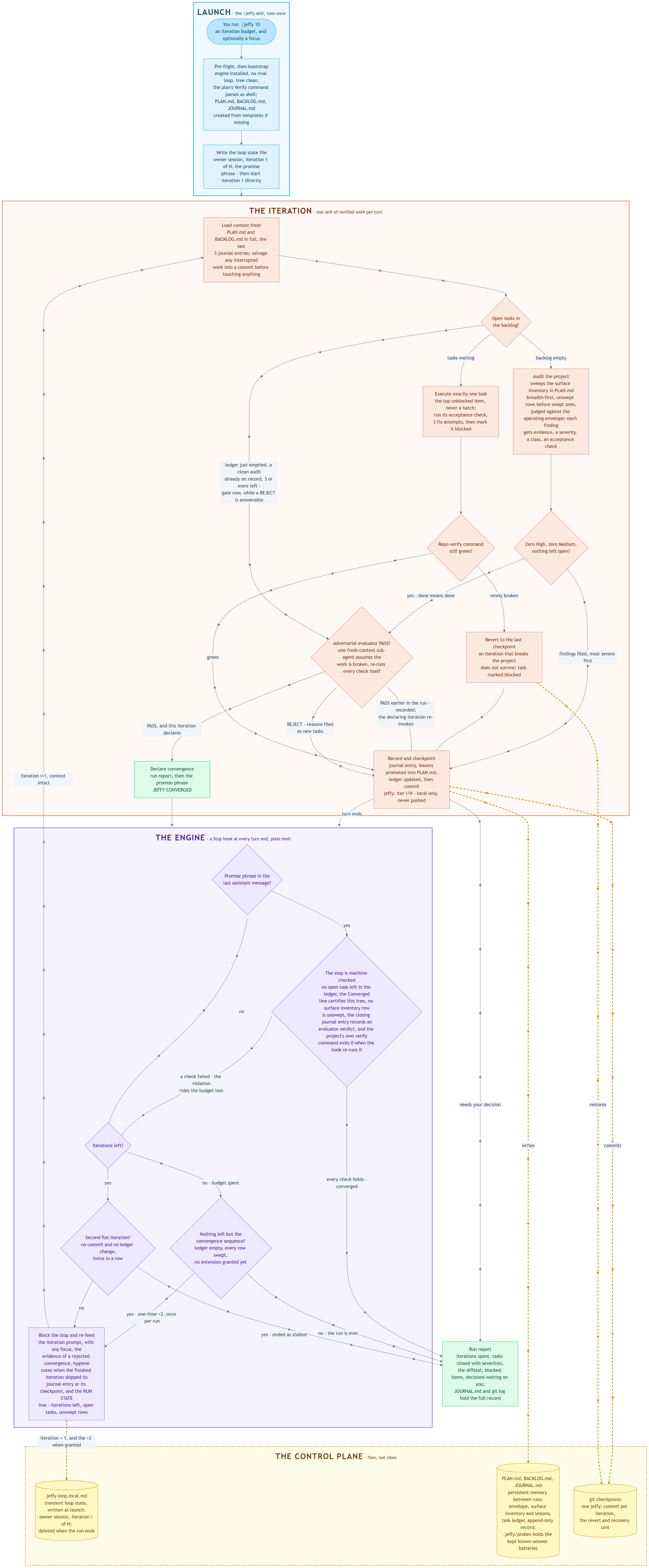
How one command becomes a run. Solid arrows are control flow; dashed arrows are the file reads and writes that steer it. Outside a run the Stop hook exits instantly - no live state file, no behavior - and /cancel-jeffy ends a run at any time. Diagram source: media/flowchart.mmd.
Running /jeffy in a Claude Code session:
- Bootstraps the loop's memory at the project root:
PLAN.md(goal, operating envelope, surface inventory, verify command, lessons, definition of done),BACKLOG.md(the task ledger - findings prioritized most severe first, plus proposals awaiting your decision, settled defect classes, and the Converged record), andJOURNAL.md(append-only iteration log). They persist between runs. - Runs the budgeted loop. The first audit fills the surface inventory and the backlog. Each iteration after that either audits or executes exactly one task, verifies it, and checkpoints it; a task that newly breaks the verify command is reverted. Once one full audit comes back clean of High and Medium, the run stops auditing and finishes the ledger.
- Stops for a reason and reports. Convergence - a clean audit, an empty ledger, a fully swept inventory, the adversarial evaluator's PASS, all re-checked in shell by the Stop hook - or the budget, a stall, a hard blocker, or your cancel. The run report lists tasks closed with severities, the diffstat, rows swept of rows total, and anything waiting on your decision.
Use several short runs, not one long one
A budget is a ceiling, not a target, and the practice that produced every receipt here is the same one worth copying: run /jeffy 10, let it finish, close the session, then open a new one and run /jeffy 10 again. The receipts that took 40 or 58 or 74 iterations got there as four to eight budgeted runs, never as one enormous budget.
That is not superstition about round numbers. The loop is built to start each iteration from written state - PLAN.md, BACKLOG.md and the last few journal entries - precisely because a fresh reading of the record is more reliable than a long conversation's memory of it. Inside a single session, though, that conversation keeps growing: every audit, every diff, every command output stays in context, and the loop ends up reasoning over its own accumulated transcript instead of the files it was designed to reason over. A new session throws that away and forces it to re-read what it actually wrote. The receipts bear the cost of skipping this out: in the python-dotenv run, later runs kept filing Highs and Mediums on surface that earlier runs had already swept and scored clean.
The restart also gives you the natural review point. Between runs the tree is committed, the report is written, and the handoff names what comes next, so it costs nothing to read the journal, answer anything filed under Proposed, and decide whether to keep going. And because every journal entry is stamped with the run that produced it, a bug introduced in run 3 stays attributable to run 3 rather than dissolving into one undifferentiated log.
Nothing breaks if you hand it a bigger budget. The state files persist, the ratchet skips a re-audit on an unchanged tree, and a fresh run picks up exactly where the last one stopped. Short runs are simply how you get the loop's design working for you instead of against it.
Jeffy built this repository by running on itself, and that convergence is re-earned, not archived - every fresh run has to reach it again with fresh evidence. It last did on 2026-07-31, the day after v1.5.0 shipped, running Fable 5 at x-high effort: the opening audit filed three Mediums against the repo's own trust-model and check-count claims, one iteration each fixed them, and the stop still had to be earned. The dev journal stays out of the published tree, since state files are the loop's memory rather than the product, but the closing sequence, abridged, shows the texture of a converged stop:
## iter 5/8 | e64f9b2c-160059 | 2026-07-31 | AUDIT | audit

Verification: bash scripts/validate.sh exit 0 fresh this iteration,
119 OK, 0 FAIL, 96s wall against the hook's 240s verify budget.
Inventory: all 12 rows stand. Dimension scores over all 12 swept rows,
fresh evidence each: (12 dimension scores, every one None)
Result: zero High, zero Medium, zero new findings at any severity.
Closeout begins: no further audit or replenishment this run; only the
convergence sequence remains.

## iter 6/8 | e64f9b2c-160059 | 2026-07-31 | EVALUATOR | converged

Verification: Evaluator: PASS - fresh-context adversarial review
confirmed scope, re-ran the Verify command at exit 0 (119 OK, 0 FAIL,
1 SKIP), (re-proved each of the run's three findings against the
shipped files) and found no missed in-envelope High or Medium.
Closing conditions: closing audit scored zero High zero Medium over
all 12 swept rows; Now, Next, Later all empty; all three filed
findings completed (D1 at 5e9be82, D2 at 71a420c, D3 at fa73cf3);
no unswept or stale inventory row; Converged line appended for
fa73cf3a6e5e277d80e48dc2d34111f67cc4f526.

(run report, and then the session's last words - the phrase the
Stop hook verifies against every condition above before letting
the run end:)

<promise>JEFFY CONVERGED</promise>
When Jeffy converges on your project, the checkpoint lands in your git log and under ## Converged in the loop's backlog, so relaunches on an unchanged tree re-verify instead of re-auditing. Run /jeffy on your own project and read the journal it leaves behind.
The rules a run lives by
Each rule is enforced by the iteration prompt, the state files, or the Stop hook itself - not by good intentions.
Every iteration
- One verified task per iteration. Every task carries a runnable acceptance check; done means the check ran and passed. Three failed fix attempts mark the task blocked with a reason instead of thrashing.
- Checkpoint everything, push nothing. Every iteration ends in a local commit prefixed
jeffy:- the revert and recovery unit. No pushes, no branches; pre-flight warns on a dirty tree so your work is never swept into a checkpoint. Without git, checkpoints degrade to journal-only discipline. - The verify gate guards every change. An iteration that newly breaks the verify command recorded in
PLAN.mdis reverted on the spot and its task marked blocked. - Interrupted work is salvaged, never discarded. A run that resumes over a dirty tree commits the salvage before touching anything.
- Every iteration answers for its hygiene. Between iterations the hook checks the journal entry (heading grammar, with a run token telling two runs in one session apart), the checkpoint, and that
JOURNAL-archive.mdonly ever grows. Violations ride the next re-feed as an ITERATION HYGIENE note. - Stalls end runs before budgets do. Progress means HEAD moved or
BACKLOG.mdchanged. The first flat iteration re-feeds with a STALL note; a second consecutive one ends the run from shell. Without git the ledger signal alone decides. - The hook does the budget arithmetic. Every re-feed carries a RUN STATE line the engine counts itself - the iteration and how many remain after it, open tasks per section, unswept rows - and once the ledger is empty over a swept surface it adds what the convergence sequence still costs, so a run plans its endgame instead of discovering it at the last iteration.
Every audit
- Audits work from a written map, never from wandering. The first audit lists the whole public surface as a checkbox inventory in
PLAN.mdand probes it breadth-first before filing anything. Every sweep records the commit it certified, a row reopens when its code changes, dimension scores claim only swept rows, and no run converges while a row is unswept. - Sweeps prove correctness, not liveness. A row that computes values needs a known answer or a strong invariant - run-without-crashing certifies nothing - and every documented parameter must be shown to change the output at two or more values. A parameter whose value changes nothing is a finding, never a pass.
- Instruments are kept, not rebuilt. A row's known-answer battery lives under
.jeffy/probes/and the checkpoints commit it, so a re-sweep re-runs the battery instead of reconstructing it, and a battery is updated in the same iteration as the behavior it pins. - Every finding is classed by the files its fix will touch. Backlog lines are written
- [ ] ID (Severity, class, dimension): finding. Acceptance: check.with a class of runtime, test, build-ci, docs, or dev-tooling, and a section is ordered by severity first, then runtime ahead of the rest, because shipped behavior is what a user meets and perimeter work is what a run drifts into. - Severity comes from the envelope, never from imagination. Envelope changes and audit escalations go to the Proposed section of
BACKLOG.mdfor your approval - the loop never widens its own mandate. - Changes are made with the map open. Before touching shared code the loop reads its callers and the tests that pin it and states the contract the change preserves; a change that alters behavior updates the documentation and reopens the affected inventory rows in the same iteration.
- The third strike forces structure. Repeated-idiom fixes must enumerate and cover every sibling site; the third finding sharing one root cause forces a single structural fix or a user decision, never a fourth spot patch.
Convergence
- Convergence is sticky. The converged commit is recorded; relaunching on an unchanged tree re-verifies and re-converges in O(1) instead of re-rolling the audit dice. A seeded backlog or a focus directive always gets a real run, and settled defect classes are never re-litigated on unchanged code.
- Convergence needs the adversarial evaluator's signature. One fresh-context sub-agent that assumes the work is broken re-runs the checks itself, bound by the same envelope and evidence rules. It runs the iteration the ledger first empties - given a clean full audit on the record and three or more iterations left - while a rejection can still be answered. At most two reviews per run, three when the first landed before the budget's midpoint; a second rejection ends the run, and so does a cap reached with no passing verdict in the closing entry; a session that cannot spawn sub-agents records that instead of silently skipping the gate. The ratchet never invokes it.
- The converged stop is enforced in shell. At the promise the Stop hook itself re-checks: no open task, a Converged line whose commit still certifies the tree, no unswept inventory row, an evaluator verdict recorded in the run's closing journal entry, and the project's verify command exiting 0, re-run by the hook under a timeout (240s default,
verify_timeout_secondsto override). Violations block the stop and re-feed the evidence; missing infrastructure fails open with a stderr diagnostic.
Always
- Published code is run code. Anything that leaves the project - an issue body, a report, a pull request - must have been executed in exactly the form it is published. A trimmed version of a verified script is new, unverified code.
- Lessons persist. An operational rule learned the hard way - a build quirk, a command that must not be used - is promoted to the Lessons section of
PLAN.md, which every future iteration reads in full. Add your own lines there to steer future runs: fix the loop, not the run.
Contributing
Before submitting a change, run the repo validator:
bash scripts/validate.sh
It gates, among other things:
- Syntax and lint - both installers and the Stop hook (
bash -n, PowerShell parser, shellcheck). - Skill integrity - frontmatter, referenced paths, the governance markers that keep the envelope, ratchet, verify gate, run report, and convergence rules from silently regressing - including the
Command:line the default plan hands the hook to run - and the iteration prompt's injection invariants. - Behavior, not just parsing - both installers and the Stop hook are exercised end to end, every gate proven able to fail. The full scenario list is below.
Both installers run non-interactively against sandboxed profiles (skills and engine must land, and the hook registration must appear exactly once even after a re-run and carry the 600s timeout, whether written fresh or upgraded from an older entry), and the Stop hook itself is exercised through its full lifecycle: mid-budget re-feed, budget exhaustion, completion promise, foreign-session isolation, and the no-state no-op. The gates that guard the converged stop are held to the same standard - an open task, a Converged line that no longer certifies the tree, an unswept Surface inventory row, and a verify command that is red, that overruns its timeout, or that is declared none each have to produce the right outcome, a fully swept inventory and a pre-inventory PLAN.md are both accepted, and the verify parser is proven on the one shape the hook executes, the labelled Command: line - backticks stripped only when the wrapping pair is unambiguous, an annotated line named as a bash -n defect before anything runs, and a section carrying no command skipped with a note rather than run as prose - as are the per-iteration hygiene gates and the fail-open paths for a missing ledger, journal, or plan, a malformed counter, and a moved prompt file. The two newest gates get the same treatment: the closing extension has to be granted once at exact budget exhaustion over an empty ledger and a swept inventory and refused everywhere else - a task still open, a row still unswept, a flag already set, a frontmatter that never closes, an iteration already past its budget - and a declaration must be rejected when its closing entry records no evaluator verdict, accepted on Evaluator: PASS or a stated unavailable, exempt for a ratchet, and failed open when the journal holds no entry for the run. The hygiene gates are proven both ways too: a journal heading that names the session but not the run is rejected and a legacy state file without a run token falls back cleanly, and a rotation that shrinks or deletes JOURNAL-archive.md is caught while an appending one passes and a never-rotated project is left alone. The stall gate is proven the same way: progress on either signal stays silent, the first flat iteration draws the STALL note and arms the flag, the second consecutive one ends the run, progress resets the strike, a non-git project stalls out on the ledger signal alone, a project with neither signal skips with a stderr note, and neither budget exhaustion nor a valid promise is disturbed by an armed flag.
Core checks need only bash and coreutils; shellcheck, PowerShell, and jq passes skip cleanly when absent. CI runs the same validator on Linux and Windows.
License
MIT
Reviews (0)
Sign in to leave a review.
Leave a reviewNo results found