CrewLoop
Health Warn
- License — License: MIT
- Description — Repository has a description
- Active repo — Last push 0 days ago
- Low visibility — Only 6 GitHub stars
Code Warn
- network request — Outbound network request in docs/src/components/DocsLayout.tsx
Permissions Pass
- Permissions — No dangerous permissions requested
No AI report is available for this listing yet.
A team of specialized AI agents covering the complete software development flow — from requirements discovery to deploy. One responsibility per agent, specs as source of truth, no shortcuts.
CrewLoop



CrewLoop is a documentation-first framework of role-based AI skills. Each skill is a self-contained SKILL.md instruction set that agents load and follow, enforcing a structured workflow across discovery, architecture, design, implementation, review, and shipping.
Highlights
- Process-driven workflow: CrewLoop Hub, Architect, Designer, Engineer, Reviewer, Shipper, and nine supporting roles each own one phase and never invade another's territory.
- Mandatory specs: Every change, from a one-line fix to a full feature, gets a lightweight spec in
specs/changes/before implementation starts. - Design before code: When there is UI, the Designer defines the aesthetic direction before the Engineer writes markup or styles.
- Docs by docs-writer: READMEs, module docs, and changelogs are owned by the docs-writer skill so the engineer can focus on code and tests.
- Quality gate: The Reviewer inspects every diff for spec compliance, security, performance, and AI artifacts before anything reaches the repository.
- Conventional Commits: The Shipper generates commit messages, branches, archives specs, and opens PRs following the Conventional Commits standard.
Quick Start
Install the CLI globally and load the full crew:
npm install -g @archznn/crewloop-cli
crewloop install
Install only the skills you need:
crewloop install --skill architect --skill engineer
Install to a custom directory or for another supported agent:
crewloop install --target /path/to/your/skills/dir
crewloop install --agent claude
Validate that all skills are well-formed:
python scripts/validate-skills.py
Each skill is automatically detected and activated according to the conversation context.
CLI Reference & Options
The crewloop CLI provides commands to manage skills and integrate them with your AI coding agents.
Commands
| Command | Description |
|---|---|
crewloop install |
Installs the CrewLoop skills to your local environment. |
crewloop list |
Lists all installed skills and active hooks. |
crewloop dashboard |
Launches the real-time WebSocket dashboard. |
Global Flags for crewloop install
| Flag | Description |
|---|---|
--symlink |
Symbolically link skills instead of copying them (ideal for development). |
--force |
Overwrite existing skill configurations or hooks without asking. |
--dry-run |
Output the installation steps without modifying any files. |
--agent <name> |
Configure hooks for a specific agent (e.g., kimi, claude, codex, agy). |
--target <path> |
Specify a custom destination path for the skills. |
--skill <name> |
Install only a specific skill (can be specified multiple times). |
Real-time Activity Dashboard
The dashboard provides a real-time WebSocket visualization of active skills, tool-use events, and execution logs.
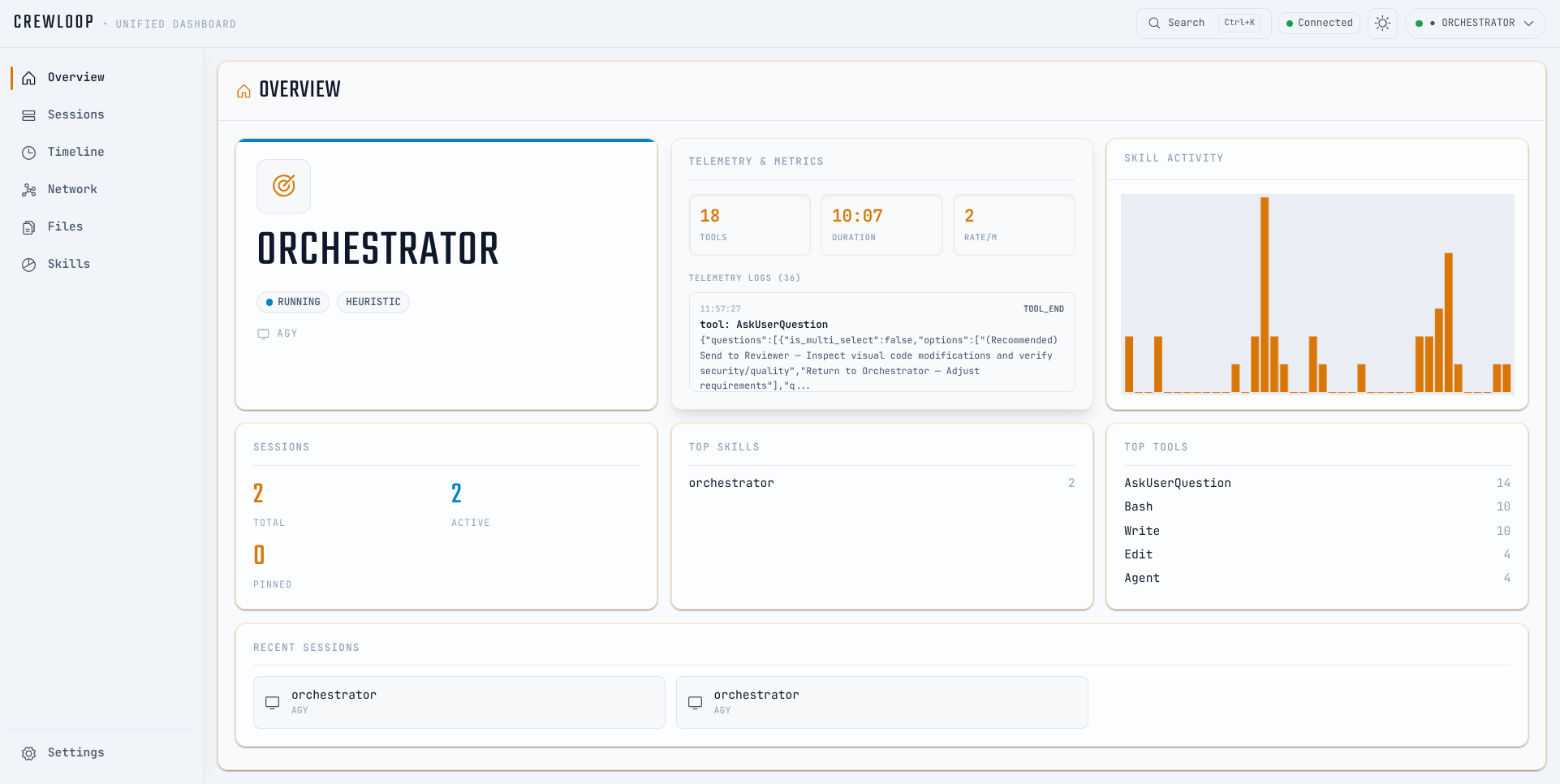
By default, the dashboard binds to http://127.0.0.1:7890. You can change this port by setting the CREWLOOP_DASHBOARD_PORT environment variable.
Running the Dashboard
You can start the dashboard using the CLI:
crewloop dashboard
Alternatively, you can run it from the source:
cd servers/dashboard
npm install
npm run dev
Keyboard Shortcuts
Cmd/Ctrl + K: Opens the command palette to search events, switch sessions, or manage active skills.
Supported Agents & Hooks
CrewLoop supports native shimming/hooking for the following AI agents:
- Kimi Code (
kimi) - Claude (
claude) - Codex (
codex) - AGY (
agy)
During crewloop install, the installer modifies the configuration or custom scripts of the selected agent. This shims their execution, allowing tool execution events (such as read/write file, run command, etc.) to be forwarded to the local dashboard WebSocket.
Meet the Crew
CrewLoop ships 19 specialist skills. The core crew owns the main delivery loop; the supporting crew jumps in when the context demands it.
Core Crew
| Skill | Phase | Responsibility |
|---|---|---|
| CrewLoop Hub | Discovery | Context gathering, requirement clarification, and routing |
| Architect | Specs | Spec creation, architecture design, and contracts |
| Designer | Design | UI/UX aesthetic direction and design specs |
| Engineer | Build | Implementation, tests, and verification |
| Reviewer | Review | Code review, quality gate, and security scan |
| Shipper | Ship | Git commit, branch creation, push, and PR |
Supporting Crew
| Skill | Phase | Responsibility |
|---|---|---|
project-brainstorm |
Brainstorm | Discovery for new or ambiguous project ideas |
long-term-manager |
Tracking | Durable tracking for projects that span multiple sessions |
diamondblock |
Memory | Managing multi-session memory, retrieving context, searching knowledge, or logging session histories |
docs-writer |
Docs | Documentation, READMEs, and changelogs |
tester |
QA | Test strategy, coverage analysis, and test plans |
product-manager |
Product | Prioritization, roadmap, and success metrics |
maintainer |
Upkeep | Bug triage, technical debt, and incidents |
researcher |
Research | Technology evaluation and proof-of-concepts |
security-guard |
Security Review | Security review, secret scanning, and auth |
accessibility-auditor |
Accessibility Review | WCAG, screen reader, and keyboard navigation review |
Skills in Action
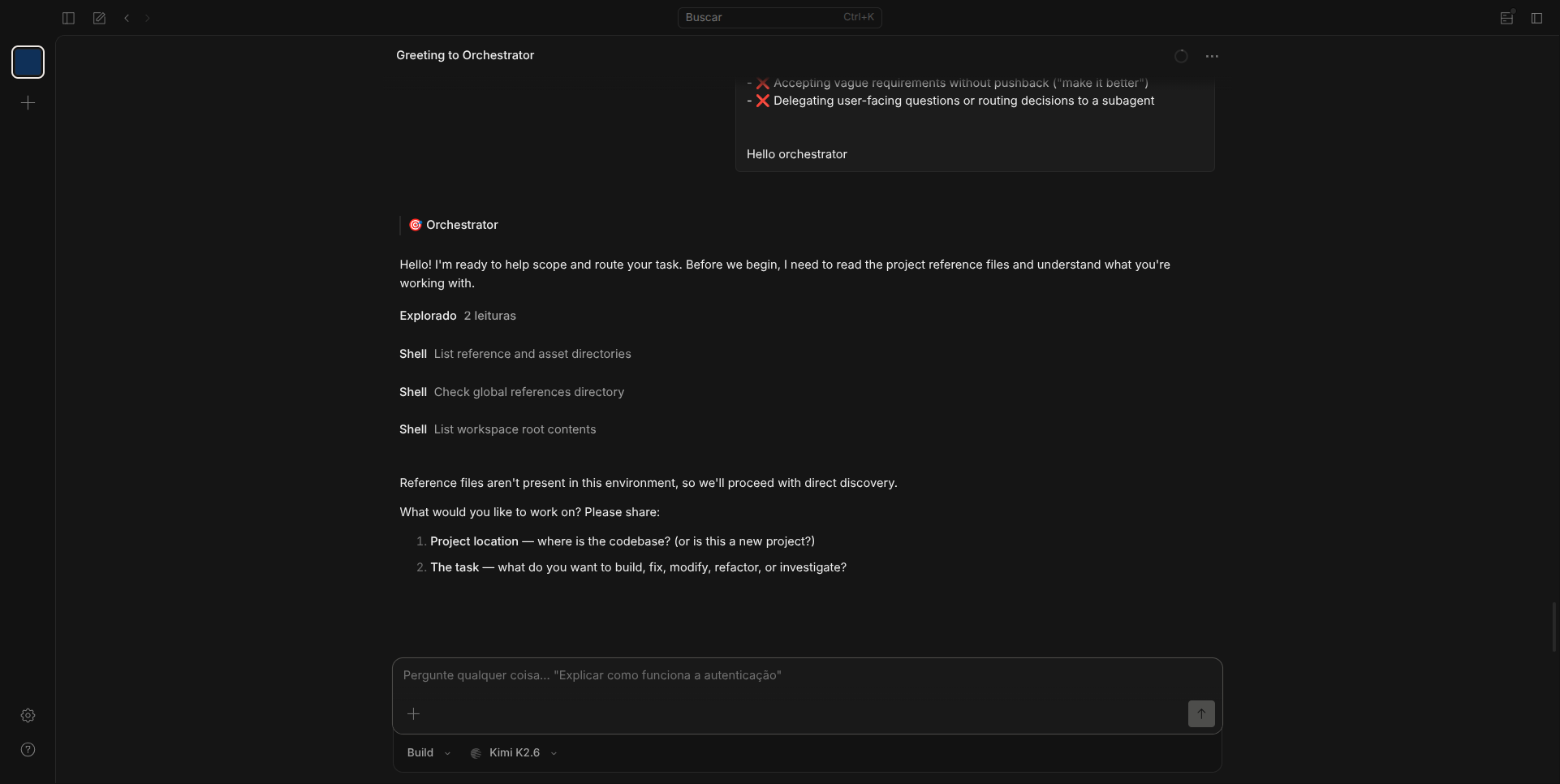
Workflow (Hub-and-Spoke)
All execution skills return control to the CrewLoop Hub, which manages task state and handles routing decisions.
flowchart TD
    O["CrewLoop Hub\nCentral Hub"] <--> A["Architect\nSpecs & Architecture"]
    O <--> D["Designer\nUI/UX Direction"]
    O <--> E["Engineer\nImplementation"]
    O <--> R["Reviewer\nQuality Gate"]
    O <--> S["Shipper\nGit & PR"]
    O <--> PB["Project-Brainstorm\nDiscovery"]
    O <--> LTM["Long-Term Manager\nMulti-Session Tracking"]
    O <--> DB["Diamondblock\nMemory & Distillation"]
    O <--> W["Docs-Writer\nDocumentation"]
    O <--> PM["Product-Manager\nPrioritization"]
    O <--> RS["Researcher\nTechnology Evaluation"]
    O <--> MN["Maintainer\nIncident & Debt"]
    O <--> T["Tester\nQA Strategy"]

    A -.-> SD["Schema-Designer\nAPI & DB Schemas"]
    SD -.-> A
    D -.-> FA["Frontend-Architect\nComponent Spec"]
    FA -.-> D
    S -.-> DO["DevOps-Specialist\nCI/CD & Docker"]
    DO -.-> S

    SG["Security-Guard\nSecurity Review"] -.-> R
    AA["Accessibility-Auditor\nAccessibility Review"] -.-> R
    R -.-> SG
    R -.-> AA
Flow rules:
[!IMPORTANT]
Core Routing Rule: Under the star topology, no execution skill is allowed to hand off directly to another execution skill. All roads return control to the CrewLoop Hub.
- CrewLoop Hub is the central hub — every skill hands control back to CrewLoop Hub at the end of its turn.
- CrewLoop Hub always routes to Architect first — to create or update specifications.
- Architect is the design gatekeeper — once the spec is created, control returns to CrewLoop Hub, which routes to Designer (for UI) or Engineer (for code).
- Designer acts before Engineer — when there is UI, the Designer creates the visual specification before the Engineer implements.
- Engineer never does git, review, or docs — it implements code and tests, then returns to CrewLoop Hub.
- Reviewer is the quality gate — no code reaches the repository without review.
- Shipper is the only skill that touches git — commit, branch, push, and PR.
- Sub-skills assist core skills —
project-brainstormhelpscrewloop-hub;schema-designerhelpsarchitect;frontend-architecthelpsdesigner; anddevops-specialisthelpsshipper. - Specs are archived — the
specs/changes/folder is moved tospecs/archive/on commit. - Bug-fixing Pipeline — Bug triaging is handled by the Maintainer, who yields control to the CrewLoop Hub. The CrewLoop Hub routes to the Architect to create a lightweight specification (
.spec.yaml+tasks.md), then to the Engineer for implementation and testing, to the Reviewer for verification, and to the Shipper to commit/ship and archive the spec.
[!NOTE]
Standard Developer Cycle Example:CrewLoop Hub(Discovery) ->Architect(Spec creation) ->CrewLoop Hub(Briefing) ->Engineer(Build & Tests) ->CrewLoop Hub(Handoff) ->Reviewer(Quality gate check) ->CrewLoop Hub(Approval) ->Shipper(Git commit & PR) ->CrewLoop Hub(Complete).
Repository Layout
crewloop/
├── skills/                # Role-based SKILL.md instructions
├── packages/cli/          # npm-published CLI installer
├── servers/dashboard/     # Real-time WebSocket dashboard
├── docs/                  # Docusaurus documentation site
├── references/            # Shared conventions and workflow reference
├── scripts/               # Validation and packaging helpers
└── specs/                 # Active, archived, and living specs
Adding a New Skill
- Copy
assets/templates/skill-template.mdtoskills/<skill-name>/SKILL.md. - Fill in the YAML frontmatter and role instructions.
- Add the skill to the README tables if it is user-facing.
- Run
python scripts/validate-skills.py. - Open a PR; the Reviewer validates structure and the Shipper archives the spec.
Releasing
Versions are published automatically from main:
- The Shipper bumps the version in
package.json(and workspace manifests) following semver. - Merging to
maintriggers.github/workflows/release-tag.yml, which creates avX.Y.Ztag. .github/workflows/publish-npm.ymlpublishes@archznn/crewloop-skillsto npm.
Manual releases are not required.
Contributing
Edit the files in skills/ and references/. Keep each SKILL.md concise and use reference files for shared detail. Run python scripts/validate-skills.py before opening a PR. For the full workflow, see references/workflow.md.
License
Reviews (0)
Sign in to leave a review.
Leave a reviewNo results found